

Disability management (DM) has increasingly been recognised on an international scale as a valuable intervention for the reduction of occupational disability (Buys, Reference Buys2010). Importantly, DM has value for the spectra of workplace stakeholders via its contribution to reduced human and financial costs related to workplace illness and injury. Current estimates suggest that illness and disability in Canada total approximately 2.4% of gross payroll (Stuart, Reference Stuart2013) that, in 2012 alone, totalled 16.6 billion dollars. In Canada, the development of DM has been driven by perceived stakeholder value as well as a changing legislative environment more onerous for employers. Exponentially increasing costs and recent changes in policy and legislation have significantly expanded responsibility for employers in terms of addressing illness and disability in the workplace (e.g., government, WorkSafeBC).
Canadian Context
Given its modest universal transfer and social insurance systems, Canada is often considered a liberal welfare state (Esping-Andersen, 1990). Social disability systems are provided by federal and provincial authorities through employer or public taxation. Federal systems are primarily provided through federal employment insurance sickness benefits or the Canadian Pension Plan in the form of disability insurance or disability savings plans. At the provincial level, disability benefits are typically provided through workers compensation or disability pension (Service Canada, 2013). From the perspective of the authors, Canada continues to face significant challenges to effective DM including differences in legislation by provincial or territorial government, lack of consistency in interpretation and implementation of DM, lack of stakeholder communication, and lack of strong Canadian research evaluating DM value and best practice.
Review of Canadian Literature
Along with Australia and Germany (and others), Canada has been considered an integral player in international DM, providing several of the primary texts in the field (Dyck, Reference Dyck2013; Geisen & Harder, Reference Geisen and Harder2011; Harder & Scott, Reference Harder and Scott2005; Harder, Wagner, & Rash, Reference Harder, Wagner and Rash2014). In addition, Canadian researchers have contributed to the DM literature in terms of literature/systematic review, qualitative and quantitative work.
Effectiveness of disability management
In an effort to evaluate the DM's potential contributions, Franche et al. (Reference Franche, Cullen, Clarke, Irvin, Sinclair and Frank2005) completed a systematic review specifically intended to evaluate the effectiveness of workplace-based return to work programs. By searching the English- and French-language literature of seven databases from 1990 through 2003, they identified 4142 peer-reviewed papers looking at return to work intervention and pain related or musculoskeletal condition. From the initial search, 10 studies were considered sufficient quality to be included. From these articles, there was strong evidence for reduced disability duration under circumstances of work accommodation offer and contact between healthcare provider and workplace. There was moderate evidence for reduced disability duration in circumstances of early contact with worker by workplace, ergonomic worksite visits, or presence of a return to work coordinator. Although evidence of sustainability for these effects was limited, all five factors also had moderate evidence for reduced costs.
In contrast to Franche et al.'s (Reference Franche, Cullen, Clarke, Irvin, Sinclair and Frank2005) positive findings, Mustard, Kalcevich, Steenstra, Smith, and Amick (Reference Mustard, Kalcevich, Steenstra, Smith and Amick2010) completed a secondary analysis with existing data from Canadian long-term care facilities. Using a representative sample of compensation records from provincial workers (2005–2006), these authors found no reduction for disability burden under the conditions of modified duty. It was highlighted however, that provincial compensation records are limited and often inaccurate, perhaps accounting for the lack of findings.
Factors affecting disability management
Lemieux, Durand, and Hong (Reference Lemieux, Durand and Hong2011) completed an exploratory qualitative study investigating supervisor perceptions regarding return to work of employees with common mental health disorders. Semistructured interviews were completed with 11 supervisors from medium and large sized companies who had been responsible for at least a single employee off work due to mental illness. From these interviews, 24 hindering or facilitating factors for return to work with common mental disorders were identified and classified into three primary categories, including factors related to the worker, workplace context, and return to work process. Similarly, Westmorland, Williams, Amick, Shannon, and Rasheed (Reference Westmorland, Williams, Amick, Shannon and Rasheed2005) completed a qualitative study (with a survey component) during which 58 Canadian employees were interviewed and identified job accommodation, meaningful communication, and job retraining as important aspects of the DM process. Ergonomic modifications, DM policy and procedure, and health and safety education were also considered integral aspects of a workplace DM program. Taken together these studies suggest the importance of multi-level considerations when proposing DM interventions.
Stakeholder perspectives on disability management
In addition to their contributions regarding DM factors, Lemieux et al. (Reference Lemieux, Durand and Hong2011) contributed knowledge regarding stakeholder perspectives. Specifically, these authors noted that although supervisors were open to facilitating return to work for workers with common mental health disorders, supervisors also wanted their own perspectives and constraints recognised in the process. Supporting the perspectives identified by Lemieux et al. (Reference Lemieux, Durand and Hong2011), Franche et al. (Reference Franche, Cullen, Clarke, Irvin, Sinclair and Frank2005) provide a literature review that contrasts the challenges of diverse stakeholder paradigms in studying and implementing disability interventions. Although these authors recognise that stakeholder friction is inevitable, they propose that dissonance can be reduced such that common goals can be achieved through collaborative problem solving. The writers also propose that calibration of stakeholder involvement, supervisor and insurance case manager roles, and return to work intervention procedures can be important in reducing resulting friction. Also linked to supervisor involvement, Busse et al. (Reference Busse, Dolinschi, Clarke, Scott, Hogg-Johnson, Amick and Cole2011) surveyed 88 employees and 75 supervisors from a Canadian insurance company. The employees and supervisors were surveyed about attitudes and experiences regarding the DM process with the majority of respondents endorsing positive views towards the DM experience. However, areas of potential improvement were identified, and included case manager-employee interaction, support during the return to work process, and improvements in modification to work situations.
Other research groups have considered stakeholder perspectives beyond the immediate worksite environment. For example, Harder et al. (Reference Harder, McHugh, Wagner and Harder2006) were interested in predicting return to work of injured workers from employer DM perceptions and policies; examining factors that influence DM policies, procedures and outcomes; and examining the relationship between work, or demographic factors and return to work outcomes. Their findings highlighted that the existence of DM policies were related to company perceptions of DM and return to work outcomes for injured workers. Maiwald, Rijk, Guzman, Schonstein, and Yassi (Reference Maiwald, Rijk, Guzman, Schonstein and Yassi2011) used a qualitative research method to evaluate stakeholder perspectives regarding a healthcare workplace disability prevention (DP) program. Specifically, Maiwald et al. (Reference Maiwald, Rijk, Guzman, Schonstein and Yassi2011) were interested in discrepancies among perspectives presented by designers of the intervention, deliverers of the intervention, and workers as the receivers of the intervention. Using a grounded theory approach these authors determined that while designers proposed interventions targeted at both the individual and workplace, deliverers tended to focus on individual-directed measures, whereas workers tended to seek primarily work-directed measures. Similarly, designers were interested in a variety of outcome measures, whereas, deliverers tended to be interested primarily in reduction of lost time, and workers reported short-term value, but were concerned about whether the intervention addressed sustainable return to work. In conclusion, the authors suggest that these findings provide information about stakeholder perceptions that should be used for the purpose of intervention planning. Finally, Reynolds, Wagner, Harder, and Zimmer (Reference Reynolds, Wagner, Harder and Zimmer2007) were interested in the physicians’ role in DM and, in particular, whether, from the perspective of physicians, their individual practice of DM was consistent with professional guidelines as provided by the Canadian Medical Association. Seven physicians completed a semistructured interview and, using content analysis, the data suggested a discrepancy between actual and proposed practice such that most physicians did not feel their practice aligned with the Canadian Medical Association guidelines.
Disability management tools
Lysaght, Fabrigar, Larmour-Trode, Stewart, and Friesen (Reference Lysaght, Fabrigar, Larmour-Trode, Stewart and Friesen2012) created a tool called the ‘Support for Workers with Disabilities Scale’ and assessed its psychometric properties with 152 workers completing accommodated work. Using factor analysis, they evaluated the content and structure of the scale, and reduced the scale to 41 items intended to measure supervisor, coworker, and nonwork supports. The authors propose their scale as a useful validated outcome measure for researching social aspects of workplace disability and/or as a human resource quality management tool for ongoing improvement of DM interventions.
Conclusions from the literature
Canadian literature regarding DM continues to grow and is beginning to provide meaningful information regarding the value of DM in a Canadian context. However, despite ongoing contributions, the literature in this area remains limited. Consequently, the present study is intended to further this budding conversation and contribute to applied research in this area.
Aims of the Present Study
To our knowledge, no currently available study has considered the value of DM from employee perspectives with respect to job satisfaction, physical health, mental health, workplace morale, and absenteeism. Consequently, the present research intended to:
-
1. Provide a descriptive analysis of a Canadian sample with respect to demographics, as well as general perceptions regarding DM in the workplace.
-
2. Examine the perceived relationship between disability prevention efforts, and job satisfaction, physical health, mental health, workplace morale, and absenteeism for a Canadian sample.
-
3. Examine the perceived relationship between stay at work efforts, and job satisfaction, physical health, mental health, workplace morale, and absenteeism for a Canadian sample.
-
4. Examine the perceived relationship between return to work efforts, and job satisfaction, physical health, mental health, workplace morale, and absenteeism for a Canadian sample.
-
5. Compare perceptions of DM in private and public companies of our Canadian sample.
-
6. Compare perceptions of DM in union versus nonunion companies of our Canadian sample.
-
7. Compare perceptions of DM by gender for our Canadian sample.
Methods
Participants
Our Canadian sample included 222 participants, with the number of responses varying across items. The average age of our sample was 45.74 years (SD = 11.729), with 35.1% (N = 78) reporting as male and 62.6% reporting as female (N = 139). Educational achievement was high with 6.8% (N = 15) reporting secondary level education and 90.6% (N = 201) having some form of postsecondary education. The majority of our respondents were married or in a marital-like relationship (70.7%); however, most of the sample was nonparenting (70.3%). The socioeconomic status of the sample was middle class with an average corrected family income of US$86,603.59 (SD = $35663.91). Most respondents reported as professionals (31.5%), technicians/associate professionals (24.8%), clerical support workers (17.6%) and/or managers (15.3%). Only 38 respondents (17.1%) self-identified as an individual with a disability and three reported migrant working status (1.4%). The majority of the sample was working full-time (N = 199, 89.6%). The sample reported moderate to good physical health (M = 2.51, SD = .877; scale from 1 = very good to 5 = poor) as well as mental health (M = 2.29, SD = .913). Similarly, our sample missed little work due to disability, illness or health problems (M = 2.04, SD = 1.107; scale from 1 = none to 6 = six months or more) and had both high job satisfaction (M = 1.84, SD = .813; scale from 1 = very satisfied to 5 = very dissatisfied) and work-related morale (M = 2.19, SD = 1.039; scale from 1 = strongly agree to 5 = strongly disagree).
Procedure
The Canadian data was collected as an aspect of a larger international study regarding international DM perspectives, completed by researchers from Australia, Canada, China, and Switzerland. In each country, local research team members collected survey data regarding the influence of DM on job satisfaction, physical health, mental health, morale, and sickness absence (see Measures section). For the Canadian respondents, survey information was collected from respondents at six different companies using an online format. As an aspect of the larger study, each of the participant companies also completed qualitative interviews with workplace stakeholders (two employees, DM practitioner and human resource representative); these data will be reported elsewhere. Participant organisations were recruited in western Canadian provinces by word-of-mouth and convenience sampling; they were required to have 100 or more employees, be a public or private institution and have a DM program in place for no less than two years prior to data collection. Our six organisations included two postsecondary institutions, both public and unionised; a health services agency, public and unionised; and engineering consulting firm, private and nonunionised; an industrial construction company, private and nonunionised; and a financial services institution, private and nonunionised. This research was approved by the Research Ethics Board of the University of Northern British Columbia, as well as by the respective boards within the other countries.
It should be noted that participant organisation recruitment in Canada was experienced as difficult. Nearly 90 Canadian companies were contacted in order to achieve the six participant organisations. Example reasons for refusal of participation included suspicion of research, lack of time/resources, and not interested in participating. Many companies simply did not return our efforts at contact.
Measures
Survey data was collected using a team-created survey tool, given a lack of previously available surveys measuring these variables. The survey was created as a full international team effort so that influence of country contextual differences could be minimised to the extent possible. Survey tools were translated into German, Simple Chinese and Traditional Chinese, and then subsequently reverse translated to ensure consistency of meaning. Sample items from our questionnaire included ‘The workplace disability management program contributes positively to my job satisfaction’ and ‘The workplace disability management program contributes positively to the satisfaction of employees’. For each perception item, responses could be ranked on a five-point Likert scale ranging from strongly agree to strongly disagree.
Results
Descriptive Analyses
Most respondents reported that their company took measures to prevent disability (M = 2.15, SD = .893; scale from 1 = strongly agree to 5 = strongly disagree), support staying at work (M = 2.30, SD = .933), and support return to work (M = 2.17, SD = .853); however, respondents were more likely to report stay at work (SAW) and return to work (RTW) initiatives for their coworkers (Self SAW: M = 2.67, SD = 1.117; Self RTW: M = 2.46, SD = 1.173; Coworker SAW or RTW: M = 2.07, SD = 1.003). Similarly, respondents thought the quality of care provided to coworkers through these initiatives was higher than that received by the individual (Self SAW: M = 2.67, SD = 1.117; Self RTW: M = 2.66, SD = 1.274; Coworker SAW or RTW: M = 2.32, SD = 1.144).
Respondents felt that employers should continue to offer DM programs (M = 1.45, SD = .685). However, despite wanting DM programs to continue, respondents saw only moderate benefit in the programs for job satisfaction, physical health, mental health and morale (M = 2.47, SD = .899; M = 2.67, SD = .847; M 2.62, SD = .883; M = 2.69, SD = .933).
In comparison, respondents saw benefits for coworkers as slightly more positive than individual benefits (M = 2.26, SD = .838; M = 2.37, SD = .796; M = 2.46, SD = .840; M = 2.51, SD = .892). Interestingly, respondents reported muted perceived benefit of DM programs in terms of reduced sick times (Self: M = 3.21, SD = .827; Co: M = 3.04, SD = .722).
Regression Analyses
Using the Canadian sample (N = 218), multivariate regression was employed to predict DM's influence on job satisfaction, physical health, mental health, morale and time missed, from respondents’ perceptions of whether their company provided DP, SAW, and RTW initiatives within their organisation (from 1 = strongly agree to 5 = strongly disagree). It is important to note that in every case, a DM program existed in participant companies for a period of at least two years. Therefore, the questions reflected participants’ perceptions of the DM program that existed within their workplace.
Disability management program influence on job satisfaction
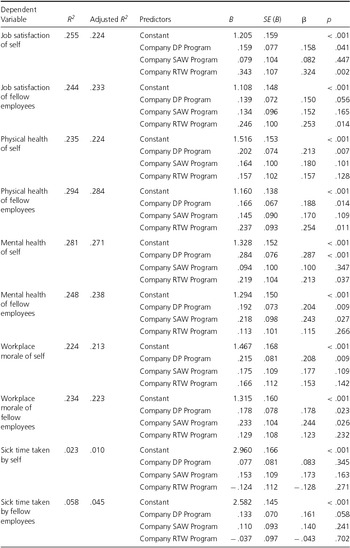
RTW program predicted perceptions of DM program influence on individual and coworker job satisfaction. In contrast, DP program only predicted perceptions of DM's influence on job satisfaction for the individual, not for coworkers, and SAW program did not predict either individual or perceived coworker job satisfaction. That is, Canadian employees reported DP and RTW program as linked to DM's influence on their own job satisfaction; alternately, for their coworkers, only RTW program was reported to have a positive relationship with job satisfaction (see Table 1).
Standard Regression of Company Disability Management Program Variables in Prediction of Employee Workplace Perceptions

Note:
DP = disability prevention; SAW = stay at work; RTW = return to work.
Disability management program influence on physical health
DP predicted perceptions of DM's influence on individual and coworker physical health. In contrast, RTW program only predicted perceptions of DM's influence on physical health for coworkers, not for the individual, and SAW program did not predict perceptions of either individual or coworker physical health. That is, Canadian employees reported DPs as linked to DM's influence on their own, as well as their coworkers’, physical health, but perceived RTW program as beneficial only for their coworkers.
Disability management program influence on mental health
DP predicted perceptions of DM's influence on individual and coworker mental health. In contrast, SAW program only predicted perceptions of DM's influence on mental health for coworkers, not for the individual. Alternately, RTW program only predicted perception of DM's influence on mental health for the individual. That is, Canadian employees reported DP efforts as having a positive impact of DM's influence on mental health for both themselves and their coworkers, but felt RTW program was only significantly positive for them as individuals, and SAW program was only significantly positive for their coworkers.
Disability management program influence on morale
Only DP predicted DM's influence on workplace morale for both the individual and coworkers. Neither SAW nor RTW programs were predictive of DM's influence on individual morale; however, SAW program was significantly predictive of DM's perceived influence on workplace morale for coworkers.
Disability management program influence on sick time
Interestingly, for Canadian employees, there were no significant relationships between any of the DP, SAW, or RTW programs for DM's perceived influence on individual or coworker sick time.
Group Difference Analyses
Public versus private companies
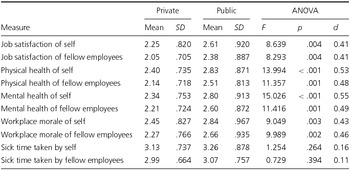
Using one-way ANOVA, comparisons were made between the Canadian sample's respondents from public versus private companies on DM's influence for job satisfaction, physical health, mental health, morale and reduced sickness absences (for both the respondent and the respondent's perception for coworkers). Using p ≤ .05 as the criteria, differences were revealed for both individual and coworker responses to job satisfaction, physical health, mental health, and morale. In each case where differences were noted, private agencies resulted in more positive responses; respondents from private companies ranked DM's influence on their individual and coworkers job satisfaction, physical health, mental health, and workplace morale as greater than did respondents from public companies (see Table 2).
Means, Standard Deviations, and Results of One-Way ANOVAs Comparing Employee Workplace Perceptions by Private vs Public Companies

Union versus nonunion
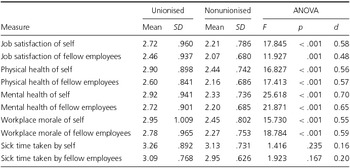
Using one-way ANOVA, comparisons were made between the Canadian sample's respondents from union versus nonunion work environments on DM's influence for job satisfaction, physical health, mental health, morale, and reduced sickness absence (for both the respondent and the respondent's perception for coworkers). For all analyses, Canadian respondents from nonunionised work environments reported more positive responses. That is, workers in nonunionised environments reported more positive perceptions regarding DM's influence on job satisfaction, physical health, mental health, morale, and reduced sickness absence for both themselves and their coworkers (see Table 3).
Means, Standard Deviations, and Results of One-Way ANOVAs Comparing Employee Workplace Perceptions by Unionised vs Nonunionised Employees

Gender
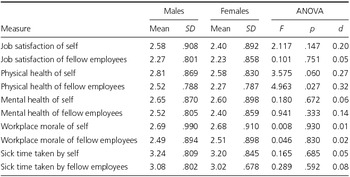
Using one-way ANOVA, comparisons were made between self-reported males and females in the Canadian sample on DM's influence for job satisfaction, physical health, mental health, morale and reduced sickness absence (for both the respondent and the respondent's perception for coworkers). There was only one significant difference between the responses of males and females for any of the variables; specifically, Canadian male respondents (N = 77, M = 2.52) reported significantly poorer perceptions of DM's influence on the physical health of coworkers (nearly significant difference for physical health of self as well), as compared to Canadian female respondents (N = 134, M = 2.27) (see Table 4).
Means, Standard Deviations, and Results of One-Way ANOVAs Comparing Employee Workplace Perceptions by Gender

Discussion
Our middle-class sample reported both good physical and mental health and evidently missed little work due to disability, illness or health problems. They also felt they had high job satisfaction and were supported by their organisation for efforts towards DP, SAW, and RTW. Despite the respondents’ belief that disability interventions should be continued, only moderate perceived benefit in terms of job satisfaction, physical health, mental health, and morale were reported; perceived value was even lower with respect to effect on reducing absenteeism. Our predictive analyses linking DP, RTW, and SAW programs with job satisfaction, physical health, mental health, morale, and reduced absenteeism showed a strong pattern suggesting greatest impact for DP efforts. That is, DP significantly predicted perceptions of physical health, mental health, and morale for both the respondent and their coworkers; similarly, DP predicted job satisfaction for the individual, although not for coworkers. In contrast to the consistency in perceived value for DP for both the individual and coworkers, RTW and SAW efforts were only seen as valuable for coworkers. Specifically, for coworkers only, perception of return to work interventions significantly predicted both perceptions of job satisfaction and physical health, and perceptions of stay at work interventions significantly predicted perceptions of mental health and morale. Only in the case of job satisfaction did perceptions of return to work efforts significantly predict perceived value for both the respondent and coworkers.
DP is an integral aspect of occupational health and safety such that we expect DP efforts are likely longer standing, more familiar and more consistent within our participant workplaces (e.g., occupational health and safety committees, safety-related training etc.). Similarly, we expect that all respondents would have, at some point, had experience with DPs; whereas not all participants would necessarily have personally been exposed to services provided by SAW or RTW programs. Consequently, we propose increased exposure and familiarity as the primary explanations for the dominance of DP in contributing to positive perceptions regarding workplace outcomes related to DM. In contrast to long-term and personal knowledge of DP efforts, we expect many of our participants likely had no personal experience with RTW or SAW programs. However, employees may have interacted with coworkers who had accessed RTW or SAW programs, and found them helpful. As a result, individuals appeared to perceive return to work and stay at work programs as helpful, but primarily for those other than themselves.
An unexpected finding revealed by our data was that our Canadian employee sample reported no perceived influence of DM programs on reduced sick time. It is important to note that the present research reflects employee perceptions regarding the effect of DM on sickness absence, and does not reflect objective measures of absenteeism. Despite the lack of objective measures for the purpose of comparison, it is important to note that, from the perspective of employees, DM has limited perceived value in terms of reducing their own sick leave or the sick leave of their coworkers. This finding may reflect that employees truly believe DM has little effect on absenteeism. Alternately, this finding may reflect the lack of concern employees hold with respect to organisational financial outcomes, as compared to psychosocial outcomes that have more direct application to themselves and their coworkers. Another potential explanation for the lack of relationship between perceptions of DM interventions and sickness absence may be related to interpretation of DM as a construct. That is, DM programs may be viewed as more related to injury as compared to illness, such that sickness absence may not be typically considered as a desired outcome of DM. Each of these explanations are supported somewhat by previous literature. Similar to our findings, Dowd et al. (Reference Dowd, McGrail, Lohman, Sheasby, O’ Connor, Calasanz and Parente2010) found weak correlations between objective absenteeism data and employee perceptions of DM programs. Also, Maiwald et al. (Reference Maiwald, Rijk, Guzman, Schonstein and Yassi2011) found that perceptions related to the value of DM programs differed by role in the program (i.e., receiver, provider, etc.).
Further findings from our data revealed that for our sample of Canadian workers, perceptions regarding the influence of DM were more positive for private and/or nonunionised companies. We expect that for the Canadian public and unionised workplaces, efforts at preventing and minimising effects of occupational health and safety are more common and have existed longer than for private or nonunionised companies. Consequently, employees in public and unionised workplaces may see DM as valuable, but only as one aspect of health and safety among many. In contrast, for private and/or nonunion workplaces, the existence of a DM program may be the only type of intervention program in the workplace and/or may reflect an organisational culture supportive of employees. In support of this suggestion, Amick et al. (Reference Amick, Habeck, Hunt, Fossel, Chapin, Keller and Katz2000) state:
it is likely that a people-oriented culture facilitates the development of a strong safety climate and the implementation of ergonomic practices that reduce risks, and fosters a DM program that results in appropriate and productive work outcomes. These policies and practices would be consistent with a management perspective that views investments in people-through safety, health, and accommodation-as an equally important strategy to achieving the productivity and financial goals of the organisation.
The present study had several limitations. First, our data were all cross-sectional, self-report data collected using a team-developed survey. Consequently, we have no objective measurement of the quality of DM provided by the participant organisations, objective absenteeism data, and so on. Similarly, the psychometric properties of our questionnaire have not been externally tested and no conclusions can be drawn regarding causal relationships. We cannot say for certain that the existence of DM interventions resulted in increased job satisfaction or other positive workplace outcome factors. Second, our sample was composed of organisations who volunteered to commit time and resources to participating; consequently, our sample likely represents a group of particularly willing organisations and individuals. Third, our sample was primarily middle class and nonparenting, so that our findings have minimal generalisability. Fourth, we were working with a small number of respondents in a limited, convenience-based sample such that only a very limited generalisation of data may be appropriate. Finally, the present data were collected as an aspect of a large international study so that internal limitations were imposed on the survey tool (e.g., had to be understandable in an international context), potentially limiting the depth and breadth of information that could have been collected from our Canadian sample.
Conclusions
The present data demonstrate that DM interventions were reportedly valued by our sample of Canadian employees, especially with respect to DP. Individual workers may have longer and greater experience with DP, as compared to SAW and RTW programs, leading to more perceived value from DP as it relates to job satisfaction, physical health, mental health, and morale. For SAW and RTW programs, workers' primary involvement may have been through coworkers, so that perceived value tended to focus on coworker benefit, as opposed to individual benefit. Interestingly, our sample of Canadian workers saw minimal benefit of DM intervention as it related to reducing sickness absence; however, this may reflect a limited interpretation of the DM construct, or a lack of concern for financial outcomes that are more typically concerns of employers/organisations. Finally, our data demonstrated that workers in private and/or nonunionised workplaces reported more perceived value from DM interventions, perhaps suggesting less access to similar types of programs, or alternately, that responsive employers are likely to provide DM programs. Overall, our data provide evidence that our sample of Canadian workers see value in DM interventions and that the perceived value tends to be focused on factors specifically related to worker interests (i.e., psychosocial factors).
Acknowledgements
We would like to thank all of the employees who agreed to participate in our survey, in particular those that completed more than one research component. We would also like to acknowledge Swiss Network for International Studies who generously funded this project.