




No CrossRef data available.
Writing starts with own name writing: From scribbling to conventional spelling in Israeli and Dutch children
Published online by Cambridge University Press: 19 July 2005
Abstract
The development of children's writing of their own names as compared to their writing of dictated words was examined on samples of children ranging from 2 to 5 years of age, who were immersed in Hebrew or Dutch and recruited from low to high socioeconomic status families. Analyses were based on four data sets collected in three studies. From a young age, children wrote their name on a higher level than they wrote other words, and name writing improved with age more rapidly than word writing across the whole age range. Furthermore, the intercorrelations between word writings, corrected for age, were generally higher than the correlation between word and name writing, indicating that children exhibit a unique approach to the writing of their own name, irrespective of other background variables. Children's advanced skill in writing their name may suggest that name writing promotes the development of writing in general.
Information
- Type
- Articles
- Information
- Copyright
- © 2005 Cambridge University Press
Children's emotional bond with their own first names is often used by caregivers to introduce them to literacy. From early on, many children are exposed to their written name on their personal possessions, such as their bedroom door, their drinking glass and cubby hole in nursery school, and their artwork displayed at home or school. From a very young age, they are encouraged to copy their names, to try to write them on their own, to name the letters in them, and so on. Consequently, it comes as no surprise that children's knowledge of their written names emerges early. Ferreiro and Teberosky (1982, p. 212) state: “The child's own name as a model of writing, as a first stable written string and as a prototype of all subsequent writing, often fulfills a very special function in the psychogenesis [of writing].”
In recent years, studies have examined the development of this knowledge and its possible contributions to early literacy. Children raised in literate societies recognize their names very early. In a study by Villaume and Wilson (1989), some 2-year-olds and most 3-year-olds could already select their own written name when presented with three options. Moreover, many 4- to 5-year-olds can print their name in conventional spelling (Ferreiro & Teberosky, 1982; Tolchinsky–Landsmann & Levin, 1985). By the age of 4–6, when writing words with random letters or spelling errors, children often overuse the letters that appear in their name (Bloodgood, 1999; Ferreiro & Teberosky, 1982; Gombert & Fayol, 1992; Levin, Share, & Shatil, 1996; Treiman, Kessler, & Bourassa, 2001) and are more proficient at naming these letters than other letters (Arrow, Fletcher–Flinn, & Nicholson, 2003; Levin & Aram, 2004; Treiman & Broderick, 1998; Treiman & Kessler, 2003).
How does familiarity with their written names promote children's literacy? The overuse of name letters in writing other words displayed by children immersed in different languages (English, French, and Hebrew) suggests that they learn from their name how to retrieve and print a certain number of letters. This may arouse their interest in letters in general and alert them to the graphic features of the alphabet. Similarly, learning the names of certain letters may spark their curiosity and sensitize them to letter names, particularly in alphabets whose letter names are phonologically patterned, such as English, Turkish, or Korean (see Treiman, Tincoff, & Richmond–Welty, 1997). Moreover, when children's names provide them with knowledge of the sounds of several letters, as in the case of Hebrew, where all letter names start with the sounds that the letters stand for (in their role as consonants; Levin & Aram, 2004), this may help them understand the underlying alphabetic principle of writing: the mapping of graphemes onto phonemes.
The studies above all suggest that young children gain in letter knowledge (i.e., printing letters, naming them, and possibly retrieving their sound) from their experience of their name. However, they do not indicate whether this experience enhances children's conception of superordinate print characteristics that are common to most current scripts, for example, linearity, segmentation into written units, and controlled number of units per word.
Children's knowledge about their own written name appears quite unique. Bialystok (1991) showed that many 3- to 5-year-olds change their reading of a written word on the basis of contextual cues, altering their response when the drawing that accompanied the written word was changed. In contrast, children of only 2–3 years of age already recognize their name as a fixed string of letters and attribute to this string a fixed meaning across contexts (Ferreiro & Teberosky, 1982; Villaume & Wilson, 1989). Similarly, whereas children as young as 3–4 are only sporadically occupied with scribbling, copying, or spelling out a specific word, they are frequently encouraged to produce their written name: to scribble it, then to copy it by hand or computer, and finally to spell it out on their own. We suggest that these routine experiences with their own name promote children's conception of name writing, including the superordinate characteristics of print, such as segmentation into units and linearity.
The question is whether the unique experience of name recognition and writing advances children's knowledge of superordinate print characteristics in reference to name prior to print in general. If this is the case, a gap should appear from early on between the levels of name writing and word writing. This question is important because it sheds light on the possible contribution of intensive literate experience with particular stimuli to the acquisition of literacy.
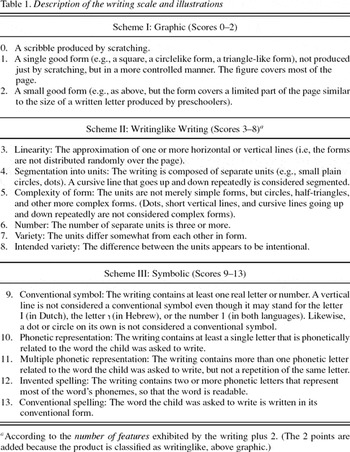
The changes in children's writing from ages 2 to 5 were recently studied among Israeli and Dutch children (Levin & Bus, 2003), who were asked to write their names and several dictated words. The development of their writing was described by means of a model composed of three sequential schemes: graphic, writinglike, and symbolic. The graphic scheme ranges from scribbling to small forms, such as a circle or a square constricted in size, and depends primarily on the child's graphic control. Children create such products both as writing and as drawing, although neither the children themselves nor mothers of same age children are able to tell whether they were meant to be writings or drawings. Consequently, as scribbling is generally accepted as the starting point for drawing (e.g., Adi-Japha, Levin, & Solomon, 1998; Kellogg, 1969), it can be conceived as the starting point for writing as well.
The writinglike scheme reflects children's growing assimilation of writinglike features: segmentation into units, linearity, arbitrary simple units (e.g., dots, lines or small circles), or complex units that graphically approximate letters. Children and mothers of same age children recognize these products as writings rather than drawings. The symbolic scheme ranges from the use of symbolic units (numbers or letters), through writing with letters that partially represent the required sounds (partial phonetic writing), to conventional spelling. These products are clearly recognizable as attempts to write, and, at the highest levels, are actually readable.
In the age range we studied, 52% of the writings produced were graphic, 34% were writinglike, and 14% were symbolic. Thus, although about half of the products included features of writing, as opposed to drawing, the majority contained neither conventionally shaped letters nor letters chosen on the basis of their sound value. The study analyzed developmental changes in writing in very young children, revealing scores increasing with age. However, no distinction was made between name and word writing, both of which were regarded by the model as representing writing in general.
The current investigation examines whether name writing develops faster than word writing and whether it is related to writing in general, before and after the transition to printing letters and understanding the alphabetic principle. Four data sets collected in three studies were employed. In all three studies, children were asked to write their own name and several dictated words, and the products were analyzed by means of the model described above.
In Study I, the participants were low socioeconomic status (SES) Israeli children (Aram, 2004; Aram & Biron, 2004), in Study II middle SES Israeli and Dutch children (Levin & Bus, 2003), and in Study III middle to high SES Dutch children (Both–de Vries & Bus, 2004). Study III provided two data sets, because the sample was divided in two with each group presented with a different list of words. The four data sets span the age range from 2 years, 4 months (2;4) to 5;1. The two orthographies, the variety in SES, and the extended age range offer the opportunity to examine the discrepancies between name and word writings on a broad spectrum across factors significant to literacy development, so as to show the robustness of these phenomena.
We predicted that children would be more advanced in name writing than in word writing. It was predicted that name writing would progress with age more rapidly, so that the gap between name and word writing would increase with age. Finally, due to children's distinct experience with their name, the intercorrelations between words were expected to be higher than the correlations between name writing and other word writing.
METHOD
The data employed were collected in studies designed for different purposes. However, in all studies young children who had not yet been exposed to the formal teaching of reading or writing were asked to write their name and several dictated words. The scoring scale devised by Levin and Bus (2003) was used to analyze the data from all studies.
Procedure and task
Children were tested individually in a quiet corner or separate room in their play- group, nursery, preschool, or kindergarten. The interviewers were female students.
Each child was asked to write his/her name and then several dictated words presented one at a time. The instructions were straightforward: “Write your name” and “Write X” (a certain word). All the words were chosen for being frequently used in discourse with children, so that it was presumed that the participants were familiar with them on the oral plane.
In Study I, children were given a pencil to write with. In Studies II and III, six colored felt-tipped pens were offered, and the children selected whichever one or ones they wished to use. A sheet of white paper at least A5 in size (148 × 210 mm) was provided for each item. The interviewer recorded the dictated word, the direction of writing, and any oral comments made by the child.
Scoring
The writing scale consists of three sequential schemes: graphic, writinglike, and symbolic. Written products are first sorted by scheme, and then scored by subscale: 0–2 for the graphic scheme; 3–8 for the writinglike scheme; and 9–13 for the symbolic scheme. The scale is described in detail in Table 1.

STUDY I
Participants
The sample consisted of 243 children: 122 nursery school children ages 2;11–3;11, and 121 preschoolers ages 4;00–4;11. Girls constituted 49% of the sample. The children were selected randomly from 13 nursery schools and preschools in a poor neighborhood on the outskirts of Tel Aviv–Jaffa, with only children diagnosed as having special educational needs being excluded.
Stimuli
Children were asked to write their own name and four dictated words: the Hebrew equivalents of carrot, cucumber, chicken, and fish. The words were chosen because they differ in phonological length, ranging from one to four syllables.
STUDY II
Participants
The sample consisted of 96 children: 48 Israeli and 48 Dutch children equally divided between genders and among three age groups: 2;4–2;11, 3;0–3;7, and 3;8–4;5. The children were randomly selected from play groups, nursery schools, and preschools in middle class neighborhoods in Israel and The Netherlands.
Stimuli
Children were asked to write their own name and eight words: the Hebrew or Dutch equivalents of grass, sun, flower, three flowers, mother, baby, father,and bird. The words were chosen as they stand for objects that young children typically draw.
STUDY III
Participants
The sample consisted of 96 children equally divided between genders and among three age groups: 3;5–3;11, 4;0–4;6, and 4;7–5;1. The children were randomly selected from play groups, nursery schools, and preschools in middle to upper class neighborhoods in The Netherlands.
Stimuli
Children were asked to write their name and eight words. The sample was divided into two equal groups per age, with each writing a different set of words. The first set consisted of the Dutch equivalents of flower, three flowers, rabbit, man, ball, book, liquorices, and snow, and the second set of tree, three trees, baby, mother, wheel, box, tomato, and sun. The words were chosen as they stand for objects that young children typically draw.
RESULTS
Coding reliabilities
In all three studies, reliabilities were based on coding performed by independent judges (i.e., the authors and their assistants). Coding was carried out by stimulus. In Study I, for example, the coding of writings of carrot was completed before the coding of writings of cucumber. The products of each stimulus were presented in random order, and the judges were blind to the children's age and other products. In Studies I and II, the coding was performed by three independent judges. The final score was based on the agreement of two to three judges, and in the rare cases in which all three judges disagreed, the mean score was calculated. In Study III, the coding was performed by two independent judges, and where there were discrepancies between them, the final score was based on agreement reached in discussion. In each study, Cronbach's alpha values were computed across the stimuli for each age group separately.
STUDY I
The sample used for assessing coding reliability consisted of 52 children, equally divided by age group. Four children were randomly recruited from each of the 13 classes in the study. Cronbach's alpha values for the younger and older age groups were .90 and .94, respectively.
STUDY II
The entire sample of 48 Israeli and 48 Dutch children, divided into three age groups, comprised the sample for assessing coding reliability. Two Israeli and one Dutch researcher served as judges. Cronbach's alpha values for Israeli children in the younger, middle, and older age groups were .88, .93, and .91, respectively. The corresponding values for the Dutch children were .83, .93, and .91.
STUDY III
The sample employed for assessing coding reliability consisted of 21 children equally divided by age group. Cronbach's alpha values for the youngest, middle and oldest group were .98, .97, and .97 respectively. The values for sets 1 and 2 were .96 and .97, respectively.
Age and name versus word writing
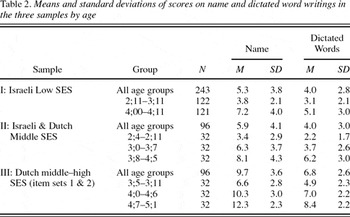
Table 2 shows the mean writing level by age in each study. Results suggest that writing improved with age and that name was written on a more advanced level than words.

Nonparametric analyses were carried out as the scale was not strictly interval. To test whether name writing was more advanced than word writing, we conducted the Wilcoxon matched-pairs signed-ranks test, comparing score on name with mean score on dictated words for each age group separately.
STUDY I
In each age group, more children scored higher on name than on dictated words than vice versa. Results of the Wilcoxon matched-pairs signed-ranks test indicated that the difference was significant for the younger and the older groups (Z=2.56, p<.05, N=122; Z=7.09, p<.001, N=121, respectively).
To discover whether the gap between the level of name and word writing increased with age, the difference between the name and word scores was calculated for each child. A Mann–Whitney U test found the gap between name and word writing to be significantly larger for the children in the older age group (mean rank=141.69) than for the younger children (mean rank=102.47; Z=-4.42, p<.001, N=243).
STUDY II
In all age groups and both nationalities, more children scored higher on name than on the mean of the eight dictated words than vice versa, with significant differences yielded by all but the youngest group (Z=1.46, ns; Z=3.41, p<.001; Z=2.92, p<.001, each N=32), for the youngest, middle, and oldest groups, respectively. These results indicate that from the age of 3, children wrote their names on a more advanced level than they wrote dictated words.
Again, the difference between the name and word scores was calculated for each child to discover whether the gap increased with age. A Kruskal–Wallis test did not find any significant increase with age for any of the groups in either of the samples (Israeli sample: mean rank=18.81, 28.91, 25.78; Dutch sample: mean rank=23.09, 26.22, 24.19; for the youngest, middle, and oldest groups, respectively). However, a Mann–Whitney test found close to significant difference between the youngest and the middle groups across nationalities (Z=-1.88, p<.06).
STUDY III
Once again, more children in all age groups scored higher on name than on dictated words than vice versa. The difference was significant for the youngest, middle, and oldest groups (Z=3.05, p<.001; Z=3.90, p<.001; Z=4.95, p<.001, respectively, each N=32).
The gap between the level of name and word writing was found to increase with age, with a Kruskal–Wallis test revealing a significant effect of age across the two data sets, χ2 (df=2)=11.09, p<.004. Mann–Whitney U tests showed the gap between name and word writing in the youngest group (mean rank=27.46) to differ significantly from the gap in the middle (mean rank=37.44) and oldest groups (mean rank=40.34, Z=-2.12, p<.03, N=32; Z=-3.37, p<.001, N=32, respectively), whereas the gap between the middle and oldest groups did not differ significantly. These results suggest that progression on name is faster than on other word writing, at least to the age of 4;6.
Results across studies clearly substantiate the hypothesis that name writing improves more rapidly with age than the writing of dictated words. Confirmation was obtained across a wide age range and among children immersed in different orthographies/languages, raised in two cultures, and of varied SES.
Relations between name and word writings
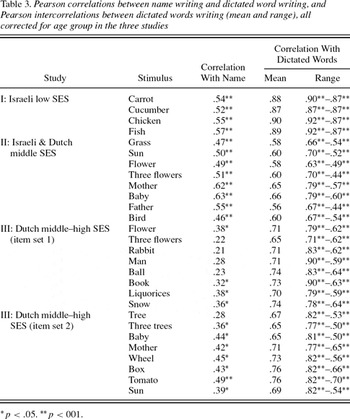
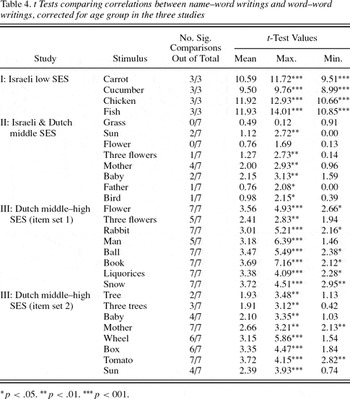
To test whether the intercorrelations between words exceeded the correlation between word and name writing, parametric statistics (i.e., Pearson correlations), were required. Although our previous analyses were nonparametric, the use of parametric statistics was adopted because they enable comparing dependent correlations; furthermore, the Pearson and Spearman correlations were found to be very close. Pearson correlations for the entire sample, corrected for age group, are presented in Table 3. In all three studies, the mean correlation between the level of writing of each word and the writings of all other words, corrected for age group, exceeded the corrected correlation between word writing and name writing. We then performed t tests to compare the correlation between the writing of two words with the correlation between each of these words and name writing. The formula used for the t tests took into account the dependency between the correlations, as they were based on the same sample (Cohen & Cohen, 1983, pp. 56–57). The results of this analysis appear in Table 4.


STUDY I
The mean partial intercorrelations between each of the four dictated words and all other words were very high, ranging from .90 to .87 (mean r=.89). In contrast, the partial correlations between name and each word were moderate (r=.52–.57, mean r=.55). Table 4 reveals that the correlations between the words were significantly higher than between word and name writing, across all comparisons.
STUDY II
The mean partial intercorrelations between each dictated word and all other words were moderate, ranging from .66 to .56 (mean r=.60). The corrected correlations between name and word writing were somewhat lower but also moderate, ranging from .63 to .46 (mean r=.53). As can be seen from Table 4, on only 11 of the 56 comparisons was the intercorrelation between words significantly higher than the correlation between word and name writing. This score is not above the chance level of 5% significance.
STUDY III
The mean corrected intercorrelations between each dictated word and all other words were moderately high (r=.74–.65, mean r=.71; and r=.76–.65, mean r=.70), for item sets 1 and 2, respectively. In contrast, the corrected correlations between name and word writing were either low or insignificant (r=.38–.21, mean r=.30; and r=.49–.28, mean r=.41) for the two sets, respectively. As shown in Table 4, the correlations between words were significantly higher than between word and name writing in 52 of the 56 comparisons for item set 1, and 39 of the 56 comparisons for item set 2. This score is above the chance level of 5% significance (χ2=32.04, p<.001).
To conclude, in line with expectations, in Studies I and III name writing and dictated word writing reveal a certain degree of independence, with words producing stronger correlations among themselves than with name. In Study II, however, most of the intercorrelations were at a similar level, varying from moderate to high. Nonetheless, here the mean intercorrelation between words was somewhat higher than between words and names as well.
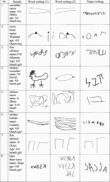
Figure 1 presents the writing of names and dictated words by eight Israeli and Dutch children drawn from Studies I and III. Examples 1–4 illustrate major points in the development of writing of own name: from pseudoletters (example no. 1), to partly pseudo-partly random letters (no. 2), to a conventional letter (initial) followed by random letters (no. 3), to conventional spelling of a name (no. 4). The rest (nos. 5–8) are all conventional and readable spellings of names.

Word and name writing by Israeli and Dutch preschoolers
All the examples illustrate that name writing is more advanced than the writings of two dictated words that appear alike. Moreover, the discrepancy between name and dictated word writings varies across children. Conventional name writing appears along with drawings (no. 4), scribbles (no. 5), wavy lines imitating text (no. 6), random writing that replicates own name writing (no. 7), and random letters some of which are borrowed from own name (no. 8). Two examples deserve special reference. Very few children drew when asked to write (no. 4). We believe that drawing is a sign of a child's refusal to pretend to write when he or she knows there is a correct way to write a word, but is unable to produce it. Hence drawings were not scored as writing (Gombert & Fayol, 1992; Levin, Share, et al., 1996). “Three tress” were written by some children as three words (no. 8) suggesting that for these children each written word stands for a referent, not a word. The fact that the three “words” for tree are not spelled identically lends credence to the interpretation that these children do not write words, but rather mark objects, as indeed, three trees may not necessarily all be alike (see Ferreiro & Teberosky, 1982; Levin & Bus, 2003).
DISCUSSION
The results of this study indicate that children are more advanced in writing their names than in writing dictated words, and that they progress more rapidly on name writing. This trend appears across a long age range (2–5 years), in children exposed to different orthographies (in this case Semitic and Latin represented by the Hebrew and Dutch writing systems) and growing up in families ranging in SES from low to high. These findings shed light on the possible significance of mediating name writing to very young children, even at an age when many adults conceive children to be too young to be involved in any writing activities.
The advantage found for name writing over other word writings might be explained by children's preference for their name, which exhibits itself at a very early age (Mandel, Jusczyk, & Pisoni, 1996). We would argue, however, that it stems primarily from differential mediation. Caregivers, alert to children's interest in their name, typically select this word type as a starting point to direct their attention to print, to encourage them to mimic it by scribbling or producing marks, to practice writing a letter string, and to name letters and become acquainted with their sounds. Without such mediation, the mere bond to their spoken name would not cause children to learn about its written form. Indeed, previous research has found the level of children's writing of their names to be strongly affected by SES (Ferreiro & Teberosky, 1982), lending credence to the role we attribute to mediation.
Although the samples from which our data were taken represented different SES groups, direct comparison between SES groups is not possible because the age groups were not identical. Nevertheless, some indication of the effect of this variable is provided by the fact that low SES children aged 2;11–3;11 wrote their name at a lower level than middle SES children aged 3;0–3;7 (M=3.6 and 6.3, respectively; see Table 2).
Not only is name writing mediated by caregivers at a younger age and more frequently than the writing of other words, but it is further promoted by children's early awareness of the cultural convention whereby a written name on a creative product is a sign of authorship. Consequently, young children ask their caregivers to print their name on their artwork, and subsequently try to scribble it, then to copy it from a model, and later attempt to write it by themselves. These experiences further children's conceptions of print. With time, they come to understand that name and other word writings share certain characteristics, such as segmentation into units or linearity. In this manner, progress in name writing promotes other word writings.
When caregivers enrich children's understanding of their written name by naming the letters or linking the sounds to the letters, children become aware of letter names and sounds, and eventually of the alphabetic principle itself. These experiences enhance their understanding of the written code and instill the basic skills involved in inventing the spelling of dictated words.
Research has shown that children's spelling of dictated words is a useful reflection of their understanding of the alphabetic principle, letter knowledge, and phonological awareness (Shatil, Share, & Levin, 2000), whereas name writing is not. Hence, in preschool and kindergarten, many children still write dictated words using random letters or only with a few letters phonetically related to the required sounds (e.g., Aram & Levin, 2001; Brenneman, Massey, Machado, & Gelman,1996; Gombert & Fayol, 1992; Levin, Korat, & Amsterdamer, 1996; Levin, Share, et al., 1996; Sulzby, Barnhart, & Hieshima, 1989). In contrast, as early as preschool, children often spell their name wholly or partially in conventional form, prior to comprehending the alphabetic principle. Consequently, they may recognize their written name without having any idea as to how this string is related to the name, or may write their name with the appropriate letters without being able to order them in the correct sequence or to name the letters (Villaume & Wilson, 1989).
Because children master spelling of their name before they understand the principles behind it, at some point they may reveal discrepancies between name writing and their comprehension of writing in general. This phenomenon was documented in a longitudinal case study (Martens, 1999). Months after she had started printing her name with the conventional string of letters, Sarah began inventing her name writing, coming up with CAYI (perhaps indicating that she attributed sounds to letters based on their names, such as C for /s/). We noticed an Israeli 4-year-old who spelled her cousin's name, Shalev, conventionally (SLB), and a few months later started spelling this name with a voweling letter (SLHB) that is unnecessary in Hebrew. This suggests that as children gain a growing understanding of the written system, their writing of names undergoes reconstruction, reflected either in the way they write their name or in the way they perceive the principles underlying name writing. Future studies might do well to take advantage of such phenomena in order to deepen our knowledge of the possible role of name writing in promoting children's literacy.
References
Adi-Japha E.,
Levin I., &
Solomon S.
1998.
Emergence of representation in drawing: The relation between dynamic and referential aspects.
Cognitive Development,
13,
25–
51.Google Scholar
Aram D.
2004.
Early literacy interventions: The relative roles of storybook reading, alphabetic activities, and their combination.
Manuscript submitted for publication.
Aram D., &
Biron S.
2004.
Joint storybook reading and joint writing interventions among low SES preschoolers: Differential contribution to early literacy.
Early Childhood Research Quarterly,
19,
588–
610.Google Scholar
Aram D., &
Levin I.
2001.
Mother–child joint writing in low SES: Sociocultural factors, maternal mediation, and emergent literacy.
Cognitive Development,
16,
831–
852.Google Scholar
Arrow A.,
Fletcher–Flinn C. M., &
Nicholson T.
2003.
“That's my name”: Possible precursors to reading development.
Poster presented at the
Annual Conference of the Society for Scientific Study of Reading,
Boulder, CO.
Bialystok E.
1991.
Letters, sounds, and symbols: Changes in children's understanding of written language.
Applied Psycholinguistics,
12,
75–
89.Google Scholar
Bloodgood J. W.
1999.
What's in a name? Children's name writing and literacy acquisition.
Reading Research Quarterly,
34,
342–
367.Google Scholar
Both–de Vries A., &
Bus A. G.
2004.
How symbolic is young children's writing?
Manuscript submitted for publication.
Brenneman K.,
Massey C.,
Machado S. F., &
Gelman R.
1996.
Young children's plans differ for writing and drawing.
Cognitive Development,
11,
397–
419.Google Scholar
Cohen J., &
Cohen P.
1983.
Applied multiple regression/correlation analysis for behavioral science
(2nd ed.).
Hillsdale, NJ:
Erlbaum.
Ferreiro E., &
Teberosky A.
1982.
Literacy before schooling.
New York:
Heinemann.
Gombert J. E., &
Fayol M.
1992.
Writing in preliterate children.
Learning and Instruction,
2,
23–
41.Google Scholar
Kellogg R.
1969.
Analyzing children's art.
Palo Alto, CA:
National Press.
Levin I., &
Aram D.
2004.
Children's names contribute to early literacy: A linguistic and social perspective.
In D. Ravid &
H. Bat-Zeev Shyldkrot (Eds.),
Perspectives on language and language development
(pp. 219–
241).
Dordrecht:
Kluwer Academic.
Levin I., &
Bus A.
2003.
How is emergent writing based on drawing? Analyses of children's products and their sorting by children and mothers.
Developmental Psychology,
39,
891–
905.Google Scholar
Levin I.,
Korat O., &
Amsterdamer P.
1996.
Emergent writing among kindergartners: Cross-linguistic commonalities and Hebrew-specific issues.
In G. Rijlaarsdam,
H. van der Bergh, &
M. Couzijn (Eds.),
Current trends in writing research: Theories, models and methodology
(pp. 398–
419).
Amsterdam:
Amsterdam University Press.
Levin I.,
Share D. L., &
Shatil E.
1996.
A qualitative–quantitative study of preschool writing: Its development and contribution to school literacy.
In C. M. Levy &
S. Ransdaell (Eds.),
The science of writing
(pp. 271–
293).
Mahwah, NJ:
Erlbaum.
Martens P. A.
1999.
Mommy, how do you write “Sarah?”: The role of name writing in one child's literacy.
Journal of Research in Childhood Education,
14,
5–
15.Google Scholar
Mandel D. R.,
Jusczyk P. W., &
Pisoni D. B.
1996.
Infants' recognition of the sound patterns of their own names.
Psychological Science,
6,
314–
317.Google Scholar
Share L. C., &
Levin I.
1999.
Learning to read and write in Hebrew.
In M. Harris &
G. Hatano (Eds.),
Learning to read and write: A cross linguistic perspective
(pp. 89–
111).
Cambridge:
Cambridge University Press.
Shatil E.,
Share D. C., &
Levin I.
2000.
On the contribution of kindergarten writing to grade 1 literacy: A longitudinal study in Hebrew.
Applied Psycholinguistics,
21,
1–
21.Google Scholar
Sulzby E.,
Barnhart J., &
Hieshima J.
1989.
Forms of writing and rereading from writing: A preliminary report.
In J. Mason (Ed.),
Reading–writing collection
(pp. 31–
63).
Neeham Heights, MA:
Allyn & Bacon.
Tolchinsky–Landsmann L., &
Levin I.
1985.
Writing in preschoolers: An age-related analysis.
Applied Psycholinguistics,
6,
319–
339.Google Scholar
Treiman R., &
Broderick V.
1998.
What's in a name? Children's knowledge about the letters in their own names.
Journal of Experimental Child Psychology,
70,
97–
116.Google Scholar
Treiman R., &
Kessler B.
2003.
The role of letter names in the acquisition of literacy.
Advances in Child Development and Behavior,
31,
105–
135.Google Scholar
Treiman R.,
Kessler B., &
Bourassa D.
2001.
Children's own names influence their spelling.
Applied Psycholinguistics,
22,
555–
570.Google Scholar
Treiman R.,
Tincoff R., &
Richmond–Welty E. D.
1997.
Beyond zebra: Preschoolers' knowledge about letters.
Applied Psycholinguistics,
18,
391–
409.Google Scholar
Villaume S. K., &
Wilson L. C.
1989.
Preschool children's explorations of letters in their own names.
Applied Psycholinguistics,
10,
283–
300.Google Scholar
Description of the writing scale and illustrations
Means and standard deviations of scores on name and dictated word writings in the three samples by age
Pearson correlations between name writing and dictated word writing, and Pearson intercorrelations between dictated words writing (mean and range), all corrected for age group in the three studies
t Tests comparing correlations between name–word writings and word–word writings, corrected for age group in the three studies
Word and name writing by Israeli and Dutch preschoolers
 You have
Access
- 110
- Cited by