Abbreviations
ACC = anterior cingulate cortex; AD = Alzheimer's disease; bvFTD = behavioral variant frontotemporal dementia; DLPFC = dorsolateral prefrontal cortex; fMRI = functional magnetic resonance imaging; FTD = frontotemporal dementia; IPD = idiopathic Parkinson's disease; LBD = Lewy body dementia; GABA = Gamma-aminobutyric acid; ICD = impulsive control disorder; IRI = interpersonal reactivity index; ISTAART = international society to advance Alzheimer's research and treatment; MBI = mild behavioral impairment; MBI-C = mild behavioral impairment checklist; MCI = mild cognitive impairment; MFC = medial frontal cortex; NIA-AA = National Institute on Aging-Alzheimer's Association; NPS = neuropsychiatric symptoms; OFC = orbitofrontal cortex; PD = Parkinson's disease; PDD = Parkinson's disease dementia; PFC = prefrontal cortex; RMET = reading the mind in the eyes test; SCI = subjective cognitive impairment; SCT = social cognition training; SLN = salience network; SSRI = selective serotonin reuptake inhibitor; SST = social-skills training; ToM = theory of mind; TPJ = temporoparietal junction; VMPFC = ventromedial prefrontal cortex.
Introduction
Our clinical understanding of neurodegenerative disorders, such as Alzheimer's disease (AD) and Lewy body dementia (LBD), has advanced considerably in the past decades. Cognitive deficits, such as amnesia, agnosia, aphasia, or apraxia, were considered as the hallmarks of these neurocognitive disorders. It is now well recognized that the non-cognitive deficits that include neuropsychiatric symptoms (NPS), such as mood disturbances and behavioral changes, are common at diagnosis and during the course of neurodegenerative disorders (Lyketsos et al., Reference Lyketsos, Lopez, Jones, Fitzpatrick, Breitner and DeKosky2002; Teipel et al., Reference Teipel2015). Changes in personality, behavior, or comportment have been acknowledged as an integral element for the diagnosis of dementia by the National Institute on Aging-Alzheimer's Association workgroups (NIA-AA) (McKhann et al., Reference McKhann2011). Changes in personality and behavior, such as social withdrawal, loss of social etiquette, or failure to reciprocate emotionally, may be signs of impaired social cognition. Social cognition, the cognitive ability to process social information coming from others, such as emotions, making inferences about what other people might be thinking, and responding appropriately to them, has recently gained importance in neurodegenerative research (Henry et al., Reference Henry, Von Hippel, Molenberghs, Lee and Sachdev2016). Recently, the Diagnostic and Statistical Manual of Mental Disorders-Fifth Edition (DSM-5) has incorporated impairment in social cognition as one of the core criteria for neurocognitive disorders, alongside impairment in memory and executive functions, hence recognizing its importance (American Psychiatric Association, 2013).
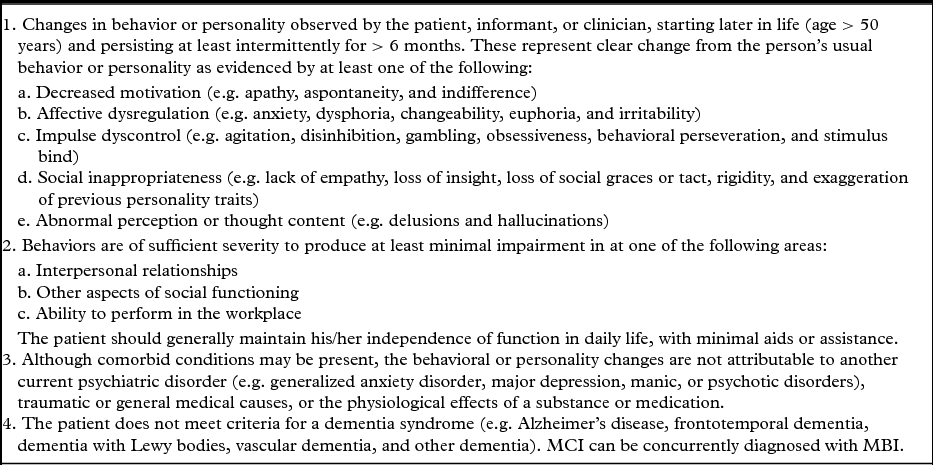
A shift has also occurred in clinical research towards investigating possible prodromal and preclinical stages of major neurocognitive disorders, such as mild cognitive impairment (MCI) and subjective cognitive impairment (SCI), with the hope of finding disease-modifying treatments before significant irreversible cognitive and functional decline has occurred (Cummings et al., Reference Cummings, Dubois, Molinuevo and Scheltens2013; Jessen et al., Reference Jessen2014). Similar to subjective cognitive complaints and mild cognitive changes (Reisberg and Gauthier, Reference Reisberg and Gauthier2008), new onset psychiatric or behavioral symptoms in middle-aged patients without cognitive symptoms may predict the presence of an unrecognized neurodegenerative disorder (Peters et al., Reference Peters2013; Rosenberg et al., Reference Rosenberg, Mielke, Appleby, Oh, Geda and Lyketsos2013). This is especially true for behavioral-variant frontotemporal dementia (bvFTD) where mood and behavioral disturbances are often the earliest presenting manifestations, years before the onset of noticeable executive dysfunction on standard assessments. Mild behavioral impairment (MBI) is a new concept emerging in clinical research. Similar to MCI being a prodromal stage for major neurocognitive disorders, MBI has been initially proposed to identify patients at higher risk of developing bvFTD. MBI is now recognized as a significant risk factor for various other neurocognitive disorders, such as AD and LBD (Taragano et al., Reference Taragano2009). Building on previously elaborated criteria for MBI by Taragano and de Mendonça (Taragano and Allegri, Reference Taragano and Allegri2003; de Mendonca et al., Reference de Mendonca, Ribeiro, Guerreiro and Garcia2004), the NPS Professional Interest Area of the International Society to Advance Alzheimer's Research and Treatment (NPS-PIA of the ISTAART) group has developed new research criteria to better identify and study patients with changes in behavior or personality who are at an increased risk of developing dementia (Ismail et al., Reference Ismail2016). Social inappropriateness is one of the five core components of the ISTAART research diagnostic criteria for MBI, emphasizing the importance of assessing social cognition (see Table 1).
ISTAART research diagnostic criteria for MBI

Abbreviations: ISTAART = International Society to Advance Alzheimer's Research and Treatment; MBI = mild behavioral impairment; MCI = mild cognitive impairment.
The purpose of this paper is to review the concept of social cognition, particularly in prodromal stages of neurodegenerative disorders, by covering the neuropsychological components of social cognition, its neural basis and impairment in different neurocognitive disorders. We will also briefly review the different assessment tools and interventions currently available to evaluate and treat social inappropriateness in the clinical setting. Understanding the neuroscience behind social cognition may provide a better comprehension of the behavioral changes regularly observed in neurodegenerative disorders and help to address them more appropriately.
Search strategy and selection criteria
We performed a comprehensive review of the literature using electronic databases (Ovid MEDLINE, Embase, PsycINFO, and Cochrane Central Register of Controlled Trials) for papers published in English or French using keywords and synonyms associated with the epidemiology, pathogenesis, diagnosis, and treatment for “social inappropriateness,” “theory of mind (ToM),” “empathy,” and “neurodegenerative disorders” such as AD, bvFTD, idiopathic Parkinson's disease (IPD), and LBD. We manually searched the reference lists of identified reports for additional papers to supplement our electronic search. We conducted our searches up to November 2016, without restrictions for time. We largely selected publications in the past 10 years, but did not exclude important older publications. Selection criteria also included a judgment on the novelty of studies and their relevance for the well-informed general physician.
Social cognition and its impairment
Social cognition encompasses various explicit and implicit psychological processes that permit individuals to gain benefits from being part of a social group (Frith, Reference Frith2008). These processes, which occur through social interactions, may be elicited by verbal or non-verbal stimuli. Social stimuli, such as facial expressions, body postures, prosody, hand gestures, or eye gaze directions, give important signals about the surrounding environment. They may, for example, alert for the presence of danger or for the location of a particular area of interest to investigate. These external cues help people to learn about the world through others’ experiences without undergoing the trials and errors themselves. Showing emotions, noticing and understanding others’ emotions, and responding to them with empathy and sympathy are all prosocial behavioral processes. These may be automatic and unconscious, but all help individuals of a group feel closer, enhance collaboration, and inhibit aggressive interactions. ToM, an important concept of social cognition that is also known as “mentalizing,” refers to the ability to attribute mental states such as beliefs, desires, and knowledge to oneself and others, as well as to appreciate that these may differ from our own (Premack and Woodruff, Reference Premack and Woodruff1978). ToM is often divided into “affective ToM” and “cognitive ToM,” referring to the ability to mentalize others’ emotional and cognitive states, respectively. Closely related to ToM, meta-cognition is the ability to reflect on our own actions and thoughts and to notice alterations in our cognitive abilities (Frith and Frith, Reference Frith and Frith2012).
For these mostly unconscious social cognitive processes to be successful and beneficial, one must perceive the received social cues, interpret them correctly, and respond to them adequately. Social processes are considered “higher-order cognitive tasks” as they require intact perception and attention, executive functions, and knowledge of acceptable social behaviors (Shany-Ur and Rankin, Reference Shany-Ur and Rankin2011). The significance of social cognition has been appreciated early on in developmental psychological studies. Its impairment and impact on functional outcomes has been characterized in psychiatric disorders (i.e. schizophrenia, bipolar disorder, and personality disorders), in developmental disorders (i.e. autism spectrum disorder, attention deficit hyperactivity disorder, and fetal alcohol syndrome), as well as in acute brain damage (i.e. stroke and traumatic brain injury) (Henry et al., Reference Henry, Von Hippel, Molenberghs, Lee and Sachdev2016). Interest in social cognitive impairment in neurodegenerative disorders is relatively new.
Neural basis for social cognition
Knowledge of the neural basis of social cognition comes from lesion studies and activation studies involving functional magnetic resonance imaging (fMRI) of patients performing specific social tasks. Various brain regions have been recognized as having potential roles in social cognition. Major areas consistently linked to its processes include the medial frontal cortex (MFC), particularly the orbitofrontal cortex (OFC), the anterior cingulate cortex (ACC), the amygdala, the temporoparietal junction (TPJ), the superior temporal gyrus, and the temporal poles (Amodio and Frith, Reference Amodio and Frith2006; Shany-Ur and Rankin, Reference Shany-Ur and Rankin2011). Some of these areas have been found to be important elements of the salience network (SLN), which is activated during tasks requiring attentional selection, task switching, and self-regulation of behavior (Farb et al., Reference Farb2013). The right hemisphere is particularly involved in perception of information and behavioral responses. Although subtasks of social cognition can be linked to distinct neural networks, everyday life social interactions are rich in information and often require contributions of many networks in order to be processed effectively. Furthermore, a single social stimulus can be processed through various different parallel channels, demonstrating important neural circuit intricacy. Entanglement of social cognition with other cognitive domains, especially executive functions, also adds to its complexity.
Lesions of the OFC are known to produce disinhibited social conduct, such as disclosing personal information to strangers, hypersexuality, and compulsive gambling (Beer et al., Reference Beer, John, Scabini and Knight2006; Peters et al., Reference Peters2006). Lesions of the dorsolateral prefrontal cortex (DLPFC) near the ACC region have been linked to deficits in motivational regulation and emotional behavior (Devinsky et al., Reference Devinsky, Morrell and Vogt1995), while lesions to the amygdala and fusiform gyrus have been associated to impaired facial emotion recognition (Adolphs et al., Reference Adolphs, Tranel and Damasio2003). Mentalizing, being able to view a situation from another person's perspective, seems to be dependent on the TPJ, superior temporal gyrus, and DLPFC. These regions are also involved in moral reasoning (Kalbe et al., Reference Kalbe2010; Abu-Akel and Shamay-Tsoory, Reference Abu-Akel and Shamay-Tsoory2011).
Several neuropeptides and neurotransmitters have been identified as contributing to social processes, including dopamine, serotonin, gamma-aminobutyric acid (GABA), oxytocin, and vasopressin. BvFTD patients, in whom social behavior is prominently altered, demonstrate low levels of prefrontal serotonin and dopamine (Franceschi et al., Reference Franceschi2005). Social isolation is known to cause alteration of dopaminergic transmission in the PFC and striatum and contributes to increased abnormal impulsive behaviors (Baarendse et al., Reference Baarendse, Counotte, O'Donnell and Vanderschuren2013). Studies on PD patients have generated the neurochemical hypothesis of ToM whereby dopaminergic and serotonergic dysfunction contribute to its impairment (Abu-Akel, Reference Abu-Akel2003). Oxytocin, a neuropeptide produced in the paraventricular and supraoptic nuclei of the hypothalamus, may have a role in modulating social processes. Low oxytocin levels are associated with life history of aggression in personality disorder patients (Lee et al., Reference Lee, Ferris, Van de Kar and Coccaro2009). Its administration in non-human mammal models has been shown to facilitate social recognition, bonding, and reduce anxiety associated with social threat (Meyer-Lindenberg et al., Reference Meyer-Lindenberg, Domes, Kirsch and Heinrichs2011), while in humans administration has been associated with enhanced performances on social tasks (Guastella and MacLeod, Reference Guastella and MacLeod2012; Finger et al., Reference Finger2015).
Clinical assessment of social inappropriateness
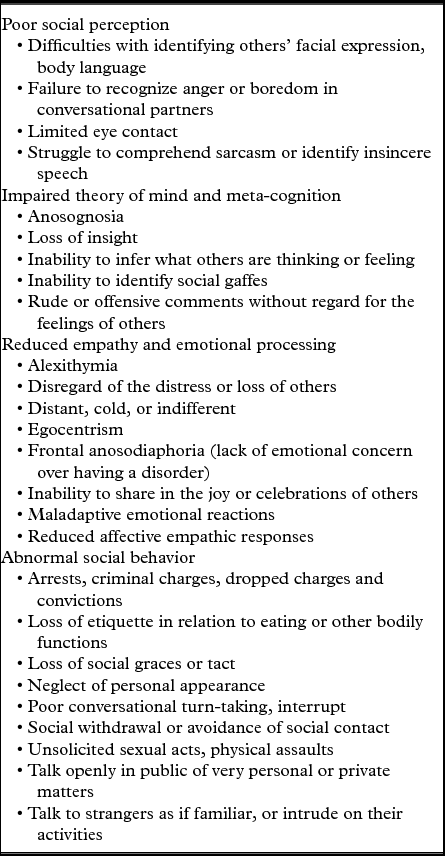
Clinical assessment of social cognition is informative and valuable in many psychiatric and neurological disorders. Similar to the evaluation of cognitive complaints, patients brought to clinical attention must be thoroughly questioned about their past medical history, family medical history, as well as their premorbid personality and socioemotional environment. Since insight is frequently impaired in patients with behavioral impairment, the presence of an informant who has noticed the changes in personality and interpersonal conduct is essential. Various behaviors may be of clinical significance, ranging from small breaches in social etiquette to frank sociopathic acts (see Table 2). Social interactions and human behaviors are complex processes, and behavioral disturbances may have various causes, including mood disorders, psychotic disorders, substance abuse, and neurological disorders. Social inappropriateness may be broadly and somewhat arbitrarily divided into different clinical presentations according to presenting symptoms if they are secondary to poor social perception, impaired theory of mind, reduced emotional empathy, or abnormal social responses (Henry et al., Reference Henry, Von Hippel, Molenberghs, Lee and Sachdev2016).
Signs of impaired social cognition

Numerous tests, initially elaborated and validated in diverse populations such as autistic or brain-injured patients, are clinically available to evaluate objectively social cognition subdomains in neurodegenerative disorders. These tests, much like the assessment of any other cognitive domains, are dependent on some level of intact attention, executive functions, and memory. Normality on these tests does not exclude neurodegeneration or impairment in social cognition, as discrete deficits may not be objectified early on. Furthermore, a few studies have explored their psychometric proprieties, and additional prospective validations are required before these tests may be universally used clinically.
Perception of social cues can be evaluated through recognition tasks of visual or auditory emotions. The Ekman task evaluates the recognition of six basic emotions (anger, disgust, fear, sadness, surprise, and happiness) in 60 different pictures (Ekman and Friesen, Reference Ekman and Friesen1976), while the Florida Affective Battery evaluates discrimination of facial affect as well as prosody discrimination through many subtasks (Bowers et al., Reference Bowers, Blonder and Heilman1999).
The ability to mentalize is most often studied through the False-Belief Task, an extensively validated test where patients must be able to disregard their own knowledge and project themselves into someone else's position in a specific situation and make inferences (Wimmer and Perner, Reference Wimmer and Perner1983). The Faux-Pas Test measures the ability to perceive faux pas and to identify social gaffes (Stone et al., Reference Stone, Baron-Cohen and Knight1998). Finally, the Reading the Mind in the Eyes Test (RMET) is a widely validated tool to assess the ability to make inferences on emotions from eyes (Baron-Cohen et al., Reference Baron-Cohen, Wheelwright, Hill, Raste and Plumb2001).
The assessment of what constitutes an adequate empathic response is somewhat subjective. Available measures report the patient's experiences to the emotions of others and are therefore dependent on the perspective and self-awareness of the patient, while other available tools are informant-rated measures of empathy. The Interpersonal Reactivity Index (IRI) is a 28-item questionnaire answered on a 5-point scale exploring the patient's perspective taking, fantasy, empathic concern, and personal distress in interpersonal settings (Davis, Reference Davis1980).
Many scales evaluating the presence of impaired behavioral responses exist, such as the Neuropsychiatric Inventory (Cummings et al., Reference Cummings, Mega, Gray, Rosenberg-Thompson, Carusi and Gornbein1994), the Frontal Behavior Inventory (Kertesz et al., Reference Kertesz, Davidson and Fox1997), and the Frontal Systems Behavior Scale (Grace et al., Reference Grace, Stout and Malloy1999). They identify and grade behavioral disturbances commonly encountered in the clinical settings, such as inflexibility, apathy, risky behaviors, and impulsivity. Finally, the MBI-Checklist (MBI-C) is a newly developed rating scale created to assess various different behavioral changes exhibited by older adults (decreased motivation, emotional dysregulation, impulse dyscontrol, social inappropriateness, and abnormal perception or thought content) that might precede the onset of dementia (Ismail et al., Reference Ismail2017). Selected items of the scale were derived by an expert panel consensus. In the MBI-C, five questions pertaining to societal norms explore the presence of inappropriate social behaviors and their severity. They inquire about changes in empathetic response, loss of social graces such as discussing private matters in public or making rude, crude, or lewd sexual remarks, uncharacteristic familiarity with strangers, as well as the loss of adequate social judgment.
Impairment of social cognition in neurodegenerative disorders
Similar to cognitive symptoms in dementia being secondary to neurodegeneration of strategic brain structures, changes in interpersonal conduct are also believed to be related to neuropathological changes in specific areas of the brain.
Behavioral-variant frontotemporal dementia
BvFTD is a neurodegenerative disorder where affected patients present early on with behavioral disinhibition, apathy or inertia, loss of sympathy or empathy, perseverative and stereotyped behaviors, hyperorality and appetite changes, and deficits in executive functions with relative sparing of memory and visuospatial functions (Rascovsky et al., Reference Rascovsky2011). Social cognition deficits are early, prominent features in this clinical syndrome, mainly related to the initial atrophy of the medial frontal lobes, insular, and anterior temporal neocortex, most often with an initial right hemispheric lateralization. Patients remain independent in the early stages because of minimal impairment of other cortical functions. With progression of the degeneration, patients eventually develop classical cognitive deficits such as amnesia, aphasia, and apraxia, and require interventions to palliate functional decline. The early stages of bvFTD may lead to erroneous psychiatric diagnoses, while the later stages of bvFTD may be mistaken for a diagnosis of AD (Lindau et al., Reference Lindau2000).
In patients with prodromal bvFTD, behavioral symptoms precede neuropsychological and neuro-imaging abnormalities by several years (Gregory, Reference Gregory1999). In a retrospective study inquiring about initial symptoms (Barber et al., Reference Barber, Snowden and Craufurd1995), 68% of patients who would later on receive a pathologically confirmed diagnosis of bvFTD had presented with loss of empathy, inappropriateness of affect, or behavioral disinhibition years before clinical diagnosis. In a more recent study, 62.5% of bvFTD patients presented with changes in social behavior, such as loss of social awareness, social withdrawal, and disinhibition, as the initial manifestation of their disease (Shinagawa et al., Reference Shinagawa, Ikeda, Fukuhara and Tanabe2006). Inhibition, especially of inappropriate emotional impulses, was the most frequent early impaired domain of bvFTD patients in a study by Lindau et al. (Reference Lindau2000), reported in 46.2% of patients. Early preferential atrophy of the ventromedial prefrontal cortex (VMPFC), more specifically of the OFC region, relative to the DLPFC is associated with impaired social conduct with minimal executive dysfunction. Hypometabolism of the OFC on positron emission tomography (PET) scan has been associated with disinhibited and apathetic manifestations (Peters et al., Reference Peters2006). Lack of inhibition over inappropriate responses to social context is not the only explanation for bvFTD patients’ behavior. BvFTD patients have been shown to have deficits in their ability to integrate social contextual information to guide their decision-making behaviors, such as expression of prosocial acts and punishment (O'Callaghan et al., Reference O'Callaghan2016). Reduced perception of social cues seems to contribute to the impaired social conduct. Patients with bvFTD have been found to have impaired recognition of negative facial emotions when compared to AD patients and healthy adults (Fernandez-Duque and Black, Reference Fernandez-Duque and Black2005). Decreased grey matter volume in the right MPFC has been linked to poor facial emotion recognition (Bertoux et al., Reference Bertoux, Volle, Funkiewiez, de Souza, Leclercq and Dubois2012). Vocal cues associated with sarcasm and insincere speech are also poorly understood by bvFTD patients with a more pronounced degree of right temporal pole atrophy (Shany-Ur et al., Reference Shany-Ur2012). More severe atrophy at the right temporal pole, right anterior fusiform gyrus, and right subcallosal gyrus also correlates with lower levels of empathy on the IRI in these patients (Rankin et al., Reference Rankin2006; Dermody et al., Reference Dermody2016). Additionally, bvFTD patients present significant early ToM impairment when tested on the False-Belief tasks and the RMET (Fernandez-Duque et al., Reference Fernandez-Duque, Baird and Black2009; Torralva et al., Reference Torralva2009; Freedman et al., Reference Freedman, Binns, Black, Murphy and Stuss2013), tasks that are known to correlate with behavioral abnormalities (Gregory et al., Reference Gregory2002). Decline in ToM abilities may predict the development of neurocognitive disorders. In a longitudinal study of 4,150 normal healthy participants, isolated ToM deficits on the RMET were found to be a predictive marker for the development of progressive frontal lobe impairment and bvFTD (Pardini et al., Reference Pardini2013).
Alzheimer's disease
AD is the most frequent neurocognitive disorder in the world. It is characterized by progressive cognitive decline with early and prominent impairment in episodic memory. NPS are frequent at diagnosis and during the evolution of the disease (Lyketsos et al., Reference Lyketsos, Lopez, Jones, Fitzpatrick, Breitner and DeKosky2002). Although significantly less frequent than in bvFTD patients, AD patients often present with behavioral changes at onset, such as disinhibition and social awkwardness (Lindau et al., Reference Lindau2000; Shinagawa et al., Reference Shinagawa, Ikeda, Fukuhara and Tanabe2006). Disinhibition, social awkwardness, and apathy have been reported as the first symptoms in 6.9%, 5.0%, and 2.0%, respectively, of patients with AD (Lindau et al., Reference Lindau2000). Social inappropriateness seen in AD is probably multifactorial, in part secondary to altered social cognitive abilities such as perception of social cues, impaired processing, and loss of control over reactions. Time of onset of these deficits concurrent with other cognitive symptoms during the course of the disease is still unclear but several studies have reported their early presence in patients with amnestic and multiple-domain MCI subtypes.
MCI participants have significant deficits in facial emotion processing and discrimination when assessed on the Florida Affective Battery, prior to the more advanced cognitive deficits associated with AD (Teng et al., Reference Teng, Lu and Cummings2007). These could be secondary to increased burden of amyloid plaques and neurofibrillary tangles in the frontal lobes, more particularly at the OFC. Additionally, progression of the neurodegeneration from the entorhinal cortex and hippocampus towards the anterior and lateral temporal structures, including the amygdala, may contribute to the impaired facial emotion recognition. Abnormalities in visual and auditory recognition of even basic emotions are frequently described in AD patients, which could contribute to abnormal, inappropriate behaviors (Weiss et al., Reference Weiss2008). Furthermore, several studies assessing ToM abilities through the False Belief, RMET, and Faux-Pas tasks have demonstrated poor inference skills for AD patients (Gregory et al., Reference Gregory2002) and MCI patients (Moreau et al., Reference Moreau2015) compared to healthy normal controls. Perspective-taking difficulties in AD have been hypothesized to cause empathic deficits in these patients. Early atrophy in AD of the left TPJ, left temporal fusiform cortex, left inferior temporal gyrus, left angular gyrus, and bilateral middle and superior posterior temporal gyrus has been identified as the neural substrates of lack of empathic concern in these patients (Dermody et al., Reference Dermody2016).
Although MCI, AD, and bvFTD patients present similar deficits in perception and processing of information on social cognition assessments, MCI and AD deficits translate less frequently into severe behavioral problems. This could reflect different patterns of neurodegeneration. Observed deficits on ToM tasks in some MCI and AD patients may be secondary to underappreciated deficits in working memory and executive functions, which are required in more sophisticated and complex ToM tasks. Executive dysfunction secondary to DLPFC atrophy but intact self-restraint from unaffected VMPFC may produce less behavioral anomalies in MCI and AD (Lindau et al., Reference Lindau2000).
Idiopathic Parkinson's disease and Lewy body dementia
IPD is primarily a neurodegenerative movement disorder where affected individuals present with bradykinesia, rigidity, resting tremor, and postural and gait changes. A subset of IPD patients eventually develops personality and cognitive changes and is diagnosed with Parkinson's disease dementia (PDD). LBD is the second most common cause of neurodegenerative dementia and is characterized by the presence of Parkinsonism, recurrent visual hallucinations, and fluctuation of cognition and attention. Both disorders, IPD and LBD, are alpha-synucleiopathies (McKeith et al., Reference McKeith2004).
Studies have reported that IPD patients have difficulties with recognition of faces, as well as recognition of emotions from visual and auditory cues (Ariatti et al., Reference Ariatti, Benuzzi and Nichelli2008; Bodden et al., Reference Bodden, Dodel and Kalbe2010). Impairment in ToM has been reported in IPD patients on the False Belief, Faux-Pas, and RMET tasks when compared to healthy adults (Saltzman et al., Reference Saltzman, Strauss, Hunter and Archibald2000). Striatal dopamine depletion in the dorsolateral and orbital frontostriatal loops has been implicated in their impaired ToM performances. However, evidence must be interpreted carefully as those studies included advanced IPD patients where executive dysfunction and psychiatric comorbidities are prevalent and could explain impairment on assessments. In contrast to AD and bvFTD, social cognitive deficits in IPD appear later in the course of the disease, as suggested from studies demonstrating early IPD patients perform comparably to healthy controls (Péron et al., Reference Péron2009; Bodden et al., Reference Bodden, Dodel and Kalbe2010). Unlike AD and bvFTD, it is not known if these deficits translate to significant interpersonal difficulties. Although IPD patients are known to be at an increased risk of impulsive control disorders (ICDs), such as compulsive gambling, buying, sexual behaviors, and eating, these behavioral manifestations are thought to be primarily related to the use of PD medications, especially dopamine agonists (Weintraub et al., Reference Weintraub2015). Little is known about the course of the social abilities of LBD patients. A case series with seven LBD patients demonstrated impaired ToM on the Faux-Pas task but not on the RMET task when compared to healthy controls (Heitz et al., Reference Heitz2015).
Mild behavioral impairment
MBI has been proposed as a diagnostic construct aimed to identify patients presenting persistent NPS who are at an increased risk of developing dementia (Ismail et al., Reference Ismail2016). This clinical entity regroups patients commonly seen by psychiatrists rather than neurologists or geriatricians, who present various late-onset behavioral or personality changes without significant cognitive impairment. These patients can sometimes come to clinical attention after having had conflicts with the law, such as being accused of shoplifting or performing unsolicited touching (Liljegren et al., Reference Liljegren2015). Not uncommonly, these patients are misdiagnosed with a psychiatric disorder prior to the recognition of the underlying neurocognitive disorder (Woolley et al., Reference Woolley2011). Although all neurodegenerative disorders may manifest themselves initially with various NPS, abnormal social behaviors, such as indifference, lack of empathy, or loss of social tact, in the absence of cognitive deficits may be more predictive of prodromal bvFTD (Shinagawa et al., Reference Shinagawa, Ikeda, Fukuhara and Tanabe2006; Taragano et al., Reference Taragano2009). The ISTAART provisional diagnostic criteria for MBI as well as the MBI-C will require prospective validation of its construct as it is still unclear what are the most common, earliest neuropsychiatric manifestations in the different prodromal dementias.
Treatment of social inappropriateness
Lack of empathy and impulsive behaviors in patients with neurodegenerative disorders are particularly distressing for caregivers (Hsiesh et al., Reference Hsiesh, Irish, Daveson, Hodges and Piguet2013). Research on possible interventions to palliate abnormal behaviors secondary to impaired social cognition is fairly recent. Promising therapeutic avenues under investigation include special behavioral psychotherapeutic programs and pharmacotherapy.
Previous drug trials in dementia, especially in bvFTD, have focused on the management of NPS by targeting serotonergic dysfunction. Although several trials have demonstrated the efficacy of selective serotonin reuptake inhibitors (SSRIs) for the treatment of some behavioral disturbances (mainly disinhibition, irritability, and aggression) in FTD (Swartz et al., Reference Swartz, Miller, Lesser and Darby1997; Moretti et al., Reference Moretti, Torre, Antonello, Cazzato and Bava2003; Herrmann et al., Reference Herrmann, Black, Chow, Cappell, Tang-Wai and Lanctôt2012) and in AD (Lanctôt et al., Reference Lanctôt, Herrmann, van Reekum, Eryavec and Naranjo2002; Porsteinsson et al., Reference Porsteinsson2014), no studies have assessed the specific effects of SSRIs on social cognitive endpoints. Similarly, the evidence for trazodone in AD and FTD patients for behavioral symptoms is limited (Martinón-Torres et al., Reference Martinón-Torres, Fioravanti and Grimley Evans2004). Antipsychotics are frequently prescribed to patients with dementia presenting with NPS. However, no studies have explored their effects on social cognitive endpoints in this particular population. A few studies have evaluated antipsychotic treatment and social cognition in schizophrenia with inconsistent conclusions on their effectiveness (Kucharska-Pietura and Mortimer, Reference Kucharska-Pietura and Mortimer2013). Recent trials have investigated the possible therapeutic effects of oxytocin administration in bvFTD. Single intranasal oxytocin administration in bvFTD patients has been associated with significant improvement of scores on social cognitive and neuropsychiatric scales compared to placebo (Jesso et al., Reference Jesso2011; Guastella and MacLeod, Reference Guastella and MacLeod2012). Preliminary results of a randomized, placebo-controlled, double-blind study indicate that intranasal oxytocin administrated twice daily for one week may improve empathic behaviors in these patients (Finger et al., Reference Finger2015).
Behavioral training programs are being designed to attempt to ameliorate social cognitive deficits for a variety of neuropsychiatric disorders, such as schizophrenia, traumatic brain injury, and autism. Social cognition training and social-skills training have been shown to increase facial emotional recognition and discrimination as well as ameliorate empathy in these populations (Hooker et al., Reference Hooker2013). However, no studies on these programs have been conducted to date in populations with dementia.
Conclusion
NPS are frequent in neurodegenerative disorders and their evaluation should be a part of any comprehensive neurocognitive assessment. Disintegration of personality and of interpersonal conduct is particularly concerning for the patient's family and caregivers. Through various manifestations, social inappropriateness is frequently the first sign of an unrecognized early neurodegenerative process, such as AD and bvFTD, years before noticeable impairment on classical neuropsychological assessment and brain atrophy on imaging. The ISTAART research diagnostic criteria for MBI will facilitate identification of patients with significant mood and behavioral changes and standardize their study.
Conflict of interest
None.
Description of authors’ roles
P. Desmarais reviewed the literature and drafted the initial manuscript. N. Herrmann, K. L. Lanctôt, M. Masellis, and S. E. Black revised the paper and provided a critical revision of the literature review and interpretation. All authors have contributed to the writing and revising of the manuscript and approved the final version submitted for publication.
Acknowledgments
P. Desmarais received a fellowship grant from the Fondation du Centre Hospitalier de l'Université de Montréal for his training in cognitive neurology. N. Herrmann and K. L. Lanctôt are supported by the Canadian Consortium on Neurodegeneration in Aging and peer reviewed grants from the Alzheimer Society of Canada (grant 15-17), Alzheimer's Drug Discovery Foundation (grant 20140503), Canadian Institute of Health Research, National Institute on Aging of the National Institutes of Health (grant R01AG046543), and the Heart and Stroke Foundation (grant NA 7220) in addition to research contracts funded by AbbVie Pharmaceuticals, Roche and Lundbeck Canada, Inc. S. E. Black and M. Masellis are supported by the Department of Medicine of the University of Toronto, the Sunnybrook Health Sciences Centre, and the Sunnybrook Research Institute. S. E. Black is also supported from the Deborah Ivy Christian Brill Chair in Neurology of the University of Toronto and the Toronto Dementia Research Alliance. We are grateful to Andréanne Wassef and Quoc Dinh Nguyen for their help with the project.