Introduction
Freshwater ecosystems are the most threatened environments on the planet. However, mechanisms that prioritize the conservation of these areas remain scarce (Abell et al. Reference Abell, Thieme, Revenga, Bryer, Kottelat, Bogutskaya, Coad, Mandrak, Balderas, Bussing, MLJ, Skelton, Allen, Unmack, Naseka, Ng, Sindorf, Robertson, Armijo, Higgins, Heibel, Wikramanayake, Olson, López, Reis, Lundberg, Sabaj Pérez and Petry2008; Cooke et al. Reference Cooke, Lynch, Tickner, Abell, Tatenda, Fiorella, Raghavan, Harrison, Jähnig, Vollmer and Carpenter2024; Gatti Reference Gatti2016; Nogueira et al. Reference Nogueira, Buckup, Menezes, Oykawa, Silva, Kasecker and Ramos2010; Wu et al. Reference Wu, Zhang, Qu and Martinez-Capel2023). In Brazil, the situation becomes even more worrying when considering stream environments, which are characterized by the concentration of many endemic species (Castro Reference Castro2021). These environments are also threatened by increasing human activity (Casatti et al. Reference Casatti, Langeani and Castro2001), such as the fragmentation, destruction, or removal and replacement of riparian vegetation by pasture and monoculture, silting, pollution, and introduction of non-native species (Brejão et al. Reference Brejão, Hoeinghaus, Roa-Fuentes, Pérez-Mayorga, Ferraz and Casatti2021; Casatti et al. Reference Casatti, Langeani and Castro2001, Reference Casatti, Brejão, Carvalho, Silva, Pérez-Mayorga, Manzotti, Zeni, Ramires and Langeani2020; Dala-Corte et al. Reference Dala-Corte2020; Larentis et al. Reference Larentis, Kliemann, Neves and Delariva2022; Leitão et al. Reference Leitão, Zuanon, Mouillot, Leal, Hughes, Kaufmann, Villéger, Pompeu, Kasper, Paula, Ferraz and Gardner2018). Such anthropic actions can act together to reduce the size of streams, causing a deleterious effect on local biodiversity, including fish species (Dala-Corte et al. Reference Dala-Corte2020; Oliveira and Bennemann Reference Oliveira and Bennemann2005) and their respective parasites (Vidal-Martinez et al. Reference Vidal-Martinez, Pech, Sures, Purucker and Poulin2010).
Although parasites represent a significant fraction of global biodiversity, it is generally accepted that their elimination is beneficial to free-living organisms (Gómez and Nichols Reference Gómez and Nichols2013). However, parasites can significantly impact the morphology, behaviour, physiology, and reproduction of their hosts, playing a crucial role in ecosystems by regulating the abundance of host populations, stabilizing food webs, and contributing to the structure of biological communities (Poulin and Morand Reference Poulin and Morand2004; Timi and Poulin Reference Timi and Poulin2020). Thus, parasites can interfere with the composition of the host community, and it is in this sense that parasites can play a key role during biological introduction processes (Dunn and Hatcher Reference Dunn and Hatcher2015; Perkins et al. Reference Perkins, White, Pascoe and Gillingham2017), altering the interaction forces between native and introduced/invasive species (Dunn and Hatcher Reference Dunn and Hatcher2015).
As a result of the process of species introduction and biological invasion on the structure of the local parasite community, the non-native species may: (1) lose part of its naturally occurring parasites (‘Enemy Release Hypothesis’) (Colautti et al. Reference Colautti, Ricciardi, Grigorovich and Macisaac2004; Keane and Crawley Reference Keane and Crawley2002; Llopis-Belenguer et al. Reference Llopis-Belenguer, Blasco-Costa, Balbuena, Sarabeev and Stouffer2020; Mitchell and Power Reference Mitchell and Power2003; Torchin et al. Reference Torchin, Lafferty and Kuris2002, Reference Torchin, Lafferty, Dobson, Mckenzie and Kuris2003), resulting in a positive effect on their colonization process in the new environment; (2) be colonized by new species during the invasion (native parasite acquisition process), increasing the abundance of native parasite taxa, thus increasing the probability of native hosts becoming infected (‘spillback’) (Llopis-Belenguer et al. Reference Llopis-Belenguer, Blasco-Costa, Balbuena, Sarabeev and Stouffer2020). If the introduced species is not a competent host for the parasite development, it can act as an ‘ecological sink’ for native parasites, resulting in a dilution effect, decreasing the risk of infection of native hosts; (3) the introduced host can bring some of its natural parasites, being able to transmit them (co-invasion) or not (co-introduction) to native fish in the new area (‘spillover’) (Llopis-Belenguer et al. Reference Llopis-Belenguer, Blasco-Costa, Balbuena, Sarabeev and Stouffer2020). The latter increases the chances of native hosts being infected by new parasites with which they have no co-evolutionary relationship, and therefore have no defence mechanisms, and may have a deleterious effect on the native host population (Llopis-Belenguer et al. Reference Llopis-Belenguer, Blasco-Costa, Balbuena, Sarabeev and Stouffer2020; Poulin Reference Poulin2017).
In this context, the present study analyzes the parasite fauna of Psalidodon bifasciatus (Garavello & Sampaio, Reference Garavello and Sampaio2010) (Characiformes, Acestrorhamphidae) (= Astyanax bifasciatus), a fish characterized by opportunistic feeding habits and a generalist omnivorous diet (Mise et al. Reference Mise, Fugi, Pagotto and Goulart2013; Neves et al. Reference Neves, Delariva, Perkins, Fialho and Kratina2024). This fish was originally described as endemic, abundant, and widely distributed in the Iguaçu River basin (Baumgartner et al. Reference Baumgartner, Pavanelli, Baumgatner, Bifi, Debona and Frana2012). The Iguaçu River basin represents an ecoregion recognized for its fish assemblage, characterized by low taxonomic richness and high endemism (Delariva et al. Reference Delariva, Neves, Larentis, Kliemann, Baldasso and Wolff2018; Garavello and Sampaio Reference Garavello and Sampaio2010). In Brazil, this basin borders the Ribeira, Tibagi, Ivaí, Piquiri, and Paraná III basins (Neves et al. Reference Neves, Silva, Delariva, Fialho and Netto-Ferreira2020; Parolin et al. Reference Parolin, Volkmer-Ribeiro and Leandrini2010;). Recently, P. bifasciatus has been recorded in the Piquiri River basin (upper Paraná) (Neves et al. Reference Neves, Silva, Delariva, Fialho and Netto-Ferreira2020). Neves et al. (Reference Neves, Silva, Delariva, Fialho and Netto-Ferreira2020) proposed that P. bifasciatus may have been introduced into the Piquiri River basin based on two lines of evidence. First, analysis of mitochondrial cytochrome oxidase I gene (mt-COI) sequences from specimens in both basins revealed no haplotype structure specific to each basin, suggesting that all individuals belong to a single population (Neves et al. Reference Neves, Silva, Delariva, Fialho and Netto-Ferreira2020). Second, the uplift of the Iguaçu Falls, which resulted in the isolation of the Iguaçu River basin ~22 million years ago (Oligocene-Miocene Period) (Garavello and Sampaio Reference Garavello and Sampaio2010; Neves et al. Reference Neves, Silva, Delariva, Fialho and Netto-Ferreira2020), is far too ancient to account for the small genetic distances observed.
Although P. bifasciatus has been the target of studies on biological aspects such as biomarkers (Nimet et al. Reference Nimet, Amorim and Delariva2018), diet (Pini et al. Reference Pini, Abelha, Kashiwaqui, Delariva, Makrakis and Makrakis2019), and its geographic distribution (Neves et al. Reference Neves, Silva, Delariva, Fialho and Netto-Ferreira2020), data on parasites are still incipient. There is only one report of a digenean species, Saccocoelioides miguelmontesi Montes, Croci, Barneche, Ferrari, Cardarella & Martorelli, Reference Montes, Croci, Barneche, Ferrari, Reig Cardarella and Martorelli2024, parasitizing the pyloric caeca of P. bifasciatus from the Iguaçu River, Argentina (Montes et al. Reference Montes, Croci, Barneche, Ferrari, Reig Cardarella and Martorelli2024). Here, we aim to characterize the parasitic fauna (component community) of P. bifasciatus in two streams, one from the lower Iguaçu River basin and the other from the Piquiri River basin (upper Paraná), and compare them regarding the richness and diversity of parasitic species and the structure of the parasitic communities between the basins.
Materials and methods
Study area
Fifty-one females of P. bifasciatus were collected, 26 specimens from the Carolina stream (25°7′1.29″ S and 53°10′34.81″ W), located in the municipality of Catanduvas, lower Iguaçu River basin, and 25 specimens from the Carreira stream (24°58′52.07″S and 53°16′15.76″ W), in the city of Cascavel, Piquiri River basin (upper Paraná), both located in the State of Paraná, Brazil (Figure 1). The environmental characterizations of both study areas are presented in Table S1 of the Supplementary Material.
The geographic location of sampling areas in the lower Iguaçu River basin and upper Paraná River basin, State of Paraná, Brazil.

Collection of hosts
The collections of P. bifasciatus were carried out in September 2018 by electrofishing. After capture, fish were euthanized in ice water, individually packaged in plastic bags, and stored frozen until laboratory analysis. All specimens had their standard length (cm) (using a 0.1 cm ichthyometer) and total mass (g) (using a 0.01 g scale) measured. Fish identification was performed using specialized taxonomic keys such as the species description article (Garavello and Sampaio Reference Garavello and Sampaio2010) and identification keys for both the upper Paraná River basin (Ota et al. Reference Ota, Deprá, Graça and Pavanelli2018) and the lower Iguaçu River basin (Baumgartner et al. Reference Baumgartner, Pavanelli, Baumgatner, Bifi, Debona and Frana2012).
Collection and identification of parasites
All hosts had their body surfaces (skin and fins) inspected for parasites (helminths, myxozoans, and crustaceans) using a stereomicroscope. For the collection of ectoparasites, mucus was scraped, the nostrils were washed, and the gills were removed. The gill arches were placed in a vial with distilled water and shaken vigorously to release the monopisthocotyls. Subsequently, both the fluid and the gill arches were analyzed in a Petri dish under a stereomicroscope. The monopisthocotyls found were collected and quantified. For identification, they were mounted on semi-permanent slides with Gray & Wess or Hoyer medium and covered with a coverslip (Eiras et al. Reference Eiras, Takemoto and Pavanelli2006) for observation of sclerotized structures (e.g., haptor, vagina, and copulatory complex).
To search for endoparasites, a longitudinal incision was made on the ventral surface of the hosts, allowing exposure, removal, and individual analysis of the organs (heart, liver, stomach, intestines, swim bladder, spleen, gallbladder, mesentery, urinary bladder, and gonads). In addition, the eyes were also removed and examined for parasites. The visceral cavity and each organ were examined using a stereoscopic microscope to collect and quantify the parasites. The nematodes were fixed and preserved in 70% ethyl alcohol, and for analysis of structures of taxonomic value, they were cleared in lactic acid (Eiras et al. Reference Eiras, Takemoto and Pavanelli2006).
Morphological and morphometric analyses of the parasites were performed using a computerized image analysis system with Differential Interference Contrast (DIC) – LAS V3 (Leica Application Suite). Identifications were made to the lowest taxonomic level possible, based on identification keys and pertinent literature (Cohen et al. Reference Cohen, Justo and Kohn2013; Moravec Reference Moravec1998; Thatcher Reference Thatcher2006; Zago et al. Reference Zago, Franceschini, Müller and Silva2018, Reference Zago, Franceschini, Abdallah, Müller, Azevedo and Silva2021). The names of the parasite taxa follow the World Register of Marine Species digital database (WoRMS 2026). To test the sufficiency of samples, in other words, assess whether the number of hosts collected was enough to represent the actual parasite communities, the parasite species accumulation curve was built for both areas using the Vegan package (software R, function specaccum (rarefaction method)). The number of hosts collected was sufficient to obtain a representative sample of the parasite species present in the infracommunities, and both curves showed a trend towards stability (Figure S1).
Voucher specimens of the hosts have been deposited in the Coleção Ictiológica do Nupélia (Núcleo de Pesquisas em Limnologia, Ictiologia e Aquicultura, State University of Maringá) Campus of Maringá, State of Paraná, Brazil (NUP 25174). Voucher specimens of the parasites (Cacatuocotyle papilionis [CHIBB 958L–959L]; Characithecium paranapanemense [CHIBB 960L–961L]; Dactylogyridae gen. sp. [CHIBB 962L]; Diaphorocleidus neotropicalis [CHIBB 963L]; Gyrodactylus sp. [CHIBB 964L–965L]; Nematoda gen. sp. (larvae) [CHIBB 10655–10656]) were deposited in the Helminthological Collection of the Biosciences Institute of São Paulo State University, UNESP, Campus of Botucatu, state of São Paulo, Brazil.
Data analysis
To characterize the parasitic community of P. bifasciatus in the two basins, parasitological parameters were calculated according to Bush et al. (Reference Bush, Lafferty, Lotz and Shostak1997): prevalence (P), mean intensity of infection (MII), and mean abundance (MA). In addition, MII and MA are presented as mean ± standard deviation, followed by the range (minimum – maximum) considering the site of infection/infestation and the origin of the hosts (lower Iguaçu River basin and Piquiri River basin (upper Paraná)).
It should be noted that the calculations were made at the infracommunity and component community levels (sensu Bush et al. Reference Bush, Lafferty, Lotz and Shostak1997). All analyses and statistics were performed with the aid of the Vegan Package in the R program (RStudio Team 2015), with a p-value <0.05 being considered significant.
To assess whether there is a difference in the standard length of hosts between areas, the data was tested for normality and homoscedasticity (Shapiro-Wilk test) and subsequently compared between the sample areas using the Mann-Whitney U statistical test (wilcox.test function).
To evaluate whether there is a difference in the richness of parasitic species of P. bifasciatus between the different distribution areas, taxonomic richness (Krebs Reference Krebs1989) was calculated at the infracommunity level, tested for normality and homoscedasticity (Shapiro-Wilk test, shapiro. test function), and the median richness of the infracommunities between the sampling areas (Mann-Whitney U statistical test, wilcox. test function). To assess whether there is a difference in the diversity of parasitic species of P. bifasciatus between the different distribution areas, the Brillouin Diversity Index (Brillouin Reference Brillouin1956) was calculated at the infracommunity level. For the calculation, it was necessary to remove the fish that were not parasitized (23 replicates for the lower Iguaçu River basin and 12 replicates for the Piquiri River basin (upper Paraná)) using the Tabula package (index_brillouin function) (Frerebeau Reference Frerebeau2019). Subsequently, using the Vegan package, the values were tested for normality and homoscedasticity (Shapiro-Wilk test, shapiro. test function) and compared between the sampling areas (Mann-Whitney U statistical test, wilcox. test function).
To verify whether the structure of the component community of P. bifasciatus parasites differs between the sampling areas, a matrix was created with absolute abundance data for all parasite species for each area. First, non-metric multi-dimensional scaling (NMDS) analysis was performed using the metaMDS function, and a scale graph was generated to visualize the structure of the parasite communities for the host species in both areas. In addition to comparisons made through permutational multivariate analysis of variance, one-way PERMANOVA, using the adonis function (Anderson Reference Anderson2001), based on the Bray-Curtis dissimilarity and 9999 random permutations (Anderson Reference Anderson2001). For this analysis, the independent variable consisted of the sampling areas, while the dependent variables were the abundances of parasite species, and the infracommunities were used as replicates. When significant differences were observed in the PERMANOVA, a multivariate permutational dispersion analysis (PERMDISP) was applied, using the betadisper function, using the Bray-Curtis dissimilarity, with 9999 random permutations (Anderson Reference Anderson2001), to assess whether the observed differences are related to the dispersion of the data or differences in the composition of the component communities. Subsequently, the SIMPER overall pool similarity percentage analysis was applied using the simper function (Clarke Reference Clarke1993), using the same data matrix and Bray-Curtis dissimilarity, to verify the contribution of parasite species to the total dissimilarity of the component community between the sample areas.
Results
The specimens of P. bifasciatus in the lower Iguaçu River basin presented a mean standard length of 7.97 ± 0.16 (6.80–10.00 cm) and a mean total mass of 12.38 ± 0.93 (4.77–25.29 g), while in the Piquiri River basin (upper Paraná), the hosts presented a mean standard length of 8.32 ± 0.23 (6.50–10.00 cm) and a mean total mass of 17.44 ± 1.42 (6.70–34.28 g). There was no difference in the standard length of P. bifasciatus between the sampling areas (U = 263, p = 0.24). While no myxozoans and crustaceans were detected, six helminth taxa were found in the examined fish. All parasites recorded in the present study (Table 1) represent new records of host-parasite interactions involving P. bifasciatus in the sampled areas.
Host collection site, parasitological attributes (P: prevalence; MII: mean intensity of infection/infestation; MA: mean abundance) and infection/infestation site (SI) for each parasite taxon recorded in Psalidodon bifasciatus (Characiformes, Acestrorhamphidae) from Carolina stream (CA), lower Iguaçu River and Carreira stream (CR), Piquiri River basin, upper Paraná River, Paraná, Brazil

* Statistically different values (p <0.05).
In the lower Iguaçu River basin, 23 hosts were parasitized with at least one helminth taxon (P = 88.46%), totalling 93 helminth specimens belonging to six taxa, including one species of nematode in the larval stage and five monopisthocotyls (Monopisthocotyla, Platyhelminthes) taxa (four belonging to the family Dactylogyridae and one to Gyrodactylidae (Table 1)). Monopisthocotyls of the family Gyrodactylidae were the most prevalent (76.92%) and abundant (2.73 ± 0.68 [0–18]) parasites in the component community (Table 1).
In the Piquiri River basin (upper Paraná), 12 hosts parasitized with at least one helminth taxon (P = 48%) were recorded, totalling 15 parasite specimens belonging to two taxa: a nematode species in the larval stage and a monopisthocotyl belonging to Gyrodactylidae (Table 1). These two parasite taxa were the same reported for the lower Iguaçu River basin. Nematoda gen. sp. (larva) was the most prevalent (28.00%) and abundant (0.36 ± 0.12 [0–2]) taxon (Table 1) in the analyzed component community.
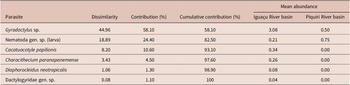
Regarding the parasitic community of P. bifasciatus in the two sampling areas, a greater richness of helminths (U = 710, p <0.01) was observed for the hosts of the lower Iguaçu River basin, but differences in helminth diversity between the two areas were not significant (U = 132, p = 0.11). The structure of the parasite component community of P. bifasciatus differed between the sampling areas (one-way PERMANOVA [GL = 1, F = 8.75, and p <0.01], (PERMDISP [GL = 1, F = 0.72, and p = 0.40]). The NMDS showed dispersion in the composition of the component communities among the streams, with five parasitic taxa (Cacatuocotyle papilionis Zago, Franceschini, Müller & da Silva, 2018, Characithecium paranapanemense Zago, Franceschini, Abdallah, Müller, Azevedo & da Silva, 2021, Dactylogyridae gen. sp., Diaphorocleidus neotropicalis Zago, Franceschini, Abdallah, Müller, Azevedo & da Silva, 2021, and Gyrodactylus sp.) associated with the infracommunities of the lower Iguaçu River basin and one taxon (Nematoda gen. sp. (larva)) associated with the Piquiri River basin (upper Paraná) (Figure 2). The parasite taxa that contributed most to the observed differences were Gyrodactylus sp. (58.10%) and Nematoda gen. sp. larvae (24.40%), with a total dissimilarity of 76.62% (SIMPER overall) (Table 2).
Spatial representation of the non-metric multi-dimensional scaling (NMDS) ordination showing the similarity of the parasitic infracommunities of Psalidodon bifasciatus in the Carolina (CA) and Carreira (CR) streams of the lower Iguaçu River and Piquiri River basins, upper Paraná River, respectively. The pink hexagons represent the infected hosts of the Carolina stream, while the blue triangles represent the infected hosts of the Carreira stream.

Percentage values of the contribution of parasite species to total dissimilarity (76.62%) in the structure of the component parasite community of Psalidodon bifasciatus (Characiformes, Acestrorhamphidae) between Carolina stream, lower Iguaçu River, and Carreira stream, Piquiri River basin, upper Paraná River, Paraná, Brazil

Discussion
In the present study, the structure of the parasite community of P. bifasciatus differed between the native and introduced areas. In the lower Iguaçu River basin, a predominance of monopisthocotyls and greater richness of parasitic taxa (six taxa) were observed, while in the Piquiri River basin (upper Paraná), the community was characterized by a greater prevalence of larval nematodes and lower richness of parasitic taxa (two taxa).
The predominance of monopisthocotyls in small characiforms, such as P. bifasciatus in the stream of the lower Iguaçu River basin, may be related to the life cycle and mode of dispersal of these parasites, associated with the behaviour of the host species of forming schools, this gregarious habit already being observed for other species of the family Acestrorhamphidae (Acosta et al. Reference Acosta, Queiroz, Brandão and Silva2015; Miguel et al. Reference Miguel, Ramos, Zago, Delariva and Franceschini2024; Negrelli et al. Reference Negrelli, Abdallah and Azevedo2017; Orsi et al. Reference Orsi, Carvalho and Foresti2004; Shibatta et al. Reference Shibatta, Orsi, Bennemann and Silva-Souza2002; Suzuki and Orsi Reference Suzuki and Orsi2008). Monopisthocotyls have a monoxenous life cycle, and their transmission can be facilitated by direct contact between hosts. In dactylogyrids, their free-swimming larval forms (= oncomiracidia) actively seek a new host from the school (Eiras et al. Reference Eiras, Takemoto and Pavanelli2010; Thatcher, Reference Thatcher2006), so the proximity between these individuals can facilitate the transmission of these parasites. In this sense, the formation of schools, despite being a defence and anti-predatory tactic (Suzuki and Orsi Reference Suzuki and Orsi2008), can also influence the infection dynamics of some parasites, increasing the probability of parasite transfer (Negrelli et al. Reference Negrelli, Abdallah and Azevedo2017).
Gyrodactylus sp. was the only monopisthocotyl occurring in both basins in the present study. This occurrence in both areas may be associated with their reproductive tactics, since they are viviparous and reproduce through sequential polyembryony (hyperviviparity) (Boeger et al. Reference Boeger, Kritsky and Torta2003; Maule and Marks Reference Maule and Marks2006). Thus, viviparous gyrodactylids present rapid reproduction, with a high rate of diversification, associated with the optimization of the colonization capacity of new host groups and geographic areas, allowing the population of these parasites to grow and establish themselves more quickly than oviparous monopisthocotyl taxa (Boeger et al. Reference Boeger, Kritsky and Torta2003; Scott and Anderson Reference Scott and Anderson1984).
The occurrence of Nematoda gen. sp. only in the larval stage in hosts from both sampling areas indicates a heteroxenous cycle with suitable hosts in both basins. Considering that the areas are relatively close (~30 km) and that P. bifasciatus has an intermediate position in the trophic chain (Mise et al. Reference Mise, Fugi, Pagotto and Goulart2013; Nimet et al. Reference Nimet, Amorim and Delariva2018), it is suggested that piscivorous birds can act as definitive hosts for these nematodes (Anderson Reference Anderson2000), so that the geographic barrier can be broken by flight, allowing the dispersal of these parasites.
The low richness of endohelminths in the study corroborates the data from Miguel et al. (Reference Miguel, Ramos, Zago, Delariva and Franceschini2024), who analyzed the parasitic fauna of Astyanax lacustris (Lütken, 1875), another small characiform, in the same streams as the present study. The structure of the parasitic community of A. lacustris showed low richness of endoparasitic taxa and a predominance of ectoparasites of the class Monopisthocotyla (Miguel et al. Reference Miguel, Ramos, Zago, Delariva and Franceschini2024). The authors associated this pattern with a possible influence of diet, specifically the consumption of a low variety of macroinvertebrates that may act as intermediate hosts to parasites transmitted via the trophic chain, and gregarious habit of the host species, respectively (Miguel et al. Reference Miguel, Ramos, Zago, Delariva and Franceschini2024). The variety of macroinvertebrates is supplied as allochthonous material by the riparian vegetation of the analyzed streams, which are areas of great anthropogenic influence. This anthropogenic influence can result in the simplification of riparian vegetation, impacting the richness and abundance of macroinvertebrates dependent on this vegetation (Allan et al. Reference Allan, Castillo and Capps2021; Al-Shami et al. Reference Al-Shami2017; Couceiro et al. Reference Couceiro, Hamada, Luz, Forsberg and Pimentel2007; Yoshimura Reference Yoshimura2012). Considering that these macroinvertebrates represent one of the main food sources for stream fish (Lo et al. Reference Lo, Reed, Castello, Steel, Frimpong and Ickowitz2020; Pires et al. Reference Pires, Souza and Silva2024; Silva et al. Reference Silva, Fugi, Carniatton and Ganassin2014), especially for small omnivores such as P. bifasciatus (Neves et al. Reference Neves, Delariva, Perkins, Fialho and Kratina2024). Thus, changes in the richness of these groups can influence the life cycle of parasites, whose transmission occurs trophically.
Considering the differences in richness, parasitological attributes, and component community structure for the parasitic communities reported for the host species between the two areas, the results reported here support the hypothesis that the differences in parasite communities may be related to the distribution of P. bifasciatus. Characteristics associated with lower disturbance rates, greater habitat diversity, and the availability of allochthonous material from riparian vegetation may play a fundamental role in the persistence and diversification of parasite communities in streams (Miguel et al. Reference Miguel, Ramos, Zago, Delariva and Franceschini2024). Although the best environmental conditions were observed in the stream from Piquiri River basin (upper Paraná), which presents a higher proportion of forest cover, greater habitat availability for biota, and a higher environmental integrity index (see Table S1), our data do not support the expected pattern, which would be the greatest parasite species richness in the stream with the best observed environmental qualities. Thus, our results reinforce the hypothesis of a possible introduction of P. bifasciatus into the Piquiri River basin (upper Paraná), given that only two parasitic taxa were reported for this species in the Piquiri River basin (upper Paraná) versus six parasitic taxa recorded in the lower Iguaçu River basin.
If this host introduction process occurred, comparison of the parasitic component community of P. bifasciatus between the sampled areas becomes relevant, as it may lead to two distinct situations: (1) co-introduction, i.e., parasites from the native area may be co-introduced, although this co-introduction might be evident only after some time (one or several decades) (Taraschewski, Reference Taraschewski2006); (2) parasite loss, i.e., P. bifasciatus may have lost some of its parasites during its introduction to the new area. This parasite loss could have a positive effect on its colonization process in the new environment, supporting the “Enemy Release Hypothesis” effect (Keane and Crawley Reference Keane and Crawley2002; Llopis-Belenguer et al. Reference Llopis-Belenguer, Blasco-Costa, Balbuena, Sarabeev and Stouffer2020; Torchin et al. Reference Torchin, Lafferty and Kuris2002, Reference Torchin, Lafferty, Dobson, Mckenzie and Kuris2003).
The loss of parasite taxa in areas of non-natural distribution can be associated with three factors: (1) host invasion occurs because of the introduction of life cycle stages that harbour few or no parasite species (i.e., larval stages). In this case, parasites may be lost during host development (Torchin et al. Reference Torchin, Lafferty and Kuris2002); (2) in cases where invasion occurs through the introduction of adult hosts, colonization is usually carried out by a reduced number of individuals (compared to the number of adult individuals present in the native area), reducing the likelihood of introducing parasitized hosts. Furthermore, even if parasites are introduced, population bottlenecks in the host after introduction can interrupt parasite transmission and dissemination (Torchin et al. Reference Torchin, Lafferty and Kuris2002); and (3) some parasite taxa have complex (heteroxenious) life cycles, which require two or more host species to complete their life cycle (Madi and Ueta Reference Madi and Ueta2009; Torchin et al. Reference Torchin, Lafferty and Kuris2002). Thus, the lack of competent hosts for all stages of the life cycle prevents the establishment of the parasite (Madi and Ueta, Reference Madi and Ueta2009; Torchin et al. Reference Torchin, Lafferty and Kuris2002).
Furthermore, it should be considered that the introduced host may be colonized by native parasites (Llopis-Belenguer et al. Reference Llopis-Belenguer, Blasco-Costa, Balbuena, Sarabeev and Stouffer2020), mainly parasites of native host species phylogenetically close to the introduced host species (Colautti et al. Reference Colautti, Ricciardi, Grigorovich and Macisaac2004), such as other species of the same family, such as A. lacustris, Psalidodon bockmanni (Vari & Castro, 2007), Psalidodon fasciatus (Cuvier, 1819) that occur in the Piquiri River basin (upper Paraná) (Camargo et al. Reference Camargo, Forneck, Dutra, Ribas and Cunico2021; Ota et al. Reference Ota, Deprá, Graça and Pavanelli2018). In this context, Diaphorocleidus neotropicalis was reported in the Piquiri River basin (upper Paraná) parasitizing Astyanax lacustris (Lütken, 1875) (Miguel et al. Reference Miguel, Ramos, Zago, Delariva and Franceschini2024). There are also reports of Characithecium paranapanemense for in streams of the middle Paranapanema River, Southeast Brazil (Zago et al. Reference Zago, Franceschini, Abdallah, Müller, Azevedo and Silva2021). Considering that Diaphorocleidus and Characithecium are parasitic genera that exhibit some ecological flexibility and parasitize species phylogenetically close to P. bifasciatus, this may lead to the sharing of these parasitic taxa between hosts, mainly due to ‘ecological fitting’ (Janzen, 1985). This possibility should be further investigated.
Recent studies (Frota et al. Reference Frota, Oliveira, Benedito and Graça2019, Reference Frota, Ota, Deprá, Ganassin and Graça2020; Reis et al. Reference Reis, Frota, Depra, Ota and Graca2020) indicate that the occurrence of P. bifasciatus in the upper Iguaçu River basin and the Paranapanema and Ribeira de Iguape basins corroborates recent headwater capture events between coastal drainages and those that flow into the continent (Frota et al. Reference Frota, Oliveira, Benedito and Graça2019, Reference Frota, Ota, Deprá, Ganassin and Graça2020; Ribeiro Reference Ribeiro2006). Thus, P. bifasciatus could be one of several cases of ichthyofaunal exchanges due to the hydrological rearrangement of geographic boundaries between ecoregions (Ribeiro Reference Ribeiro2006; Reis et al. Reference Reis, Frota, Depra, Ota and Graca2020). These rearrangements were possibly promoted by the Ponta Grossa Arch, which is a geological structure that facilitates events of capture and isolation of headwaters between the drainages of the Paranapanema, upper Iguaçu River, and Ribeira de Iguape basins, enabling the exchange of ichthyofauna between the basins (Frota et al. Reference Frota, Oliveira, Benedito and Graça2019, Reference Frota, Ota, Deprá, Ganassin and Graça2020; Morais-Silva et al. Reference Morais-Silva, Oliveira, Fabrin, Diamante, Prioli, Frota, Graça and Prioli2018; Ribeiro Reference Ribeiro2006). However, the biogeographic processes that explain the occurrence of P. bifasciatus in the Piquiri River basin (upper Paraná), such as the sharing of this species with the lower Iguaçu River basin, are still poorly understood. This highlights the need for further studies that investigate the dispersal processes of this and other small fish species.
In summary, the helminth fauna of P. bifasciatus in two streams of the lower Iguaçu River basin and the Piquiri River basin (upper Paraná) reported here contributes to the increase in parasite data information for both basins. The differences in richness and abundance in the component parasite community between the basins may be associated with a possible introduction process of the species into the Piquiri River basin (upper Paraná). Thus, the observed parasitic pattern corroborates the Enemy Release Hypothesis. In this sense, we emphasize the need for more in-depth studies about the distribution pattern of P. bifasciatus in the Piquiri basin and other systems in the upper Paraná River basin. Furthermore, investigating the parasitic fauna of P. bifasciatus in the Paranapanema and Ribeira de Iguape basins is needed to determine whether there is a shared parasitic fauna between them. Finally, we emphasize the importance of further work that includes characterization of the parasitological fauna of species found in these environments, especially streams, and with species that have never been evaluated from a parasitological perspective. These studies contribute to our understanding of the biology of local ichthyofauna, as well as ecological interactions in stream environments, which allows for the knowledge and proper conservation of these environments.
Supplementary material
The supplementary material for this article can be found at http://doi.org/10.1017/S0022149X26101199.
Acknowledgements
We would like to thank the Postgraduate Program in Biological Science (Zoology) (IBB/UNESP), São Paulo State University (UNESP), School of Engineering, Ilha Solteira, Fish Ecology Laboratory (Pira-FEIS/UNESP), Wild Animal Parasitology Laboratory (LAPAS-IBB/UNESP), Ecology and Biomonitoring Ichthyology Laboratory (LIEB-UNIOESTE-Cascavel), for the use of laboratory facilities and logistics.
Author contribution
All authors (Miguel, BS, Franceschini, L, Zago AC, Delariva, RL, Balbuena, JA, Ramos, IP) contributed to the study conception and design. Miguel, B.S, performed the data preparation, curation, and analysis. The manuscript was written by Miguel, BS, and revised by the co-authors. All authors read and approved the final manuscript.
Financial support
The authors would like to thank the Brazilian Federal Agency for Support and Evaluation – Coordenação de Aperfeiçoamento de Pessoal de Nível Superior (CAPES) (Finance Code 001), National Council for Scientific and Technological Development (Conselho Nacional de Desenvolvimento Científico e Tecnológico – CNPq) (Finance Code 001), and São Paulo Research Foundation (FAPESP) for scientific support.
Competing interests
The authors declare that they have no known competing financial interests or personal relationships that could have appeared to influence the work reported in this paper.
Ethical standard
The Psalidodon bifasciatus specimens were collected under a biological material collection permit granted by the Sistema de Autorização e Informação em Biodiversidade (Sisbio) (License No. 25039) and euthanized in accordance with the Ethics Committee (CEUA Authorization No. 3730/2016, Unioeste, Campus of Cascavel, SisGen Certificate AD47DE1). The authors affirm that all procedures contributing to this work comply with the ethical standards of relevant national and institutional guidelines on the care and use of laboratory animals.
Statement on generative AI and AI-assisted technologies in the writing process
In preparing this manuscript, the authors used Grammarly to check grammar and spelling. Using this tool, the authors also reviewed and edited the content as needed. Therefore, the authors assume full responsibility for the content of this publication.