Introduction
The human reaction to bereavement is characterized by a variety of feelings, thoughts and behaviors, of which grief is often regarded as the most common reaction (Rozenzweig et al. Reference Rozenzweig, Prigerson, Miller and Reynolds1997). One possible consequence of bereavement is an unresolved and prolonged grief, termed complicated grief. Complicated grief includes a set of symptoms such as persistent intense yearning, and longing for and disruptive preoccupation with thoughts of the deceased. These symptoms are prominent, elevated at 6 months and beyond after the loss, and are often resistant to antidepressant treatment (Pasternak et al. Reference Pasternak, Reynolds, Schlernitzauer, Hoch, Buysse, Houck and Perel1991; Horowitz et al. Reference Horowitz, Siegel, Holen, Bonanno, Milbrath and Stinson1997).
Complicated grief has been referred to as ‘traumatic grief’, ‘complicated grief disorder’ and as ‘prolonged grief’ (Shear et al. Reference Shear, Simon, Wall, Zisook, Neimeyer, Duan, Reynolds, Lebowitz, Sung, Ghesquiere, Gorscak, Clayton, Ito, Nakajima, Konishi, Melhem, Meert, Schiff, O'Connor, First, Sareen, Bolton, Skritskaya, Mancini and Keshaviah2011) and is distinctly different from depression ‘accounted for by bereavement’, as mentioned in the Diagnostic and Statistical Manual of Mental Disorders, fourth edition (DSM-IV). Recently, complicated grief has been included in the DSM-5 under the name ‘persistent complex bereavement disorder’ (Boelen & Prigerson, Reference Boelen and Prigerson2012).
Of the population experiencing bereavement, complicated grief affects between 9% and 20% (Newson et al. Reference Newson, Boelen, Hek, Hofman and Tiemeier2011), with variations based upon social, cultural and clinical background as well as age. Complicated grief strongly affects the well-being of the bereaved (Lannen et al. Reference Lannen, Wolfe, Prigerson, Onelov and Kreicbergs2008) and it is associated with sleep disturbances (Hardison et al. Reference Hardison, Neimeyer and Lichstein2005), depression and a higher risk of suicide (Szanto et al. Reference Szanto, Prigerson, Houck, Ehrenpreis and Reynolds1997), abuse of alcohol (Hardison et al. Reference Hardison, Neimeyer and Lichstein2005) and poor health (Lannen et al. Reference Lannen, Wolfe, Prigerson, Onelov and Kreicbergs2008).
In addition, psychosocial risk factors have been described, such as a loss, unexpected death or suicide (Ginzburg et al. Reference Ginzburg, Geron and Solomon2002; Mitchell et al. Reference Mitchell, Kim, Prigerson and Mortimer-Stephens2004), lack of social support or inability to adapt to the resulting changes (Ott, Reference Ott2003). However, the etiology of complicated grief is not well established.
Recently, a cross-sectional study of 211 older adults reported that bereavement was associated with poorer memory performance, especially in men (Rosnick et al. Reference Rosnick, Small and Burton2010). Another study of 50 elderly people observed that bereaved persons performed worse in tests of attention, information processing speed, and verbal fluency (Ward et al. Reference Ward, Mathias and Hitchings2007) when compared with non-bereaved persons. Furthermore, whether such associations also exist for complicated grief remains to be studied.
In the elderly, accumulating pathology in the brain can lead to structural changes visible on magnetic resonance imaging (MRI). These structural changes include cortical atrophy and white matter lesions, which have been associated with cognitive decline (Vernooij et al. Reference Vernooij, Ikram, Vrooman, Wielopolski, Krestin, Hofman, Niessen, Van der Lugt and Breteler2009). Such changes could increase the vulnerability to complicated grief. However, studies exploring complicated grief and structural brain changes have not been performed. The aim of the current study was to examine the relationship of complicated grief with different domains of cognition and with brain volumes assessed by MRI in the general population. We tested two hypotheses. First, we postulated that persons with complicated grief symptoms perform worse in cognitive tests than those without grief or with normal grief. Second, we postulated that persons with symptoms of complicated grief have less brain volume than persons without grief or with normal grief.
Method
Study participants
The study utilizes data from the Rotterdam Study, a large population-based cohort designed to examine the occurrence of chronic diseases. The study has been described in detail elsewhere (Hofman et al. Reference Hofman, van Duijn, Franco, Ikram, Janssen, Klaver, Kuipers, Nijsten, Stricker, Tiemeier, Uitterlinden, Vernooij and Witteman2011) and was approved by the medical ethical committee of the Erasmus Medical Center. Participants gave written informed consent.
From July 2004 to September 2009, 6321 persons were interviewed at home; this interview included the Inventory of Complicated Grief (ICG). Individuals with Mini-Mental State Examination (MMSE) score <23 (n = 346), major depression (n = 112), and with an ICG score ⩾ 22 but with less than 6 months since the loss of a loved one (n = 29), missing data on the MMSE (n = 163) or on the question ‘Are you currently experiencing grief?’ (n = 170) were excluded. Therefore 5501 eligible persons aged over 45 years, with complete data on complicated grief symptoms and cognitive functioning were available.
From August 2005 onwards, participants from the Rotterdam Study were invited for brain MRI. Individuals with dementia, claustrophobia or MRI contraindications were excluded. Of the 4566 persons that were approached for imaging, 3759 participated (84%). After the same exclusion criteria as above were applied, 3607 persons with data on complicated grief for the structural MRI study were available.
Assessment of complicated grief
All participants were asked if they were currently grieving. If the answer was positive we asked formal follow-up questions ‘When did this person die?’, and ‘Who was this person?’. Participants who were mourning over someone with severe disease or a pet were not eligible for follow-up questions and classified as controls. The participants who answered the first question affirmatively were assessed for complicated grief with the Dutch version of the ICG (Prigerson et al. Reference Prigerson, Maciejewski, Reynolds, Bierhals, Newsom, Fasiczka, Frank, Doman and Miller1995). The ICG is considered the ‘gold standard’ for measurement of complicated grief in older adults because it has high internal consistency, and good convergent and criterion validity. A total of 17 questions were asked and responses were provided on a five-point scale to reflect an increase in severity (never, seldom, sometimes, often, always) (Newson et al. Reference Ochsner and Gross2011). One item from the original English inventory, ‘I feel bitter over this person's death’, was removed as a pilot study revealed that this sentiment had a very similar meaning within the Dutch language as the included item: ‘I feel anger over this person's death’. Two further items (relating to seeing and hearing the deceased) were combined into one due to their similarity.
A summary score for the ICG was calculated by totaling each individual item score (responses from 0 = never to 4 = always) across the 17 items providing a potential score range of 0 to 68. Participants with a score of less than 22 were considered as participants with grief symptoms. Participants with a score of 22 or greater and with symptoms reported for at least 6 months were considered to have complicated grief. This cut-off was based on the cut-off in the original version of the ICG (original cut-off of 25 from 19 items).
We classified participants into three groups: no grief (control group); persons with ‘normal’ grief (experiencing non-complicated grief as shown by an ICG score < 22); and those with complicated grief (ICG score ⩾ 22). The non-grieving control group included persons who had experienced bereavement in the past but were not grieving at the time of interview. Likewise, persons grieving for a pet or a loved one with a severe disease were included in the control group.
We also performed additional analyses, using a cut-off of 30, to define participants with complicated grief (Shear et al. Reference Shear, Frank, Houck and Reynolds2005; Zuckoff et al. Reference Zuckoff, Shear, Frank, Daley, Seligman and Silowash2006). This resulted in 703 persons with ‘normal’ grief (experiencing non-complicated grief as shown by an ICG score <30) and 67 persons with complicated grief (ICG score ⩾ 30).
An additional short assessment instrument with 13 items (including two severity questions) has been introduced to establish prolonged grief disorder. Seven of the eleven items correspond to items in the ICG. The mean score on these items for persons with complicated grief in our study was 14.13 v. 5.38 for persons with normal grief (p ⩽ 0.001).
Assessment of cognitive functions
All participants underwent the MMSE, the Stroop Test, the Letter–Digit Substitution Test (LDST), the Word Fluency Task, and a 15-word verbal learning test.
The MMSE is a widely used test for screening dementia and provides a reliable measure of global cognitive functions.
The LDST, a modified version of the Symbol–Digit Modalities Test, was used to measure processing speed. Substitution tests are essentially speed-dependent tasks that require the subject to match particular signs – symbols, digits or letters – to other signs within a specified time period. Participants make as many letter–digit combinations as possible within 60 s, following an example that shows the correct combinations. The LDST has the advantage of using letters and digits, signs that are well known to those taking the test. Substitution tasks involve visual scanning, mental flexibility, sustained attention, psychomotor speed, and speed of information processing (van Hoof & Lezak, Reference van Hoof and Lezak1995; Natu & Agarwal, Reference Natu and Agarwal2002; Vander et al. Reference Vander Elst, van Boxtel, van Breukelen and Jolles2006).
The Stroop Test consists of three standard trials. Trials 1 and 2 measure attention and concentration. In trial 1, the cards show color names printed in black and participants are asked to name the printed word. In trial 2, the cards show colored blocks and participants are asked to name the printed color. Trial 3 is an interference trial considered an effective measure of an executive function. The cards show color names printed in a different color from the color name and participants are asked to name the color of the ink. The outcome variable is the time needed to finish trial 3 (Reeve & Schnadler, Reference Reeve and Schnadler2001).
The Word Fluency Task was used to test verbal fluency. Participants are asked to name as many animals as possible within 60 s. The 15-word verbal learning test tests memory functions with immediate recall and delayed recall components. Participants were given a list of 15 unrelated words repeated over five different trials and were asked to repeat. Another list of 15 unrelated words was given and the client was asked again to repeat the original list of 15 words and again after 30 min.
For each participant, we calculated Z-scores for each test separately except for MMSE.
We constructed a compound score for global cognitive function with the average of all individual tests except the MMSE (Prins et al. Reference Prins, van Dijk, den Heijer, Vermeer, Jolles, Koudstaal, Hofman and Breteler2005).
Assessment of general cerebral parameters and white matter lesions
Brain MRI was performed on a 1.5 Tesla scanner (USA) with an eight-channel head coil and included T1-weighted, proton-density-weighted and fluid-attenuated inversion recovery sequences (Ikram et al. Reference Ikram, van der Lugt, Niessen, Krestin, Koudstaal, Hofman, Breteler and Vernooij2011). Post-processing steps have been described elsewhere and include a conventional k-nearest-neighbor brain tissue classifier extended with white matter lesion segmentation (de Boer et al. Reference de Boer, Vrooman, van der Lijn, Vernooij, Ikram, van der Lugt, Breteler and Niessen2009), obtaining quantitative measures of white matter volume, gray matter volume and white matter lesion volume. Total brain volume was defined as the sum of gray matter plus normal white matter and white matter lesions.
Assessment of covariates
Potential confounders were selected based on previous publications and included determinants of grief or brain atrophy (Ikram et al. Reference Ikram, Vrooman, Vernooij, van der Lijn, Hofman, van der Lugt, Niessen and Breteler2008; Rosnick et al. Reference Rosnick, Small and Burton2010). Information was collected in home interviews and physical examination. The following variables were tested as possible confounders: age (continuously per year), sex, level of education (low, medium, high), systolic blood pressure (mmHg), diabetes mellitus, history of stroke, history of depression, history of anxiety, current depressive symptoms, and alcohol consumption. Diabetes mellitus was defined as a fasting serum glucose level of ⩾7.0 mmol/l and/or the use of blood glucose-lowering drugs. Stroke was defined according to World Health Organization criteria as a syndrome of rapidly developing clinical signs of focal or global disturbance of cerebral function, with symptoms lasting 24 h or longer or leading to death. History of depression was defined by self-reported history of depression with treatment by a psychiatrist or psychologist or use of antidepressant medication as measured by pharmacy records as described previously (Luijendijk et al. Reference Luijendijk, van den Berg, Dekker, van Tuijl, Otte, Smit, Hofman, Stricker and Tiemeier2008). History of anxiety was assessed by the Composite International Diagnostic Interview (Hek et al. Reference Hek, Tiemeier, Newson, Luijendijk, Hofman and Mulder2011) according to DSM-IV criteria. Current depressive symptoms were assessed with a validated Dutch version of the Center for Epidemiologic Studies Depression scale (range 0–60) (Beekman et al. Reference Beekman, Deeg, Van Limbeek, Braam, De Vries and Van Tilburg1997), with a score of 16 or above suggesting clinically relevant depressive symptoms. All participants with clinically relevant depressive symptoms were interviewed by one of two clinicians using the Present State Examination, a semi-structured psychiatric interview (Wing et al. Reference Wing, Babor, Brugha, Burke, Cooper, Giel, Jablenski, Regier and Sartorius1990). Participants with diagnosis of major depression, as classified according to the DSM-IV, were excluded.
Alcohol consumption was classified as low if the participant drank zero to two glasses per day, moderate if he/she drank three to four glasses per day, and high if he/she drank five or more glasses per day.
Statistical analysis
Information on demographic characteristics was compared among the groups using a χ2 test for categorical data and an analysis of variance for continuous variables.
First, we investigated the association of complicated grief with measures of cognitive performance. We tested the differences between participants with normal grief and controls. Next we compared participants with complicated grief with controls as well as with those participants with normal grief (the latter two groups each used as reference) with analyses of covariance (ANCOVA).
Second, we explored the association of complicated grief with total brain volume and subsequently with gray matter, and white matter separately. Also, we investigated white matter lesions. Again, we compared the three groups using ANCOVA.
We mutually adjusted brain volume parameters and cognitive function when testing the association with complicated grief.
All analyses were adjusted for age and sex, level of education, systolic blood pressure, diabetes, and history of stroke, history of depression and anxiety, current depressive symptoms, and alcohol consumption.
The ICG is designed as a screening measure and not to assess severity of grief. However, we performed continuous analyses in persons grieving using the scores on the ICG to test whether there is a dose–response relationship between the grief symptoms score and cognition function or MRI brain measures independently of the predefined cut-off.
Results
Of the 5501 eligible participants, 4731 were classified as experiencing ‘no grief’, 615 as experiencing ‘normal grief’, and 155 as experiencing ‘complicated grief’.
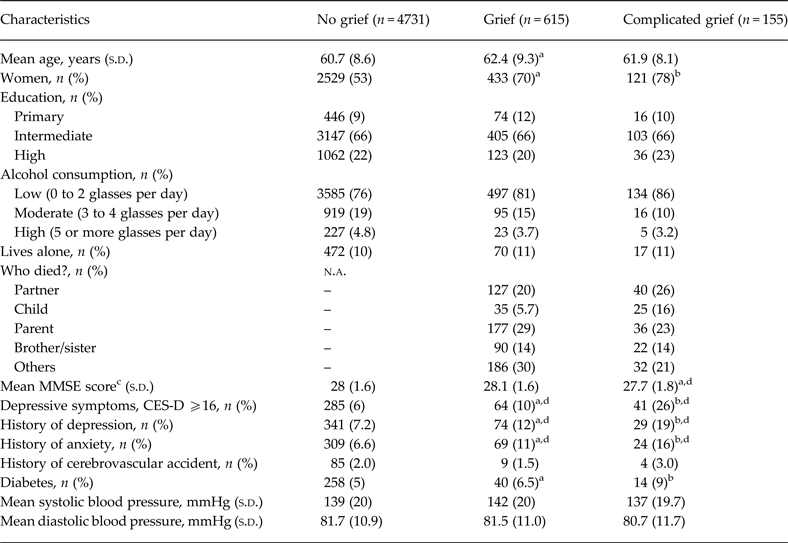
Table 1 presents the characteristics of the study population. The main causes for grief were death of a partner (complicated grief, 26%; normal grief, 20%) or parent (complicated grief, 23%; normal grief, 29%). When compared with persons without grief or with normal grief, participants with complicated grief were more likely to be female, older, have current depressive symptoms and a lower MMSE, consume less alcohol and have a history of depression, stroke and diabetes.
Baseline characteristics of the study population (n = 5501)
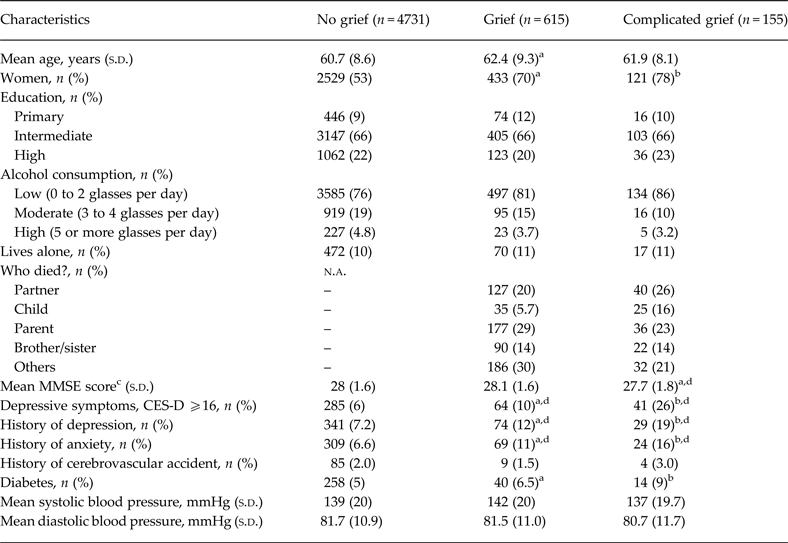
s.d., Standard deviation; n.a., not applicable; MMSE, Mini-Mental State Examination; CES-D, Center of Epidemiological Studies Depression scale.
Group comparisons were performed with χ2 or analysis of variance.
aComparison of no-grief participants with grief participants (p < 0.05). bComparison of no-grief participants with complicated-grief participants (p < 0.05). cParticipants with MMSE <23 were excluded. dComparison of grief participants with complicated-grief participants (p < 0.05).
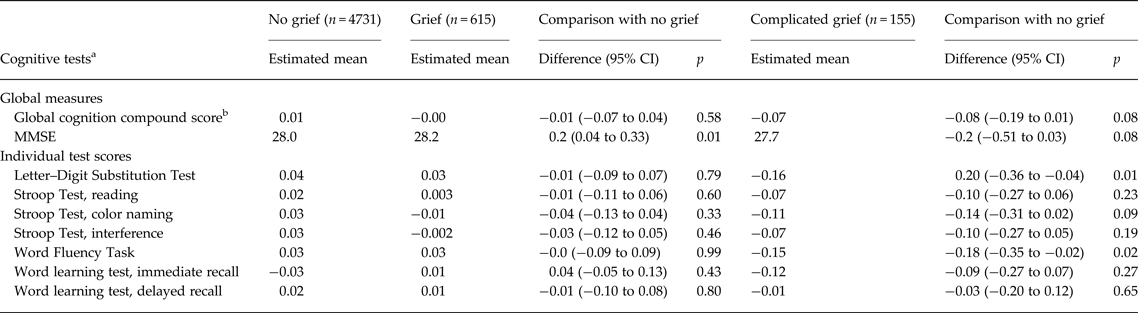
Table 2 shows the cognitive test scores across the three groups. Participants with complicated grief had lower scores in the LDST [Z-score −0.16 v. 0.04, 95% confidence interval (CI) −0.36, −0.04, p = 0.01] and the Word Fluency Task (Z-score −0.15 v. 0.03, 95% CI −0.35 to −0.02, p = 0.02) compared with no-grief participants. Participants with normal grief had slightly higher MMSE scores (score 28.2 v. 28.0, 95% CI 0.04–0.33, p = 0.01) than no-grief participants. No other differences were found. When participants with complicated grief were compared with those with normal grief, we found that they had significantly lower MMSE scores (score 27.7 v. 28.2, 95% CI −0.7 to −0.13, p = 0.004). Also, participants with complicated grief had lower scores in the LDST (Z-score −0.16 v. 0.03, 95% CI −0.36 to −0.02, p = 0.02) and the Word Fluency Task (Z-score −0.15 v. 0.03, 95% CI −0.36 to −0.003, p = 0.04) than participants with normal grief. No differences in the Stroop Test or word learning test, immediate and delayed recall, were observed between these two groups.
Cognition in participants with no grief, normal grief and complicated grief (n = 5501)
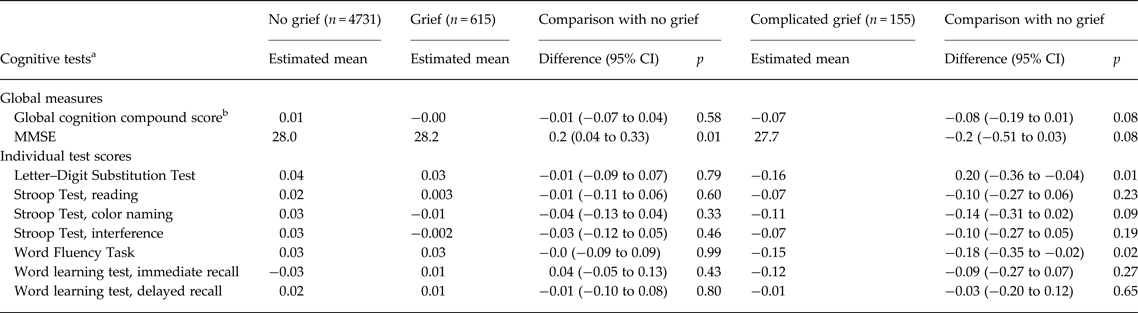
CI, Confidence interval; MMSE, Mini-Mental State Examination.
aAll individual cognitive tests scores have been standardized. Those for the Stroop Test have additionally been inverted to indicate poorer performance with lower scores. All analyses are adjusted for age, sex, level of education, blood pressure, history of depression, history of anxiety, history of stroke, diabetes, alcohol consumption and Center for Epidemiologic Studies Depression scale score ⩾ 16. bGlobal cognitive function (average of three trials of the Stroop Test; Letter–Digit Substitution Test, Word Fluency Task, 15-word learning test – immediate and delayed recall).
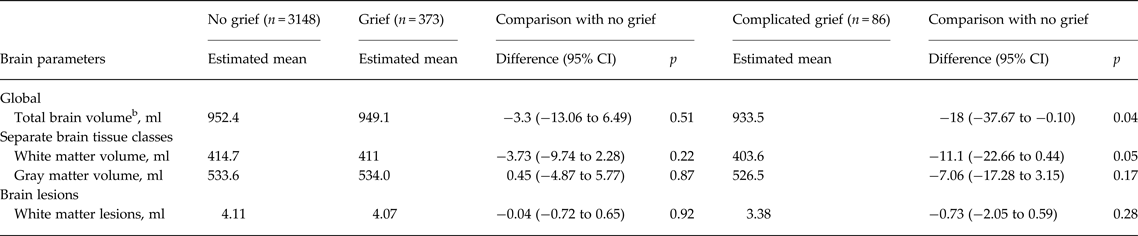
Next we compared the brain tissue volumes and white matter lesions across the three groups (Table 3). Of the 3607 study participants, 3148 were classified as experiencing ‘no grief’, 373 as ‘normal grief’ and 86 as ‘complicated grief’. When compared with no-grief participants, complicated-grief participants were more likely to have smaller total brain volume (volume 933.5 ml v. 952.4 ml, 95% CI −37.67 to −0.10, p = 0.04). Indeed, all the brain volume comparisons between non-grieving persons and those with complicated grief were consistently negative, indicating a smaller volume associated with complicated grief. No differences in brain tissue volumes between participants with normal grief and those without grief were observed. When we entered both cognitive and brain tissue volume parameters in a single model, the association between complicated grief and smaller total brain volume disappeared; however, the association between lower cognitive functioning and complicated grief remained (data not shown). When we performed analyses using a cut-off of 30 to define complicated grief, we found that participants with complicated grief had lower MMSE scores than non-grievers (score 27.4 v. 28, 95% CI −1.00 to −0.16, p = 0.007) and normal grievers (score 27.4 v. 28.2, 95% CI −1.18 to −0.31, p = 0.001). As in the analyses using a less stringent cut-off, consistent differences in cognitive parameters (LDST, Word Fluency Task) were found, suggesting that persons with complicated grief perform worse in these tasks independent of the case definition.
Brain volume differences in participants with no grief, normal grief and complicated grief (n = 3607) a
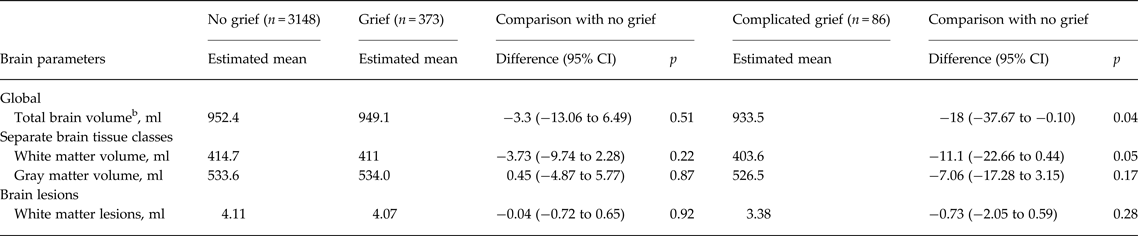
CI, Confidence interval.
aAll analyses are adjusted for age, sex, level of education, blood pressure, history of depression, history of anxiety, history of stroke, diabetes, alcohol consumption and Center for Epidemiologic Studies Depression scale score ⩾16. bTotal brain volume = gray matter + normal white matter + white matter lesions.
Using the cut-off of 30 on the ICG to define complicated grief, we found that participants with complicated grief had less gray matter (volume 512.78 ml v. 533.60 ml, 95% CI −37.90 to −3.72, p = 0.017) and less white matter volume (volume 387.14 ml v. 414.74 ml, 95% CI −46.92 to −8.28, p = 0.005) than participants with no grief. The total brain volume of participants with complicated grief was smaller (volume 903.31 ml v. 952.42 ml, 95% CI −80.50 to −17.71, p = 0.002) than that of participants with no grief. The continuous analyses in persons with grief showed that higher scores on the ICG were associated with lower MMSE score (B=−0.02, 95% CI −0.03 to −0.01, p = 0.002) and smaller total brain volumes (B = −1.28, 95% CI −2.16 to −0.40, p = 0.004).
Discussion
In this population-based study we investigated whether persons with complicated grief differ in cognitive function and structural brain changes from participants with normal grief and a control group without grief. Compared with either normal-grief or no-grief groups, participants with complicated grief performed worse in domains of executive function, and information processing speed, and had a lower total brain volume as measured by structural brain imaging.
The few previous studies of bereavement and cognition demonstrated poorer memory performance and attention in persons with normal grief, but did not specifically examine complicated grief (Xavier et al. Reference Xavier, Ferraz, Trentini, Freitas and Moriguchi2002; Ward et al. Reference Ward, Mathias and Hitchings2007; Rosnick et al. Reference Rosnick, Small and Burton2010; Corruble et al. Reference Corruble, Falissard and Gorwood2011). Two other studies examined the emotional Stroop Test in persons with complicated grief, demonstrating that participants have more cognitive interference compared with no-complicated-grief participants (Maccallum & Bryant, Reference Maccallum and Bryant2010; O'Connor & Arizmendi, Reference O'Connor and Arizmendi2014). However, the mechanisms supposedly underlying the association between normal grief and poor cognition may also explain our observations in persons with complicated grief. First, individuals with grief or complicated grief may perform worse in the cognitive tests because they find it more difficult to direct their attention (Maccallum & Bryant, Reference Maccallum and Bryant2010; Rosnick et al. Reference Rosnick, Small and Burton2010; O'Connor & Arizmendi, Reference O'Connor and Arizmendi2014). Interestingly, no differences in Stroop Tests 1 and 2 were observed between complicated-grief participants and non-grievers in the present study, suggesting that attention problems cannot easily explain our findings. However, we did not perform the emotional Stroop Test, which uses death-related and neutral cue words. Second, depressed mood, which is common in persons with normal grief, may interfere with cognitive performance in the bereaved (Boelen & Prigerson, Reference Boelen and Prigerson2007). However, we excluded participants with major depression and adjusted our analyses for depressive symptoms.
Participants with complicated grief were characterized by more brain atrophy, whereas white matter lesion volumes, which reflect vascular brain damage, did not differ between those with complicated grief, normal grief or no grief. We argue that the absence of specific compartmental differences between the groups is most likely due to a non-specific process in participants with complicated grief. Our study cannot establish the temporal sequence, but if this is not a chance finding, our results suggest that differences in structural brain volumes are linked to complicated grief.
The observed brain volume loss could be a consequence or a precipitating factor of complicated grief. If poorer cognitive performance in persons with complicated grief is a consequence of the brain loss, the observed atrophy may reflect a vulnerability to developing complicated grief. This interpretation is in accordance with the results of the cognitive testing. The Word Fluency Task is considered to be related to the intact function of the frontal cortices and the medial temporal areas (Pihlajamäki et al. Reference Pihlajamäki, Tanila, Hänninen, Könönen, Laakso, Partanen, Soininen and Aronen2000; Funahashi, Reference Funahashi2001), and the LDST is sensitive to brain dysfunction (Lezak et al. Reference Lezak, Howieson and Loring2004). The Word Fluency Task and LDST were affected most in persons with complicated grief. In our study, participants with complicated grief had lower brain volumes. It is recognized that as people get older, their brain volume decreases and that different brain regions decrease in volume at different rates (Romanowski & Wilkinson, Reference Romanowski and Wilkinson2011). The brain volume decrease implies neuronal loss that may disrupt the microstructural integrity of the fascicles connecting the prefrontal cortex with the cortical (frontal, temporal and occipital lobes) and the subcortical areas (amygdala and hippocampus), and even in the functioning of corticostriatal circuitry (Elliot, Reference Elliot2003; Shimada et al. Reference Shimada, Kato, Ito, Makizako, Doi, Yoshida, Shimokata, Washimi, Endo and Suzuki2012). A lack of cerebral connectivity could explain a more prolonged resolution of grief in older adults as well as the poor performance in cognitive tests.
Alternatively, cognitive impairment may be a consequence of complicated grief. Recently a study showed that the regional brain activation to grief cues frequently includes the dorsal anterior cingulate cortex and the insula, as well as the posterior cingulate cortex (O'Connor, Reference O'Connor2012). Some researchers have proposed that the anterior cingulate cortex, specifically the anterior cingulate gyrus, is part of an executive attention network, and its main role is to regulate the processing of information from other networks, both sensory modalities, and emotional (Ochsner & Gross, Reference Ochsner and Gross2005; Posner & Rothbart, Reference Posner and Rothbart2007; Posner et al. Reference Posner, Rothbart, Sheese and Tang2007; Nelson et al. Reference Nelson, Dosenbach, Cohen, Wheeler, Schlaggar and Petersen2010; Pearson et al. Reference Pearson, Heilbronner, Barack, Hayden and Platt2011). The regional neural activation of the dorsal anterior cingulate gyrus, insula, and posterior cingulate cortex in persons with complicated grief could cause a deregulation in the network processing the information.
Complicated grief is also perceived as a continuous and chronic stress. Chronic stress has long-lasting negative effects on cognitive performance (Rosnick et al. Reference Rosnick, Small and Burton2010). This stress can act in two forms: first, precipitating the neuronal loss and resulting in atrophy of the brain and cognitive decline. Second, glucocorticoids can cause a pronounced loss of synapses which are independent of volume brain loss, producing a disconnection among the brain areas (Tata et al. Reference Tata, Marciano and Anderson2006). Importantly, these explanations for the possible causal process need not be exclusive.
In our study, we found no differences in cognition and structural brain changes between persons with normal grief and the controls. These findings were not unexpected if one views grief as a normal life event, unrelated to pre-existing vulnerabilities such as structural brain volume loss. The previous studies finding poorer cognition in participants with normal grief could be explained by the lack of distinction between normal grief and complicated grief; i.e. previous studies combined persons with normal grief and complicated grief.
Strengths of our study include the very large sample size, the population-based setting and the volumetric quantification of brain tissue volumes. A control group of non-grieving persons was used to provide a contrast to participants with normal grief and those with complicated grief. Also, we controlled for clinically relevant depressive symptoms and excluded persons with major depression.
Some limitations of the current study should also be mentioned. First, it is not possible to evaluate if these associations were causal due to the cross-sectional design of the study. Second, we used a slightly modified version of the original ICG. Third, we focused on selected cognitive domains (e.g. global, memory, information processing speed, and executive function), and could not examine cognitive domains such as visuospatial processing, visuoperceptual tasks, or naming. Fourth, we studied global tissue volumes, but not subcortical or lobar tissue volumes. Fifth, we could not examine if complicated grief was associated with poorer self-care or if there were nutritional deficiencies.
Conclusion
In conclusion, we found that participants with complicated grief had poorer cognitive performance than non-grievers and normal grievers, and lower total brain volume than non-grievers. Our study underscores the importance of assessing social, neuropsychological and biological factors that may underlie the occurrence of complicated grief or may result from prolonged exposure to a normal grief reaction. The neuropsychological differences between persons with and without complicated grief were more modest than in clinical studies (Xavier et al. Reference Xavier, Ferraz, Trentini, Freitas and Moriguchi2002; Ward et al. Reference Ward, Mathias and Hitchings2007; Maccallum & Bryant, Reference Maccallum and Bryant2010; Rosnick et al. Reference Rosnick, Small and Burton2010; Corruble et al. Reference Corruble, Falissard and Gorwood2011; O'Connor & Arizmendi, Reference O'Connor and Arizmendi2014). Thus, any clinical implications must be inferred cautiously. We suggest that physicians should monitor patients who are in a prolonged grieving process closely and test these persons for possible cognitive deficits. Our analyses with a cut-off of 30 showed a more marked difference between participants with complicated grief and persons without grief, suggesting that clinical definitions of complicated grief describe a cognitively more compromised group. Support techniques for complicated grievers could include cognitive support and treatment or prevention of vascular risk factors, as these can slow the process of brain atrophy. Similarly, patients with known cognitive deficits should be offered support for cognitive problems in addition to psychological and social support if confronted with the loss of a loved one to prevent complicated grief.
We carefully controlled for cognitive decline by adjusting for the MMSE score. However, our results suggest that complicated grief, like severe depressive symptoms, may in some persons be prodromal of dementia. To address the temporality of the associations observed, we are planning to follow the participants and conduct a longitudinal study of the cognitive changes in participants with complicated grief.
Acknowledgements
The Rotterdam Study is supported by: the Erasmus Medical Center and the Erasmus University Rotterdam; The Netherlands Organization for Scientific Research (NWO); The Netherlands Organization for Health Research and Development (ZonMw); the Netherlands Genomics Initiative; the Ministry of Education, Culture and Science; the Ministry of Health, Welfare and Sports; and the European Commission (DGXII). H.C.S.P was supported by an Erasmus Columbus (ERACOL) grant. R.F.-P. is supported by a National Health and Medical Research Council (NHMRC) Early Career (ECR) Fellowship (1053666). H.T. was supported by the Vidi grant of ZonMw (2009-017.106.370). The funders had no role in the study design or data collection and analysis. The authors report no competing interests. We want to thank all the persons who contributed to this paper.
H.C.S.P. performed the statistical analyses and wrote the manuscript. M.A.I. supervised the collection of cognition and imaging data. N.D. helped with depression data and the writing of the article. R.F.-P. assisted with the writing of the article. H.G.P. reviewed the manuscript and provided expertise on complicated grief. B.F.J.V. supported the analyses of cognition. A.H. is the guarantor of the Rotterdam Study. M.V. supervised the imaging data analyses. H.T. formulated the hypothesis, designed the method, reviewed the manuscript and provided overall supervision. H.C.S.P. and H.T. had full access to all of the data in the study and take responsibility for the integrity of the data and the accuracy of the data analysis.
Declaration of Interest
None.