Introduction
Dirofilaria immitis is the causative agent of cardiopulmonary dirofilariosis, a disease transmitted by culicid mosquitoes belonging to the genera Culex spp., Aedes spp. and Anopheles spp., and whose main hosts are domestic and wild canids and felids (McCall et al., Reference McCall, Genchi, Kramer, Guerrero and Venco2008). It is a severe and generally chronic disease that causes vascular and pulmonary damage, and, in the absence of treatment, the death of the parasitized animals. The existence of canine dirofilariosis means a risk for human populations because mosquitoes can feed indiscriminately on animal reservoirs and people, inoculating infective L3 developed from microfilariae acquired in a previous blood meal from an infected dog. In humans, D. immitis immature worms can cause benign pulmonary nodules that can be confused with pulmonary carcinomas in radiology (Simón et al., Reference Simón, Morchón, González-Miguel, Marcos-Atxutegi and Siles-Lucas2009). Since both the life cycle of vectors and the larval development of the parasite depend on temperature and humidity, the distribution and the prevalence of dirofilariosis are determined by environmental conditions, appearing in tropical, subtropical and humid temperate areas around the world (Simón et al., Reference Simón, Siles-Lucas, Morchón, González-Miguel, Mellado, Carretón and Montoya-Alonso2012). Currently, dirofilariosis is considered an emerging disease, attributing this fact to climate change, unsuitable management of pets, human intervention in the environment and the existence of wild reservoirs (Genchi et al., Reference Genchi, Mortarino, Rinaldi, Cringoli, Traldi and Genchi2011; Simón et al., Reference Simón, Siles-Lucas, Morchón, González-Miguel, Mellado, Carretón and Montoya-Alonso2012).
In Spain, prediction models based on geo-environmental features and epidemiological data establish that the highest risk and prevalence occur in the Canary and Balearic Islands, south-east peninsular coastal areas and inland peninsular areas with irrigated crops and wetlands (Simón et al., Reference Simón, Afonin, López-Díez, González-Miguel, Morchón, Carretón, Montoya-Alonso, Kartashev and Simón2014; Montoya-Alonso et al., Reference Montoya-Alonso, Carretón, Simón, González-Miguel, García-Guasch, Morchón and Simón2015, Reference Montoya-Alonso, Carretón, Morchón, Silveira-Viera, Falcón and Simón2016). In the province of Salamanca (west-central Spain), a moderate to low risk was predicted, except for an irrigated area close to the capital where the risk is higher (Simón et al., Reference Simón, Afonin, López-Díez, González-Miguel, Morchón, Carretón, Montoya-Alonso, Kartashev and Simón2014). The existence of D. immitis in the canine population of Salamanca has been known since the middle of the 20th century, thanks to the discovery of adult worms in the heart of a greyhound that died suddenly while running after a hare, in the irrigated area referred to previously (Simón-Vicente, Reference Simón-Vicente1956). However, the first epidemiological study appeared 30 years later, finding that the disease was hyperendemic (prevalence of 33.3%) in the irrigated area where the first report was made, while in many areas of the province canine dirofilariosis was completely absent (Pérez-Sánchez et al., Reference Pérez-Sánchez, Gómez and Encinas1989). Twenty years later, a subsequent study showed a moderate decrease in prevalence, which was established as 29.08% in the hyperendemic area (Morchón et al., Reference Morchón, Mellado, González-Miguel, Hernández, Hernández and Simón2011). The zoonotic potential of canine infections was demonstrated due to a seroprevalence of 22% of anti-D. immitis antibodies (Simón et al., Reference Simón, Muro-Alvarez, Cordero-Sánchez and Martín-Martín1991; Espinoza et al., Reference Espinoza, Cordero, Muro, Lorente and Simón1993), as well as six clinical pulmonary cases which were reported in the human population resident in the hyperendemic area (Cordero et al., Reference Cordero, Muñoz, Muro, Simón and Perera Madrazo1992a, Reference Cordero, Muro, Simón, Tapia and Espinozab).
The aim of the present study was to monitor the prevalence and distribution of D. immitis in the canine population of the province of Salamanca, to determine the trend of the disease in the canine reservoir of the area.
Materials and methods
Description of the area of study
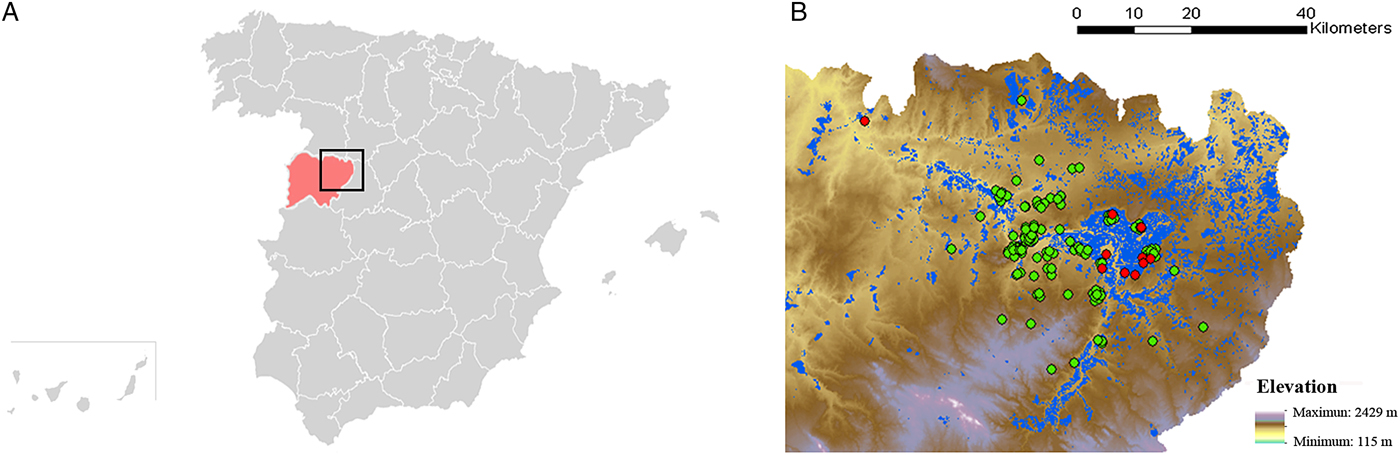
The study area occupies the north-eastern part of the Salamanca province (west-central Spain) with an approximate extent of 4500 km2, as part of a plateau of average elevation 823 m (fig. 1). It is crossed by the middle course of the Tormes river, along which large areas of irrigated crops are grown. The rest of the territory has predominantly dry-crop agriculture and steppe vegetation. The climate is semi-arid, cool, with cold winters and short, warm summers, with an annual rainfall of 400–500 mm and an average temperature of 10–13°C (Luis-Calabuig & Montserrat, Reference Luis-Calabuig and Montserrat1979; Oliver-Moscardó & Luis-Calabuig, Reference Oliver-Moscardó and Luis-Calabuig1979). According to data from the Spanish National Institute of Statistics (http://www.ine.es/), the province is underpopulated – 339,395 residents, of whom 237,000 live in the study area. Of these, 213,212 live in the metropolitan area – 148,042 in the city of Salamanca and 65,170 in suburban municipalities located mainly in the area with irrigated crops. In this area, there are many residential areas and farms, and the population almost doubled between 2000 and 2015. This human demographic behaviour has been accompanied by a considerable increase in the canine population. Only approximately 24,000 people live in municipalities where dry crops predominate.
Geographical location (in red) of the province of Salamanca in Spain (A). Geographic information system (GIS) map of the area of extensively irrigated crops along the Tormes river, near the capital Salamanca (B). The orography of the province and the spatial distribution of irrigated crops (in blue) are represented. The red and green spots represent, respectively, the spatial distribution of positive and negative cases of canine dirofilariosis detected in the study.

Collection of blood samples
Blood samples were obtained between October 2014 and October 2015, from 191 dogs (110 males, 81 females; aged between 3 months and 14 years (mean 7.46 years)) living in the north-eastern quadrant of the province of Salamanca. Seventy-nine samples were taken from dogs resident in the city of Salamanca, 66 from dogs living in municipalities located in areas with irrigated crops, and 46 samples from dogs living in areas with predominantly dry crops. All samples came from dogs seeking veterinary attention. For each animal, a questionnaire collecting information related to sex, age, breed, municipality, activity, habitat, prophylaxis and medication was completed, including the consent of the owners for participation in the study. Dogs were not subjected to any specific prophylaxis related to dirofilariosis; only 38% were subjected to routine deworming of intestinal helminths with several drugs, among which milbemycin was included on a monthly basis during the spring and summer. None were treated with moxydectin.
Blood tests, geographic information system (GIS) and statistical analysis
Blood samples were collected in tubes with EDTA and maintained at 4°C until testing. To identify circulating antigens of D. immitis in serum, all serum samples were analysed with a commercial immunochromatographic test kit (Uranotest Dirofilaria®, Urano Vet SL, Barcelona, Spain) following the manufacturer's instructions. In addition, a modified technique of the Knott test (Acevedo et al., Reference Acevedo, Theis, Kraus and Longhurst1981) was used to check whether there were microfilariae in the blood of the animals included in the study. To represent the analysed samples and the positive cases, a map was made using the program Arc-GIS 10.1 (ESRI, Redlands, California, USA). For that, several layers with the orography and areas of irrigation in the zone and geographical references of sampled municipalities were included (ITACYL-AEMET, 2013). Data were analysed using SPSS Base 20.0 software for Windows (SPSS Inc./IBM, Chicago, Illinois, USA). χ2 tests to compare proportions were performed. In all cases, the significance level was established at P < 0.05.
Results and discussion
The prevalence of D. immitis in the analysed sample of dogs was 5.8% (11 positive out of 191 tested animals). However, all the positive cases came from municipalities in the area where irrigation predominates (fig. 1). Considering the sample analysed in these municipalities, prevalence was 16.7%. By sexes, the prevalence of D. immitis was 5.4% in males and 6.8% in females. With regard to age, the infection was not detected in dogs aged less than 3 years, while the highest prevalence was 10% in animals between 3 and 6 years of age, followed by 5.9% in dogs older than 6 years. Significant differences were not found for any group (P < 0.05). Microfilariae in blood were found only in 5 out of the 11 animals positive for the test for circulating antigens, thus the rate of microfilaraemic infections was 45.4%.
The epidemiological parameters of canine dirofilariosis in a given area depend on climatic factors such as temperature and humidity, management of pets and intervention on the environment by the human population, influencing the regulation of parasite and vector populations (Simón et al., Reference Simón, Siles-Lucas, Morchón, González-Miguel, Mellado, Carretón and Montoya-Alonso2012). All these factors are susceptible to change in short periods of time, so it is necessary to maintain active surveillance to detect these changes and to apply new tools or to modify the existing ones to keep the parasitosis under control.
The present data demonstrate that the geographical distribution of dirofilariosis in Salamanca remains stable in areas where it was detected in previous studies (Pérez-Sánchez et al., Reference Pérez-Sánchez, Gómez and Encinas1989; Morchón et al., Reference Morchón, Mellado, González-Miguel, Hernández, Hernández and Simón2011). Moreover, our results confirm the risk of transmission in Salamanca predicted by a geo-environmental model that included the existence of irrigated crops in the dry climate inland of the Iberian Peninsula (Simón et al., Reference Simón, Afonin, López-Díez, González-Miguel, Morchón, Carretón, Montoya-Alonso, Kartashev and Simón2014). In accordance with this, in the present study, cases of canine dirofilariosis were detected only in the area where these kinds of crops exist. Nevertheless, from 1989, when the first epidemiological study was made (Pérez-Sánchez et al., Reference Pérez-Sánchez, Gómez and Encinas1989), to the present, canine prevalence on the irrigated area has been reduced by almost half (from 33% to 16.67%). It is difficult to determine the reasons for this decline, when the increase in the pet population in the area and the absence of generalized prophylaxis against cardiopulmonary dirofilariosis seemed to combine to increase the prevalence. It is likely that the use of insecticides in residential areas and farms, just like routine deworming for treatment of intestinal helminths including, in some cases, milbemycin in some of the animals, had contributed to hinder the circulation of Dirofilaria by decreasing the mosquito population and the rate of microfilaraemia. In addition, the importance of the management of pets appears to be clearly reflected by the fact that in the city of Salamanca no positive cases appeared, despite it being surrounded by extensive areas of irrigation. Housing in flats, the limited time for daily walking and the scarcity of mosquitoes within the city, drastically decreasing the risk of exposure to mosquito bites, could be key factors in the absence of infections, because anti-Dirofilaria prophylaxis is not applied.
In conclusion, Dirofilaria infections are still present in the canine population of the province of Salamanca and they are strongly linked to the existence of irrigated crops, but the prevalence has been reduced considerably with respect to the prevalence observed in previous studies. In the absence of generalized prophylaxis against D. immitis, this reduction could be attributed to factors/actions not specifically related to the control of heartworm disease. It would be necessary to investigate the extent to which the decrease in canine dirofilariosis could influence the risk for the human population resident in the area.
Acknowledgements
The authors would like to thank all the veterinary clinics (Clínica Veterinaria La Vega, Salamanca and Centro Veterinario Los Álamos, Villares de la Reina, Salamanca) that cooperated in the present study; without them this study could not have been realized.
Financial support
This research received no specific grant from any funding agency, commercial or not-for-profit sectors.
Conflict of interest
None.
Ethical standards
The study was carried out in accordance with the current European legislation on animal protection and was approved by the ethical committe of the Veterinary Medicine Service of Las Palmas de Gran Canaria University (Spain).