Introduction
In this article I examine the pathway from music revival to innovation through the poetics of mu‘arada, which is an Arab literary device entailing building upon pre-existing models, here applied to music. I argue that Arabic prosody plays a fundamental role in the rhythmic innovation that characterises much of the musical innovation of the Tajdīd min al-Dakhil (Renewal from Within), a movement that gained traction in Lebanon in 2009. I will examine Mustafa Said’s musical piece, “Al-Burda” (The Mantle Ode), to demonstrate the relationship between revival and new musical creativity, Arabic prosody and musical rhythm. This article is structured in three parts. In the first section, I provide a historical overview of the development of the poem, the Burda (Mantle Ode), from Ka’b Ibn Zuhayr (the seventh century) until Tamin al-Barghouti (b. 1977) through the poetics of mu’arada. In the second section, I analyse the development of the concept, structure, and the legacies of “Al-Burda” as a musical piece. In the third section, I analyse “Al-Burda” composed by Mustafa Said. I draw upon a combination of ethnographic materials, and analyse the compositional process and the recorded piece. In my analysis, I contrast rhythmic innovation with poetic metres through an examination of rhythmic cycles, such as the jūrjina, the baḥr al-basīṭ, and the muhajjar.
The Tajdīd min al-Dakhil (Renewal from Within) is a contemporary music revival movement of music from the Arab renaissance or Nahḍa era (1885–1194). The movement gained traction from 2009 to 2017 in Lebanon although it comprised a wider transnational network of musicians, musicologists, pedagogues, music collectors, and patrons ailing form Egypt, Kuwait as well as Europe. The movement was made possible due to the coexistence of contributions by three key individuals and institutions that created the elements possible for its occurrence. First, the work laid out since 1980s by musician and musicologist Nidaa Abou Mrad and his founding of the Music Institute at the Antonine University. Second, the collection gathered by founder and patron of Arabic Music Archiving and Research Foundation (AMAR), Kamal Kassar. Lastly, the archiving, research, performance, and composition work of Mustafa Said who, alongside his solo performance work, founded the Aṣil Ensemble for Contemporary Arab Music, the main music performance outlet for the Tajdīd movement. “Aṣil” means “authentic” in Arabic, and hence, the group encompasses a presentation of “authenticity,” according to Said, in Arab contemporary music. Said’s version of authenticity is not only contested but outrightly rejected by many who do not ascribe to a notion of contemporality solely rooted in an Islamic past, as the discussion below on the splintering of the Tajdīd will show. Despite its controversy, the work of Said and the Aṣil Ensemble gives the Tajdīd a new dimension, pushing it beyond the realm of revivalism onto the creation of new repertoires inspired by the Nahḍa.
In 2017, the Aṣil Ensemble caused, in my view, the Tajdīd to splinter into two distinctive factions, diverging in ways in which Nahḍa music is used to inspire their current work. The first is the traditionalist framework represented by the musical, archival, aesthetic-philosophical ideas, and the works of Mustafa Said and the Aṣil Ensemble working within the realm of traditional music. The other is what I call the dissident Tajdīd since it consists of group of musicians that broke away with Said and members of the Aṣil Ensemble around 2017 due to divergences on the role of religion, gender, sexuality, the digital and analogue technology’s role in the making of contemporary Arab music, as well as personal, financial, aesthetical, and ideological ones.
Between 2009 and 2017, the Aṣil Ensemble was constituted by a diverse and international cohort of musicians. Bilal and Reda Bitar, two young brothers who played the qānūn Footnote 1 and santur Footnote 2 (Bilal) and violin and viola (Reda); Ghassan Sahhab, qānūn player, renowned lecturer, and musicologist, Abed Kobeissy and Ali Hout who played tambūr Footnote 3 and buzuq Footnote 4 (Abed) and riqq Footnote 5 or daff Footnote 6 (Ali and later formed the electro acoustic duo, “Two or the Dragon”). There was also an uncle and a niece, Oussama Abdelfattah and Farah Kaddour, playing bass and soprano ‘ūd Footnote 7 respectively. Oussama also sang occasional vocal solos and, due of note in this context, Farah was the first permanent female member of the Aṣil Ensemble during that time. After Reference Said2015, Oussama left (reasons non-disclosed) and was replaced by Firas Andari. Later in 2017 and for a couple of performances only, the group included two more female members: the Palestinian singer Salwa Jaradat and percussionist Lama Kassen. All these musicians, except for Salwa, are Lebanese, from different religious and socio-economic backgrounds, and united in their passion for music. All musicians were trained in musicology and music performance at the Music section of the Antonine University. There they studied in-depth music, performance practice, aesthetics of Nahḍa music with both Mustafa Said and Nidaa Abou Mrad. The exceptions to this group are the German percussionist Joss Turnbull, who trained in Iran and Germany while also conducting a solo career as an experimental musician; Egyptian nāy Footnote 8 player Mohammad Antar (Mustafa Said’s brother) and me a Portuguese-born, British-educated cellist and ethnomusicologist.
From 2017 onwards, only Ghassan Sahhab, Bilal Bitar, Joss Turnbull, and I (until 2021) remained members of the Aṣil Ensemble, and a new group with the same name and instrumentation was formed in Cairo. The rest of the members left the group due to the high commitment and demands from Said in terms of performance level, historical and Arabic literature or linguistic knowledge, aesthetic, philosophical or personal agendas. Several musicians also had competing musical engagements that would enable them to make a living out of music alone. Performances in theatres that served food, drinks, and allowed tobacco smoking were discouraged by Said who considered these conditions to debase music, and thus, musicians had to choose between Said’s highly technically accomplished, aesthetically outstanding but exclusivist musical vision, or to make a living from working across genre, venue, audience, aesthetic, and philosophical spectrum.
This article focuses on the traditionalist faction of the Tajdīd epitomised in the works of Mustafa Said and the Aṣil Ensemble (from 2009 to 2017 in Lebanon and in its current format from 2020 onwards in Egypt). Having introduced Mustafa Said and discussed the history and development of his group, the Aṣil Ensemble, I will now turn to an overview discussion on competing understandings on the role of musical past, revivalism, tradition (turāth), authenticity (aṣāla), and authority in contemporary Arab for the “traditionalist Tajdīd.” Henceforth, “traditionalist Tajdīd” will be referred to simple as Tajdīd, since at the time of the composition, performance, and recording of “Al-Burda,” the piece at the centre of this article, the splintering of the Tajdīd had not yet occurred.
Ali Jihad Racy’s book, Musical Change and Commercial Recording in Egypt: 1904 to 1932 (Reference Racy1977), pioneered the examination of Arabic music traditions prior to 1930s, when processes of modernisation led to its significant change. Racy’s research provides the first ethnomusicological insight into the Nahḍa music tradition through analysing the emergence of the recording industry in Egypt. He summarily describes the Careene musical life and the activities of the latest Nahḍa’s chief singers, such as Abdu al-Hamuli, Sheikh Salama Higazi (or Hijazi), and Shaykh Yusuf al-Manyalawwi. His assessment of change in musical life in Egypt in the early twentieth century was based on both the analysis of musical catalogues of record companies active in Egypt at the time, like Gramaphone, Odeon, Baidaphon or Pathé, as well music recordings on wax cylinders and 78-rpm flat discs which had until then been kept away in private collections. Part of the materials accessed by Racy for this study was the collection of Abd el-Aziz al-Anani, comprising over seven thousand recordings and currently owned by the AMAR Foundation at the centre of the revival actions of the Tajdīd.
Nahḍa music entered its twilight period in 1930s. According to Frederic Lagrange (Reference Lagrange1994), four key processes triggered the radical change in Arab traditional music between 1925 and 1935 that the Tajdīd attempted to recover. These processes are: first, the abandonment of the waṣla Footnote 9 form as the central musical expression; second, the relegation of improvisation as a creational (compositional) principle to becoming an ornamental principle used to embellish pre-composed music; third, the simplification of vocal musical phrases to adhere to song-type phrases which would be easy to sing in groups and by amateurs, and fourth, the transformation of the takht Footnote 10into the Arab-oriental orchestra to expand on orchestration possibilities and volume of sound. The music tradition that emerged through these processes was a modern Arab music called turāth (lit., “tradition”) important to the Egyptian and Levantine cultural life of the mid- to late twentieth century.
During this time, multiple terms were used to refer to Arab traditional urban music. As Salwa El-Shawan highlights in her article describing the processes of change in Cairo between 1927 to 1977, terms such as muīsīqā al-sharqiyya, Arab music, and mūsīqā al-arabīyya remain in use today (Reference El-Shawan1980:86). In addition, prior to 1940s both “al-muīsīqā al-arabīyya and vocal music were designated by al-maghna (roughly the context of singing) and by al-tarab (lit., “the enchantment”)” (El-Shawan Reference El-Shawan1980 in Rijo Lopes da Cunha Reference Rijo Lopes da Cunha2017:74). These terms disappeared by virtue of becoming irrelevant to the musical life in the 1950s. The variety of terminology used to refer to Arab music are the terminological adjustments that echoed the profound changes that have impacted music aesthetics, performance practice, and processes of transmission, distribution, consumption, and innovation. Out of all the terms used, none is more prevalent and more encompassing than “turāth.”
In this article, I argue that it is fundamental to frame turāth as a dynamic concept, with shifting stylistic and temporal boundaries that are called into question when contextual political, socio-economic or technological advances bring it into question. However, the terminological debate about what constitutes turāth for the Tajdīd remains an ongoing topic in my conversations with the Beirut-based musicians, musicologists, pedagogues, and music aficionados with whom I have worked closely. This seems to attest to the dynamic quality of turāth and to its capability to adapt to the changing nature of music as the cultural production of meaning through time (Rijo Lopes da Cunha Reference Rijo Lopes da Cunha2022:11–15). This pliability of the concept of turāth can be traced historically to well-known terminological debates that occurred soon after the Cairo Conference in 1932. Yet, it is the developments after the conference that the Tajdīd reacted against. For the Tajdīd, terms like al-mu al-muīsīqā al-arabiyya al-klasikiyya are undesirable since they perpetuate and perform the colonial legacy each time a piece of music within this category is played, consumed, or experienced (ibid.).
To complicate matters further, the Tajdīd project is in alignment with a form of national consciousness that looks beyond the nation-state framework to “escape the nation” (Sajed and Seidel Reference Sajed and Seidel2019). Artistic practice enables musicians such as Mustafa Said to situate his work within a wider momentum for anticolonial struggles. As the musical imaginary expands, so does the technical and aesthetic lexicon extend beyond its national narratives and settled upon a “Eurocentric grammar of exclusion and rigid boundary drawing” (ibid.:587). The ambiguity of this position is that it posits the musical imaginary away from Euro-American colonial and neo-colonial experiences while attaching the new lexicon to another foreign, but currently non-threatening, former coloniser: the Ottoman Empire.
Music revival initiatives constitute a form of political action that seeks to repossess, recreate, and recontextualise the historical past for present purposes (see Bithel and Hill Reference Caroline and Hill2014; Davis Reference Davis1997, Reference Davis2004; El-Shawan Reference El-Shawan1984; Livingston Reference Livingston1999). For instance, Davis’ account of the foundation in 1934 of the Rashidiyya Ensemble, sponsored by the Tunisian state through the Ministry of Cultural Affairs (Davis Reference Davis1997:78, Reference Davis2004:51–52) to preserve the Tunisian Ma’luf Footnote 11 led to its institutionalisation which subsequently introduced “radical changes in the processes of transmission and performance reflecting music ideologies and aesthetic values directly opposed” (Davis Reference Davis1997:78) to the practices of Tunisian Mašāyikh Footnote 12 in the early twentieth century. Another account of music revival is provided by El-Shawan through the examination of the establishment of the Firqat al-Mūsīqa al-Arabiyyah (Arabic Music Ensemble) created by by the Egyptian Ministry of Culture in 1967 to revive live performances of Arab traditional music. However, if on the one hand the revival of live performances of Arabic music was achieved, on the other hand the establishment of this ensemble has contributed to its institutionalisation (El-Shawan Reference El-Shawan1984:271), the erasure of heterophonic subtilities, repetitions, and improvisation sections that characterised the aesthetics of the takht (Rijo Lopes da Cunha Reference Rijo Lopes da Cunha2022:2).
The music revival performed by the Tajdīd is a form of “musical-political behaviour” (Baumann Reference Baumann1996:72) that seeks alternative answers to current mainstream notions of tradition, identity, and belonging in Lebanon and in Egypt. The problem inherent to the most traditional faction of the Tajdīd movement led by Mustafa Said and the Aṣil Ensemble is its orthodoxy, insofar as it focuses on a mythologisation of the musical practices of the Mašāyikh which form the markers of musical authenticity. This essentialising of tradition that excludes the notion of hybridity from the framework of authenticity is equally a form of authenticity in and of itself (Lavie and Swedenburg Reference Lavie, Swedenburg, Lavie and Swedenburg1996:11). The music of the Nahḍa is an example of such hybrid authenticity. As I stated in a previous article, Nahḍa music is a “complex hybridized language drawing upon Egyptian urban secular songs, religious cantillation and paraliturgical hymnody (Muslim and Christian), Aleppan art music, and the Ottoman art music tradition” (Rijo Lopes da Cunha Reference Rijo Lopes da Cunha2022:4). Despite this, Mustafa Said’s music, the Aṣil Ensemble, and the dissident Tajdīd continued to evolve.Footnote 13
“Al-Burda” (The Mantle Ode) and the Poetics of Mu’arada : From Ka‘b Ibn Zuhayr to Al-Barghouti
The poem, “Qaṣīdat al-Burda” or “Poem of the Mantle,” is historically rooted in pre-Islamic poetic tradition. The first poem to hold this sobriquet was originally titled “Su’ad Has Departed” and presented as a gift to Prophet Mohammed on the occasion of its author’s, Ka’b Ibn Zuhayr, conversion to Islam in the seventh century C.E. (Stetkevych Reference Stetkevych2010:31). Stetkevych argues that Ibn Zuhayr’s Burda marks the transition from pre-Islamic poetry to the Islamic poetry by drawing upon the pre-Islamic panegyric genre called qaṣīdat al-madḥ (praise poem). The qaṣīdat al-madḥ,
served as a vehicle for the praise of the kings and tribal lords of the pre-Islamic warrior aristocracy and, in Islamic times, was to become the preeminent form of courtly ode that dominated the Arab-Islamic poetic tradition until the early twentieth century. (ibid.:2)
Stetkevych argues that an analysis of Ka’b’s Burda, in the context of the prose anecdotes that accompany the poems in classical Arabic poetry, sets in evidence the “multifaceted ritual, moral, political, and economic functions” (ibid.:2) of this poetic genre. The second historical poem to be known as “Burda,” and that which holds the most prestige until today, was written in thirteenth century Mamluk Egypt by the Sufi Imam Sharaf al-Din al-Būṣīrī’s (1212–1295). Al-Būṣīrī (1212–1295) composed his Burda poem as a poetic praise of the Prophet Mohammed, during a period of severe illness, inaugurating what would become known in Arabic Literature as al-madīḥ al-nabawī. The most distinguishable feature between this genre and the qaṣīdat al-madḥ, the form of the previous Burda, is that this later includes short narratives of the life of the Prophet (sīrat al-nabī).
It was the physical and spiritual healing powers attributed to al-Būṣīrī’s Burda poem that gave it popular recognition since the thirteenth century. This led to the poem’s incorporation within Sufi orders, especially the Shāddiliyya, where it was chanted with mystical intent, for both personal devotion and liturgical usages. As it became part of widespread public recitations, particularly those held on special occasions such as the Prophet’s birthday (mawlid al-nabī) (ibid.:71), the Burda poem gained further fame and, as it did so, gave way “to series of commentaries, expansions, a new sub-genre of al-madīḥ al-nabawī and counteract poems that build upon a pre-existing model (mu’āraḍa), i.e., the most famous example is Ahmad Shawqi’s “Nahj al-Burda” (The Way of The Mantle, 1910) (ibid.:61).
Ahmad Shawqi’s poem “Nahj al-Burda” is intrinsically associated with the socio-political contestation, as well as the cultural and literary production that marked the Nahḍa period, and that gained renewed contemporary relevance in the context of the Tajdīd min al-Dakhil movement (Rijo Lopes da Cunha Reference Rijo Lopes da Cunha2017, Reference Rijo Lopes da Cunha2022). At that time, Egypt was trapped between two domineering powers: the dying Ottoman Empire on the one side and emergent British Arab domination on the other. Such entrapment led to a “political and cultural paralysis, despondency, and humiliation that Shawqī’s “Nahj al-Burda” addresses and that his Iḥyāh Project of revival seeks to remedy” (Stetkevych Reference Stetkevych2010:163). Al-Shawqi’s “Nahj al-Burda” seeks to provide an answer to such socio-political asymmetries derived from the colonial legacies of the Ottomans and later the British by calling for a restoration of the humanistic, rather than religious, values of the Islamic Umma (ibid.) which will come to play in the contemporary poem by al-Barghouti.
Tamim Al-Barghouti and Mustafa Said: The Makings of a Contemporary Burda
The poem “Al-Burda” written by Tamin al-Barghouti came to public in Reference Al-Barghouti2013 and follows the tradition initiated by al-Būṣīrī.Footnote 14 Al-Barghouti is a Palestinian-Egyptian poet whose parents were equally famous Palestinan authors, Mourid Barghouti and Radwa Ashour. According to al-Barghouti, to understand his Burda poem it is necessary to be familiar with the socio-political context in which the preceding poems emerged since, he claims, there are relevant parallels to be drawn (Al-Barghouti, pers. comm., 11 June 2016). First, despite different provenances from within the Arab world, all poets lived in Cairo, and secondly that, al-Barghouti claims, all three poetic forms preceding Barghouti’s emerged in historical periods pervaded by a “sense of threat towards the entire Arab-Islamic civilisation” (ibid.). Such statement foregrounds the political undertones of al-Barghouti’s poem as well as Said’s musical adaptation of this Burda.
Al-Barghouti resorts to the poetics of mu’arada, an Arab literary device entailing building upon pre-existing models, to write his poem. This literary tradition allows him not only to innovate contemporary Arabic poetry but, more crucially, also provides a historically-rooted comment on the poet’s perceived threats to Arab-Islamic culture. Whilst Ahmad al-Shawqi’s Burda addressed external threats, posed by the Ottoman forces and the British empire to Egyptian sovereignty and culture, Barghouti’s poem addresses both external (foreign) and internal (Arab) threats. Barghouti (born in 1977) claims that his lifetime have been marked by three fundamental external threats: namely, the occupation of Palestine (1948) by Israel, the invasion of Iraq (2003) by the United States, which he claims as the root-cause for the Arab revolutions (or Arab Spring)Footnote 15 that engulfed Egypt and the Levant in 2011 (ibid.).
It was during the Egyptian revolution of 2011 that al-Barghouti and Said met in a show of direct political and artistic engagement at Cairo’s Taḥrir Square. They joined the public protests that led to the fall of the Egyptian president Hosni Mubarak.Footnote 16 However, to both poets and musicians’ personal disappointment, the revolution of 2011 gave way to a rise in Islamist conservatism marked by the democratic election of President Mohammad Morsi in June 2012. Throughout my fieldwork, I was able to witness Said’s engagement with the Egyptian revolution because he frequently travelled between Beirut and Cairo to participate in political rallies. Such involvement led to the musician’s short imprisonment and subsequent withdrawal of passport by the Egyptian authorities (Said, pers. comm., Reference Said2013). It was, however, the military coup of Egyptian president Abdel Fattah al-Sisi, that Said most assertively opposed. “Al-Burda,” as written by al-Barghouti, poignantly addresses the socio-political discontent towards Arab and other ruling political elites. The verses selected by Mustafa Said seem to particularly reflect upon the failure of the 2011 Egyptian uprising in providing political accountability. Moreover, these verses foreground the contemporary relevance of questions about social justice and the interplay between religion and political power as posed by Nahḍa thinkers, such as Rifai’ al-Taḥtawi (1801–1873) and Jamal al-Din al-Afghani (1838–1897)Footnote 17 (Kassab Reference Elizabeth Suzanne2009:20–21).
The practice of improvisation in “Al-Burda,” and the allocation of specific improvised sections throughout the piece can be also understood as an act of defiance. The practice of improvisation has been discussed by Racy as a way of operating “textural stretching” (Racy Reference Racy2003:89–91), enhancing emotional arousal (ibid.:93–96) or as symbolic practice (Racy Reference Racy2000:302–303). Despite improvisation being an established practice in Arabic music, the institutionalisation of music and the introduction of notation since the 1940s impacted upon and crystallised the practice of improvisation. However, in the context of Said’s Burda, improvisation has been a crucial part of composition of the piece, a music creation process that has been noted in other musical contexts by Bruno Nettl (Reference Nettl1974). As the following section in this article demonstrates, improvisation has determined the length of the composition and the overall timbral quality of the composition, which has expanded from the inception of the piece according to the availability of instruments and performers capable of improvising in the appropriate style of Arab music idioms.
“Al-Burda”: Concept, Structure, and Legacies––The Legacy of the Mašāyikh
Said’s “Al-Burda” was composed in early 2013; seventy-three verses from al-Barghouti’s poem were set to music. As al-Barghouti stated in a personal interview “both me and Mustafa share a common project: the search for an alternative modernity. One that does not model itself after the forms of governance and cultural blueprints of Europe and North America but also looks at India, China and other nations throughout the world” (al-Barghouti, pers. comm., 11 June 2016). In this sense, revisiting Arabic musical and poetic heritage is crucial to the creation of new cultural material that speaks to both the time and region in question. Therefore, from the outset, “Al-Burda” as a musical piece establishes a dialogue with the poetic and cultural Arabic heritage on the one hand and, on the other hand the musical practices of the Mašāyikh of the Nahḍa era which had been neglected in the context of Arabic secular urban music practices (classical Arabic music) since the mid-twentieth century. According to Said, a collective group of melodies associated with al-Būṣīrī’s Burda (lāzimat al-Burda) was used to teach young students of Inšād Footnote 18 not only how to deliver a text according to classical articulation rules, as set in the Qur’an and classical poetry of the poetic metres (al-awzān al-Khalīliyya), but also, how to improvise a melody on a given metric cycle (Said Reference Said2010:21).
The Mašāyikh were individuals with a sophisticated level of education achieved through their religious training, frequently at the Al-Azhar Mosque in Cairo, which enabled them to navigate both secular and religious music environments at the turn of the twentieth century (Danielson Reference Danielson1991; Rijo Lopes da Cunha Reference Rijo Lopes da Cunha2022:9). Setting a contemporary Burda poem to music allowed Said to not only emulate the Mašāyikh practice but also to imbue his musical practice with authenticity and authority. This is derived both using a historical text such as “Al-Burda” as well as other historical poems with roots in Islamic tradition. Moreover, “Al-Burda” also allows him to display and explore on the techniques he himself learnt in the Inšād school of Tanta (Egypt) named after the Sufi Imam Ahmad al-Badawi (1199–1276) and later in the al-Ahzar Mosque school. This parallel between Said’s musical educational background (going from a religious education to being a contemporary globalised musician) and that of the sheikhs of the Nahḍa is not only desirable but plays a crucial role distinguishing the work of Said and the Aṣil Ensemble, whose name “Aṣil” means “authentic” in Arabic, and further affirmed by association with the Mašāyikh which has long been considered a source of authenticity in Arabic culture (Danielson Reference Danielson1991:114).
This connection is further explored in Said’s Master’s thesis entitled “Modal Systems of the Inšād Tradition in Egypt’s Modern Period” (Reference Said2010). He asserts that most Nahḍa singers were originally munšidīn (singers), such as Sheyykḥ Salama Hijazi, who subsequently favoured secular music, but that other singers maintained both secular and Sufi music practices for example Sheykḥ Yusuf al-Manyalawwi. Similarly, Virginia Danielson suggests that authenticity in Arab culture is rooted in “Muslim education” which is the common denominator that unites all proponents for authenticity in the Arab culture (Danielson Reference Danielson1991:114).
In this light, the practice of the Mašāyikh of the nineteenth and early twentieth century established a precedent in bridging the religious, or mystical, world with secular culture whilst lending the performances an authentic Arabic imprint. This is expressed by Said, who argues that the religious musical training of these musicians created a link between both types of musical practices which is at the core of the renewal and innovation of music during the Nahḍa era. The statement
[…] the munšidīn not only brought the inshad [sic] outside [the religious and para-liturgical Sufi practice] but also developed it, extending it from given models and refining it without external [western music] elements (Said Reference Said2010:18)
lays out the tenets of the Tajdīd min-Al-Dakhil that Said, his musicians, and the Tajdīd group are pursuing today.
Establishing this parallel with the Nahḍa seems to lend Said and the Aṣil Ensemble music a mark of authenticity and historical engagement whilst prompting an innovative approach to music composition and performance as practised in today’s Arab music world. In this light, “Al-Burda” is a central piece within the context of Tajdīd min al-Dakhil since it illustrates how Said and the Aṣil Ensemble work on innovating Arabic music. That is to say, whilst looking for poetic and musical legacy in the Nahḍa period, they do not solely engage in the recreation of its repertoire, musical practices, and aesthetics but rather imitate the principles of musical form and improvisation, and the music–text relationship which played a fundamental role in Arab music during the Nahḍa period.
The Music Application of the Poetic Legacy of Mu’āraḍa
As a poetic form, Burda draws upon the Nahḍa poetic legacy of Ahmad Shawqi in the same manner that Shawqi’s one draws upon the homonymous poem by al-Būṣīrī. Said claims “[I’ve decided to set it to music because] it is a good poem. It has all the main elements of internal development [Tajdīd min al-dakhil] and it deals with poetry in a very similar way that I deal with music” (al-Barghouti, pers. comm., 10 March 2013). He continues, “it is clearly a twenty-first century poem that draws upon Arabic classical poetic tradition, taking it further and turning it into a contemporary piece of Arabic poetry. This we call mu’āraḍa (building upon pre-existing models)” (Said, pers. comm., 10 March 2016).
This statement sets Said’s work within a literary-poetic Arabic historical lineage which, as previously mentioned, lends his music further authoritative potential. It also illuminates our understanding of the musical and aesthetic guidelines which serve him when producing new musical material, by invoking mu’āraḍa as a compositional technique which results in a setting that is profoundly innovative.
Musical Legacy
There are no known precedents from the Nahḍa period of setting the qaṣīda al-Burda to music. Conceptualised as a continuum, Said’s Burda lasts approximately one hour without any intermissions. To put this in context, Lagrange (Reference Lagrange1994) indicated that masters such as Yusuf al- Manyalawwi would have been able to extend the semi-improvised piece such as the dawr into a lengthy piece (1994:67). Of the practice of improvisation, there is no recorded evidence due to the limitations posed by the recording techniques of the Nahḍa era. There are only two previous references to musical settings of this poem.
The first comes from the practices of the Sufi brotherhoods in north Africa which have been known to perform al-Busairi’s version of the poem, and the second is the “Nahj al-Burda” written by the Egyptian composer Riad al-Sumbati in 1946. His setting can be classified as an Ughniyya, the long song that rose to fame in Egypt in the mid-1940s which forms a significant part of the Egyptian and Levantine turāth (Marcus Reference Macus2007:119–120) and was brought to fame by Umm Kulthum’s performances. However, Said’s Burda bears no resemblance to al-Sumbati’s piece; the only point of comparison is their respective durations, with both lasting up to one hour, as demonstrated below. The variety and constant development of musical material in “Al-Burda” composed by Mustafa Said stands far apart from the Ughniyya’s relatively limited and repetitive musical material.
Said claims the concept which informs the structure and development of his “Al-Burda” is the Egyptian Sufi ritual, known as ḥalqat al-ḍhikr. By seeking inspiration from the mystical ritual of the ḍhikr for a secular piece of contemporary music, Said is evoking what is thought to have been the practice of the Mašāyikh of the Nahḍa who, he claims, brought to the secular music practices of the Nahḍa their vocal and improvisatory style which was deeply rooted in religious practices (Said Reference Said2010). However, unlike the ḍhikr, “Al-Burda” does not consist of a series of interrelated suites but is rather a single continuum. All the different sections within “Al-Burda” are part of its organic development and do not function as separate entities. It is through the analysis of the overall structure of Said’s “Al-Burda” that the influence of the ḥalqat al-ḍhikr becomes apparent.
The ḍhikr shares similarities with the structure of “Al-Burda” composed by Mustafa Said. According to Shannon, it “is to be performed without intermissions but would rather consist of a series of interrelated suites” (Shannon Reference Jonathan Holt2003:267). This sets it apart from “Al-Burda.” Shannon has discussed how the ḍhikr is a piece that is conceived as a continuum that develops over a lengthy period, this poses several questions regarding its relation to religious mysticism in the concert hall, primarily in relation to the performer – audience dynamics. “Al-Burda” also develops in an overall continuum structure that influences the dynamics between performer and audience. The ḍhikr‘s main feature consists of repetition of the same melodic and rhythmic material. It progresses over a lengthy time, sometimes hours, during which successive repetitions of this musical material are raised by diatonic steps in a melodic progression. This melodic progression from a lower to a higher register can be understood to symbolise the progression, or the path, of the pleader towards the divine. It is frequent for a ḍhikr to repeat one single melody, or a very small variety of melodic phrases, rising eventually to a very high pitch for the male voice of its participants (Shannon Reference Shannon2006:117–118; see also Racy Reference Racy1983:401).
Despite being based on the same compositional premise of the development of musical material in diatonic steps throughout the entire work, Said’s “Al-Burda” has taken a different route. The stepwise progression, or development, of the musical material in Said’s “Al-Burda” is articulated as a progression from maqām to maqām according to the base note. It starts in Bayyati (D), moving into Segah (E half [1/4 or 3/4 ♭]), Jaharkah (F) and finally, Nawa (G) (see Marcus Reference Macus2007:19–22). The main constituent elements of the waṣla also serve as an inspiration for the Burda. The structure of the modern waṣla was laid out in the book “al-Musiqi al-Sharqi” (The Oriental Music) by Kamil al-Khula‘i, published in 1904. It consists of a suite-type form comprising a succession of musical pieces, which can be replaced by another piece of the same type without hindering the overall structure of the suite, while performance progresses from being pre-composed to include larger degrees of improvisation.
“Al-Burda” draws upon the concept of structure and developmental progression of the ḥalqat al-ḍhikr. A parallel between these two musical forms is particularly expressed in the way both progress from mainly pre- composed to an increasing degree of improvisation through their development. In the case of “Al-Burda,” its instrumental overture (muqaddima) and vocal sections are largely pre-composed, despite always containing a certain degree of freedom. However, the constituent elements of the middle section in “Al-Burda” contain numerous solo vocal improvisations before returning to a full ensemble rendition of a precomposed section in the finale. However, despite “Al-Burda” having musical sections with distinguishable characteristics, these do not constitute independent musical forms that succeed one another to form a suite-type form as in the waṣla.
Although “Al-Burda” is conceptualised as a continuum whose organic development lead to distinguishable sections, it is not really clear what the difference is. When asked about the parallel with the suite form, Said stated, “yes, the piece uses the main elements of a traditional waṣla but in a very different format.” Nonetheless, it is evident that the variety of musical materials, of timbral and rhythmical combinations—to which is added its conception as a continuum in the style of a ḍhikr, turns it into a contemporary piece with a complexity of its own.
Al-Burda and Contemporary Arab Music: From Debut Concert (Beirut 2014) to Recording
The CD recording of Al-Burda (2015) was taken from the debut of the piece in the Beirut Madina Theatre on 22 May 2014. The opening night was intensively prepared through four-hour long rehearsals with a break in between. At each rehearsal, the piece was played from beginning to end with mistakes being corrected along the way. Afterwards, Mustafa would give extensive and detailed feedback about the performance of the musicians. These notes would range from setting the lawāzim Footnote 19 to rhythmic precision or dynamics. Usually Said would address his feedback to the entire ensemble, then address an instrumental group or section, like bowed strings or percussion, or specific instruments and instrumentalists. Musicians would listen attentively and make mental notes, only rarely writing notes on the ever-present sheets of the poetry that lay around the musicians.
The poetry was the only guide for the music. Every musician would have a copy of the poem which they would use as reference and would use to note a lawāzim at the end of a particular verse or the name of the rhythmic cycle played at a given moment. These exhaustingly detailed rehearsals were held every day during the fifteen days prior to the concert. A few days before the debut, a private concert was held at Kamal Kassar’s house in a room that seemed prepared especially for the playing and listening of music. The audience included Kamal, his wife, a few of their guests (one of whom was a journalist for a Lebanese newspaper), and other artists.
Two days before the debut, we were joined by the poet al-Barghouti for that day’s rehearsal at Bitar’s house. This rehearsal was supposed to be al-Barghouti’s preview of the piece but it also would be the first time we would hear the entire poem recited by its author. Although the sense of tension and nervousness was palpable amongst the musicians, we were all spellbound by the power of al-Barghouti’s intoxicating recitation skills during that rehearsal. On the usual cigarette break before the second part of the rehearsal, most musicians were restless. Although some confessed the meaning of the poem was extremely hard to understand, especially those of a Christian background like Ghassan or Khalil, others whose upbringing had been more closely linked with Islam, such as Abed, Ali and Bilal, could follow the meaning with greater ease.
However, disquiet about the political implications of the poem became palpable in the musician’s demeanour. Complex discussions emerged between the ensemble member that challenged my knowledge of Arabic language and although, musicians would occasionally revert to English (to include the non-Arab members of the ensemble in the discussion), there was a tangible sense of restlessness through not only in what was said but also in what seemed to be left untold. Kobeissy, the most talkative amongst the ensemble members said that the issue was about turning the concert into a political act of contestation, while the musicians wanted it to remain as a purely musical event. The presence of al-Barghouti and his reading of the poem conjured a sense of uneasiness hitherto not present.
This unease was directly linked to the notion of resistance (muqāwama) evoked by both the presence of the poet and by the suggestion of the poem per se. As evoked by al-Barghouti in his Burda, resistance referred to injustice and corruption among the ruling elites in the Arab world at large. However, the word resistance or muqāwama is used in Lebanon to refer to Hezbollah, following the group self-identification as the “Islamic Resistance in Lebanon” (Nilsson Reference Nilsson2020:1995). In a group with such varied religious backgrounds, this association was unwelcomed. The musicians returned from the break on the balcony to play the second repetition of the piece. By the end of the rehearsal, it was agreed between al-Barghouti and Mustafa that the word resistance would not be mentioned, a condition set by Mustafa himself to perform in the concert, and that al-Barghouti would refrain from emphasising the political meanings of his poem. Despite the agreement, the concert did become a highly politicised event.
On the day of the concert the musicians were called to the Madina Theatre for a sound-check at ten in the morning and to prepare for the evening’s performance. After the sound-check was done, the musicians were left to rest and prepare the customary white trousers and shirt that constitute the ensembles trademark image, before returning to the theatre. A second sound-check was done in the afternoon with a brief run through some moments, and the musicians’ mood seemed to be eased by the usual jokes. As usual, Mustafa would take some time backstage to sit on his own in a separate room requesting silence, or the maximum silence possible amongst the remaining musicians. Amongst the whispering and group selfies, the tension was palpable but so was the immense joy of finally being able to give a live performance of a piece we had all worked so hard together to bring to life.
Once on stage we all headed to the seats where each of our instruments lay, in the customary semi-circle disposition. From our seats we could see that the audience was not only the predominantly secular intellectual theatregoers who usually frequent performances in the Hamra district of Beirut. The audience was equally comprised of people who seemed usual here in this theatre, seemingly more religious with plenty of veiled ladies, and judging by the reaction that would follow, a fair number of Palestinians or people of Palestinian descent. Kamal Kassar sat in the front row at the centre.
The ensemble entered the stage, followed by al-Barghouti who, after a brief introductory talk, began reciting “Al-Burda.” Unlike recitation in the rehearsal that lasted approximately half an hour, his performance lasted a full hour. He emphasised some verses, repeated them, and was interrupted by an enthusiastic response from the audience. His poetic performance was enchanting. However, the musicians were tired of being on stage behind the enthused poet. Indeed, they were not only tired—some were becoming angry. Even though the music concert had not yet started, the performance had already turned into what some feared the most: a political act. The crowd cheered: resistance (muqāwama) was repeatedly chanted. There was no doubt that this poem had a clear political message. A message against political and ruling elites, who despite having a just ruler in the example of the prophet, would turn a blind eye to this example, as stated in the poem. Towards them, the Arab ruling elite and the West, an act of resistance was not only needed but almost mandatory (Al-Barghouti, pers. comm., 11 June 2016) to restore the Arab Middle East to a natural balance.
The concert was played and well received by the audience, despite lasting for two hours with no intermission. However, the political message seemed to obscure the music. That night after the concert, I joined some of the musicians who, on this occasion spoke amongst themselves; nevertheless, discontent was palpable. Ghassan, Ali and their wives, and Bilal and Khalil, sat in the locally famous intellectual hang-out restaurant Ta-Marbouta. A woman interrupted us as we stood outside for a cigarette: “the concert was fabulous, but al-Barghouti went on for too long. I loved it, I’m a Palestinian but it was too long!” she said smiling. The musicians exchanged glances. “Al-Burda,” in both Barghouti’s poetic form and Said’s musical setting, is embedded with socio-political significance. The above narrative description of the debut concert held in Beirut 2014 enables us to see how the overt message of Barghouti’s recitation obscured Said’s musical message.
Rhythmic Innovation
One the most strikingly innovative aspects of “Al-Burda” is the usage of a large variety of rhythms. Some of these rhythms originate from outside of the Arab Levantine music tradition, deriving from Arab traditions from the Gulf region (countries in the Gulf Cooperation Council as well as Yemen and Iran). Said claimed that these rhythms were recorded in Arab music theory books. However, the rhythms were relatively unknown both in practice and in their origins. I will discuss these rhythms in accordance with their order of appearance in the piece. Having already mentioned how the biṭāna section, in which a chorus comprised of all the instrumentalist of the group introduces rhythmic variety, I will focus on the first of these sections in this discussion.
1. The Jūrjina
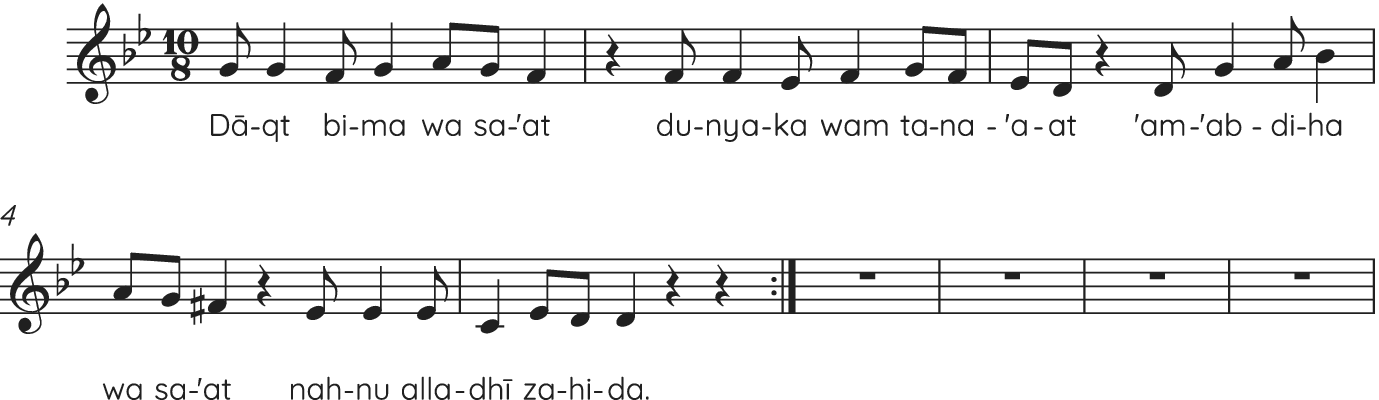
The third biṭāna section of the piece corresponds to verse 14 and introduces a rhythmic cycle new to the Egyptian and Levantine music traditions (Track 5 at 02’53”). In the rehearsals, this cycle would mostly be called by its common name jūrjina, although it was occasionally referred to as samā’ī khafīf (or a light sama’i rhythm), which Said considered the more correct form for the context. Said was attempting to generalise a usage separated from the Iraqi nomenclature. Jūrjina consists of an odd rhythmic cycle, which in this case is the 5/8 (or 10/8 or even 10/4). This rhythm, which is closely associated with the urban musical traditions of Iraq, creates an apogee in the first section of the piece. Although the Jūrjina is associated with the Arab music tradition of Iraqi-urban song (peste) as well as Kurdish folk traditions, it was unfamiliar to many musicians of the Aṣil Ensemble.
I understood that the use of these rhythms served not only to innovate Levantine music traditions by borrowing from other Arabic and regional traditions, but also suggested a sense of belonging to the wider Arab world, all-encompassing in its regenerative potential. It also emphasises the solemn moment that follows on verse 19 (Track 1) by providing a timbral contrast between the solo ‘ūd, instrumental and vocal unison and the new section which was introduced by a silence followed by solo biṭāna vocals singing without instrumental accompaniment.
Al-Barghouti’s “Al-Burda” is written in the basīṭ metre, the full form of each hemistich being defined in prosodic terms (tafā‘īl) as Mustafʿilun Fāʿilun Mustafʿilun Fā‘ilun, which can be represented as: / – – ⋃ – / – ⋃– /– – ⋃– / – ⋃– /.Footnote 20 Thus each hemistich is divided into four metric units. During rehearsals Said would recite the tafā‘īl whenever there would be problems of adjusting the positioning of the verse to the melody or to the rhythmic cycle. Occasionally, the musicians were asked to repeat the melody of a given section and sing it over the tafā’īl. Figure 1 demonstrates how verse 14 comprises a total of four metric unites per hemistich summing up a total of eight metric units per total of the verse. In the table, I have written the verse which is divided onto two hemistichs and bellow provided its prosodic metre (tafā‘īl) Mustafʿilun Fāʿilun Mustafʿilun Fā‘ilun for reference.
Arabic prosody subdivision of verse 14.

The coincidence between the melodic structure and the tafā‘īl perfectly corresponds to the poetic verse as is demonstrated in the transcription below (Figure 2). The melody descends from the initial G to final D, which encompasses the entire verse.
Third biṭāna in the rhythmic cycle of jūrjina, or Samā’ī khafīf. Transcription according to Track 3 (2’53”–3’12”) in Al- Burda CD. Transcribed by the author.

However, the melodic descent is divided into two smaller melodic units that illustrate each of the hemistichs. From G to D descent in the first melodic unit, and from D ascending to B flat and descending again to the final part of the maqām in D in the second hemistich (Figure 2). These two units can also be subdivided in another two smaller melodic cells corresponding to the) baḥr albasīt. Therefore, there are four small melodic cells that correspond to the four repetitions of the basīt and together encompass the entire melody of the verse. However, there is no such exact correspondence between poetic verse and rhythmic cycle.
The jūrjina rhythm, as mentioned above, is composed of ten units per cycle which poses some challenges to the setting of the verse in baḥr al-basīṭ. This challenge comes from the fact that the poetic metre of the al-basīṭ subdivides into four units, therefore adjustment is needed to enable compatibility with a ten units per rhythmic cycle like the jūrjina. Said found a simple but creative solution to combine the poetic metre and the rhythmic cycle whereby each pair of metric feet is distributed over one rhythmic cycle aided by the inclusion of a pause between each unit (Figure 2). Each metric foot of baḥr al-basīṭ of / – – ⋃– / – ⋃– / (Mustafʿilun Fāʿilun) is separated by a pause which renders the metric feet and the rhythmic cycle compatible. This solution represents an important element of innovation regarding the Nahḍa models.
This introduction of the jūrjina (or samā’ī khafīf) is also an innovation within traditional music practices of the Arab Levantine region and Egypt. There is no recorded precedent for the use of the jūrjina during the Nahḍa period, in which most poems were set in a cycle of four subdivisions of the unit. These pieces were known as qaṣīda al-waḥda, or qaṣīda (poem on the beat) which were both a secular and a Sufi musical form.Footnote 21 For example, the qaṣīda, Alā fī sabīl allāh sung by Shāyḥ Yuṣūf al-Manyalāwwī or the qaṣīda, Kam bat’āna ma’ al-nasim sung by Abou al-‘Ula Muhammad, two landmark Nahḍa musical pieces, both serve to illustrate the pervasive use of the wahḍa metric cycle or rhythmic cycles divisible by four. These examples reinforce the extent to which Mustafa Said departed from the Nahḍa rhythmic conventions with his use of the jūrjina rhythmic pattern.
2. The Basīt
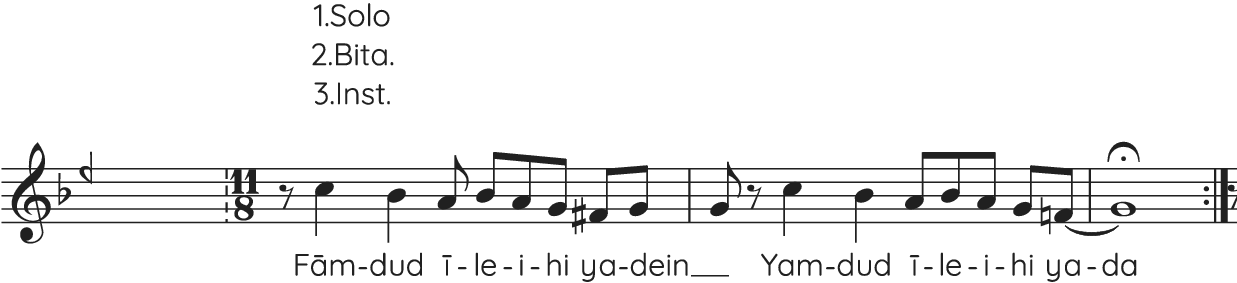
Another innovative element brought about by “Al-Burda” is the juxtaposition between poetic prosody and rhythm using a rhythmic cycle, the basīt, named after Arab poetic metric foot. This cycle comprises eleven units per cycle, and it can be described as follows:
This rhythmic cycle is a recent invention. Said claims to be uncertain of the origins of this rhythmic cycle stating that it was “possibly used in nineteenth century Turkish music” (London, pers. comm., 10 March 2016). However, he has no evidence for the practice of this rhythm in this context. Further, he states that the baḥr al-basīṭ is not used in recordings he has heard gathered at the AMAR Foundation of Nahḍa music traditions. Additionally, renowned musician and Arab musicologist Ahmad al-Salhi states on the “Al-Burda” CD leaflet that “[he has] never heard or known about this rhythm before” (al-Salhi Reference Al-Salhi2016:7)Footnote 22 reaffirming the innovative element brought about by the adaptation of the baḥr basīt /– – ⋃– / ⋃ ⋃– /to a rhythmic cycle.
Despite this lack of evidence, Said claims that the basīt rhythmic cycle is “in the books” and pointed to Arab music theory where descriptions of the basīt rhythmic cycle could be found, mentioning for example, “al-Urmawi, the Book of Songs by Isphahani, and al-Khulā’ī or any book or treatise on music theory in Arabic, Turkish, or Iranian sources”(ibid.).Footnote 23 This broad-brush naming of sources did not add clarity in the search from the origins of this rhythmic cycle. However, it does highlight a need to be anchored in the theoretical tradition as a guarantee of authority. No such cycle is cited in the literature, and it has evidently been derived from the metre of the poem, as indeed Said states, “like many other rhythmic cycles, it was taken from the ‘arūd [poetic prosody]” (ibid.). The use of the al-basīt in the piece appears after the refrain “‘ālā-n-nabīū” sung by the entire biṭāna from verses 50 to 53. The qaṣīda (poem) is introduced by a repetitive lawāzim performed by all instruments in the baḥr al-basīṭ (Figure 3). After this instrumental introduction of the rhythm, Said starts singing the qaṣīda. His delivery of the text demonstrates how this section perfectly juxtaposes the poetic metre in baḥr al-basīṭ, the rhythmic al-basīt in 11/8 and the melody which is helped by the melody’s syllabic structure. All the musical elements (rhythmic and melodic) place an emphasis on the Mustafʿilun Fa‘ilun structure of the verse.
Basīt rhythmic cycle from Track 9, 00’15” (CD 5) here transcribed with the tafā’īl basīt subdivision. Transcribed by the author.

In this sense, it follows closely the structure of the qaṣīda al-waḥda, since the poem is sung on the beat without the need to include pauses to make all different elements perfectly conflate. However, the main distinction between this section and a “Nahḍa qaṣīda al-waḥda” is that these used to be set on waḥda—a rhythm of four beats per cycle—or rhythmic cycles that would be multiple of the waḥda—whereas here the cycle comprises 11 beats per cycle. Therefore, one can argue that this section functions as a contemporary take on the “Nahḍa qaṣīda al-waḥda” where the rhythmic cycle is derived directly from the poetic metre, which is in this line. This section ends with an exchange between soloist and biṭāna over the second hemistich of verse 53 reaching a climatic point with the full ensemble and biṭāna (Figure 4 and 5).
Transcription of the lawāzīm in baḥr al-basīṭ. Transcribed by the author.

“Al-Burda” verse 53 set to baḥr al-basīṭ.

3. The Muhajjar
Perhaps one of the most memorable moments of the piece is achieved with the introduction of the rhythmic cycle known as muhajjar. Before the introduction of this rhythm, the qaṣīda is sung solo by Mustafa Said in a semi-improvised melody over verses 63 to 68. The melodic flow is steady, mostly emphasising the upper tetrachord of maqām nahawand in G. The melody descends on the last hemistich of verse 68 from G to D, displaying the entirety of maqām bayyātī, in a cadence reiterating main maqām of the piece. This vocal melodic section is followed by a new section in which a short melodic phrase is exchanged between the ensemble’s plucked stringed instruments and the bowed string instruments and nāy (Figure 6).
Instrumental melody exchanged between the ensemble’s plucked string and bowed strings with a nāy section. Transcribed by the author.

Underlying this melodic exchange, which is repeated twice, the percussion section plays a discrete rendition of the muhajjar rhythm. After this, the melody disappears, leaving the entire ensemble to play only the rhythmic muhajjar on the lower bass note D of each instrument. However, only the beats 1, 2, 3, 7, 11, and 13 of the rhythmic cycle are played (Figure 7). The depth of register combined with the repetition of those beats in muhajjar creates a moment of quiet mystery. This is a climatic tension that almost feels like an anti-climax since, unlike most musical climaxes, it is not reached through a melodic progression to a high register with a full-blown mass of instruments playing at full power. This climax is achieved by the withdrawal of melody, leaving only a few beats of the rhythm to narrate the unresolved tension that relates to meaning of text.
Instrumental tutti over the bass note D emphasising beats 1, 2,3, 7, 11, and 13 of the rhythmic cycle of the fourteen-beat cycle of muhajjar. Transcribed by the author.

The tension inferred by this phrase is alleviated by the re-introduction of melody by a solo improvisation on the ‘ūd while the full ensemble continues repeating the beats of the muhajjar in a hypnotic pulse underneath. The first few notes of the improvisation emphatically mark the return to maqām bayyātī. Whilst Said improvised on the ‘ūd the full ensemble marks the predetermined beats of the muhajjar for six bars. The end of this improvisation leads to a return to the melodic phrase which was exchanged between the plucked and bowed string instruments, and nāy before returning to that same pattern and the number of repetitions described in Figure 3.
Like this pattern, after two exchanges of this melody between both instrument groups, a new variation over the muhajjar is introduced. Whilst the ensemble carries on emphasising muhajjar over the bass note D, Oussama, the second solo vocalist performs a new vocal melody on top over verse 66. After this verse is repeated twice, the group returns to a melody-less emphasis of the muhajjar cycle on bass D, as shown above in Figure 3, for the duration of two cycles. Following this, a new vocal variation is introduced by a vocal semi-improvisation, over the muhajjar, and played as before by the entire ensemble. The improvisation resembles a syllabic recitation on one pitch on the first hemistich verse 67, progressing to a slight variation of melodic range through the second hemistich, and continuing into the following verse.
The conclusion of this section explores multiple timbral and melodic variances over the muhajjar, which appears with a biṭāna over verse 69 of the poem. This verse is sung by entire ensemble with a syllabic melody (Figure 3) which is repeated twice. The syllabic structure of this melodic phrase allows for the emphasis to remain on the rhythmic cycle of muhajjar, rather than dispersing it to the melody.
In a practice that resembles the weaving of a mantle (Burda), melodic and timbral combinations are introduced, removed, and reintroduced again with a new combination until the section is complete. First, there is the timbral exchange between plucked and bowed instruments over the same melody, after which we are left with the bare rhythmic structure. Woven on top of it, Mustafa Said continued to explore different melodies either sung by himself, or by the second soloist Oussama or by the entire ensemble, giving variations not only of the melody but also of the texture. In this sense, Said is true to the poetic practice of mu’āraḍa which claims that in each re-writing of a given work something is added to it.
Conclusion
This article has addressed the relationship between poetic metre and rhythmic cycles which is an area that ethnomusicological studies have yet to explore in depth. Ethnomusicological literature about music in the Arab world has mostly privileged the study of melodic structures and music performance in relation to its own cultural context. Few studies take in consideration the relationship between text and melody, and even fewer, the relationship between poetic metre and rhythmic cycles.
The Burda, both in its poetic and music form, is embedded in ideals of a regional reform established by thinkers during the Nahḍa period. According to Said, the use of religious and Sufi mystical material serves to engage with a cultural heritage and enables musicians to reach out to the Arabic speaking population in a language that is likely to be familiar. Yet, the Tajdīd’s proposal for a contemporary Arab music that is emmeshed in Islamic religious ideas is, to say the least, a contested one.
Glossary

ACKNOWLEDGEMENT
I am indebted to Mustafa Said, Ghassan Sahhab, Abed Kobeissy and Bilal Bitar whose knowledge and insights helped form my understanding of the Tajdīd min al-Dakhil movement. I extend my gratitude and thanks to Kamar Kassar (AMAR Foundation) and Prof. Owen Wright.