INTRODUCTION
People with criminal records encounter formidable obstacles in the labor market (Pager Reference Pager2003, Reference Pager2007; Pager, Bonikowski and Western 2009; Uggen et al. Reference Uggen, Mike, Lageson, Ebony and Whitham2014; Sugie, Zatz, and Augustine 2020) and higher education (Stewart and Uggen Reference Stewart and Christopher2020), are blocked from civic participation in most states (Uggen and Manza Reference Uggen and Jeff2002), face adverse physical and mental health outcomes (Massoglia and Pridemore Reference Massoglia and William2015; Sugie and Turney Reference Sugie and Turney2017), and grapple with exhaustion brought on by the day-to-day stigma they encounter (Western et al. Reference Western, Braga, Jaclyn and Catherine2015; Western Reference Western2018; Miller Reference Miller2021). Ban the Box (BTB) laws seek to combat labor market discrimination by delaying the disclosure of a criminal record until the interview stage of the hiring process. The policy is designed to avert discrimination at the initial application stage, allowing applicants with records to “get a foot in the door” and make an impression on employers, as opposed to being screened out when they check the application “box” that inquires about their criminal history.
Research in both neo-institutional sociology and sociology of law makes clear, however, that employers do not always follow the law in lockstep, and legislative change does not always translate to improved outcomes (Kalev, Dobbin and Kelly 2006; Edelman Reference Edelman2016). For instance, firms may fail to comply with legal changes, through either neglect or outright disobedience (Kelly Reference Kelly2010) or interpret statutes in ways that minimize major changes to business practices (Edelman Reference Edelman1992). Moreover, compliance is endogenous, such that courts adjust judicial constructions of fairness to incorporate emerging organizational practices that firms adopt in response to new laws (Edelman, Uggen, and Erlanger Reference Edelman, Christopher and Erlanger1999). Many firms engage only in what Lauren Edelman (Reference Edelman1990, Reference Edelman1992) calls “symbolic compliance”—changes that signal knowledge of the law but do not disrupt day-to-day business practices. Neo-institutionalists further argue that responses to legal changes diffuse through organizational networks; businesses that are excluded from major industry or occupational networks may be less likely to signal compliance (DiMaggio and Powell Reference DiMaggio and Powell1983; Edelman Reference Edelman1992; Edelman and Suchman Reference Edelman and Suchman1997). How firms have responded to federal, state, and local BTB laws, and whether these laws have imparted any attitudinal or behavioral change in hiring managers, remains an open question.
The present study has three objectives. First, we examine factors contributing to noncompliance with BTB: policy implementation with on-the-ground workers, hiring-manager awareness and sources of information on BTB, and sources of noncompliance. Second, we consider whether and how BTB has altered hiring-manager practices and attitudes. Third, we identify the continuing importance of background checks as an alternative source of gatekeeping in the absence of the “box.” To address these research objectives, we analyze thirty longitudinal in-depth interviews with fifteen organizations between 2007–8 and 2016 and a repository of job applications taken from workplaces audited in a field experiment in 2007–8 and recollected in 2016.
BACKGROUND
The number of people with criminal records in the United States has increased drastically across the last fifty years, rising over 500 percent between 1970 and 2010 (Bureau of Justice Statistics 2020; Sentencing Project 2021). As of 2010, over nineteen million adults in the United States have been convicted of felony-level crimes or approximately 8 percent of the total US adult population (Shannon et al. Reference Shannon, Christopher, Jason, Melissa, Sara and Michael2017), and approximately 30 percent of US youth are arrested by the age of twenty-three (Brame et al. Reference Rivera2012). With the advent of quick and cheap methods for accessing criminal record information, a growing number of employers now routinely check applicants’ criminal records (Holzer, Raphael, and Stoll 2006; Bushway, Stoll, and Weiman Reference Bushway, Stoll and Weiman2007; Corda and Lageson Reference Corda and Lageson2020; Lageson Reference Lageson2020). People with criminal records are frequently marginalized from many aspects of social life, including employment (Kirk and Wakefield Reference Kirk and Wakefield2018). As a result of these social problems, BTB laws seek to ameliorate employment discrimination results from the mark of a criminal record (Pager Reference Pager2003, Reference Pager2007).
Discrimination in Hiring and BTB Laws
Scholars have demonstrated widespread discrimination against individuals with criminal records in the labor market, primarily through field experiments (Pager Reference Pager2003, Reference Pager2007; Pager, Bonikowski, and Western 2009; Uggen et al. Reference Uggen, Mike, Lageson, Ebony and Whitham2014). There are several theoretical why firms discriminate. Firms exhibit “tastes” for discrimination, which refers to patterned tastes, preferences, and ideological biases in hiring (Becker Reference Becker1957). These biases can be motivated by the composition of actors within firms, widespread social preferences of consumers, and more. Discrimination in hiring practices is prevalent across firms, as employers select applicants who match their specific needs and tastes (Rivera Reference Rivera2011, 2012; Tilcsik Reference Tilcsik2011; Rivera and Tilcsik Reference Rivera and Tilcsik2016). In particular, members of vulnerable status groups (Ridgeway Reference Ridgeway2014), such as lower-status race, gender, and class groups (Correll, Benard, and Paik Reference Correll, Stephen and In2007; Pager, Bonikowski, and Western 2009; Benard and Correll Reference Benard and Correll2010; Gaddis Reference Gaddis2015; Quadlin Reference Quadlin2018; Yavorsky Reference Yavorsky2019), as well as those with criminal records (Pager and Quillian Reference Pager and Lincoln2005; Holzer, Raphael, and Stoll 2006) are likely to face labor market discrimination. In particular, African Americans with and without criminal records face demonstrable discrimination in hiring (Pager Reference Pager2003, Reference Pager2007) and are routinely passed over for advancement (Skaggs Reference Skaggs2009).
Unlike race and gender status vulnerabilities in the labor market, criminal record status must be discovered, typically through criminal history questions and background checks in hiring. Although audit studies show that criminal records can be disqualifying across the entry-level labor market, the salience of a criminal record for employment may depend on the type of job. Many employers may be reluctant to hire a person with a criminal record for work involving customer interactions (“front of house” positions) or jobs with vulnerable people (such as in health care or involving children). One study shows that the effect of arrest or conviction, compared to other sources of information on drug use, was more detrimental to applicants in office jobs as opposed to manual labor (Sugie, Zatz, and Augustine 2020). Similarly, a survey of US adults found that respondents were less likely to hire an applicant with a criminal record when the position queried was for health care, as opposed to retail or construction, and that this effect was stronger among adults who had made a hiring decision in the prior three years (Denver, Pickett, and Bushway Reference Denver, Pickett and Bushway2017). Therefore, strong evidence suggests that criminal record status can be a disqualifying characteristic for many employers and that industry and job type may moderate these effects.
Applying for and obtaining employment is a complex two-sided process between applicants and employers. From the applicant’s side, they must first apply for a job. Whereas some research showcases a “detachment” from the labor market among people with criminal records through willful nonemployment (Apel and Sweeten Reference Apel and Gary2010), other work makes clear that most reentering people do search for and gain employment but with varying degrees of success. The research on job searches among persons with criminal records highlights both the transient and erratic nature of work available to them (Sugie Reference Sugie2018). Compared to those with no criminal record, people who had been arrested, convicted, or incarcerated had lower odds of using social networks and higher odds of relying on agencies and reentry organizations and responding to advertised positions (Smith and Broege Reference Smith and Broege2020). Naomi Sugie (Reference Sugie2018) demonstrates that a large proportion of young reentering men engage in “foraging” work because of difficulties in finding gainful employment.
Further, applying for jobs generally requires physical proximity. Recent scholarship shows that employers and industries known to hire those with criminal records tend to be geographically distant from where people with criminal records live, especially for Black applicants (Rucks-Ahidiana, Harding, and Harris Reference Rucks-Ahidiana, Harding and Harris2021). This spatial mismatch adds an additional layer of inequality where the ability to gain employment is driven by whether low-skilled, poor, and urban individuals have the resources to travel to job-rich areas (Sugie and Lens Reference Sugie and Lens2017). If, despite these difficulties, an applicant does secure an interview, they are then in the difficult situation of how to discuss their criminal past. Research both before and after widespread adoption of BTB laws shows that this interaction requires a laborious presentation of self and stigma management, with applicants choosing what to selectively disclose about their criminal record (Harding Reference Harding2003; Augustine Reference Augustine2019; Goodman Reference Goodman2020). Unfortunately, stigma management and selective disclosure continues after the interview process and even into employment, as continuous background checking and other sources of information can bring records to light. The presence of criminal record questions on an application is tied directly to this stigma management, as it sets the stage for what will be discussed at an interview and the degree of stigma management that must be performed.
By removing the criminal record question, BTB laws increase the likelihood that an applicant with a criminal history may be invited for an interview, at which point job applicants may overcome their record due to increased control over their own stigma management. Research shows that applicants who meet face-to-face with hiring authorities help employers reconstruct prejudicial stereotypes based on group membership with more nuanced information about their individual qualities (Pager Reference Pager2007, 103; Pager, Western and Sugie 2009). In keeping with this idea, jurisdictions with BTB laws restrict how and when firms can ask applicants about their criminal histories.
As stated above, BTB laws emerged as a policy intervention to ameliorate early-process criminal record discrimination (Henry and Jacobs Reference Henry and Jacobs2007; LaPlant and Vuolo Reference LaPlant and Vuolo2021). First adopted by Hawaii in 1998, BTB laws have spread rapidly in recent years. President Barack Obama introduced a federal BTB law in 2015, and, nationwide, over thirty-five states have adopted BTB laws (Avery and Lu Reference Avery and Han2020), such that today a majority of US citizens live in a BTB or “Fair Chance” jurisdiction.Footnote 1 In Minnesota, the site of our study, firms are required to wait until the interview stage (or a conditional job offer) to ask about an applicant’s criminal history (though they are not required to delay running a criminal background check).Footnote 2 Notably, Minnesota’s policies apply to both public and private employment, effective as of 2010 and 2014 respectively. While BTB was mandated, whether employers have removed criminal history questions from their applications in compliance with BTB policy is unknown. As we discuss below, whether and how employers have altered their hiring practices after BTB enactment remains the subject of scholarly debate (Agan and Starr Reference Agan and Sonja2017), and, to our knowledge, no longitudinal study has examined how the personal attitudes of hiring managers have changed in response to BTB laws.
Organizational Responses to Legal Change
Organizations embedded in the same networks often look to one another when encountering legal ambiguity and pursue legitimacy by copying the structures and practices of other organizations (Meyer and Rowan Reference Meyer and Rowan1977). In their foundational work, Paul DiMaggio and Walter Powell (Reference DiMaggio and Powell1983) theorize that, through coercive, mimetic, and normative isomorphism, organizations within the same networks alter their behavior and practices until most behave in similar ways. BTB serves as a coercive mechanism, which seeks to change the business practices of firms. BTB laws represent a legal challenge for organizations that are directed to alter their business practices to comply with the law. Organizational actors interpret legislation and construct responses to legal mandates based on the preexisting institutionalized ideas and practices of the organization (Edelman Reference Edelman1992; Sutton and Dobbin Reference Sutton and Dobbin1996; Dobbin and Sutton Reference Dobbin and Sutton1998; Kelly and Dobbin Reference Kelly and Frank1998, Reference Kelly and Frank1999; Edelman, Uggen, and Erlanger Reference Edelman, Christopher and Erlanger1999). Legislation designed to curtail workplace discrimination leads to a range of organizational responses from no action whatsoever to moderate changes in business practices.
In response to equal employment opportunity legislation, affirmative action orders, and court decisions about diversity, firms experience considerable uncertainty surrounding the legality of their personnel practices (Dobbin et al. Reference Dobbin, Lauren, Meyer, Richard Scott, Ann and Lynne1988, Reference Dobbin, Sutton, Meyer and Richard1993; Sutton and Dobbin Reference Sutton and Dobbin1996). Legal uncertainty encourages the adoption of law-like governance policies as symbolic demonstrations of compliance. The adoption of these processes, which mimic US judicial practices toward defendants, suggest that law is a normatively strong force on organizations (Dobbin and Sutton Reference Dobbin and Sutton1998). Similarly, legal environments can impact business practices even in the absence of direct legal mandates. For example, due process procedures have grown more widespread among non-union employees even in the absence of legislation requiring them (Edelman Reference Edelman1990). While they have hardly been universally successful in establishing diverse workplaces, some legal changes have also translated to business practice changes associated with increased diversity (Kalev, Dobbin, and Kelly 2006). Nevertheless, a long line of research finds that organizational responses to many legal changes are largely symbolic, and do not significantly alter business practices (Edelman Reference Edelman1990, Reference Edelman1992; Kalev and Dobbin Reference Kalev, Frank and Erin2006; Kalev, Dobbin and Kelly 2006; Dobbin, Kim and Kalev Reference Dobbin, Soohan and Alexandra2011). Edelman and colleagues (Reference Edelman, Krieger, Eliason, Albiston and Virginia2011) illustrate how broad and often-ambiguous legislation provides organizations with considerable flexibility to construct compliance in ways that do not disrupt existing business practices.
Regarding equal employment opportunity and affirmative action laws, firms have been far more likely to adopt measures of symbolic compliance than they were to establish new structures such as Equal Employment Opportunity Commission offices. Edelman (Reference Edelman1990) argues that equal employment opportunity and affirmative action laws are often perceived by organizations as being in conflict with managerial interests; this conflict forces organizations to balance compliance and managerial agency, such that they will do the bare minimum to be perceived by the law as compliant. This situation motivates a process of response to the law in which organizations “test, negotiate, and collectively institutionalize forms of compliance that, to the greatest extent possible, maximize both interests” (Edelman Reference Edelman1990, 1406; Reference Edelman2016). Thus, while firms may construct legal responses that symbolize compliance, many on-the-ground business practices will likely remain the same, due to both the organizational context and the individual attitudes and preferences of hiring managers (Edelman Reference Edelman1992). Organizational actors are ultimately responsible for the shift in practices in response to legal change, and there is evidence that this shift is uneven, with some actors holding onto former practices more than others (Lynch Reference Lynch1998; Kelly Reference Kelly2010). Thus, the attitudes of organizational actors greatly influence organizational response to law, and responses are likely not uniform across organizations.
Although the diffusion of similar business practices is widespread within organizational networks, not all businesses are part of organizational networks with high-level knowledge of legislation and legal changes (Kelly Reference Kelly2010), which may leave isolated businesses to fend for themselves in response to legal ambiguity. Erin Kelly (Reference Kelly2010) explains that the high noncompliance rate of the Family and Medical Leave Act of 1993 was partially driven not only by firms knowingly violating the law due to a lack of sanctions but also by firms’ lack of familiarity with the law and “failure to update” their preexisting institutions and business practices.Footnote 3 Thus, some proportion of noncompliance may be due to ignorance rather than to an outright refusal to comply or symbolic constructions of compliance.
The extent to which the state penalizes noncompliance also affects how organizations adapt to new policies (Dobbin and Sutton Reference Dobbin and Sutton1998). Lack of enforcement can result in employers ignoring legal mandates (Glass and Fodor Reference Glass and Éva2011). Organizations with records of poor compliance and prior violations of regulatory policy are particularly likely to skirt compliance with new laws (Short and Toffel Reference Short and Toffel2010). In the BTB context, firms that discriminate in the absence of a legal prohibition may be more likely to be noncompliant (or delay adoption) when antidiscrimination becomes the law of the land. They may also engage in behavior that, while legal, subverts the inclusive intent of BTB laws, such as engaging in the use of criminal background checks prior to selecting applicants for interviews.
Similarly, social reputation may drive compliance (Kelly and Dobbin Reference Kelly and Frank1998, Reference Kelly and Frank1999; Bartley and Child Reference Bartley and Curtis2014). In the case of persons with criminal records, a reputation as a “fair chance” employer for people with records could work either for or against employers. Some customers may appreciate employers providing an important social good in their nondiscriminatory hiring practices, but others may react negatively and become less willing to patronize such businesses (Holzer, Raphael, and Stoll 2006). When there is no penalty, employers may also comply out of self-interest, such as tax breaks given to firms that hire individuals with criminal records (Baum and Oliver Reference Baum and Oliver1992). In view of this research literature, we expect that firms may symbolically comply with new BTB laws, but we do not expect significant changes in their hiring practices.
Today, criminal record questions remain an institutionalized practice on job applications that serve to exclude applicants with criminal histories. BTB laws seek to remedy this exclusion. However, businesses may not comply with the law at all or may comply through the removal of their criminal history question but institutionalize new forms of gatekeeping, such as statements on applications that explicitly indicate that hiring will be conditional on a clean criminal background check. Organizational discretion and hiring managers likely play a critical role in these processes.
Discretion and Hiring Managers
Both individual hiring managers’ beliefs and attitudes and the organizational environment constrain and enable the choices of individual hiring managers (Lageson, Vuolo, and Uggen Reference Lageson, Mike and Christopher2015). Some hiring managers must follow relatively strict directives about whom they can and cannot hire, while others have a great degree of discretion. How individual hiring managers respond to the mark of a criminal record thus depends not only on their personal attitudes but also on the institutionalized practices in their organization and the amount of discretion their role is allowed. Changes in both legislation and broader legal environments may alter the balance between a hiring manager’s individual preferences and the organizational directives, such as equal employment opportunity legislation, affirmative action, or BTB laws.
BTB laws, which restrict the autonomy of employers to inquire about applicants’ criminal histories, must overcome both entrenched institutionalized practices and threats to managerial autonomy—autonomy that may enable biases in hiring. Extant research provides evidence for the efficacy of BTB laws that is quite mixed, and cautions of unintended consequences for Black men (Raphael Reference Raphael2021). In terms of efficacy, one national study found better labor market outcomes after a public employment BTB law was passed (Craigie Reference Craigie2019), while another covering public and private employers in Seattle found no effect (Rose Reference Rose2021). Regarding criminal justice outcomes, a Hawaii study linked public and private BTB policy to reductions in recidivism (D’Alessio, Stolzenberg, and Flexon 2015).
Beyond efficacy, however, several studies paint a troubling picture of how employers might respond when information on criminal records is restricted at the application stage. Experimental and observational studies show that employers are more likely to discriminate against African American applicants when applications do not have criminal record questions, including after the passage of a BTB law (Vuolo, Lageson, and Uggen Reference Vuolo, Lageson and Christopher2017; Agan and Starr Reference Agan and Sonja2018; Doleac and Hansen Reference Doleac and Hansen2020). According to theories of statistical discrimination, employers may fear or assume that African Americans possess a criminal record unless they are provided with evidence to the contrary – indicated by a clear “no” response to a criminal record question (Agan and Starr Reference Agan and Sonja2017). Yet research thus far has not engaged directly with employers to understand how their decision processes may have changed post-BTB. Further, noncompliance with the law has been observed in field experiments (Agan and Starr Reference Agan and Sonja2017, Reference Agan and Sonja2018). In such cases, noncompliers are continuing to gather criminal history information on job applications.
Taken together, we know little about how BTB laws have been implemented, whether and how organizations comply with the laws, and what role discretion, organizational environment, and hiring managers’ individual preferences play in policy implementation. Our study fills this gap by using longitudinal qualitative interview data and a quantitative analysis of a sample of job applications, with data collection occurring before and after a statewide BTB policy applying to all employers in Minnesota. Minnesota has both public sector (created in 2010) and private sector employment (created in 2014) BTB laws, intended to delay employer access to an applicant’s criminal records.Footnote 4 We seek to expand on sociological work in organizations and legal change using the specific case of BTB. We ask whether employers modify their hiring practices in response to BTB, and, if so, how they balance the legislation alongside their own preferences, the preferences of the organization, and those of the broader field.
DATA AND METHODS
This research builds longitudinally upon previous work conducted in 2007–8 to estimate the effect of a low-level criminal record on employment prospects (Uggen et al. Reference Uggen, Mike, Lageson, Ebony and Whitham2014; Lageson, Vuolo, and Uggen Reference Lageson, Mike and Christopher2015; Vuolo, Lageson, and Uggen Reference Vuolo, Lageson and Christopher2017).Footnote 5 That study involved a field experiment of 605 private employers in the Twin Cities area in Minnesota. Employers were randomly selected weekly from entry-level classified ads in five print sources (Minneapolis Star Tribune, St. Paul Pioneer Press, Employment News, Employment Guide, and JobDig) and one online source (Craigslist), all common sources in 2007–8. All entry-level job opportunities were selected for the audit so long as they required no special skills or licenses, instructed applicants to apply in person, and were located in the seven-county Twin Cities metropolitan area. Given this method, our original dataset is a representative sample of positions advertised in these six sources in the Twin Cities 2007–8 labor market.
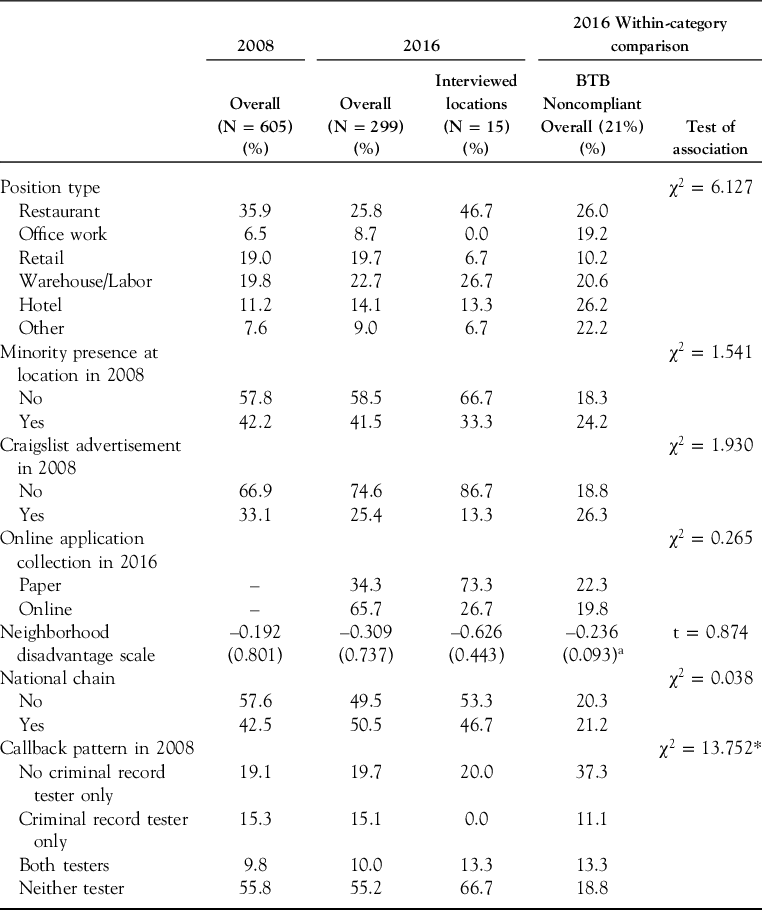
The researchers matched actors into four same-race pairs, with the members of each pair rotating the presentation of a misdemeanor record to employers. The field testers collected a job application when visiting each establishment, which formed the basis of a dataset that included information about whether and how each employer inquired about criminal records. The authors then conducted forty-eight interviews with hiring managers at audited workplaces, inquiring about their hiring practices, use of background checks, protocols for applicants with certain offenses, and more. Interviewees were not aware their establishment had been audited. In the current study, we follow up on the latter two data collections by recollecting applications from all employers that remained open in 2016 and interviewing fifteen of the managers in these organizations. In addition, we use data on firm characteristics from the initial audit as independent variables when analyzing the information in the applications. Table 1 displays the descriptive statistics for the original 2008 sample in the second column (variables described in detail below).
Descriptive statistics of variables and bivariate association tests

Notes:
* p < 0.001; a Non-compliant average compared to average among BTB compliant locations of –0.328 (0.048).
Applications Data and Analytic Methods
Between January and October of 2016, we collected job applications from the original sample of entry-level job applications collected in 2007–8. In the 2008 study, applications were either successfully obtained, or it was established that the site only accepted resumes (hence, not asking a criminal record question) for 69 percent of the sampled employers, which here represents an analogue to the response rate. In the 2016 collection, we attempted to get application information from all of the original businesses. First, we conducted internet searches to check which businesses had closed since the previous study, which left 425 locations (70 percent) in the sample. Closed businesses were not contacted and coded as missing. With the 120 closed businesses removed, we have application information from 305 locations, or 63 percent of the businesses open in both 2008 and 2016. Some of these include employers that we did not successfully obtain applications from in the 2008 round. Of the 412 applications from the 2008 collection, eighty-seven had closed and we were able to obtain information for 217 of the remaining employers, for an analogue to a retention rate of 67 percent.Footnote 6
Researchers collected applications online via websites and in person. As in the original data collection, some businesses only accepted resumes with no application and thus were coded as not querying criminal records in 2016. Notably, among businesses with application forms in both rounds of data collection, workplaces used a single entry-level application, regardless of position. As there was no formal advertisement for employment in 2016 as there was in 2008, our 2016 application collection methods attempted to mimic the real-life process of online and in-person job application. We first attempted to find online applications, as these would expend the least time and energy for an application relative to traveling to a business. This procedure resulted in a larger number of online applications over paper applications in our 2016 sample (66 percent versus 34 percent). We then collected paper applications when online applications were not available. In-person applications offer applicants a greater chance of face-to-face contact with employers, which may be advantageous to people with criminal records (Pager Reference Pager2007).
The third column of Table 1 shows the characteristics of the retained businesses in 2016. The businesses that remained open in our 2016 sample are remarkably similar to the full 2008 sample on most variables, although the 2016 businesses have fewer restaurants and a slightly higher percentage of national chains. Judging from these characteristics, there appears to be little evidence of unusual selectivity patterns in the latter sample, such that we consider our sample to be generally representative of entry-level advertised positions in the Twin Cities in 2008 in organizations that remained open in 2016.
We use information from the applications to operationalize several key concepts. First, we coded any inquiry about an applicant’s criminal history, including any arrests, misdemeanors, or felonies, as the presence of a criminal record question. Second, in January 2014, inquiries by private employers about an applicant’s criminal history on initial job applications became illegal in Minnesota. We coded noncompliance as the presence of a criminal record question on a 2016 job application. Third, we dichotomously coded any statements about background check requirements as background check statements, which alerted applicants that, to acquire a job, they would have to submit to a criminal background check.
This study uses binary and multinomial logistic regression, as well as descriptive statistics, to assess changes in job applications over time. Our models include several independent variables. First, we use a job position classification, grouping openings by the type of work advertised in 2008, with categories “restaurant,” “retail,” “warehouse/labor,” “hotel,” “office,” and a heterogeneous “other” category (for example, health care, driver, security). Second, we include a dichotomous variable for whether the 2008 job advertisement was online on Craigslist compared to any of the paper sources. For 2016, we coded applications as collected online or not online. Third, we incorporate a variable for the diversity of the workplace as observed by field audit testers in 2008, measured by whether there were any employees of color present at the time of application collection. Fourth, we include an indicator for whether the business is a national chain, defined as having locations outside of Minnesota and the two counties of Wisconsin that are part of the Minneapolis-St. Paul-Bloomington metropolitan area.
Fifth, we include a variable for the tester callback pattern in the original study, with the following four categories: called only the tester without the criminal record; called only the tester with the criminal record; called both; and called neither. We define a callback as a tangible positive response from an employer—an on-site job offer, an on-site interview, a voicemail job offer or interview request, or a call from an employer for something beyond a reference or request for basic information. Finally, we include a neighborhood disadvantage scale (created as part of the 2008 study) to assess any neighborhood association between local economic and social conditions and change in job applications. To construct the scale, we conducted factor analysis of items that include the percentage below the poverty line, the Index I crime rate, the percentage of individuals who own a home, the median household income, the percentage of adults employed, the percentage of African American residents (due to the area’s high rates of racial inequality), and whether the tract lies within one of the two major cities.
In-depth Interview Data and Analytic Methods
Next, fifteen interviews were conducted in 2016 at the same employment sites of the interviews in the original 2008 study (Uggen et al. Reference Uggen, Mike, Lageson, Ebony and Whitham2014; Lageson, Vuolo, and Uggen Reference Lageson, Mike and Christopher2015). Out of the forty-eight businesses included in in-depth interviews in 2008, eight had closed permanently by January 2016. The remaining forty organizations were approached by the first author, who asked for the person in charge of hiring entry-level positions at the organization. The first author then explained that she was a student at the local university, and that she wished to interview hiring managers in the Twin Cities metropolitan area about their hiring practices and their knowledge of the BTB laws in Minnesota. Hiring managers in fifteen organizations agreed to and were interviewed for the project, and the final response rate was thus 37.5 percent. The person interviewed was typically a manager, assistant manager, and/or the owner of the business, and there was no deception involved in recruiting participants.
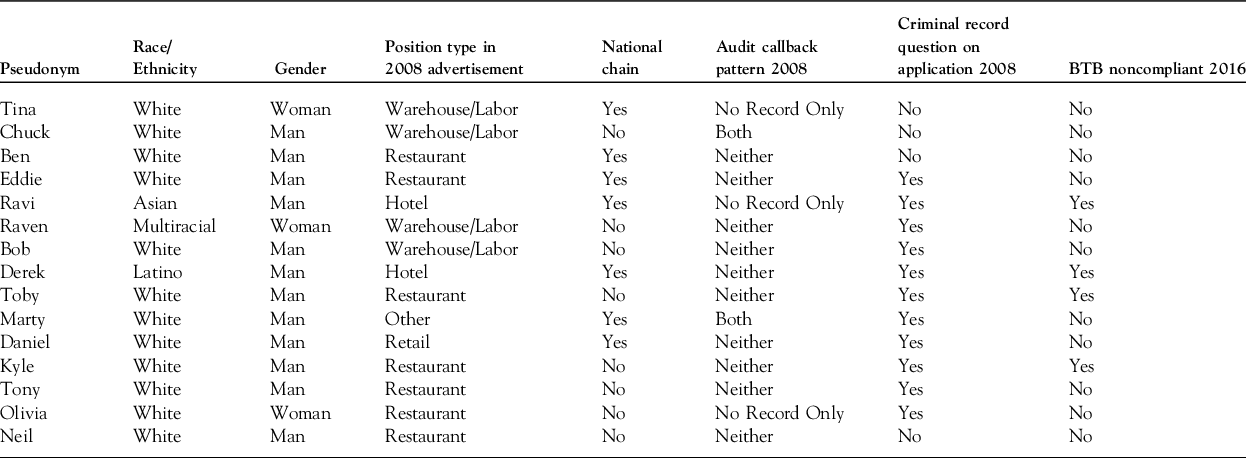
We analyze interview data from two points of time (2008 and 2016), for a total of thirty interviews. The organizational continuity allows us to analyze data longitudinally about the attitudes and decision-making processes of business organizations in Minnesota pre- and post-BTB. Table 1 shows that the characteristics of the interviewed businesses generally mirror those of the overall sample, apart from a higher proportion of restaurants and locations where paper applications were the source in 2016 as opposed to online applications. Notably, national chains and local businesses are represented at nearly equal proportions, similar to the 2016 data as a whole. Characteristics of the specific interviewees and businesses are provided in Table 2.
Interviewee demographic and firm characteristics

The second interview took place between January and April 2016. Interviews were face to face and occurred either in the business location itself or in nearby coffee shops. We targeted hiring managers for interviews, which we defined as employees of a business that conducted some or all of the hiring for entry-level positions at their business. They were not required to be owners (only two individuals were business owners). Further, they were typically not the same person who held that position in 2008; only two of the hiring managers were interviewed in both 2008 and 2016. As we were interested in organizational responses to hiring related to BTB, we did not view these personnel changes as problematic, given that the lens of our analysis is at the organizational level. Of the fifteen interviewees, twelve were men, and twelve were white. All those individuals interviewed had attended at least “some college,” with 80 percent reporting that they had obtained a bachelor’s degree. The businesses were diverse in terms of their size, number of locations, and number of employees. Interviews lasted an average of thirty-five minutes, with a minimum of seventeen minutes and a maximum of forty-seven minutes. Additionally, in 2016, the authors conducted one interview with a BTB representative from the Minnesota Department of Human Rights, who provided information about the implementation, communication, and enforcement of BTB throughout Minnesota.
In our interviews, we inquired about the general hiring behavior of hiring managers at their business, what they look for in an employee, and the methods they use to recruit potential employees. Employers were asked whether they were aware of the BTB legislation, how they felt about it personally, how they were instructed to respond to the legislation, whether they believed it changed or affected their hiring practices, whether they felt personally burdened by the legislation, whether the legislation limited their discretion in hiring, and how they felt about hiring or working with those with criminal backgrounds. We also asked them to describe their reservations in hiring applicants with criminal histories and whether certain offenses would preclude employment at their business. Additionally, we inquired about the type of company, the entry-level workers they typically hire, the demographics of workers, and additional establishment-level characteristics.
Interviews were recorded and transcribed, with identifying information removed before analysis. The authors based the coding scheme in grounded theory (Glaser and Strauss Reference Glaser and Strauss1967; Esterberg Reference Esterberg2002), and coding was conducted by the first author. The interview responses for the interviewees’ personal attitudes toward BTB were coded for negative, neutral, or positive statements about BTB and negative, neutral, or positive statements about hiring applicants with criminal backgrounds. Next, the data were coded for behavioral changes in response to the BTB legislation. The codes reflect interviewees’ descriptions of how their behavior altered (or did not alter) in response to the legislation. Further, data was coded in light of the perspectives of Frank Dobbin and colleagues (Reference Dobbin, Lauren, Meyer, Richard Scott, Ann and Lynne1988) on the development of workplace legal protocols and DiMaggio and Powell’s (Reference DiMaggio and Powell1983) mechanisms of institutional isomorphism.
RESULTS
To understand and explain how BTB has changed hiring for organizations, we weave both quantitative and qualitative data throughout our results. First, we examine compliance with, and diffusion of, BTB. Here, we quantitatively examine changes in the applications, followed by interview data that describes how noncompliance continued, including through a lack of knowledge on the policy. Second, we use our interview data to describe how BTB has affected hiring practices, noting considerable within-organization continuity and the primacy of discretion over any consideration of BTB. Finally, we conclude with both quantitative and qualitative data on background check disclaimers written on job applications and individual managers’ use of this mechanism, describing the emergence of such statements as a potential gatekeeping mechanism to deter applicants with records.
Compliance with, and Diffusion of, BTB
Quantitative Changes in Job Applications
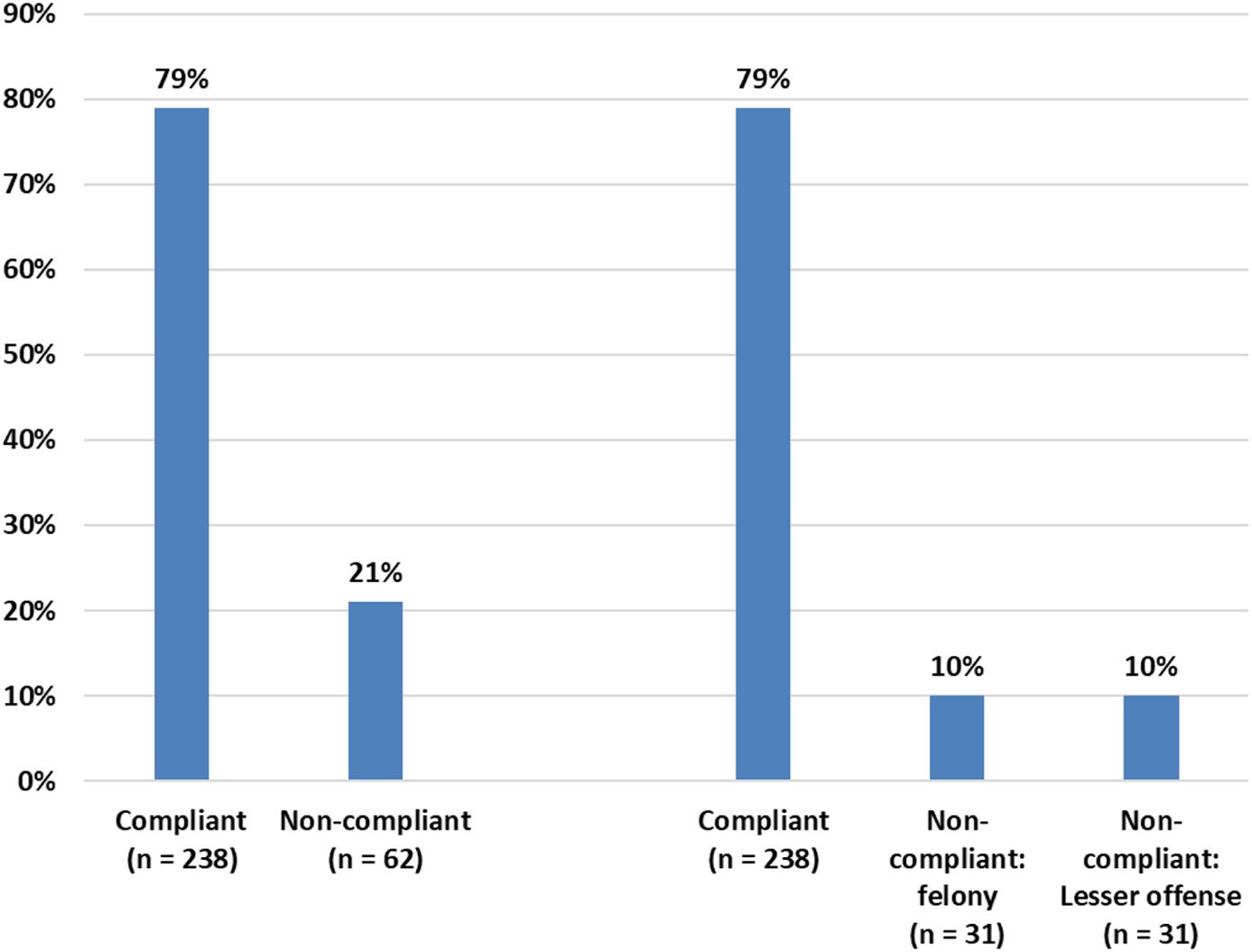
We begin by quantitatively assessing compliance among our sample of job applications. Figure 1 shows the descriptive breakdown of applications in the sample. Approximately 79 percent of businesses did not have a criminal record question on their application, while 21 percent did, meaning one-in-five businesses in our sample use applications that are noncompliant with the BTB law. On the right side of the graph, the 21 percent of applications containing the question are broken down into whether the question inquires about felony offenses (10 percent) or lesser offenses (10 percent), such as misdemeanor or arrest.
Compliance with BTB in 2016.

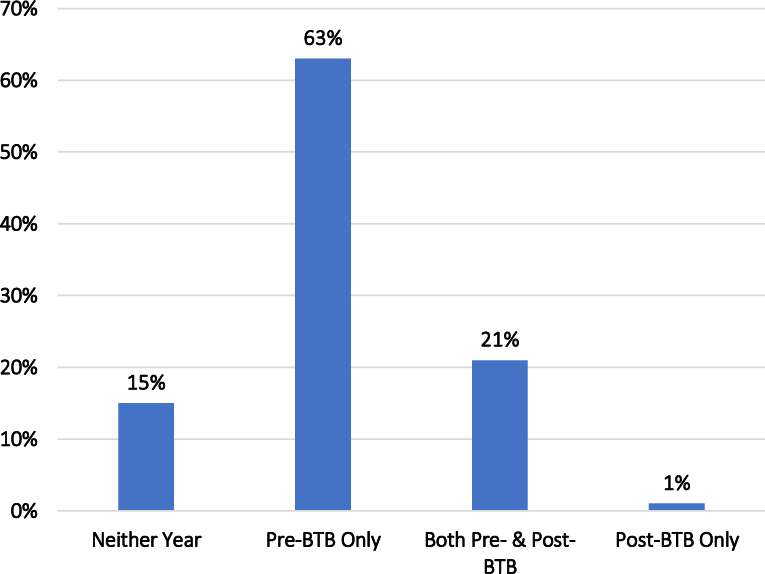
Figure 2 shows within-business changes in criminal record questions on applications. Most employers (63 percent) asked a criminal record question in 2008 but not in 2016. This group thus became compliant with BTB (although we note that this change could have occurred prior to the law’s passage). Next, 15 percent of applications did not have the question in either year and were thus compliant. Regarding noncompliance, 21 percent had the question in both years, and 1 percent changed from not having a criminal record question in 2008 to having one in 2016.
Presence of a criminal record question in 2007–8 and 2016.

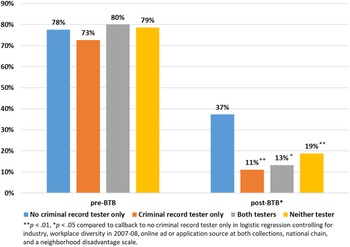
Next, we assess the factors associated with noncompliance in 2016. The final two columns in Table 1 show the percentage of companies that were noncompliant with BTB in 2016 within categories of the variables. The relationship between the 2008 callback pattern and noncompliance is statistically significant (p < 0.01). The highest rate of noncompliance (37.3 percent) is among employers who discriminated against the applicant with the criminal record by calling back only the tester without a record. By comparison, noncompliance among the locations that did not discriminate by calling back only the tester with the record, both testers, or neither tester was 11.1 percent, 13.3 percent, and 18.8 percent, respectively.
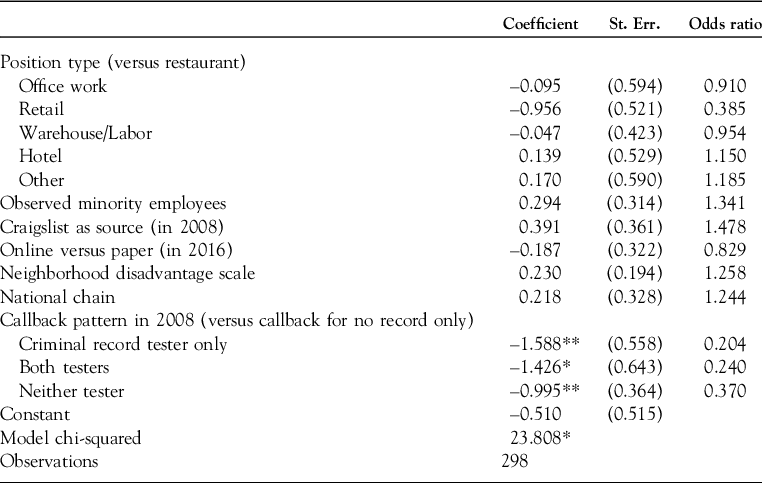
Figure 3 shows these percentages graphically as well as the 2008 pre-BTB period for comparison. Perhaps surprisingly, no other variable is related to noncompliance. Discrimination based on a criminal record and its implications for compliance with BTB perhaps transcends industry, an organization’s technological approach to applications, and an organization’s size. Table 3 then includes these characteristics together in a logistic regression model, where the callback pattern is again the only significant predictor. Compared to the employers that only called back the tester without the criminal record, the odds of noncompliance with BTB are 79.6 percent (p < 0.01), 76.0 percent (p < 0.05), and 63.0 percent (p < 0.01) lower for employers who called back only the tester with the record, both, or neither, respectively. Stated in the reverse, relative to the employers that discriminated, the odds of compliance with the law (having no criminal record question) are 4.9, 4.2, and 2.7 times higher for the three respective nondiscriminating employers. Not surprisingly, the pairwise comparisons between the three nondiscriminating callback patterns are nonsignificant. With these quantitative findings in mind regarding compliance among job applications, we turn to our interviewees’ understanding of compliance in their hiring practices.
Percentage of sample asking a criminal record question by 2008 callback pattern.

Qualitative Understandings of Compliance
Table 2 displays the pseudonyms and characteristics of the participating firms and hiring managers. Of the fifteen firms interviewed, five (one-third) had a criminal history question on their applications in violation of BTB (a somewhat higher percentage at 33 percent than the 21 percent among all applications). However, only one interviewee reported knowing they were noncompliant. Derek, a man in his mid-twenties who was the general manager of a national chain hotel location, said he not only knew of the BTB law but also “knew it well.”Footnote 7 He stated he was not concerned with the noncompliant application at his hotel: “[The noncompliance] is not a big deal. … Typically we won’t disqualify [an] applicant just because they have conviction,” he said. “We like to bring people in to do an interview and kinda based upon their interview processing skills, how they like to explain their conviction, how they explain how it happened, what they’ve done to resolve an issue, if they’re currently resolving it now, if they are going through mitigation or litigation processes and what they have or have not learned from the conviction itself.”
Logistic regression for criminal history question on 2016 job applications

Notes:
* p < 0.05, ** p < 0.01
As a manager of a national chain that was willfully noncompliant with the BTB law, Derek’s rationale for his noncompliance is due to his firm’s past and current attitude toward applicants with criminal records. Derek’s hotel chain did not automatically disqualify job applicants with criminal records. He described the firm’s attitude toward BTB as indifferent and felt that his business would suffer no consequences for not complying, as he had not witnessed any sanctions being placed on local firms and knew that the cost for noncompliance is low for a large corporate hotel chain ($500 for each violation per month, with a maximum of $2,000 [Minnesota Department of Human Rights, 2014]). Thus, the lack of sanctions for noncompliance may undermine the coercive isomorphism mechanism expected.
We interviewed a staff member from the Minnesota Department of Human Rights (MDHR), Taylor, to obtain an understanding of the MDHR’s efforts to notify employers of the law change and enforce compliance. Taylor explained that notification of the law was significantly affected by the small staff size of the department and the lack of funding provided to the department for implementing and spreading the word to all affected businesses: “We have less than fifty people that work for the Department of Human Rights, so we’ve tried to stage workshops and conferences both in and out of the metro area to spread the word about BTB, but a lot of small businesses might not have been notified about the law and don’t know what it is.” Due to the lack of funding in the department and the inability for the department to notify businesses statewide, Taylor said that, as of April 2016, no businesses had been sanctioned for noncompliance with the BTB law. Taylor noted that the department hoped that the media and diffusion throughout the business community would be enough to alert businesses that they would have to change their applications but acknowledged that this diffusion may not reach certain businesses, especially beyond the Twin Cities.
Business’s lack of awareness about the new law may have made it seem as though companies were intentionally violating the BTB policy, when in fact some may have never known they were supposed to eliminate the box from their applications. Nevertheless, as demonstrated by Derek and his hotel chain, larger businesses with more resources may have in full knowledge chosen to ignore the BTB law, either due to indifference caused by the known lack of sanctions or due to outright disagreement with the law. We next consider how lack of knowledge and/or indifference may be the case by explicitly inquiring about our interviewees’ knowledge of the BTB policy.
Situating Compliance within the Knowledge of BTB
Almost half of the interviewees stated that they had not heard of BTB when interviewed in 2016, and over half of those who said they had heard of the policy stated that they did not remember whether a state and/or legal representative notified their business of BTB going into effect. When, in 2016, we asked Raven, a manager of an independently owned suburban dry cleaners, whether she knew what BTB was, she said: “[I] never heard of it.” The private sector BTB law had been in effect for two years. Thus, noncompliance may be driven partially by ignorance of the law.
Of the interviewees aware of BTB, six of the seven businesses did not include criminal history questions on their applications, while one did. Among the other eight interviewees that claimed to have no knowledge of BTB, a few expressed some apprehension about whether they were allowed to ask a criminal record question anymore, signaling some informal knowledge of the law. Kyle, a manager at a pizza restaurant, said he had worked for the restaurant since 2000 and “wasn’t sure if the application [still] had a question.” While Kyle did not appear to know about BTB and continued responding to interview questions, he stopped making eye contact with the interviewer and appeared uncomfortable when asked about any criminal record questions on his applications. This visible discomfort may be due to Kyle’s business knowingly violating the BTB law and not disclosing their noncompliance or could be due to an in-the-moment realization of his business’s noncompliance and subsequent embarrassment or concern over sanctions.
Many employers explained that they initially heard of a law that forbade asking the criminal history question on job applications “through the grapevine,” as Bob put it, though he did not recognize BTB by name. Bob, a middle-aged male entrepreneur who owns a local dry cleaning and laundromat business with a handful of locations in the metropolitan area, remarked that he did not know the BTB law by name and, in response to an interview question about criminal record questions, asked: “Do they [other businesses] do that anymore? … I noticed you couldn’t find applications that had it on there anymore.” This quote exemplifies the rudimentary understanding of the BTB law that several hiring managers in the sample displayed, and, following neo-institutional theories of diffusion, how businesses look to others in their network when presented with ambiguity about legal directives.
Stability and Change in Organizational Practices after BTB
Organizational Continuity
Given that our interviews were conducted with the same organizations in 2008 and 2016, we can make organizational comparisons to pre-BTB attitudes. When comparing the interview data about hiring applicants with records, it is striking how similar the responses are within businesses. Several organizations did not change their rhetoric about job applicants with criminal records between 2008 and 2016. For example, a suburban restaurant had different hiring managers in 2008 and 2016; however, the two managers used incredibly similar language to describe their concerns over hiring someone with a criminal record. Sam responded in 2008: “We look for all felony offenses, and sexual predators—we have kids who work here.” Eddie responded in 2016: “I would wanna know if a somebody came in here and had like, sexual issues, and I have like 18- or 19-years old hostesses, you know, that would concern me.” Notably, both Sam and Eddie highlighted risks of sexual predation and framed their concerns about hiring applicants with criminal records around the ages and gender of their workers, though they managed the restaurant at different times.
Next, Bob, quoted in the previous section, espoused extremely similar sentiments about hiring applicants with a record in 2008 and 2016, stating that his personal “feel” was the most important judge of an applicant. Bob described in both interviews how body language, eye contact, and an applicants’ personal presentation were more meaningful indicators of their fit in the business than a criminal conviction. However, in both interviews, Bob also articulated apprehension with hiring someone with a record of violence, saying in 2008: “First is the people that work here, the people that are here already. That is always the number one priority. Any object can be replaced, but I can’t get people’s lives back if something happens.” Then, in 2016, he states: “We have the safety of other people. … I got people depending on me to create a safe, stable and dependable environment that is predictable. And it’s pretty though for someone to expect for me to provide that with my eyes closed.” Though BTB laws went into effect between Bob’s first and second interviews, his concerns with hiring someone with a criminal record did not change. In both quotes, Bob framed himself as the guardian of a safe environment for his employees and that hiring an applicant with a criminal history could jeopardize their safety. Although his firm’s job application complied with BTB, Bob personally still relied on the same hiring practices he had used before BTB: first and foremost, getting a feel for an applicant and, if he felt the “feel” was right, then considering their criminal history.Footnote 8
Organizational continuity was not exclusively to the detriment of applicants with criminal records. Peggy, the 2008 manager at a national chain manufacturing business, said that her organization encouraged individuals with records to apply and did not place them at any job sites that explicitly requested workers without records or where workers had previously experienced prejudice. Tina, the 2016 manager of that same business, described very similar practices, saying: “Some of our clients will require a background check and while others don’t really need one, so it really depends. We don’t ask [them] until they accept the job offer and then from there we go through it.” Peggy and Tina’s manufacturing business did their best to hire applicants with records and place them at record-friendly job sites, both in 2008 and 2016. The BTB law does not specifically encourage or require this proactive placement of employees, and the persistence of this institutional practice may be beneficial to applicants with criminal records.
Hiring Discretion and BTB
With BTB policies, hiring managers initially operate with less information on applicants. Such a change could result in a shift in their discretionary practices. Surprisingly, most of our participants did not consider BTB to be a factor in their hiring decisions. Instead, they balanced their own individual preferences and the preferences of their business in making hiring decisions. First, hiring managers tended to prioritize the preference of the business in their hiring decisions over their personal attitudes. Derek, the hotel manager who worked at a noncompliant firm, explained how he prioritized the preferences of his organization over his ambivalent attitude about employees with criminal records:
Typically, we don’t disqualify any applicants based on their record. … I’ve done it [hired individuals with records], but I don’t get the best results from it. … I’m a little more hesitant and wary … but it really depends on how they act and what steps they’re taking forward from it. My hesitation would increase depending on how heavy the crime is.
Derek expressed earlier in his interview that he did not believe that the BTB law had in any way changed his hiring practices. Derek’s company worked alongside local halfway houses to assist formerly incarcerated individuals with employment, and Derek routinely hired and managed individuals with criminal records. Though he felt he “[didn’t] get the best results” from his employees with criminal records, Derek continued hiring them because it was the preference of his organization.
Next, some hiring managers discussed how the biggest aspect of their hiring behavior depended on their own intuition or “feel” for potential employees. More than half of our respondents stated that they primarily relied on their personal appraisal of an applicant’s character vis-à-vis the job interview. For example, Bob opined that applicants often lie about criminal histories on job applications; he stated that his “gut intuition” was a more dependable gauge of character than the job application. Similarly, Eddie, an older manager at a national chain restaurant, echoed Bob, saying: “Most people won’t disclose even back on their application … they say, ‘Everything I say is truthful’ and I found out, for example, that you were held for murder for five years and you didn’t disclose that on your application.” Eddie mentioned that, in the past, he had discovered criminal histories through background checks when promoting an entry-level employee to an assistant manager position and that it irrevocably altered his perception of that employee.
In contrast, a few hiring managers used the application and resume as their main evidence for the character of a potential employee. Tony, an executive chef at a country club in a wealthy suburb, remarked that he paid “special attention” to the length of time applicants spent at jobs on their resume and time between jobs, saying: “That’s one big thing that I look at … the amount of time that they spend in each job. If someone is going from kitchen to kitchen every six months, that leads me to believe it’s not probably going to last that long with us.” Rather than rely on his personal connection to, or gut feeling about, an applicant, Tony put more weight into the information on the application or resume, finding that to be a better indicator of the potential quality of any given applicant. Similarly, Chuck, a construction manager, said: “You can tell by resume or something like that, that if you have somebody who never seems to be at a job for more than six or twelve months, there’s usually a reason why.” When asked if he believed he could assess the quality of a potential employee from the in-person interview alone, Chuck said: “I’m not sure you can really tell … there’s little nuances you can kind of see and tell … but a lot of times, it’s a crapshoot.” While still a potential “crapshoot,” Chuck also relied on evidence of character from someone’s resume rather than any gut feeling or intuition.
Again, no respondent expressed that the BTB law was a major consideration in their hiring practices or that it impacted their openness to hiring applicants with criminal records. The employers who stated that they were open to hiring applicants with criminal records did not cite BTB as a reason, and employers who said they were not comfortable or had reservations about applicants with criminal records did not believe BTB constrained their managerial discretion. For example, Tina, the hiring manager from the manufacturing company that routinely employed individuals with records, described originally feeling apprehensive about managing employees with criminal records when she started at the organization in the early 2000s but stated that her attitude changed the longer she worked in her position:
Before I came to this job, my answer may be different, to be honest with you, but working in the manufacturing with what I do now, I see so many people that have something. … I work with their POs, I work with their halfway houses, and a lot of them are the most dependable, hardest workers, because they’ve gone through something and they’re at the point in their life where they want to change, and they want to work hard … some of them are our hardest workers.
Tina’s business did not ask applicants to disclose whether they had a criminal record in 2008, so the organization’s business practices were not altered by the BTB law. Tina identified how exposure to employees with criminal records led her to believe that they work as hard (if not harder) than employees without criminal records.
Post-BTB, other interviewees felt less comfortable hiring individuals with criminal histories, like Eddie, the previously mentioned hiring manager who did not believe applicants with records would be honest about their criminal history on applications. In this vein, Olivia, a manager at a country club, was the only interviewee who said in 2016 that she would definitively not hire any person with a criminal history (though others reported misgivings about specific convictions). Olivia had very few known experiences with employees with criminal histories. She did not feel that BTB was fair to employers and did not believe the law had changed her hiring practices. Olivia could not even recall interviewing anyone with a criminal record; when asked if applicants ever disclosed their records to her in interviews or if she noticed references or credentials that came from correctional institutions, Olivia replied: “I don’t see it so often—two to three times a year—[I] look it up online and it’s a release program or that kind of thing, they try to list it as a job and I’m like okay, no.” Olivia, though not frequently presented with the mark of a criminal record, emphatically said “no” to hiring applicants with records, even though she was aware of BTB. The lack of enforcement and sanctioning, however, may have passively supported her continued disregard for applicants with criminal histories.
Two hiring managers interviewed in 2016 expressed that their attitudes toward applicants with criminal records had changed based on exposure to employees with a record, but, importantly, neither said that BTB itself was a part of their attitudinal change. However, respondents may subconsciously be reacting to either the BTB law or the broader cultural change surrounding criminal records; in our 2016 interviews, only one interviewee stated that they would not want to hire an applicant with any type of criminal background, while, previously in 2008, 25 percent of those interviewed said they would not want to hire someone with a criminal record. Thus, hiring managers may not perceive BTB as changing their attitudes toward applicants with criminal records or their hiring choices, but there is still some evidence that a shift has occurred, whether subconsciously facilitated by BTB or not.
Background Checks as an Alternate Means to Information
Background Check Statements on Applications
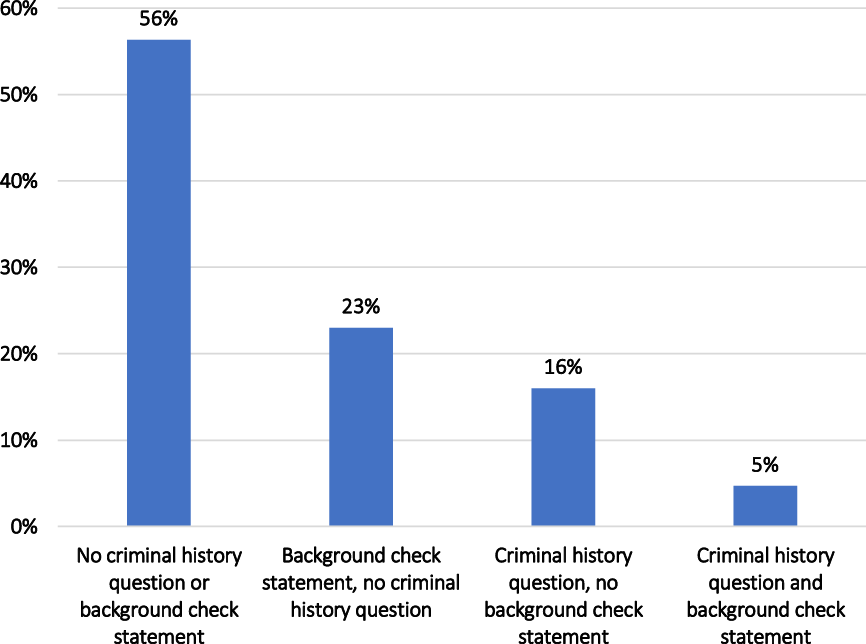
We observed a considerable proportion of applications in our sample that contained a background check statement, a sentence or paragraph indicating that applicants must consent to a criminal background check to be considered for the position. These statements could represent an alternative gatekeeping mechanism, like the criminal record question, by warning applicants that the employer still has access to criminal record information. These statements sometimes specified that a criminal record would not necessarily disqualify someone from employment, while others sometimes listed specific offenses that would be disqualifying. As displayed in Figure 4, approximately 56 percent of applications did not contain a criminal history question or a background check statement in 2016. However, another 23 percent of applications included a background check statement but no criminal record question. That is, almost a quarter of firms indicated on their job application that a criminal background check would be required, thus sending a signal about the use of criminal history in hiring, even though they were technically compliant with the BTB law. Considering noncompliance with BTB, an additional 5 percent or applications had both a criminal history question and background check statement, while 16 percent only had the criminal history question.
Background checks and criminal history questions in 2016.

Background check statements varied considerably. Some firms boldly announced that they would be conducting background checks on the first page of their application, while other statements appeared in fine print near the end of the application. Some applications made clear that candidates would not be disqualified based on their record alone, though it is unknown whether applicants would believe this based on the statement itself. Conversely, a small proportion of these applications stated that persons with specific convictions—for example, theft, assault, or drugs—could not or would not be hired for certain positions but maintained that applicants would not be disqualified based on other criminal history or for other positions. Again, varying levels of gatekeeping are apparent among these statements.
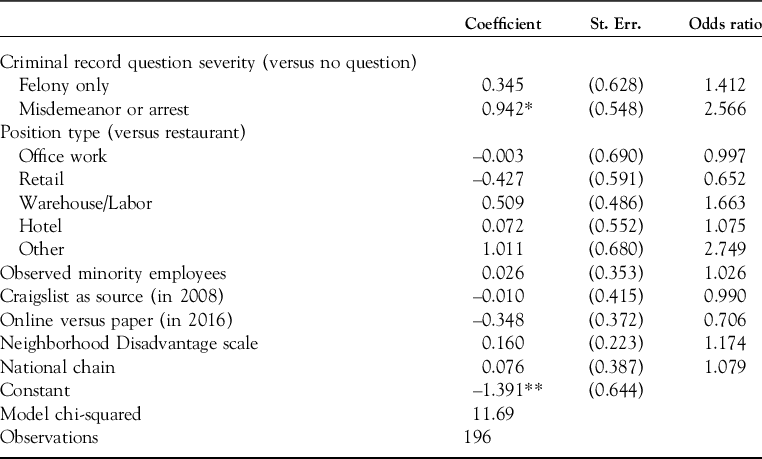
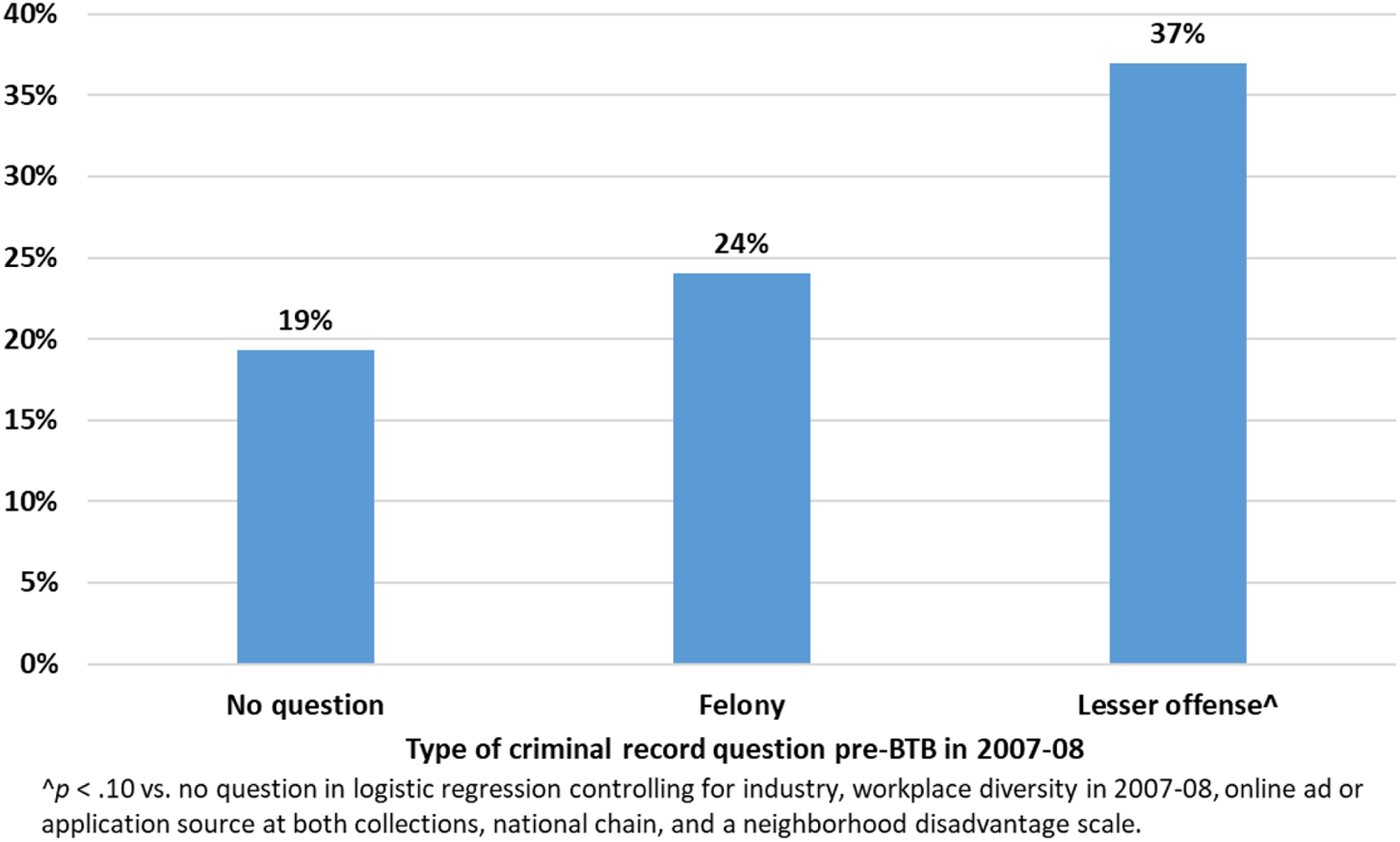
Table 4 shows the results of a logistic regression model for background check statements. Overall, the covariates are largely nonsignificant in predicting 2016 background check statements, although businesses with more restrictive criminal record questions in 2008 may have been more likely to have a background check statement in 2016 (p < 0.10). That is, the odds of a background check statement among employers that asked about lesser offenses beyond felonies in 2008 were 2.57 times more likely to include a background check after the passage of BTB. As shown in Figure 5, among employers who asked the most encompassing form of criminal record question in 2008, 37 percent had a background check statement in 2016. By comparison, 24 percent of those with a felony-only question and 19 percent of those with no question included a background check statement in 2016. In the presence of a BTB policy, at least among those who were compliant, this background check would represent the primary form of information about an applicants’ criminal history, complemented with simple internet searches. Thus, we next consider how our interviewees used such alternatives to the criminal record question.
Logistic regression for presence of background check statement on 2016 job applications

Notes:
* p < 0.10, ** p < 0.05
Percentage of post-BTB 2016 sample with a background check statement.

Use of Background Checks
Of the fifteen people interviewed, zero said that they ran background checks on all job applicants, and five interviewees claimed that they had never conducted a background check on an applicant. Put differently, ten of the fifteen people interviewed had used a background check for at least one applicant. The five businesses that did not conduct background checks employed anywhere from twenty to eighty employees and spanned a variety of industries. Of the ten hiring managers who ever ran a background check on an applicant, several outsourced the background check to a human resource official or business and did not run the check themselves.
Of the ten interviewees who reported conducting background checks, four asserted that they only run background checks on applicants when they plan to extend an offer (otherwise known as a conditional hire). Chuck, the construction company manager quoted earlier saying interviewing is largely a “crapshoot” explained: “When we know that we’re gonna hire somebody, yeah, we do the background check … if [that] comes back favorable, we hire them.” Although Chuck’s local business did not have a criminal history question on their application in either 2008 or 2016, he did rely on background checks on applicants at the conditional-hire stage. Several other interviewees, including Eddie, the formerly quoted restaurant manager, stated that they only conduct background checks for promotions of in-house entry-level workers to managerial positions, such as when a server is promoted to an assistant manager.
Some of the employers in the sample, such as Bob from the dry cleaners, stated that they used general internet searches on their applicant pool for entry-level positions and then background checks for applicants they wanted to hire. Bob said, for example: “I wouldn’t spend the money to investigate somebody if they didn’t impress me much.” Other managers only used background checks on higher-ranking positions. Olivia, the manager of a suburban country club, told us her firm “only runs a background check for a comptroller … like a CFO” rather than for any entry-level employees. Thirteen of the hiring managers in our sample said that they would hypothetically feel comfortable using a background check, indicating that they do not view the use of background checks as being in conflict with the reasoning behind the BTB law. Although background checks are not prohibited before in-person contact in the Minnesota BTB law, using a background check to eliminate an applicant at the earliest stage would essentially produce the same outcome. Again, almost no employer in our sample used background checks on their entire pool of applicants, and a majority of them used them only on applicants at the conditional-hire stage. As opposed to using a noncompliant application or including a background check statement on an application, the use of background checks at the earliest stages of the application process does not appear to be a primary mechanism of excluding applicants with records.
Only one interviewee disclosed conducting background checks before an interview, which is unsurprising since conducting background checks costs money, making it unlikely that many employers would have the resources or time to conduct them for entire applicant pools. While no interviewee claimed to run background checks on the entire pool of applicants, and background checks themselves do not appear to be a gatekeeping mechanism for any business in the sample to discriminate against applicants at the first stage of the job application process per se, background checks at the conditional-hire stage may continue to exclude applicants with criminal records.
DISCUSSION
The goals of BTB policies are to allow individuals with criminal records to get a foot in the door with employers by delaying knowledge of an applicant’s criminal record until the interview stage. At that point, applicants with records can then use stigma management strategies and more selective disclosure to increase their chances of employment (Harding Reference Harding2003; Augustine Reference Augustine2019; Goodman Reference Goodman2020). Applying for jobs, however, is a complex two-sided process. When BTB policies are passed, there may be differential adoption and effects among the employers responsible for implementing them. To examine this phenomenon, we capitalized on a previous data collection effort prior to public and private BTB policies in Minnesota. We revisited organizations to determine whether they comply with BTB, their awareness of BTB, the effects of BTB on hiring practices, and the use of background checks as an alternative to criminal record questions. We found that one in five employers in our sample were noncompliant and that noncompliance is more likely among employers that previously discriminated against applicants with criminal records. We also found that, whether compliant or not, our participants expressed that they were either unaware of BTB or informally learned about the policy from other workplaces. Indeed, interviews from the same organizations before and after showed considerable continuity, and employers still relied on organizational preferences and personal discretion to make hiring decisions. Finally, we found that background checks, which are not prohibited by the private Minnesota BTB law, still offer a mechanism for employers to uncover records, and that statements declaring that such checks would occur were common. Below, we detail each of these findings and their implications for scholarship on the sociology of law, discrimination, and social change.
Our sample of job applications from 2016 showed that a nontrivial number of organizations were noncompliant with the BTB laws. Over two years after the private BTB law went into effect, 21 percent of our sample continued to ask a criminal history question on their application. Analysis of our prior data collection of applications and our audit of employer callbacks prior to BTB revealed that noncompliance was not significantly different across job types and that businesses that discriminated against job applicants with a criminal record in 2008 were much more likely to be noncompliant with the BTB law in 2016. These noncompliant businesses neither removed their criminal history question nor responded to the coercive element of potential economic sanctions for noncompliance. The lack of actual economic sanctions through 2016 and the relatively weak enforcement in general of the law in Minnesota may have influenced the rate of noncompliance (Kelly Reference Kelly2010). This noncompliance undermines the intention of BTB, such that the law does not translate to increased face time between applicants with criminal records and hiring managers and perpetuates the labor market disadvantage of such applicants. However, this finding should be interpreted within the study context, in which the Minnesota Department of Human Rights lacked the resources to formally communicate the parameters of the legal change to firms or to resources to assess noncompliance and enforce sanctions on noncomplying firms. In other settings, BTB laws may be backed by different state tools and resources that reduce noncompliance and enhance compliance.
Next, we examined employer knowledge regarding BTB, including the source of BTB information (or lack thereof). Echoing Kelly (Reference Kelly2010), we showed through our interview data that some BTB noncompliance may be a “failure to update,” insofar as organizations fail to update preexisting practices due to a lack of familiarity or knowledge of the legal changes. Kelly suggests that a lack of state resources to enforce laws, proper notification of legal changes, and economic sanctions may all lead organizations to fail to update, which is a form of passive noncompliance (Kelly Reference Kelly2010, 54–58; see also Simpson and Koper Reference Simpson and Koper1992; Edelman and Talesh Reference Edelman, Krieger, Eliason, Albiston and Virginia2011). Several of our respondents displayed limited knowledge of the BTB law; approximately half were hiring managers of smaller businesses without human resources or other legal personnel, and either knew nothing about BTB or were only vaguely aware of the law from what they had heard through the grapevine of their communities. Somewhat surprisingly, the hiring managers of national chain businesses were also generally uninformed about BTB. A handful of chain managers knew of the law, including Tina, whose business was compliant, and one firm was knowingly noncompliant, and the manager Derek attributed this attitude to their relaxed perceptions of criminal histories. As Derek’s business was not discriminating against applicants with criminal records, they did not feel the need to comply with the BTB law, even for symbolic reasons.
When hiring managers were aware of BTB, they described learning of the policy and its requirements through either human resource office personnel or legal contacts or their organizational networks (DiMaggio and Powell Reference DiMaggio and Powell1983). Organizations that had access to human resources or staff attorneys engaged in coercive isomorphism, complying with the law to avoid sanctions, while organizations without these contacts engaged in mimetic isomorphism when they noticed criminal history questions disappearing from job applications in their organizational networks to retain legitimacy, echoing past work on organizational behavior (DiMaggio and Powell Reference DiMaggio and Powell1983; Dobbin et al. Reference Dobbin, Sutton, Meyer and Richard1993). Future research, perhaps spanning multiple labor markets, could assess whether and how different sizes of businesses or the presence of human resources departments or legal services influence employer responses to BTB laws.
Taking advantage of within-organization longitudinal qualitative data, we next explored whether BTB affected hiring practices. We found that, within organizations, hiring managers’ reported hiring practices and preferences were extremely similar in 2008 and 2016. Organizations in our sample that had an institutional preference for screening applicants did so before BTB was mandated in Minnesota, while organizations that preferred not to hire applicants with criminal records continued to discriminate after BTB. In line with work by Mona Lynch (Reference Lynch1998), the on-the-ground “field agents,” who are supposed to enact legal change, often behaved based on their institutionalized previous practices or their own attitudes. We found that hiring managers did not perceive the BTB law as having changed with their hiring practices and that organizations largely treated hiring practices the same way between 2008 and 2016, paralleling similar qualitative studies examining how changes to police and correctional officer practices may result in few changes to outcomes (Skolnick Reference Skolnick1966; McCleary Reference McCleary1978; Lemert Reference Lemert1993). Moreover, hiring managers in our study described their “gut feeling” about an applicant as ultimately determining that applicants received callbacks (Rivera 2015), with over half of the interviewees invoking this language to describe their hiring process. This continued emphasis on hiring manager intuition and discretion may perpetuate both conscious and unconscious prejudices against applicants, as prior research shows that feelings of “fit” between hiring managers and applicants are shaped by social biases and status inequalities (Moss and Tilly Reference Moss and Chris2001).
Finally, we showed that a significant portion of applications contain background check statements, indicating a future background check on applicants that can be discouraging to people with criminal histories. Almost one-third of applications contained such a statement. Our interview data suggest that most employers only initiate background checks for individuals to whom they plan to extend an offer rather than for the entire applicant pool. However, several expressed ambivalence about hiring applicants with a criminal record, suggesting that the background check may continue to serve as a barrier, specifically after the interview stage but before an offer of employment is made. Moreover, we found that, for the presence of a background check statement on an application, organizations that previously asked more encompassing criminal record questions were more likely to now have such statements, although we note that this effect was marginally significant. As background check statements are technically not prohibited in the specific wording of the 2014 private BTB law in Minnesota, this finding showcases the way in which firms symbolically comply with legal mandates but continue to enact their preferences in hiring decisions in new, but equally discriminatory, ways (Edelman Reference Edelman1990, Reference Edelman1992). Firms construct legal responses to mandates that do not technically violate the wording of the mandate but still accomplish the preferences and desires of the organization—in this case, “taste” for discrimination may present as including statements meant to discourage persons with criminal records from applying to jobs at their business.
For individuals with criminal records, employment is vitally important. Employment not only serves as a “turning point” (Laub and Sampson Reference Laub and Sampson1993) or a “hook for change” (Giordano, Cernkovich, and Rudolph Reference Giordano, Cernkovich and Rudolph2002) in the life course or a necessary condition for post-release but also as a means of survival. There are many obstacles between employment and people with criminal records, including spatial mismatch between available jobs and their residences (Sugie and Lens Reference Sugie and Lens2017; Rucks-Ahidiana, Harding, and Harris Reference Rucks-Ahidiana, Harding and Harris2021), discouragement and dropping out of the formal labor market in favor of more accessible, but less sustainable, “foraging” work (Sugie Reference Sugie2018), and discrimination in the callback stage of the application process (Pager Reference Pager2003, Reference Pager2007). Moreover, people with criminal records suffer from higher-than-average rates of homelessness, disability, mental illness, and isolation (Western Reference Western2018), and are disproportionately low-educated racial and ethnic minorities (Western and Pettit Reference Western and Becky2004; Shannon et al. Reference Shannon, Christopher, Jason, Melissa, Sara and Michael2017). Employment is often a necessary (but insufficient) condition required to ameliorate these disadvantages.
BTB laws are intended to reduce barriers to employment for those with criminal records. While evidence for the efficacy of BTB laws has been mixed thus far (D’Alessio, Stolzenberg, and Flexon 2015; Craigie Reference Craigie2019; Rose Reference Rose2021) and may result in statistical discrimination against African American men without records (Agan and Star Reference Agan and Sonja2018), we show that a lack of compliance with BTB persists and that background checks may render the removal of criminal history questions useless. We link prior discrimination based on criminal records with later noncompliance with the BTB effort to address such discrimination—through outright noncompliance and subverting the intent of the law via background check statements. Barriers to applicants with criminal records will remain in place if firms and their on-the-ground agents do not comply with the laws and continue to exclude applicants based on their criminal record status.
There are some limitations to the methods used in this study, which largely relate to generalizability. The study is limited to a single labor market in Minnesota. The structural aspects of the labor market of the Twin Cities metropolitan area that contribute to noncompliance may not be generalizable other labor markets, particularly those of different sizes or with varying levels of racial and ethnic diversity. Relatedly, although we find that our 2016 quantitative and qualitative data parallel our original data collection on most measurable characteristics, we cannot completely eliminate the possibility of selection bias. For our longitudinal quantitative analysis of job applications, we only analyzed organizations that remained open between 2008 and 2016 and could be successfully contacted by the authors; it is unclear how the missing data due to business closures affects our findings. In light of these limitations, we still find a sizeable portion of organizations continuing to ask applicants about their criminal history and that those who discriminated against applicants with records in 2008 were more than twice as likely to be noncompliant in 2016. For the qualitative data, hiring managers that accepted an interview may have been biased toward or against hiring those with criminal histories, which may influence the interview results. Similarly, although we employed no deception in recruitment, some interviewees may have held back their thoughts during interviews to seem more progressive toward applicants with criminal records to maintain social desirability. Nevertheless, we show that, even in our small sample, the hiring managers expressed a broad range of attitudes regarding applicants with criminal histories, and there was continuity demonstrated within organizations, tempering our concerns over selection effects.
In line with previous research on legal change, legal ambiguity, and organizational behavior, BTB legislation had a limited effect on organizational hiring practices, did not impact hiring managers’ perceptions of how they made hiring decisions, and did not affect how they feel about job applicants with criminal backgrounds. We contribute to the literature on legal compliance and noncompliance by illustrating how contexts in which legal changes are paired with few to no enforcement mechanisms resources result in organizational noncompliance and continued discriminatory behavior. Further, laws worded in ways that can be widely interpreted lead to symbolic constructions of compliance that do not translate to on-the-ground changes in organizational practices.Footnote 9
We acknowledge that our study took place under unique and specific circumstances. While the BTB law had been in effect for over two years before the second round of our study began, the law was not communicated to a wide network of businesses and was not reliably enforced in terms of legal sanctions against non-compliers. That said, our findings suggest that the evaluation of laws that ask organizations to significantly change business practices may require an investigation into state behavior, such as the intensity of the state’s notification efforts to businesses, the immediacy and certainty of sanctions for noncompliance, and/or the number of personnel and resources dedicated to ensuring laws are enforced by other means.
Organizations adapt to legal mandates in a variety of ways; some construct symbolic compliance with laws (Edelman Reference Edelman1990, Reference Edelman1992, Reference Edelman2016), which then diffuse across the field to other organizations (DiMaggio and Powell Reference DiMaggio and Powell1983); some align their practices with practices modeled by the state (Dobbin and Sutton Reference Dobbin and Sutton1998); and some fail to update their existing practices at all (Kelly Reference Kelly2010). Responses to BTB have followed the pattern of many previous legal mandates intended to combat prejudice and discrimination, such as lack of compliance, symbolic compliance that works in the favor of the organization’s preferences, and a minimization of major behavioral changes. We add to this literature by demonstrating a corresponding lack of underlying attitudinal change. In response to BTB, organizations generally evaded changing their on-the-ground practices; while most removed stigmatizing criminal record questions from their applications, many continued to use criminal background checks and put stigmatizing criminal background check statements on their applications. Among our participants, most continued their hiring practices as they did before BTB, making almost no changes in their hiring process or disclosing any changes in their attitudes toward hiring applicants with criminal histories.
Our findings suggest that policy makers who seek to use legal mandates to enact social change must take several actions: first, they must have the resources to proactively notify businesses of legal change; second, they must actively enforce legal mandates and sanction noncompliance; and, third, they must construct legal mandates in ways that limit opportunities for subversion of intent, including additional gatekeeping mechanisms such as laissez-faire background checks. To effectively evaluate the impact of legal changes such as BTB, social and legal actors must do what they can to ensure compliance before adequately assessing the capacities and limits of new policy.