Introduction
Common mental disorders such as depression and anxiety are known to be major complications of pregnancy and their continuation into the postnatal period can impede the healthy development of the mother–child relationship.Reference Martins and Gaffan 1 Clinically, there is increasing recognition of the need for effective treatment of common psychological disorders in pregnancyReference Lewis, Bailey and Galbally 2 , Reference Galbally, Lewis and Buist 3 and extensive investigation of the long-term impact on child development. In this context, understanding the impact of maternal psychological health in pregnancy on fetal development is essential for consideration of the long-term implication for offspring’s mental and physical health. As fetal growth may provide a better indicator of intrauterine conditions than birth weight or size, the current review examines studies reporting on the impact of maternal depression, anxiety or stress over pregnancy on fetal growth measured using ultrasound biometry.
Prenatal depression, anxiety and stress
Maternal depression, anxiety and stress are common during pregnancy. Prenatal depression has been reported to be more prevalent than postnatal depression,Reference Andersson, Sundström-Poromaa, Wulff, Aström and Bixo 4 with some studies reporting prevalence as high as 22% in first trimesterReference Lee, Lam and Lau 5 and others reporting higher prevalence in second trimester (13%).Reference Bennett, Einarson, Taddio, Koren and Einarson 6 Depressive disorders include several diagnostic subtypes; the most common being major depressive disorder (MDD) and dysthymic disorder. Dysthymia involves chronic and persistent depressed mood across at least 2 years, whereas MDD involves daily symptoms of depressed mood and loss of interest or pleasure over a period of at least 2 weeks. 7
The prevalence of perinatal anxiety has been reported to be ~7%.Reference Andersson, Sundström-Poromaa and Bixo 8 Anxiety disorders also consist of various subtypes including generalized anxiety disorder involving chronic worries about everyday life and specific experiences of anxiety such as social anxiety disorder or specific phobias. There are numerous reports of maternal anxiety and depression in the perinatal period being associated with offspring vulnerability to behavioral and emotional problems during childhood and adolescence.Reference Huizink, Mulder and Buitelaar 9 – Reference Lewis 11 Moreover, a number of findings suggest that maternal anxiety in particular may have specific programming effects for cognitive development. Several large studies have shown prenatal state anxiety to be associated with an increased likelihood of attention and hyperactivity problems, and the effect seems to be stronger for boys in some studies.Reference O’Connor, Heron, Golding and Glover 12 , Reference O’Connor, Heron, Golding, Beveridge and Glover 13
The current review also considers maternal experiences of major stressors over pregnancy. Notably, in the latest edition of the DSM, five posttraumatic stress disorder and acute stress disorder have been removed from the anxiety disorders classification and are now included under their own section for trauma and stress-related disorders. However, most studies examine stress not as a psychiatric disorder but in terms of exposure to major life stressors. A wide range of prenatal stress exposures has been examined in relation to child outcomes in epidemiological studies. These include self-reported stress predicting restless and disruptive temperament in toddlersReference Gutteling, De Weerth and Willemsen-Swinkels 14 , Reference Lewis and Olsson 15 and attention problems.Reference O’Connor, Heron, Golding and Glover 12 , Reference O’Connor, Heron, Golding, Beveridge and Glover 13 Several studies have found maternal experiences of life stressors in pregnancy to predict both emotional and behavioral problems in preschool children.Reference Lewis and Olsson 15 , Reference Clavarino, Mamun and O’Callaghan 16 One often cited study found that pregnancy exposure to a major life stressor, namely the WWII German invasion of the Netherlands, was associated with higher rates of adult-onset schizophrenia.Reference van Os and Selten 17 Although most studies rightly separate depression, anxiety and stress exposures, it should be noted that clinically these commonly co-occur and may also unfold in a sequential manner. For instance, exposure to major stressors may be accompanied by anxiety symptoms, which may then increase the risk of depression.
Birth weight and fetal growth
Restricted fetal growth is known to be associated with a number of poor neurodevelopmental outcomes in childhood.Reference Murray, Fernandes and Fazel 18 In particular, growth restriction is associated with delays in motor, cognitive, social and behavioral development.Reference Levine, Grunau and McAuliffe 19 It is well known that birth weight has been a central focus of the fetal programming paradigm. The initial epidemiological studies undertaken by BarkerReference Barker 20 – Reference Barker 22 developed a comprehensive model of fetal programming based on associations between birth weight and later increases in rates of cardiovascular disease and its primary risk factors of hypertension and diabetes. The Developmental Origins of Health and Disease model however implies that birth weight is only a proxy for endocrine and nutritional factors influencing the intrauterine environment, which is the major factor driving these later health and disease outcomes.Reference Gluckman, Hanson and Bateson 23
There is now robust evidence that prenatal mental health is associated with poor birth outcomes. A number of reviews have already reported consistent associations between both antenatal depression and anxiety, and both birth size and postnatal growth rates. FieldReference Field 24 reviewed this literature and concluded that infants of depressed mothers were more likely to have low birth weights and be premature. A recent meta-analysis of 12 studies reported maternal anxiety to be significantly associated with a 76% increased risk of low birth weight.Reference Ding, Wu and Xu 25 Another recent meta-analysis of 29 studies of prenatal depression found increased risk for preterm birth, low birth weight and intrauterine growth restriction (39, 49 and 45% increased risk rates, respectively).Reference Grote, Bridge and Gavin 26
Patterns of fetal growth
However, birth size is only an approximate index for fetal development and must be interpreted in the context of gestational age at delivery. In addition, examining birth size alone may overlook important intrauterine programming mechanisms related to the broader concept of fetal growth and the clinical diagnosis of fetal growth restriction (FGR).Reference Simmons 27 , Reference Baschat 28 FGR can be caused by infection, genetic abnormalities, teratogenic and neurotoxic exposures or obstetric complications such as pre-eclampsia and other hypertensive conditions. Depending on the cause, differences in the timing and degree of restriction in fetal growth impact on different parameters of growth and with different effects. For example, there are distinct early- and late-onset growth restriction patterns and each has been shown to predict differences in the type and severity of child neurodevelopmental outcome.Reference Baschat 28 In early-onset FGR there is a disproportionate reduction in head growth and overall reduction of fetal size and this has been found to predict an increased risk of cerebral palsy as well as a wide spectrum of psychomotor and cognitive delays.Reference Wells, Shea and O’Connell 41 , Reference Lo, Mertz and Loeb 42 The impact of late-onset FGR with slowing head growth in late pregnancy is more subtle and shows associations with a decrease in perceptual performance, motor ability, cognition, attention and memory and in some cases an impact on future school achievement.Reference Maina, Saracco and Giolito 43 The relationship between head growth and neurodevelopment appears to follow a clear biological gradient: one recent study found that for each standard deviation reduction in head size there was a corresponding increase of 10% in suboptimal outcome.Reference Fattal-Valevski, Toledano-Alhadef and Leitner 29
Patterns of growth restriction need to be understood in the context of fetal adaptations to placental insufficiency and the associated hypoxic–ischemic intrauterine environment. Such adaptations are designed to promote survival and maximize fetal brain growth in the context of placental dysfunction, which depending on the cause, may be acute or chronic.Reference Baschat 28 Fetal adaptation takes the form of alterations in vascular flow and can be identified clinically by a reduced Doppler pulsatility index in the middle cerebral artery. This indicates a redistribution of cardiac output toward the myocardium and brain. These vascular changes imply fetal adaptations designed to spare brain growth and function at the expense of liver and lung growth and show up as biometric reductions in abdominal circumference (AC). Thus, when brain growth as measured by head circumference (HC) is spared, an asymmetric growth pattern is observed as reflected in the HC/AC ratio. However, if hypoxic and ischemic conditions persist, head growth cannot be maintained and the fetus becomes symmetrically growth restricted. Given that this represents an end stage in a continuum of features of progressively more severe FGR, it is not surprising that reduced fetal HC is one of the most consistent predictors of adverse child neurodevelopment.Reference Baschat 30
The assessment of growth is complex and needs to consider both pathological and non-pathological factors. Non-pathological factors include gestational duration, fetal gender, maternal size and age, parity, and ethnicity.Reference Blair, Liu, de Klerk and Lawrence 31 In this review, prenatal measures of fetal size typically included the estimated fetal weight (EFW), the HC and AC. However, we were interested also in the HC/AC ratio, given its ability to capture the degree of asymmetry in growth restriction.
Mechanisms for the impact of maternal mental disorders on fetal growth
The specific mechanisms by which maternal mental disorders may impact on fetal development are currently unclear. However, it is possible to integrate a number of areas of investigation to map out some of the likely processes involved. First, maternal psychological distress is often (but not always) associated with modifications in neuroendocrine function such as elevations in the maternal stress response reflected in changes in cortisol regulation, alteration in levels of adrenocorticotropic hormone and adrenaline and noradrenaline.Reference Seckl 32 , Reference Diego, Jones and Field 33 However, this is complicated by the fact that the maternal circulation of glucocorticoids naturally increases across pregnancy.Reference Seng, Rauch and Resnick 34 Some studies have also found that levels of corticotropin-releasing hormone (CRH) in mid-pregnancy are associated with prenatal, but not postnatal depression.Reference Rich-Edwards, Mohllajee and Kleinman 35 Any transmission of maternal conditions to the fetus passes through the utero–placental system and it is important to recognize that vascular and placental biology is complex and may moderate, adapt to or exacerbate such maternal conditions for the fetus.Reference Robinson, Chidzanja and Kind 36 A number of studies, both animal and human, suggest that elevations in maternal hypothalamic pituitary axis (HPA) and sympathetic nervous systems induce restrictions in uterine vasculatureReference Stjernquist and Owman 37 and in sheep it has been shown to reduce fetal insulin levels.Reference Diego, Jones and Field 33 Another emerging area of research has focused on 11β-hydroxysteroid dehydrogenase (11β-HSD2), which inactivates maternal cortisol during its passage across the placenta. Animal studies have shown a link between high maternal stress and reduced placenta 11β-HSD2 activity and a small number of recent findings indicated there may be a similar pattern in humans.Reference O’Donnell, O’Connor and Glover 38
As BarkerReference Barker 21 has argued, fetal adversity, even for a short period, can slow and therefore alter the patterns of rapid cell division in fetal development, either as a direct effect of under nutrition or via changes in the function of growth or endocrine factors. Fetal neural development may be impacted in a similar manner, influencing not only cell density and function but also the developing connectivity across developing brain regions.Reference Massaro, Rothbaum and Aly 39 It is possible that these processes result in not only intrauterine growth restriction or preterm birth but may also have long-lasting effects on mental health outcomes via fetal HPA axis (elevation or blunting of cortisol response, CRH elevations, changes in sympathetic nervous system and cardiovascular function) programming later maladaptive stress response or anxious temperament. So two alternations in neural networks may arise from different patterns of neuronal growth during fetal development and these may not result in psychopathology until later neural development such as during puberty or early adulthood in response to physical or psycho-social challenges.Reference Wu, Imhoff-Kunsch and Girard 40 Another important feature of the relationship between maternal mental health and fetal development that may have mechanistic implications is the use of antidepressants by pregnant women who experience both depressive and anxiety disorders.Reference Lewis and Olsson 15 The influence of antidepressants on fetal growth is also a matter of major clinical interest to obstetricians, psychiatrists and pediatriciansReference Clavarino, Mamun and O’Callaghan 16 and raises important research questions regarding safety and long-term child growth and development.Reference Galbally, Lewis and Buist 3
This current review aims to determine whether maternal depression, anxiety and stress predict reduced fetal growth. In particular, we were interested in effects on different fetal growth parameters and whether there are notable differences among maternal experiences of depression, anxiety and stress on fetal growth. Our focus was on the most prevalent mental health conditions in pregnancy and in this review we did not include search terms covering a wider range of prenatal maternal mental disorders including psychotic, bipolar, somatoform and eating disorders. In future reviews this would be of interest. This review also aims to make methodological recommendations for future studies of maternal mental health in pregnancy and fetal growth.
Method
Search strategy
A systematic search of abstracts and titles of peer-reviewed articles was conducted using PsycINFO, Medline, Web of Science, Embase and Scopus databases including papers up to July 2014. Search terms included two key concepts: anxiety/depression/stress and fetal growth. In order to identify studies investigating maternal mental health and fetal growth the following terms were used to systematically search databases: fetus OR fetal OR foetus OR foetal OR prenatal OR intrauterine OR grow* OR develop* AND depress* OR anxi* OR apprehens* OR stress* OR distress*. To narrow the search further in PsycINFO and Scopus the following terms were also included: maternal OR mum* OR mom* OR mother* OR woman*. Reference lists of identified relevant articles were searched for other appropriate articles.
Inclusion and exclusion criteria
Records were included for review if they met the following criteria: (a) fetal growth was measured during pregnancy via ultrasonography; and (b) one or more of depression, anxiety and stress were measured during pregnancy using a validated instrument. Studies were accepted in any language. Exclusion criteria included (a) studies that were not conducted on humans and (b) studies that only used birth outcome as a measure of fetal growth.
Data extraction
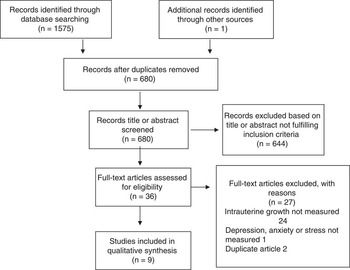
Two raters were used to extract data from identified studies and were highly consistent across independent ratings. Where disparities did arise in terms of reportable data, they were resolved in discussion. There was considerable heterogeneity in study methodology making the studies not suited to meta-analysis or calculation of a single statistical metric. Data were minimally transformed from the manner in which papers originally presented in their analyses. This included calculation of standardized β-values where association studies were presented and where appropriate data were provided in the publication. In the case of group comparisons M and s.d. were used to calculate Cohen’s d effect sizes. Multiple papers from the one study, as in the case of the two Generation R papers, were permitted and considered separately in the results and discussion. The assessment of confounding and study quality was undertaken and is also a point of commentary within the narrative report on each study and in a general sense within the discussion. Fig. 1 shows preferred reporting items for systematic reviews and meta-analyses (PRISMA) flow diagram for studies included.
PRISMA flow diagram of included and excluded studies.

Study quality
The Newcastle–Ottawa quality assessment scales for case–control and cohort studies were used to assess study quality.Reference Wells, Shea and O’Connell 41 This widely used instrument employs a starring system to rate the quality of methodological features across a total of nine items and has been extensively evaluated.Reference Lo, Mertz and Loeb 42 A maximum of one star for each item is allocated within three categories: participant selection, characterization of the exposure and outcome of interest, and a maximum of two stars for comparability that covers the degree to which adequate adjustment for covariates has been undertaken.
Results
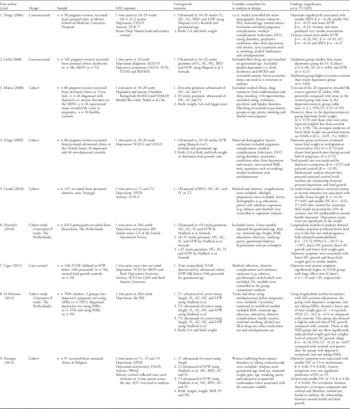
Each of the nine studies presented in Table 1 examined different aspects of the influence of depression, anxiety and stress on fetal growth. The studies differed considerably in which predictors were measured, the specific measures used and the number of time points used. In all but two studies, mental health was measured only once in pregnancy. Fetal growth was also measured at diverse intervals and in only three studies was growth measured more than once in pregnancy. Many studies also reported on birth weight.
Summary of studies and key findings

β, Standardized β weight; BAS, Behavioral Avoidance Scale; BIS, Behavioral Inhibition Scale; CES-D, Centre for Epidemiological Studies Depression Scale; DAS, depression, anxiety and stress; EPDS, Edinburgh Postnatal Depression Scale; GA, Gestational Age; GAD, Generalized Anxiety Disorder; HADS, Hospital Anxiety and Depression Scale; PRAQ, Pregnancy-Related Anxiety Questionnaire; SCID, structured clinical interview for DSM-IV axis I disorders; SCID-D, Structured Clinical Interview for the DSM-Dissociative Symptoms; SES, Socio-economic Status; STAI-T, State Trait Anxiety Interview-Trait; STAXI, State-Trait Anger Expression Inventory; AC, abdominal circumference; BPD, biparietal diameter; BMI, body mass index; EFW, estimated fetal weight; FL, femur length; HC, head circumference; IUGR, intrauterine growth retardation; MINI, Mini International Neuropsychiatric Interview; PI, ponderal index; T1, trimester one, T2, trimester two, T3, trimester three; MDD, major depressive disorder; BSI, Brief Symptom Inventory; SSRI, selective serotonin reuptake inhibitor; AUC, area under the curve.
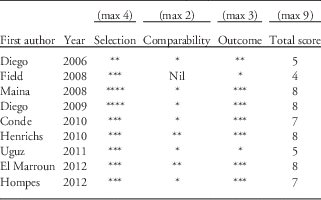
A summary of findings applying the Newcastle–Ottawa Scale to assessment of study quality is presented in Table 2 and this shows a reasonably consistent level of study quality with the majority of studies not obtaining maximum scores on comparability due to limited control for covariants such as maternal pregnancy diet as discussed further below.
Study quality ratings on the Newcastle–Ottawa Scale

Self-reported symptoms and diagnosed mental disorders
A total of five studies have investigated the associations of maternal depression, anxiety or stress with fetal intrauterine growth parameters by measuring mental health through either self-report measures or structured diagnostic interviewing to establish psychiatric disorders. All of these studies controlled for the effects of pregnancy complications, infectious diseases, diagnosis of other mental disorders, fetal sex, socio-economic status, maternal age and ethnicity. Of these studies, only one reported no association between maternal mental health and fetal growth.Reference Maina, Saracco and Giolito 43 Each study that measured associations between maternal mental health and fetal HC growth reported significant associations. In addition, each study that examined maternal mental health and fetal growth reported diverse findings on the specific fetal growth parameters impacted.
The only study not to report a significant association between maternal mental health and fetal growth was a study by Maina et al. who recruited three groups of pregnant women: one group who at the time of the study were diagnosed with an acute depressive and/or anxiety-related psychiatric disorder (n=20), the second group who had experienced at least one stressful life event during or within 1 year before pregnancy (n=20) and a healthy control group (n=40). The study reported two cases where AC was below the 10th percentile in the high-stress group (and no cases in the other groups) but this was not a significant between-group difference. No differences were found on uterine or umbilical Doppler velocimetry. However, the study did report that those fetuses exposed to maternal depression and/or anxiety had significantly lower mean birth weights compared with the healthy control group. This lower birth weight suggests some earlier form of growth delay and it is possible that growth slowed in the psychiatric and stress group only between the final ultrasound assessment at 34 weeks and birth, that is, late-onset FGR. However, in the light of findings from other studies under review, it is most likely that the small sample size of 20 in the high-risk groups has contributed to these non-significant findings.
Uguz et al.Reference Uguz, Gezginc and Yazici 44 measured the prevalence of FGR via ultrasound in third trimester using a multi-measures design by measuring maternal depression and anxiety using both self-report measures and diagnostic interviewing in third pregnancy trimester. They reported significant differences between the control and FGR groups on mean scores of the Beck Depression and Anxiety Inventory and on prevalence of major depression and generalized anxiety disorder diagnoses. A limitation of this study was that other possible causes of FGR were not measured or controlled in analyses, including maternal medical conditions, nutrition, body mass index (BMI) and socio-economic factors.Reference Grote, Bridge and Gavin 26 This study also measured fetal growth and maternal mental health at only 1 time point during pregnancy, which limits the range of possible analyses.
The remaining three studies were methodologically stronger in using repeated-measure designs. However, they reported conflicting results in regards to specific fetal growth parameters. For example, using a sample of 147 pregnant women, Conde et al.Reference Conde, Figueiredo and Tendais 45 measured depression and anxiety during the first and second pregnancy trimesters using self-report measures [Edinburgh Postnatal Depression Scale (EPDS) and State Trait Anxiety Interview-State (STAI-S)] and measured fetal growth parameters once via ultrasound (20–22 weeks gestation). In multivariate analyses where depression and anxiety from first and second trimester were entered together into a regression model, anxiety measured in the second trimester emerged as the strongest predictor of fetal growth outcomes. Specifically, growth parameters for fetal HC (only when maternal education and parity were controlled for in the model) and femur length (FL) were predicted. This important finding suggests that in a multivariate model maternal anxiety is a stronger predictor of fetal growth than maternal depression. Although this study was highly rated in terms of study quality, it did not control for maternal nutritional factors in pregnancy.
Perhaps clarifying the relationship between maternal mental health and fetal growth, the remaining two studies were both based on data collected in the Generation R Study based in Rotterdam, the Netherlands. Using a sample of 6313 pregnant women from Generation R, Henrichs et al.Reference Henrichs, Schenk and Roza 46 measured maternal depression, anxiety and stress once using self-report measures and measured fetal growth in both second and third trimesters. They reported that both maternal depression and anxiety were negatively associated with growth trajectories of fetal HC and weight gain; and neither were associated with growth trajectories of FL. Maternal depression was negatively associated with fetal AC growth trajectories, whereas anxiety was not. Interestingly, maternal stress (measured using the family assessment device) was only associated with smaller HC measurements when anxiety was not adjusted for in the analysis, suggesting that the effects of stress can be accounted for via anxiety. A limitation of this study was the lack of control for antidepressant use and a single measurement of depressive and anxiety symptoms using a symptom rather than diagnostic measure.
The limitation of controlling for antidepressant exposure was addressed in a subsequent paper from the same Generation R cohort, which investigated the effects of maternal antidepressant exposure during pregnancy and depression on fetal growth. El Marroun et al.Reference El Marroun, Jaddoe and Hudziak 47 reported that their single measure of mental health was taken at an average 20.6 weeks gestation and fetal growth parameters via ultrasound during each pregnancy trimester. Using the same study population but reporting a larger sample of 7696 pregnant women the study reported on 7027 control mothers (no or low-depressive symptoms), 570 who had clinically relevant depressive symptoms measured using the Brief Symptom Inventory (BSI) and 99 (1.28%) were exposed to selective serotonin reuptake inhibitors (SSRIs) during pregnancy. The study reported that fetuses with mothers experiencing clinically relevant depressive symptoms had reduced growth rates of HC and that fetuses exposed to SSRIs during pregnancy had a more pronounced reduction of HC growth. Interestingly, when 28 SSRI-using women who also experienced high-depressive symptoms were excluded from analyses, the association between maternal SSRI use and fetal head growth remained the same, possibly implying that the higher rate of reduced head growth may be linked more to the severity of depression rather than SSRI exposure. These findings are consistent with previous reports of the association of maternal depression with fetal HC growth, and suggest that further work on antidepressant treatment and fetal growth is required.
In design, scale and analysis, these two studies from Generation R are the most sophisticated studies in this area of research to date. They used a very large sample, repeated-measure design, complex non-linear regression modeling and controlled extensively for confounding in order to examine fetal growth across each pregnancy trimester. However, the one major limitation of both studies was that mental health was only measured once during pregnancy, and also using two brief subscales – anxiety and depression scale (six items each) – of the BSI. The study findings should therefore be treated with caution, as a single measurement on a brief instrument that captures symptoms reported over the last 7 days is unlikely to fully account for the often episodic symptoms of depression or anxiety, which typically fluctuate in intensity throughout pregnancy. Further, Henrichs et al. reported that the BSI was tested against the Composite International Diagnostic Interview in 917 Generation R women and this found very low positive predictive values for depressive (6.8%) and anxiety disorders (10.4%).
Mental health and neuroendocrine function
Each of the four studies that measured maternal mental health as well as maternal neuroendocrine function reported associations between maternal cortisol levels and fetal growth. In fact, each of these studies reported neuroendocrine function as better predictors of fetal growth outcomes compared with depression, anxiety and stress measured via self-report. All studies controlled for effects of pregnancy complications, infectious diseases, diagnosis of other mental disorders, fetal sex, socio-economic status, maternal age and ethnicity.
Using a sample of 40 depressed and 40 non-depressed women, Diego et al.Reference Diego, Field and Hernandez-Reif 48 measured EFW and cortisol levels at 18–20 weeks gestation. This study measured fetal weight and urinary cortisol levels at the time of the ultrasound assessment but only once during the course of pregnancy. Nevertheless, mediation analysis revealed prenatal maternal cortisol levels to mediate the relationship between maternal depression and fetal growth outcomes. The study reported no significant associations between depression and fetal growth rate after controlling for maternal cortisol levels. Again, this study did not control for maternal nutrition.
A similar effect of maternal cortisol levels on fetal growth was reported by Field et al.Reference Field, Diego and Hernandez-Reif 49 This study investigated the differences on fetal growth parameters between participants suffering from MDD (n=54) and dysthymia (n=48). The Structured Clinical Interview for DSM-IV Axis 1 Disorders was used to diagnose MDD and dysthymia and self-reports were also used to examine depression, anxiety, daily hassles, anger and behavioral inhibition. Cortisol was measured via urine samples. Ultrasound scans were administered once at 16–22 weeks gestation. The study reported that the dysthymia group had lower fetal growth measurements and decreased depressive, anxious, anger and behavioral inhibition scores on self-report measures. Dysthymia is a chronic state of depressive symptoms, which is likely to impact maternal functioning across much of pregnancy suggesting a greater likelihood of early FGR. Interestingly though, the dysthymia group reported higher cortisol levels and decreased fetal growth measures, suggestive of a mechanism in which maternal cortisol impacts on placental function and impacts on fetal growth from early in pregnancy. However, this study’s lack of longitudinal measurement prevents analysis of such a theory.
Diego et al.Reference Diego, Jones and Field 33 obtained similar results when maternal cortisol and norepinephrine were examined along with measures of maternal psychological distress. The study reported that both maternal psychological distress and neuroendocrine function were negatively associated with fetal growth parameters. Notably, when maternal socio-demographic factors, psychological distress and neuroendocrine function were examined in a structural equation model, prenatal cortisol was the only significant predictor of fetal weight. The study also reported that maternal psychological distress was significantly associated with maternal neuroendocrine function, further highlighting the pathway from maternal mental state to maternal HPA dysregulation resulting in FGR. Although this study was highly suggestive, there were some limitations due to the limited quality in the measurement of maternal mental health and urinary cortisol.
Using a more robust measure of maternal mental health, fetal growth and cortisol function, Hompes et al.Reference Hompes, Vrieze and Fieuws 50 recruited a sample of 91 pregnant women and repeatedly measured mental health and growth parameters in each pregnancy trimester. Notably, this study used a very robust protocol for the measurement of salivary cortisol at 4 time points across the day. The study measured maternal depressive symptoms using the EPDS and Hospital Anxiety and Depression Scale (HADS) (depression), and anxiety using the Pregnancy-Related Anxiety Questionnaire and HADS (anxiety). They reported depression was the only significant predictor of HC in third trimester in both the univariate and multivariate models, and that cortisol was a significant predictor only in the multivariate model. Further, that cortisol showed a significant association with growth of biparietal diameter (BPD), FL and AC between trimesters but not in a univariate model. Anxiety was associated with BPD growth in a univariate model only. Although this study used a more robust measure of fetal growth and maternal mental health than all other previous studies, the small sample size was relatively small. As distinct from Diego et al., as no correlation was found between depressive or anxious symptoms and cortisol, the authors concluded that cortisol does not mediate the relationship between mental health and fetal growth.
The studies by Henrichs and Hompes were the only two studies that reported analysis of fetal growth asymmetry using the HC/AC ratio in relation to maternal mental health. (Although it is to be noted that most other studies obtained data that would allow examination of this relationship.) Henrichs reported that while anxious symptoms were associated with HC and AC separately, there was no association with asymmetric growth. Depression was associated with head but neither abdomen nor HC/AC ratio, and it is interesting that these authors drew the conclusion that the fetus is unable to use an adaptive brain sparing growth pattern in the context of maternal psychological distress. However, Hompes reported a very different and suggestive set of findings. This study ran a multivariate model including symptoms of depression and anxiety, cortisol levels and importantly a measure of the way the mother builds her attachment relationship to the developing fetus (The Maternal–Fetal Attachment Scale) as predictors of the HC/AC ratio. This model explained a significant 28.9% of the variance with the attachment variable making the largest contribution in the model. In univariate models anxiety predicted differences in the HC/AC ratio. As the only existing studies of asymmetric fetal growth draw markedly different conclusions, this important question of whether the fetus can mount an adaptive alteration of growth pattern in the light of maternal psychological distress remains unclear.
Discussion
This systematic review presents an emerging body of evidence suggesting that depression, anxiety and stress experienced during pregnancy are consistently associated with FGR. These findings are consistent with those of earlier reviews focusing only on birth size.Reference Field 24 , Reference Mulder, de Medina and Huizink 51 , Reference Alder, Fink, Bitzer, Hösli and Holzgreve 52 However, the current review suggests that associations of growth with maternal depression, anxiety and stress can be detected early in pregnancy, that there may be important differences between exposure to depression, anxiety and stress, and that there may be important differences between subtypes of mental disorder such as MDD and dysthymia. There are also notable inconsistencies in results in the specific fetal growth parameters associated with maternal mental health and contradictory findings in terms of asymmetric patterns of fetal growth. There is some preliminary evidence for maternal cortisol levels as a mediator of maternal mental health and fetal growth but findings are not completely consistent in this area.
Fetal growth is a complex process that is regulated by a variety of factors including maternal and fetal genetics, maternal nutrition that determines nutrient and oxygen availability to the fetus, vascular placental dysfunction due to maternal health or pregnancy-related conditions, and the interaction of maternal and placental hormones.Reference Gicquel and Le Bouc 53 , Reference Owens 54 Clinically, FGR is diagnosed through ultrasound using a combination of fetal growth measurements and changes in fetal and placental vascular function through Doppler. It is notable that few studies examined this combination of both growth and changes in placental blood flow resistance. This may represent an important way of clarifying the mechanisms involved as, in fetal medicine, placental blood flow resistance is a strong indicator of hypoxic–ischemic events that are associated with developmental delays in studies of perinatal brain injury. As other studies have identified growth restriction to be linked with decreased myelination and decrease in serotonin production,Reference Romanini, Valensise, Ciotti, Arduini and Giorgi 55 , Reference Longo and Packianathan 56 there is room for continued work on biomarkers of fetal brain development associated with maternal mental-health-induced FGR.Reference Serpero, Bellissima and Colivicchi 57
Findings from the current review highlight the particular role of maternal anxiety over pregnancy as a key exposure for fetal development. The review found consistent evidence for an association between maternal anxiety and reduced fetal head growth. These are important findings that can be added to those findings already showing that maternal anxiety in pregnancy is a strong predictor of child attention and behavioral problems.Reference Clavarino, Mamun and O’Callaghan 16 , Reference Van Batenburg-Eddes, Brion and Henrichs 58 , Reference Van den Bergh, Mulder, Mennes and Glover 59 Only one study by Conde et al. examined the relationship between maternal mental health, fetal growth and fetal activity levels, and found that maternal anxiety did predict both lower growth and high fetal activity levels. This is a key finding as several studies have already shown that infants of mothers who showed high anxiety, particularly in early pregnancy, had fetuses with high rates of physical activity. In these studies this early marker was associated with a developmental pathway of irritable temperament and at 9 years these children showed higher activity levels, attention deficits, difficulty inhibiting behavior and higher aggression.Reference Van den Bergh and Marcoen 60 Although probably complicated by direct genetic transmission, it may well be that maternal anxiety in pregnancy plays a key role in the transmission of offspring attention deficit and hyperactivity disorder (ADHD) and impulsive temperament and this key hypothesis in child mental health needs further investigation.
An indirect mechanism by which maternal mental health may impact on fetal growth is in terms of an interaction between psychological distress and the quality of maternal nutrition.Reference Wu, Imhoff-Kunsch and Girard 40 Indeed, dietary enhancement may well be one of the most accessible and immediate interventions to preserve optimal fetal development in the context of maternal psychological distress.Reference Jacka, Reavley and Jorm 61 This pathway remains unexamined in this area of study. Although Barker’sReference Barker 20 original observations noted the effects on fetal development of maternal diet, these were based on relatively extreme circumstances such as famine. There is also likely to be a more complex bi-directional relationship between maternal mental health in pregnancy and the quality of nutrition. Diet quality has preliminary evidence as a risk factor for depression and anxiety in adults.Reference Barker, Kirkham, Ng and Jensen 62 Maternal ante and postnatal depression is also likely to impact on postnatal rates of lactation.Reference Keenan, Bartlett and Nijland 63 These associations are further complicated by the role of maternal obesity during pregnancy.Reference Rodriguez 64 Van Lieshout et al.Reference Van Lieshout, Taylor and Boyle 65 conducted a systematic review of 12 studies up until 2011 showing associations of maternal pregnancy obesity with offspring cognitive problems, attention deficit hyperactivity symptoms, eating disorders in adolescence and psychotic disorders in adulthood. Only four of the nine studies in this review controlled for maternal BMI, which remains one of the covariates inconsistently examined in this literature.
Other covariates inconsistently examined include antidepressant exposure and other medication use, cigarette smoking and alcohol consumption, and cannabis use. Women depressed during pregnancy have been found to be more likely to smoke cigarettes and take a variety of prescription medications.Reference Lewis, Bailey and Galbally 2 Maternal cigarette smoking during pregnancy is known to be associated with a significant reduction in birth weight.Reference Suzuki, Sato and Zheng 66 Maternal alcohol and cannabis use during pregnancy has known effects on growth, being associated with mothers delivering smaller infants and infants presenting features similar to those with fetal alcohol syndrome.Reference Hingson, Alpert and Day 67 Given that illicit drug use, smoking and alcohol use are more likely during pregnancy in the context of psychological distress, such factors should be routinely controlled in future studies.
The findings from the current review do not clarify whether antidepressant use during pregnancy is associated with effects on fetal growth. Two pathways are possible here: either medication use may reduce depressive symptoms and thereby reduce the impact of depression on fetal growth, or in an interactive fashion, antidepressants might potentiate the effects of depression on FGR. The clinical significance of this question is highlighted by the increasing prescription of antidepressants, growing from 2% in 1996 to 7.6% in 2004/2005 in the United States.Reference Andrade, Raebel and Brown 68 Henrichs et al. did not examine antidepressant use in their analysis of Generation R data, whereas El Marroun’s study of the same cohort did examine SSRI exposure, which was low by international standards at 1.2% of the sample. This study found that SSRI exposure did reduce depressive symptoms over pregnancy but was also associated with a greater degree of reduced fetal head growth compared with the depressed and non-medicated group. A number of additional analyses suggested that SSRI exposure may impact the rate of fetal head growth beyond the effect of depression alone. El Marroun’s study also found that the SSRI-exposed group were more than twice as likely to be born preterm. This is the only study to date to have sufficient power to separate the effects of depression and antidepressants on fetal growth and requires independent replication and long-term child follow-ups.Reference Galbally, Lewis and Buist 3 , Reference Galbally, Lewis and Buist 69 The findings are particularly important given that some researchers have suggested that by reducing depressive symptoms, antidepressants may also have an effect of protecting fetal development from the effects of depression in pregnancy. Optimal prescription practices during pregnancy remain a topic of lively debate.Reference Oberlander 70
There was considerable variation in the measurement of depression, anxiety and stress, potentially contributing to some of the inconsistencies in the literature. Most studies administered self-report measures that tend to be less accurate than structured interviews by trained mental health professionals and do not permit distinctions between subtypes of depressive or anxiety disorders.Reference Adams, Soumerai, Lomas and Ross-Degnan 71 There have also been concerns that commonly used measures of depressive symptoms may confound anxious or depressive symptoms in the perinatal period with somatic features of pregnancy such as fatigue and sleep disturbance.Reference Matthey and Ross-Hamid 72 Of particular note is that the majority of studies measured mental health symptoms at only 1 time point during pregnancy, which makes it difficult to draw conclusions about the timing of depression, anxiety and stress over pregnancy as an influence on fetal growth, given that these symptoms may be episodic. In the context of Field’s findings of distinct effects of dysthymia compared with MDD, this suggests that future studies should use a combination of structured diagnostic interview and repeated self-report of symptoms.
There are numerous methodological challenges that arise in the area and require careful consideration in future study design. Questions have been raised as to the reliability of repeated administration and inter-rater reliability of fetal ultrasound biometry. A review of the possible sources of inaccuracy suggested that inaccuracy can arise because of limited use of multiple measurements, poor image quality, differences in calibration of equipment and variation in administrator competence.Reference Dudley 73 Ideally, studies should employ quality control procedures for scanning data such as blinded repeat scanning by different operators and quality checks of all scans. The time points where fetal growth parameters were measured also differed between most of the studies. Studies that measure fetal growth at one or 2 time points may be less accurate and do not permit examination of the rate of growth over time. Of particular note is that major impacts on fetal development occur in early gestation and a distinct mode of early FGR has been identified as strongly associated with poor neurodevelopmental outcomes, however no studies in this review measured symptoms in this early gestational time period and most assessed mental health symptoms at around 20 weeks gestation. By this point, a substantial amount of organ growth has occurred. Measurement of fetal growth is complex and studies to date tend to focus on single parameters with mixed results. Blair et al.Reference Blair, Liu, de Klerk and Lawrence 31 developed a formula for optimal birth weight, which considered additional factors in fetal growth such as ethnicity, neonate gender, maternal height and parity. Design of fetal growth studies could benefit from a more integrated model of fetal growth taking into consideration such factors as well as different rates of growth over time. Consideration needs to be also given to the fact that the first half of gestation is dominated by placental growth, whereas fetal growth tends to increase rapidly from around mid-gestation onwards.Reference Owens 54 Research in this area is yet to integrate findings on the role of the placenta in facilitating fetal growth and studies examining the impact of maternal health on placenta size and function are rare.Reference Lewis, Galbally, Gannon and Symeonides 10 , Reference Seth, Lewis, Saffery, Lappas and Galbally 74
In conclusion, the current review has found that there is a small but reasonably consistent body of research that suggests that maternal psychological distress in the form of depression, anxiety and stress are significant factors in fetal development. Additional prospective, repeated-measure designs are required to investigate this complex relationship between maternal mental health in pregnancy and fetal growth. The field will also be advanced by studies that include measures of the possible mechanisms of this transmission. Further studies are also needed to address differences in fetal development across the heterogeneity within depressive, anxiety and stress-related disorders in pregnancy. Although not a focus of the current review, there are few studies examining the fetal growth patterns of mothers presenting with other mental disorders such as psychotic, personality and eating disorders, although birth outcomes in such cases suggest similar patterns of growth restriction.Reference Matevosyan 75 – Reference Stein, Murray, Cooper and Fairburn 77 Studies are needed which follow-up fetal growth patterns with examination of postnatal growth in order to examine whether these small growth differences have long-term clinical relevance in predicting functional and clinical outcomes. In addition, the issue catch-up growth needs to be considered in such follow-ups. Efforts to address mental disorders in pregnancy are significant not only in addressing the mother’s well-being but increasingly can be understood as a major preventative intervention for the developing child.Reference Lewis, Galbally, Gannon and Symeonides 10
Acknowledgements
None.
Financial Support
This review was undertaken without any financial support.
Conflicts of Interest
MG has previously received honorarium for speaking from Lundbeck. The other authors declare that they have no competing interests.
Ethical Standards
This paper is a review of published literature.