Does more civic engagement—mass participation in private associations and organizations—lead to more responsive democratic governance? Considerable research has argued that to be the case, and something of a scholarly industry has arisen that assesses the character, causes, and consequences of such engagement in countries around the world (as recent examples, see Mettler 2002 and Pattie, Seyd, and Whiteley 2003). The value of civic engagement for the health of democracy has been proclaimed too, by civic reformers inside and outside the academy (as examples from a voluminous literature, see Kirlin and Kirlin 2002 and Swain 2001). Notable attention is also being devoted to how higher civic engagement might be fostered by the educational system (e.g., Dubnick 2003). Yet we have no systematic evidence for the literal representational benefits of civic engagement.
Four scholarly works offer especially prominent arguments for the representational value of civic engagement. Fukuyama (1995, 3–32, 355–63), Oliver (2001, esp. 205), and Uslaner (2002, 218) propose distinctive, though related, conceptions of how civic engagement enhances civic values in the mass public and responsiveness by the political elite and government. Doubtless, however, the most systematic advocate for the influence of civic engagement on democratic responsiveness is Robert Putnam. In Bowling Alone Putnam argues that higher levels of civic engagement have two important effects. They increase the level of social capital, “social networks and the norms of reciprocity and trustworthiness that arise from them” (Putnam 2000, 19) and thus, second, increase the degree to which the mass public communicates its preferences to political leaders and achieves successful representation of those preferences in public policy (Putnam 2000, 338–49). In Making Democracy Work Putnam (1993, 89–91) also argues that civic engagement enhances democratic representation by facilitating interest aggregation and articulation.
Two key expectations are common to these arguments. The first is that greater civic engagement is associated with better representation of mass preferences in government policy. Second, the effect of civic engagement on government responsiveness is separate from those of conventional democratic participation in elections and voting. Indeed, Putnam (2000, 37) explicitly observes that voting is not a form of social capital, thus social capital and conventional participation must influence government in distinctive ways.
Verba and Nie's (1972) seminal work on mass political behavior offers a little-appreciated elaboration of these causal expectations. Verba and Nie (1972, 47–48, 322–27) distinguish civic engagement (that they refer to as communal participation) as being a form of mass political behavior that delivers “information” about group preferences especially well to the political elite. In contrast, voting participation in their argument places high “pressure” on the political elite to respond to mass preferences but provides little explicit information on those preferences. Political leaders may be particularly influenced, further, by civic engagement and the information it provides. Verba and Nie (1972, 323) even conclude that leaders may at times respond to the preferences of civic engagement activists to the neglect of general mass preferences. Thus Verba and Nie—like Putnam, Oliver, and Uslaner—expect civic engagement to have a direct causal effect on representational outcomes independent of the influence of other modes of participation such as voting, and their construction of the information and pressure inducing functions of different forms of participation explains how this can be the case.
Verba and Nie (1972, 326–27) also propose a second path by which civic engagement might influence representation—by way of an interaction with the level of voting participation. They argue that voting participation, which imposes pressure, interacts with civic engagement, which offers information on preferences, so that higher levels of both produce especially high and positive representational outcomes. They observe that “the general pressure of the vote appears to enforce the effectiveness of the other, more specific modes of participation” (326).
Putnam (2000, 22), however, elaborates the preceding general expectations by conceptualizing differences between civic engagement in bonding social capital organizations and bridging social capital ones. Bonding social capital organizations, which are often based on kinship or whose membership tends to be class-exclusive, are “inward looking and tend to reinforce exclusive identities and homogeneous groups.” Putnam cites fraternal organizations as a good example. In contrast, bridging groups are “outward looking and encompass people across diverse social cleavages,” as would be the case with civil rights and ecumenical religious organizations. Bridging organizations, further, particularly enhance “reciprocity,” the expectation that social exchanges in a community will be directed at mutual rather than individual benefit. These distinctions suggest that bridging-group civic engagement should engender positive representational benefits but that bonding-group engagement is harmful to the democratic process. It is only bridging groups, and not bonding social capital ones, that generate the reciprocity that is central to Putnam's expectations for the benefits of social capital. Bonding social capital groups, in contrast, promote exclusive interactions and values that encourage government responsiveness to the few instead of to the community at large.
These expectations about the two kinds of civic engagement comport with other conceptual observations. In Making Democracy Work (1993, 171–76) Putnam argues that social networks must encompass people of various social groups and statuses to engender reciprocity—as only bridging organizations do by definition. Fukuyama (1995, 23–32) and Uslaner (2002, 26–38) make related arguments. Other scholars have also concluded that some kinds of civic engagement may lead to values that compromise reciprocity, trust, and democratic processes (e.g., Fiorina 1999, Hero 2003, and Levi 1996, 47).
Like virtually every student of associational involvement, Putnam (2000, 48–64) also postulates that active and involved civic association membership will have different consequences than nominal membership. Active membership is widely believed to confer more benefits to individual organizational members and to the efforts of the organization itself to achieve its goals. Thus higher levels of active and involved membership in bridging and in bonding social capital civic associations can be expected to induce especially high positive and negative effects, respectively, on democratic representation.
The preceding distinctions suggest that levels of bridging-group and bonding-group civic engagement should have different direct effects on democratic responsiveness. But the second causal path that Verba and Nie suggest above implies that these two forms of civic engagement might also influence representation differently in interaction with the level of mass voting behavior. Higher levels of bridging-group civic engagement (whether nominal or active), first, might interact with higher voting participation to produce especially higher levels of responsiveness—because bridging groups are expected to promote community-wide values that would be reinforced by the pressure of voting participation. In contrast, high bonding-group engagement might interact with voting participation to depress responsiveness. Bonding-group engagement promotes exclusive rather than general values, and high levels of information about such values being transmitted to the political elite would moderate the expected positive effect of voting.1
Verba and Nie (1972, 176–80) provide what we judge to be unique evidence on a critical assumption for this expectation, one on which some critics of Putnam have raised questions. Even members of bonding-group civic associations with explicitly nonpolitical organizational foci reported notable levels of political discussion of community affairs in these organizations.
The preceding conceptual arguments about civic engagement have been very influential, but there is no compelling evidence for them. Only Berry, Portney, and Thomson (1993) provide explicit evidence on civic engagement and the representation of mass preferences—in analyses for five American cities. Yet the general implications of this research are unclear because the five cities were chosen because of high levels of civic engagement and the results cannot be generalized to the universe of communities that varies in levels of such engagement.
The remaining empirical work on the policy consequences of civic engagement and social capital does not address representation per se (e.g., Knack 2002 and Putnam 1993, 99–162, 2000, 287–335). Such analyses assess objective levels of policy outputs, outcomes, or innovation but not how any aspect of policy literally relates to mass preferences. Further, such analyses—and even those by Putnam—do not distinguish bridging and bonding engagement and rarely take account of nominal versus active membership. In the large, separate body of research on mass participation generally, only the work of Verba and Nie (1972) systematically examines the representational consequences of civic engagement. Yet Verba and Nie do not take account of the conceptual distinctions about civic engagement outlined above because their research preceded the development of these conceptualizations.
We examine the effects of active and nominal levels of bridging and bonding civic engagement in American communities on mass–elite agreement on community public policy priorities. Our tests are for the set of communities—and samples of their citizens and leaders—examined by Verba and Nie in Participation in America (1972). The parts of this data set that are critical to the present analysis—the data on mass–elite policy “concurrence,” on various community attributes, and on the communities of residence of the individual mass respondents—were not archived by Verba and Nie and were effectively lost. But Hill (2004) reconstructed and validated those data with help from participants in the original research project. This data set is perhaps uniquely valuable for studying the relationships of concern here too. Oliver's (2001) and Putnam's (2000, esp. 336–40) conceptions of the roles of civic engagement for democratic governance are especially relevant to local community settings. Further, Putnam's (2000, 48–64) empirical description of trends in civic engagement in the United States indicate that the Verba and Nie data were collected near the peak level of such engagement, when its effects on the democratic process should have been especially evident. Finally, the richness of the Verba and Nie data set allows us to carry out especially appropriate empirical tests of the expectations discussed above.
The expectations about civic engagement and representation that are summarized above imply the following specific hypotheses about mass–elite policy agreement that are testable with the Verba and Nie data on these communities.
H1: The higher the membership in bridging social–capital organizations in a community, the higher the agreement on the policy agenda between the mass public and the elite.
H2: The higher the membership in bonding social–capital organizations in a community, the lower the agreement on the policy agenda between the mass public and the elite.
H3: Higher active membership levels in bridging and in bonding social–capital organizations in a community should lead to especially higher and lower agreement, respectively, between the mass public and the elite on the policy agenda.
H4: Levels of bridging-group and bonding-group civic engagement will interact with levels of voting participation in communities to produce especially high levels and low levels, respectively, of agreement between the mass public and the elite on the policy agenda.
DATA AND MEASURES FOR THE HYPOTHESIS TESTS
Most of the data employed here come from the large, multipart effort to examine political behavior and representational processes in American communities that culminated in the publication of Participation in America. In that project a representative sample of the American public was interviewed in 1967 about a wide range of their political attitudes, the degree to which they engaged in various forms of conventional political behavior, and their assessment of political issues in their communities. Further, 64 communities with populations projected to be under 50,000 were chosen for oversampling so that estimates of average community mass attitudes and participation could be derived (Verba and Nie 1972, 345–49). Samples of political elites chosen by positional status were interviewed about their attitudes and participation in these 64 communities. The interview team also collected considerable data on the demographic attributes of these communities and on various political and nonpolitical organizations there.
The dependent variable in our analyses is Verba and Nie's measure of mass–elite policy “concurrence,” or agreement between the mass sample and the elite sample in each community on the policy agenda for that community. This measure comports closely with one of Oliver's (2001, 205), Putnam's (2000, 338–47), and Berry, Portney, and Thomson's (1993, 101–14) major assertions about the democratic consequences of civic engagement—that it increases communication between the mass and the elite. Along with these authors, we assume that higher scores on this measure are also associated with better representation of mass preferences in local government policy. This assumption is widely adopted, too, as reflecting one avenue by which such policy representation may be achieved—in analyses of dyadic representation between legislators and their constituents (e.g., Miller and Stokes 1963, 50–51), dynamic representation of mass preferences in national government policy (Stimson, MacKuen, and Erikson 1995, 545–46), and partisan representation across Western industrial democracies (Powell 2000, 248). Substantial empirical support also exists for this assumption, especially in the extensive dyadic representation literature—ranging from the original work of Miller and Stokes (1963) to the most recent paper on this subject by Hurley and Hill (2003).
The mass samples in individual communities used to create this measure ranged in size from 15 to 30, although the vast majority of communities had 22 or more such respondents. The elite sample was composed of the highest locally elected public official, the highest elected county government official, the highest official of the largest local Democratic and Republican party organizations, the head of the local Chamber of Commerce (or a near-equivalent private executive if there was no Chamber of Commerce), the editor or publisher of the local newspaper, and the highest official in the local school board.2
Both the mass and the elite samples are doubtless small, raising a possible concern about our ability to validly estimate mass–elite agreement in these communities. We have replicated our principal analyses, however, for subsets of the communities with relatively larger and smaller numbers of mass respondents—producing the same hypothesis test outcome (e.g., to accept or reject the null) and reasonably similar regression coefficients for all the theoretically important explanatory variables. Hansen (1972, 223, 230; 1975, 1187) presents a series of analyses that demonstrate remarkable similarities in levels and patterns of mass–elite agreement across different subsets of the full elite sample (e.g., government officials vs. private-sector individuals) and, thus, elite groups of varying sizes.
Both the mass and the elite samples were asked open-ended questions about the most important problems facing their communities and the responses were used to calculate the concurrence scores (Verba and Nie 1972, 412–14). “Component” concurrence scores were computed separately for each mass respondent with replies from the members of the elite sample about: (1) the elite respondents' own perceptions of the most important problems, (2) the elite respondents' perceptions of what the mass public viewed as most important problems, and (3) which problems the elite respondents themselves had been attempting to solve.
As an example, suppose a citizen stated that the crime rate was one of the most important community problems. If all the members of the elite sample in his or her community also said crime was such a problem, the mass respondent would be scored 100 on that response (or 50 if half the elite agreed, and so on). If all of the elite sample also perceived this to be an especially important problem for the public in their community, the respondent would be scored 100 on the second component. If all the elite respondents said that this was a problem they themselves were actively working on, the respondent would be scored 100 on the third component. Mass respondents were allowed to name up to two problems that were of particular importance in the community, and both responses were scored as outlined here.
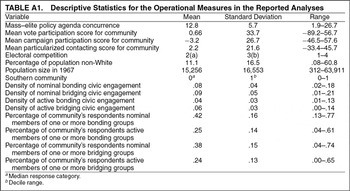
The above “component” scores computed for each mass respondent's named policy problems were then averaged, to create a single, overall concurrence score for that individual. Then all these individual concurrence scores were averaged for the mass respondents in a community to create a community-wide, mass–elite policy agreement measure. Higher scores on this aggregate measure indicate higher overall mass–elite agreement on community policy problems. (Descriptive statistics on this and all the variables analyzed in the paper are given in the Appendix.)
In response to the concern that individuals might agree about a policy problem but have different preferences for its solution, Verba and Nie (1972) specifically observe that “the problems mentioned were most often those for which agreement on the selection of a problem would imply agreement on the direction, if not the details, of a solution. Citizens and leaders complain about shortages of community facilities, job shortages, traffic, crime, pollution” (328).
For our most important explanatory variables, for bridging and bonding civic engagement, the Participation in America data allow us to create measures that comport closely with the concepts specified above.3
These data and the other mass-survey items used to create measures for our analyses are taken from the data set that Verba and Nie archived with the ICPSR under study number 7015. It was necessary, however, for the data reconstruction effort explained in Hill 2004, to discover which specific community each mass respondent resided in—information not included in the archived data set.
Mass respondents were queried about membership and active membership in
each of a long list of types of organizations. To categorize particular types of organizations as bridging or bonding ones, we adopted the general conceptions and particular examples in Putnam (
2000, 22–24). Thus we categorized fraternal organizations, labor unions, fraternities, sororities, farm organizations, study clubs, and professional societies as bonding groups. We categorized service clubs, veterans' organizations, political organizations, sports associations, school service organizations, and hobby organizations as bridging groups.
4 We did not code church-group membership into either type of organization because Putnam (2000, 22) observes that some religious associations can be characterized as bridging, and some as bonding, social–capital organizations. Further, the survey question about church-group membership used in the Participation in America study did not discriminate among the many kinds of such organizations that respondents might report engagement with.
We recognize that some associations provide a degree of both bridging and bonding engagement. Putnam (2000, 23) himself observes that these groups should be judged for relative degrees of each kind of social–capital experience. Thus there is some imprecision in any effort to associate particular groups with only one type of social capital, and some observers may believe different classifications of particular groups would be preferred. But we have followed Putnam's general and specific conceptions as closely as possible, and we report below detailed, supplementary analyses that support our coding of groups into categories.
We calculated two original kinds of measures of community engagement in these organizations, and we report hypothesis test results for both kinds to demonstrate the generalizability of our findings. We judge the first set of measures to be the theoretically most important because they comport not only with the distinctive characterizations of bridging and bonding groups but also with the discussion in Putnam (1993, 171–76) of the importance of the density of networks of civic engagement across an entire community or political system. These measures also reflect Granovetter's (1973, 1373–76) conceptualization of the density of individuals' social networks in a community—some of which are based in civic associations, which he styles as having benefits for individuals and the community that are very similar to Putnam's construction of bridging and bonding social capital.
Conceptually, the density of civic engagement refers to how extensive association memberships are across both mass respondents and a set of organizations in a community. To measure this concept of density, we follow Granovetter's examples of how the density of individual-level social networks can be extended to assess such density at the community level. Thus the operational definition, for example, of the density of active membership in bridging organizations is the total number of active bridging-group memberships reported by all the respondents in a community, divided by the product of the number of possible types of bridging organizations multiplied by the number of respondents. Higher scores on this measure indicate communities where more mass respondents are linked with each other in more bridging groups. Based on this conceptualization, we have created measures of the density of nominal and active membership in both bridging and bonding social capital organizations.
The second set of measures of civic engagement replicates generally those used in Putnam (2000, 48–64) and Oliver (2001, 20, 216–17), who did not have sufficient data to assess the theoretically preferred concept of density of engagement and thus measured simple, nominal, or active membership rates. One example measure here, then, for nominal membership in bridging groups, is the percentage of mass respondents in a given community who reported nominal membership in one or more of the types of bridging groups. We created comparable percentage measures for nominal bonding-group engagement, active membership in bridging groups, and active membership in bonding groups.
Hypothesis 4 about how levels of civic engagement might interact with levels of mass participation in elections requires a measure of voting participation at the community level. Our measure of this concept is taken from Verba and Nie's (1972, 56–81) intensive analysis of the “modes of participation,” which explored the underlying structure and dimensions for a large number of discrete measures of different types of mass participation in politics. Their principal components analysis of these data uncovered a separate dimension of voting participation at the individual level. Verba and Nie then aggregated the factor score measure for this dimension at the individual level into a measure of mean community-level voting participation for their own analysis of mass–elite policy concurrence. We employ the same community-level measure in our analyses.5
The measure of voting participation level by community is the original one created by Verba and Nie as opposed to the version they subsequently developed that is “corrected” for the effects of mass respondents' levels of socioeconomic status as a control for a rival explanation of mass–elite policy agreement. We control for rival explanatory variables like this directly in our analyses, but replication tests of our analyses with Verba and Nie's corrected measure of voting participation produce hypothesis test results for civic engagement identical to those reported here.
Other political and socioeconomic attributes of communities besides civic engagement, of course, may influence the degree of mass–elite policy agreement. Thus our analyses control for the theoretically and substantively most notable rival explanations of this form of democratic representation. First, abundant research assumes that such representational linkages are more successful when the participation of the mass public in politics is higher. Verba and Nie (1972, 47–48), recall, articulate some of the rationales for this common expectation—because higher mass participation generally increases pressure on the elite to respond to mass preferences, and some forms of participation contribute information about the nature of those preferences.
Thus our analyses control for the rival effects of all the “modes” of political participation that Verba and Nie (1972, 56–81) uncovered—that is, for community-level, mean voting participation, particularized contacting, and campaign participation.6
We do not control for the measure of communal participation created by Verba and Nie because it amounts to an aggregate of our separate measures of bridging and bonding social–capital civic association membership.
Prior research on representative democratic politics in various kinds of polities, and by Verba and Nie (
1972) and Hansen (
1972,
1975) specifically on the communities under study here, suggests that voting participation should be a particularly important influence on mass–elite policy agreement.
Second, considerable prior research also demonstrates that more competitive elections provide the mass public more choice among leaders and policy alternatives and lead to greater mass influence over actual policy (e.g., Dahl 1971, 23–26). Thus we control for the effects of the competitiveness of local elections with an original measure of that concept created for this analysis. That measure takes account of the facts that local elections in American communities may be legally partisan or nonpartisan and that the type of elections held in communities also varies with the form of local government operating there. Our scale of competitiveness is principally based on an ordinal measure of the frequency with which elections for the head of the local government are competitive, whether based on partisanship or not. This information was derived from original interview data from community elite informants. A dozen communities, however, do not have scores on the latter measure because there is no single elected head of local government—which would be the case under some variants of council–manager and commission forms of government. Competitiveness scores for the latter communities are based on additional elite interviews with local political party leaders—in which they reported the frequency with which the two major political parties both generally endorsed local candidates for elections.7
If both parties report always endorsing local candidates, as one example, the community was coded as having high electoral competition. Further, analyses with an alternative measure of election competition for that subset of communities with elected heads of local government produced identical hypothesis test results in our various models.
The final measure of election competition, then, is a four-point ordinal scale that takes account of competitiveness in these respects.
One other control variable was selected for its prominence in research on democratic governance: the population size of the communities. Dahl and Tufte (1973) offer an extended theoretical argument for why smaller political systems—which they argue are often especially socially homogeneous too—should demonstrate more successful democratic governance. Further, Oliver (2001, 33–67) advances much the same argument specifically for American communities. Our measure of the population size of the communities is an original estimate for 1967, the year in which the survey data were collected. It is calculated by linear extrapolation of the change in population between the decennial censuses for 1960 and 1970 (U.S. Bureau of the Census 1973 and earlier years).
Finally, we add two control variables because of their substantive prominence in various analyses of democratic politics in America. First, we control for the percentage of the population of communities that is ethnically non-White or, more specifically, for the percentage of the population that is either Black, “other races” by U.S. Census criteria, or Hispanic and non-White, data that were collected originally for the analyses here (U.S. Bureau of the Census 1973). Diversity based on race or ethnicity has, of course, created unusual challenges for the democratic process in America—especially in the period when our data were collected. Finally, because of the distinctive cultural character of former Confederacy states and the association of that culture with nondemocratic political routines, we include a dummy variable for those communities located in the South.
No other rival explanatory variables that we could add to the reported models either have significant relationships with agenda agreement, change the findings with respect to civic engagement, or have sufficiently compelling theoretical rationales in our view to require that they be added to the models.8
We tested as additional predictor variables measures of median family income, change in population size over recent years, isolation of the community from large population centers, income inequality among those mass respondents who were interviewed by Verba and Nie, and ethnic diversity among those same mass respondents.
HYPOTHESIS TEST RESULTS
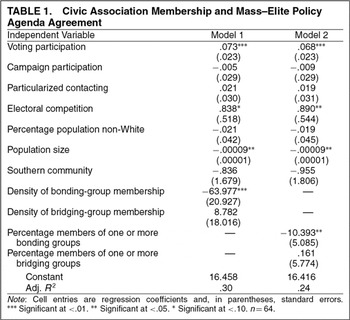
Table 1 presents OLS regression models for tests of hypotheses 1 and 2 about the effects of nominal bridging- and bonding-group membership on mass–elite policy agreement. The first model in the table employs measures of the density of bridging- and bonding-group membership, and the second model employs the measures based on percentages of membership in one or more of the bridging- and bonding-groups for respondents in a given community. The hypothesis test results are quite striking. They are also consistent across both kinds of measures and are not the product of any modeling specification problem that we can detect.
Contrary to hypothesis 1, neither measure of membership in bridging social capital organizations is significantly related to mass–elite policy agreement. Yet membership in bonding social–capital associations is quite strongly and negatively associated with mass–elite agreement—and with both measures of such civic engagement. Thus there is notable support here for hypothesis 2 and for the particular, negative characterization Putnam and others have offered of bonding social capital groups, but not, of course, for hypothesis 1, about the positive effects of bridging groups or for more general expectations of how civic engagement enhances democratic governance.
We note that the other results in Table 1 conform generally to expectations. The theoretically most prominent predictors—for voting participation, election competition, and community size—are significant as hypothesized. The remaining control variables, however, are not significant. Further, none of the results in Table 1, especially those for the civic engagement variables, are the product of collinearity among the predictor variables—for which we ran various tests and supplementary analyses, the selection of variables included in the models, deviant cases, the univariate distributional properties of the predictor variable, or unusual functional forms in the relationship of civic engagement with mass–elite agreement.9
As examples of the evidence that indicates little collinearity among the predictor variables, none of the measures of civic engagement in either Table 1 or Table 2 has a variance inflation factor >2.1, and all but one of the variance inflation factors are <2.0.
The negative relationships of bonding-group civic engagement with mass–elite agreement and the null relationships with bridging-group engagement are both replicated, too, when we estimate models that include only a measure of bonding- or of bridging-group engagement alone.
Further, the results in Table 1 for civic engagement summed across all types of bonding groups and all types of bridging groups are compatible with the results of analyses for individual types of groups in these two broad categories. That is, comparable regression models with engagement measures for single types of bonding groups (e.g., fraternal organizations alone) produce generally comparable relationships with mass–elite agreement.10
Individual types of bonding groups with relatively larger mean membership levels, for which it is feasible that community-wide effects might be realized, have negative relationships with mass–elite agreement. Groups with very small mean membership levels, for which community-level effects of their presence are less likely, do not demonstrate effects on concurrence alone. When the membership percentages for these small groups are summed, however, their combined size is also negatively and significantly related to mass–elite agreement.
Comparable models with civic engagement measures for single types of bridging social–capital groups, and with various subsets of such groups, all produce insignificant relationships with mass–elite agreement. These analyses provide convergent evidence for the construct validity of our reported measures of civic engagement and indicate that our results are robust to the aggregation required to construct
general measures of bonding- and bridging-group civic engagement—which is necessitated by the distinctive theoretical expectations for these two categories of groups.
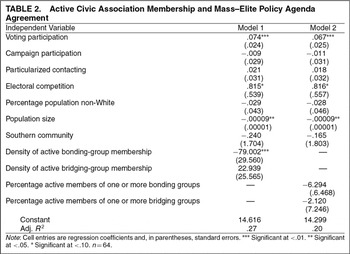
Table 2 reports results for hypothesis 3 about how active engagement with civic associations should have stronger relationships with mass–elite agreement than nominal membership alone. Active membership in bridging social–capital associations, and by both measures of such engagement, is, however, unrelated to policy agreement levels, just as is the case for nominal membership in such groups. The density of active engagement in bonding social–capital groups, in contrast, is negatively associated with mass–elite agreement, although the measure for active “percentage” membership in one or more bonding groups is not significant.
Thus the finding here on the density of active bonding-group membership replicates generally the finding for the density of nominal bonding-group membership in Table 1—and with a somewhat larger regression coefficient as was hypothesized. But because the second measure of active membership in bonding groups (based on the percentage of respondents who are members of one or more groups) is not significant, there is only mixed support for hypothesis 3. We speculate, however, that the relatively small numbers of mass respondents who report active civic engagement could explain why such activity demonstrates limited to no community-wide effects like the one investigated here.
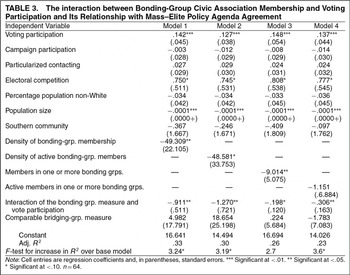
Finally, Table 3 reports regression models for the test of hypothesis 4 about the possible interaction of civic engagement, an information-providing mass activity, with voting participation, a pressure-inducing mass activity. We tested such models for all of the measures of civic engagement employed above—for both of the alternative measures of nominal and active membership in both bridging and bonding social–capital groups—using the same base regression models as reported in Tables 1 and 2. None of the analyses with bridging groups resulted in significant interactions, while three of the four for bonding groups produced negative interactions as hypothesized. Thus, for parsimony we report in Table 3 only the interaction models for the four measures of membership in bonding groups.
In Table 3 the negative interactions between voting participation and the density of nominal bonding-group membership, the density of active bonding-group membership, and active membership in one or more bonding groups all pass the conventional F-test for statistical significance in comparison with the relevant restricted models. (The interaction test for the fourth measure, the percentage of respondents in a community who are nominal members of one or more bonding groups, just misses statistical significance as shown in Model 3.) Thus in all three of these models there is a substantial, negative, conditional influence of bonding-group membership on mass–elite agreement through the interaction with voting participation.
This conditional relationship merits elaboration. As noted above, the effect of voting participation on mass–elite agreement is theoretically interpreted as a democratic-process mechanism. Thus the significant interactions here mean that higher levels of bonding-group membership moderate—or degrade—this democratic linkage. The conditional effects are sizable too, and they can be demonstrated by conventional procedures for “decomposing” the full interaction regression models (Friedrich 1982). That is, one can use components of the full interaction model to demonstrate how the effect of voting participation on mass–elite concurrence is moderated at different levels of bonding-group membership (estimates most appropriately made, too, within the range of typical values of bonding-group membership).
Recall that the coefficient for voting participation in any full interaction model in Table 3 indicates the effect of voting participation on concurrence when the bonding-group measure in that model equals zero. Yet by appropriately decomposing the full interaction equation and solving for the desired values, one can estimate the regression coefficient for voting participation on concurrence at any specific value of bonding-group membership and the t-value associated with that coefficient. For example, when the density of nominal bonding-group membership is relatively low, specifically at one-half a standard deviation below the mean of such membership levels across the communities (within a range where many cases are observed), the estimated coefficient of voting participation on mass–elite agreement is 0.088, with a t-value of 3.906 (Friedrich 1982, 804–20). In contrast, when the density of nominal bonding-group membership is relatively high, specifically at one-half a standard deviation above its mean (also a point where many cases are observed), the coefficient for voting participation is only 0.054, with a t-value of 2.212. At both values of bonding-group membership there is a positive effect of voting turnout on mass–elite agreement, but there is a substantially weaker effect of voting participation at higher levels of bonding-group membership.
CONCLUSIONS
Theory-generating discussions of civic engagement have been dominated by a general, overarching expectation that more of such engagement is better for the health of democratic processes. By necessity, because of data availability, existing theory-testing scholarship has only investigated such general relationships as well. That empirical scholarship has also been restricted to the examination of policy outcomes only diffusely linked to literal representational processes. Yet many theoretical discussions of civic engagement have recognized that distinct forms of such participatory activity exist, such as for bridging and bonding social–capital organizations, and the latter kinds of organizations are expected to have radically different consequences for democratic processes.
We have provided what we believe is the first analysis of the relationships of different forms of civic engagement with democratic responsiveness. We find no support for the hypothesized positive effect of bridging-group membership, but we uncover strong support for two negative effects of bonding-group membership on representation. One of these effects is the direct, negative association between higher bonding-group membership—measured in either of two alternative ways—and mass–elite policy agenda agreement. The second, also theoretically expected, effect is in the negative interaction where higher bonding-group membership depresses the salutary effect of voting participation on representation. Thus we provide considerable evidence for the concerns of many scholars that civic engagement has a “dark side” for democracy (Fiorina 1999) and no support for the positive view of such engagement.
Our findings on bridging groups will doubtless be disappointing to many. Why these groups have no effect on mass–elite agreement, however, is not clear. Perhaps the numeric scope of their membership in the typical community is insufficient (although bridging groups are not more limited in this respect than are bonding groups). Perhaps the typical breadth of engagement of different social groups, classes, ethnic groups, and the like is not sufficient for such groups to speak effectively for the community at large. Our analyses cannot resolve this concern, so it remains a task for future research.
It is valuable to remember, however, what our findings do not imply. Our results are unambiguous for community-level consequences of different forms of civic engagement. But they should not be interpreted to mean that such engagement is unimportant for individuals. Thus the genesis of different kinds of civic engagement and their consequences at the individual level remain notable topics for research. Indeed, such research may demonstrate associations between civic engagement and theoretically important, individual-level political attitudes and behavior (e.g., Brehm and Rahn 1997, Uslaner and Conley 2003, and Verba, Schlozman, and Brady 1995).
As might be said of the results of any single study, the findings here beg for replication and extension. Of particular interest would be analyses that explicate more fully the causal linkages between both individual-level and group-level bonding social–capital behavior and representational outcomes. Absent such research, however, one implication of our findings is clear. We should temper the remarkable and often unqualified belief in the value of civic engagement that has inspired much of the research discussed at the beginning of this article. Yet this is not an observation of despair. Our results confirm that conventional democratic processes of citizen participation in competitive elections are important determinants of representational outcomes. Perhaps our faith and our applied work should be invested more in stimulating these processes.
An earlier version of this paper was presented at the annual meeting of the Midwest Political Science Association, April 15–18, 2004, Chicago. We thank Sidney Verba, John Petrocik, and, especially, Susan Hansen, Paul Kellstedt, the reviewers, and the editor for comments on earlier versions of this paper or for assistance in creating some of the data employed here. The data are available from the first author on request.






Comments
No Comments have been published for this article.