Introduction
Consumption of poultry products from free range or organic production systems has increased in recent years among various countries (Fanatico et al., Reference FANATICO, PILLAI, CAVITT, EMMERT, MEULLENET and OWENS2006). Meat products from free-range systems have been associated with improved flavour and high nutritive values by marketers and consumers (Fanatico et al., Reference FANATICO, PILLAI, CAVITT, OWENS and EMMERT2005a; Wang et al., Reference WANG, SHI, DOU and SUN2009), low fat contents and higher concentrations of vitamins and minerals in meat products (Michalczuk et al., Reference MICHALCZUK, ŁUKASIEWICZ, ZDANOWSKA-SĄSIADEK and NIEMIEC2014). In addition, outdoor broiler production systems may have positive impact on animal welfare, although the possibility of free bird movement can affect carcass yield. (Fanatico et al., Reference FANATICO, PILLAI, HESTER, FALCONE, MENCH, OWENS and EMMERT2008).
Free range and outdoor production systems are becoming an important alternative for producers interested in targeting such as market created from consumers’ needs. Free range and outdoor production systems have several factors influencing meat quality, including genotype, age, nutrition, density, and pasture intake (Chen et al., Reference CHEN, JIANG, TAN, XU, ZHANG, WEI and WANG2013) which might explain the variable results found in the literature. These factors must be reviewed and considered to assess the feasibility of such production systems in the tropics. In addition, there is variability associated with poultry breeds (commercial lines, indigenous breeds and their resulting crosses) and the availability of non-conventional tropical feeds. However, in spite of the increased interest in outdoor production systems, in the tropics research on meat production and quality still is scarce. Considering the above, the objective of this review was to obtain an overview of the main factors associated with meat quality under free range and outdoor production systems in the tropics and its future perspectives.
Alternative broiler production
Based on different cultural aspects, guidelines for alternative poultry production were created in different countries. Each one establishing specific regulations and describing the required characteristics for ‘Natural’, ‘Organic’ and ‘Free-Range’ production systems.
natural systems
AVAL (2001) and USDA (2008) reported that so-called ‘natural’ broilers systems were first developed in both Brazil and the United States (U.S.) and are defined as the production of broilers with only ‘natural’ ingredients in the feed. The conditions of these rearing systems are modern infrastructure, fast-growing genotypes and controlled living conditions. Antibiotics, coccidiostats or animal-derived ingredients in the diets are not allowed (Fonseca, Reference FONSECA2012). Probiotic and prebiotics products, organic acids and vegetal extracts can replace such inputs (Fanatico et al., Reference FANATICO, OWENS and EMMERT2009).
organic systems
Sundrum (Reference SUNDRUM2006) reported that organic systems put less importance to economic measures; however, it takes into account health management, animal welfare and end product quality. Within the specific requirements of the system, synthetic ingredients and genetically modified feeds are prohibited as dietary supplementation. In some European countries and in the U.S., if organic sources are not available to farmers, the use of limiting synthetic amino acids is allowed at low levels (Sorensen, Reference SORENSEN2012).
free-range systems
Free-range refers to those production systems where chickens can voluntarily access outdoor areas for most of their lives. The European legislation for these systems includes animal density, genotype, feed composition and age at slaughter, contrary to the U.S. regulation which does not include any such specifications (Fonseca, Reference FONSECA2012).
Both regulations differentiate free-range into three main systems: pastured, day range and traditional free-range for the U.S. regulation; and free-range, traditional free-range and total freedom for the European legislation. Slow-growing broilers can be used and as they can obtain additional nutrients from the pasture and forage. These systems are extensively used by small and medium-scale farmers (Fanatico et al., Reference FANATICO, OWENS and EMMERT2009). According to Almeida et al. (Reference ALMEIDA, HORSTEDA, THAMSBORG, KYVSGAARDC, FERREIRAD and HERMANSEN2012) parasitic infestations are among the most common health-related problems affecting these rearing systems.
According to Faria et al. (Reference FARIA, VIEIRA, SOUZA, ROCHA and PEREIRA2012), in the Brazilian free-range systems, commercial lines are not allowed. The feed only contains feedstuffs of plant origin and the use of growth promoters is forbidden. In France, Label Rouge systems (‘red label’) have specific guidelines for poultry production. Lewis et al. (Reference LEWIS, PERRY, FARMER and PATTERSON1997) and Smith et al. (Reference SMITH, NORTHCUTT and STEINBERG2012) stated that specifications include small-scale operations, late-growing strains fed low-fat and high-cereal diets and reared at low animal density with access to free-range areas with a minimum age of 81 d at slaughter.
However, many tropical countries have worked with different systems without officially established regulations, with the exception of Brazil and China. Adapting requirements established mainly by the United States and the European Union to the conditions of each country and local regulations is one of the challenges that organic and free-range systems in tropical areas have to look forward.
Strains adapted to production in semi-captivity
In tropical countries, in order to enhance the production parameters, standard commercial broiler strains are used in free-range production systems; however, these genotypes usually have lower performance when compared to local animals in the same conditions (Yalçin et al., Reference YALÇIN, OZKAN, TÜRKMUT and SIEGEL2001). This is because native chickens breeds are more resistant to high temperature and other local conditions (Almeida and Zuber, Reference ALMEIDA and ZUBER2010). For this reason, native breeds are often presented as an alternative to improve poultry production in the region.
Bassler (Reference BASSLER2005) suggested that the ideal genotype for organic and free range poultry production systems is a dual-purpose population in which males are intended for meat production and females for egg production. The use of dual purpose birds offers the advantage of avoiding the slaughter of all day-old males that as normally done with specialised egg production lines. Some of these birds are used as a high quality animal protein source in the pet food industry and for zoo animals. A viable alternative is to use male chickens from layer strains for meat production because of their robustness and relatively high survival rate (Sogunle et al., Reference SOGUNLE, OLANIYI, EGBEYALE, AKINOLA, SHITTU, ABIOLA, LADOKUN and SOBAYO2013).
There are two drawbacks associated with a long maturity period, the high cost of breeding and that not all consumers prefer this type of chicken meat (Lichovníková et al., Reference LICHOVNÍKOVÁ, JANDÁSEK, JŮZ and DRAČKOVÁ2009). However, Ugwu (Reference UGWU2009) and Semakula et al. (Reference SEMAKULA, LUSEMBO, KUGONZA, MUTETIKKA, SSENNYONJO and MWESIGWA2011) reported that cockerels live weight increases with age, cheap local materials can be used for housing construction (Goodger et al., Reference GOODGER, BENNETT and DWINGER2002), management requirements are minimal (Guèye, Reference GUÈYE2009) and feed resources employed can vary depending on rearing system and the local conditions (Sogunle et al., Reference SOGUNLE, OLANIYI, EGBEYALE, AKINOLA, SHITTU, ABIOLA, LADOKUN and SOBAYO2013).
Several developing countries have implemented programmes for small-scale poultry production, and the Cuban Campero chicken is an example of this (Godínez et al., Reference GODÍNEZ, GARCÍA, FUMERO and PLASENCIA2006). Developed countries such as France encourage this type of production with the lines Sasso Label Rouge poultry and England has the specific Free-Range breeds (Dottavio and Di Masso, Reference DOTTAVIO and DI MASSO2010). Genotypes including genes such as the Frizzle, the Dwarf or the Naked Neck are useful in free-range production systems (Baelmans et al., Reference BAELMANS, PARMENTIER, NIEUWLAND, DORNY, DEMEY and BERKVENS2005), with the Suqin yellow chicken of China being an example. This chicken has a medium body size and can be considered as a dual purpose breed for both meat and egg production. It is popular among the people in China as its meat is considered to have more flavour than that from commercial broilers (Tong et al., Reference TONG, WANG, LU, ZOU, CHANG and FU2014). Another example is given by Sogunle et al. (Reference SOGUNLE, OLANIYI, EGBEYALE, AKINOLA, SHITTU, ABIOLA, LADOKUN and SOBAYO2013) in Africa, who recommended the Novogen strain should be raised in free-range system for better performance in terms of FCR.
In summary, as stated by Afna (Reference AFNA2006), the productive performance of different genotypes can be affected by various factors such as temperature, housing conditions, management and nutrition. Therefore, it is necessary to select birds for these systems according to the specific characteristics of each region.
Feeding schemes
Although there are some studies on free-range laying hens in the tropics (Abou-Elezz et al., Reference ABOU-ELEZZ, SARMIENTO-FRANCO, SANTOS-RICALDE and SOLORIO-SANCHEZ2012; Varguez-Montero et al., Reference VARGUEZ-MONTERO, SARMIENTO-FRANCO, SANTOS-RICALDE and SEGURA-CORREA2012), little has been documented about the behaviour of free-range chickens for meat, and there are important differences between the two types. Among specific characteristics, age of the birds to complete the breeding cycle is a determining factor. Laying hens start accessing outdoors at 16 weeks age and can live up to 70 weeks old, however the slow growing chickens used for outdoor systems, which can live for up to three months, could graze for half of this time (Santos et al., Reference SANTOS, SAKOMURA, FREITAS, FORTES and CARRILHO2005). This means that the research on laying hens may not be directly applicable to much younger broilers and, for this reason, it is important to consider research on free-range systems for meat chickens with their specific requirements in mind.
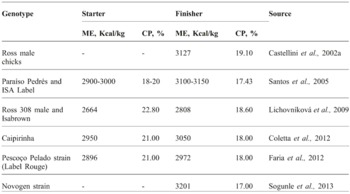
Most of the published studies for free-range systems propose feeding schemes based on two stages, which are starter (one to five weeks old) and finisher (six to 15 weeks old). Table 1 shows the variation in metabolisable energy (ME) and crude protein (CP), depending on the breed or commercial line of chickens used.
Different feeding schemes for free-range chickens according to genotype.

Not reported (-)
In order to have an adequate adjustment of the nutritional requirements for broiler chickens the knowledge on body composition and bird growth potential is required. Therefore, growth curves may help to define specific nutritional programmes and optimal age at slaughter.
Available and low cost resources used in organic and free-range systems
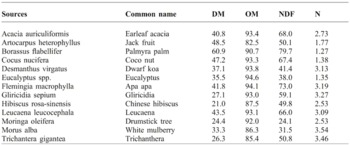
In the tropics, a variety of trees and shrubs can be used in free-range systems as important sources of protein and other nutrients. Table 2 shows some feed sources that could be used in free-range systems and their chemical composition.
Chemical composition of tropical trees and shrubs used in free-range systems (% on dry matter basis).

Source: Ly, Reference LY2005. Organic Matter (OM), neutral detergent fibre (NDF) and nitrogen (N).
Dawkins et al. (Reference DAWKINS, COOK, WHITTINGHAM, MANSELL and HARPER2003) reported that chickens prefer paddocks with trees because they provide shade from the sun and protect them from predators, and trees can provide food and act as wind breaks. Other species such as legumes, that are considered cover crops offer protection against erosion, provide nitrogen and plant material to the soil. These include the genera Desmodium, Arachis, Canavalia, Mucuna and Dolichos, which are used as a source of grain and forage (Duranti, Reference DURANTI2006).
Although pasture may provide a source of energy, amino acids, and bioactive compounds (e.g. xanthophylls, saponins) for growing broilers, its high fibre content and the presence of secondary metabolites may restrict nutrient utilisation with a subsequent reduction in growth rate and FCR (Morán Reference MORÁN2006; Ponte et al., Reference PONTE, ROSADO, CRESPO, CRESPO, MOURAO, CHAVEIRO-SOARES, BRAS, MENDES, GAMA, PRATES, FERREIRA and FONTES2008a). Both the chemical composition of feeds and their effect on birds have been discussed (Savón and Scull, Reference SAVÓN and SCULL2006; Walugembe et al., Reference WALUGEMBE, ROTHSCHILD and PERSIA2014). Alternative feeds could be used to reduce the detrimental effect that secondary compounds have (Vadivel et al., Reference VADIVEL, PUGALENTHI, DOSS and PARIMELAZHAGAN2011) and their use is feasible under the specific conditions of each producer because of its easy application.
Carcass characteristics and meat quality
Available data discusses the effects of age at slaughter, genotype, sex, dietary supplementation and rearing system on broiler meat quality (Castellini et al., Reference CASTELLINI, BERRI, LEBIHAN-DUVAL and MARTINO2008; Fanatico et al., Reference FANATICO, BREWER, OWENS-HANNING, DONOGHUE and DONOGHUE2013; Dal Bosco et al., Reference DAL BOSCO, MUGNAI, ROSATI, PAOLETTI, CAPORALI and CASTELLINI2014).
carcass characteristics
Tong et al. (Reference TONG, WANG, LU, ZOU, CHANG and FU2014) found that in Suquin yellow chickens the breast yield increased linearly with increasing free-range days, whereas the thigh, leg, thigh bone, and foot yields decreased linearly. However, Castellini et al. (Reference CASTELLINI, MUGNAI and DAL BOSCO2002a) reported in Ross male chicks that percentages of breast and thigh meat increased when birds had free access to outdoor. Data from these studies suggest that regardless of genotype employed in farming systems, the degree to which such inputs were affected probably depends on differences in activity level due to outdoor access. In general, while most days animals have access to outdoors in free-range systems, carcass characteristics improve due to increased activity (Mikulski et al., Reference MIKULSKI, CELEJ, JANKOWSKI, MAJEWSKA and MIKULKA2011), which enhances bird comfort and welfare.
nutritive values
Poultry meat has a high nutritional value because it contains adequate amounts of carbohydrate, protein, lipids and water (Wang et al., Reference WANG, SHI, DOU and SUN2009). Several studies reported no differences in the meat protein content with values between 22.3% and 24.7% (Castellini et al., Reference CASTELLINI, DAL BOSCO, MUGNAI and PEDRAZZOLI2006; Faria et al., Reference FARIA, VIEIRA, SOUZA, ROCHA and PEREIRA2012) and in the ash contents that ranged from 1% to 1.3% (Castellini, Reference CASTELLINI2005; Faria et al., Reference FARIA, BRESSAN, SOUZA, RODRIGUES, CARDOSO and DA GAMA2009) in organic systems. However, lipid content in meat is influenced by sex, i.e. Lonergan et al. (Reference LONERGAN, DEEB, FEDLER and LAMONT2003) reported more lipids in females than in males.
lipid content
Both the taste and the nutrient composition in chicken meat are influenced by the total lipid content. Several studies reported a decrease in the lipid content in chicken meat from outdoor systems when compared with intensive systems (Husak et al., Reference HUSAK, SEBRANEK and BREGENDAHL2008; Givens et al., Reference GIVENS, GIBBS, RYMER and BROWN2011). Phospholipids have very important physiological functions for both cells (Wood et al., Reference WOOD, ENSER, FISHER, NUTE, SHEARD, RICHARDSON, HUGHES and WHITTINGTON2008) and health (Tian et al., Reference TIAN, ZHU, XIE, WANG, WU and GONG2010). Sun et al. (Reference SUN, LIU, QIN and LONG2012) found greater concentrations of phospholipid in the muscle of pasture reared birds compared with those indoor housed. These authors considered that the higher total lipid content in the carcass of chickens was a result of increased deposition of fat in their meat. According to Kroliczewska et al. (Reference KROLICZEWSKA, ZAWADZKI, SKIBA, KOPEC and KROLICZEWSKI2008), feed ingredients can modify the cholesterol content in broiler meat. Sun et al. (Reference SUN, LIU, QIN and LONG2012) reported a lower cholesterol level in the breast muscle of pasture-reared birds compared to those from intensive rearing system. These authors attributed this to the free-range birds being reared at pasture and hence were able to consume forage containing both high levels of fibre and biologically active substances, which affect cholesterol metabolism in the poultry body and alter its content in meat (Sun et al., Reference SUN, SHANG, LIU and LONG2010).
Castellini et al. (Reference CASTELLINI, MUGNAI and DAL BOSCO2002a), found that chickens raised on organic systems had less abdominal fat and higher percentage of breast and drumstick meat compared to those housed indoors. They studied the chemical-physical characteristics of these two meat portions and found higher moisture and lower fat for the organic birds. This was associated with locomotive activity that promotes myogenesis against lipogenesis. Similar results were reported by Faria et al. (Reference FARIA, VIEIRA, SOUZA, ROCHA and PEREIRA2012) in semi-confined systems. Moreover, Castellini et al. (Reference CASTELLINI, DAL BOSCO, MUGNAI and PEDRAZZOLI2006) found lower levels of intramuscular fat in Kabir than in Ross chicken strains, and argued that the chemical composition of the breast meat was affected by genotype in organic systems because Ross chickens were less active than Kabir chickens (Castellini et al., Reference CASTELLINI, MUGNAI and DAL BOSCO2002b).
In recent years, there has been great interest in the use of poultry meat as a source of long chain n-3 fatty acids, α-linolenic acid (ALA; 18:3n-3), icosapentaenoic (EPA; 20:5n-3) and docosahexaenoic acid (DHA; 22:6n-3) because they are considered functional foods that reduce the incidence of certain diseases (Givens et al., Reference GIVENS, GIBBS, RYMER and BROWN2011). Free-range chickens are expected to consume variable amounts of forages, although pasture is a poor source of EPA and DHA. Ponte et al. (Reference PONTE, ALVES, BESSA, FERREIRA, GAMA, BRAS, FONTES and PRATES2008b) suggested a significant conversion of ALA as a precursor for the synthesis and deposition of these two essential fatty acids in broiler meat through desaturation and elongation of fatty acids in birds with access to pasture. In order to improve the composition of these substances in meat, other ingredients can be used in the diet of birds (López-Ferrer et al., Reference LÓPEZ-FERRER, BAUCELLS, BARROETA and GRASHORN2001a; Reference LÓPEZ-FERRER, BAUCELLS, BARROETA, GALOBART and GRASHORN2001b; Sun et al., Reference SUN, LIU, QIN and LONG2012), however, further studies are needed to clarify how these interact with rearing systems.
Physical characteristics
water holding capacity and pH
Water holding capacity (WHC) is a parameter used to describe the ability of the meat products to maintain water within their fibres (Gaya and Ferraz, Reference GAYA and FERRAZ2006). According to Dabes (Reference DABES2001) when WHC decreases, meat loses its quality through exudates and becomes drier and harder. Castellini et al. (Reference CASTELLINI, MUGNAI and DAL BOSCO2002a) and Fanatico et al. (Reference FANATICO, PILLAI, CAVITT, EMMERT, MEULLENET and OWENS2006) found a lower WHC when chickens were reared in free-range system or have access to outdoors (Fanatico et al., Reference FANATICO, PILLAI, EMMERT and OWENS2007), and ambient temperature and amount of exercise are thought to influence the variations reported in the literature for WHC. In general, different studies show no influence of sex in the values of WHC in outdoor production systems (Fanatico et al., Reference FANATICO, CAVITT, PILLAI, EMMERT and OWENS2005b; Musa et al., Reference MUSA, CHEN, CHENG, SHUIEP and BAO2006; Faria et al., Reference FARIA, VIEIRA, SOUZA, ROCHA and PEREIRA2012).
It is necessary to maintain the stability of meat by controlling muscle pH because high values result in a shorter shelf life due to microbial proliferation. Bacteria usually grow in a pH range of 4.5 to 7.5, while fungi have a wider growth range, from 2.0 to 9.0 (Baruffaldi and Oliveira, Reference BARUFFALDI and OLIVEIRA1998). Fresh poultry meat has an average pH of 6.4 (Baracho et al., Reference BARACHO, CAMARGO, LIMA, MENTEM, MOURA, MOREIRA and NÄÄS2006). Castellini et al. (Reference CASTELLINI, DAL BOSCO, MUGNAI and PEDRAZZOLI2006) reported a low pH in Kabir birds reared under organic systems. Similar results were observed by Faria et al. (Reference FARIA, BRESSAN, SOUZA, RODRIGUES, CARDOSO and DA GAMA2009) in the Pescoço Pelado strain. Both experiments suggested birds raised under organic systems, due to the better welfare conditions and less stress, have more glycogen availability which reduces pH. Bendall (Reference BENDALL1973) found that at slaughter, pH was determined by the activity of glycolytic enzymes and the initial glycogen reserves of the muscle. Additionally, Tong et al. (Reference TONG, WANG, LU, ZOU, CHANG and FU2014) expressed that pH was positively correlated with WHC and negatively with colour of the meat due to the fact that it influences the structure of myofibrils.
colour and tenderness
For consumers, meat colour is indicative of quality, both for the selection of fresh meat and at the time of consumption. Santos et al. (Reference SANTOS, SAKOMURA, FREITAS, FORTES and CARRILHO2005) has stated that, in general, free-range birds have acceptable meat colour. Lonergan et al. (Reference LONERGAN, DEEB, FEDLER and LAMONT2003) and Fanatico et al. (Reference FANATICO, CAVITT, PILLAI, EMMERT and OWENS2005b) confirmed that, in semi-confined systems, meat luminosity (L*) and red content (a*) were not different between sexes. However, yellowness (b*) intensity increased in females, regardless of the strain. Similarly, Fanatico et al. (Reference FANATICO, PILLAI, EMMERT and OWENS2007) found that slow growing strains had meat and skin which were more yellow (b*) and had a higher α-tocopherol level in breast meat than the fast growing strain. According to Faria et al. (Reference FARIA, VIEIRA, SOUZA, ROCHA and PEREIRA2012), females had more breast meat due to sexual dimorphism and accumulate more carotenoid pigments from feeds which increased yellow colouration.
According to Santos et al. (Reference SANTOS, SAKOMURA, FREITAS, FORTES and CARRILHO2005), motor activity is the major factor affecting the tenderness of tissues and Dozier et al. (2005) observed that this characteristic was not affected by stocking density in a free-range system.
Conclusions
Current data indicates that producing quality meat in organic and free-range systems is feasible in tropical countries. However, it is necessary to establish suitable conditions for these production systems to be considered viable, obtaining quality products and maintaining profitability. Furthermore, the positive effects arising from the use of pasture in organic and free-range meat production systems, on animal behaviour, forage intake, animal welfare, and meat quality, which are frequently hypothesised in the literature, have not been properly studied. Therefore, taking into consideration the available native breeds, feed resources and potential to develop or to adapt production systems for the tropical areas, more research is needed focussing on poultry meat production under free range systems, especially in tropical regions.
Acknowledgements
This work was supported by TWAS-CONACYT, Mexico.