On May 12th 2014, the world football association FIFA announced the slogans to be portrayed on the team buses of each of the 32 national teams participating in the world cup in Brazil. The slogan announced for team Belgium was “verwacht je aan het onmogelijke” (lit. expect you to the impossible; “expect the impossible”) which is ungrammatical in Dutch (the correct Dutch being “verwacht het onmogelijke”). In fact, that Dutch slogan seems to be a poor translation from the French version of the slogan, which was also portrayed on the player bus (attendez-vous à l’impossible). What is interesting about that translation is that it places Dutch words in a French syntactic frame, suggesting that in (perhaps not very proficient) learners of a second language (L2), the selection of words and syntactic structure can sometimes proceed independently. Of course, more proficient French/Dutch L2 learners will have mastered the skill to produce correct Dutch sentences, whether these sentences are syntactically identical to their French translation equivalents or not.
This paper asks how late second-language learners learn the syntax of a second language. To address that question, we first review studies that considered syntactic representations in adult monolinguals and bilinguals, as well as studies that focused on (first and second) language learning. We focus particularly on psycholinguistic studies using structural priming (Bock, Reference Bock1986). We then present a reanalysis of data collected by Schoonbaert, Hartsuiker and Pickering (Reference Schoonbaert, Hartsuiker and Pickering2007), that bears upon the question of how lexical-syntactic representations vary with second language (L2) proficiency. Next, we sketch our account of the development of L2 syntax, which extends an earlier account presented by Bernolet, Hartsuiker and Pickering (Reference Bernolet, Hartsuiker and Pickering2013). This approach differs from other work in second language acquisition (SLA) research in the sense that it is based on relatively explicit and mechanistic theories of the stages and representations a speaker moves through when mapping a message onto a sentence (e.g., Pickering & Branigan, Reference Pickering and Branigan1998). But it is important to point out that our view has much in common with emergentist perspectives on language acquisition (e.g., O’Grady, Kwak, Lee & Lee, Reference O’Grady, Kwak, Lee and Lee2011) that try to understand acquisition phenomena in terms of frequency of exposure and difficulty of processing.
Syntactic representations in adults’ native language
Psycholinguistic theories of syntactic representation in monolingual adult sentence production are typically based on structural priming, the phenomenon that speakers are more likely to choose a particular syntactic structure after having previously processed a sentence with that same structure, as opposed to an alternative structure. In a series of pioneering studies, Bock and colleagues (e.g., Bock, Reference Bock1986) demonstrated structural priming in a paradigm involving sentence repetition and picture description under the guise of a memory task. Participants were more likely to describe a picture with a passive sentence (e.g., The church is being hit by the lightning) when they had just repeated a passive (The bank manager was mobbed by a gang of teenagers) than after an active sentence (A gang of teenagers mobbed the bank manager). Similarly, participants were more likely to provide a picture description with a Prepositional Object (PO) dative (The girl is showing her report card to the boy) after a PO prime sentence (an undercover agent sold some cocaine to a rock star) than after a Double Object (DO) dative prime sentence (an undercover agent sold a rock star some cocaine). Further studies (Bock, Reference Bock1989; Bock & Loebell, Reference Bock and Loebell1990) demonstrated that this type of priming must be rather abstract: Priming effects do not depend on whether prime and target sentences have the same thematic roles or have overlap in (closed-class) lexical items. Priming further cannot be explained by overlap in prosody.
Since these original reports of structural priming, the effect has been replicated many times, in many different languages, and different syntactic constructions, using different paradigms, in experiments and analyses of speech corpora, in behavioral indices and in neural measures, and in many different groups of language users, including aphasic and amnesic patients, children, and second language learners (e.g., Bernolet, Hartsuiker & Pickering, Reference Bernolet, Hartsuiker and Pickering2007; Reference Bernolet, Hartsuiker and Pickering2009; Bock, Dell, Chang & Onishi, Reference Bock, Dell, Chang and Onishi2007; Branigan, Pickering & McLean, Reference Branigan, Pickering and McLean2005; Ferreira, Bock, Wilson & Cohen, Reference Ferreira, Bock, Wilson and Cohen2008; Gries, Reference Gries2005; Hartsuiker & Kolk, Reference Hartsuiker and Kolk1998a; Reference Hartsuiker and Kolk1998b; Hartsuiker & Westenberg, Reference Hartsuiker and Westenberg2000; Hartsuiker, Pickering & Veltkamp, Reference Hartsuiker, Pickering and Veltkamp2004; Huttenlocher, Vasiyeva & Shimpi, Reference Huttenlocher, Vasilyeva and Shimpi2004; Melinger & Dobel, Reference Melinger and Dobel2005; Pickering & Branigan, Reference Pickering and Branigan1998; Potter & Lombardi, Reference Potter and Lombardi1998; Scheepers, Reference Scheepers2003; Segaert et al. Reference Segaert, Kempen, Petersson and Hagoort2013; see Pickering & Ferreira, Reference Pickering and Ferreira2008 for a review).
Two sets of findings from structural priming have been particularly important to inform theories of syntactic representation in language production: the lexical boost effect (e.g., Pickering & Branigan, Reference Pickering and Branigan1998) and the finding that structural priming is relatively long-lived (e.g., Bock & Griffin, Reference Bock and Griffin2000). First, even though lexical overlap between a prime and target sentence may not be necessary to obtain structural priming, lexical overlap (in particular of the head verb or head noun of the construction taking part in the syntactic alternation) has been shown to greatly enhance structural priming, a phenomenon known as the lexical boost to structural priming (e.g., Pickering & Branigan, Reference Pickering and Branigan1998). Thus, if a target utterance requires the verb to give, speakers are more likely to reuse the previous sentence's structure (e.g., a DO dative) if that sentence used give than if it used show. Similarly, in alternations involving nouns (e.g., the red sheep vs. the sheep that is red), priming is stronger if prime and target both have the same head noun (sheep) than if they have different head nouns (Cleland & Pickering, Reference Cleland and Pickering2003). In addition to a boost from lexical identity, there is also a semantic boost (e.g., if prime and target have semantically related nouns such as sheep and goat vs. sheep and knife; Cleland & Pickering). In priming across languages, there is also a boost when verbs in prime and target are translation equivalents rather than unrelated verbs (Schoonbaert et al., Reference Schoonbaert, Hartsuiker and Pickering2007), although this boost only occurred when priming from L1 to L2 and not in the reverse direction.
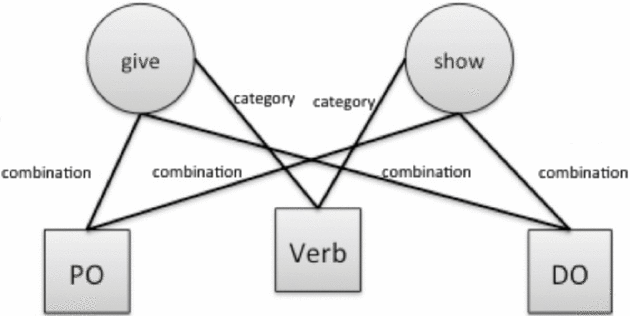
Pickering and Branigan (Reference Pickering and Branigan1998) accounted for the lexical boost effect in terms of a lexicalist model of syntactic representation, which was an extension of Roelofs’ (Reference Roelofs1992) model of lexical access in word production. Pickering and Branigan's model (Figure 1) assumes a level of lexical concepts and a level of lemmas. Lemmas are abstract lexical representations with connections to their corresponding concepts and word forms and, importantly, to lexical-syntactic information such as word class (noun, verb, etc.), grammatical gender and countability (for nouns), and importantly, combinatorial information, depicted in Figure 1 by combinatorial nodes. These nodes specify the grammatical alternations the verb (or noun) can engage in, such as the PO dative and DO dative for many dative verbs. If a speaker processes a particular sentence (e.g., a PO dative with the verb give), this leads to activation of the lemma node for give as well as the PO node. If the speaker's next description also requires the use of either the DO or the PO, she will be relatively likely to choose the PO, because the corresponding node would retain some of its activation. If it so happens that the speaker also needs to use the same verb again, the choice for a PO would be extra likely: this is because the use of PO with give during the processing of the prime sentence has led to a temporary increase in the strength of the link between the corresponding lexical and combinatorial nodes (perhaps through a form of Hebbian learning). Thus, not only has the PO node retained some activation, it receives extra activation from the lemma node via this boosted link.
Fragment of the lexical network in Pickering and Branigan's Lexicalist residual activation model, showing part of the network for two verbs. For simplicity's sake, the connections with the conceptual and phonological levels are omitted, as are representations for other types of syntactic information besides syntactic category and combinatorial information (e.g., tense, aspect, and number).

It is important to note that a second set of findings is somewhat difficult to account for in terms of this model. While the most obvious prediction of a residual activation model would be that priming would decay over time (because the residual activation of the combinatorial nodes would gradually decay), Bock and Griffin (Reference Bock and Griffin2000) demonstrated that structural priming can be surprisingly persistent. In their design, target items followed the primes either immediately (lag of 0) or after a number of fillers. Structural priming survived such a lag manipulation, even up to lag 10 (also see Bock et al., Reference Bock, Dell, Chang and Onishi2007; Hartsuiker, Bernolet, Schoonbaert, Speybroeck & Vanderelst, Reference Hartsuiker, Bernolet, Schoonbaert, Speybroeck and Vanderelst2008). This longevity of priming is suggestive that priming results in rather long-term changes to the syntactic processing system and can thus be viewed as a form of learning.
Indeed, Chang, Dell and Bock (Reference Chang, Dell and Bock2006; see also Chang, Janciauskas & Fitz, Reference Chang, Janciauskas and Fitz2012) proposed a dual path model that views priming as a form of implicit, error-based learning. A mismatch (error) between a predicted and an actual prime sentence would lead to a relatively permanent adjustment of connection weights. Lexical and thematic representations are separated from the syntactic network, which captures abstract priming. Chang et al.'s model could simulate structural priming data from a wide range of experiments. Important for our purposes, learning in the model resulted in an increase in abstractness of representations, as in the course of development it started to capture commonalities between different syntactic structures (i.e., intransitive locatives and passives). The assumption that priming is a form of implicit learning is further supported by the finding that patients with amnesia who have impaired memory for sentence structure still display normal structural priming effects (Ferreira et al., Reference Ferreira, Bock, Wilson and Cohen2008). Additionally, the assumption that priming is error-driven is supported by the inverse frequency effect in structural priming: the finding that structures that occur relatively infrequently tend to display stronger priming than more frequent structures (e.g., Hartsuiker & Westenberg, Reference Hartsuiker and Westenberg2000).
Because of the separation between lexical and syntactic representations in the dual path model, this model has no intrinsic mechanism that can boost structural priming when lexical items are repeated. Indeed, Chang et al.'s (Reference Chang, Dell and Bock2006) simulations showed that the model predicts comparable priming in repeated vs. non-repeated lexical head conditions, thus failing to mimic the pattern of empirical data. Chang et al. suggested that the lexical boost may not be a direct effect of the syntactic processing system per se, but would reflect an additional mechanism, based on a participant's explicit, episodic memory of the previous priming trial. Explicitly recalling the prime sentence would then facilitate the production of the target sentence (perhaps by some sort of editing process of substituting some of the prime sentence words for target sentence words). Importantly, any such explicit recall would likely be greatly facilitated if there is lexical overlap, so that target sentence words function as a retrieval cue.
This explicit memory account of the lexical boost is supported by Hartsuiker et al.'s (Reference Hartsuiker, Bernolet, Schoonbaert, Speybroeck and Vanderelst2008) results with dative sentences in Dutch. In their key experiment, lexical overlap between prime and target was crossed with the number of fillers separating prime and target. If there is an implicit learning component to structural priming, the priming effect should survive lags of 2 or 6 intervening filler items, both in conditions with and without verb repetition. Importantly, if the lexical boost of priming is based on explicit memory of the prime sentence, one would expect it to be present at lag 0, but not at later lags. These predictions were borne out by the data.
Summarizing, structural priming data have led to lexicalist theories (Pickering & Branigan, Reference Pickering and Branigan1998) and implicit, error-based learning theories (Chang et al., Reference Chang, Dell and Bock2006). At this point, the latter type of theories has not been adapted to bilingualism. In contrast, Hartsuiker et al. (Reference Hartsuiker, Pickering and Veltkamp2004) proposed a bilingual version of Pickering and Branigan's account; we will therefore couch our discussion in terms of the bilingual lexicalist model. However, we will return to implicit learning theories in the General Discussion.
L2 adult representations
How is syntactic information represented in a second language? Hartsuiker et al. (Reference Hartsuiker, Pickering and Veltkamp2004) argued that there are many commonalities in sentence structures in different pairs of languages, even though there are structures that are unique for each language. For instance, the active (1a) and “fue”-passive sentence in Spanish (1b) are structurally similar to the English active (1b) and passive (2b):
-
(1a) El presidente escribió una carta
-
(1b) The president wrote a letter
-
(2a) La carta fue escrito por el presidente
-
(2b) The letter was written by the president
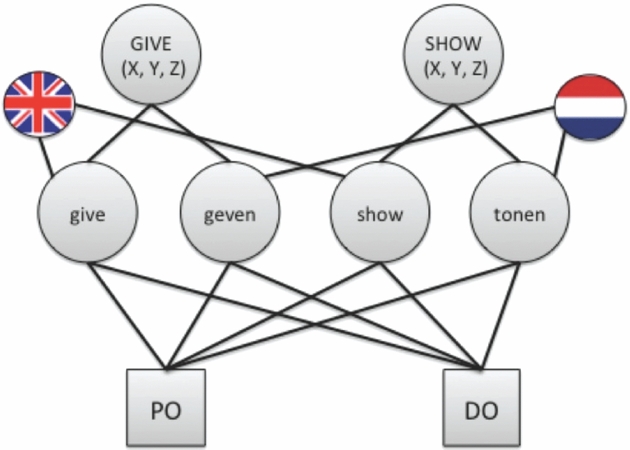
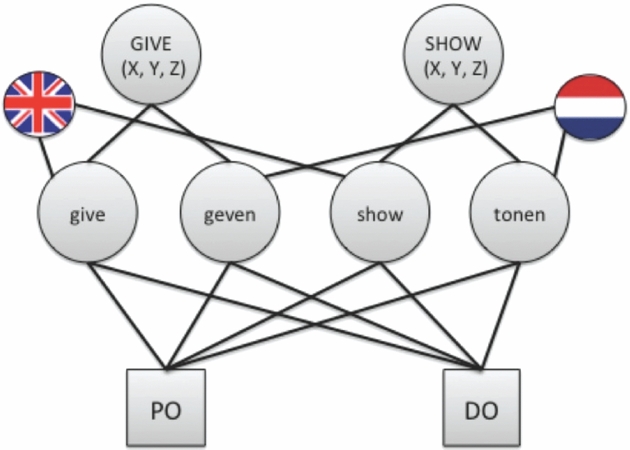
One possibility would be that Spanish–English bilinguals have separate representations for each language, despite the strong similarity. But alternatively, bilinguals might share representations whenever the structures are sufficiently similar. A shared syntax account would predict structural priming across languages, and this is what Hartsuiker et al. found: Given passive prime sentences in Spanish, Spanish–English bilinguals were more likely to describe pictures in English using passives as compared to Spanish actives or Spanish intransitive (baseline) sentences. Hartsuiker et al. therefore proposed the bilingual extension of Pickering and Branigan's (Reference Pickering and Branigan1998) model of lexico-syntactic representations shown in Figure 2. As in the original model, there are lexical nodes that are connected to the relevant combinatorial nodes. The model assumes that combinatorial nodes are shared between languages (as are the conceptual nodes) and that the lexical nodes are connected to language nodes that tag them for the relevant language. Note that this approach differs from certain views on SLA that postulate a separation between representations in L1 and L2 (Pienemann, Reference Pienemann1998).
Fragment of Hartsuiker and colleagues’ (2004; Schoonbaert et al., Reference Schoonbaert, Hartsuiker and Pickering2007) adaptation of the lexicalist residual activation model to the case of bilingualism. The figure shows the network for two dative verbs and their translation equivalents in Dutch and English. The nodes with flags are language nodes that tag verbs for English and Dutch respectively.
Hartsuiker et al.'s results were consistent with those reported by Loebell and Bock (Reference Loebell and Bock2003) who showed cross-linguistic priming of double object and prepositional object datives in German-English bilinguals. Interestingly, Loebell and Bock did not find cross-linguistic priming of actives and passives in that group. However, Loebell and Bock did not find priming within German either, and more recently Bernolet et al. (Reference Bernolet, Hartsuiker and Pickering2009) demonstrated priming between Dutch and English passives.
Structural priming across languages has now been observed in many studies, using a variety of language pairs, constructions, and paradigms (e.g., Bernolet et al., Reference Bernolet, Hartsuiker and Pickering2007; Reference Bernolet, Hartsuiker and Pickering2009; Reference Bernolet, Hartsuiker and Pickering2013; Bernolet, Hartsuiker & Pickering, Reference Bernolet, Hartsuiker and Pickering2012; Cai, Pickering, Yan & Branigan, Reference Cai, Pickering, Yan and Branigan2011; Desmet & Declercq, Reference Desmet and Declercq2006; Kantola & Van Gompel, Reference Kantola and Van Gompel2011; Meijer & Fox Tree, Reference Meijer and Fox Tree2003; Salamoura & Williams, Reference Salamoura and Williams2006; Reference Salamoura and Williams2007; Schoonbaert et al., Reference Schoonbaert, Hartsuiker and Pickering2007; Shin & Christianson, Reference Shin and Christianson2009; Reference Shin and Christianson2012; see Hartsuiker & Pickering, Reference Hartsuiker and Pickering2008 for an early review).
Is priming between languages stronger than priming within languages? Hartsuiker and Pickering (Reference Hartsuiker and Pickering2008) argued that, according to a lexicalist model with fully shared syntax, priming between languages should be of comparable magnitude to priming within a language, because both languages would use one and the same node. Kantola and Van Gompel (Reference Kantola and Van Gompel2011) contrasted such a full syntactic sharing model with an account according to which syntactic representations of different languages are separate but connected, so that residual activation of a syntactic node in language A would prime the syntactic equivalent node in language B somewhat. Under the reasonable assumption that this priming would lead to less activation of the language B node than the language A node, this predicts weaker priming between than within languages. In contrast, Kantola and Van Gompel found no significant differences in priming within and between Swedish and English with datives, thereby replicating Schoonbaert et al., who similarly found equivalent within- and between-language priming between Dutch and English datives (see below).
However, two recent studies did find evidence for stronger within-language than between-language priming. In a study of two very closely related languages (Cantonese and Mandarin), using very proficient bilinguals, Cai et al. (Reference Cai, Pickering, Yan and Branigan2011) observed stronger within- than between-language priming with datives in one experiment and a trend in the same direction in a second experiment. They interpreted this finding within the framework of Hartsuiker et al.'s (Reference Hartsuiker, Pickering and Veltkamp2004) shared syntax model (Figure 2). Specifically, they assigned an important role to the language nodes for controlling the production language. These language nodes would send activation to all the words of the appropriate language and so in the case of within-language priming, the previously used lemma would be more active than in the case of between-language priming, and would send activation to the previously used combinatorial node via the recently strengthened link. Additionally, Bernolet et al. (Reference Bernolet, Hartsuiker and Pickering2013) tested less proficient Dutch–English bilinguals in an experiment involving genitives (e.g., the hat of the cowboy vs. the cowboy's hat). Whereas the first construction is practically identical in Dutch and English, the second construction differs in terms of morphological realization and pragmatic conditions of use. Priming was much stronger within the second language than between the first and second language. Bernolet et al. accounted for this in terms of proficiency, with less proficient speakers not yet sharing syntactic representations for these constructions (a finding we will return to below).
Evidence for syntactic sharing does not only come from studies using structural priming across languages, but also from studies that tap into both languages in a more implicit way. Runnqvist, Gollan, Costa, and Ferreira (Reference Runnqvist, Gollan, Costa and Ferreira2013) had Spanish–English and Chinese–English bilinguals produce sentences for which the structural frequency could vary between languages (for instance, the passive is much less frequent in Spanish than in English). They found that production latencies were affected by the structural frequency of the language not in use, suggesting a common representation that ‘inherits’ frequency from both languages. This conclusion is consistent with results on the production of adjective + noun phrases from children simultaneously acquiring English and French (Nicoladis, 2006). Like English, French allows prenominal adjectives (AN), but this is restricted to only a few adjectives; most adjectives occur post-nominally (NA). Nicoladis showed that incorrect AN-productions in French occurred more frequently in these young bilinguals as compared to monolingual French children, suggesting that the bilinguals had a shared AN representation for both languages and so were affected by the English order.
Learning L1 representations
It might be useful to view the processing models presented in Figures 1 and 2 as the end states of the lexical-syntactic acquisition trajectory in L1 and L2 respectively (Bernolet et al., Reference Bernolet, Hartsuiker and Pickering2013). This then raises the question of how early lexico-syntactic representations are organized and how this changes with experience. According to an influential proposal by Tomasello (2000), initial syntactic representations in children are organized around specific lexical items (sometimes referred to as “verb islands”). In terms of the lexico-syntactic model depicted in Figure 1, one might imagine for example that the child has a specific PO combinatorial node for to give, another PO node for to show, and no combinatorial node yet for to lend. If young children do not yet have combinatorial nodes that are shared between lexical items, this predicts no structural priming in conditions without lexical overlap, while priming should occur in conditions with lexical overlap (i.e., because prime and target would use the same, lexically-specific syntactic node). Consistent with that prediction, Savage, Lieven, Theakston and Tomasello (Reference Savage, Lieven, Theakston and Tomasello2003) observed structural priming both with and without lexical overlap in 6 year old children, while 3 year olds and 4 year olds only showed priming when there was lexical overlap. Kemp, Lieven and Tomasello (Reference Kemp, Lieven and Tomasello2005) reached similar conclusions in a study that elicited determiner + adjective + noun responses in 2, 3, 4, and 6 year olds. While the 3 to 6 year olds showed priming in lexical overlap conditions, only the 6 year olds showed clear evidence of abstract priming.
However, several further studies showed abstract structural priming more early on. Huttenlocher et al. (Reference Huttenlocher, Vasilyeva and Shimpi2004) reported abstract priming of transitives and datives in 4 and 5 year olds; these findings are consistent with an early study by Whitehurst, Ironsmith and Goldfein (Reference Whitehurst, Ironsmith and Goldfein1974). Shimpi, Gámez, Huttenlocher and Vasilyeva (Reference Shimpi, Gámez, Huttenlocher and Vasilyeva2007) also found robust evidence for abstract priming of datives and transitives in 4 year olds and even 3 year olds; the latter finding was confirmed by a study testing for transitive priming in 3 year olds (Bencini & Valian, Reference Bencini and Valian2008). Similarly, Messenger et al., Reference Messenger, Branigan and McLean2011 and Messenger, Branigan, McLean and Sorace (Reference Messenger, Branigan, McLean and Sorace2012) observed abstract priming in 3 and 4 year olds. Comprehension studies confirm this: Thothathiri and Snedeker (2008) reported both lexically specific and abstract priming from comprehension to comprehension in 3 and 4 year olds and Arai and Mazuka (2014) reported abstract priming in Japanese 5 and 6 year olds.
How are the effects of lexical overlap and abstract structure related to each other in development? Rowland, Chang, Ambridge, Pine and Lieven (Reference Rowland, Chang, Ambridge, Pine and Lieven2012) tested 3–4 year olds, 5–6 year olds, and adults. They observed a small abstract priming effect in all age groups. Interestingly, there was a large and significant lexical boost in adults, a much smaller boost in the older children, and no lexical boost in the younger children. These results cannot be easily reconciled with an account according to which children start out with lexically specific syntactic representations, because such accounts would predict lexically based priming in all groups, including the very youngest. The results do fit, however, with an account according to which the lexical boost reflects explicit memory of the prime sentence, as discussed above, under the (not unreasonable) assumption that explicit memory improves with development.
Learning L2 representations
Only one study has tested for cross-linguistic structural priming in bilingual children (Vasilyeva, Waterfall, Gámez, Gómez, Bower & Shimpi, Reference Vasilyeva, Waterfall, Gámez, Gómez, Bowers and Shimpi2010). These authors tested Spanish–English bilingual children ranging in age from 5;2 to 6;5 years old. These children had been exposed to Spanish at home for at least the first three years of their life, followed by exposure to English for at least one and a half years. The children spoke Spanish at home and English at school. Similarly to the late Spanish–English bilingual adults tested by Hartsuiker et al. (Reference Hartsuiker, Pickering and Veltkamp2004), these bilingual children showed abstract priming of transitives when priming from Spanish to English. However, there was no effect when priming was from English to Spanish.
Vasilyeva et al. (Reference Vasilyeva, Waterfall, Gámez, Gómez, Bowers and Shimpi2010) interpreted this difference in effect as a function of priming direction as evidence for an “asymmetric representation” of the two languages; but since these authors did not have a within-language (Spanish to Spanish) control condition, it is impossible to rule out an alternative account according to which pragmatic constraints on the usage of the passive (i.e., the fue-passive is rather infelicitous in Spanish) prevent this structure from being elicited in the first place. Consistent with that account, Vasilyeva et al.'s participants never produced full passives; similarly, a study by Gámez, Shimpi, Waterfall and Huttenlocher (Reference Gámez, Shimpi, Waterfall and Huttenlocher2009) showed that Spanish 4 and 5 year olds in a within-Spanish priming experiment never produced fue passives; rather, when primed with a fue passive they tended to produce reflexive constructions (se venden manzanas; Apples are being sold). Aside from this asymmetry, one interpretation of Vasilyeva et al.'s findings is that syntactic representations are shared across languages from an early age on.
More recently, Gámez and Vasilyeva (Reference Gámez and Vasilyeva2015) tested young (5–6 year old) L2 learners of English in a within-L2 study. They found structural priming, so that learners exposed to passives in English were more likely to produce passives. Interestingly, the priming effect appeared to be stronger in a condition where the subjects repeated the prime sentences as compared to a condition in which they merely listened to the prime sentence; note that studies on adults tested in L1 typically show no effect of prime repetition (Bock, Dell, Chang & Onishi, Reference Bock, Dell, Chang and Onishi2007).
Studies with adult participants have either focused on learning a new structure in the L1 or on second language learners. In a paradigm somewhat similar to structural priming, Kaschak (Reference Kaschak2006) presented participants from Florida with a series of sentences that used the “needs verbed” construction (the meal needs cooked) which occurs in some dialects of English but which Floridians were assumed to be unfamiliar with. Although the participants initially encountered comprehension difficulties with this construction, only limited exposure of the construction sufficed to eliminate the cost in reading times. Furthermore, the participants also generalized the construction to a different syntactic context (e.g., What this meal needs is cooked). Thus it seems that the comprehension system requires only a handful of encounters with a particular structure in order to deal with further instances of that structure.
Several studies on late second language learners have focused on priming within the L2. McDonough (Reference McDonough2006) tested a group of advanced English as a second language learners with a variety of different L1s. It turned out that the participants had a very strong preference for using the PO, and in Experiment 1, there was priming of the PO, but not of the DO structure. In Experiment 2, only DO primes were used in a priming phase. Even though this could not overturn the strong preference for the PO, DO responses were now more frequent in the priming condition than in a pre-experimental baseline, suggesting there was some priming of DO. The authors speculated that the DO is a form that tends to be acquired later in L2 learning and that some of the participants only had item-specific representations of the DO. McDonough and Kim (Reference McDonough and Kim2009) showed priming for another type of construction, namely Wh-questions in L2 learners. Shin and Christianson (2011) tested Korean learners of English and found priming for DOs and for constructions with separated clausal verbs (e.g., the man is wiping the table off).
A study on transitive priming with Korean–English second language learners (Kim & McDonough, Reference Kim and McDonough2008) also showed evidence for structural priming as well as a lexical boost to priming. The authors divided the participants in three groups of low, intermediate, and high proficiency on the basis of a cloze test. All three groups showed stronger lexically based than abstract priming; but a comparison of effect sizes suggested that this difference was strongest in the low-proficiency group, a finding the authors interpreted as evidence for the low-proficiency group relying more on lexically specific syntactic representations.
Summarizing, very young L2 learners already show structural priming across their languages, suggesting that syntactic representations can be shared between languages from a young age on (note that it remains to be seen whether this generalizes to simultaneous bilinguals; the young bilinguals tested so far had learned Spanish before English). Studies on adult subjects show that a limited number of structural primes suffices to elicit structures that can be seen as developmentally advanced in L2 speakers (such as DOs in Korean learners of English) and even to comprehend novel structures in L1 (such as the ‘need verbed’ construction in English). Importantly, some studies suggest that the degree to which there is abstract priming depends on L2 proficiency; the next section will therefore consider that suggestion in more detail. We will report the results of Bernolet et al. (Reference Bernolet, Hartsuiker and Pickering2013) in some detail and then reanalyze the data of Schoonbaert et al. (Reference Schoonbaert, Hartsuiker and Pickering2007), which sets the stage for our account of syntactic acquisition in L2.
Proficiency and cross-linguistic structural priming
Bernolet et al. (Reference Bernolet, Hartsuiker and Pickering2013) investigated structural priming of genitives both within the L2 and between the L1 and L2 of Dutch learners of English. The participants rated their proficiency in English on a seven-point scale (a measure that correlates with more objective measures of proficiency; Lemhöfer & Broersma, Reference Lemhöfer and Broersma2012), and priming effects were considered as a function of proficiency. As mentioned above, Dutch has both an “of-genitive”, which is structurally identical to its counterpart in English (3a); and an “s-genitive” (3b), which differs from its English counterpart in the restrictions on condition of usage (in Dutch the head noun cannot be inanimate) and its morphology (English uses the clitic “ ‘s “ unless the head noun ends with a sibilant; Belgian Dutch uses a free standing gender-marked personal pronoun). Bernolet et al. therefore assumed that the s-genitive was a developmentally more advanced form that not all participants had mastered equally well.
-
(3a) De hoed van de cowboy (the hat of the cowboy)
-
(3b) De cowboy zijn hoed (lit. the cowboy his hat; the cowboy's hat)
The experiments presented both types of genitives as primes in related conditions that repeated the head noun (or its translation equivalent in the cross-linguistic experiment) or in unrelated head noun conditions. There were 24 participants in Experiment 1 (L1 to L2) and 24 participants in Experiment 2 (L2 to L2) and self-rated proficiency was used as a continuous predictor in a mixed logit model. In the L1 to L2 experiment, there was 6% priming in the unrelated condition and much stronger priming (23%) in the related condition; thus there was a translation equivalence boost. In the L2 to L2 experiment, there was a 48% priming effect in the unrelated condition and 80% priming in the related conditions; thus, there was a lexical boost.
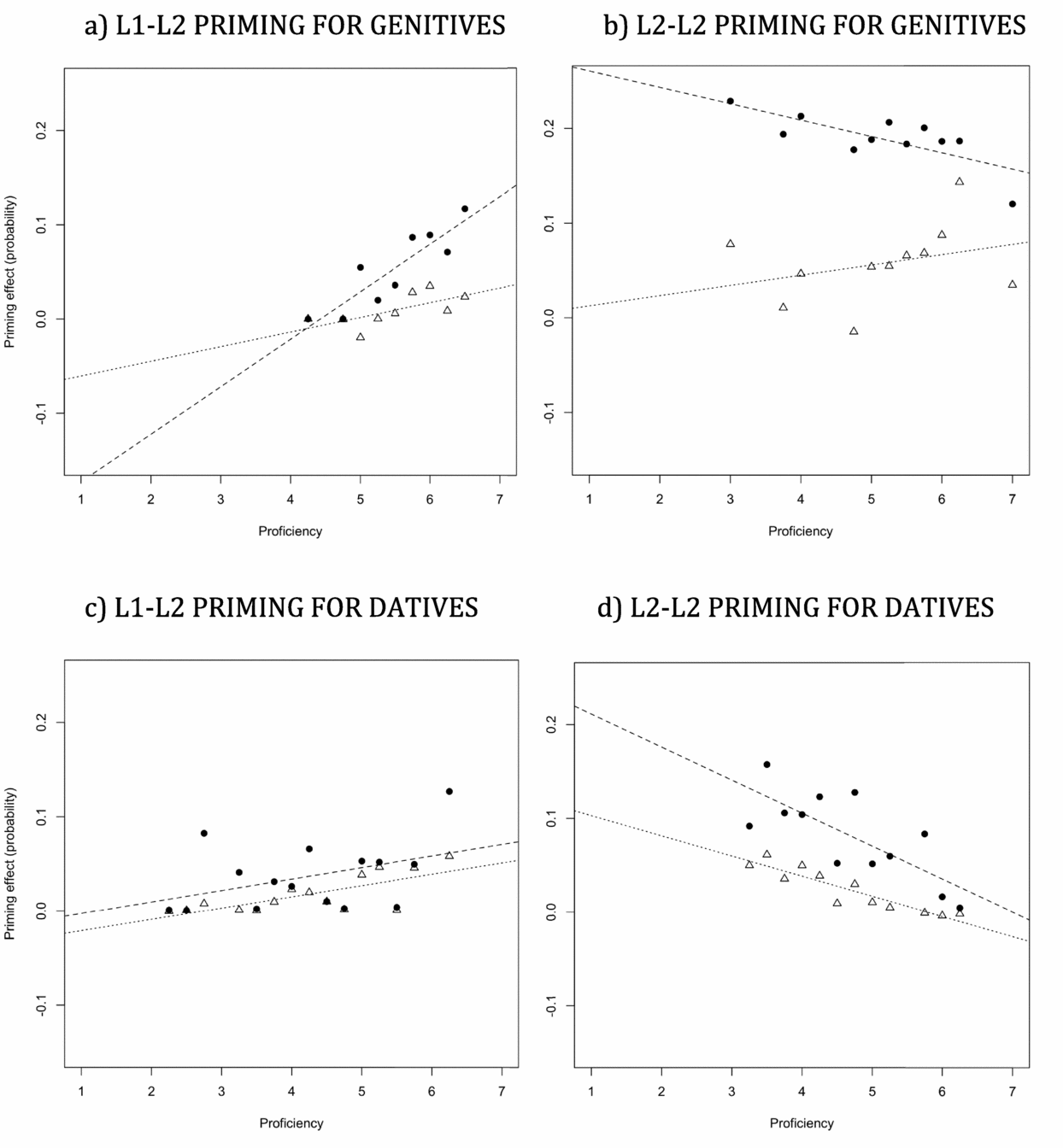
Summarizing, there was priming and a relatedness boost in both the within-language priming experiment and in the between-language experiment, with much stronger priming within-languages than between-languages, both in the abstract priming conditions and in the related conditions. As mentioned above, Bernolet et al. (Reference Bernolet, Hartsuiker and Pickering2013) accounted for this effect of prime language by assuming that the least proficient participants did not yet have representations for the genitive that are shared across languages. Thus, only the more proficient participants displayed cross-linguistic priming. Consistent with this account, proficiency was a significant predictor of priming in the L1 to L2 experiment, both in the related and the unrelated conditions; the more proficient the participants were, the stronger the priming (Figure 3a).
Relation between priming and proficiency for genitives (Bernolet et al., Reference Bernolet, Hartsuiker and Pickering2013; upper panels) and for datives (reanalysis of Schoonbaert et al., Reference Schoonbaert, Hartsuiker and Pickering2007; lower panels). Panels (a) and (c) L1 to L2 priming; Panel (b) and (d) L2 to L2 priming. Priming in the unrelated conditions is represented by triangles and a dotted regression line; priming in the related conditions by circles and a dashed regression line.

Interestingly, in the L2 to L2 experiment, proficiency also predicted priming, but now the direction of the effect depended on lexical overlap: in the unrelated condition, more proficient participants again tended to show larger priming effects. But in the related conditions, the less proficient participants had larger priming effects than the more proficient participants (even though those participants still showed sizable priming; Figure 3b).
Together with the observation that low-proficient participants tended to produce s-genitives only in the related conditions and the findings that transfer errors (the nun her hat) were made predominantly by the high-proficient participants, these results led to an account, according to which only high-proficiency participants have abstract representations for the s-genitive that are shared between their L1 and L2. Hence, the high-proficiency participants show priming within-L2 in both the related and unrelated conditions, as well as priming between L1 and L2. They make transfer errors when they select the correct syntactic representation, but make mistakes in the morphological realization of the structure. Because the low-proficient participants have no abstract representations (but do perhaps have several item-specific representations), they show little abstract priming, neither in the within-language unrelated conditions nor in between-language conditions. However, in the within-language, related conditions, they can profit from the fact that the prime sentence (e.g., The doctor's hat is green) is an almost exact model of the target utterance (e.g., The nun's hat is green). If speakers are uncertain about the best way to describe the picture, a good strategy might be for them to use their explicit recall of the previous sentence and copy and edit it. We assume that low-proficiency speakers (who are more uncertain about these constructions) are more likely to engage in this strategy than high-proficiency speakers, which leads to a very large priming effect in the related conditions.
Thus, Bernolet et al.'s (Reference Bernolet, Hartsuiker and Pickering2013) account shares the assumption of many studies in L1 and L2 syntactic acquisition that more advanced participants are more likely to have abstract representations of more complex (or developmentally advanced) constructions; it therefore predicts stronger abstract priming in more proficient L2 learners. This is similar to the process of abstraction in the course of development that takes places in implicit learning models (Chang et al., Reference Chang, Dell and Bock2006). But Bernolet et al.'s account differs from other accounts in its explanation of priming in related conditions – rather than viewing this (exclusively) as priming of a lexically-specific node, they also argue for another mechanism: namely a process of retrieving the previous utterance from explicit memory and imitating it with only minimal ‘edits’. Before we discuss the implications of these findings further, we first reanalyze an existing data set to assess and refine this account further.
Reanalysis of Schoonbaert et al. (Reference Schoonbaert, Hartsuiker and Pickering2007)
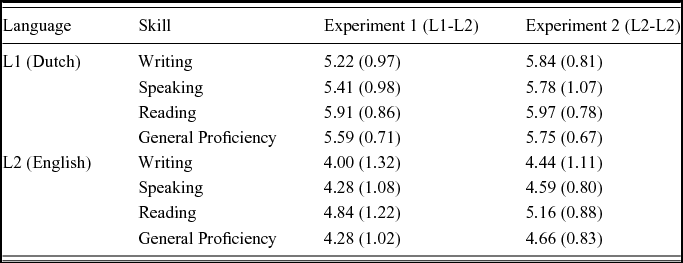
In order to test whether the relations between proficiency and structural priming across languages and within a second language can be generalized to another structural alternation, we reanalyzed the data reported in Schoonbaert et al. (Reference Schoonbaert, Hartsuiker and Pickering2007; Experiment 1 and 2). These authors tested Dutch–English bilinguals on DO (4a) and PO datives (4b) in same verb (or translation verb equivalent) conditions and in different verb conditions in the direction L1-L2 (Experiment 1, 32 participants) and in the direction L2-L2 (Experiment 2, 32 participants). Proficiency in L2 English was assessed using the same self-rating scale as used by Bernolet et al. (Reference Bernolet, Hartsuiker and Pickering2013), but was not included as a covariate in the analyses (see Table 1 for Schoonbaert et al.'s proficiency ratings)
Self-Assessed Ratings (7-Point Likert Scale Ranging From Very Bad to Very Good) of L1 and L2 Proficiency (Experiments 1 & 2 Schoonbaert et al., Reference Schoonbaert, Hartsuiker and Pickering2007)

Note. Standard deviations are indicated in parentheses. L1 = native language; L2 = second language.
-
(4a) De kok toont de bokser een hoed (the cook shows the boxer a hat)
-
(4b) De kok toont een hoed aan de bokser (the cook shows a hat to the boxer)
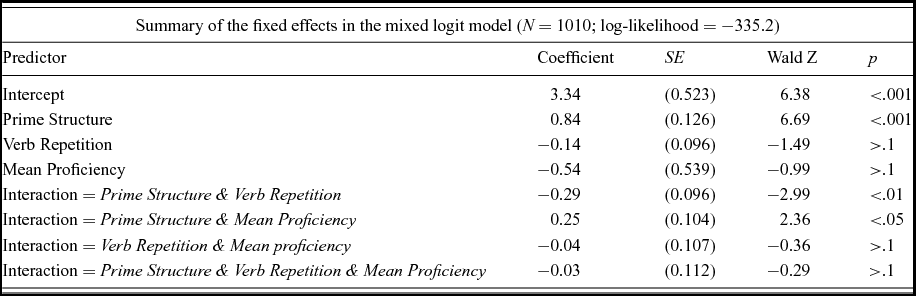
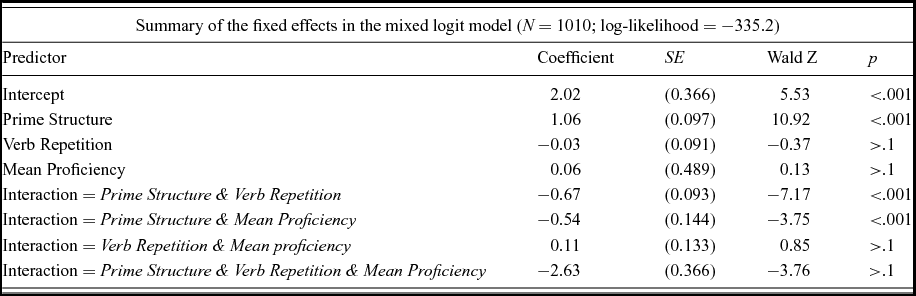
In the L1 to L2 experiment, there was 8% priming in the unrelated condition and much stronger priming (17%) in the related condition; thus there was a translation equivalence boost. In the L2 to L2 experiment, there was a 9% priming effect in the unrelated condition and much stronger priming in the related condition (36%); thus, there was a lexical boost. Similar to Bernolet et al. (Reference Bernolet, Hartsuiker and Pickering2013), but differently from Schoonbaert et al. (Reference Schoonbaert, Hartsuiker and Pickering2007), our reanalysis used logit mixed effect models with proficiency as a continuous variable. We ran a full model that predicted the logit-likelihood of a PO-dative response, with Prime Type (DO, PO), Meaning overlap, and their interactions as fixed factors and random intercepts for participants and items. The mean L2 proficiency was added as a continuous predictor (this variable was centered to its mean). We added random slopes for participants and items using forward selection, but the final model contained only those random slopes that significantly improved the model's fit (a random effect of Prime Type for items for the L1 to L2 experiment), as was done in Bernolet et al. (Reference Bernolet, Hartsuiker and Pickering2013). The best fitting model is summarized in Table 2.
Results analyses Experiment 1 (L1-L2)

The positive intercept indicates an overall preference for the PO-dative (used on 68% of trials). There was a clear effect of priming as well as an interaction, indicating that priming was stronger in the same meaning conditions (i.e., a translation equivalence boost), as Schoonbaert et al. (Reference Schoonbaert, Hartsuiker and Pickering2007) also concluded based on ANOVAs. Importantly, priming interacted with proficiency. There was no three-way interaction between priming, meaning overlap, and proficiency. As shown in Figure 3c, the relation between proficiency and priming was similar to that in Bernolet et al. (Reference Bernolet, Hartsuiker and Pickering2013); the more proficient the speakers were, the stronger the priming effect. Thus, even though the DO and PO dative are both more similar between Dutch and English than the of- and s-genitive, it seems that also for datives, lower-proficiency participants have no abstract, language-independent representations yet and hence show no structural priming across languages.
Table 3 summarizes the results of Schoonbaert et al.'s (Reference Schoonbaert, Hartsuiker and Pickering2007) within-L2 experiment. As was the case for the between-language experiment, there was again clear evidence for a priming effect and a lexical boost, confirming Schoonbaert et al.'s ANOVAs. There was a clear interaction with proficiency; but, importantly, there was no three-way interaction between prime type, verb repetition, and proficiency. Figure 3d displays the relation between priming and proficiency in this (within-L2) experiment. Clearly, the relation is now negative, so that more proficient participants show less priming both in the same meaning and different meaning conditions. Thus, it seems that at least in the case of DO and PO datives, the relation between priming and proficiency differs, depending on whether priming is between-languages (more priming in more proficient speakers) or within-language (less priming in more proficient speakers). We suggest below that in the case of datives, less proficient speakers use an explicit memory strategy even in the case of different meaning items.
Results analyses Experiment 2 (L2−L2)

The data pattern obtained in our reanalysis of Schoonbaert et al.'s (Reference Schoonbaert, Hartsuiker and Pickering2007) data as a function of proficiency resembled that of Bernolet et al. (Reference Bernolet, Hartsuiker and Pickering2013), with one exception. Specifically, in both studies, priming across languages was stronger the more proficient participants were. Additionally, in the related meaning conditions of both studies, priming within-L2 was stronger the less proficient the participants were. Only in the different meaning conditions of the within-L2 experiments was there a difference: stronger priming with more proficiency in Bernolet et al., and stronger priming with less proficiency in Schoonbaert et al. (see Figure 3). To account for the full pattern of data from both studies, we assume that (a) less-proficient bilinguals do not have abstract, shared representations across languages yet; hence they do not show cross-linguistic structural priming. In contrast, high-proficient bilinguals do have abstract representations and so they do show priming across languages; (b) less-proficient bilinguals rely more than high-proficient bilinguals on an explicit memory strategy such as copying the prime sentence while slightly adjusting it so as to convey the relevant message (e.g., changing the doctor's hat to the nun's hat). They are particularly likely to do this when they have not formed abstract representations of a structure in L2 and so are highly uncertain about how to formulate the appropriate sentence. It is this mechanism that would drive the negative relation between priming and proficiency in the case of Bernolet et al.'s study with genitives.
Our reanalysis of Schoonbaert et al. (Reference Schoonbaert, Hartsuiker and Pickering2007) shows there is also such a negative relation in the case of DO and PO datives, but now this relation also holds for the unrelated conditions. The negative relation in the related conditions could be the result of the same mechanism we proposed in the case of the genitives: low-proficient participants would be more likely to engage in a strategy of retrieving the previous sentence from explicit memory and imitating it with minimal changes. We suggest that the participants would tend to use a similar explicit-memory strategy in the unrelated conditions. Given that the English DO and PO dative are quite similar to their Dutch counterparts, participants might find it relatively easy to engage in such a strategy even in the unrelated conditions. Consider (5a-5d): it is clear that only a limited number of content word substitutions suffice to create 5a(5c) on the basis of 5b(5d). Furthermore, because quite a few dative verbs have similar meanings (Schoonbaert et al.'s item set for the unrelated conditions contained verb pairs like offer–hand and hand–give), the complete prime and target utterances are very similar in meaning as well (as opposed to the genitive constructions, in which the head nouns are completely unrelated). Hence, also in the unrelated conditions priming is stronger in lower-proficiency subjects (who are likely to use an explicit-memory strategy) than in higher-proficiency subjects (who are less like to use such a strategy and instead draw on their implicit memory for dative syntax to form a new sentence).
-
5a. The nun gives a banana to the swimmer
-
5b. The cowboy shows a fish to the judge
-
5c. The nun gives the swimmer a banana
-
5d. The cowboy shows the judge a fish
An account of L2 syntactic acquisition
In Figure 4, we sketch a possible account of (late) L2 syntactic acquisition, which extends our earlier accounts in terms of a lexically-based model (Bernolet et al., Reference Bernolet, Hartsuiker and Pickering2013; Hartsuiker et al., Reference Hartsuiker, Pickering and Veltkamp2004). Our account assumes that learning results in a network of representations that strikes a balance between two principles, namely representational specificity and economy. In other words, the learning system strives towards a situation that captures relevant differences between linguistic representations (e.g., different syntactic alternatives) while minimizing the number of representational elements (nodes). To do so, we assume two processes that respectively instantiate new representational nodes to represent newly acquired information and one that merges existing nodes to abstract over similar information. The first process (see discussion) might take place along the lines of MacKay's (Reference MacKay, Neumann and Prinz1990) Node Structure Theory; when an incoming stimulus does not activate any existing node, a new node will be automatically formed to represent this new information. It is conceivable that the process of abstraction could result from a form of Hebbian learning – if two nodes are always active together they might become functionally equivalent to a single node. It is important to note that while the computational mechanisms of instantiation and merging we suggest here are specific to the localist framework we have adopted here, the general principles of specificity and economy are compatible with (and arguably emergent properties of) distributed theories too, including recurrent networks such as the one at the core of Chang et al.'s (Reference Chang, Dell and Bock2006) model.
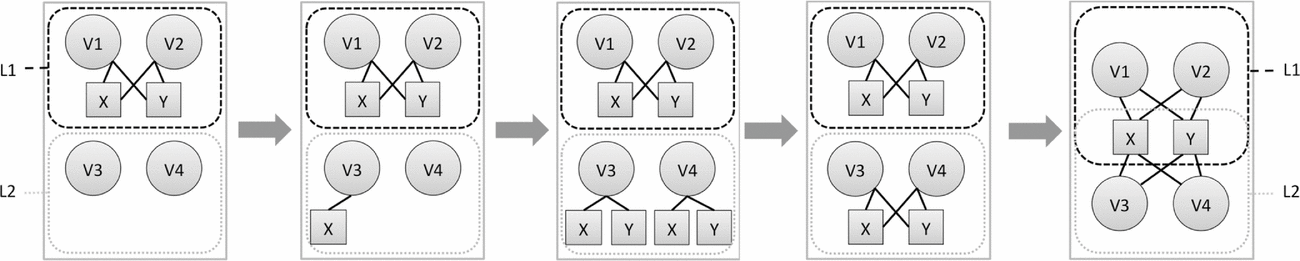
Developmental model. V1 and V2 are verbs in L1 and V3 and V4 are verbs in L2; X and Y are combinatorial nodes that eventually become shared between the different verbs of both languages. Consecutive model states during different points of the L2 syntactic acquisition trajectory are shown from left to right. The L1 lexicon is depicted in the upper part of the model, the L2 lexicon in the lower part. To save space only lexical and combinatorial nodes are shown.

Each panel in the figure shows a snapshot of the lexico-syntactic network in L1 (top) or L2 (bottom) at different moments of development. For simplicity's sake, it only shows two lexical nodes (V1 and V2) that are fully connected to two combinatorial nodes (X and Y), while leaving out the other nodes to which these nodes are connected (e.g., the conceptual nodes, the language node, the word category nodes, etc.). The situation shown on the left-hand side is that obtained after successful L1 acquisition; the speaker represents that in her L1, the structures X and Y can be used with both lexical item V1 and lexical item V2. One can thus expect this person to have abstract structural priming within L1.
The last panel is that of a second language learner who has reached considerable proficiency in their L2. The speaker now has lexical representations in L2 (i.e., V3 and V4), and these lexical items are both connected to the combinatorial nodes X and Y that are now fully shared across languages. In fact, this state of the system is the situation that Hartsuiker et al. (Reference Hartsuiker, Pickering and Veltkamp2004) described in their shared-syntax model. The difference with their account is that we now view this model as the end state of the developmental trajectory. We predict that a person who has reached this level of second language acquisition to show abstract structural priming of comparable magnitude within- and across-languages.
The intermediate panels of the figure show snapshots of the lexico-syntactic representational system as it develops; for simplicity's sake we have left out several possible states of the system in between the ones shown here and that it is possible that the transition from language-specific to shared representations may not be as orderly as suggested here (e.g., it might be possible that whereas structure X is already shared between L1 and L2 there are still language-specific representations of Y).
We assume L2 acquisition begins with learning of lexical representations without firm connections to syntactic information. A native speaker of French may have learned the English word expect for instance, but without representing the appropriate syntactic information relevant to this verb (such as that it does not require or allow a reflexive pronoun and a prepositional argument, in contrast to its French counterpart attender). If the speaker now tries to use that verb in English, she has no English syntactic information to rely on and so she is likely to use syntactic representations she does have (namely French ones), leading to transfer such as Expect you to the impossible (an Anglicized version of the Dutch example from the beginning of the paper). Importantly, low-proficient learners have another option besides transferring syntax: they might imitate structures they hear more competent users of that language (e.g., native speakers) produce. They can do this, for instance, by answering a question using a parallel sentence to that of the question (e.g., when asked “is that Jon's beer or my beer?” a parallel answer would be “Jon's beer” rather than “Jon’s”). We argue that such imitation mechanisms might be based on retrieval of sentences from explicit memory and editing them, and that these mechanisms play a role during structural priming within a second language. We thus predict that in this early stage, there is no abstract priming between languages but there may be effects within L2 (especially in related conditions) resulting from copying and editing prime sentences that are explicitly recalled.
In the next stage, syntactic representations in L2 emerge, presumably on the basis of exposure to these structures. Kaschak (Reference Kaschak2006) has shown that limited exposure to a new structure (in L1) is sufficient to reduce costs in reading time when encountering that structure. Studies on adult L2 learning show that after sufficient exposure to priming sentences, developmentally advanced forms begin to emerge (e.g., Kim & McDonough, Reference Kim and McDonough2008). A possible implication is that combinatorial nodes, and links to the verbs they co-occur with can be formed after relatively limited exposure. It is possible that a combinatorial node represents a structure that is very similar to that in the L1; but the second language acquisition system cannot tell by encountering a structure with a particular lexical item how item-specific this structure is in the L2. We thus assume that acquisition starts out with language-specific, and item-specific representations, presumably with nodes for highly frequent structures formed earlier than for less common structures (hence there is already an X-node but no Y-node yet in the second state depicted in Figure 4).
After sufficient exposure to L2, incrementally adding combinatorial nodes will lead to the situation depicted next. Now, there are combinatorial nodes for both more frequent and less frequent structures but they are still specific for lexical items. In this state, one still expects no abstract priming between or within languages; but there ought to be item-specific priming effects that are now based on residual activation of structural nodes (as opposed to an explicit memory effect). Note that this prediction can, in theory, be distinguished from that relating to the very initial state: if explicit memory effects were somehow ruled out (e.g., by a lag manipulation or by testing amnesic patients), speakers in this state should still have item-specific priming within L2, whereas speakers in the initial state without L2-syntactic representations should not even show item-specific priming (in fact, they would be likely to show transfer of the L1 on every trial).
In the fourth state shown in the figure, the speakers have abstracted structures X and Y across multiple words in L2. In this state, one would expect the speakers to show both item-specific and abstract priming in the L2, as well as a lexical boost to priming, but there should be no cross-linguistic priming. Note that there may be an intermediate state between the third and fourth state, in which one structure (e.g., X) is already shared between V3 and V4, while there are still item-specific representations for structure Y. Similarly, there may also be an intermediate stage between the fourth state and the final state shown at the bottom of the figure, during which some structures are already shared between languages (e.g., structure X could be connected to all four lemmas) while there are language-specific nodes for structure Y. It is possible that this latter scenario was true for some of Bernolet et al.'s (Reference Bernolet, Hartsuiker and Pickering2013) participants: after all, the of-genitive is very similar between Dutch and English and may be quickly shared; the English s-genitive is somewhat different and has been suggested to be a developmentally more advanced structure. Hence, it might be argued that for at least the less proficient participants, this structure is not yet shared between languages.
As indicated in the figure, our theory assumes that bilingual syntactic representations move from item-specific to more abstract, with abstraction taking place both across words within a language and between languages. But additionally, as suggested by Bock and Griffin (Reference Bock and Griffin2000), Chang et al. (Reference Chang, Dell and Bock2006), and Hartsuiker et al. (Reference Hartsuiker, Bernolet, Schoonbaert, Speybroeck and Vanderelst2008), there is evidence supporting the account that there is an explicit memory component to priming in addition to a more abstract component. This explicit memory component has mainly been offered as an alternative account of the lexical boost (i.e., alternative to the idea that links between lemmas and combinatorial nodes retain activation; Pickering & Branigan, Reference Pickering and Branigan1998). However, it is very much conceivable that even in the absence of lexical overlap, there could nevertheless be an explicit component to structural priming. Based on the relations between priming and proficiency that we observed in Bernolet et al. (Reference Bernolet, Hartsuiker and Pickering2013) and in our reanalysis of Schoonbaert et al. (Reference Schoonbaert, Hartsuiker and Pickering2007), we argue that (a) such explicit memory strategies can lead to structural priming; (b) such strategies are more likely when participants are less proficient; (c) such strategies are more likely when it is easier to copy (and slightly edit) the prime response; hence this strategy is more successful in same meaning than different meaning conditions; (d) however, if the structures are similar enough across languages (e.g., PO and DO datives in Dutch and English), such strategies even happen without meaning overlap.
General Discussion
This paper reviewed the representation and acquisition of syntax in both the first and second language, focusing specifically on the results of structural priming studies. This review indicated that accounts of structural priming in L1 differ in whether they view the lexical boost of priming as a result of a temporary strengthening of links between lexical and syntactic nodes or rather as a process of imitating, and partly changing, the prime sentence on the basis of explicit memory. Studies on priming between both languages of bilinguals have demonstrated cross-linguistic priming, suggesting that syntactic representations are shared between languages, and this conclusion is further supported by studies using alternative paradigms. Studies on the development of syntactic representations have shown evidence for abstract priming in young children. Interestingly, one study showed a much stronger lexical boost in older children and adults than in younger children, suggesting that the youngest group could rely much less on explicit memory. Finally, studies on syntactic development in L2 showed that a limited amount of exposure can be sufficient to elicit developmentally advanced forms in L2 learners; these studies also suggested that proficiency might modulate the strength of priming.
In the next section we examined the role of proficiency, discussing in some detail the results from Bernolet et al. (Reference Bernolet, Hartsuiker and Pickering2013) and presenting a reanalysis of the data from Schoonbaert et al. (Reference Schoonbaert, Hartsuiker and Pickering2007). These studies showed that proficiency indeed modulates structural priming in L2 learners, but that this modulation depends on the prime language. In particular, if priming is from L1 to L2, priming is stronger for more proficient participants, suggesting that with more proficiency, subjects are more likely to share syntactic representations across their two languages. The situation is more complex for priming within-L2. In the case of genitives (Bernolet et al., Reference Bernolet, Hartsuiker and Pickering2013), there was more priming for more proficient speakers in the unrelated conditions, but more priming for less proficient speakers in the related condition. We argued that especially the low-proficient speakers used an explicit-memory strategy, but only in the related conditions. But in the case of datives (Schoonbaert et al., Reference Schoonbaert, Hartsuiker and Pickering2007), low-proficiency speakers had stronger priming in both the related and unrelated conditions. We argued that in the case of datives, an explicit memory strategy is relatively easy, and so the low-proficient speakers used it even in the unrelated condition.
Based on our review of the findings and our analysis of proficiency, we sketched an outline of a theory of L2 syntactic acquisition. The theory assumes that L2 learners in the very initial stages of learning have no L2 syntactic representations yet. These learners might often transfer syntactic information from their L1 or, if possible, imitate the utterances of more proficient conversation partners. As the learners gain experience with their L2, syntactic representations will start to develop (presumably for more frequent structures first). Importantly, we assume that these representations are initially language- and item-specific; only after sufficient exposure do they become shared. The end state of the learning trajectory would then be akin to the model sketched by Hartsuiker et al. (Reference Hartsuiker, Pickering and Veltkamp2004), in which syntactic representations are fully shared across languages and lexical items. We finally assume a modulation of explicit memory processes that can act in addition to priming to determine syntactic choices.
The account presented in this paper is couched in terms of the residual activation model (Pickering & Branigan, Reference Pickering and Branigan1998). This has the distinct advantage that the relationships between syntactic and lexical information in different languages can be represented relatively easily; furthermore, there is an explicit bilingual version of the residual activation model (Hartsuiker et al., Reference Hartsuiker, Pickering and Veltkamp2004), whereas error-based, residual activation models (e.g., Chang et al., Reference Chang, Dell and Bock2006) have not yet been extended for bilingualism. Nevertheless, we believe that such bilingual, implicit learning models should be possible in principleFootnote 1 ; and note that like Chang et al. we also argue for a role of explicit memory in accounting for the lexical boost. In fact, one very interesting aspect of a bilingual version of implicit learning models is that such models by definition make assumptions about learning mechanisms: a fascinating question then is whether such a model would move through a similar transition of states as suggested by the verbal account sketched in this paper.
One important aspect of development that our account does not explain is that of node formation in learners. Based on the literature reviewed in this paper, it seems that exposure to a limited number of trials is sufficient to change learner's behavior (i.e., to read a novel construction in L1 without measurable cost or to produce a novel construction in L2). One possibility is that exposure to (and presumably understanding of) a sentence with a novel structure suffices to create a new representation (MacKay, Reference MacKay, Neumann and Prinz1990). This would fit the assumption of implicit learning models that novel, and hence unexpected, sentences lead to a rather large error term and hence a large amount of learning. But a further possibility is that the formation of representations is boosted by the imitation of structures, including imitation of only some aspects (global structure, function words) with other elements substituted. Consistent with this idea, Gámez and Vasilyeva (Reference Gámez and Vasilyeva2015) found stronger L2 to L2 priming when the bilingual children were forced to repeat the prime sentences and thus needed to retrieve that sentence from explicit memory and imitate it. Such an account is in fact consistent with early theories of syntactic acquisition in L1 (Whitehurst & Vasta, Reference Whitehurst and Vasta1975), that view syntactic learning as driven by (a) understanding and (b) ‘selective’ imitation (i.e., imitation of structure). Importantly, on such an account, the processes taking place during structural priming, including the explicit memory mechanisms that are now invoked to explain the lexical boost (e.g., Chang et al., Reference Chang, Dell and Bock2006; Hartsuiker et al., Reference Hartsuiker, Bernolet, Schoonbaert, Speybroeck and Vanderelst2008), would be part of a functional mechanism to learn new structures. On this view, priming should not only be considered as a method to gauge the existence of shared syntactic representations, but could be seen as a model of syntactic learning.
The account sketched here also has several implications for the interpretation of results from structural priming studies. Our comparison of the Bernolet et al. (Reference Bernolet, Hartsuiker and Pickering2013) study with genitives and the Schoonbaert et al. (Reference Schoonbaert, Hartsuiker and Pickering2007) study with datives shows that results obtained with one syntactic alternation need not be the same for another alternation. On our account, English genitives and datives (in the case of Dutch learners of English) differ in the extent to which they ‘invite’ explicit-memory strategies. More generally, as argued by Bernolet et al. (Reference Bernolet, Hartsuiker and Pickering2009), there could be additional levels at which priming takes place (e.g., the level of information structure), and syntactic alternations can differ in the extent to which such extra-syntactic priming plays a role. It thus seems important that in the future, the rather limited range of structures (mainly datives and transitives) tested in children and L2 learners is extended.
Additionally, the account of the lexical boost we have argued for here has consequences for the interpretation of priming in related vs. unrelated conditions in learners. One pattern that has been observed in some of the earlier studies on structural priming in children is one of priming in related conditions only, and this has been interpreted as evidence for lexically-specific structural representations. However, it is also possible that abstraction takes place rather early in L1 (and L2) development, but that in the related conditions there is an additional boost of priming due to explicit memory processes. Since it is possible that explicit memory for sentences, or the tendency to use a strategy on the basis of explicit memory changes in the course of development, the lexical boost may also vary with development.
The account we have sketched here relies strongly on data from structural priming. This has the advantage that it allows for a detailed way of assessing which syntactic representations are abstracted over languages and that the paradigm has been shown to work successfully within- and across- different languages in both adult and child language learners. Structural priming experiments lead to causal conclusions (in the sense that one can argue that the structure of a prime causes a subject to respond in particular ways) and, arguably, processes taking place during priming are the same processes that underlie syntactic learning. On the other hand, cross-linguistic priming has the disadvantage that it creates a mixed-language context by definition. Future work should therefore aim to extend the repertoire of methods, for instance by considering whether a particular structure in language A inherits the frequency of that structure in language B (e.g., Runnqvist et al., Reference Runnqvist, Gollan, Costa and Ferreira2013) and how this changes in L2 language acquisition.
In conclusion, we present an account of syntactic learning in L2, that argues for: (a) an initial phase without L2 syntactic representations; speakers transfer from the L1 during this phase and imitate native speakers; (b) an intermediate phase, during which L2-specific nodes are formed; (c) a final phase, when the L2-specific nodes have been merged with L1-specific nodes whenever this is possible, to form language-independent nodes. Whereas structural priming effects depend on the structure of the network corresponding to the particular phase one is in, we further argue that there are also explicit-memory processes that affect the strength of priming. Such processes may in fact be crucial for syntactic learning in that they are necessary for imitation, which in turn may be an important driving force for the instantiation of new syntactic nodes.