If liberty and equality, as is thought by some, are chiefly to be found in democracy, they will be best attained when all persons alike share in the government to the utmost. – Aristotle, Politics
Although Africa lags in economic development, the continent as a whole has experienced a wave of democratization since the end of the Cold War. More African countries are democratic and fewer are autocratic today than ever before. This growth of democracy raises many interesting questions for Africa: does it mean that African countries are ‘getting institutions right’ and will achieve steady economic growth (Rodrik, Reference Rodrik2004)? Is it improving conditions for people in the more democratic countries? Does it reduce the likelihood of civil war, which has been so destructive in Africa?
This paper carefully considers the available evidence to answer these questions through cross country panel analysis. A new instrument, the spatial lag of democracy, is used to estimate regressions on economic growth and civil violence. The instrument varies over time, which allows for regressions that account for bias due to endogeneity while also considering country fixed effects. The identification is based on the concept of waves of democracy: since democracy often spreads horizontally at certain times, democracy in neighboring countries exogenously impacts democracy in a given country (Knutsen, Reference Knutsen2011). The results show significant impacts of improved property rights on economic growth and of increased political participation on reducing civil violence. Further estimates suggest that both effects may be driven by civil liberties. The trend of democratization for Africa is thus likely to reap many benefits in the years to come.
1. Democracy in postcolonial Africa
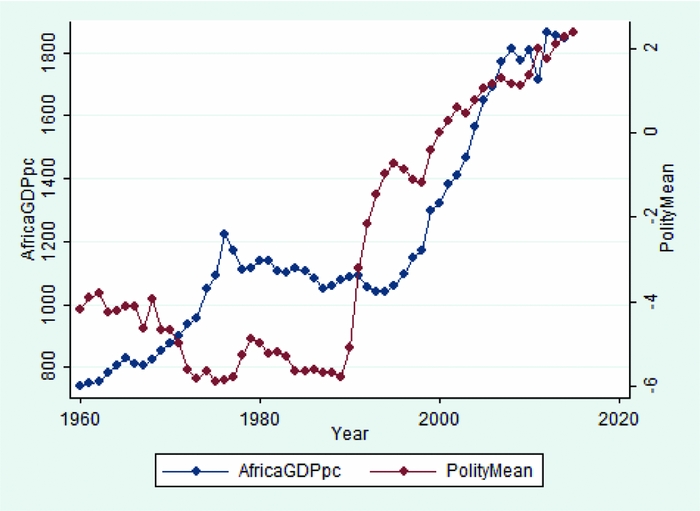
Since the end of the Cold War, Africa has become steadily more democratic. This trend is easily seen using Polity scores (Marshall and Jaggers, Reference Marshall and Jaggers2007).Footnote 1 Figure 1 shows the trend of the mean Polity score for Africa, where the sample includes all continental African countries; each country enters the sample at independence (or when data become available). The trend is clear: the mean score hits a trough in the late 1980s and then begins its ascent around 1990. It briefly decreases in the late 1990s and then continues to rise.
Mean democracy score and GDP per capita for Africa.

Figure 1 illustrates a wave of democratization in Africa starting in 1990. Research on democratization suggests that such waves are common throughout history; Europe experienced several waves in the 19th century and they have been the subject of close study (Huntington, Reference Huntington, Diamond and Plattner1996; Van de Walle, Reference Van de Walle1999). These waves occur in part because countries do not exist in isolation. When one country starts a revolutionary shift toward democracy, people in neighboring countries take notice and become more likely to attempt a change in their country, particularly if their neighbor is successful.Footnote 2 A similar mechanism was at play in the independence movements of African countries, which also came in a large wave beginning in the late 1950s. Northern Africa also experienced a wave more recently with the Arab Spring.
Democracy is associated with better governance, which can mean better institutions that will enable economic growth (Acemoglu et al., Reference Acemoglu, Johnson and Robinson2001) and better public goods that will improve welfare. Also, democratic countries are generally considered to be more stable and less prone to war. The wave of democratization in Africa is clearly good in terms of expanded freedoms in more democratic countries. This paper examines further if these more democratic countries have an advantage in economic growth and in peace and stability.
There is a strong cross-country correlation between democracy and gross domestic product (GDP) per capita (Acemoglu et al., Reference Acemoglu, Johnson, Robinson and Yared2008). The relationship between democracy and national income has thus been studied carefully under Lipset's ‘modernization hypothesis’, which suggests that increasing national income will lead to democratization (Boix and Stokes, Reference Boix and Stokes2003; Goldstone et al., Reference Goldstone, Bates, Epstein, Gurr, Lustik, Marshall, Ulfelder and Woodward2010; Paldam and Gundlach, Reference Paldam and Gundlach2008). Others claim that good institutions, which are associated with democracy, are necessary for economic growth to happen (Acemoglu et al., Reference Acemoglu, Johnson and Robinson2001; Rodrik et al., Reference Rodrik, Subramanian and Trebbi2004). As can be seen in Figure 1, continent-wide GDP increased from the independence period of the early 1960s until around 1980. From there it decreased until the early 1990s, at which point it began an ongoing steady climb.
Before 1990, there is no discernable positive relationship between GDP growth and democracy. If anything, African countries on average became less democratic from the early 1960s to 1980, whereas their economies grew. Both variables are relatively stagnant during the 1980s, and then the mean Polity score begins its increase five years before GDP starts growing again in the mid-1990s. For the rest of the sample both are increasing, suggesting that the wave of democratization may have contributed to the later turnaround in GDP growth. There is no indication here that higher GDP contributed to the overall rise in democracy, and thus little support for the modernization hypothesis in Africa.
Those who argue that democracy is good for growth tend to focus on institutions. Specifically, Acemoglu and Johnson (Reference Acemoglu and Johnson2005) use Polity's Executive Constraints variable as a measure of property rights institutions, which they argue are critical for growth. If the wave of democratization contributed to subsequent economic growth in Africa, it is possible that the mechanism was improved property rights. Knutsen (Reference Knutsen2011), for instance, argues that democratization leads to improved property rights. More recent work by Alfonso-Gil et al. (Reference Alfonso-Gil, Lacalle-Calderón and Sanchez2014) argues that Executive Constraints is a strong indicator of civil liberties and that stronger protection of civil liberties improves economic growth. The trend of increasing democratization holds for increasing Executive Constraints scores as well.
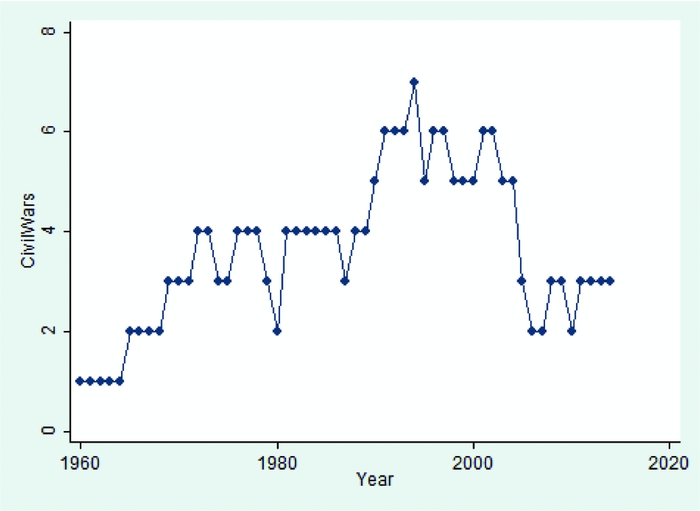
It has been argued that democratic governments are less prone to wars, both internal and external (Przeworski and Limongi, Reference Przeworski and Limongi1997). The logic is that democratic governments are more inclusive, which allows internal opposition groups to voice their concerns through the political system rather than turning to violence, obviating civil conflicts. Although interstate wars have been rare, civil wars have unfortunately been all too common in post-colonial Africa. Figure 2 plots the number of civil wars taking place by year in postcolonial Africa. The data for civil violence comes from the Major Episodes of Political Violence (MEPV) dataset.Footnote 3 The civil violence variable puts total civil violence on a scale from one to ten, where one represents sporadic political violence and ten represents ‘extensive, systematic, and indiscriminate destruction of human resources and/or physical infrastructure’ (Marshall, Reference Marshall2006). A three for this variable represents serious political violence, whereas a four marks the jump to ‘serious warfare’ (Marshall, Reference Marshall2006). For Figure 2, any episode of violence rated four or higher is counted as a civil war.
Civil wars in post-colonial Africa, number of episodes per year.

The unfortunate trend is that the number of ongoing civil wars has gradually increased in the post-colonial period. The wave of democratization does not seem to have decreased the overall number of civil wars. However, what the wave shows is a trend of political change across the continent, so it is not surprising that such a massive change includes many episodes of civil conflict. It is still worth investigating whether the countries that have opened their political process have decreased episodes of civil violence. Polity data on political participation is used to examine this trend further.
The Polity project defines 10 participation concepts based on country scores for regulation and competition in the political system (Marshall and Jaggers, Reference Marshall and Jaggers2007). Countries are counted as Dictatorships if they score a one or a two, which indicates ‘repressed competition’, where one person or party dominates the political process and excludes others from participating. Factional states score a six or a seven, which indicates restricted competition based on competing political factions, without any one being dominant.Footnote 4 Finally, democratic countries are those that score an eight, nine, or ten, indicating that the political process is competitive and liberalized or transitioning to a competitive liberal regime. Table 1 presents the type of participation regimes, as defined by Polity, in African countries by decade.
Political participation by decade – number of countries of each regime

Source: POLITY IV.
The trend in Table 1 is clear and consistent with the wave of democratization in Figure 1. Most African countries were dictatorships through the late 1980s, at which point many began to shift towards more competitive participation regimes. By 2005, the number of dictatorships had dropped to 5 from 40 in 1985, whereas the number of democratic/liberalizing countries increased to 22 in 2015. The number of factional regimes also increased drastically to 17 in 2005 from 0 in 1985. Since the end of the Cold War, there has been a major trend toward democratic governments with greater political participation in Africa. How does this trend relate to civil violence?
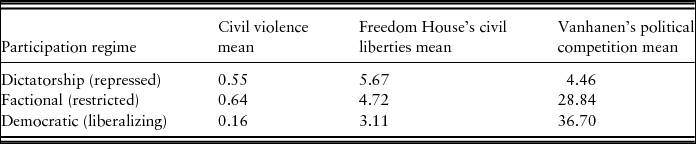
Table 2 presents summary statistics for the civil violence variable by lagged participation regime. Factional regimes are the most prone to civil violence, followed closely by dictatorships, whereas democratic/liberalizing regimes are much less prone to civil violence. Indeed, the mean civil violence scores for dictatorships and factional regimes indicate that in an average year those regimes experience sporadic political violence. Taken together, Tables 1 and 2 suggest that the continued episodes of civil violence in Africa may be associated with transitions from dictatorships to factional regimes and from factional regimes to democratic regimes, which is consistent with the finding of Goldstone et al. (2006) that ‘partial democracies’ are a key part of democratic transitions.
Civil violence by participation regime (lagged one year)

Source: POLITY IV and MEPV datasets.
BenYishay and Betancourt (Reference BenYishay and Betancourt2014) make a useful distinction between electoral democracy, as indicated by increased political participation and measured by the Polity participation variable, and liberal democracy, which incorporates civil liberties and protection of basic freedoms. They show that civil liberties have a more persistent impact on subsequent outcomes and also that civil liberties are complementary to political rights (BenYishay and Betancourt, Reference BenYishay and Betancourt2014). This delineation of electoral and liberal democracies may help explain why factional regimes are more prone to civil violence; it seems likely that regimes which partially democratize through holding elections but fail to protect civil liberties are less likely to find growth and stability.
Table 2 shows Freedom House's civil liberties score by participation regime as well as Vanhanen's political competition score (Vanhanen, Reference Vanhanen2000). The Freedom House score ranges from one to seven, with one being the most free and seven being the least free. It is clear that democratic regimes are much freer than either factional regimes or dictatorships. Vanhanen's measure shows the percentage of votes received by non-majority parties in the last election, so high percentages indicate greater democratic participation from multiple parties (Vanhanen, Reference Vanhanen2000). Although dictatorships show very little electoral competition, factional regimes on average have almost as much electoral competition as democratic regimes. The summary data thus support BenYishay and Betancourt's (Reference BenYishay and Betancourt2014) conclusion that civil liberties are a critical component of maintaining democracy.
The data indicate that Africa has experienced a wave of democratization that began at the end of the Cold War. This wave has included an improvement in the mean level of Executive Constraints, which scholars have argued is critical for economic growth (Acemoglu and Johnson (Reference Acemoglu and Johnson2005); Alfonso-Gil et al., Reference Alfonso-Gil, Lacalle-Calderón and Sanchez2014). The data also indicate a massive shift in political participation from dictatorships into to factional and democratic regimes with corresponding increases in political competition and civil liberties. Dictatorships and factional regimes are more prone to civil wars, which remain common in Africa. Hopefully the number of civil wars will drop as more African countries become democratic. The next step is to see if the associations identified here hold up in econometric analysis.
2. Identification in cross-country regressions
There is a vast literature of cross-country regressions analyzing the effects of institutions and/or democracy on GDP or GDP growth; this literature can be broadly divided into three phases based on the question of identification. The initial phase began when reasonable cross country data first became widely available. Datasets typically had small samples that limited the number of variables in any one regression, so the first identification concern was simply a question of which variables belonged in a small sample regression. Many papers presented different variables that were significant in some specification of a cross-country regression on growth or GDP. This first phase culminated in Sala-I-Martin's (Reference Sala-i-Martin1997) ‘million regressions’ paper, in which he attempted to settle the question of which variables belong in cross country regressions by actually running several million regressions and seeing which variables were consistently significant. His results indicate that political institutions are significant determinants of GDP; however, his million regressions were ordinary least squares (OLS) regressions that did not account for endogeneity.
Acemoglu et al. (Reference Acemoglu, Johnson and Robinson2001) began the second phase by finding plausible instruments for institutions in a cross-country regression. Their seminal paper has spawned many other works using instrumental variables to identify the effects of endogenous variables on growth or GDP. Rodrik et al. (Reference Rodrik, Subramanian and Trebbi2004), for example, use instruments for institutions and trade integration to test the effects of institutions, trade integration, and geography on GDP across countries. They find that institutions ‘rule’ over trade integration and geography as a determinant of GDP. Miguel et al. (Reference Miguel, Satyanath and Sergenti2004) use rainfall as an instrument to show that negative growth shocks increase the likelihood of civil war in Africa. Acemoglu and Johnson (Reference Acemoglu and Johnson2005) attempt to push the IV approach as far as possible and conclude that due to the paucity of instruments it is impossible to ‘unbundle’ institutions at the country level. Although Acemoglu and Johnson (Reference Acemoglu and Johnson2005) conclude that country-level institutions cannot be ‘unbundled’, the IV literature formed a consensus that institutions are a significant determinant of long-term growth across countries. Research in this phase focused on parsimonious specifications, being careful to not include variables that might be endogenous without proper instruments.
This second phase is now coming to an end, interestingly, due in part to the paper ‘Income and Democracy’ by Acemoglu et al. (Reference Acemoglu, Johnson, Robinson and Yared2008). In ‘Income and Democracy’, the authors put together a panel of countries and show that when country and time fixed effects are introduced, the effect of income on democracy disappears. Their paper focuses solely on the effect of income on democracy in the presence of fixed effects; they do not argue that it calls into question the earlier IV results. However, the instruments used in most of the IV regressions are time-invariant, so they cannot be used in a specification that also includes fixed effects. Knutsen (Reference Knutsen2011) presents estimates that include fixed effects and an instrumental variable based on waves of democracy to show that democratization improves property rights. However, his analysis does not extend to growth or GDP. It is therefore an open, and very important, question as to whether the strong relationship between property rights and growth holds with fixed effects.
Other studies have investigated the impact of fixed effects without instrumental variables. Rodrik and Wacziarg (Reference Rodrik and Wacziarg2005) analyze regime changes and find that democratic transitions are positively associated with GDP growth when controls for other regime changes are included. However, they do not delve further into what aspect of democracy improves growth and their specifications may still be subject to endogeneity bias. Papaioannou and Siourounis (Reference Papaioannou and Siourounis2008) similarly argue that fixed effects greatly lessen the endogeneity problem and show a significant relationship between income and democracy with fixed effects but without instrumental variables. The contribution of this paper is to estimate the impact of democratization on growth and civil violence with an instrumental variable in the presence of country fixed effects.
The variance in a panel of countries can be divided into the within and between variance. In the data used here, the within variance makes up 78% of the variance of Growth, and 62% of the variance of civil violence. Of the institutional variables, the within variance makes up 58%, 52%, and 64% of the variance of the Polity, Executive Constraints, and Participation variables. It is therefore reasonable to expect fixed effects to markedly change the results of IV regressions on institutions, as they do in Acemoglu et al. (Reference Acemoglu, Johnson, Robinson and Yared2008). Indeed, all of the IV regressions seen in the second phase of this literature are now called into question and must be seen as underspecified unless it can be shown that fixed effects do not change the estimates. The literature has now entered phase three, where it is necessary to account for fixed effects.
Some would disagree. Gundlach and Paldam (Reference Gundlach and Paldam2008), for instance, argue that country and time-fixed effects may be correlated with the variables of interest, in their case income, and therefore may capture the true effect of these variables. Econometrically, however, their argument is backwards. A strong correlation between fixed effects and the institutional variables used here does not bias the 2SLS results, and if it results in insignificant effects of the variables of interest, that is because the fixed effects are the key variables.
Accounting for the endogeneity of institutions/democracy while also including fixed effects requires an instrumental variable that varies across countries and over time. This paper presents estimations that account for endogeneity and include fixed effects by introducing a new instrumental variable: the spatial lag of democracy.
3. Instrumental variables estimates with fixed effects
Democracy may lead to better institutions, which then promote economic growth and democracy may obviate civil war through more inclusive politics. These possible mechanisms are investigated econometrically through IV estimates on Growth and civil violence that use a spatial lag of Polity scores as the key instrumental variable to identify the effects of Executive Constraints and political competition, respectively.
A spatial lag is a weighted average of the values of a variable for neighboring countries. The intuition behind it is that in a sample of contiguous units it is likely that the effects of some variables will be present in neighboring units. The types of weights used to calculate spatial lags vary; for this research the inverse distance from the country center is used as the weight because it is clearly exogenous and it gives close neighbors a stronger weight than those further away. The spatial lag of Polity thus gives a value for each country in each period that is the weighted average of the Polity scores of all other countries in the sample, with the closest neighbors receiving the strongest weight.
A valid instrument must meet the exclusion restriction that it correlates strongly with the endogenous covariate but does not affect the dependent variable directly. For the spatial lag of Polity to be valid it must correlate strongly with the endogenous covariates: Executive Constraints and political competition, but have no direct effect on growth or civil violence.
The trends of democracy in postcolonial Africa and the wave of democratization that began around 1990 are clear. The fact that such a wave exists suggests that democratization in one country is associated with democratization in another; indeed, history is full of such incidences. The timing of the wave is no coincidence either. The end of the Cold War was seen as the victory of the democratic/capitalist system and the wave of revolution in Eastern Europe clearly was felt in Africa as well. The history of democracy is full of horizontal expansion – across many countries at the same time rather than independently in each country. Indeed, Knutsen (Reference Knutsen2011) uses a similar instrument and argument, showing that democratization waves are exogenous to national politics but still impact national institutions. It is reasonable then to expect the spatial lag of democracy to correlate strongly with the level of democracy in any country. The data support this notion: the spatial lag of Polity has pairwise correlations of 0.43 with Executive Constraints and 0.52 with political competition.
The exclusion restriction for this instrument requires that waves of democracy have no direct effect on growth or civil violence in a given country. The key assumption is that democracy waves are exogenous to national politics in any given country (Knutsen, Reference Knutsen2011). The strong historical experience of democracy waves coupled with the clear starting point in Africa's democracy wave at the end of the Cold War lends credence to the notion that these waves are clearly international trends that are exogenous to individual countries’ politics.
However, one might see a ‘reflection effect’, where democracy in one country improves democracy in another, which in turn improves democracy further in the original country (Manski, Reference Manski1993). This effect could invalidate the instrument; to avoid it a temporal lag of Polity is used for the spatial variable. Thus the instrumental variable is lagged one period (three years), which should obviate any problems from reflection. The temporal lag strengthens the instrument in general; it is unlikely that growth or civil violence in a country is caused by broad trends in democratization three years previously. Thus the instrument meets the exclusion restriction: it has a clear effect on the level of democracy, and thus property rights and political participation in any country. At the same time, it is not likely to have any direct impact on growth or civil violence in such a country three years hence.
Data
The data used here have been taken from many sources, which are detailed in the descriptive tables and in the references. The base sample is the continent of Africa. The sample is limited to Africa because it is more fitting for the panel regressions with spatial lags estimated here. The borders of African countries were largely determined by the colonial powers in Berlin in 1884–1885 so they are clearly exogenous to the current political regimes. Having exogenous borders makes cross-country regressions more believable because the borders delineate the units of analysis. In places like Europe or Southeast Asia where borders were determined by political and military power, it is possible that the delineation of the units of analysis is endogenous to the variables of interest.
African countries became independent relatively recently, mostly within the same time period, and they have had similar experiences both prior to and after independence. The independence date thus gives a clear start point for each country to enter the data and the similarity of experiences makes comparisons across countries more believable.
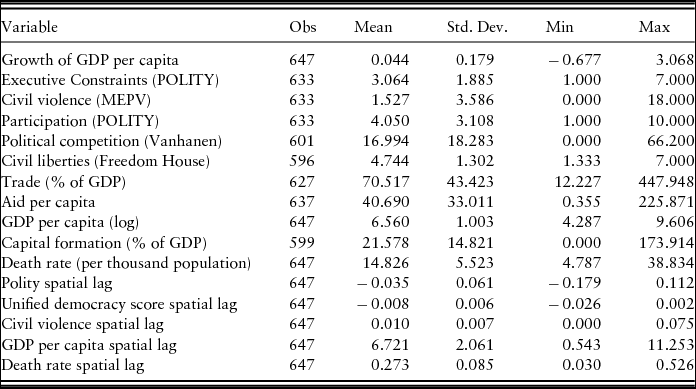
Table 3 presents descriptive statistics of the variables used. The data are an unbalanced panel that has been averaged over three-year periods. Data are not available for all African countries in every period, but the dataset was put together to cover as much of the postcolonial period as possible. The final sample has 647 observations over 18 periods covering the years 1961–2014. It includes 45 countries, nearly every country in Africa.Footnote 5
Summary statistics for key variables

Growth is averaged over each three-year period, whereas the civil violence variable is summed over each period. The participation variable is measured at the beginning of each period and is made up of the 10 participation concepts identified in the POLITY data; 1 represents the least participatory regime and 10 the most (Marshall and Jaggers, 2006). Executive Constraints, civil liberties, and political competition were described previously; these variables come from various sources and were taken here from the Quality of Governance dataset (Teorell et al., Reference Teorell, Dahlberg, Holmberg, Rothstein, Khomenko and Svensson2016). Other economic variables come from the World Development Indicators from the World Bank. Additional spatial lags are considered to account for possible spatial effects.
Estimation
Equation (1) is the basic specification:
 $$\begin{equation}
{y_{it}} = \alpha {D_{it}} + X{\text{'}_{it}}\beta + Z{\text{'}_{it}}\gamma + {\mu _{it}},\vspace*{-12pt}
\end{equation}$$
where yit is the outcome of interest (growth or civil violence), Dit is the democracy variable, Xit is a vector of endogenous covariates, and Zit a vector of exogenous covariates. Since instruments are not available for all potentially endogenous variables, specifications are estimated both with and without the endogenous covariates in Xit .
In a panel data model, the error term has the following structure:
 $$\begin{equation}
{\mu _{it}} = {c_i} + {\rm{ }}{t_t} + {\varepsilon _{it}},\vspace*{-12pt}
\end{equation}$$
where ci and tt are the country and time fixed effects, respectively, and εit is the true stochastic error term. Estimating (1) without time and country fixed effects assumes that ci and tt are orthogonal to Dit, Xit, and Zit. If this assumption is false, the estimates of α, β, and γ are biased; if it is true then the estimates of α, β, and γ will not change when fixed effects are included. Estimates here are shown with and without country fixed effects, thus, testing whether country specific unobserved heterogeneity affects the estimations. Time fixed effects are assumed to be orthogonal to the variables of interest.
For the instrumental variables estimations, the first stage specification is as follows:
 $$\begin{equation}
{D_{it}} = \delta {P_{it}} + X{\text{'}_{it}}\beta + Z{\text{'}_{it}}\lambda + {\mu _{it}},\vspace*{-12pt}
\end{equation}$$
where Pit is the Polity spatial lag and µit has the same form as in (2). The Growth equation includes six endogenous covariates including Executive Constraints. Other endogenous variables include measures of physical capital (capital formation) and human capital (death rate per thousand population), the level of GDP per capita (logged), exports as a percentage of GDP and aid per capita. The capital variables are traditional components of capital-accumulation growth models and therefore can be expected to increase growth. Ideally, education data would be used to measure human capital but it is not available for much of the sample; the death rate is used as a proxy for human capital. Log GDP per capita is expected to have a negative impact on growth due to the catch-up effect. Trade and aid are each expected to directly increase growth. All endogenous variables are lagged one period since growth effects are not likely to be contemporaneous.
The estimations for civil violence take the same form as equation (1), although with slightly different endogenous variables. The civil violence estimation adds growth to the set of endogenous variables. Growth is present because negative growth shocks have been shown to increase the likelihood of civil conflict (Miguel et al., Reference Miguel, Satyanath and Sergenti2004). Trade is included to test the hypothesis that more open economies are more integrated into the world economy and thus less prone to conflict. Finally, aid per capita is included because aid is often targeted at crisis areas with the intention of obviating or alleviating pressures that might lead to violence.
The set of exogenous covariates is the same for both growth and civil violence and includes an indicator variable for the Cold war as well as spatial lags of GDP per capita, civil violence, and the death rate. These are included to account for possible spillovers from poverty, violence, and sickness in neighboring countries.
Results
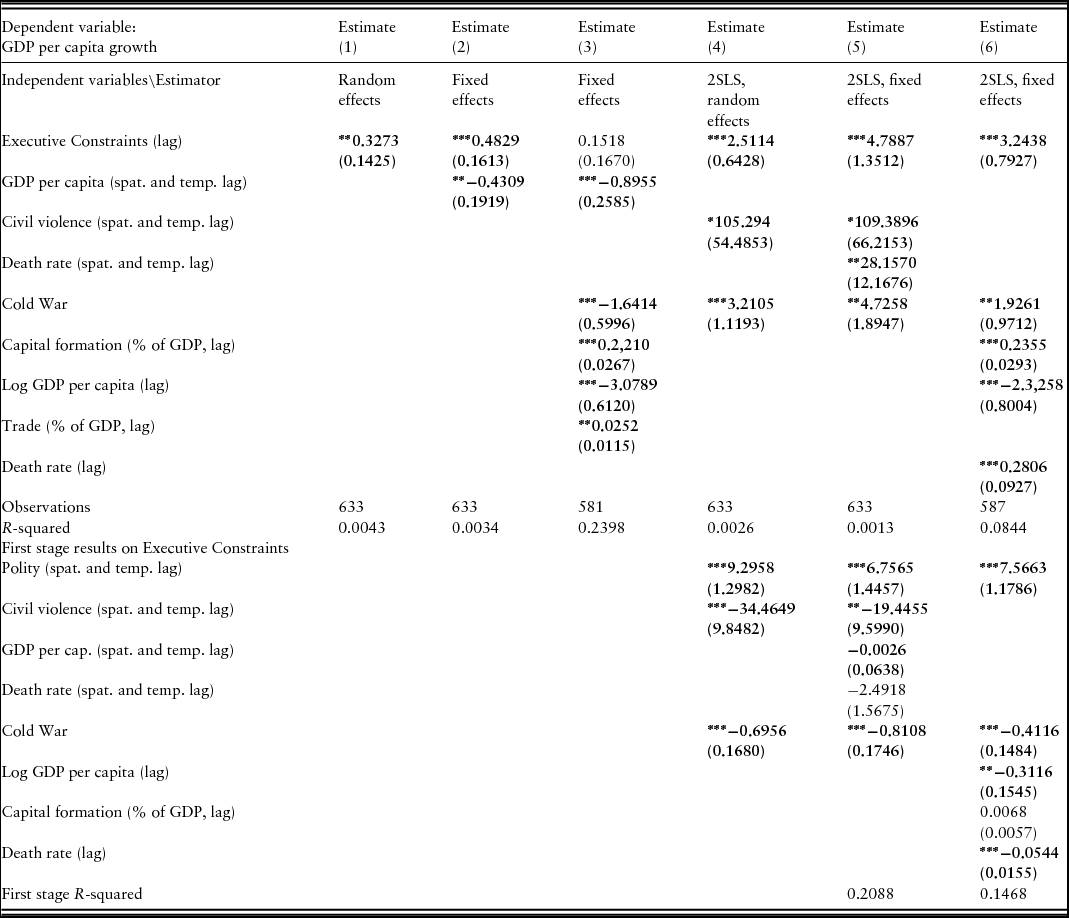
Table 4 presents initial estimates on growth. The first three columns present panel estimations without instrumenting for Executive Constraints; the first estimates are random effects estimates, whereas the second and third include country fixed effects, the third with other endogenous variables. The next three estimates follow the same structure but are instrumental variables panel estimates using the Polity spatial lag to instrument for Executive Constraints. For all estimates, initial regressions were run including the full set of exogenous variables and endogenous variables for estimates (3) and (6). Dependent variables that were insignificant at the 10% level were then dropped from the estimates so long as the remaining estimated coefficients were not substantially changed.
Initial regressions on GDP per capita growth

*, **, and *** indicate significance at 10%, 5% and 1%, respectively. Standard errors in parentheses.
Executive Constraints has a positive significant estimated coefficient in both random and fixed effects estimates without other endogenous variables (estimates (1) and (2)). Once these are added, the estimated impact of Executive Constraints is insignificant (estimate (3)). The significant endogenous variables (trade, log GDP per capita, and Capital Formation) all have the expected sign. Once the endogeneity of Executive Constraints is accounted for through instrumentation a larger estimated coefficient is found that is significant at 1% in estimates (4)–(6). The magnitudes range from 2.5 to 4.8, suggesting a large impact of improved institutions on growth. A one point increase in the Executive Constraints score is estimated to increase annual growth by 2.5–4.8%. This estimated impact is larger than previous estimates of around 1% (Acemoglu and Johnson, Reference Acemoglu and Johnson2005).
The first stage results indicate a strong instrument. The estimated impact of the Polity spatial lag is positive and significant at 1% in all three IV estimations. The estimated coefficients on other variables are generally in line with expectations. Log GDP per capita (lagged one period) has a significant negative impact on growth, providing support for convergence. Capital formation has a significant positive estimated coefficient, as expected in standard growth models. The Death Rate, included as a measure of human capital, has a surprising positive impact on estimate (6); the reasons for this are unclear. There is also some evidence of surprising spatial effects. Estimates (4) and (5) indicate that having neighboring countries with more civil violence and higher death rates increases growth. However, these effects are not robust to the inclusion of other covariates. The Cold War indicator also has a surprising positive estimated impact on growth; however, it also has the expected negative estimated impact on Executive Constraints. On the whole, these estimates indicate a successful instrument and a strong impact of Executive Constraints on growth in African countries. The reported R-squared values appear low, but this is in large part due to the panel estimator used; the reported R-squared values do not include variance that is explained by country fixed effects.
Additional estimatesFootnote 6 consider an alternative measure of democracy, the mean unified democracy score (Pemstein et al., Reference Pemstein, Meserve and Melton2010), as an instrumental variable and also consider the Freedom House's civil liberties score as the independent variable. Estimates are robust to these alternate specifications and the estimated coefficients on civil liberties are of similar magnitude and significance to those on Executive Constraints.
The estimates on growth use three year average growth rates. The use of averages in a panel could potentially lead to serial correlation in the data. Additional regressions were thus estimated that used the first observation of the economic growth rate for each period rather than the three year average. Results are very similar and the key findings on economic growth are robust.
Overall, the estimates on GDP growth presented here indicate a very strong impact of democracy on economic growth in Africa. The estimated impact larger than prior studies is found and seems to be driven by improvements in civil liberties, broadly conceived as protection of individuals from government expropriation and from restrictions on behaviors. The use of the democracy spatial lag as an instrument allows for panel estimation with country fixed effects, which provides strong evidence that institutions play an important role in economic growth in Africa.
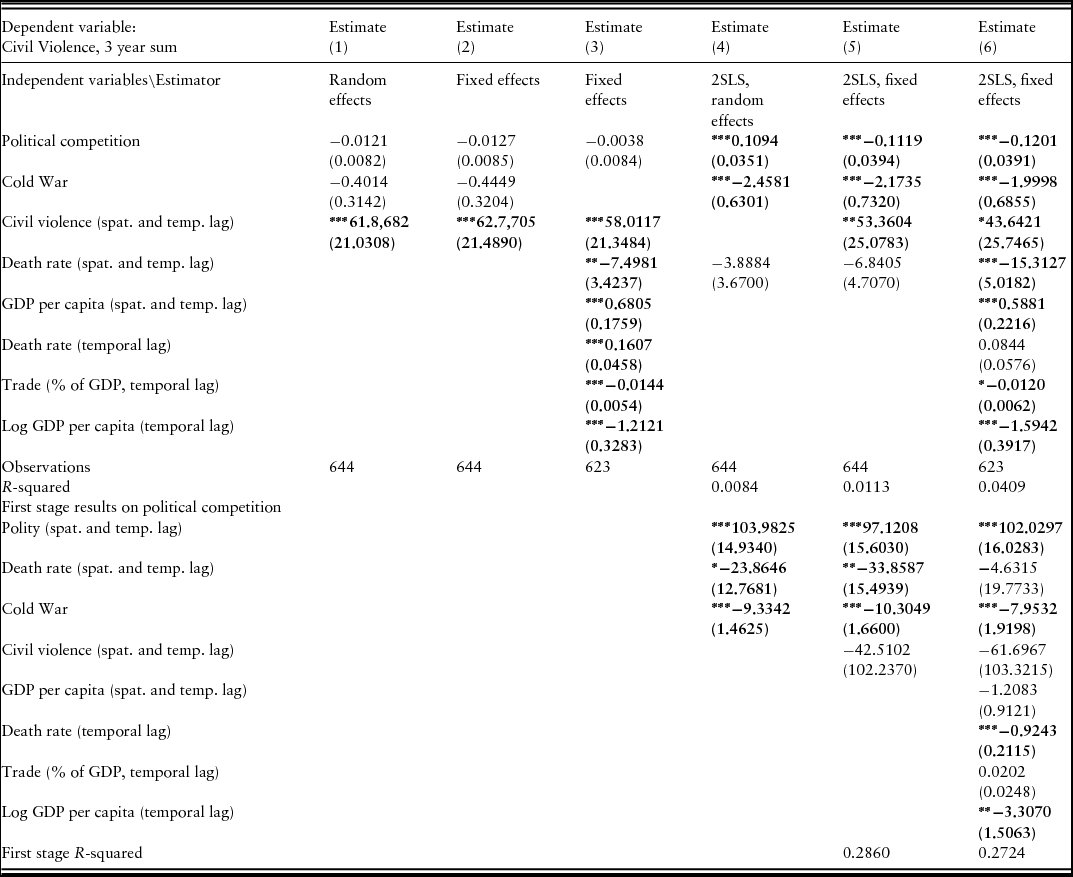
Democracy may also impact civil violence. The next set of estimates considers the impact of political competition on civil violence. The dependent variable for these estimates is the three year sum of civil violence and the measure of political competition is Vanhanen's competition variable, which measures the percentage of votes not captured by the party in power (Vanhanen, Reference Vanhanen2000). Table 5 presents the first results.
Initial regressions on civil violence

*, **, and *** indicate significance at 10%, 5%, and 1%, respectively. Standard errors in parentheses.
The first three estimates in Table 5 are panel estimators. Estimate (1) is a random effects model with no other endogenous covariates, whereas estimates (2) and (3) are fixed effects estimations with and without other endogenous variables, respectively. These initial estimates show no impact of political competition on civil violence. There is a strong spatial impact of civil violence here; the civil violence spatial lag is consistently positive and significant, suggesting spillovers from civil violence in neighboring countries. Other endogenous variables in estimate (3) are all significant with the expected sign.
Estimates (4)–(6) are instrumental variables panel estimates following the same pattern as (1)–(3). The first stage results show that the Polity spatial lag has a positive and significant impact on political competition, indicating a strong instrument. Political competition is estimated to have a negative impact on civil violence that is significant at the 1% level in estimates (4)–(6). The magnitude of around −0.1 implies that a 10% increase in the vote share of minority parties in a country would reduce the level of civil violence by one point. This finding is robust to the inclusion of country fixed effects and other endogenous variables. Increased trade and higher GDP per capita are also estimated to decrease civil violence. Somewhat surprisingly, growth from previous periods had no significant effect (and was dropped from the estimation).
Additional estimatesFootnote 7 again consider an alternative measure of democracy for the instrumental variable (the unified democracy score) as well as Freedom House's civil liberties score in place of the political competition variable. Results are robust to these alternate specifications, and also show an impact of civil liberties on civil violence that is consistently significant at the 1% level.
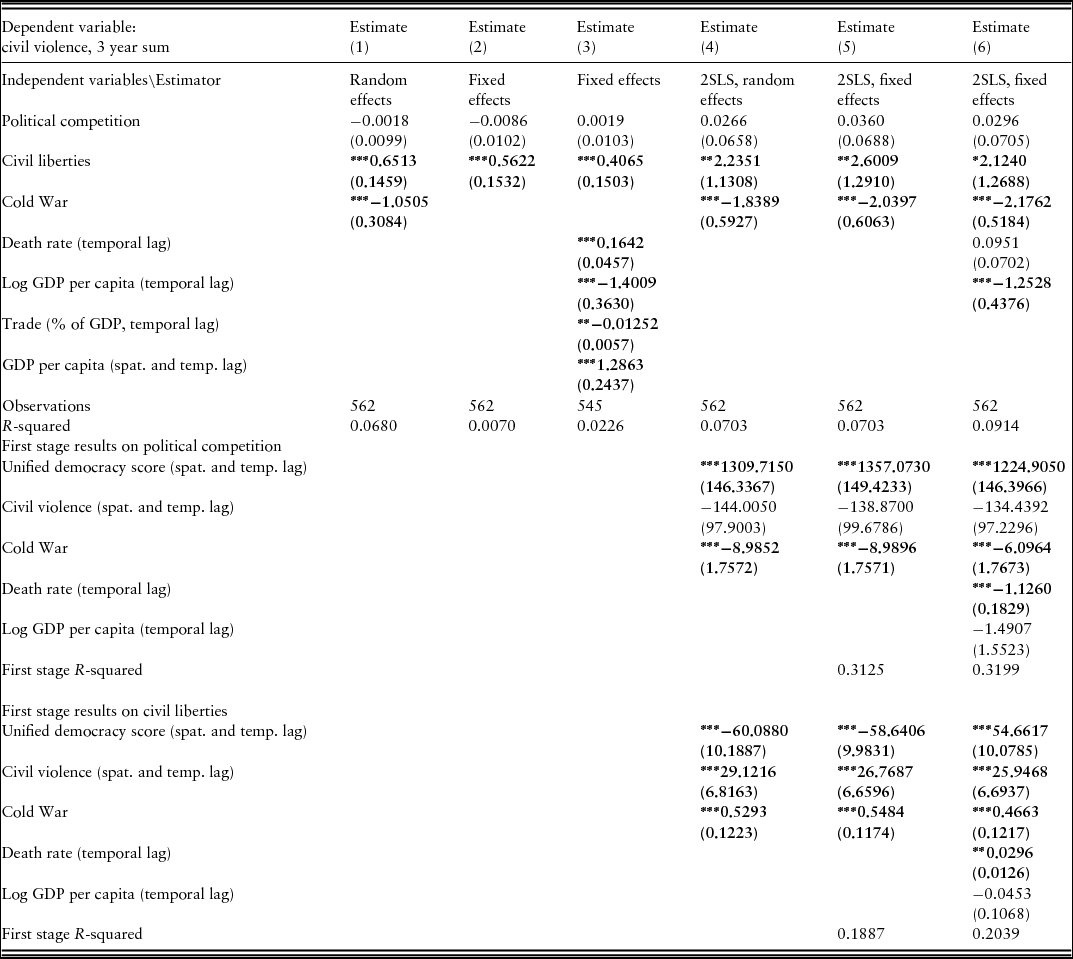
The results on civil violence thus indicate that democratization can decrease civil violence by improving both electoral (as measured by political competition) and liberal (as measured by civil liberties) democracy. Which of these is more important? Is civil violence more likely to stem from exclusion from the political process (limited electoral democracy) or from strict limits on individual freedoms (limited liberal democracy)? Table 6 presents some final estimates that attempt to shed light on this question by estimating the impact of both political competition and civil liberties on civil violence in the same specification.
Estimates on civil violence with two democracy variables

*, **, and *** indicate significance at 10%, 5%, and 1%, respectively. Standard errors in parentheses.
The first three estimates in Table 6 are once again panel estimates without instrumentation. With two endogenous democracy variables two instruments are needed to identify the impact of both. The two instruments considered thus far – spatial lags of Polity and the unified democracy score – are too highly correlated to consider as separate instruments. However, the additional estimates showed that the spatial lag of civil violence was highly correlated with civil liberties and also had no impact on civil violence once civil liberties were accounted for. These results indicate that civil violence in neighboring countries is likely to lead to restrictions on civil liberties in any given country and that those restrictions, not any direct spillovers from neighboring violence, then lead to increased civil violence in a given country. Based on this argument the spatial lag of civil violence is used as an instrument for civil liberties in estimates (4)–(6) in Table 6.
The initial panel estimates in Table 6 (estimates (1)–(3)) show no impact of political competition on civil violence and a significant impact of civil liberties of around 0.5, which is about one fourth the magnitude of the previous instrumental variables estimated coefficient on civil liberties. The instrumental variables estimates (4)–(6) show similar results on political competition; when civil liberties are also included political competition has no impact on civil violence. When instrumented for, civil liberties are estimated to have a large impact of over 2 that is significant in each estimate, although only at the ten percent level in estimate (6). First stage results show that the unified democracy score has a highly significant impact on both variables while the civil violence spatial lag has a strong estimated impact on civil liberties but not political competition. Estimated coefficients on other variables are consistent with prior results.
Although the identification is not perfect as the spatial lag of civil violence could impact civil violence through means other than civil liberties, the estimates provide some initial evidence that improving liberal democracy rather than electoral democracy will reduce civil violence. These results are robust to the inclusion of country fixed effects and other endogenous variables.
As with the growth regressions, the estimates on civil violence in Tables 5 and 6 could be influenced by serial correlation given the use of three year sums of the dependent variable. The use of sums in this case also may increase the variance of the dependent variable, making significant results more likely. Additional estimates with the first observation of civil violence from each period were thus estimated and are available online.Footnote 8 The results are robust to this change. The magnitudes of the estimated coefficients on political competition and civil liberties are smaller, which is expected, but still significant across most specifications.
4. Discussion
The data are a three year panel while many of the major papers showing significant effects of institutions use a cross section of countries to analyze the long run determinants of GDP per capita (Acemoglu and Johnson, Reference Acemoglu and Johnson2005; Acemoglu et al., Reference Acemoglu, Johnson and Robinson2001; Rodrik et al., Reference Rodrik, Subramanian and Trebbi2004). One might be tempted to argue then that those estimations are substantially different and fixed effects are not needed in them. Such an argument is incorrect. Without fixed effects, panel estimation is equivalent to the cross-section data used in those papers, only with a larger sample. It is evident in Tables 4–6 that the institutional variables are significant without fixed effects, much as they have been found to be in the IV estimates in the literature.
Serial correlation can also be problematic in panel regressions, as can dynamic panel bias. Additional estimates (not shown) consider corrections for autocorrelation and find similar results. Estimates were also considered that used one observation from every three years rather than averages or sums as presented above. These estimates also were similar to those presented above, indicating no evidence of problems due to serial correlation. Dynamic panel bias could reduce the estimated coefficients on any lagged dependent variables. While this bias is not directly controlled for; it would result in smaller estimated coefficients when present, so the finding of any significant lagged dependent variables suggests that dynamic panel bias is small.
There always concern in cross country regressions about the choice of sample, especially because it is often driven by data. It is fair to ask here, are the results driven by the sample? The sample used here includes every country in Africa that has data available, which is 45 out of 49. Concerns about sample are somewhat alleviated by the estimations without fixed effects that are similar to what is found in the literature. If anything, restricting the sample to Africa might be expected to weaken the results without fixed effects, but this is not the case. The data here was chosen to cover as many countries in Africa for as many years as possible. As mentioned previously, this deliberate sampling with controls for spatial effects presents a more solid grounding for econometric estimation than much previous work, which relied on samples determined entirely by data availability.
There are also some disagreements in the literature about how to define institutions and democracy (Green, Reference Green2011; Kurtz and Schrank, Reference Kurtz and Schrank2007). Both Polity and the unified democracy score were used for the instrumental variable and the results are robust with both. Other measures of democracy are available, but none cover the range of years and countries that Polity and UDS do so other measures were not considered because they would reduce the sample substantially.
The dependent variables also have strengths and weaknesses. Executive Constraints is available for a broad range of countries and years, but is also somewhat vague in terms of interpretation. Acemoglu and Johnson (Reference Acemoglu and Johnson2005) use it as an indicator of property rights, but more recent work suggests that Executive Constraints is an indicator of civil liberties (Alfonso-Gil et al., Reference Alfonso-Gil, Lacalle-Calderón and Sanchez2014). The results here show very similar estimated impacts on growth from both Executive Constraints and Freedom House's civil liberties score. These similar results suggest that Executive Constraints indeed is a fair proxy for civil liberties, but also that protection of civil liberties is beneficial for economic growth.
There is not a clear consensus in the literature on what data to use to measure civil war. Some prefer a binary variable that simply indicates a single threshold for civil war, rather than the ten point scale used here, and there are disagreements about what constitutes a civil war (i.e., number of casualties, time frame, etc.). The civil violence variable used here can be converted to a binary indicator and probit regressions similar to the estimations in Table 6 were estimated. However, in a probit with fixed effects many of the observations are predicted perfectly and thus are dropped from the estimation. This prevents an accurate test of the importance of fixed effects so these estimations are not reported. There are valid concerns about measuring civil violence on a continuous scale, but it will be difficult to test fixed effects with binary civil war variables. There are also indications that the relationship between democracy and civil conflict may be non-linear. Stable autocracies may not be prone to conflict, nor stable democracies, but rather countries in between. However, attempts to test a non-linear relationship in this data find no support for it, although this may be due largely to data limitations such as a small sample and the construction of both the Civil Violence and Participation variables.
5. Conclusion
The trend of democratization in Africa is clear and continuing. This paper analyzes two ways democratization may offer additional benefits beyond those of democracy itself. Panel regressions are estimated to determine if democracy leads to faster economic growth through better institutions and less civil conflict through increased political participation. The effects of democracy are estimated through instrumental variables estimation, which follows the long empirical literature on institutions and economic growth. This paper contributes to that literature by introducing a new instrument, the spatial lag of democracy, and then considering country fixed effects in panel estimation.
Results indicate a strong impact of democracy on economic growth in African countries. The estimated impact of Executive Constraints on growth is larger than previous findings and is robust to inclusion of country fixed effects, other endogenous variables, and alternative measures of democracy for the instrument. Interestingly, a similar impact of civil liberties on growth is found, which is consistent with recent work arguing that Executive Constraints is an indicator of civil liberties (Alfonso-Gil et al., Reference Alfonso-Gil, Lacalle-Calderón and Sanchez2014).
Initial estimates on civil violence suggest that increasing political competition will reduce civil conflict. Subsequent estimates extend this finding to civil liberties as well. Improving civil liberties is also estimated to reduce civil violence and estimates that consider both political competition and civil liberties show a significant impact of civil liberties and no effect of political competition. These results suggest that civil liberties are the most important aspect of democracy for reducing civil violence.
Overall, results here confirm previous findings that institutions are important for economic growth in instrumental variables estimates with fixed effects. Further, civil liberties are found to have significant impacts on both growth and civil violence. A one point improvement in a country's civil liberties score is estimated to both increase economic growth by around four percent and also decrease civil violence by two points. The results here thus indicate that there will be lasting benefits to African countries of moving towards democracy. We can hope that the wave of democratization continues or accelerates and that Africa may begin to emerge from its half-century of under-development.