William Russell's organ voluntaries are still relatively little known, yet they offer much of interest and variety, reflecting musical styles ranging from high baroque to early Romantic and combining sacred and secular elements. As Gillian Ward Russell has said, ‘Russell's voluntaries belong to three different worlds: the church, the small concert hall or drawing room and the theatre or pleasure garden’.Footnote 1 In addition, they are innovative in their use of the resources available on contemporary organs. This article will scrutinize Russell's music from a stylistic point of view, considering a possible range of influences; it will also examine how he exploited the organs of the period.
Russell published his first set of Twelve Voluntaries for the Organ or Piano Forte in London in 1804 by subscription; 227 subscribers are listed, including many well-known musical figures of the day including a number of cathedral organists: Thomas Attwood (then organist of St Paul's Cathedral and onetime pupil of Mozart), the brothers Samuel and Charles Wesley, Samuel Webbe, William Crotch, Charles Burney and Matthew Camidge. The list makes informative and fascinating reading, giving the various organists’ church and other musical posts where relevant, and so offering a snapshot of who was playing where around 1804. The volume is ‘respectfully dedicated by permission to the Governors & Guardians of the Foundling Hospital’; Russell was organist in the Hospital Chapel. When he came to publish his second set of Twelve Voluntaries in 1812, Russell had no need of subscribers, because the success of the first volume had been considerable and his reputation was secure; neither is there any dedication. The engraving of volume 1 is rather rough and ready, and the typeface inconsistent; that of volume 2 is much more elegant, with decorative borders on every page and a clearer typeface. (These features can be seen in some of the musical examples.) Despite the superior printing and appearance of volume 2, it was published, like volume 1, at a cost of 10/6.
Russell (1777–1813) came from a London family of organists and organ builders. He was a son of the organ builder Hugh Russell, and he deputised for his father from the age of 11. He subsequently played at Great Queen Street Chapel, Lincoln's Inn Fields, then at St Mary Aldermary; in 1798 he was appointed organist at St Anne's Limehouse, and in 1801 at the Foundling Hospital Chapel (with which Handel had been famously associated in his day). Significantly, both of these establishments boasted particularly fine, colourful organs. Russell evidently had ‘progressive’ ideas on organ design, and wished to take advantage of early nineteenth-century developments. Some pieces in both the 1804 and 1812 collections of voluntaries require pedals (although not necessarily independent pedal pipes) and occasionally he writes a true trio texture; he increasingly exploited the effects afforded by colourful solo stops, thus extending the practices of eighteenth-century English organ composers. His short career was particularly associated with the two London organs mentioned above: the Foundling Hospital Chapel instrument had been built by Thomas Parker in 1768, and that in St Anne's, Limehouse by Richard Bridge in 1741. Within a week of taking up his duties at the Foundling Hospital Chapel, Russell was requesting improvements to the organ, which surely suggests a measure of self-confidence; shortly afterwards he asked for a complete overhaul and additional stops. Following an endorsement of Russell's suggestions by Thomas Attwood, Hugh Russell was commissioned to undertake this work. In 1810–11 Hugh Russell also carried out reconstruction work on the organ at Limehouse.Footnote 2
As well as his church duties, Russell worked as pianist and composer at the Sadler's Wells Theatre; as we will see, the influence of opera and theatrical music can be strongly felt in some of the voluntaries. He died at the early age of 36, barely two years after the publication of the second set of voluntaries. In 1814 The Monthly Magazine published an obituary stating that ‘As a performer of the pianoforte and organ he has few equals’.
Stylistically, Russell's writing blends, and sometimes simply juxtaposes, a number of disparate musical influences. In many respects his pieces are in the long tradition of English voluntaries by Stanley, Greene, Boyce, Walond, Nares, Keeble and others, and demonstrate a characteristic English gift for fresh, elegant melody; Handelian grandeur is sensed in the confident gestures of opening movements. We are also reminded of the individual musical language of Samuel Wesley (1766–1837); Wesley was a friend, colleague and close contemporary of Russell, and some of his voluntaries and fugues must have been known to Russell. Russell's admiration for Haydn is manifest (Russell uses a Haydn fugue subject in Voluntary X (1812) and his fugues owe something to Haydn in their manner of cumulative growth). He must have known the music of Mozart, Dussek and other contemporaries, and the use of early Romantic harmonic language suggests that he had heard Weber. Sometimes Russell seems even to anticipate Mendelssohn. Some voluntaries, such as Voluntary I (1804), are in fact suites; others are in a two-movement ‘prelude and fugue’ structure. Overall, the voluntaries are extremely varied in their construction.
They fall into various recognizable ‘types’ or genres, although there is much variety within these categories. Towards the end of both volumes are the grand ‘preludes and fugues’ (although not so named by Russell) to be played on the full organ: nos. IX, X, XI and XII (1804) and nos. VIII, IX, X, XI, XII (1812). Following well-established eighteenth-century precedents, a number of voluntaries are two-movement works in which an Adagio on the diapasons is followed by a movement featuring one or more solo stops or stop-combinations. Other voluntaries contain three or more separate but linked movements, forming substantial suites of varied movements. We do not know whether Mendelssohn knew Russell's voluntaries, although this is quite possible. Mendelssohn's Six Sonatas of 1845 – to some extent compilations of movements written earlier – seem to follow the English voluntary tradition in this respect. It is often pointed out that they are sonatas only in name, and are really suites; indeed, they were originally commissioned from Mendelssohn as ‘voluntaries’ by the London publisher, Coventry & Hollier.
Before scrutinizing the music in detail, it is important to consider something of the organs Russell had in mind, as these have an essential bearing on the effectiveness of the music. (The stoplists of both Limehouse and the Foundling Hospital organs are given in Appendix 2.) Many mid-to-late eighteenth-century composers of voluntaries indicated their intended registrations in some detail – amateur organists no doubt welcomed such assistance – but Russell was unusually precise. All the standard registrations are found, such as ‘diapasons’ which always meant the open and stopped 8′ diapasons together; ‘full organ’ generally indicates the complete chorus to mixture on the great, possibly including a tierce mixture (or sesquialtera) and also the trumpet (Russell occasionally asks for ‘full organ without the trumpet’.) It is sometimes effective to use a reduced ‘full organ’, for example the two diapasons 8′ 8′, principal 4′ and fifteenth 2′ without the mixtures. Russell nowhere authorizes this, simply using the standard term ‘full organ’ in all cases. However, in the German and Dutch traditions organo pleno can be variously interpreted, and one imagines this was likely also to have been the case in early nineteenth-century England. It is worth noting that, unusually on an English organ of the time, Russell's organ in the Foundling Hospital Chapel had a double diapason 16′ on the great. Some of the textures in his ‘full organ’ movements seem to benefit from the use of manual 16′ tone – such as the opening of Voluntary XI (1804) with its wide spaces between right and left hands which the 16′ tone fills in.
Voluntary XI (1804) bars 1–10

Solo stops and stop-combinations specified by Russell include the traditional cornet, hautboy, trumpet and Cremona, as well as the more exotic French horn; significantly, when he writes for the cornet – a stop that was beginning to lose favour by the early years of the nineteenth century – the musical style is generally more retrospective (although an exception is Voluntary III (1804); see below). We shall further consider these registrations when examining the works themselves, since the textures are closely bound up with the actual sounds. Despite Russell's precision, today's performer is faced with certain decisions. For example, Russell (and his contemporaries) often indicated ‘swell’ without specifying which stops to draw; sometimes this is obvious, but not always.
The extent to which Russell would have expected players to manipulate the swell expression pedal is not clear, although there are some clues. Only rarely does Russell explicitly instruct the player to do so, most obviously in the ‘full swell’ Largo of Voluntary IV (1812). As can be seen Example 2, this work has large accent-like symbols, which seem to indicate repeated depression of the trigger swell pedal, although it is not entirely clear how this should be done. The following Allegro is headed ‘The Swell Pedal not to be used in this Movement’. (There is a single example of this accent-like symbol in bar 13 of Voluntary II (1812); see Ex. 3 below).
Voluntary IV (1812) from bar 1
Voluntary II (1812) indicating Russell's use of three staves.
The other reference to the swell pedal is in a footnote to Voluntary I (1812), where Russell politely if ungrammatically requests: ‘As the Swell in this & the 3d Voluntary is intended as an Echo to the Trumpet it is requested the Pedal may not be used’. Presumably, he means that the swell box should be kept closed to enhance the echo effect – in other words, using this division in its original manifestation as an echo manual.
Russell seems to have been the first English composer to write independent parts for organ pedals. Compared with their development in the rest of Europe, pedals appeared very late in English organs. At first there were no pedal pipes as such, the pedals simply being ‘pull-downs’, permanently attached to the great, and operating whatever stops were drawn there. (Even these were rare before about the end of the eighteenth century.) We must remember, however, that English organs of the period had a manual compass extending down to GG, and so pull-downs assisted the organist in making full use of the available compass.Footnote 3
Russell often uses the pedals as a third hand, to enable fuller chords to be played by the hands, with the left hand in the tenor register; sometimes (as in the very first Voluntary) double-pedalling in octaves is required. At times the pedal line is completely independent, resulting in a true trio texture. This is first seen in Voluntary VII (1804), and again in Voluntary II (1812) where Russell for the first time notates on three staves.Footnote 4 Russell's organs at St Anne's Limehouse and the Foundling Hospital had no independent ranks of pedal pipes, but only pedal pull-downs.
We turn first to the suite-voluntaries. Voluntary I in C (1804) is a fine example, and highly reminiscent of pieces such as Stanley's Voluntary VI in D, Op. 6 (published 1752). Stanley's is a four-movement piece, comprising an Adagio for the diapasons, a triple-time trumpet solo, and a contrasting Adagio in A minor leading back to a lively movement featuring solo flute with ‘eccho's’. In similar vein, Russell's Voluntary I in C comprises an Adagio for the diapasons, a jaunty triple-time ‘Spirituoso’ movement mostly for trumpet solo, with echoes, but also involving ‘trumpet bass’ towards the end, a reflective ‘Gratioso’ (the spellings are Russell's) in A minor, and a vigorous Allegro moderato for the full organ.
One of the most extended ‘suite’ voluntaries is no. VII in E flat (1804), comprising four movements, and lasting almost 15 minutes. It is worth investigating this work in some detail, since it demonstrates many facets of Russell's style. The voluntary begins with an arresting dotted Maestoso on full organ, confident and purposeful; although Handelian echoes can still be detected, it inhabits a later-eighteenth-century harmonic world. A half-close leads directly into a long movement – perhaps too long – featuring the trumpet of the great organ, with echoes on the swell. This may the first trumpet voluntary to be in the key of E-flat; C or D were the traditional trumpet keys, in both orchestral and organ works. Perhaps Russell, great admirer of Haydn that he was, had heard his celebrated Trumpet Concerto in E-flat, written in 1796? Stylistically, Russell's movement, with its mellifluous thirds and sixths, its elegantly turned phrases and gracefully ornamented melodic lines, would not sound out of place in The Magic Flute. In fact, its opening is reminiscent of the beginning of Papageno's ‘Ein Mädchen oder Weibchen’ (see Examples 4 and 5).
Voluntary VII (1804) opening of Andante maestoso
Opening of Mozart, ‘Ein Mädchen oder Weibchen’, from The Magic Flute
A short Siciliano – a commonly found genre in eighteenth-century voluntaries – prepares for the energetic fugue with its long, semiquaver subject. Interestingly, Russell responds to his subject with a real rather than a tonal answer.Footnote 5 This was not the Bachian way of doing things, but was a characteristic English practice; one can find examples in composers such as Stanley (see the fugue of his Organ Concerto no. III in B-flat). Russell's fugues are always fluent and melodically appealing, if prone to repetitive sequences and over-reliance on tension built up by dominant pedals; here there are four such pedals. Nevertheless, it is a noble movement of considerable cumulative power.
The other notable voluntary-suite from the 1804 set is no. XII in C minor. Beginning in a sombre C minor, replete with sighing appoggiaturas and expressive chromatic language, the opening Adagio (played, as was traditional, on the diapasons) is redolent of Mozart, but perhaps also looks forward to an early Romantic language, perhaps that of Weber. Particularly remarkable is the third movement entitled ‘March’, still in C minor. Gillian Ward Russell suggests that certain rhythmic and melodic patterns here – the opening triple-knocks, ominous dotted figures in octaves, chromaticism, dramatic forte/piano contrasts and so on – are symbols of Freemasonry.Footnote 6 The movement compares interestingly with the passage in the Finale Act II of The Magic Flute featuring the Two Armed Men, as can be seen in Examples 6 and 7.
Voluntary XII (1804) opening of March
Introduction to the duet for the Two Armed Men, Mozart, The Magic Flute
The rather sinister, dark mood is dispelled in the sudden, blazing tonic major of the Largo, played on full organ in majestic style, which then leads into a fugue built upon an extraordinary whole-tone subject. (The Largo and Fugue together make a fine pairing, like the prelude–fugue pairs at the end of volume 2, and they can be used separately.) Russell treats this striking subject with great inventiveness; although the movement is arguably overlong, again with too many dominant pedals, it is nevertheless extremely invigorating, ending with a particularly grand peroration. Overall, this Voluntary is one of Russell's finest.
Voluntary XII (1804) whole-tone fugue subject
Despite their blend of sacred and secular influences, it is likely that Russell's voluntaries were most often heard in church. Although we don't know for certain at what point in services the pieces were played, it seems likely that the great ‘preludes and fugues’ were primarily intended at the conclusion. As already mentioned, they are all registered for ‘full organ’ and today they still make effective, life-affirming final voluntaries. It is worth looking briefly at each in turn. Voluntary IX (1804) is in A minor, perhaps not as optimistic and bright as the major-key preludes, but strong and arresting. Dotted rhythms prevail in the opening triple-time Largo (as indeed they do in many of Russell's preludes). Here he is still paying homage to Baroque idioms, yet with harmonic touches and melodic turns of phrase that suggest the later eighteenth century. These powerful rhythms give way to a smoother, more lyrical passage, which prepares for the fugue. Its striding subject, clearly outlining the tonic triad, is reminiscent of such melodic subjects by Stanley and others; here Russell does not over-stretch his material, writing a taut and well-crafted movement.
Voluntary X (1804) in G minor begins with a short Larghetto to some extent reminiscent of the prelude in Voluntary IX above. This sets the scene for another vigorous fugue whose fine subject makes much of the interval of a 7th, and which is developed skilfully and pleasingly. Baroque composers made much use of the classic falling diminished 7th in their fugue subjects, but it is interesting to observe that mid-nineteenth-century composers quite often were to exploit major and minor 7ths in fugues. Examples include Mendelssohn's Fugue in E minor for piano (without opus number, published 1841 in Notre Temps) and the fugue in the finale of from Schumann's Piano Quintet in E-flat Op 44.
Voluntary XI in E minor has a rather different overall structure. Registered typically for full organ, it begins imposingly with massive semibreve chordal phrases alternating with dotted chords (see the opening in Example 1, above); this movement leads into a lyrical and relatively short triple-time fugue. Once again, Russell writes a real answer to a subject that would require a tonal answer in the Germanic tradition. The fugue ends with a full close, but is followed by a gentle Andantino in the tonic major, which is registered for diapasons only, and perhaps recalls the style of Samuel Wesley. The plan of this voluntary – grand opening, fugue, relaxed final movement – is reminiscent of Mendelssohn's Sonata no. 3 in A, published 40 years later. It is perhaps not too fanciful also to see a backwards link between this sort of structure and that seen in some Handel overtures, where the two energetic sections of a typical French overture are followed by a contrastingly relaxed movement, often a dance. Examples include the overtures to Samson (a minuet) and to Faramondo (a gentle Andante). One finds the same plan in some of Stanley's organ concertos.
As noted above, the last five voluntaries of Russell's 1812 publication are ‘preludes and fugues’, mostly in major keys. One of the finest is no. IX in B-flat, its fugue quite similar in some respects to the B-flat fugue which concludes the voluntary-suite no. VIII (1804). Like that earlier movement, this is a double fugue, not dissimilar to Haydn's ‘Achieved is the glorious work’. It is much more extended, however, with two dramatic pauses, where cadenzas may be inserted or stops conveniently added. Following the second of these pauses, the final 18 bars drive to the final cadence with exhilarating energy, the left hand quavers rushing headlong down to the bottom B♭ of Russell's long-compass great manual. (This has to be adapted when played on a present-day C-compass manual.)
The other 1812 ‘prelude and fugue’ pair that must be mentioned is Voluntary X in G. A grand Handelian opening, strongly reminiscent of the Samson overture, sets the scene for one of Russell's finest fugues, based on a subject borrowed from Haydn (and acknowledged as such, no doubt as an act of homage, in the score). Haydn sets it effectively if arguably rather perfunctorily to the words ‘Paradisi gloria’ in his Stabat Mater; Russell's treatment is far more extended and contains some dramatic moments, such as an arresting move to the tonic minor (at bar 132) before the final section.
Both volumes include voluntaries of a lighter nature, in terms of musical style and also in the specified registrations. A fine example is Voluntary II in F (1804), in two linked and gently contrasting sections. This is a piece that would sound well on a chamber organ in an intimate setting, although Russell's registration, prescribed for the choir division of the organ, suggests a church instrument. (For the opening Andantino, Russell specifies the 8′ stopped diapason and 4′ principal of the choir organ, and for the accompanying Allegretto the player is instructed to add the 2′ Fifteenth. The effect of this on a contemporary instrument is light and clear.) The triple-time Andantino is suave and mellifluous, full of graceful turns and appoggiaturas, and gently chromatic; although owing something to Russell's classical models, it somehow sounds distinctively English in its melodic charm. These features are to some extent continued in the  Allegretto, despite its more energetic tempo and figuration.
Voluntary VII in A (1812) begins with an elegant Siciliano of an appropriate pastoral nature, characterized by drone basses, and again replete with graceful melodic contours enhanced by turns and appoggiaturas. Given the gentle style, the specified registration is initially surprising, and notably precise: Russell asks for ‘The 2 Diapasons, Trumpet and Hautboy’ of the swell organ – a registration possible only on a substantial church instrument. Russell presumably wants a rustic sound, conjuring up shepherds’ piping; the sort of swell trumpet he had in mind was presumably fairly restrained. This Siciliano is written for the short-compass swell of Russell's day, its bottom note often being tenor C or even tenor (‘fiddle’) G; in this Siciliano Russell's lowest note is tenor F♯. The following Allegretto moderato, again specified for the choir 8′4′2′ registration mentioned above, is also notable for its melodic charm and elegance.
English voluntaries featuring solo stops and stop-combinations had grown in popularity since at least the early years of the eighteenth century. Russell was particularly attracted to such ingratiating pieces, and was here no doubt influenced by his association with the theatre and opera; many of these pieces are secular in character, although they were probably played in church. He writes movements for the cornet, hautboy, trumpet and cremona as well as the exotic French horn.
A favourite type had always been the cornet voluntary, where a slow-moving movement on the diapasons was followed by a brisk and lively solo on the cornet stop. This compound stop was ubiquitous in seventeenth- and eighteenth-century French organs, and it also became popular in eighteenth-century England. The cornet, found on the great organ, contains pipes of five pitches, 8′, 4′, 2 2/3′, 2′, 1 3/5′, which blend to form a pungent and characterful sound; its use is almost exclusively as a solo stop. Some organs had a smaller-scale cornet, generally on the swell, for echo use with the big great cornet. Quite often this contained only the three upper ranks, to which would be added other stops at 8′ and 4′ to make up the complete cornet. Voluntary V (1804) is a classic example of the type, requiring both cornet and echo cornet, and is retrospective in style, highly reminiscent of the cornet voluntaries of Stanley, Boyce, Walond and others. However, after 20 bars Russell introduces new musical material in an elegant galant style, to be played on ‘flute choir’; this generally meant a flute at 4′ pitch, with no 8′ tone. This central passage, therefore, offers considerable contrast to its surroundings. Russell concludes the piece (and also his other two cornet voluntaries) with a short Adagio on diapasons only. These endings can sound strangely redundant to modern ears, but Russell's older contemporary Jonas Blewitt (c. 1757–1805) explains their purpose: ‘I will here presume to add that in the very same manner should every piece of Music, that has a Presto movement, be concluded. It brings back that solemnity of mind which such a volatile air has permitted to sport with too much for the dignity of Church or Cathedral Service.’Footnote 7
Russell's Cornet Voluntary in A from the 1812 set (no. IV) is very similar in almost all respects to that described above, and again interpolates a contrasting passage on a solo flute. More unusual and intriguing, however, is Russell's first cornet voluntary, no. III in the 1804 volume. It opens with an introductory Larghetto to be played on ‘full swell’ (that of the early nineteenth-century English organ). The musical idiom and the elegance of the writing might suggest a gentler registration to present-day players, yet Russell's instructions are unequivocal. We know exactly what he means by ‘full swell’ from a note given in Voluntary IV (1812).Footnote 8 A sprightly cornet solo follows, contrasting great and swell cornets as was traditional. Entirely untraditional, however, is Russell's marking in the score ‘a la Pollacca’ – seemingly an attempt to bring the cornet up to date by writing for it in the currently fashionable style of the polonaise. A number of piano polonaises were current in the early Romantic period (Mozart's son Franz Xaver published Quatre Polonaises melancoliques around 1818–21) but I know of no other example in contemporary organ music, certainly not in the form of a cornet voluntary. This movement is a fascinating example of Russell's ability effectively to bring together old and new styles, and to introduce secular influences into a traditional organ genre. This piece too ends with a solemn passage on the diapasons; bearing in mind Blewitt's remark, such a passage might have been considered especially desirable, given the levity of this polonaise.
The great trumpet had long featured as a solo stop, nearly always in the traditional trumpet keys of C or D. As mentioned above, Russell uses it in the second ‘Spirituoso’ section in Voluntary I in C (1804), alternating with the swell. Although not specified, one presumes that here Russell intends the smaller swell trumpet to provide the echoes. We have already noted the solo trumpet's appearance in the second section of Voluntary VII (1804) in the more unusual key of E-flat; the trumpet is again used, in the traditional key of D, in Voluntary III (1812).
More surprising is Voluntary I (1812) which, after an introductory ‘diapasons’ movement, introduces the solo trumpet in the remarkable key of E minor. Although marked ‘maestoso’ and characterized by dotted rhythms, this is a far from traditional trumpet movement, with its expressive, chromatic harmony involving both Neapolitan and augmented sixths. It also requires independent pedals from time to time, to support the manual writing in which both hands are fully occupied. The following musical example illustrates these various features.
Voluntary I (1812) from bar 87
The short link played on the swell, seen at the close of the above example, leads into the final E major section, the style of which recalls Samuel Wesley. The concluding Largo maestoso is in the tonic major, and the gentle, lyrical writing seems strangely at odds with the instruction ‘full organ’. However, it would work convincingly on a small chorus of perhaps 8′8′4′2′.
Voluntary VI in F (1804) and Voluntary VI in E-flat (1812) both specify ‘French horn’ for movements featuring traditional passages for two horns in thirds and sixths (seen in, for example, Handel's Water Music). John Stanley wrote for ‘corno’ in his Voluntary in F, Op. 7 no. 6 (1754), but gives the alternative ‘diapasons’, as French horn stops were something of a rarity. Russell also gives this alternative; although the modifications to the organs he regularly played included the addition of solo stops, the French horn was not one of these, and neither Limehouse nor the Foundling Hospital had this stop. Voluntary VI in F (1804) begins with a Largo on the ‘full swell’ (see above), before moving into the French horn movement. Variety is obtained here by alternating the horn section with passages played on ‘swell’ (no particular stops specified) and ‘flute choir’ – again, probably the 4′ flute alone. The central section of the tripartite Voluntary VI (1812) is a triple-time Vivace for the French horn which here is alternated with contrasting passages played on the choir cremona (a type of clarinet stop).
The vox humana, often used as a solo stop in the eighteenth century, is nowhere specified in Russell's voluntaries; the Foundling Hospital organ originally had one on the choir, but this was removed in Hugh Russell's remodelling of 1805 (see Appendix 2). Although once again popular in the late nineteenth and early twentieth centuries, this stop seems to have fallen out of favour in the early nineteenth century, ceding its place to the cremona. This is perhaps a reflection of the growing popularity of the orchestral clarinet at this time.
Russell is especially partial to duetting with the hautboy and cremona, and it is here that his theatrical background particularly influences his organ writing. After an opening ‘diapasons’ movement, the Siciliano of Voluntary IV in D (1804) highlights solos for the swell hautboy and choir cremona in alternation; they are like two characters on stage. After a showy (notated) cadenza on the hautboy and an increasingly ornamented melodic line, the two solos eventually move in parallel thirds and sixths, almost like a pair of operatic lovers. Voluntary VIII in B-flat (1804), a suite in four movements, does something similar, and it is here that we find a trio texture requiring an independent pedal bass, the first instance of this in Russell's voluntaries. The alternating solo stops are supported by the great stopped diapason; but, significantly, in those passages where both solos stops sound together – right hand cremona, left hand hautboy – the great stopped diapason sounds on the pedals which are coupled to the great.
Voluntary VIII (1804) excerpt from Andantino
One of Russell's most remarkable voluntaries is no. II in C (1812). Both movements of this secular-sounding work are notated on three staves, with an independent pedal part for much of the time. Gillian Ward Russell views it as ‘experimental’, and sees in it a move towards Romantic freedom in form and style. (Arguably the same is true of Voluntary I in E minor, discussed above; in both, Russell is extending previous practices in original and innovative ways.) The Largo of no. II in C begins with the swell hautboy unusually accompanied by the great diapasons; after two phrases, even more surprisingly, the hands are reversed and the hautboy accompanies the diapasons, which then assume a melodic role (see Ex. 3 above). On many organs it would be difficult to achieve a successful balance with these registrations; Russell's hautboys must have been characterful and pungent, or the diapasons very gentle. The movement continues to alternate the hands in this way, and there is some showy writing for the hautboy, with cadenzas, flourishes and so on. The ensuing Allegretto, characterized by elegant and shapely melodic writing, retains this registration, but additionally introduces the choir cremona which engages in much duetting with the hautboy, like a pair of orchestral instruments. The movement continues (perhaps for too long) in an elaborate, ornamented style, but contains some modulatory and other surprises. Throughout, Russell provides specific registrational instructions and other performance indications.
One of the most notable aspects of these voluntaries is the unusually precise performance instructions (in addition to the precision of the registrations already noted); Russell obviously had clear ideas of how he wanted his pieces to be played. Almost all movements bear tempo indications, including carefully nuanced instructions such as ‘andante maestoso’ and ‘andante vivace’. Ornamentation is copious and carefully marked, with ubiquitous use of the fashionable turn that had become so much part of late eighteenth-century melodic style. Phrasing and articulation are indicated extensively; the end of a longer phrase is sometimes emphasised with a wedge above the last note, by inserting a rest – or both, as seen in the following example:
Voluntary IV (1804) Bars 8–9
Russell's phrasing and articulation marks are particularly specific in elegant movements such as the Siciliano from no. IV (1804) which is lavishly provided with markings that, if carefully followed, really breathe life and vitality into the notes. Russell was especially partial to cross-beat phrasing, generally alien to baroque music, but increasingly embraced by composers from C.P.E. Bach onwards. Accents, staccato dots and wedges all make appearances and there are some written-out cadenzas – there are also pauses that might well be interpreted as invitations to insert cadenzas, as was common in the eighteenth century.
Russell's two sets of voluntaries are remarkable in many ways: in their blending of old and new; in their combining of sacred and secular; in their imaginative and innovative use of contemporary instruments; and above all, in their freshness, vitality, charm, elegance and refinement. Sadly, for posterity, Russell died at the early age of 36; inevitably, it is tempting to speculate as to how his career and musical style might have developed, had he lived longer. Given his progressive ideas on organ design, there is no doubt that he would have been intrigued and inspired by the many significant and indeed fundamental developments which were to change the English organ in so many ways in the ensuing decades – not least the eventual introduction of a full ‘German pedalboard’. And he would probably have embraced an increasingly Romantic style of writing, while still retaining aspects of the robust eighteenth-century traditions that he had inherited. We shall never know.
APPENDIX 1
A note on recording Russell's music on the 1829 Bishop organ in St James's, Bermondsey, London.
(The author's recording of the complete voluntaries, played on the above organ, is available on Delphian DCD34062; www.delphianrecords.co.uk )
Like much keyboard music, Russell's voluntaries sound at their best when played on an appropriate contemporary instrument. As already noted, the two organs that he regularly played had a wealth of colour, and reflected some of the then forward-looking ideas in early nineteenth-century organ design. (See the stoplists in Appendix 2.) Sadly, neither is extant today, although the Foundling Hospital case survives and now encases Mander's 1989 organ in St Andrew Holborn, London. Although dating from 16 years after Russell's death, the recently-restored 1829 Bishop organ in St James's, Bermondsey in London is one of the most appropriate instruments on which to perform this music today, offering ideal choruses, solo registers and fine examples of early nineteenth-century English diapasons which are fundamental to this music (see its stoplist in Appendix 2). The Bermondsey organ has all the solo stops (including a French horn) and stop-combinations asked for by Russell. (One unusual feature is that the swell cornet contains no tierce rank.) The long manual compass on the great and choir is down to GG, allowing the player to follow Russell's notation exactly, without having to resort to using occasional 16′ pedal notes for the lowest notes, as one must on a modern organ. Russell evidently intended players to make full use of the swell-pedal, at that time a relatively new device. This is underlined by the fact that he occasionally instructs against its use, requiring the division to be used in its earlier manifestation as an echo.
Most significantly, the Bermondsey organ boasts a two-octave pedal board, essential for the performance of certain pieces; as we have seen, Russell often wrote independent parts for the pedals. Bermondsey's pedal arrangements represent a later stage of development than St Anne's Limehouse and the Foundling Hospital, in that there are three independent ranks of pedal pipes as well as pedal couplers; Russell's organs had only pedal pull-downs. In performing this music at Bermondsey, I employed various solutions, sometimes coupling, sometimes using the pedal ranks independently; I freely used the double diapason and trombone ranks for pedal-points and for final cadences, as I believe this is in the spirit of the music. The large-scale pedal double diapason, although described as a 16′ stop, extends down to GG and so enters the 32′ octave, adding unusual weight and sonority. Russell, interested in the latest developments in organ design, would surely have approved of its use. Had he lived to the age of 52, he might well have played the Bermondsey organ himself, and I cannot imagine that he would have eschewed these innovative pedal ranks.
As with some of Thomas Parker's other organs, Russell's Foundling Hospital instrument was enharmonic, containing four extra pipes in each octave to give pure thirds (for example, E–G♯, A♭–C). There is no such provision at Bermondsey, where the temperament is approximately 1/5th comma meantone (a system described by the organ builder Bishop). For most of Russell's music this poses no difficulty, although the major third F♯–A♯ in certain pieces (e.g. Voluntary XI, 1804) sounds rather pungent. While it is true that the Foundling Hospital organ would have offered pure thirds in such instances, the large majority of organs on which Russell's music would have been played did not have the extra pipes, and so probably sounded much as at Bermondsey.
Some aspects of the Bermondsey organ represent the latest technological advances of the time and were to an extent experimental. Russell's music shares the same sense of adventure; the fact that different musical styles rub shoulders is symptomatic of that period in English music, and results in a fascinating if occasionally slightly odd mix. Music and organ complement each other perfectly.
APPENDIX 2
Stoplists of the two organs with which Russell was particularly associated, and that of St James's, Bermondsey, London, as it is at present.
THE ORGAN OF THE FOUNDLING HOSPITAL CHAPEL
THOMAS PARKER (1768)
HUGH RUSSELL (1805)
The stoplist indicates alterations made in 1805 by Hugh Russell, along with earlier alterations; this information is as given by Gillian Ward Russell in BIOS Journal 13, p.46.
Great organ (GG, AA–e3; GG sharp added 1805)
Choir organ (GG, AA-e3; GG♯ added 1805)
Swell organ (g–e3; extended C–e3 1805)
Pedals (pulldowns: GG–C 1798)
THE ORGAN IN ST ANNE'S LIMEHOUSE
RICHARD BRIDGE (1741)
HUGH RUSSELL (1799, 1810)
The stoplist indicates alterations made in 1810 by Hugh Russell, along with earlier alterations; this information is as given by Gillian Ward Russell in BIOS Journal 13, p. 46.
Great organ (GG–d3, short octave; extended in 1810 to FF–f3)
Choir organ (GG–d3, short octave; extended in 1810 to FF–f3)
Swell organ (c–d3; extended in 1799 to E–d3, and in 1810 to E–f3]
Pedals (pulldowns: GG–C 1799)
The lowest notes of the 1810 great Open diapason were playable on the pedals.
THE ORGAN OF ST JAMES'S, BERMONDSEY, LONDON
J.C. BISHOP, 1829 (as at present, restored to its 1829 condition by Martin Goetze and Dominic Gwynn, 2001 onwards)
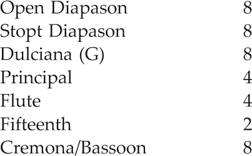
Great organ (GG to f3)