INTRODUCTION
The present study examines sociohistorical and linguistic evidence in order to gauge the feasibility of the creole hypothesis for Barlovento Spanish, a variety spoken on the central coast of Venezuela. Several studies have examined the possible former existence of a Spanish-based creole in the formation of Caribbean Spanish (e.g., Álvarez & Obediente Reference Álvarez, Obediente, Perl and Schwegler1998; Díaz-Campos Reference Díaz-Campos1998; Díaz-Campos & Clements Reference Díaz-Campos, Clements, Sayahi and Westmoreland2005; Laurence Reference Laurence1974; Lipski Reference Lipski1993, Reference Lipski, Schneider and Neuman-Holzschuh2000, Reference Lipski2005; McWhorter Reference McWhorter1995, Reference McWhorter2000; Megenney Reference Megenney1985, Reference Megenney1989, Reference Megenney1999; Otheguy Reference Otheguy, Baley and Shuy1973; Schwegler Reference Schwegler1996). The main contribution of this article to the general creole literature consists of the examination of the role of the Spanish crown's monopolization of the slave trade and the sociohistorical consequences not only in coastal Venezuela, but also in other Spanish regions where similar historical conditions predominated.Footnote 1 Under the influence of studies analyzing English- and French-based creole varieties, scholars have pursued the creole genesis hypothesis in the case of Caribbean Spanish, an area in which African heritage has been very influential. Lipski Reference Lipski1993 notes that according to previous studies, such a creole apparently originated from an Afro-Portuguese variety spoken on the coast of Africa and was brought to Spanish America by slaves, affecting the Spanish spoken in the area. Given the situation found on the English and French islands in the Caribbean where creole languages developed, it seems logical to posit similar conditions for Spanish America, which would have facilitated the emergence of Spanish-based creoles. Particularly in the case of Venezuela, McWhorter (Reference McWhorter2000:12) states:
Venezuela is home to a vibrant, consciously Afro-Venezuelan culture of folklore, music and dance, heritage of the heavy importation of Africans to work mines and plantations. Once again, black-white disproportion reigned, such as the 230 blacks on the Mocundo hacienda (Acosta Saignes Reference Acosta Saignes1967:179). Megenney (Reference Megenney1989:53) notes that ‘in this type of social situation we would have expected to see the formation of a genuine Spanish-based creole with heavy amounts of sub-Saharan influences,’ but once again, we find nothing of the sort.
Taking McWhorter's quote as a point of departure, we analyze the sociohistorical conditions as well as linguistic evidence in order to determine the feasibility of the creole hypothesis in the particular case of Venezuela. Our approach is original in that for the first time the social configuration, the role of the Spanish crown and the Roman Catholic Church, and the linguistic evidence are examined together in an attempt to provide a more complete picture of the plausibility of the creole genesis hypothesis in one of the former mainland Spanish colonies. This investigation contributes in providing a multi-pronged approach to shed light on the debate over the origins of Latin American Spanish.
ON THE CREOLE BASIS FOR AFRO-CARIBBEAN SPANISH
Some studies focusing on the nature of Caribbean Spanish posit that an earlier Afro-Portuguese creole was brought by slaves to the Caribbean (Lipski Reference Lipski1993, Reference Lipski2005). This hypothesis, consistent with the monogenesis hypothesis (see McWhorter Reference McWhorter1997), is based on the argument that creoles have a common historical origin in a Portuguese-based pidgin spoken on the West Coast of Africa. Later on, this Portuguese-based pidgin supposedly relexified when it came into contact with languages such as English, French, Spanish, and Dutch. Early studies in Hispanic linguistics have paid more attention to the analysis of Latin American Spanish based on dialectal influences from the original varieties that settlers brought with them to America (see Henríquez Ureña Reference Henríquez Ureña1921, Lipski Reference Lipski1994a, Parodi Reference Parodi2001, and Wagner Reference Wagner1924 for general descriptions). In the 1980s and thereafter, interest in the African heritage of Spanish in Latin America led some scholars to examine Palenquero and Spanish varieties spoken in the Caribbean. This section specifically focuses on previous research that argues for the existence of a prior creole in the Spanish Caribbean.
The work of Álvarez & Obediente Reference Álvarez, Obediente, Perl and Schwegler1998 examines phenomena in Venezuelan Spanish that could be attributed to the existence of a creole language. Features similar to the ones presented by Álvarez & Obediente are also discussed in Megenney Reference Megenney1985, Reference Megenney1989, Reference Megenney1999. The notion of simplification is taken from the universal theory of creole genesis as proposed by Bickerton Reference Bickerton1981. Álvarez & Obediente list the following phenomena: (i) seseo (lack of distinction between the fricative interdental, voiceless /ɵ/ and the fricative, alveolar, voiceless /s/: caza [kaɵa] ‘hunt’, casa [kasa] ‘house’); (ii) aspiration or deletion of syllable-final /s/ (e.g. lunas [lúnah] ‘moons’); (iii) yeísmo (e.g. lack of distinction between the lateral, palatal, voiced /ʎ/ and the fricative, palatal, voiced /ʝ/: halla [aʎa] ‘he/she finds,’ haya [aʝa] ‘there may be’); (iv) deletion of intervocalic /d/ (e.g. hablado [aβlao] ‘spoken’); (v) syllable-final /r/-deletion (e.g. comer [kome] ‘to eat’); and (vi) alternation between /l/ and /r/ (i.e. [kalne] instead of [karne] carne ‘meat’, [barkon] instead of [balkon] balcón ‘balcony’). A crucial point made by Álvarez & Obediente Reference Álvarez, Obediente, Perl and Schwegler1998 is that the phenomena presented above are not unique to Caribbean and Venezuelan Spanish. However, they argue for multiple causation – that is, that the phonological phenomena may be the result of African substratum influences, as well as internal changes in the language, and other possible influences.
Regarding syntactic phenomena, Álvarez & Obediente present an extended list: (i) deletion of copula verbs (e.g. El ø tranquilo, como si no le importara ‘He was calm as if he did not care’); (ii) deletion of the preposition a in direct or indirect objects (e.g. uno va a agarrar ø el niñito ‘one goes to hold the little child’); (iii) non-inverted order in questions (e.g. ¿Qué tú quieres? ‘What do you want?’); (iv) the use of the non-emphatic subject (e.g. yo fui a tocarle a la dueña de la casa ‘I went to knock on the house owner's door’); (v) ta as preverbal marker (e.g. ta comiendo ‘he/she is eating’); (vi) the use of emphatic ahí ‘over there’ (e.g. dame un lápiz ahí ‘give me a pencil over there’); (vii) focalized ser (e.g. yo vivo es en Caracas instead of donde yo vivo es en Caracas ‘where I live is in Caracas’); (viii) double negation (e.g. no sé donde queda la calle no ‘I do not know where the street is no’) and double assertion (e.g. ya está bueno ya ‘enough is enough’).
As we will argue in detail below, the hypothesis proposed by Álvarez & Obediente Reference Álvarez, Obediente, Perl and Schwegler1998Footnote 2 does not seem to be supported by the linguistic facts, which in turn do not allow conclusions regarding the existence of a possible creole (or semi-creole) stage in the substratum.Footnote 3 Of particular relevance for our analysis, and a perspective not considered by Álvarez & Obediente Reference Álvarez, Obediente, Perl and Schwegler1998, is the sociohistorical background of the area during the colonization period, particularly as it pertains to Venezuela. We will suggest that if we take into account the social history of Venezuela, particularly the role of the Spanish crown in the slave trade, many of the linguistic features discussed by Álvarez & Obediente Reference Álvarez, Obediente, Perl and Schwegler1998 are more easily accounted for by appealing to a non-creole origin. In the next section, we examine other perspectives regarding the African contribution to the formation of Caribbean Spanish with particular emphasis on Venezuelan Spanish.
ON THE NON-CREOLE BASIS FOR AFRO-CARIBBEAN SPANISH
Some of the previous research on the African linguistic contribution to Afro-Caribbean Spanish maintains that the facts do not support the prior existence of a Spanish-based creole language as its precursor. However, it is important to note that this work presents a different perspective from that of the traditional literature in Hispanic linguistics (see Henríquez Ureña Reference Henríquez Ureña1921 and Wagner Reference Wagner1924, among others), in which the African contribution is not taken into account. Using the same tools of the literature on language contact, this research explores the sociohistorical and linguistic phenomena that could be related to African influence.
Laurence Reference Laurence1974 presents a linguistic analysis of the Spanish Caribbean and compares it with the English and French Caribbean. She points out that the Spanish, English, and French Caribbean have in common an influential African heritage, but she challenges the monogenetic hypothesis for the formation of Caribbean Spanish. One of the elements in her discussion is the documented Bozal Spanish that did not become a fully crystallized creole. Laurence Reference Laurence1974 argues that the sociohistorical conditions in the Spanish Caribbean suggest the following: (i) Africans did not outnumber Spanish-speaking EuropeansFootnote 4; (ii) social mobility in Spanish America was greater than that in the English and French CaribbeanFootnote 5; and (iii) the plantation system was introduced late in the Spanish colonies,Footnote 6 so that by the time the plantation system developed, earlier African arrivals and mixed groups of the population had established Spanish as their language. Laurence (Reference Laurence1974:493) focuses her analysis on the case of Cuba, where, she maintains,
The true plantation society ideally reproduces conditions favorable for the crystallization of a creole: demographic preponderance of Africans, rigid caste system, minimal contact with whites, etc. We have seen the emergence of such a society in Cuba at a relatively late date when a different kind of societal pattern had already been established. But the picture is significantly different in the French and English colonies, which, in the middle decades of the seventeenth century were suddenly transformed into sugar colonies and inundated with slaves. A plantation society with its rigid caste system then developed very rapidly.
In short, Laurence argues that sociohistorical conditions strongly differed between the Hispanic Caribbean and the French and English Caribbean. She states that there is no evidence that a generalized Spanish creole existed in colonial times, as was the case in the French and English Caribbean. According to her perspective, there are no substantial elements to support the hypothesis that current Caribbean Spanish is the product of decreolization.
Lorenzino Reference Lorenzino, Perl and Schwegler1998 uses the notion of semi-creolization, which he defines as a partial restructuring of a language by a person/community learning the language. Such a partial restructuring in the plantation situation implies that a new variety began to form there but never went beyond the initial stage of restructuring. Lorenzino's study examines the historical factors contributing to the formation of societal structure in the Spanish Caribbean,Footnote 7 with special emphasis on the role played by the African population.
The rapid disappearance of the native population and the introduction of African slaves to the workforce in the development of sugarcane crops is one of the factors pointed out by Lorenzino as characteristic of Spanish Caribbean society. At the same time, the formation of mixed racial groups such as mulattoes could have introduced linguistic changes through second language acquisition, internalization of African language structures, dialectal leveling, or koineization. Lorenzino Reference Lorenzino, Perl and Schwegler1998 also maintains that the role of African languages among slaves during the 18th century should be taken into account because Africans at that time constituted an important part of the population. Another factor he mentions is the relatively low proportion of slaves per plantation owner in certain areas such as the Dominican Republic, which created a different situation from Haiti and Jamaica, where massive slave importation was the norm. This is a crucial point for our analysis of Barlovento Spanish because, as we argue below, the demographic figures show the low proportion of Blacks to Whites in coastal Venezuela, which includes the Barlovento area.Footnote 8
Lorenzino focuses on the Spanish varieties spoken in Cuba, Puerto Rico, and the Dominican Republic, maintaining that the restructuring of the superstratum under the influence of African languages in the naturalistic acquisition of Spanish produced varieties that are not radically different from creole languages. His restructuring hypothesis (Lorenzino calls it “semi-creolization”) does not assume the prior existence of a creole (Lorenzino Reference Lorenzino, Perl and Schwegler1998:33). He further notes that the case of the Hispanic Caribbean is particularly suitable for proposing the restructuring hypothesis because the social conditions allowed for a closer relationship between Africans and Europeans. For instance, the Spanish Caribbean can be characterized as having plantations with a low number of slaves, more opportunities for education, and higher levels of racial mixing. The problem with Lorenzino's hypothesis is that semi-creolization, or partial restructuring, is difficult to quantify and to test empirically.
The extensive and prolific work of Lipski (Reference Lipski1989, Reference Lipski1993, Reference Lipski1994b, Reference Lipski, Schneider and Neuman-Holzschuh2000, Reference Lipski2005) on the African contribution to Caribbean Spanish includes analyses of Bozal Spanish and Afro-Dominican Spanish. Lipski (Reference Lipski1993, Reference Lipski, Perl and Schewgler1998, Reference Lipski, Schneider and Neuman-Holzschuh2000) examines the social and linguistic aspects of Bozal Spanish spoken in 19th-century Cuba. The general viewpoint maintained is that the controversial monogenetic hypothesis is not necessary to account for the phenomena found in Bozal Spanish. Instead, he proposes that African traces in Afro-Caribbean Spanish can be described as the result of imperfect second language acquisition. Particularly, Lipski Reference Lipski1993 points out that by taking into account the group of West African languages that were spoken by Africans brought to Spanish America, one can predict common patterns of interlanguage phenomena of the Afro-Hispanic population. Some of the phenomena predicted by Lipski Reference Lipski1993 include (i) simplification of inflectional endings, (ii) simplification of pronouns, articles and prepositions, (iii) the use of repetition, and (iv) simple sentences with few instances of subordination or conjunction. These features, he notes, are also consistent with Afro-Hispanic speech in Peninsular literary texts from the 16th century (Lipski Reference Lipski, Perl and Schewgler1998 lists the work of Lope de Rueda, Lope de Vega, Quiñones de Benavente, Sánchez de Badajoz, Rodrigo de Reinosa, Góngora, Feliciano de Silva, Luis de Miranda, Jaime de Guete, Simón Aguado, and Gaspar Gómez de Toledo).
Lipski claims that first arrivals would have spoken this imperfect second language variety (Lipski uses the term “pidginized” in reference to this variety). It is possible that their immediate descendents would have learned such a variety. Nonetheless, subsequent generations would have acquired Spanish natively. This would explain why the only traces remaining are found in the vocabulary. Lipski's analysis of Bozal Spanish constitutes an important point of reference for our own investigation. It is important to consider that in a more recent work Lipski (Reference Lipski2005: 303) points out that “the debate on the possible creolization of Caribbean Spanish is far from over,” suggesting that definite conclusions cannot be given on the subject. In this spirit, a discussion considering the arguments both in favor of and against the monogenetic and second language acquisition hypotheses is developed below.
An analysis of African influences in Dominican Spanish is presented in Lipski Reference Lipski1994b. In his assessment of the sociohistorical conditions of the Dominican Republic, Lipski maintains that the presence of African Bozales decreased earlier there in comparison with the situations of other Spanish colonies in the Caribbean. Furthermore, he argues that massive importation of slaves in the 19th century to work on the sugar plantations barely involved the Dominican Republic. However, Lipski acknowledges that the contact language situation with Haitian creole and varieties of creole English makes it difficult to distinguish between traces of Bozal Spanish and the impact of such language contact.Footnote 9 Moreover, he notes that the sociohistorical situation in the Dominican Republic is not comparable with Cuba, where there is a rich literary tradition representing the speech of African Bozales. In contrast, a corpus of Bozal Spanish in the Dominican Republic cannot be found. On the other hand, he also notes that in the 19th century criollo Africans (Africans born in the Americas) outnumbered African-born Bozales. Lipski Reference Lipski1994b argues that nonstandard phenomena found in Dominican speech are related to the influence of Haitian and English varieties instead of being a direct result of earlier Bozal Spanish.
With respect to the demographic figures for the Dominican Republic, for the year 1794 Lipski (Reference Lipski1994b:8) notes a sharp contrast with those for Haiti (roughly 90% Black and 10% White), pointing out that 66% of the Dominican population was constituted by Blacks and mulattoes, and only 29% were slaves. By 1801, the distribution was 30% Europeans, 50% mulattoes, and 20% Africans. Furthermore, Lipski (Reference Lipski1994b:8) states: “At least the free blacks and an undetermined number of slaves were American-born and spoke Spanish as a native language.” Even though one cannot overlook the African presence in the Dominican Republic, Lipski (Reference Lipski1994b:44) maintains that the predominant mulatto sector of the population did not “move away from Spanish cultural patterns” and, in fact, they were an important part of the social structure.
McWhorter Reference McWhorter1995 also presents an analysis of language contact varieties of Spanish. The point of departure for his study is based on the following observation:
Indeed, despite the fact Spain was a well established and wide ranging colonial power as England, France, Portugal, or Holland, it is striking that not only are there no compelling records of any previous Spanish-based creoles, but the few Spanish-based creoles extant today can all be demonstrated to have arisen as Portuguese-based creoles, only relexified by Spanish later. (McWhorter Reference McWhorter1995:213)
The scarcity of Spanish-based creoles is explained by McWhorter by taking into account three key factors: (i) Sugar plantations were developed late in Spanish America. Smaller plantations in which Africans had contact with Europeans were the predominant pattern. This situation allowed acquisition of Spanish by African descendents who transmitted the language to new waves of African immigrants. (ii) Spanish took over previously Portuguese areas where a Portuguese-based pidgin might have been spoken. (iii) the Spaniards did not have trade ports in West Africa where a pidgin variety could have existed and been brought to America. For the purpose of this study, we focus on the first aspect, as it is related to the discussion of Spanish varieties in the Caribbean. Specifically, McWhorter presents an analysis of Cuban Bozal Spanish that is consistent with the one developed by Lipski (Reference Lipski1989, Reference Lipski1993, Reference Lipski1994a, Reference Lipski, Perl and Schewgler1998, Reference Lipski, Schneider and Neuman-Holzschuh2000, Reference Lipski2005).Footnote 10 McWhorter questions the hypothesis that Bozal Spanish was a pidginized variety on the sugar plantations and that the redistribution of the population and access to the standard made any traces of this earlier variety disappear. Like Lipski, McWhorter finds the features described as being characteristic of Bozal Spanish (e.g., lack of gender agreement, omission of articles, occasional omission of copula, preverbal tense markers, possession expressed through parataxis) to reveal a second-language variety of Spanish. For instance, he challenges Otheguy's (Reference Otheguy, Baley and Shuy1973) analysis of tá (e.g. tá jugá instead of está jugando ‘he/she is playing’) as a present tense marker. McWhorter maintains that tá is always used before verbs with syllable-final stress and that the construction tá + V corresponds to the present progressive in the standard. He also points out that the simple present tense is used without tá as a marker of present tense, concluding that the analysis of tá as a present tense marker is more costly than deriving it from the standard verb estar ‘to be’ (for further details see Lipski Reference Lipski2005, Perl Reference Perl and Perl1987). In short, McWhorter argues that Bozal Spanish is better characterized as a second-language variety than as a pidginized register.
McWhorter Reference McWhorter2000 reanalyzes the scarcity of Spanish creoles with the main purpose of questioning the limited access hypothesis. He examines demographic figures in colonial Colombia, Ecuador, Peru, Venezuela, and Mexico, claiming that the African population in each area was big enough to foster the emergence of a creole language. He hastens to point out, however, that the varieties spoken in many of these regions are typical Latin American dialects of Spanish that are mutually intelligible with standard varieties, maintaining that these Spanish dialects lack the deep restructuring common in Sranan Creole, Haitian Creole, and São Tomense.
In the specific case of Venezuela, McWhorter points out that there was a heavy importation of Africans to work on plantations and in mines. As quoted earlier in this article, he refers to the case of the Mocundo hacienda, where there was a disproportionate ratio of Africans to Europeans. As is explained in the analysis section, this picture presented by McWhorter does not accurately reflect the social and historical reality of Latin America. McWhorter not only overlooks the fact that within the groups he is referring to as “Africans” there were mixed-race segments of the population who were born in the Spanish colony and spoke Spanish natively, but he also misses the fact that in some of the territories there was never an interest in developing agricultural commerce because the Spanish crown was more interested in exploiting mineral resources.Footnote 11 Venezuela constitutes a particularly good example of this, given that political and commercial developments there were very slow during colonial times. In fact, Venezuela consisted of five provinces that were under the political and military control of the Audience of Santo Domingo. In 1550, the provinces were under the jurisdiction of the Audience of Santa Fé de Bogotá. When by 1777 commercial and agricultural activities were on a better footing, the Spanish crown decided to give a degree of autonomy to Venezuela and created the Captaincy General of Venezuela. We will argue below that certain historical facts regarding the Spanish colonies and the scarcity of creoles invalidate the limited access hypothesis, an issue to which we return in our discussion of the demographic statistics of colonial Venezuela.
So far, we have presented some of what we consider the most important points in the discussion concerning the African heritage of Latin American Spanish in the Caribbean, including a review of the various hypotheses regarding the formation of Caribbean Spanish. Our particular contribution to this discussion focuses on the Barlovento area of Venezuela. In trying to account for the linguistic evidence in Venezuelan Spanish, we will explore the role certain sociohistorical factors played in Barlovento, such as the Spanish crown's policies concerning the slave trade, the Roman Catholic Church's role in the process of acculturation of slaves, and the demographic data and what they say about the African presence in the area in question.
SLAVE TRADING IN SPANISH AMERICA: THE ROLE OF THE SPANISH CROWN
As mentioned above, sociohistorical facts of societal structure, demographic data, and the formation of the plantation societies in America, especially in the Caribbean, are crucial elements in determining the conditions for the emergence of creole languages. This general overview of the slave trade in America is the first step in presenting the necessary evidence to determine the predominant conditions in Spanish America and to understand their linguistic consequences.
According to Collier, Skidmore & Blakemore Reference Collier, Skidmore and Blakemore1992,Footnote 12 the slave trade from Africa to Europe and America began during the second half of the 15th century. Calculations estimate that approximately 9.5 to 10 millionFootnote 13 Africans survived the Atlantic crossing to be forced into slavery. The majority of them had as a final destination the developing plantation system in America and the Caribbean. As Arcila Farías Reference Arcila Farías1946 notes, however, the main interest of Spain was to import Africans to work in the mines and not in the plantation system.Footnote 14Figure 1 presents the number of slaves imported to the Americas.
Slave imports to the Americas by region (adapted from Collier et al. Reference Collier, Skidmore and Blakemore1992:139).

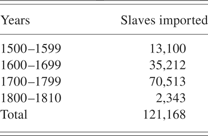
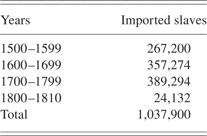
The regions receiving the majority of the African influx were the British Caribbean, the French Caribbean, and Brazil. A total of 9% of African immigrants were brought to Spanish America. The strongest wave of immigration occurred from 1701 to 1810, when 63% of Africans were brought to the Spanish Americas and the Caribbean. The process of the slave trade was not steady, since one can identify different periods in which certain regions received more African immigrants. Spanish America, for instance, had the greatest influx of African immigrants from 1451 to 1600. In the second half of the 17th century there was a shift in the direction of slave trading as French and British islands absorbed 45% of the African immigrants brought to the Americas.Footnote 15 Collier et al. Reference Collier, Skidmore and Blakemore1992 point out that the economic development of Brazil and the Caribbean took slave trading in the New World to unprecedented levels. In the particular case of Spanish America, Brito Figueroa (Reference Brito Figueroa1963:110) presents the estimates summarized in Table 1.
Legal importation of slaves to Spanish America between 1500 and 1810.
The demographic figures reveal an important trend with respect to the structure of colonial societies under the rule of different European powers. Whereas massive importation of slaves was not encouraged by the Spanish crown until the second half of the 18th century, the British and French were in need of a greater labor force very early in the 18th century, owing to the development of the plantation system. Indeed, Collier et al. Reference Collier, Skidmore and Blakemore1992 maintain that at the beginning of the 18th century Jamaica became the largest plantation sugar producer in the world.
Historical sources (e.g., Acosta Saignes Reference Acosta Saignes1967) point out that one of the reasons why the Spanish crown restrained the free flow of slave trading was the fear of rebellions. There are references to African rebels and Maroon uprisings very early in the 17th century. The reaction of the Spanish crown was to restrict an already limited system controlled by means of licenses and contracts. Consistent with this fear of rebellions, Troconis de Veracoechea (Reference Troconis de Veracoechea1969:20) states:
These rebellions of Africans began very early in America: On December 26, 1522 the first incident is reported in La Española. Twenty Wolofs escaped Diego Colon's sugar refinery. They joined other slaves and killed some Spaniards.Footnote 16
In 1532, a law banning the trade of African Wolofs was proposed. Troconis de Veracoechea also reports on rebellions in other areas of the Americas that led the Spanish crown to temporarily halt slave trading in these areas.
The Spanish crown limited the free flow of Africans by imposing bureaucratic restrictions. Slave trading was possible for those holding special licenses and contracts (Spanish asientos). The licenses were authorizations given by the Spanish crown to individuals, while the contracts were monopolistic commercial agreements between companies (or foreign governments) and the Spanish crown. According to García Reference García1990, there were many institutions and other organizing bodies involved in regulating the expedition of licenses and contracts (asientos), including the Council of Indies, the Negroes Junta, the Conservative Judges, and the Factors. The House of Contracts governed this system for slave trading. Both licenses and contracts limited the number of Africans to be brought as well as where they could be traded. These first contracts were given to Portuguese traders (Henriquez Freire, 1576; Simón de Tovar, 1579; Pedro de Santiago, 1583; Antonio de Sepúlveda, 1587; Pedro Gómez Reynel, 1596, etc.). García points out that Portuguese traders were familiar with Africa because of their earlier expeditions in the 15th century. Furthermore, political ties between Spain and Portugal contributed to a solidified Portuguese monopolistic control of the slave trade in Spanish America. In addition to dependence on Portuguese traders, the controlled system imposed increased costs and the possibility of bringing more slaves, especially to places that were not politically or economically important to the Spanish crown.
Another factor involved in the irregular flow of Africans to Spanish America is the end of the political and economic union between Spain and Portugal in 1640. Between 1580 and 1640, Portugal formed part of Spain. As García (Reference García1990:20) notes, this break between the two countries also had the effect of interrupting the regularity of slave trading in Spanish America because Spain did not have the specialized maritime infrastructure for slave trading in coastal Africa. Moreover, at that time Spain did not enjoy good relationships with emerging European powers because they were in competition for control of territories in the New World. However, there was a dire need for labor, as evidenced by testimonies of settlers and businessmen requesting the introduction of more slaves to overcome economic difficulties produced by the lack of labor force. García (Reference García1990:20) quotes a letter written by Joseph de Andrade in 1645:
Mine work, in particular gold, as well as work in the haciendas of the Indies has declined and keeps declining everyday with great economic loss because of the lack of Africans caused by the uprising of Portugal.Footnote 17
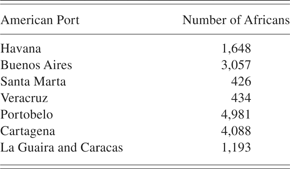
The irregular arrival of Africans to Spanish America also continued during the last part of the 17th century. But during this period, Dutch traders illegally introduced slaves into Spanish America. García points out that the slave population at that time in the territory of Venezuela was calculated at around 24,000. This situation changed when Spain approved a new ten-year contract with the Guinea Royal Company of France. García Reference García1990 states that this agreement between the French and Spanish crowns gave a new official governmental status to slave trading. The contract stipulated the introduction of 4,800 Africans per year. However, this goal was not reached because French traders had to face constant attacks at sea. García Reference García1990 cites archival documents stating that 14 out of 34 ships belonging to French traders were attacked or lost. Brito Figueroa Reference Brito Figueroa1963 also maintains that there were high levels of mortality on the French slave ships: 20% of captive Africans died before arriving at the port of departure, 12% while traveling at sea, and another 5% at their final destination. Table 2 shows the numbers of Africans introduced by the French company to the Spanish colonies.
Numbers of Africans introduced by the Guinea Royal Company of France to Spanish America at the end of the 17th century (adapted from García Reference García1990:22).
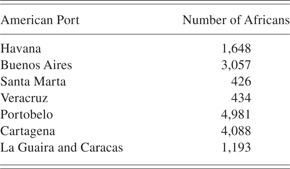
Once the agreement with France ended, Spain afforded exclusive rights for trading to the English crown. This new contract was the product of the Utrecht Peace Treaty. This agreement allowed the introduction of 4,800 Africans per year over 30 years, but in 1718 several obstacles – including smuggling and commercial practices in addition to the bureaucratic regulations stipulated by the Spanish crown – caused the temporary suspension of the agreement. Moreover, the outbreak of war in Europe disturbed peace between England and Spain, producing the cancellation of the contract that was supposed to last until 1743. Then, in 1789, Carlos III opened the traditional monopolistic system of contracts to free slave trading. This is the period in which Spanish Caribbean islands such as Cuba needed an African labor force to maintain and expand their plantation system. The decision to allow free slave trading was made much later than in other areas in the Caribbean controlled by France and England, where from the very beginning there was more flexibility for commercial activity owing to less interference on the part of the respective crowns.
As becomes apparent in the discussion so far, the dynamic of slave trading in Spanish America suggests that the role of the Spanish crown was to protect its interests in its colonies by creating a bureaucratic system that limited the free flow of African slaves to its possessions until late in the 18th century, a system that Brito Figueroa Reference Brito Figueroa1963 describes as a capitalistic-commercial monopoly with the participation of the state (i.e., the Spanish crown). On the one hand, as previously mentioned, there had long been a fear of rebellion, and several colonies experienced uprisings that are documented in formal communications from colonial times. On the other hand, the bureaucratic structure, created along with the use of third parties to provide the African labor force, produced a restricted and costly system for local businessmen in Spanish America. In fact, Brito Figueroa Reference Brito Figueroa1963 maintains that by 1550, a slave was sold for 200 pesos in Spanish America, while the same slave would be sold for 50 pesos in Spain. This is especially relevant in the case of Spanish America because Spain did not have ports in Africa and relied on other European powers to provide its colonies with African labor. The consequences of these sociohistorical conditions in colonial Spanish America account for the fact that Spanish colonies received 9% of the imported Africans while British and French territories together received 45%. These demographic figures clearly challenge the idea proposed by McWhorter Reference McWhorter2000, according to which certain regions of Spanish America (e.g., coastal Venezuela) would have had an African population comparable to those of British and French colonies, so that conditions for the emergence of a creole language would have been ideal. For the specific case of Venezuela, we have presented evidence in favor of the position that, consistent with Laurence Reference Laurence1974, small farms were the predominant pattern in agricultural areas, while the statistics indicate an average of one to two slaves per household in the city. We elaborate on this in the next section.
SLAVE TRADING AND DEMOGRAPHIC CONFIGURATION OF COLONIAL VENEZUELA
The importation of Africans to the mainland colony of Venezuela began during the early 16th century. Brito Figueroa Reference Brito Figueroa1963 states that the Spanish crown authorized licenses to introduce 400 or more Africans during the early 16th century. Both Brito Figueroa Reference Brito Figueroa1963 and Acosta Saignes Reference Acosta Saignes1967 report that Gerónimo Ortal brought 100 slaves to Venezuela's eastern coast. In 1528, the Spanish crown made an agreement with the Welser, an association of German merchants, which stipulated the introduction of 4,000 slaves. The Welser brought only 2,500, and the Spanish crown authorized additional individual licenses. According to Brito Figueroa Reference Brito Figueroa1963, the development of the colonial economy demanded the expansion of the labor force, and during the 16th century a total of 13,100 Africans was brought to Venezuela to meet that need. This is the period in which the contracts (asientos) were in the hands of Portuguese traders. At the same time, the Spanish crown gave authorization to certain individuals by means of the license system. In general terms, the situation described above for all Spanish colonies applied also to Venezuela. There was a restricted system of asientos meant to control the commercial activity involved in slave trading. First, the monopolistic control was in the hands of Portuguese traders and individuals with licenses authorized for slave trading. Acosta Saignes Reference Acosta Saignes1967 describes slave trading in Venezuela as slow and maintains that in many provinces there were complaints because of the lack of African labor.Footnote 18 In fact, in reference to the slave trade in the 16th century, Arcila Farías (Reference Arcila Farías1946:394) concludes that: “there never was any considerable number of Africans in Venezuela during that century.”Footnote 19
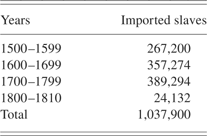
During the 17th century, the Spanish crown continued strict control of the slave trade in Venezuela. By then French traders had entered the picture, taking the place of the Portuguese; and during the early 18th century English traders became players in the slave trade, introducing slaves into Venezuela. Although slave trading during this time was more regular, Acosta Saignes Reference Acosta Saignes1967 notes that the economic situation of the settlers in Venezuela did not allow for massive importation of Africans. And even though by the late 18th century slave trading became free of regulation, in Venezuela the Spanish crown still created the Guipuzcoana Company to regulate commercial activity, including slave trade, in the region. Table 3 shows Brito Figueroa's (Reference Brito Figueroa1963:137) data on slave importation in Venezuela from 1500 to 1810.
Importation of Africans to Venezuela, 1500–1810 (adapted from Brito Figueroa Reference Brito Figueroa1963:137).
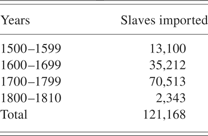
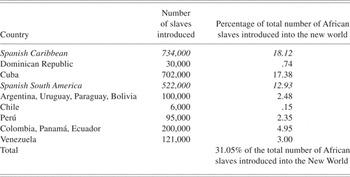
Brito Figueroa Reference Brito Figueroa1963 states that 12% of all the Africans were taken to Venezuela, though he does not provide the figures for other Spanish colonies. Curtin Reference Curtin1969 presents a comparative table with the geographical distribution of Africans imported to the different areas of Spanish America. According to him, the number of slaves introduced into Venezuela represents only 3% of the total number of Africans brought to Spanish America. Table 4 gives a comparative view of slave import estimates to Spanish America, gleaned from Curtin's statistics.
Number and percentage of slaves imported to Spanish America, by country/region as compared to the total number of slaves introduced into the New World (approximately 40,450,885 individuals).

The raw numbers provided by Curtin and Brito Figueroa regarding the total number of slaves brought to Venezuela are consistent. However, one has to take into account the difficulty of reporting exact figures. In any case, the proportion of slaves taken to Venezuela, whether 3% or 12%, does not come close to the estimated 702,000 slaves imported to Cuba for labor purposes. Lipski Reference Lipski1989, Reference Lipski1993, Reference Lipski1994a, Reference Lipski, Perl and Schewgler1998, Reference Lipski, Schneider and Neuman-Holzschuh2000, Reference Lipski2005 claims that Bozal Spanish, a contact-language variety spoken in Cuba, can be best described as a second-language variety of Spanish. Lipski's perspective is that the conditions for the emergence of a creole variety based on demographic distribution of the population in Cuba were not favorable. Consistent with Lipski's viewpoint, one would also have to question the possibility of pidginization or creolization in Venezuela, since the number of imported slaves was considerably lower than in Cuba.
Particularly relevant to our discussion is the socioeconomic development of Venezuela as compared with other areas in Spanish America and the Caribbean. In colonial times, there were two socioeconomic hubs of Spanish America: the Viceroyalty of New Spain and the Viceroyalty of Peru. Venezuela did not form part of either of these viceroyalties, but rather formed a separate entity consisting of five provinces (Caracas, Cumaná, Maracaibo, Barinas and Guayana) that were relatively autonomous. Politically, these provinces were dependent on the Audience of Santo Domingo or the Audience of Santa Fé according to the ruling of the Spanish royal crown. It was not until the late 18th century that Venezuela was declared the Captaincy General of Venezuela, attaining political and military autonomy. In other words, the sociohistorical conditions (Venezuela's lack of political and military status) were not favorable for the development of a large-scale plantation economy.
As explained above, the main interest of Spanish settlers was exploiting mineral resources. In the case of Venezuela, Brito Figueroa Reference Brito Figueroa1961 maintains that the development of the first cities (Cubagua, Cumaná, and La Asunción) was related to the exploitation of precious gems, but all resources found were exhausted early on.
Agricultural activities related to cocoa and coffee were important in the development of the colonial economy during the 16th century, but it was not until the late 18th century that economic and social development became prosperous enough to bring political and military autonomy through the establishment in 1777 of the Captaincy General of Venezuela. This sociohistorical situation contrasts sharply with, for example, that of Jamaica, a colony considered to be the largest producer of sugar by the early 18th century. The introduction of Africans into Jamaica to meet the demand for labor explains in part why Jamaica had 23% of all African slaves in the British colonies at that time.
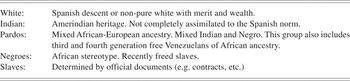
Another central issue in the discussion of the Venezuelan population distribution is the composition of the ethnic groups during colonial times. There was a considerable difference in ethnic composition between Venezuela and the French and English Caribbean. Racial mixture was far more common in Venezuela, and mixed-race groups tended to be acculturated and were higher on the social hierarchy than were slaves (see Waldron Reference Waldron1977 and Lipski Reference Lipski2005). This demographic situation challenges McWhorter's (Reference McWhorter2000:12) view, according to which the African population outnumbered Europeans so that the conditions for the emergence of a creole were ideal. Lombardi Reference Lombardi1976 provides a distribution of Venezuela's population from 1800 to 1809 according to the Bishopric of Caracas. The makeup of colonial Venezuela according to ethnic groups is shown in Table 5. Figure 2 presents the distribution of the population in central and coastal Venezuela from 1800 to 1809.
Ethnic groups in colonial Venezuela.

Population by race in coastal and central Venezuela from 1800 to 1809 (Lombardi Reference Lombardi1976:132).

It is apparent that the predominant group was the pardos, representing 38.22% of the total population. (Pardos are individuals of mixed-race origin born in America, including those of mixed African and European ancestry as well as mixed Indian and African, according to Lombardi's Reference Lombardi1976 description taken from religious documents of colonial Venezuela.) The next most numerous group was the Whites, with 25.5%, while slaves represented only 15.09%. From these figures, one can see that 76.85% of the population, including the heterogeneous populace of third and fourth generation Venezuelans who were native speakers of a variety of Spanish, contrasts with 23.15% representing the pure African-heritage groups.
One could hypothesize that this 23.15% would be cohesive enough socially and linguistically to develop its own language variety. However, as we will explain below, living conditions were not favorable for the concentration of large groups of Africans in coastal Venezuela, which includes Barlovento as well as Caracas.
The apparent disproportion between whites and Africans that McWhorter Reference McWhorter2000 contends could have created conditions for a creole language to emerge can be accounted for by considering the composition of the ethnic groups in colonial times. This is a crucial element in understanding how to interpret the limited access hypothesis in the case of Spanish America and, particularly, of Venezuela. Although there is no doubt about the predominant African heritage of the population, one cannot simply assume an analysis where the disproportion between Europeans and Africans would justify the emergence of a creole. The figures presented above challenge a simplistic analysis of the sociohistorical situation in coastal Venezuela. One can suggest that pardos represent a second-generation group of mixed origin that was already assimilated to the local culture, including the language. One can question the notion of cultural assimilation, but the sociohistorical and linguistic evidence does not suggest the current existence of speech norms that radically differ from those among other segments of the Venezuelan population. Furthermore, one needs to take into account that first-generation Africans did not arrive in massive numbers because of the restrictions that existed until 1789. The demographic figures presented by Lombardi Reference Lombardi1976 are consistent with the ones presented by Brito Figueroa Reference Brito Figueroa1961, who maintains that the population in central Venezuela (including the Barlovento area) was composed of 107,178 inhabitants who were distributed as follows: 33,809 Whites, 17,027 indigenous, 32,673 pardos, 5,053 free Blacks, and 18,616 slaves. Given these figures, we can speculate that racial mixture played an important role in the process of acculturation, which probably implied the loss of native African languages by the second generation. The pardo group was especially important in this process of acculturation.
Waldron Reference Waldron1977 describes pardos living in Caracas as a complex and diverse social group who were considered second-class citizens by virtue of their African heritage. She explains that a number of pardos practicing manual crafts and trades were economically prosperous, owned houses, ran their own businesses, and owned their own slaves. Waldron (Reference Waldron1977:75) also states: “These individuals topped the hierarchy of Pardo society while at the same time [they] mimicked white society as far as was legally permissible.” This observation reveals a cultural orientation toward the dominant Spanish norm.
Another important piece of evidence that helps us understand the social structure of colonial Venezuela is information about the number of slaves per household. As noted above, Brito Figueroa Reference Brito Figueroa1963 maintains that 121,168 slaves entered Venezuela during the colonial period. Waldron Reference Waldron1977 provides figures for the city of Caracas, which she describes as the urban area with the most slaves in the territory. These slaves were personal servants or domestic workers. Waldron points out that by 1759, 35% of the households registered a slave. She calculates an average of 5.8 slaves per family unit. This estimate remained constant until 1792 even though there was considerable population increase within the city. Waldron also points out that of the 5,000 to 6,000 slaves in Caracas, 65% were women laboring in domestic jobs such as cleaning, childcare, and cooking. Male slaves, on the other hand, were expected to assist white men or pardo artisans. The averages presented by Waldron Reference Waldron1977, as well as the descriptions of activities slaves would have engaged in, reveal a context in which close contact with Whites and the target language was likely. We have to acknowledge that learning a second language does not necessarily imply attrition of other languages. However, we do not find evidence to rule out or maintain that a creole language existed in Barlovento. Furthermore, there is not a radical difference between the variety of Spanish spoken in Barlovento and other rural dialects of coastal Venezuela.
Regarding more specific numbers for the Barlovento area, Castillo Lara Reference Castillo Lara1981 reports that there were 462 slaves in the towns of Curiepe and Capaya in 1781, and he also notes the existence of 462,000 cocoa trees in these two towns. The average distribution of slaves per farmer was 15.4. This figure is very important because it suggests that the type of system predominant in Barlovento is consistent with the concept of sociétés d'habitations: small farms where the slaves were in direct contact with Spanish settlers, a situation that might make it likely that slaves were exposed to Spanish and were able to learn it as a second language (Chaudenson Reference Chaudenson2001).
We are in agreement with McWhorter's (Reference McWhorter2000:39) statement that “the claim that bozal Spanishes were Spanish creoles is false; they were transient immigrant varieties.” Nonetheless, we disagree with McWhorter's account according to which Spanish mainland colonies are described as having the perfect conditions for creole genesis. In our view, he does not take into consideration the role of the Spanish crown, discussed above, or the sociohistorical conditions predominant in Spanish America. Moreover, the interpretation he presents of the situation in colonial Venezuela is, from our perspective, taken out of context. Racial divisions in British and French colonies were significantly different from those found in Spanish colonies. In fact, the description of Whites, as explained in Lombardi Reference Lombardi1976, allows “non-pure White” with “merit and wealth” to be included in this category. This classification is distinct from more segregated societies in the Caribbean. Of course, these mixed-race groups were not at the top of the social hierarchy, but they were well above slaves, according to colonial customs. Furthermore, the demographic evidence shows that mixed-race groups along with Whites were a majority in colonial Venezuela. The mixed-race group of pardos as described by the Bishopric of Caracas also reveals that they were men and women born in America, assimilated to the social system, and native speakers of Spanish.Footnote 20
RELIGION AND ACCULTURATION OF AFRICAN SLAVES
Study of sociohistorical conditions has shown that the proportion of slaves in Spanish America was, as mentioned, not as massive as it was in French and British colonies. At the same time, a key factor in the social structure of Spanish America, and most particularly of Venezuela, is the emergence of mixed-race groups such as pardos who were acculturated and occupied an intermediate position within colonial society. In this section, we study the relationship between the church and the state in order to determine the impact of religion in the process of acculturation of the nonwhite population. Laviña Reference Laviña1989 maintains that the Spanish crown viewed as their tacit obligation the conversion to Christianity of any peoples that entered into contact with Spanish conquerors. He points out that this mandate was forced violently upon the indigenous people, although the topic of slave indoctrination does not appear frequently in historical documents.
Laviña explains that slavery existed in Europe before the arrival of Europeans to America (see also Tinhorão Reference Tinhorão1997). Policies created to regulate slavery in medieval Europe were insufficient or inapplicable in the New World, given the new conditions. Slaves in medieval Europe were captives of war and were mainly dedicated to domestic and artisanal labor. Laviña mentions legal documents from the 16th century compiled by Diego de Encinas in which some references to slaves' indoctrination with Christianity appear. Among these, there is one particular document that explicitly prohibits the introduction of Muslim or Jewish slaves to American territories. This kind of policy points to ways in which the Spanish crown tried to maintain cultural homogeneity and induce acculturation.
The first extended Spanish document about slavery, Tractatus de instauranda aethipum salute, appeared in the 17th century and was written by Father Alonso de Sandoval. Laviña Reference Laviña1989 states that Sandoval lived in Cartagena de Indias, where he had direct contact with Africans and their customs and living conditions. Laviña labels Sandoval's work the first piece of ethnographic research about Africans in Spanish America. He also points out that Sandoval's work was used by clergy in charge of instructing slaves about Christianity. Teaching Christianity is clearly a way to teach not only religion itself, but also the language and culture.
In his research, Laviña makes reference to the fact that the first legislation created to regulate slavery in Spanish America appears in a document entitled Las siete partidas ‘the seven certificates’. These norms dictated that slavery was the result of captivity from a just war. Anyone born under that condition or anyone who sold himself or herself as a servo was also considered a slave.
According to Laviña, Father Sandoval's document questions the legitimacy of African slavery as well as the validity of the baptism of slaves. The Council of Indies dismissed these issues, arguing that Spanish colonies were provided with slaves by other European powers. On the other hand, Sandoval's worries about Africans' baptism became an issue within the Roman Catholic Church because Sandoval was accustomed to briefly indoctrinate the new arrivals. He also rebaptized these new arrivals, who initially received the sacrament of baptism before being brought to Spanish America. Laviña claims that, excluding Sandoval's work, the church supported slavery in America. This is also the viewpoint presented by Brito Figueroa (Reference Brito Figueroa1961, Reference Brito Figueroa1963) in his analysis of slavery in Venezuela. Slavery was accepted as an economic activity necessary for the survival of the colonies. Laviña (Reference Laviña1989:46) also adds:
If to this argument one adds that slaves arriving to America would be baptized and indoctrinated in the Catholic faith, an African should be almost grateful for having the luck of being a slave for an American planter. S/he would save his/her soul, discipline his/her body, and would even be able to buy his/her freedom because this was the law.Footnote 21
Even though the general notion of indoctrination was present in colonial times, Laviña Reference Laviña1989 points out that the Spanish crown was not necessarily committed to it. He also reports that during the 18th century religious indoctrination was more the responsibility of individual priests than an institutional task. By 1789, the Spanish crown dictated that slave indoctrination into the Catholic faith was the responsibility of the slave owners. They were in charge of introducing slaves to the principles of the Catholic faith in order to prepare them for baptism. This new regulation was not well received by the planters. However, Laviña notes that Catholic doctrine was taught to all Africans. Slaves were supposed to pray the Rosary every day, so a special regulation was not necessary for accomplishing indoctrination. In this regard, Laviña's study especially refers to the situation of slaves in Cuba.
According to historical sources reviewed by Laviña, religious schooling took place after labor hours. Laviña cites the duque de Estrada's observations about the use of violence to teach religion, which he considered negative because slaves would not be willing to convert. Particularly in Cuba, Laviña points out that evangelization became a main concern for official and church authorities in the mid-19th century. During that period there was an increase in slave arrivals in Cuba. Authorities also reported cases of suicide in certain groups of slaves, which caused alarm among authorities that pursued the teaching of religion as a solution to this problem.
In Estrada's document El catequismo ‘the catechism’, plantation and farm owners were said to be responsible for indoctrinating slaves beyond the simple repetition of phrases. This document also refers to the need to use simplified language with concrete examples to teach religion, especially in the case of the new arrivals known as “Bozal” slaves. The ideas of sin and punishment as a consequence of dying in sin were supposed to be inculcated, so that slaves would be docile and accept their condition. Lipski (Reference Lipski2005:284) also points out the use of religious indoctrination to ensure obedience by slaves.
For our purposes, the crucial effect of the evangelization process on the slave population was precisely the acculturation of the slaves and transmission of Spanish. Indeed, Laviña quotes from the duque de Estrada's catechism, in which the use of simple language to ensure slaves' understanding is mentioned. Furthermore, the product of this process of acculturation can be found in the groups called cofradías Footnote 22 ‘brotherhoods', which were the instrument used for evangelization in Catholic doctrine. Ascencio Reference Ascencio2001 maintains that cofradías were not only a tool for Catholic indoctrination, but they also contributed to the syncretism of elements of African religions that have persisted until today. Cofradías created an institutional space for indoctrination as well as a calendar of free days that landowners allowed for the celebration of the Catholic faith. Many of the religious festivities celebrated in the Spanish Caribbean combine Catholic saints’ names with African drum dances and music. For example, Lipski (Reference Lipski2005:127) refers to the festivals of San Juan and San Pedro, which, he states, “typify the Afro-Hispanic syncretism found in much of Venezuelan culture.” This process of cultural mixing, along with the racially mixed groups, seems to have contributed to a process of acculturation that included not only religious traditions but also the Spanish language. This observation is especially important in the case of Venezuela, where mixed racial groups (e.g., pardos) were dominant very early in the colonial period.
LINGUISTIC EVIDENCE
Some of the previous work presented above on Venezuelan Spanish (Álvarez & Obediente Reference Álvarez, Obediente, Perl and Schwegler1998; Megenney Reference Megenney1985, Reference Megenney1989, Reference Megenney1999; Mosonyi et al. Reference Mosonyi, Hernández and Alvarado1983) contains lists of phonetic and morphosyntactic phenomena attributed to the existence of a creole variety during colonial times. As noted above, the scholars supporting the creole hypothesis claim that African immigrants brought to America a Portuguese-based pidgin variety spoken in West Africa. Such a pidgin reportedly constituted the initial source for the formation of vernacular Afro-Hispanic varieties spoken throughout the Spanish Caribbean. The analysis pursued in this section is intended to determine whether these features are unique to areas of the Spanish Caribbean where trade with Africa was constant, or whether they also occur in Spanish dialects in the Iberian Peninsula. The underlying hypothesis is this: If we find these phonetic and morphosyntactic phenomena only in areas of African influence, then we would have a piece of evidence to support creole genesis.Footnote 23 In contrast, if we find the same features in other varieties without African influence, then we would have to explore other explanations beyond the creole hypothesis. With this purpose in mind, we compare the phonetic and morphosyntactic phenomena found in Venezuelan Spanish with so-called conservative varieties of Iberian Peninsular Spanish in which African influence is not attested.
Phonetic features
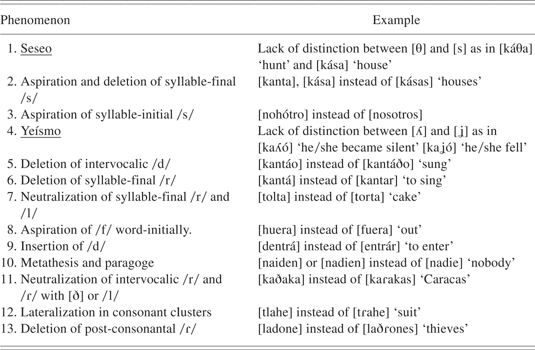
Table 6 presents some of the common phonetic features attributed to a possible creole origin in the literature analyzing Venezuelan Spanish.Footnote 24 These features have also been observed in other Caribbean Spanish dialects, so that we are able to take these previous analyses into consideration for our own study.
Phonetic features attributed to creole origin.
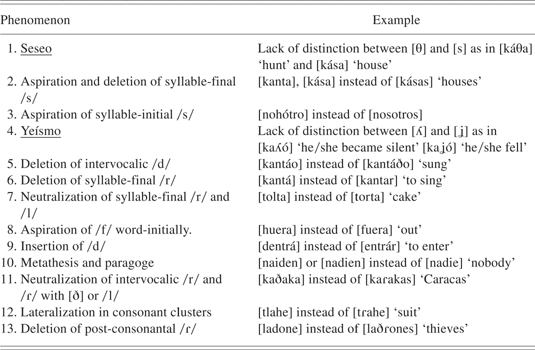
Álvarez & Obediente Reference Álvarez, Obediente, Perl and Schwegler1998 argue that substandard varieties of Venezuelan Spanish are different from the standard because of their creole origin. The first phenomenon they include in their list is seseo. Seseo can be briefly defined as the lack of the contrast between an interdental, fricative, voiceless /ɵ/ phoneme and an alveolar, fricative, voiceless /s/ phoneme. In the dialects where seseo occurs, speakers have in their phonemic inventory only an alveolar, fricative, voiceless /s/ phoneme, so that words such as taza ‘cup’ and tasa ‘rate’ are pronounced as [tasa]. In contrast, Northern Peninsular varieties pronounce taza ‘cup’ as [taɵa] and tasa ‘rate’ as [tasa], with an apico-alveolar, fricative, voiceless [s]. It is questionable to claim that seseo would be a creole feature, since all dialects of Latin American Spanish have this feature regardless of any African influence. Lipski Reference Lipski1994a describes seseo as one of the many common phenomena shared by Latin American dialects of Spanish that coincide with the principal varieties of Andalusian Spanish spoken in the Iberian Peninsula. A direct connection between seseo and African linguistic influence cannot be established, given that many varieties where the African presence was not strong also have seseo in their pronunciation repertoire.
Aspiration and deletion of syllable-final /s/ are features attributed to a possible creole origin by many scholars. Aspiration and deletion of syllable-final /s/ have been examined in many different Latin American varieties, including Argentinean Spanish (Lipski Reference Lipski1994a), Chilean Spanish (Cepeda Reference Cepeda1995), Cuban Spanish (Dohotaru Reference Dohotaru1998, Terrell Reference Terrell1977), Colombian Spanish (Lafford Reference Lafford, Páez, Guitart and Cedeño1986), Panamanian Spanish (Cedergren Reference Cedergren1973), Puerto Rican Spanish (Poplack Reference Poplack1980), Uruguayan Spanish (Lipski Reference Lipski1994a), and Venezuelan Spanish (Ruíz-Sánchez Reference Ruíz-Sánchez2004, Terrell Reference Terrell1986), as well as in southern Peninsular dialects (Moreno-Fernández 1996–Reference Moreno-Fernández1997, Vida-Castro Reference Vida-Castro2004). Furthermore, Moreno-Fernández Reference Moreno-Fernández and Alvar1996 also claims that in so-called conservative areas of Spain such as Madrid, Guadalajara, Cuenca, and Albacete one can find aspiration and deletion of syllable-final /s/. As can be seen, aspiration and deletion of syllable-final /s/ occur not only in Caribbean Spanish – where the African influence is very important – but also in American varieties where the African influence was not determinant (e.g., Argentina, Uruguay) as well as in Peninsular dialects. Given this state of affairs, the creole origin hypothesis does not offer a straightforward account of aspiration and deletion of syllable-final /s/ in Caribbean Spanish in general, nor in the particular case of Venezuelan Spanish.
Yeísmo is the absence of the phonemic contrast between a lateral, palatal, voiced /ʎ/ and the fricative, palatal, voiced /ʝ/. Yeísta dialects have in their inventory only the fricative, palatal, voiced segment, so that contrastive pairs such as pollo ‘chicken’ and poyo ‘podium’ are pronounced [poʝo], while in non-yeísta dialects pollo is pronounced [poʎo] and poyo [poʝo]. As explained above, Lipski (Reference Lipski1994a:36) regards yeísmo as one of the “common denominators of Latin American Spanish.” That is to say that the majority of Latin American varieties of Spanish possess this linguistic feature, which is also present in southern Spain. Nowadays, dialectology research (Hernández Alonso Reference Hernández Alonso and Alvar1996, Moreno-Fernández Reference Moreno-Fernández and Alvar1996) also reports the advancement of yeísmo in metropolitan areas of “conservative dialects” spoken in Castilla la Nueva and Castilla la Vieja.
Deletion of intervocalic /d/, deletion of syllable-final /ɾ/, and neutralization of syllable-final /ɾ/ and /l/ are also included in the list of features examined by Álvarez & Obediente Reference Álvarez, Obediente, Perl and Schwegler1998 as well as by Megenney Reference Megenney1999. All of these phenomena are attested in Spanish varieties spoken in Andalusia and the Canary Islands, so these features are not unique to Caribbean Spanish nor to varieties with a direct African influence. Furthermore, Hernández Alonso Reference Hernández Alonso and Alvar1996 relates, for instance, that deletion of intervocalic /d/ is a widespread phenomenon in Castilla la Vieja, whereas in Castilla la Nueva, Moreno-Fernández Reference Moreno-Fernández and Alvar1996 reports the presence not only of deletion of intervocalic /d/, but also of deletion of syllable-final /r/ and neutralization of syllable-final /ɾ/ and /l/. Once again, these phonetic phenomena cannot be considered unique to the Spanish Caribbean and its African heritage, since one can find the same features in Southern Peninsular varieties as well as in so-called more conservative dialects.
Aspiration of word-initial /f/ consists of pronouncing the fricative, labiodental, voiceless segment /f/ as a fricative, glottal, voiceless segment /h/. According to Lipski (Reference Lipski1994a:10) this phenomenon “is confined to rustic speech, with no discernible regional distribution, and is rapidly disappearing from all varieties of Latin American Spanish.” In Lipski's words aspiration of word-initial /f/ is a feature of rural speech and is not necessarily related to Caribbean or Venezuelan Spanish, since it has been attested in many Latin American Spanish varieties. In fact, Silva-Corvalán Reference Silva-Corvalán2001 has examined this phenomenon in Chilean Spanish and characterizes it as a linguistic stereotype associated with uneducated and rural speech. Since this phenomenon is found in several Latin American dialects, it is not clear whether or not it has an African origin.
We also have examples in Table 6 such as [dentra] entrar ‘to enter’ and [najden], [nadjen] nadie ‘nobody’. These productions cannot be described as unique to Caribbean Spanish. Indeed, Parodi Reference Parodi2001 attributes such productions to a rural variety of Spanish that was spoken in isolated regions far away from metropolitan areas. Instead of positing a specific origin for forms such as [asiɣun] según ‘according to’, [asina] así ‘that way’, etc., Parodi points out that these forms come from the process of expansion of Spanish through mixed racial groups. In her view, these features of rural Spanish are the product of what she calls a koiné, according to which vernacular varieties coexisted with old Castilian, Andalusian, and Toledo Spanish and with languages spoken by other local and immigrant groups. In other words, Parodi Reference Parodi2001 identifies features such as [dentra] and [najden], [nadjen] with many rural Spanish dialects not necessarily related to Caribbean Spanish and its African influence.
Mosonyi et al. Reference Mosonyi, Hernández and Alvarado1983 describe the neutralization of intervocalic /r/ and /ɾ/ with [ð] or /l/ as well as lateralization in consonant clusters, and deletion of post-consonantal /ɾ/ as influences of an African substratum in the speech of Barlovento Spanish. From the list presented in Table 6, these phenomena can be taken as local linguistic features of the Barlovento area. However, Mosonyi et al. do not present a clear connection with African substratum languages other than suggesting that this could be one way of explaining the existence of these features in speakers of the area. Alternatively, since precise evidence is not provided by Mosonyi et al. Reference Mosonyi, Hernández and Alvarado1983, one can also suggest that all of these phenomena are instances of phonological simplification due to imperfect second-language acquisition of Spanish.
In summary, the analysis of phonetic features reveals that the majority of them are found not only in Venezuelan Spanish, but also in other dialects in which African influence is not direct or determinant. In the case of the more local features, they are consistent with those features considered typical of interlanguage Spanish, that is, features common to L2 varieties of Spanish.
Syntactic features
In our analysis of syntactic features, we have included the most important phenomena reported in Venezuelan Spanish. The discussion that follows takes into account the nature and the attestation of these features in other dialectal areas apart from the Spanish Caribbean. Specifically, our analysis focuses on the possibility that these phenomena have a creole origin as claimed by several scholars.
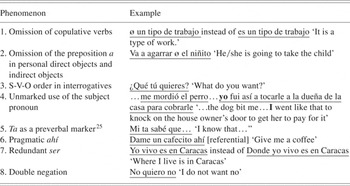
Morphosyntactic features attributed to creole origin.Footnote 25

Omission of copula verbs has been observed in Venezuelan Spanish by Álvarez & Obediente Reference Álvarez, Obediente, Perl and Schwegler1998.Footnote 26 This feature also occurs in creole varieties and African American Vernacular English. Lipski (Reference Lipski1993, Reference Lipski1994a) argues that copula omission is an occasional phenomenon that is typical of vestigial speech. He also claims that copula deletion might be an African areal feature rather than a post-creole development because a great number of West African languages use verbalized adjectives instead of the structure VERB + PREDICATE ADJECTIVE. In other words, Lipski Reference Lipski1994a suggests that copula omission may be a second-language acquisition phenomenon rather than a creole feature.
Omission of the preposition a before direct and indirect objects is the next feature mentioned by Álvarez & Obediente Reference Álvarez, Obediente, Perl and Schwegler1998. This phenomenon has also been reported in other Caribbean varieties. According to Lipski (Reference Lipski1993, Reference Lipski1994a), deletion of common prepositions is very frequent in second-language speech and vestigial Spanish, so that it could be the result of imperfect second-language learning or linguistic erosion.
Non-inverted order in interrogatives has also been linked to a possible creole origin. Lipski Reference Lipski2005 points out that questions such as ¿qué tú quieres? ‘what do you want?’ are common in some areas of the Caribbean, including Cuba, Puerto Rico, the Dominican Republic, Panama, Venezuela, and coastal Colombia, though they are more common in Cuba, Puerto Rico, and the Dominican Republic. Lipski maintains that non-inverted questions seem to appear in Spanish varieties in contact with creoles, such as the case of the eastern Güiria Peninsula area in contact with Trinidad Creole, but this hypothesis does not explain why these non-inverted questions appear in other Spanish dialects without this direct contact.
Lipski (Reference Lipski1993, Reference Lipski1994a) also relates the unmarked use of the subject pronoun to second language speech, stating that the use of redundant pronouns in Afro-Romance creoles is a result of the lack of verbal inflection. He also points out the same phenomenon in vestigial Spanish, which does not have any creole basis. Furthermore, he notes that subject pronouns are obligatory in the West African languages that came into contact with Spanish, so that one would be able to predict preference for redundant pronouns without positing the prior existence of a creole.
In previous literature, ta has been analyzed as a preverbal marker. One can question the creole origin of this phenomenon because of its close relation to aspiration and deletion of syllable-final /s/ in cases such as está ‘he/she is’ (third person form of estar ‘to be’ in present indicative). Nonetheless, Lipski acknowledges that the use of ta as a present/imperfective and durative aspect marker may be related to an Afro-Hispanic creole. At the same time, Lipski points out that, apart from ta, there is no evidence showing homogeneity to claim the prior existence of a widespread Afro-Hispanic creole as portrayed by supporters of the monogenetic hypothesis in the case of Caribbean Spanish.
The particle ahí used with non-adverbial meaning is a recent phenomenon documented in Venezuelan Spanish. There is no available work referring to this phenomenon or a similar one in Caribbean creoles. One possible hypothesis is that ahí has been reanalyzed as a discourse marker. This phenomenon needs to be examined further in order to determine its true nature.
Structures such as yo vivo es en Caracas ‘I live is in Caracas’ have been related to a possible creole origin by Álvarez & Obediente Reference Álvarez, Obediente, Perl and Schwegler1998. Nonetheless, Kany Reference Kany1945 argues that redundant or focalized ser is used in highland Colombia and Ecuador, which are varieties where little influence from African immigration can be found. In the case of Venezuela, Sedano Reference Sedano1990 maintains that redundant ser is a new development originating in the language contact situation that arose owing to extensive immigration from Colombia and Ecuador to Venezuela during the 1970s and 1980s.
Double negation is not only documented in Venezuelan Spanish, but has also been mentioned as a feature of Bozal Spanish. Schwegler Reference Schwegler1996 analyzes this phenomenon as possibly originating from the influence of Kikongo, but he states that the origins of double negation are still unclear. Lipski (Reference Lipski2005:110) explains that there may be a Haitian Creole contribution to Dominican Spanish. Lipski (personal communication) also suggests that in the case of Cuba, double negation may be connected with the influence of the Kikongo language in the region during colonial times. We concede that the question of double negation is a complex problem, and it is beyond the scope of the present article to provide a complete picture on this subject. However, we note that in order to posit a stable creole, we would need to have more linguistic evidence beyond double negation.Footnote 27 Furthermore, it is necessary to point out that even though the African presence in Barlovento is very important, one cannot identify an ethnic language variety that separates Barlovento speakers from speakers of other rural dialects in Venezuela.
CONCLUSIONS
The findings of this study suggest that, based on the available sociohistorical data on colonial Venezuela, the African slave population was not large enough to outnumber White or mixed-race groups. Indeed, Venezuela is a special case in which the number of mixed-race groups constituted a majority. Demographic evidence from colonial Venezuela indicates that pardos were predominant. Nevertheless, we agree with Lipski (Reference Lipski2005:303) that “the debate on the possible creolization of Caribbean Spanish is far from over.” The evidence presented in this article questions the existence of a prior creole, but it does not rule out its existence in isolated regions where African presence was more predominant. We have pointed out that coastal Venezuela, particularly Barlovento and Caracas, reveals a complex sociohistorical situation in which we find mixed-raced groups who were native speakers of Spanish and were acculturated to the Hispanic norm. However, there still remain questions as to whether this acculturation implies the exclusion of their African and indigenous heritage in terms of culture and language.
We have examined all key historical aspects that account for the nature of social structure in colonial Venezuela. We found that the role of the Spanish crown in developing a bureaucratic slave trade system prevented Spanish colonies from prospering as large plantation societies like the French and English Caribbean territories. Historical studies point out that only 9% of African immigration was sent to the Spanish Caribbean, while 45% went to French and English colonies. In the specific case of Venezuela, Curtin Reference Curtin1969 calculates that only 3% of all imported slaves arrived in that country. Curtin also maintains that 17.38% of these Africans went to Cuba. This piece of information, which is roughly consistent with other historical sources (e.g., Collier et al. Reference Collier, Skidmore and Blakemore1992) calls into question whether we can strongly support a creole hypothesis in the case of coastal Venezuela, and particularly Barlovento.
The historical sources we consulted on the African population and economic activity in colonial Venezuela all indicate that small plantations were predominant. In fact, the five provinces that made up Venezuela were not territories of great economic or political importance to the Spanish royal crown until 1777, when they were united under the Captaincy General of Venezuela, attaining political and military autonomy. This pattern of economic development represents well the so-called société d'habitation, in which the transmission of the target language, in this case Spanish, could occur more easily since Africans would have had direct contact with Europeans on a daily basis.
Consistent with the sociohistorical background presented, the linguistic evidence examined reveals that many of the features examined (Álvarez & Obediente Reference Álvarez, Obediente, Perl and Schwegler1998, Mosonyi et al. Reference Mosonyi, Hernández and Alvarado1983) are also found in other areas without an African influence.
Based on all the evidence we have examined, our conclusion, then, is that McWhorter's view of colonial Venezuela as a place where a creole language could have developed is untenable, and the African origins of Barlovento Spanish deserve more research before proposing a definite explanation.