Introduction
The tablet BAM 194, first published by Ebeling in 1920 (KAR 185), is a Sammeltafel that once may have belonged to the so-called library of Tiglath-pileser I.Footnote 2 Among the passages excerpted mainly from medico-magical texts, there is a short one, consisting of six lines only, at the very end of the tablet. The importance of this passage can be explained by its unique topic: it defines the effects cylinder seals had on their owners on the basis of the stones from which they were made. In this respect, BAM 194 viii’ 9’–14’ can be related to the craft of diviners as well as to that of exorcists. Its possible connection to the former profession is twofold. Firstly, it treats the raw material from which cylinder seals were carved as a sign that needs to be decoded in order to understand its meaning in relation to personal fate. Secondly, like the omen texts, BAM 194 viii’ 9’–14’ seems to consist of a protasis-like description of the observed sign (the raw material of cylinder seals) and an apodosis with the interpretation. It must be noted, however, that the first part of sentences in divinatory texts, the protasis, is always conditional, introduced by the adverb šumma ‘if’. The absence of this adverb in BAM 194 viii’ 9’–14’ renders its putative connection to divination uncertain. On the other hand, the more likely relation of BAM 194 viii’ 9’–14’ to the exorcistic lore can be seen in the repeated occurrence of the verb gar that is reminiscent of the word usage of the series na4 gar-šú (Abnu šikinšu, “the stone whose appearance”), ú gar-šú (Šammu šikinšu, “the plant whose appearance”) and muš gar-šú (Ṣerru šikinšu, “the snake whose appearance”). In addition, the listing of stones with their medico-magical effects is a genre pertaining to the craft of exorcists. Besides Abnu šikinšu, the long version of which deals not only with the external appearance of stones but also with their medical utilisation,Footnote 3 attention can be drawn also to the corpus of amulet stone lists and the short series Ṭuppi abnī (“tablet of stones”) known only from five manuscripts.Footnote 4 This series lists stones with their characteristics and defines the roles they played in the craft of exorcists. It must be noted, however, that unlike Abnu šikinšu, Ṭuppi abnī and the corpus of amulet stone lists, the series occurring in BAM 194 iii’ 9’–14’ does not seem to have found its way into the catalogue known as The Exorcist's Manual.Footnote 5
BAM 194 viii’ 9’–14’ has been referred to many times by scholars interested in the magical and medical importance of cylinder seals.Footnote 6 Besides the discussion of the passage, Reiner identified two unpublished tablets in the British Museum, K 4212 and Rm 320, as manuscripts containing the same text.Footnote 7 Subsequently, BAM 194 viii’ 9’–14’ and the newly identified manuscripts were treated by Schuster-Brandis who realised that they form a short series listing 20 stones together with their magical effects.Footnote 8
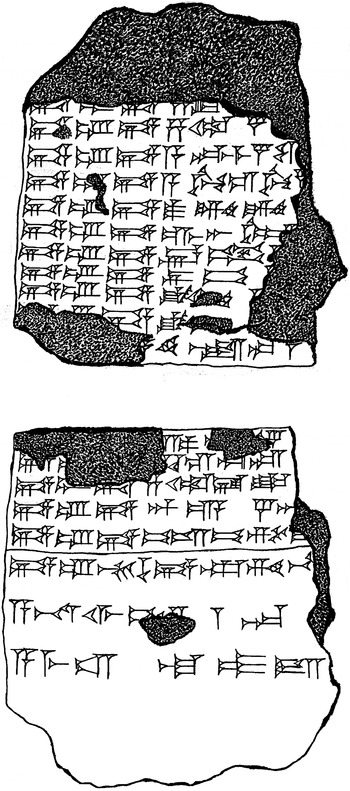
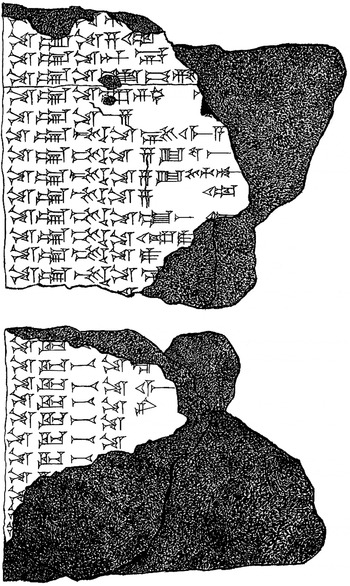
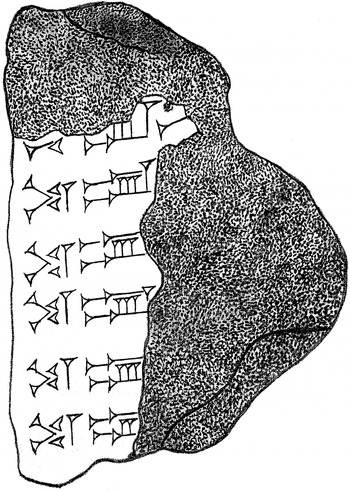
While BAM 194 viii’ 9’–14’ has already been transliterated and translated,Footnote 9 K 4212 and Rm 320 are still unpublished. This might be due to their fragmentary condition, as only the stone names are legible. The aim of this paper is to provide hand copies and transliteration of these manuscripts to which now the small fragment 81-7-27, 281 can be added.Footnote 10 Furthermore, remarks will be made against Schuster-Brandis’ interpretation concerning the second section of the series.
I would like to thank the Trustees of the British Museum for permission to publish tablets K 4212, Rm 320 and 81-7-27, 281.
Manuscripts
A = BAM 194 viii’ 9’–14’
B = K 4212Footnote 11
C = Rm 320Footnote 12 (+)? 81-7-27, 281Footnote 13
Transliteration

2: The translation of tés-a as “dignity” is based on the lexical equation téš = baštu “dignity, pride” known from Erimhuš II 16 (MSL 17, 27), although it must be noted that the form téš-a itself is not attested in connection with Akkadian baštu (CAD B 142a). The textual evidence shows that dignity was thought to be a man's possession. According to the Šuilla prayer “Nabû 5”, dignity could be acquired from gods: “Bestow upon me compassion, pity, dignity, a protective spirit (and the ability of) speaking (and) listening.”Footnote 14 On the other hand, “Marduk 5” describes the loss of dignity with the following words: “The dust (from under) my feet has been collected. My measurements have been taken (and) my dignity has been taken away. I am surrounded and grasped by the evil doings of people.”Footnote 15
As the god is not specified in the series, it can be suggested that the personal god is meant here. In this respect, attention must be drawn to Ludlul I 43–48 where the loss of dignity is related to the personal god leaving the unfortunate person behind: “My god has forsaken me and disappeared, my goddess has failed me and keeps at a distance. The benevolent angel who (walked) beside me has departed, my protecting spirit has taken to flight, and is seeking someone else. My dignity (baltu) has been taken away; my appearance has become gloomy; my worthiness (simtu) has flown away, my protection made off” (Lambert Reference Lambert1960: 32–33; see also Annus&Lenzi Reference Annus and Lenzi2010: 32).
4–5 / 24–25: The word nír could stand for a black and white striped stone; and it was also used as an umbrella term denoting different kinds of striped stones.Footnote 16 Here it seems to be used in its second meaning, since both pappardilû and muššāru are known to be striped stones.
6: According to CAD (R 324–25), the word rīdum occurring in the sixth line of the series is to be understood as “pursuit, persecution.” Likewise, Schuster-Brandis (Reference Schuster(-Brandis)2008: 50) translated this line as “die Verfolgung (?) im Körper des Mannes wird nicht gelöst werden”. The meaning “pursuit, persecution” or “Verfolgung” can be deduced from the lexical evidence that equates rīdum with Sumerian ús (AHw II 981; CAD R 324a). However, another meaning of the word is “common sense, proper attitude,” which, compared to the one preferred by CAD and Schuster-Brandis, is more often attested. In fact, CAD refers to only one other passage where rīdum may be translated as “pursuit, persecution.” This is Ludlul III 20–21 that describes the attack of fever with the following words: “My nose whose breathing has become blocked ina rīdi ummi – He soothed its affliction and now I breathe [freely]” (Lambert Reference Lambert1960: 52–53; see also Annus&Lenzi Reference Annus and Lenzi2010: 40).Footnote 17
The translation of rīdum as “common sense, proper attitude” fits well the context in the series. It may explain that if a person wears a carnelian cylinder seal, then “(his) common sense / (his) proper attitude will not be released” from his body. This translation would also explain the otherwise problematic negation of the verb du8 (pašāru). According to Schuster-Brandis (Reference Schuster(-Brandis)2008: 51 n. 100), the appearance of the negated verb form nu-du8-ár (ul ippaššar) in a context like this, where one expects a positive statement, is surprising, since du8 (pašāru) usually expresses the removal of diseases and other evils from the patient's body. Schuster-Brandis’ interpretation is based on the negative meaning of rīdum, “pursuit, persecution”, that should be released (du8 without negation) if the statement is positive in the sixth line of the series. It is possible, however, that the logic of the line is the other way round. Thus rīdum would refer to a positive phenomenon (common sense / proper attitude), which will not be released from the person's body (du8 with negation). Should we accept the meaning “common sense, proper attitude” instead of the former “pursuit, persecution” here, only the above-discussed passage Ludlul III 20–21 remains as evidence for rīdum meaning “pursuit, persecution”. It is possible to translate “common sense, proper attitude” there too, however. The following translation is suggested: “My nose whose breathing has become blocked due to the proper attitude of fever.” This passage would thus describe the expected action of fever, its proper attitude, which is to attack the respiratory organs and make breathing difficult.
11 / 31: The series seems to make an exception by mentioning the word dag-gaz (takkassu), which means “unworked block, slab” (CAD T 75a). Therefore, it refers not to a particular type of stone, but instead specifies that the cylinder seal was made of a block of stone.Footnote 18
13 / 14: Another exception was made in ll. 13 and 14 with the word alam (ṣalmu) that means “statue (in the round),” “relief” and “figurine (used for magic purposes)” (CAD Ṣ 78b). As in the case of dag-gaz, it can be suspected that the series mentions the original form or function of the piece of stone from which the cylinder seal was carved. Consequently, the word alam can be understood as a reference to the fact that the cylinder seal was cut out of a particular stone, which used to be a statue. Probable archaeological evidence for an old stone statue being re-used as a cylinder seal comes from Ur, where a steatite statue has been found that “has been deliberately broken; it would seem to have been an old figure of which the material was being re-used, probably by a maker of cylinder seals” (Woolley Reference Woolley1976: 252).Footnote 19
33’–43’: The third section of the series deals with the ambiguous HÚB.TIL described by Schuster-Brandis (Reference Weidner2008: 47) as “Aus den Belegen wird deutlich, daß HÚB.TIL ein Gegenstand sein muß, der beim Tragen eines Siegels bzw. in Zusammenhang mit einem Siegel gebraucht wurde und aus Stein gefertigt sein konnte.” The most important attestation of HÚB.TIL meant by Schuster-Brandis is in the seventh column of BAM 194, which contains the folk-etymological explanation for the stone name na4 ka-gi-na (haematite / magnetite). The last two lines of the relevant passage give the description of an object that appears to be a cylinder seal with settings and HÚB.TIL, both made of precious metal: “(Only) the pious man wears it ( = the stone) whose settings are of silver (and) whose HÚB.TIL is of silver.”Footnote 20 Additionally, Schuster-Brandis drew attention to some administrative texts from Mari that mention, according to the interpretation of Bottéro (Reference Bottéro1957: 185, 318), an object called HÚB.TIL.LÁ. This reading was later reinterpreted as GUR7.ME by Durand (Reference Durand1983: 240–42) who argued that the object was a composite jewel, possibly a medallion, made of precious metals and different semi-precious stones.Footnote 21 Should Durand's interpretation be accepted, the object called HÚB.TIL.LÁ or GUR7.ME in the Mari texts seems to have little to do with HÚB.TIL occurring in the series and also in the seventh column of BAM 194. In both cases it is obvious that HÚB.TIL was part of cylinder seals and it could be made of different types of semi-precious stones (as in the third section of the series) as well as of precious metals (as in BAM 194 vii’). According to the archaeological evidence, the use of precious metal settings was only one technique employed in connection with cylinder seals.Footnote 22 In addition, attention can be drawn to the use of handles, which were attached to cylinder seals by means of dowels. These handles, known from the late Uruk period, could either be carved from stones or they could also be cast in metals. In the Jemdet Nasr and Early Dynastic period cylinder seals sometimes had hollowed ends that contained inlays of contrasting stones (e.g. lapis lazuli), while the Early Dynastic seals could be worn on metal pins attached to the garment. The technique of attaching metal caps to both ends of cylinder seals with bitumen is attested from the Old Akkadian period onwards. This technique became more sophisticated in the second millennium b.c. by replacing bitumen with metal rods, which were inserted into the central hole of seals and fastened the two caps together. The most elaborate settings are known from the first millennium b.c. These were either precious metal disks linked together by means of metal rods with looped ending, or, from the seventh century b.c. onwards, ridged precious metal sockets, the upper part of which also had a handle with inlaid stones or metal ornaments. Finally, it should be noted that sometimes the metal settings were imitated in the actual stone.
In spite of the archaeological evidence, the question of which part of cylinder seals was meant exactly by the ambiguous word HÚB.TIL cannot be answered with certainty. The seventh column of BAM 194 implies that it could be used together with the settings, since both ihzū and HÚB.TIL are mentioned here. One may thus speculate, though without any philological support, that HÚB.TIL refers to the ornamental handles of settings with inlaid stones and / or metal granules. With regard to the philological background of the word, no interpretation has been offered so far, nor will any conclusive argument be offered here. However, attention can be drawn to the probable syllabic reading húp-pè, which can be related to the word huppu. As an Akkadian loanword in Sumerian, hu-pu-um is attested in Ur III sources, where it denotes a piece of jewellery, possibly a ring, made of stones or metals (CAD H 239b). This is reminiscent of the looped endings of those rods that were inserted into the central hole of seals and fastened the two parts of settings together. The connection between HÚB.TIL (húp-pè) of the series and hu-pu-um (huppu) of the Ur III sources is far from certain, however.
Col. l. 3: The reconstruction of the line is based on Hunger (Reference Hunger1968: no. 299 l. 7), although note the different spelling of the verb in Hunger (Reference Hunger1968: no. 498 l. 3).
Catch line of K 4212 (ms. B).

The additional signs in the second section of the series
In its present state the series discussed here consists of three sections, the first and the second sections (ll. 1–20 and 21–31+) being separated from each other by a ruling on ms. C, while the third one (ll. 33’–43’) has come down to us on the reverse side of the same manuscript. The first section is the best understood. It lists 20 stones used for cylinder seals, and defines their magical properties. The second section of the series, on the other hand, is not very well understood. While it is obvious that the same stones occur here in the same order as in the first section, there is an ambiguity concerning the two additional signs between na4 kišib and the stone names. Schuster-Brandis argued that these signs were to be read as (na4 kišib) gaba-šú (na4 X), and translated them as “(Wenn das Siegel auf) seiner Brust (ans X-Stein ist)’Footnote 23 and ‘(Siegel) seiner Brust.”Footnote 24
Schuster-Brandis’ interpretation na4 kišib gaba-šú na4 X might be plausible in the case of ms. C. It must be noted, however, that even on this manuscript the identification of the first additional sign as GABA is not beyond doubt, for the lower horizontal wedge of this sign is hard or sometimes even impossible to read (see Fig. 3). Furthermore, attention must be drawn to l. 7’ of the same manuscript (l. 23 of the series) where the GABA sign occurs as the first element of the stone name du8-ši-a. Here the sign is written in a clear Babylonian script (note the two vertical wedges) and it is very different from the presumed GABA signs occurring next to na4 kišib.Footnote 25 The final difficulty with ms. C concerns the omission of the additional signs in the first two lines of the second section. This error seems to have been the result of the scribe copying the text mechanically and realizing only after the first two lines of the second section that the structure of the series has changed and some additional signs are needed. Then, he left his errors uncorrected and signalled only with a horizontal ruling drawn between the last line of the first section and the first line of the second section where one section ends and the next begins.
K 4212 (ms. B)

Rm 320 (ms. C)

81-7-27,281 (ms. C)

The observations presented above show that ms. C is not an error-free tablet and as such it contributes less to the interpretation of the additional signs occurring in the second section of the series. Ms. B, on the other hand, is a clearly written tablet that contains the entire first section of the series. It is followed by a colophon that begins with a catch-line referring to the first line of the second section. As Fig. 1 below shows, this catch-line contains a well-written MU sign,Footnote 26 on the basis of which the introductory passage of the second section of the series can be reinterpreted. It can be read as na4 kišib mu-šú na4 X “seal of X stone with his (= the owner's own) name (on it).” For a parallel to the phrase na4 kišib mu-šú, one can refer to the following sentences of the dream omen series Ziqīqu tablet B ll. 24, 26:Footnote 27
diš na4 kišib mu-šú sum-šú mu u numun tuku-ši
diš na4 kišib m[u-šú gar-ma it-b]a-lu dumu-šú úš
If one gives him (in his dream) a cylinder seal with his (own) name (on it): he will have a name and offspring.
If one wears (in his dream) a cylinder seal with his (own) name (on it) and one takes (it) away: his son will die.
On the basis of these arguments, the second section of the series seems to treat those instances when the cylinder seal bore an inscription mentioning the name of the person who possessed it.Footnote 28 Even in this section, however, the raw material was of crucial importance, on the basis of which this object had different effects on its owner. Unfortunately, the nature of the effects can be determined only in the case of the first six lines of the first section, that is BAM 194 viii’ 9’–14’, due to the fragmentary condition of the other known manuscripts.