Introduction
The scanning electron microscope (SEM) can be used to help discriminate between certain geological deposits and transport mechanisms (e.g. Reference Krinsley and DoornkampKrinsley and Doornkamp, 1973). Detrital quartz grains are common in sediments and varied processes and energy conditions produce recognizable surface textures on grains being eroded or transported. Identification of a suite of surface textures provides a means of identifying the origin of a deposit (Reference Krinsley and DoornkampKrinsley and Doornkamp, 1973; Reference Margolis and KrinsleyMargolis and Krinsley, 1971).
The typically “glacial” surface textures (Reference Krinsley and DoornkampKrinsley and Doornkamp, 1973) appear to depend more on the type of rock from which they are derived than their geomorphological history. Samples from precise locations from existing glaciers have indicated that it is not generally possible to distinguish between subglacial (i.e. subglacially-ground), englacial, or supraglacial deposits (Reference Whalley and KrinsleyWhalley and Krinsley, 1974). Further discussion on the topic of glacial surface textures is reported by Reference Eyles and WhalleyEyles (1978) and Reference Bull and WhalleyBull (1978).
All SEM examination of quartz sand grains from glacial environments to date has been of grains from temperate glaciers. Some recent work (Reference WhalleyWhalley, 1978) has suggested that ground edges and corners produced in subglacial environments can be replicated in the laboratory at both the pressure-melting point of ice and below. Hence, there is a need to examine closely subglacial material from a cold glacier. The study reported here was made on grains from the top layers of the sub-ice till layer (3.5 m thick) recovered from the Camp Century bore hole in north-west Greenland (Reference Hansen and LangwayHansen and Langway, 1966). A comparison is made with grains from temperate valley glaciers and laboratory experiments.
Sample preparation and analytical procedure
The original till samples were split into two 2 g fractions. One of these was washed by swirling gently in deionized water, the other was boiled for 5 min in 0.1 M nitric acid and stannous chloride to loosen adhering particles and remove iron staining and then washed. Both fractions were dried in a dust-free environment and then split further; 40 quartz grains were randomly selected from each. No difference between the two washing methods was observed other than the more efficient removal of adhering particles with the boiling. Grains with long axes from 250 to 500 µm were selected with the aid of a binocular microscope and stuck onto the mounting stub with double-stick tape. A 15 nm conductive coating of either Cr, Au, or C was applied by vacuum- or sputter-coating methods. An energy-dispersive X-ray analyser (EDX) was employed to check mineralogy. Cambridge Instruments’ Stereo-scan models 4 and 180 were used with accelerating voltages from 10 to 20 kV. The tilt angle used was generally 30° to 40°. Photographs shown here were taken in the reflective/emissive mode.
Description of particles
A variety of angular–rounded outlines are seen at low magnifications but some grains appear to be rounded with high sphericity. A graph of visual angularity–roundness estimates (Reference Shepard and YoungShepard and Young, 1961) of 100 individual grains viewed with a binocular light microscope is shown in Figure 1, which shows well-rounded as well as angular grains. SEM examination revealed a bimodal population when surface textures were examined rather than the distribution shown in Figure 1.
Histogram of percentage of grains in six angularity–roundness classes using Reference Shepard and YoungShepard and Young (1961) chart.

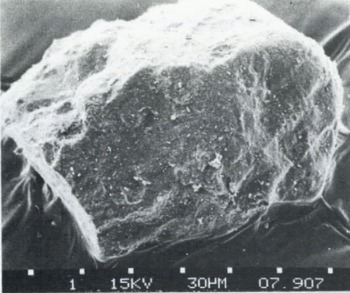
Some of the most angular grains (e.g. Fig. 2) showed little sign of rounding on the edges although poorly-developed arcuate fractures are seen at low magnification. Other angular grains (Fig. 3) exhibit distinct chipped edges although sometimes this may be slight (Fig. 4). Greater magnification (Fig. 5) often shows edge abrasion and grinding seen in subglacial grains from temperate glaciers and laboratory simulations (Reference WhalleyWhalley, 1978).
SEM photograph of an angular grain from the till with breakage but no abrasion characteristics. On all the micrographs the accelerating voltage is the second figure group from the left and the scale value is the third group in μm, the scale itself is the distance between successive white squares along the bottom of the micrograph

A grain showing more rounding than in Figure 2 due to edge abrasion

Slight edge and corner abrasion on top of a conchoidal fracture

A view showing the fractured nature of the edge abrasion seen in Figure 3.

It is probable that the grains described so far are those which have been released from the parent rock relatively recently; they show inherited characteristics together with varying degrees of attrition of corners, edges and, occasionally, of faces. There is little precipitation of silica, the basic angular shape has hardly been modified in some cases although in many the angularity is not of category 1 (Fig. 1).
Some grains (e.g. Fig. 6) have the appearance of once having been very angular but with subsequent grinding of sharp corners. This grinding can be compared with that in Figure 7, a grain with similar angularity but with considerable amounts of precipitated silica not seen on grains illustrated so far. Figure 8 shows a more advanced stage of combined edge abrasion and silica precipitation than shown in Figure 7. The rounding exhibited is in categories 1 to 3, the most rounded being the most covered by precipitation. In contrast, Figure 9 shows a much more rounded particle though with some major surface relief still left; Figure 10 illustrates detail from its surface, this is typical of rounded grains in categories 3 to 6. There is a small proportion of high-sphericity, highly-rounded grains (e.g. Fig. 11), which have a different surface texture to high angularity grains. They are similar to grains which have undergone aeolian processes of rounding (Reference Krinsley and DoornkampKrinsley and Doornkamp, 1973; Reference Margolis and KrinsleyMargolis and Krinsley, 1971).
This grain show abrasion of edges and corner but with only a little amount of silica precipitation.

A rather more rounded grain than in Figure 6 with silica precipitation in addition.


A rounded grain showing abrasional characteristics.

A typical rounded surface “up-turned plates” and silica precipitation characteristic of an aeolian-transported grain.

A well-rounded grain (category 6 of Fig .1) again typical of aeolian action.

Discussion
The interpretation of surface textures of quartz grains is not quantitative and additional difficulties are encountered with comparative estimation of angularity–roundness values. However, the photographs do show that there is more than one population present and that two different geomorphological processes seem to have been in operation.
In summarizing the results it is suggested that the samples show the following groups:
-
1. An angular component with :
-
(a) very angular material, little or no edge abrasion and no silica precipitation. This indicates relatively recent release of material. This is typified by Figure 2.
-
(b) glacially-ground grains with progressive edge (Figs 5 and 6) abrasion and increasing silica precipitation, typified by Figures 7 and 8; (a) probably grades into (b) (Fig. 4).
-
-
2. A rounded component (categories 5 and 6 of Fig. 1) consisting of medium- to well-rounded grains with upturned plates and silica deposition suggesting aeolian action. Figures 9, 10, and 11 illustrate these grain textures.
The common categories for both groups are towards the centre of the continuum (Fig. 1) giving the peak at category 3. Two groups are in fact present although the tails of these two populations merge to give an apparently monomodal distribution when two-dimensional angularity–roundness is considered.
From a subglacial environment with a till deposit of at least 3.5 m thick some evidence of glacial grinding processes on grain surfaces would be expected. Comparison with laboratory experiments and known subglacial environments suggests that there are grains which show the edge-attrition texture (group 1b) produced by grinding (Reference Whalleywhalley, 1978). Some grains, about 25%, show no traces of such abrasion (group 1a) but this is not unexpected for two reasons. First, these grains could have been of relatively recent production (i.e. release from the parent rock) and have not yet been ground. Secondly, by no means all the subglacial sediment from temperate glaciers show such abrasion features (Reference Whalleywhalley, 1978).
On the oldest grains present, edge and corner attrition are most likely, and, at the same time, there is an increased likelihood of silica precipitation on grains. Both features are a function of age (Reference Whalley and Krinsleywhalley and Krinsley, 1974). The very small (<5 µm) and sometimes clay-size grains (<2 µm) found adhering to the faces of quartz grains are found (by EDX) to be mainly quartz although some feldspar fragments are also found. This comminution debris from the grinding process is commonly found in other subglacial sediments. It is also possible however that these small fragments can be produced by weathering processes in sub-aerial positions, i.e. before glacial encroachment, or by high-energy fluvial action. The latter also produces edge attrition but of a more uniform kind than produced by glacial processes (Reference Whalleywhalley, 1978).
It is possible to explain categories showing the first mode of the angularity–roundness continuum (categories 1 to 3), in terms of grinding processes. Glacial microtextures are frequently associated with high angularity, but this need not always be so; even fresh, mechanically-fractured quartz can show rounded forms. Sharp edges and corners especially are swiftly removed by grinding thus making the grain less angular. This rounding is difficult to take beyond a certain stage however (Reference Whalleywhalley, 1978, and unpublished data of W. B. whalley).
In contrast, the very rounded grains (group 2) show all the characteristics of aeolian abrasion and rounding (Reference Krinsley and DoornkampKrinsley and Doornkamp, 1973). Examination of grains from present-day deserts shows that not all aeolian abrasion has produced highly spherical and rounded grains, roundness categories 5 to 6 being the most common. One puzzling feature of a few rounded grains was the occurrence of protrusions from the main grain. These have also been noted by Reference WooWoo and others (1976). It is possible that the stalks are in fact crystal overgrowths but the origin is unknown.
Glaciological implications
It is to be expected that indications of subglacial grinding would be found in the till below the Greenland ice sheet but not evidence of aeolian action. The findings of Reference Herron and LangwayHerron and Langway (1979) make it unlikely that any aeolian grains were deposited on the surface of the ice and subsequently buried but rather that ice overran an area on which aeolian deposits were resting. This aeolian material (component 2) was subsequently mixed with other weathered (component 1a) or subglacially-derivcd (component 1b) debris to give the till as found today.
The Camp Century core spans about 125000 years according to Reference Dansgaard and TurekianDansgaard and others (1971) but Reference WeertmanWeertman (1976) has recently suggested this could be greatly underestimated. Reference Herron and LangwayHerron and Langway (1978) have proposed that the debris-laden zones found in the lower 13 m of the Camp Century core are derived from subglacial till (examined in the present study) and added to the ice by a freeze-on process involving a basal water layer (Reference WeertmanWeertman, 1961). The examination of surface textures of quartz grains has independently suggested that grinding has taken place but it is not clear if the till was wet or frozen at the time because the formation of abrasion textures is independent of basal thermal regimes (Reference WhalleyWhalley, 1978).
The simplest explanation is that the proto-ice cap encroached over a mixture of sediments which were then incorporated into a basal till layer and that the incorporation process involved wet till.
Acknowledgements
Part of this work was carried out while W.B.W. held a Leverhulme European Scholarship at Eidg. Technische Hochschule, Zürich and, subsequently, funding was provided by a Royal Society scientific investigations grant. Electron microscope facilities were kindly provided by Dr H.-U. Nissen of the Laboratorium für Elektronenmikroscopie, E.T.H. Zürich and Mr R. Reed of the Electron Microscope Unit, The Queen’s University of Belfast. Samples and C.C.L. Jr’s participation was made possible through grants from the U.S. National Science Foundation’s Division of Polar Programs.