Introduction
Religion has been poorly represented in recent British social science research. It has taken the growing threat from faith-inspired terrorism to draw attention to this major limitation, well set out in the 2006 ‘Religion and Society’ programme of two United Kingdom research councils (the Arts and Humanities (AHRC) and the Economic and Social Science (ESRC) councils). The subject of belief also has a negligible presence in British social gerontology, which is perhaps more surprising given the prominent place of the study of adjustment in ageing studies, and the traditional view of religion as a bulwark against loss, especially in later life (Coleman and O'Hanlon Reference Coleman and O'Hanlon2004). There are, however, the beginnings of a new interest. Although affiliation to the traditional Christian churches has diminished in the UK and western Europe, the very decline of religion raises questions about its social and psychological functions and whether these functions can be replaced by other institutions (Hinde Reference Hinde1999). Although both Freud and Marx, in their own influential theories of intra-psychic and societal functioning, depicted the use of religion as a primitive and inferior mode of coping, they at least acknowledged its power and influence. A key test of alternative sources of meaning and motivation is whether they provide comparable support in the crises of life, including those of old age.
As Pargament (Reference Pargament1997) argued, faith is most revealingly studied in context, in the way a person's beliefs and religious practices interact both with the major challenges of life and with everyday hassles, but little research has been carried out on the subject of religious coping. It is difficult to question people, especially at times of stress and strain, about personal beliefs, which at least in western culture tend to be perceived as essentially private and intimate matters. Moreover, articulating the actual nature of one's beliefs, their content and the strength with which they are held, is not easy even for a strongly religious person, let alone for someone who has major doubts. It is especially difficult in a society that does not encourage the public witness of faith. For these and other reasons – including the reluctance of academic researchers to engage in discourse on matters on which they themselves lack confidence – British gerontology is poorly informed about the significance of religion. When cited, often it is no more than as a background socio-demographic variable. Even in relation to death, dying and bereavement, where the relevance of spiritual belief and particularly belief in an afterlife might be thought obvious, relatively little attention has been paid to it. Reviews of the literature on bereavement do suggest that faith is important in adaptation to the death of a loved one, but the studies carried out in this area have limited scope (Stroebe et al. Reference Stroebe, Hansson, Stroebe and Schurt2001; Walsh et al. Reference Walsh, King, Jones, Tookman and Blizard2002).
As part of the ESRC's Growing Older: Extending Quality of Life research programme of 1999 to 2003, we obtained a grant to carry out an exploratory study on the role of belief in adjustment to loss of spouse in later life. In designing the study, we had to resolve several difficult issues. Ethics committees are reluctant to allow access to bereaved people in the immediate aftermath of the death and during the first year of bereavement. They are also understandably hesitant about interviews on the subject of belief that might be seen as proselytising. We wanted to do more than scratch the surface of people's beliefs, and to encourage them to express both belief and disbelief without reservation as to how the researchers might respond. We knew from our previous local studies that among older people there are many who, though brought up as Christians had become even at a late stage of life critical of their churches and who questioned the tenets of religious faith (Coleman, Ivani-Chalian and Robinson Reference Coleman, Ivani-Chalian and Robinson2004). We also knew that bereavement could be an occasion not only of affirmation but also of the questioning of faith.
We decided to adopt a longitudinal case-study approach, and aimed to follow up to 30 bereaved spouses over a period of one year following the first anniversary of the death. Not only would this provide us with a perspective both on adjustment to bereavement and on changes, if any, in belief over a significant period of time, it would also give the participants the opportunity to consider the beliefs underpinning their understanding of life and to eludicate more fully if they wished. We adopted the format of the quasi-judicial psychological case-study (Bromley Reference Bromley1986; Coleman Reference Coleman, Jamieson and Victor2002), which we considered best suited to an exploratory investigative study. This enables the role of belief, both spiritual and non-spiritual, in the person's adjustment to bereavement to be examined separately for each individual case. The principal objective was to develop methods for examining the actual content of belief in the context of bereavement. Given the limitations of the project and our expertise, we decided to restrict the study to older people with an education in Christianity and not other faiths.
Study design
National Health Service research ethics permission was obtained to recruit samples of older bereaved spouses aged 60 or more years in two areas of the south of England through invitations sent from general medical practitioners and funeral directors. The areas included both city and rural districts. Interviews were carried out on three occasions, the initial visit taking place within one to two months of the first anniversary of the death, and subsequent visits six months and one year later. The interviewer was a qualified counsellor with many years' experience of work with older people in health-care and social-care settings. The team also included a clinical psychologist with a special interest in bereavement in later life, and a pastoral counsellor with long experience in hospital chaplaincy work. They provided advice and support both at the interview stage and in subsequent case analyses.
As usual in a psychological case-study investigation, various methods were employed, from standard questionnaires to recorded interviews. To classify the strength of spiritual belief displayed by each participant, The Royal Free Interview for Spiritual and Religious Beliefs was employed (King, Speck and Thomas Reference King, Speck and Thomas2001). This had been developed in a London hospital, partly by a member of the present research group, to provide a validated measure of the strength of spiritual belief independent of the specific content of belief or of the frequency of religious practice. It defines spiritual belief as belief in a transcendent power or force in the universe, and includes a five-item measure of the strength of spiritual belief that requires the participant to rate the degree of influence this power has on their lives and on the life of the world in general. The participant is asked to rate each item on a scale from ‘0’ to ‘10’. Although designed to provide a continuous measure of strength of belief, we have also employed it to distinguish those of strong belief (tending to score ‘8’ or above on each item) from those of moderate belief (‘3’ to ‘7’) and weak or no belief (‘2’ or less) (Coleman et al. Reference Coleman, McKiernan, Mills and Speck2002). The questionnaire also asks individuals to classify their belief as religious (i.e. pertaining to a recognised system of beliefs, values, codes of conduct and rituals), spiritual but not religious, or philosophical (i.e. reflecting beliefs containing no reference to any transcendent power or being). It also includes questions on prayer and communal worship.
Other questionnaires included a 45-item ‘Bereavement Experiences Index’ that assesses the presence of distressing symptoms of grief and was in part devised by one of the team members (McKiernan et al. Reference McKiernan, Carr, Waller and Spreadbury2007); the ‘Life-Attitude Profile’ (Reker Reference Reker1999), which provides a measure of personal meaning independent of spirituality; and the ‘Geriatric Depression Scale’ (GDS) (Sheikh and Yesavage Reference Sheikh and Yesavage1986), which provides an indication of symptoms indicative of clinical depression. Separate interview schedules were developed at each of the three observation points in the study, and approached the subject of belief in stages. Particular attention was given to establishing optimal procedures for recruiting participants and maintaining their confidence throughout the study (Mills et al. Reference Mills, Coleman, McKiernan and Speck2002). The first interview examined the person's living circumstances, life history and health, and focused on the nature of the bereavement. It also included the subject of religious background and belief, and included the questionnaires on spiritual belief, bereavement and depression. The second interview explored in more depth issues of belief, whether spiritual or philosophical, and included the questionnaire on personal meaning. The third and final interview contained individually-tailored questions on belief and bereavement based on the previous information supplied, as well as repeating the questionnaire measures of spiritual belief, bereavement and depression.
Case analyses were composed by the interviewer from the material that she had collected. Evidence was assembled under the headings: (a) life history and present situation; (b) adjustment to bereavement; (c) spiritual, religious and philosophical beliefs, and past and present support for these beliefs; (d) questioning and internal dialogues about beliefs, including belief in fate and destiny; and (e) influence of beliefs on the experience of and adjustment to bereavement. In the abbreviated case accounts that follow, précis of nine of these case studies are presented. Quotes have been selected to illustrate in particular the character of the person's beliefs and the influence on adjustment to bereavement.
The participants' characteristics
Of the 82 people who were approached by letter, 28 (34%) agreed to be interviewed (22 women and six men), an agreement rate similar to that of other bereavement studies. Men proved particularly difficult to recruit. All lived alone and independently, although some received substantial support from nearby relatives. When considering the sample as a whole, it is important to note that all had been born before the onset of the Second World War, and the experience of that war had affected deeply many of their lives, whether directly or through its influence on their parents. Also without exception they had received a strong Christian education and socialisation through one or more of: their parents, attendance at a local church Sunday school, and daily attendance at a religious school. These factors make their experience of society and religion different from most members of the subsequent cohorts who have grown up in Britain during the 1960s and later.
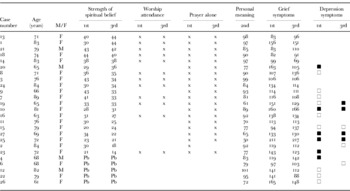
Of these 28 people, a very high proportion (93% or 26) continued in the study over the three observations (the two who did not complete were men). Table 1 presents an overview of relevant data collected on 25 of these participants.Footnote 1 The cases are ranked by the strength of spiritual belief at the final interview point. The five persons who described their beliefs as philosophical rather than religious or spiritual and who therefore did not obtain a score for strength of spiritual belief are ranked separately by case number. Table 1 also presents data on age, gender, whether the person attends services of religious worship with another person, whether he or she prays alone, as well as the indices of degree of perceived meaning in life, presence of distressing symptoms of grief, and symptoms of depression. For the last index only a threefold division is given, which distinguishes those providing definite indications of clinical depression (a score on the GDS of ‘6’ or over indicating probable depression), borderline indications (a score of ‘3–5’ indicating possible depression) and few or no indications (a score of ‘0–2’). Indices of strength of belief, attendance at worship, prayer alone, and of symptoms of grief and depression are provided for both the first and third interview points. ‘Personal meaning’ scores were obtained only at the second interview.
Indices of strength of spiritual belief, symptoms of grief, symptoms of depression, attendance at communal worship, prayer alone, and personal meaning.

Notes: M/F Male, female. Pb: Philosophical beliefs. 1st, 2nd and 3rd specify which of the three interviews applies. □ Symptoms indicative of possible depression. ■ Symptoms indicative of probable depression.
The data in Table 1 are consistent with strong underlying associations between depressive symptoms and low personal meaning, on the one hand, and moderate belief on the other; such a curvilinear relationship between belief and indices of adjustment to bereavement was suggested in an earlier report (Coleman et al. Reference Coleman, McKiernan, Mills and Speck2002). One interpretation of this pattern is that those of uncertain belief are more vulnerable to depressive symptoms and loss of meaning following the death of their spouse. The direction of causation could be the reverse, however, with loss of belief, together with loss of meaning, being a consequence of depression. It is also possible that two-way effects are present. Although there was a longitudinal element to the data collection, the numbers involved are insufficient for further statistical analysis, but case analysis provides further clues. Another interesting point in Table 1 is the evidence of praying alone even among those of relatively weak belief. Indeed admission of prayer appears to be a criterion of a religious/spiritual rather than philosophical belief system. For example, Mrs I (see later) no longer admitted to praying once she stopped referring to her beliefs as spiritual.
The case-study analyses
In making the selection of cases for presentation in this paper, we have followed Bromley's (1986) principle of choosing paradigmatic cases, i.e. exemplars of the range of major categories under examination. In this study, the principal categories of interest have been strength of belief and depressive symptoms, and changes in both of them over the course of the study. We have therefore chosen to present cases of ‘stronger’, ‘moderate/weaker’ and ‘no belief’, and to include cases of change as well as stability of belief, of both presence and absence of depressive symptoms, and of change in these symptoms over time. We have also represented the gender dimension by including two men, but it is important to note that the group of moderate believers, despite being the largest in the sample, were all women.
Stronger believers
Mrs A (Case 13)
Mrs A had cared for her husband with dementia for six-and-a-half years. For the last 18 months of his life, he lived in a care home, which she visited every day and fed him at lunchtime. She described her husband's illness and death as a series of bereavements, which had started with the diagnosis of dementia. As he became worse, she spent most of her time by his bed, and said she was distressed that she had not been there at the moment he died. By the time of the first interview, she displayed low scores on the bereavement index and indicated no symptoms of depression.
Mrs A had a strongly religious background. Both sets of grandparents had been lay readers, and she had attended a church school as well as Sunday school. She spoke warmly about the services she attended in her church, and had no difficulty in articulating the strength of her belief in God: ‘Every fraction of every minute, He's there for me, I never have a moment's doubt. … He doesn't turn any one of us away. He'll knock at the door but if you don't open it, He can't get in, can He? So that's not His fault.’ She believed also in a personal destiny planned by God: ‘I think that our lives are laid down from the time we're conceived to the time we die, and the things that happen here have already been mapped out for us to go through. We have to go through them to come out the other side.’
In her conversations, Mrs A presented a strongly coherent system of beliefs consistent with the high score she also obtained on the Personal Meaning Index. She considered that her beliefs were central to the way that she had coped with the loss of her husband. When people had stopped her and said they were sorry, her characteristic reply was: ‘No don't be sorry, be joyful, just be glad because he is at peace now’. She marked important anniversaries associated with her husband by placing flowers in the church. On a number of occasions during the interviews, she referred back to her mother's beliefs and her own identification with these same beliefs: ‘My mother always used to say to us, “He never gives you a cross without Him knowing you can carry it”. I never worry on that score. That was always her (saying), “He will never give you a cross unless He knows you can carry it”. And I think that's quite true. He carried His and we've got to learn to do the same, haven't we?’
Mrs B (Case 1)
Mrs B had experienced more difficulties in accepting the bereavement of her husband. In understanding her reactions, it seems important to take into account earlier losses – a daughter who died shortly after birth and a son at three months. These were still very painful memories for her, which she described in detail, losses which she had been unable to reconcile with her Christian faith: ‘I'm afraid I didn't think this is God's will, which I suppose it was, but I felt that they ought to have been here still. I won't say I was too Christian-like about that because it's quite hard’. Her husband had gone into hospital for an operation for a hernia, and was taken back three weeks later with severe abdominal pain. He was found to have a perforated ulcer and, following another operation, died in intensive care. Her adjustment to the bereavement seemed slow, with only a slight decrease in her initial high ‘bereavement experience’ scores at the interview following the second anniversary of the death, although on both occasions she did not exhibit marked depressive symptoms. She was also troubled by the thought that she would have to move from her house with its striking view towards the centre of the city. By the time of the last interview, her physical health had worsened and she was moving towards acceptance of the need to move.
Mrs B described her mother as ‘a great Christian’ and her father as ‘not church minded’. Her husband had been churchwarden of their local Church-of-England church for 40 years, and she had been a member of The Mother's Union over the same period. At the time of the first interview, she expressed only a moderate level of belief, but by the final interview, her ‘belief score’ had strengthened considerably. On all items she displayed an increased awareness of God's power acting in her own life and in the world at large. Her sense of personal meaning was also high. She said that her religion meant more to her now than when she was younger: ‘Maybe I understand it more. When I was young I just accepted it, didn't question it. … My faith has been tested and I have some lovely friends in the church.’
Some questions continued to test her. She remembered her (surviving) son's serious illnesses throughout his childhood and early adult life and how she prayed and couldn't understand why he suffered. She still found it hard to understand why certain things happened but implied that God had a way of working things out in the end. She acknowledged that coming to terms with bereavement would have been much harder for her without her beliefs. Furthermore, her strong links with the church ensured that a pastoral visitor called regularly after her husband died, and Mrs B found her both very helpful and very skilled. She was also fortunate in having friends who took her to church services and to monthly meetings there.
Mr C (Case 20)
Mr C displayed a moderate but strengthening spiritual belief over the course of the study. His wife had died suddenly at home in bed of heart problems. He was depressed at the time of the first interview, his ‘bereavement index score’ was high and he found it difficult to concentrate on filling in the questionnaires, but was sustained by two visions of his wife that he had seen when waking from sleep. He insisted that he had not been dreaming. These and other sensory experiences related to his wife had convinced him that ‘we're going somewhere’ after death. By the end of the study, his depressive symptoms had disappeared and his ‘bereavement index score’ had greatly diminished. His ‘belief scores’ strengthened over the same period and he had become convinced that a spiritual power had assisted him to cope with his difficulties. He said he prayed every day and that this helped but, unlike other strong believers, he did not attend church services. Instead, he visited his local church for about 15 to 30 minutes one afternoon each week. He said he struggled with understanding the meaning of what he believed, and it is significant that his ‘personal meaning’ score was lower than average. He had developed a heterodox system of belief, describing himself as a ‘non-denominational Christian’. He did not see God as a person, nor see Christ as God: ‘Good luck to them if anybody else can see God as a person. I don't see God as a person. I don't know. I just possibly see Him as a light or something like that, I don't know.’
He had attended a church school, regularly gone to Sunday school, and until the age of 18 years had accompanied his mother to a Methodist chapel out of respect for her. As he grew older, his sporting activities drew him away from church. His father never went to church, kept his beliefs to himself, and ‘as a person of high standards’, never praised his son, which Mr C said ‘hurt him as a child quite a lot’. Mr C said that he had been influenced by the teachings of both his mother and his father, the Bible, the concept of one God, the Ten Commandments and notions of right and wrong. At the same time, he found it difficult to accept the authority of the Church. He said:
I can't fall in with the system of the Church. … I was in the Masons, everything was set out for me there. I was in the army, everything was set out: I've always been in uniform. I was 20 odd years in the fire service. … I've been ruled all the way through, governed, but I can't take it with religion, I've got to feel separately and independently. … I've just got to believe what's inside of me … no way can I accept orders from anyone. That's why I found it hard with my father.
By the end of the study, a relationship with a friend of his wife's had developed, and he was likely to remarry, which means that although growing belief accompanied his recovery from bereavement, it is not possible to conclude that the former was a major influence on the latter. Nevertheless, when asked at the end of the study whether his beliefs had helped him come to terms with his bereavement, he said it was ‘the only thing that kept him sane’. Nor were his regular visits to church unimportant. As he explained, ‘I'm not a church person, I just use the church facilities … it's a comfort to know it's there. I use it every week to pray on my own for a few minutes, to have a short chat’. He also said that when you're feeling down it is another place to go and cry.
Non-believers
Mrs D (Case 26)
Mrs D's husband had died after only a brief illness, having been at work the week before. She herself had suffered a series of major operations, including a mastectomy, during the period before he died, and she thought that these events had contributed to his death. Her own life had been made even more difficult during the preceding year as a result of the unfair treatment that she felt she had received from her husband's business partner. At the time of the first interview, she described herself as often lonely and lost, and as having ‘nearly fallen apart’ around the time of the first anniversary. By the final interview her depressive symptoms had decreased, but her ‘grief scores’ were still high. Both her mother and father had been religious. She had attended a convent grammar school, of which she had negative memories: ‘The nuns used to hit me. I wasn't scared of them, I despised them because they seemed to pick on me. If they put me outside I would walk home nine miles’. She also thought she had been unfairly treated during her training to be a nurse because of her Catholic affiliation.
She identified with the definition we provided of a philosophical belief system, and explained her hostility to religious faith: ‘I was brought up as a Catholic … but I don't believe there is such a thing as a God, or if there is such a thing I think he's got a really warped sense of humour’. She said that she had lost faith ‘because of all the horrible things that happened to me in my life. My brother lost two children. … You think, well, why? You know with all the terrible people in this world. Why do they live?’ On closer investigation, however, it appeared that she did not have a coherent philosophical belief system, but rather anti-religious views. Despite her non-religious stance, she remained unsure about existence after death. She felt that her husband was still with her in some way. She heard him call her occasionally and she continued to talk to him. It was an attitude that her son shared, but that her daughter ‘couldn't take’. Mrs D's sense of personal meaning was low, and her beliefs, such as they were, had not helped her come to terms with her husband's death. She said that she ‘still asked why’. Her unresolved anger over her treatment by her husband's partner continued to make her feel angry and unhappy.
Mr E (Case 12)
Mr E, by contrast, articulated a confident philosophical belief system. His wife had died of renal failure following a long-standing illness, which had meant that he had been running the house for the previous 12 years. It had been hard to switch off her dialysis life-support, a decision that to think about still made him sad. He admitted to having been depressed for some time after she died and, at the time of the first interview, there were still mild symptoms of depression, but he also expressed a determination ‘not to let himself go’. He had been in the police force for over 25 years, which with war service had influenced his outlook on life. He said that it ‘made you a bit harder perhaps than you would normally be’. He was scathing about the present emphasis on talking through problems. It hadn't happened during the war or in the police force when he was young. He said, ‘I just got on and did it, and came home and tried to forget it’. In the same vein, he said that when he got sad thinking about his wife he ‘tried to put things out of his mind’. Nevertheless he continued to dream about his wife and sometimes forgot that she was no longer there. Occasionally, for example, he would turn around in his chair to talk to her. By the third interview, his ‘bereavement score’ had dropped considerably, and his depressive symptoms had disappeared.
Although he had attended a church school and his parents had been ‘slightly religious’, he said that he had never been interested in religion. He never went to church nor prayed, and did not believe in existence after death. During the first and third interviews, in fact, he did not want to speak about religion at all, but during the second interview he did admit to thinking about religion sometimes:
… the whole thing goes around the fact that God had a son who came to this earth to save humanity. From what? This earth has been in business now for four-and-a-half-thousand million years but the Christian religion has only been going for 2,000 years. So that's a question that I ponder in my mind. And they say when you die you go to heaven … these little toddlers, do they go to heaven? Do they stay at that age when they go up there? What do they do when they're there?
Mr E had no belief in destiny or luck. He thought ‘things just happened’, even the earth's creation: ‘There was a big bang and the world came into being and nature took over and human beings started to live on the earth, and that's it, as far as I'm concerned. They weren't made by anybody, they just occurred in nature’. Yet despite his low need for perceiving any meaning or purpose in existence (in this respect the opposite of Mr C), he had the highest ‘personal meaning’ score in the sample. He described it as a ‘realistic’ philosophy of self-responsibility. At the same time he recognised that people needed nurturing, which included support following bereavement, as he had been fortunate to receive from his daughter.
Mrs F (Case 22)
Mrs F suffered from Type 1 diabetes that was controlled by injections which she self-administered twice daily, and she was almost completely blind through a late-onset eye disease. Nevertheless, she still managed to do much of her own housework and led a very ordered existence. A sociable person, she attended a day centre which was very much the centre of her life. Her husband had died of cancer and almost until the end had helped her as much as possible, but made her do things herself when he knew he was dying. Their marriage had been very close. She described the loneliness that she now felt, especially in the evenings. Her ‘bereavement score’ was high at the time of the first meeting and she showed some symptoms of depression, but by the time of the third interview the score was greatly reduced and she displayed no depressive symptoms.
She had been very religious as a child. Right until she married, she had never missed ‘chapel’, which was her father's church. Her grandparents in particular were very religious. She had attended a church school as well as Sunday school between the ages of five and 14 years, and unlike Mrs D had positive memories of church life. She had particularly enjoyed singing hymns. She had never been confirmed, however, and had left home at the age of 15 years and had married four years later. Her husband did not believe. He had ‘his own way of thinking’ and was a ‘strong-willed man’. She could never bear ‘any unpleasantness’, and it seems she gradually stopped attending church after she married, although she did send her children to church.
Gradually, she came to share her husband's views on life, and like him did not believe in life after death, but it appeared that she retained some residual belief. In her words, ‘I don't believe there's someone up above … well, I mean there is something, I know there's someone out there, someone's created the world. Something must have happened’. She did not give much attention to such thoughts and indicated that thinking too deeply about existential matters was ‘painful’. This also meant avoiding thinking about her husband: ‘No, I try not to think about him because it upsets me if I start thinking about him’. Nevertheless, her ‘personal meaning’ score was high, and this was reflected in the positive evaluation she gave her life. As she reasoned:
Well, I suppose you're put on this earth for some purpose, if it's only to be a mother, to work, I mean I've worked jolly hard in my life, I've gone out to work and slogged for my children. I mean my children were first in everything … and they all seem to love me.
Moderate believers
Mrs G (Case 19)
Mrs G's husband had died suddenly of a heart attack in front of her without prior warning. At the time of the first interview, she still felt her husband's presence, which she found comforting. She said, ‘I feel he knows me. He is somewhere but he knows what's happening’. At the same time, she was struggling with her bereaved state and trying not to think about it by keeping active. By the time of the third interview her ‘grief score’ had reduced, but mild depressive symptoms had become more evident. She expressed moderately high beliefs throughout the study, but tinged with many doubts. She described her father as a believer who attended church regularly, whereas her mother was not a believer. When growing up, she felt closer to her mother and ‘distanced’ from her father. He had been severely traumatised when being evacuated from Normandy in 1940 and HM Troopship Lancastria sank. She remembered being frightened by his appearance on his return and not wanting to let him into the house. Although she had not attended church school or a Sunday school and only occasionally went to church, she was confirmed at 15 years-of-age, and had positive memories of the church to which she belonged during the years that followed.
She attributed her increasing loss of belief, of which she was aware, to the experiences of life. She found the divorce from her first husband ‘earth shattering’. Her loss of faith meant that she had ceased to pray, although by the time of the third interview, she said that she was praying again. When asked what prayer meant to her she said: ‘It means that I hope someone's listening but I am not sure whether they are or not. I feel hopeful that they are’. Nevertheless she regularly attended church in the hope of regaining her faith, to which she attributed great importance. She said:
I hear the church bells ringing … and I think, if you don't go today you're never going to believe in any of it again, so you'd better go and see. … I'm hoping that He might give me some kind of a sign but I don't know what it is. … Life is so easy when you believe in it all and you feel that you're shielded from everything.
She envied others their belief, but nonetheless articulated doubts about an omnipotent and all-loving God: ‘I think, well, there He is, wherever He is, and all these people who've died … they can't all be up in the sky somewhere … . and He's looking after them. And in actual fact, I don't think I can believe that He could possibly be true’. She seemed to have sided with her mother and was more inclined to believe in a cold and uncaring fate. Her ‘personal meaning’ score was very low, and she admitted in the final interview that she was not at peace with her beliefs. She had become less sure about belief in life after death. Mrs G seemed a clear example of a person who would have benefited from spiritual counselling, yet appeared to be receiving no individual pastoral care from her church.
Mrs H (Case 25)
Mrs H also consistently expressed uncertain belief but at a lower level of intensity than Mrs G. She described her beliefs as spiritual rather than religious. Although the most wealthy member of the sample, she was also the most troubled, with high ‘depression scores’ at both first and third interviews. By the end of the study, she had been referred by her GP to a psychiatrist. Her second husband, a Jewish businessman, had died of cancer. She had not expected him to die since he had seemed to her so resilient – he had survived the Nazi death camps – and gave her a great sense of security. She had found his death unbelievable, and at the time of the first interview could not accept what had happened. Her grief score was extremely high, and it was higher at the third interview. Her sense of personal meaning was the lowest in the sample.
Her upbringing had been Roman Catholic, and she described her childhood church as a happy and friendly place. She remembered that her grandparents were devout but not her parents. She gave up practising her faith when at university. Despite being an only child, she described her parents as cold and distant. She had few memories of her mother's nurture, and her father was very strict and forbidding. One could appreciate how her second husband had given her the protection and love that she had not received as a child, and how great was the loss that she experienced when he died. She believed in a spiritual power that influences our lives:
I think there is a power … outside ourselves, but I really am not always sure that it does influence our lives. I suppose it influences our lives from our point of view, because in moments of distress, you sort of think about God, but I don't think that anything comes directly from above to influence our lives.
She did however admit the continuing influence of a Catholic upbringing, saying, ‘it is too much in one's self that even if in your teenage years or earlier, you rebelled against it and you stopped going to church, it is part of yourself and when I think of something above I think of the Virgin’. But she found this help insufficient: ‘I don't think I believe enough to find it soothing or comforting. … I probably think there is something there, but not something which could relate to me’.
Mrs H went to church a few times after her husband died but it did not help. As she explained, ‘It upset me more because I couldn't bear all the talk about the departure … allusions to the other world … I didn't want to think of it precisely as that’. Although the local clergy did not offer her much help that she found useful, she still had two very good friends who were priests, who rang occasionally. Although initially she said that she did not pray, by the third interview she indicated that she did. When asked what it meant to her, she said: ‘It means a quiet time. I pray to the Virgin because she takes the place of my mother (she cried). I also pray to God sometimes’. Clearly Mrs H's bereavement had triggered old sorrows and she was in much need of support, not only to recover from the devastating loss of her husband but also from the deep-seated sadness in her life. Her faith, weak as it was, offered only limited help.
Mrs I (Case 2)
A widow aged 83 years, Mrs I is particularly interesting because she was the only member of the sample who moved from a stated ‘religious’ to a ‘philosophical’ belief system during the course of the study. Her husband had been a prisoner-of-war of the Japanese, and had been affected deeply by the experience but never spoke about it. He suffered from multi-infarct dementia towards the end of his life and eventually died from a stroke. It was a peaceful death for which his wife was grateful. Together with her mother, as a child she had attended church three times on a Sunday. Her father had not been religious. Her early memories of the church were positive, and she had been happy to bring up her children in Methodism. She had continued to attend with her husband after the children left home, and had stopped attending only in recent years. She described her disappointment with the unfriendliness of the local Methodists whom she had encountered, quite unlike her memories of childhood in the north of England. She said, ‘many of them attend church for self gratification, to be seen to be doing good, but when it comes to the crunch [are] not there to help’. During the course of the study, her belief in God's power waned significantly. Her answer to the question on belief in life after death also changed from ‘yes’ to ‘unsure’, and she gave a similarly indefinite answer to the question about whether she prayed.
Mrs I's ‘grief scores’ were of moderate intensity through the study, and some depressive symptoms had appeared by the third interview. Nevertheless, she had a high ‘personal meaning’ score linked to a strong feeling that we are given life for a purpose, although she could not elaborate this belief. She also felt that she had been given strength to cope with her loss. She described this in terms of her many friends whom she felt were a legacy from how her husband lived. As a result she did not need to go to church. Her uncertain faith seemed closely linked to her disappointment with the church. In this case the resentment dated back a long time, even to her experiences as a young mother. But since her husband's death, her beliefs appeared to have become more unstructured and solitary. She questioned her beliefs more but in isolation.
Discussion
The most striking feature to emerge from these case analyses is the variety of religious and spiritual responses in the participants' accounts of their experiences following bereavement. These differences did not appear to be related to the participants' ages or levels of disability. Simple categorisations as religious/non-religious, spiritual/non-spiritual or philosophical/non-philosophical inadequately capture the complex reality of the participants' perceptions of personal and existential meaning. For British older people socialised into the Christian religion before the Second World War and shortly afterwards, religious concepts have remained an important part of their vocabulary, even if they have rejected most tenets of religious belief. As one example, the data collected in this study suggest that prayer and the motivation to pray are still significant in the lives of the majority of older people.
This study has confirmed the findings of our earlier study that faith is not a static variable in later life (Coleman, Ivani-Chalian and Robinson Reference Coleman, Ivani-Chalian and Robinson2004). Even over just one year, significant changes were observed in religious or spiritual responses, especially when associated with life crises. Belief is malleable and in continuous interaction with experienced life events. It cannot be analysed as if it were a socio-demographic variable comparable to gender, education or occupation. To cite Pargament again, religion needs to be studied in action:
Many of the greatest religious dramas are played out by those in the later years of life. These are pivotal times, when people of greatest maturity meet situations of greatest challenge. It is in these moments that people move from the abstractions of a religion in theory to the concreteness of a religion in action (Pargament, Van Haitsma and Ensing 1995: 47).
The diversity of responses to such a major life event as the bereavement of one's spouse is evident even among the nine cases described in this paper. Mrs A appeared to be a prime example of a strong believer whom other Christians might consider close to an ideal model of belief in action. She has a lively sense of God's presence in her life and His purposes for her, and in her thinking employed the central Christian mystery of the cross, which she applied directly and confidently to her own experiences of bereavement. Significantly, perhaps, her faith is rooted in a strong family tradition.
A contrasting view was provided by Mr E, who has an equally high sense of ‘personal meaning’, but without any suggestion of belief in the operation of a special power or destiny in his or other people's lives. He has also adapted well to a troubling bereavement with the help of family support, which he acknowledged. He maintains a realistic philosophy of self-supported responsibility rooted in his own personal experience of life. It could well be that he too would be regarded by secular humanists as an ideal model of coping, able to deal with life's experiences without resort to fanciful or superstitious thinking. It might also be noted that he has the ‘advantage’ of having had to overcome only a weak religious tradition in his family of origin.
In the context of the sample as a whole, both Mrs A and Mrs E appeared rather exceptional. Even those with strong religious/spiritual motivation may struggle with accepting bereavement as God's will (Mrs B), or may rely on personal spiritual experience rather than church teaching to strengthen their faith (Mr C). Similarly, those who ostensibly express no spiritual belief may in reality be reacting against religious belief systems rather than developing a coherent form of secular thinking (Mrs D) or, even when in other ways well adapted to their situation, be unable to think of death (Mrs F). In between strong belief and no belief lies a huge terrain of what we have unsatisfactorily described as ‘moderate’ belief, which in reality are various modes of hesitant and conflicted religious/spiritual thinking. These include people with strong spiritual motivation but uncertain responses, most painfully illustrated by Mrs G. It also includes those, such as Mrs H, who are unable to obtain sufficient solace from their beliefs – for whatever reason – despite the opportunities for pastoral support that they had been offered. There are also people, such as Mrs I, who seem principally affected by disappointment with their experience of church life, even when their personal history would indicate that they would benefit from re-engagement.
Since this study was conducted, a number of United States studies have drawn attention to similar phenomena. Krause (Reference Krause2006), for example, has conducted a longitudinal study that found confirmation of the hypotheses that greater doubt about religion is associated with a decline in wellbeing over time, especially among those with lower education. The growing literature on various types of religious ‘struggle’ that deals, for example, with problems of suffering, accepting forgiveness for oneself, perceptions of diabolic influence, and conflicts within the religious community, has been well reviewed by Exline and Rose (Reference Exline, Rose, Paloutzian and Park2005). Park (Reference Park, Paloutzian and Park2005) has recognised the crucial role of religion in dealing with the recovery of meaning after loss or trauma, and has elaborated a theory of the processes of recovery which include the search for positive religious attributions. She recognised that it is important for future research, ‘to grapple with the meaning systems and meaning making of those who define themselves as “spiritual but not religious”, as well as those who define themselves as nonspiritual and nonreligious or atheistic’ (Park Reference Park, Paloutzian and Park2005: 311).
Conclusion
The limitations of the present study should be acknowledged. It is unlikely that the case studies provide a representative view of the beliefs of bereaved older people even within the limited geographical range of the sample. The interviewees had a wide range of ages and health circumstances, but as already pointed out, it was difficult to recruit men to the study. It is also possible that those with religious and/or spiritual interests were more likely to reply to the invitation that was sent to them. The fact that the only two participants to drop out in the course of the study were both non-believers would support this view. Nevertheless, the motivations to join the study were varied. We did ask our sample members why they had agreed to participate, and the reasons ‘to be helpful to others’ and ‘to be helped themselves’ were commonly stated.
The study raises important questions about the need for pastoral counselling by the Christian churches and other religious organisations. Some members of the sample (e.g. Mrs B) benefited from such counselling; others appeared to need but did not receive it (e.g. Mrs G). Such counselling should of course be provided sensitively. The minister of the church that Mr C attended for weekday prayer accepted the latter's need to be left alone in church. Nevertheless there is strong evidence from this small study that secular organisations, including health and social services, have a responsibility to provide access to pastoral help where a need becomes clear. As the threatened cuts of hospital chaplaincy services to save UK National Health Service funds confirms, pastoral counselling is often seen as an expensive luxury, when actually spiritual wellbeing, however defined, is central to many people's overall quality of life.
More fundamental questions of social policy are at stake. As Howse (Reference Howse2004) has noted, the benefits that religious belief and practice bring to society, particularly in later life, may not be replaceable. Recent debates about welfare reforms and education have acknowledged the effectiveness of faith-based systems of provision, often modelled on the United States, despite concerns about the resulting problems of exclusion and division in society. But Britain has a very different religious character from the United States, and it has to find its own way forward in an often confusing situation, of declining older forms of religion and growing new ones in which recent migrants play an important role.
The case analyses have raised many other interesting issues. For example, given the view of David Voas, based upon British survey data, that religious faith is largely a product of family upbringing (Voas and Crockett Reference Voas and Crockett2005), it is interesting to note the discernible association in many of our cases between certain/uncertain faith and clear/mixed messages in childhood (compare, for example, Mrs A with Mrs G). There is a growing interest in the application of ‘attachment theory’ to the psychology of religion (Kirkpatrick Reference Kirkpatrick2005). This is a perspective that the churches themselves should consider integrating into their approaches to evangelisation in later life. The acquisition, development, questioning and abandonment of faith are all intriguing issues, and with a little more skill and competence on the part of researchers, greater inclusion of the faith dimension in gerontological studies would enrich the study of ageing.
Acknowledgements
We acknowledge the support of the UK Economic and Social Research Council (ESRC) (Grant L480 25 4006) and of the ‘Growing Older: Extending Quality of Life’ research programme (1999–2003) directed by Professor Alan Walker. We also thank the GPs and funeral directors who helped identify recruits, and especially the participants for being prepared to open their thoughts and feelings to us on the subject of bereavement and belief.