Background
Millions of fans come to watch hockey each year expecting a safe experience. However, there are spectator hazards needing further review. Wayward flying pucks are the chief spectator hazard. Hockey pucks are small, dense, and easily propelled objects achieving high speeds. The exact puck speed depends on the strength and technique of the shooter, stick flexibility, and puck weight. The highest ever recorded speed remains controversial with a 1965 shot measuring 118mph. With improved stick technology, a 2012 shot reached 108.8mph. 1 Regardless, a puck can easily surpass 100 miles per hour. 2 Puck dangers are compounded by its temperature. Before careening into the stands, the puck is often kept at frozen temperatures before gameplay, easing player control. 1,3 This study analyzes the spectator hazard of hockey puck strikes (HPS) at National Hockey League (NHL) games, providing estimates of injury frequency, rate, and severity.
Materials and Methods
Subjects were patrons who sought medical care during the 2013-2018 seasons at a single US-based NHL venue. All data were collected retrospectively from prehospital summary information. A single Emergency Medical Service (EMS) provided medical care at this venue for all reviewed dates. The EMS service searched their computer aided dispatch (CAD) database and produced summary data of all patient contacts at the NHL venue. Aggregate numbers for all patient presentations, whether from the hockey puck or the general population, were provided for each season. In addition, HPS patrons were expressly noted.
The following information was gathered for each patron: age, sex, injury location, diagnosis, disposition, Basic or Advanced Life Support (BLS or ALS) call, and section in which the patron was sitting when the HPS occurred. No section information was recorded for the 2018 season. Injury locations were head/face, upper extremity, lower extremity, torso, none, or unknown. The possible diagnostic categories listed by the EMS agency included laceration, swelling (contusion), pain, hematoma, fracture, bleeding (abrasion), and none.
All data were entered into a spreadsheet (Microsoft Excel version number 16.56; Microsoft Corporation; Redmond, Washington USA) for analysis.
The study was reviewed and approved by the University of Massachusetts Chan Medical School Institutional Review Board (Worcester, Massachusetts USA; #H00006353_1).
Results
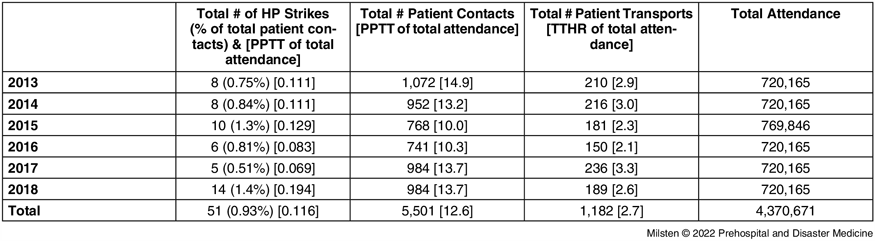
Over the six seasons, there were 51 HPS. This accounted for 0.93% of total patient contact or a patient per 10,000 (PPTT) rate of 0.116. This was compared to a 12.6 PPTT for all patient contacts. The average age of a patron with a HPS was 31 years old. There was an even split between male and female patrons with HPS. The most common location for a HPS was the head or face (75%) followed by upper extremity injuries. Laceration was most frequently diagnosed followed by contusions and pain. Approximately one-quarter of people struck by hockey pucks were transported to the hospital, with the transport to hospital rate (TTHR) being 0.027, compared to the total TTHR of 2.7 (Table 1 and Table 2). Unfortunately, the EMS agency database used did not report the missing data rate. The number of people hit by pucks who didn’t seek care is unknown, though everyone who was hit by a puck and sought care was recorded in the database.
Hockey Puck Strike Data per Season

Abbreviations: H/F, head/face; UE; upper extremity; LE, lower extremity; Unk, unknown; HPS, hockey puck strike; TTHR, transport to hospital rate.
Rate of Hockey Puck Strikes and Transports to Hospital

Abbreviations: HP, hockey puck; PPTT, patients per 10,000; TTHR, transport to hospital rate.
Discussion
Hockey puck strikes are not very common. They accounted for almost one percent of the total patient contacts with all involving BLS level of care. Baseball and hockey are sports where small, high-velocity objects fly into crowded stadiums. More baseball fans are struck with foul balls than hockey fans being struck with a puck (5.2% versus 1%), Reference Milsten, Bradley and Hill4 but when hockey fans are struck, it is generally more serious requiring transportation to a hospital 24% of the time, compared to 4%-11% for foul ball injured fans requiring transport. The PPTT for foul ball injuries was 0.20 compared to HPS PPTT of 0.116. Reference Milsten, Bradley and Hill4 Despite having an elevated transportation rate, most people with HPS returned to the game and did not want to be transported. This is listed as a refusal (instead of discharged from care), which was a function of the EMS agency’s operating procedures.
A recent case led to wide-spread safety changes at NHL games. Reference Wyshynski5 In 2002, a 13-year-old female was struck in the head by a stray puck. Sailing over the boards and glass partition, the puck bounced off another fan before striking the patient just above her nose. Although she was immediately evaluated by medical personnel on scene and was able to ambulate out of her seat and to an ambulance, the patient died of her injuries in the hospital two days later. This was not the first well-publicized event of a fan being fatally struck by a puck, with similar events happening in a game in Canada in 2000 and in the state of Washington (USA) in 1984. Reference Wong6 In 2000, a 21-year-old male was struck in the temple by a puck while watching a game. Although stunned, he was examined in a hospital and ultimately released. He later developed severe headache, slurred speech, vomiting, and eventual coma. He died approximately one week later with an epidural hemorrhage. Beyond just the tragic outcomes, severe lacerations, concussions, skull fractures, long-lasting traumatic brain injuries, dental injuries, and severe ocular injuries have all also been observed. Reference Heinzl7
In response to these events, the NHL added protective netting. At the time of the fan’s death in 2002, nets behind the goal were in existence but were not universal. In part due to this incident, the NHL has since installed safety netting in every area. Reference Yerdon8 This is now specified in the NHL rulebook which requires that “spectator netting shall be hung in the ends of the arena, of a height, type, and in a manner approved by the league.” 9 It further specifies that there must be boards 40-48 inches high with eight feet of safety glass around the ends of the rink (behind each goal) for a total of up to 12 feet in height before even reaching the netting. Notably, the sides of the rink only require five feet of safety glass and have no protective netting requirement. 9 The International Ice Hockey Federation (IIHF) has similar requirements to the NHL. 10
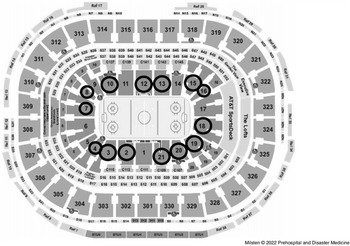
This protective netting behind the goal, which does appear to be the highest risk area for injury given that players launch their most powerful strikes towards the goal, is certainly a reassuring move in the direction of safety. However, with the lack of netting on the sides of the rink, combined with the lower safety glass requirement in that area, there remains plenty of room for pucks to fly into the crowd and cause further injuries. Which section the HPS occurred for this study was included with the summary data and was mapped in Figure 1. The HPS happened in most of the lower sections, chiefly along the sides of the rink where there is no netting and lower protective glass. In addition, there are still many thousands of lower division and amateur hockey games happening every year, not all of which can conform to the same safety requirements. Thus, even in this age of increased awareness and protective netting, spectators are at high risk of severe injury from a HPS.
Sections Where Hockey Puck Strikes Occurred.
2013: Sections 8; 13 x 2; 19; 21 x 2.
2014: Sections 3; 7; 8; 13; 18.
2015: Sections 2; 4 x 2; 8; 10 x 2; 16 x 2; 21 x 2.
2016: Sections 2; 10; 12; 19.
2017: Sections 3; 15; 19; 20.

Limitations
The primary limitation to this study was the lack of granular data. Given summary data only, there was no comparison between HPS injuries and other traumatic injuries, so even though the rate of transfers for HPS seems high when compared to foul ball injuries, it is not known how this compares to other injuries that occurred during hockey games. Furthermore, the 5,501 patient contacts would include medical issues and traumatic injuries and this study does not differentiate between the two. There are only a limited number of diagnoses options. Severity information can only be inferred from secondary data. Without specific data, severity level was determined by the percentage of transports versus refusals and that all HPS care was at the BLS level. Another limitation of the study was that it was conducted at a single site and the results may not apply to other sites. Finally, this study did not have a way to verify the validity of the database as accurate and complete, other than it was printed from the CAD data.
Conclusion
Hockey is a safe sport to watch, although HPS are the spectator hazard of concern, given that pucks can travel into the stands at 100mph. Most injuries are minor and only occur one percent of the time, but when they do occur, these fans tend to need transport to the hospital (more so than with foul ball injuries). Finally, HPS tend to occur along the lateral sides of the rink where the glass level is lower and there is no protective netting.
Conflicts of interest
The authors declare none.