Introduction
Since the 1980s, the formalization of farmers’ land rights has been the focus of international prescriptions in development policies for the global South, and particularly in Africa (Manji Reference Manji2006; Colin et al. Reference Colin, Léonard, Le Meur, Colin, Le Meur and Léonard2009). In a context of economic liberalization and criticism of the state, formalizing informal (neo)customary rights over land – that is, mapping, documenting and legalizing them – is supposed to secure these rights, reduce conflicts and allow for agricultural growth. Rural land rights formalization policies and operations in Africa have provoked many controversies with regard to their justification and timeliness (Bromley Reference Bromley2009), their economic effects (Bruce and Migot-Adholla Reference Bruce and Migot-Adholla1994; Platteau Reference Platteau1996), the recomposition of land rights and governance (Chauveau Reference Chauveau2003; Benjaminsen and Sjaastad Reference Benjaminsen and Sjaastad2008), and, lastly, the ensuing risks of exclusion (Bassett Reference Bassett, Blanc-Pamard and Cambrézy1995; Peluso and Lund Reference Peluso and Lund2011), particularly for women (Lastarria-Cornhiel Reference Lastarria-Cornhiel1997; Yngstrom Reference Yngstrom2002), pastoralists or migrants,Footnote 1 whose rights can be challenged under the argument of autochthony (Bosc et al. Reference Bosc, Chauveau, Yapi-Affou, Fian and d'Aquino1996).
Research on the social and political impacts of these operations in rural Africa highlights three main dimensions: the simplification of bundles of rights through their identification and transcription (Bassett Reference Bassett1993; d'Aquino Reference d'Aquino and Lavigne Delville1998; Musembi Reference Musembi2007); the recomposition of land-tenure regulation, with the institution of new land-tenure mechanisms – controlled either by the state or by a hybrid of local and state authorities – that replace (at least partially) the previous (neo)customary regulations (Hochet and Jacob Reference Hochet and Jacob2014);Footnote 2 and, finally, the redefinition of people's identities (Berry Reference Berry1989), with a balance between local and national citizenships (Berry Reference Berry, Sikor and Lund2010; Hochet Reference Hochet, Jul-Larsen, Laurent, Le Meur and Léonard2011), and the state gaining a local foothold (Lund Reference Lund2006).
Indeed:
by defining the levels of authority invested with responsibility for identifying rights holders, validating the assignment of rights and settling disputes, or by regulating the uses of specified areas, land-tenure policy is a powerful tool for the reorganization of rural territories and, as such, for involving the state in local governance systems. (Colin et al. Reference Colin, Léonard, Le Meur, Colin, Le Meur and Léonard2009: 24, emphasis added)Footnote 3
However, the ‘reorganization of rural territories’ through the formalization of rights is hardly addressed in the literature (Benjaminsen and Sjaastad Reference Benjaminsen and Sjaastad2008). Focusing on land rights is not the same as focusing on territories and power: ‘as territory, space is governed, but not owned by its governing agency. As property, on the other hand, space is owned, but not governed by its owners’ (Lund Reference Lund2013: 14). Little research has looked at the territorial dimensions of land rights formalization processes. Land rights formalization is based on a plot-level approach and does not necessarily create new territories, unlike other development or conservation projects that directly create new boundaries and new powers (Bassett and Gautier Reference Bassett and Gautier2014). But cultivated plots are nonetheless located in territories that are socially and politically differentiated, and the bundles of rights held by the different stakeholders vary depending on the specific plot's location. Formalization processes thus have political aspects and may also lead to ‘unexpected territorialities’ (Gautier and Hautdidier Reference Gautier, Hautdidier, Gautier and Benjaminsen2012). Territory is defined here as linked to and an outcome of the process of territoriality: that is, an ‘attempt by an individual or group to affect, influence, or control people, phenomena, and relationships by delimiting and asserting control over a geographic area’ (Sack Reference Sack1986: 19).Footnote 4 According to this definition, the related concept of territorialization refers to specific territorial projects in which various actors deploy territorial strategies (territoriality) to produce bounded and controlled spaces (territory) in order to achieve certain effects (Bassett and Gautier Reference Bassett and Gautier2014). A goal of territorialization is to govern people and resources located within and around the territory (Scott Reference Scott1998). Various types of power and customary authorities (Godelier Reference Godelier1978; Kopytoff Reference Kopytoff1987), as well as states and empires, have territorialization strategies that overlap with each other.
Drawing on the example of the plans fonciers ruraux (PFRs or rural land maps) in Benin, this articleFootnote 5 aims to discus the links between territorialization and the formalization of land rights (individual or collective). The informality of farmers’ land rights is the result of colonial and postcolonial land policies that recognized only individual ownership through a state-led process of adjudication and titling, while putting all unregistered land under state control. This informality was considered a problem in the development doctrine of the late 1980s in a context of economic liberalization and market valorization and of increasing criticism of state intervention and the abuse of power by the state in the economy and society. While international institutions pushed for privatization and supported land markets (Manji Reference Manji2006), other experts and aid agencies praised the inclusive and dynamic character of customary rights (Wily Reference Wily, Graziadei and Smith2016) and asked for legal recognition of such rights (Bruce and Migot-Adholla Reference Bruce and Migot-Adholla1994). PFRs are one of the tools created in Africa to try to allow for such a legal recognition of customary land rights (Chauveau et al. Reference Chauveau, Bosc, Pescay and Lavigne Delville1998; Gastaldi Reference Gastaldi and Lavigne Delville1998; Hounkpodote Reference Hounkpodote, Toulmin, Lavigne Delville and Traoré2002). PFRs rely on a terroir approach,Footnote 6 assuming that a village terroir is made up of contiguous plots held by individuals or families. Such a conception goes against customary, and often overlapping, land rights, as well as complex and intertwined customary and administrative territories and the diverse interpretations of what is a ‘village’.
The article starts with a conceptual framework based on the concept of the ‘territorial frame’, which allows for a systematic description of the various patterns of spatial socio-political organization – mainly customary versus state-led processes of territorialization – and their superimposition or contradictions. There follows an analysis of the implementation of PFRs in two villages of the Département des Collines in Central Benin, and an assessment of how this implementation, which is expected to survey an entire village terroir, is challenged by the socio-political organization of village territories and the possible discrepancies between customary and administrative territorial frames. In practice, surveys are never exhaustive. Only a fraction of the village terroir can be surveyed, particularly as the inhabitants of some hamlets are prohibited from registering in the PFR. PFRs therefore increase spatial inequality, since the rights of autochthons and of some migrants can be registered and can eventually gain legal recognition, while those of other groups are excluded, due to their social and tenurial standing and the status of the hamlet where they live. Implementation of the PFRs thus leads to an expansion in the range of land rights, and creates a new territory – the registered area – increasing the heterogeneity of territories and reinforcing spatial inequalities between different groups of actors.
Intertwined territories and development projects: a conceptual framework
In Central Benin, as in most places in West Africa, the term ‘village’ covers a variety of geographical and sociological areas. It does not always carry the same meaning or cover the same space according to the customary and the administrative perspective. In both cases, those in power define specific areas where they exert some control over human settlement and uses. In both cases, territories are made up of a political centre and dependent hamlets. But the ‘village’ does not constitute a homogeneous entity in either of the two rationales. To describe and understand the superimpositions and disjunctions between these two kinds of territories, we will use the concept of territorial frames; this was suggested in a study of land-tenure issues in lowland development schemes in Burkina Faso and Mali (Lavigne Delville et al. Reference Lavigne Delville, Bouju and Le Roy2000: 17–24), drawing on the notion of the land tenure frame set out in earlier studies on terroir management in Burkina Faso (Bouju Reference Bouju, Olivier de Sardan and Paquot1991; Bouju and Brandt Reference Bouju and Brandt1989). The study by Lavigne Delville et al. (Reference Lavigne Delville, Bouju and Le Roy2000) showed that some of the conflicts provoked by the lowland development schemes were linked to their specific location within territorial frames and the related competition for decision-making power.
Customary and administrative territories: intertwined frames
From the perspective of internal frontiers (Chauveau et al. Reference Chauveau, Jacob and Le Meur2004; Kopytoff Reference Kopytoff1987), the history of settlement in segmentary societies involves people migrating and settling in new places, either by being hosted by firstcomers who have already settled there, or by ritually creating a new political centreFootnote 7 and exerting control over a specific area. Such control relies on a topocentric logic (Bohannan Reference Bohannan and Biebuyck1963) structured around the centre, whose capacity for control declines with distance, and not on a geometric approach defined by borders. Newcomers are accommodated by the first settlers. They may be considered as autochthons if they arrive when space is still widely available, or settled as ‘strangers’, incorporated into the local community with a subaltern social position (Hochet Reference Hochet, Jul-Larsen, Laurent, Le Meur and Léonard2011). Such processes lead to the coproduction of political communities and territories (Chauveau et al. Reference Chauveau, Jacob and Le Meur2004) around founding areas. Settlement processes result in the creation of a set of chiefdoms comprising a central village and a series of hamlets. The central village, which is the seat of customary power, is politically autonomous, even though it maintains political and family ties with the village of origin of the founder, and frequently falls under larger political divisions. Hamlets are established in the course of settlement. Founded with the agreement of the customary authorities of the central village, they can be populated by groups coming from this central village but are often created by migrants of diverse origins. Their relationships with the central village and the chiefdom vary according to the content of the foundation pact – which is itself linked to the social status of the constituent groups and their ties to the chiefdom and to land scarcity at the time, and to subsequent developments and renegotiations. The local political communities are thus organized around the supremacy of a founding lineage – and sometimes of privileged allies – and are based on a village structure comprising a single or multiple lineages (Le Meur Reference Le Meur2006). Other social groups comprise recent or long-standing migrants settled in the central village or in hamlets that are linked to the former (and sometimes to older migrants) through a ‘tutorat’ relationship (Chauveau Reference Chauveau, Kuba and Lentz2006) that encompasses a large range of social and land arrangements (Hochet Reference Hochet, Jul-Larsen, Laurent, Le Meur and Léonard2011). Ultimately, it is the central village and the hamlets established by the chiefdom or by one of the founding lineages that define a customary political territory.
The village territory (the central village and its hamlets) is only partially delineated. Some of its boundaries, particularly the natural ones (hills or watercourses) are defined. Artificial markers are placed in certain strategic areas, but the borders are not always defined, particularly in uncultivated areas that separate villages and serve as land reserves for the future needs of villagers. Establishing migrant hamlets on the periphery of a territory is a frequent strategy for asserting control over it.
Borders can be indefinable where, at the intersection of two pioneer fronts, the terroirs overlap and neighbouring plots are cultivated by the inhabitants of different villages or hamlets. The territory is redefined further with the evolution of settlements, the extension of cropping areas, the establishment of new hamlets on the boundaries, and so on.
Over these often intertwined customary territorial frames are superimposed administrative frames linked to the state's attempts to control and organize its territory: some places are defined by the state as administrative villages while others are administrative hamlets attached to an administrative village. The administrative boundaries themselves are not always clearly delineated; in practice, the territory of an administrative village is defined by the human settlements that are attached to the administrative village centre. Similarly, the list of villages belonging to the commune defines the communal territory.
Because they have grown to the required size and seek to gain more autonomy from the administrative village on which they depend (mainly to benefit directly from infrastructure spending), many administrative hamlets (of variable customary status) are requesting that they be upgraded to administrative villages. If the population has grown sufficiently, the headquarters of a customary chiefdom, a hamlet of autochthons or a hamlet of migrants under customary trusteeship can become administratively autonomous.
Hence, administrative territories, separated by administrative divisions with a strong political component, are continuously dynamic. As well as population size, relations with the national political power were – and still are – decisive in whether an administrative hamlet can gain recognition as an administrative village. Depending on the state's political strategies with regard to local authorities, and the criteria for achieving the status of an administrative village, customary and administrative territorial frames overlap, crisscross or contradict each other. They may reflect or oppose customary spatial organization; a customary political central village may be an administrative village or a mere administrative hamlet attached to another administrative village. Each dwelling place is thus involved in a dual relation of autonomy and dependency, depending on its status in the settlement history and the administrative division.
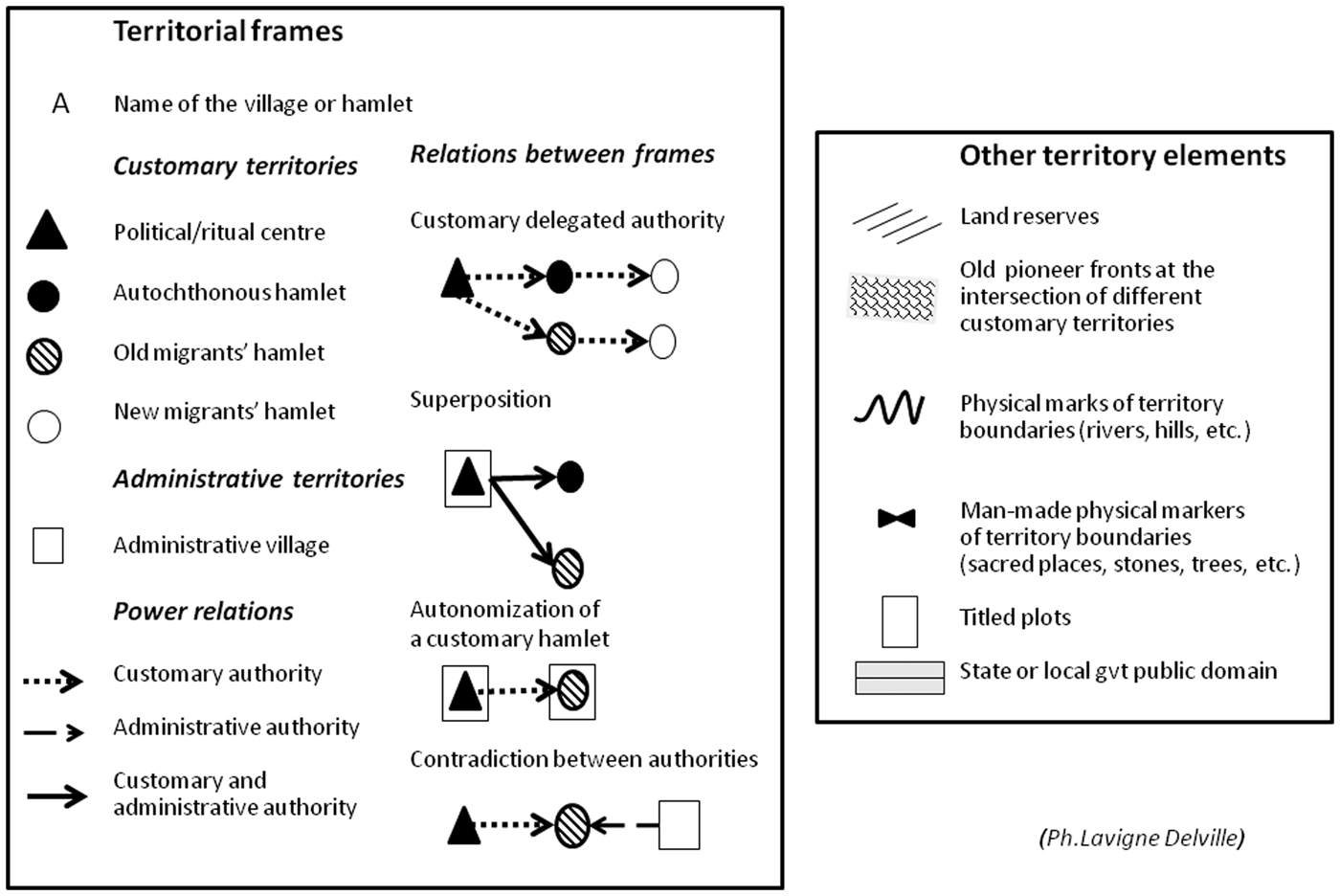
Such relations can be illustrated using a simplified representation of customary and administrative territorialities at micro-regional level (Figure 1), situating villages and hamlets, and their political status, within both systems and the relationships between them within the two territorialities. Just as a fabric is made up of intertwined yarns, the concept of the frame highlights overlapping approaches, and the superimposition and recovery of different territories and forms of political control over space. It recognizes the topocentric dimension of territories, the frequent lack of defined boundaries and the fact that territories are first defined through the ties linking the various constituent settlement areas. It allows us to characterize human settlements based on their position in these dual customary and administrative territorialities, and to identify the conjunctions and disjunctions between the two types of territories (superimposition or discrepancies between customary and administrative dependency relations). Therefore, it is possible to situate the challenges of any development intervention within this dual political configuration.Footnote 8 Making a distinction between ‘old’ and ‘new’ hamlets is clearly a simplification. It assumes that older hamlets may have stronger rights due to closer relations with autochthonous lineages, but it also relates to different waves of migration and different settlement agreements with customary authorities.
Representing territorial frames.

Development projects and unexpected territorialities
As has long been demonstrated by social anthropology, any development intervention is ‘an intervention in dynamic systems’ (Elwert and Bierschenk Reference Elwert and Bierschenk1988) and faces significant political challenges in local arenas (Olivier de Sardan Reference Olivier de Sardan2005). Furthermore, the location of infrastructure or a facility is not neutral; it has a specific place in politically and socially differentiated territories. In the case of lowland development schemes, Lavigne Delville et al. (Reference Lavigne Delville, Bouju and Le Roy2000) showed that the risk of conflict was clearly linked to territorial configurations. Local elites in a hamlet upgraded to an administrative village could attempt to negotiate a development scheme directly with the development project, without prior negotiation with the customary authority on which they depended, at the risk of starting a conflict with that authority in a strategy of political emancipation and territoriality. In the case of village-based forest management policy in Mali, Gautier and Hautdidier (Reference Gautier, Hautdidier, Gautier and Benjaminsen2012) showed how such a policy, which focused on an uncultivated area with few territorial controls or land claims, encouraged new claims and the creation of new ‘unexpected’ territories that interfered with existing customary and state territories.
These two cases call for a more systematic analysis of territorialization issues in development projects. That is what we do below, mobilizing this analytical framework to study how PFR operations interfere with existing territories and produce new territorialities.
Territorialities and conflicts in the implementation of PFRs in Central Benin
PFRs are based on the identification and mapping of farmers’ land rights, at village level, leading to a plot map and a register of rights holders. Their focus is on individual or collective land rights, not on territory or sovereignty.Footnote 9 But they also raise issues of territoriality: PFRs are supposed to cover the full village terroir and to produce a systematic map of existing customary rights. Recorded rights are then supposed to receive a land certificate and to be governed by a new ‘village land management committee’, with links to a commune-level land administration body. They are implemented at administrative village level and rely on a dubious conception of villages as autonomous entities, having their own terroir, with contiguous plots belonging to individuals or family groups. Such a conception necessarily challenges existing customary territorialities and superimposed land rights, possibly creating new, unexpected, territorialities and new sources of exclusion.
The Département des Collines: from a sanctuary to an immigration area
The Département des Collines – and, more widely the centre of Benin – is historically situated between the kingdoms of Danxomé in the south and Borgu in the north. This region was a refugee area for various social groups trying to escape the insecurity and/or political domination of these kingdoms during the enslavement raids perpetrated by the Danxomé kingdom. Because of its relative underpopulation, this region became a major immigration area in the twentieth century, with pioneer fronts moving generally towards the east and then to the north-east, where they are still active. The long settlement history of the area is eventful, with many displacements, migrations, and the founding and abandonment of villages, and it seems to be characterized by a particularly free flow of dwellings and relationships based on patronage (Anignikin Reference Anignikin2001; Le Meur Reference Le Meur2006; Reference Le Meur2012). The Département des Collines is roughly made up of two major settlement areas: Nago–Tchabé (linked to Yoruba groups) and Mahi–Idaatcha (linked to Adja–Fon groups), with more recent migrants of Fon origin or from Atacora.
Implementation of a PRF in the Dassa-Zoumé and Savalou communes: arrangements, rough jobs, conflicts and approximationsFootnote 10
Invented in Côte d'Ivoire, PFRs have been trialled in Benin since the early 1990s, in an attempt to build an alternative to individual land titles and privatization. PFRs were supposed to increase tenure security by allowing for the registration of legitimate and socially recognized rights – either individual or collective – and by avoiding conflicts due to oral informal agreements. The methodology was designed through pilot projects that took place between 1992 and 2005 (Edja and Le Meur Reference Edja, Le Meur, Colin, Le Meur and Léonard2009; Lavigne Delville Reference Lavigne Delville, Colin, Le Meur and Léonard2009). However, the issue of rights transformation through registration has not really been dealt with by project teams (Le Meur Reference Le Meur2011). A legal reform passed in 2007 allowed registered rights holders (individuals or family groups) to receive a ‘rural land certificate’ confirming the rights held on their plots (Lavigne Delville Reference Lavigne Delville2010a). Since then, PFRs have been implemented on a large scale: 300 PFRs were drawn up under a US-funded project implemented by MCA-Benin between 2007 and 2011, including twelve in Dassa-Zoumé and Savalou communes in Central Benin (Lavigne Delville Reference Lavigne Delville2014b).Footnote 11 For different reasons (an abrupt end to the project, mixed levels of interest from farmers, bureaucratic constraints, new legal changes), few certificates have been issued. Our analysis thus focuses on the mapping stage of the formalization process and not on subsequent issues related to access to and use of land certificates.
According to the methodology, a PFR is undertaken only in volunteer villages; operations are conducted by specialized teams of land surveyors and land rights specialists (sociologists, geographers, etc.); and they are carried out with the support of a local committee managing information to villagers and work organization. The plots are surveyed one after the other until the entire terroir is covered. The plot survey is conducted in the presence of rights holders and neighbours. Plot boundaries are delineated and rights holders are interviewed on the origin and content of their rights. Individual plots are registered in the name of the owner, collective plots in the name of the family group or the family head (identified as the ‘land manager’). Other rights holders (family users and people who have negotiated cultivation rightsFootnote 12) are also supposed to be recorded. Survey forms are signed by rights holders and neighbours.
However, an in-depth analysis of practices reveals a much more problematic process, with multiple issues vis-à-vis the stated willingness to produce a ‘snapshot’ of the rightsFootnote 13 and an exhaustive survey of the terroir.
Transcribing the oral and flexible rights embedded in social relations into predefined categories raises many conceptual issues (d'Aquino Reference d'Aquino and Lavigne Delville1998). Each transcription stage is potentially subject to bias and reinterpretations because of the categories selected, the cognitive frameworks and the interests of technicians, as well as local political challenges.Footnote 14 Transcription is simultaneously a translation and a partial redefinition (Le Meur Reference Le Meur2011), and the emphasis on the ‘participatory’ dimension does not mean that bias is avoided. Categorizing rights holders in terms of ‘owner/family manager’ and ‘other rights holders’ does not fit the complex overlapping rights. Moreover, who can be registered is partly the result of negotiations within local arenas. The announcement that a PFR would be drawn up in a village led to lots of discussions within family groups and at the level of the customary authorities on how to respond to the team, anticipate risks, and handle the issue of family plots, land reserves and migrants’ hamlets.
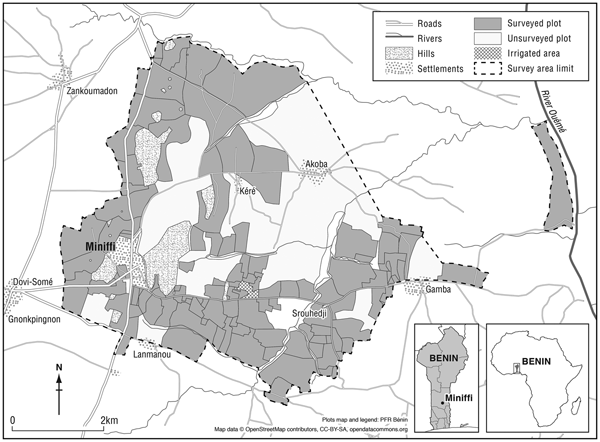
The implementation of PFRs was also hampered by frequent conflicts that blocked operations until negotiations were conducted and compromises reached.Footnote 15 Most of the conflicts involved the situation of hamlets and their inclusion in – or omission from – the PFR. Contrary to the stated ambition to survey the entire village territory, the area registered under the PFR represents only a variable part of the territory (Figure 2). Within the blocks of surveyed plots, there are still gaps, parcels or areas not yet surveyed. In-between blocks, or around them, the map leaves large spaces blank – both around the part of the territory that has been surveyed, but also within the surveyed PFR area (in light grey in Figure 2).
PFR and non-surveyed areas in Miniffi.

The official explanation given for such a partial survey is lack of time: having barely three months per village, the teams could not complete their workload, which was heavier in large villages with many small plots. Moreover, delays in the signing of contracts with service providers, practical issues (rains, people's migration), repeated absences of the beneficiaries and conflicts all prolonged the work. In fact, there was a combination of time constraints and political rejections.
PFRs thus have many gaps, and an in-depth analysis shows a dozen different causes: refusal to register one's parcel, absent owners, non-regularized purchase, areas under dispute, portions of customary territory outside the administrative boundaries, areas exploited by long-established migrants, hamlets linked to other customary territories, land reserves, and so on.
Territories, migrants, spatial inequalities and PFRs
The future of the lands situated around migrants’ hamlets crystallized most of the conflicts. The ambition to survey the entire village territory is based on a representation of the village and its territory as coherent and homogeneous. Such a representation, as seen earlier, is problematic due to the realities of agrarian and political territories, in which the governance of people and nature cannot be separated (Chauveau et al. Reference Chauveau, Jacob and Le Meur2004).
One of the issues raised in rights formalization in a customary situation is that such processes are usually based on an oversimplified conception of land rights that does not take into account the bundle of rights and the diversity of rights holders. Drawing on a conception of ownership, they assume that there is a customary ‘owner’ or ‘possessor’ of every plot, and that other people with cultivation rights are only ‘users’. As we saw in Benin, PFR methodology makes a double distinction between ‘collectively held plots’ and ‘individually owned plots’ on the one hand, and ‘delegated rights holders’ on the other. This distinction acknowledges the existence of family land heritage, but cannot explain the reality of superimposed rightsFootnote 16 that are not limited to two levels of rights, one of which (the user's) cannot claim ownership. It is also problematic in the sense that the category of ‘delegated rights’ encompasses very different situations: a young household head cultivating part of an extended family holding, a neighbour renting a plot, and a son of a migrant cultivating a plot granted to his father with a permanent transferable right are not in the same situation.
Such a conception raises issues about who is registered and the subsequent redefinition of other rights holders, even within autochthonous families. What about younger children's and women's rights? What about heads of households who enjoy permanent and transferable rights of usage on a joint family property? The stakes are even higher when it comes to migrants: registering a parcel poses the problem of who can be recognized as the principal beneficiary among the descendants of those who granted the farming rights to the newcomer, or among the descendants of those who benefited from those rights. In customary logics, the permanent and transferable user rights held by migrants or their descendants coexist with the rights of the tuteurs on the land they have historically granted. Over time, migrants and their descendants consolidate their rights with no restrictions other than a symbolic recognition of the lineage that historically settled them. Conversely, autochthonous lineage control over granted land continues but becomes practically symbolic: the plot cannot be taken back.
The obligation to state in whose name the plots are registered prevents the continuation of a situation of superimposed rights. For the autochthonous lineages, letting migrants have their land rights registered in PFRs would mean accepting that they definitively forfeit control over the land they have hitherto granted; in some cases they no longer have any power over this land, but it formally remains ‘theirs’. Will these autochthonous lineages seize the opportunity of the PFR to reassert their rights to such lands and become the legal owners, even if it means undermining the rights of migrants, and reducing them to mere users of the lands of another person? Are the latter ready to accept such a redefinition of their rights? The issue does not really concern recent migrants, whose status as farmers on the lands granted them by autochthons is not questionable; rather, it affects older migrants who have consolidated their rights of usage, transferred them, and may even have settled other migrants.
The issue of the future of the rights of migrants, both old and recent, in PFR operations is even more significant where the migrants have established hamlets, with relative autonomy in daily land management. The stakes are not related to land-tenure issues only (i.e. linked to the property rights of individuals and families). They are also political and territorial, both because the registration of migrants in the PFR implies recognition of their full rights to the land which, theoretically, is the monopoly of ‘autochthons’, and because the political control of hamlets determines the control of the surrounding territory. Allowing migrants’ rights to land to be registered would mean accepting a loss of this control.
PFRs thus engage territorialities. They can be an opportunity for autochthonous lineages to maintain or reinforce their political power over the territory and its margins: when migrant hamlets are under the control of the same customary and administrative village, they have little say. But in the case of two different and contradictory territorial controls, migrants can try to negotiate administrative support in opposition to customary authorities and claim registration. Thus PFR represents an opportunity to challenge existing power relations and redraw territorialities.
These issues are even more serious when the ‘village’ benefiting from the PFR is a customary hamlet upgraded to an administrative village. It was seen earlier that such an administrative village can have a terroir in the sense of an area exploited by its inhabitants, but has only limited autonomy over land tenure, with no territory from a customary perspective. Administrative villages are the operating unit for PFRs, but their political and land-tenure status and that of their constituent hamlets are very varied. This allows space for contingent and possibly diverse responses between ‘villages’ and within the same ‘village’, responses stemming from negotiations and power struggles.
PFRs as mirror and producer of territories: two case studies
We will discuss these issues through two case studies on the reorganization of rural territories following PFR operations. The localities selected for the study are Miniffi and Assiyo, in the Dassa commune. They represent two different configurations: as a powerful customary central village, but also an administrative village, Miniffi has experienced several overlapping administrative territorialities on its customary territory. Conversely, Assiyo, which is a former migrants’ hamlet upgraded to an administrative village, has an administrative territory built on parts of several customary territories. Both villages have witnessed tensions or conflicts during PFR operations; these have involved the use of weapons and the theft of PFR teams’ equipment. We will see that the conflicts occur where territorialities are in conflict and that the areas surveyed under the PFR process partly reflect the spatial heterogeneity of the territory. It will also be seen that implementation of the PFR and the ensuing trade-offs contribute to a redrawing of the territories, introduce new land-tenure distinctions and new territories, and produce new spatial inequalities.
Miniffi: a customary central village and administrative village
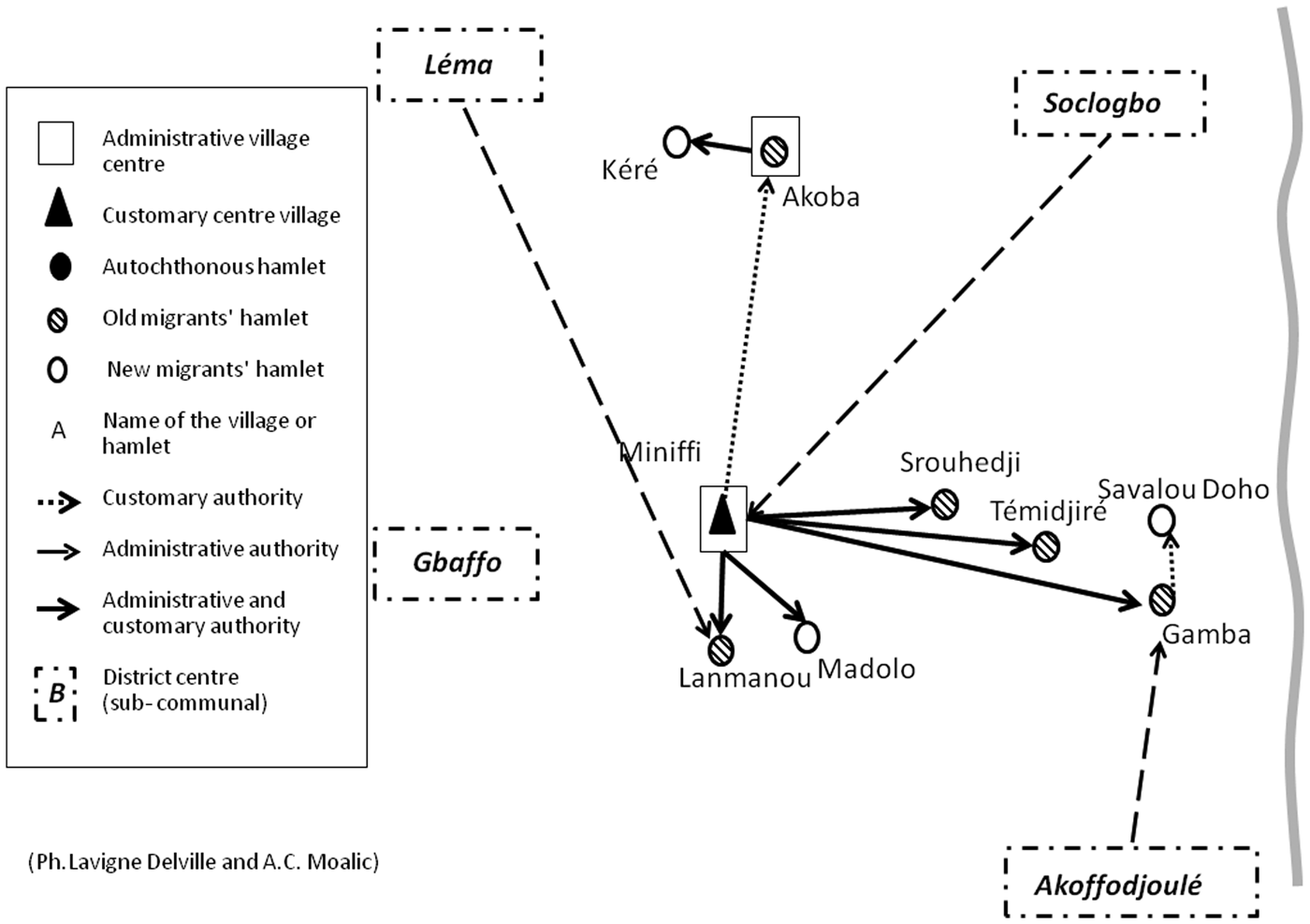
Miniffi is an ancient Mahi chiefdom in the Dassa-Zoumé region, comprising four major autochthonous lineages. It is also an administrative village attached to the Soclogbo subdivision. It comprises a dozen hamlets under customary trusteeship, with different statuses (Figure 3). Situated in the north, Akoba, an Idaatcha hamlet, was upgraded to an administrative village in 2010. The customary authorities of Miniffi approved the upgrade so that Akoba could benefit from infrastructure projects, on condition that the land-tenure prerogatives were respected. The authorities of Akoba, however, complain that the people of Miniffi come to farm on lands belonging to Akoba, behind the hill that, according to them, delineates the lands controlled by Miniffi inhabitants.
Territories in Miniffi in 2010.

One of the hamlets, Lanmanou, customarily installed by Miniffi south of its territory, was founded by Idaatcha from neighbouring regions. Although administratively integrated into the village (particularly in terms of access to collective equipment), in 1991 it was electorally attached to the village of origin of the founding lineages, Léma, which is also the headquarters of the subdivision bearing the same name and is located about fifty kilometres away from Lanmanou. This prefectural decision was taken in response to a dispute between the contiguous communes (upgraded to subdivisions) of Gbaffo and Soclogbo, given that Lanmanou is situated on the border between these two subdivisions. Gamba, a hamlet of Idaatcha migrants who came from Léma, also established on the customary territory of Miniffi, was counted under the polling station of the Idaatcha village of Banigbé, only about a dozen kilometres from Gamba and attached to the Akoffodjoulé subdivision. These hamlets are thus electoral pockets of other subdivisions, included in the administrative territories of Miniffi and Soclogbo subdivision.
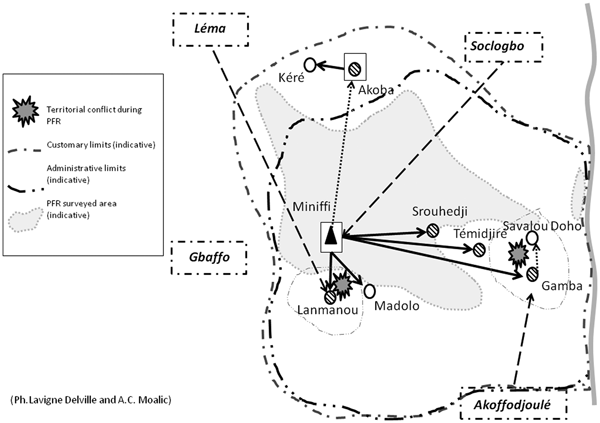
The hamlet of Gamba had itself established a hamlet of Fon migrants on its territory: Savalou Doho. During PFR operations, the authorities of Miniffi offered to the inhabitants of Savalou Doho registration of their lands in their own names. Savalou Doho accepted this gift from Miniffi, which confirmed the hamlet's attachment to Miniffi customarily and administratively. The lineages of Gamba saw this as an attempt by Miniffi to try to recover part of the lands they had granted them, and as a strategy to weaken the electoral – and hence political – strength of their hamlet. They blocked all land-tenure operations in Savalou Doho by stealing the land surveyors’ equipment and by provoking clashes that left a few people injured. Gamba inhabitants tried to garner political support and form an alliance of Idaatcha hamlets established on the customary territory of Miniffi – including Lanmanou, Madolo, Srouhedji and Témidjiré – in order to put pressure on the PFR and thus have more weight in the balance of power with Miniffi. As a result of the conflicts, approximately ten inhabitants of Savalou Doho left the hamlet and the lands exploited by the Idaatcha hamlets between Gamba and Lanmanou were not surveyed.
Part of the land surrounding the hamlet of Srouhedji was included in the PFR, with parcels registered in the name of Miniffi autochthons, thus creating a new distinction between the autochthons whose lands were surveyed and the others, between hamlets included in the PFR and over which autochthon control was reinforced and those that refused to register or were denied registration. The same scenario occurred even within these hamlets, between the majority of inhabitants and the rare individuals who succeeded in registering the lands they control in their name.Footnote 17 The area registered under the PFR therefore comprises the customary territory of Miniffi minus the lands exploited by inhabitants of Akoba, who are not part of its administrative territory, and minus the neighbouring lands of the Gamba and Lanmanou hamlets and part of Srouhedji (Figure 4).
Territories, conflicts and areas surveyed under PFR in Miniffi.

The tensions between migrants and autochthons on the subject of land control ignited by the PFR were politicized in the electoral competition between Mahi and Idaatcha at subdivisional level.Footnote 18 As political affiliations often follow ethnic ties, the ethnic composition of electoral units may influence the political balance of elected bodies. In Benin, commune councils are made up of representatives from arrondissements (sub-commune level). Changes in the composition of the arrondissement may thus change the power balance at this level, and eventually at commune level, leading to frequent renegotiations in administrative contexts and gerrymandering. The contradiction between the administrative and electoral ties of Miniffi's hamlets is a result of such issues. The conflicts linked to the PFR allowed the hamlets of Srouhedji, Lanmanou and Gamba to contest their administrative dependence on Miniffi. Thanks to the support of an Idaatcha politician, there were upgraded to administrative villages in 2015. The Idaatcha hamlets became politically autonomous within the customary territory of Miniffi, and the administrative territory of the village was reduced greatly. The political tension between the village of Mahi and the Idaatcha hamlets had been ongoing prior to the drawing of the PFR, as testified by the specific position of Gamba and Lanmanou in the electoral constituency. However, this recomposition was clearly triggered by the conflicts around the PFR.
Assiyo: a land-tenure hamlet upgraded to an administrative village
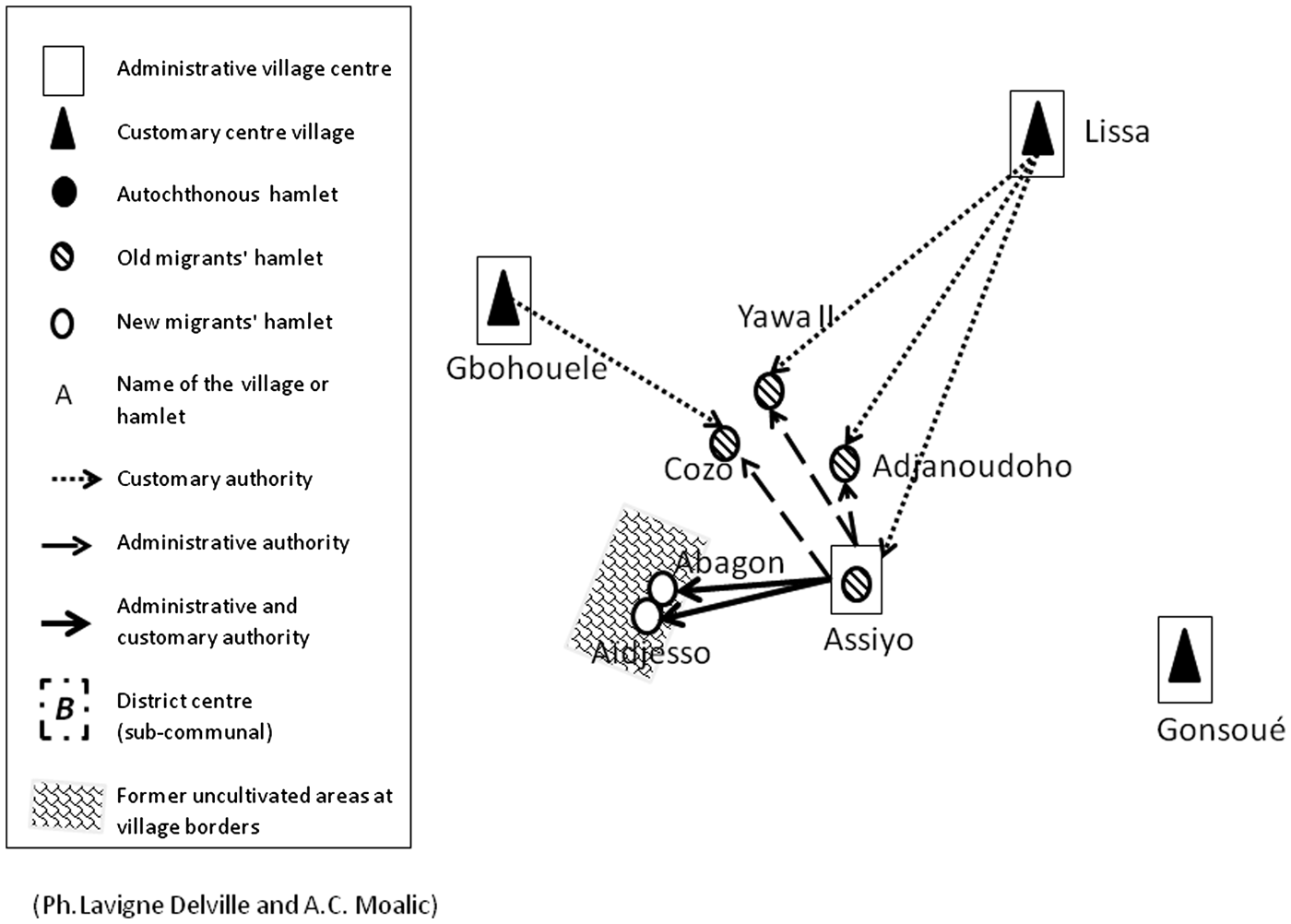
In the early twentieth century, Assiyo was established by an Idaatcha family group whose rights to clear and cultivate land had been granted by the Mahi customary authority of Lissa. Assiyo developed with the arrival of other family and migrant groups. Some Idaatcha lineages who had arrived earlier welcomed later Fon migrants, who created the small settlement groups of Aïdjesso and Abagon at the edge of the cleared areas of Assiyo and Gbohouele. In 1984, Assiyo became an administrative village. Its administrative territory included the hamlets under the customary supervision of Gbohouele (the hamlet of Cozo) and Lissa (the hamlets of Adjanoudoho and Yawa II) and encroached on the customary territories of the chiefdoms of Gbohouele and Lissa (and, to a lesser extent, Gonsoué, through the lands of a lineage that hailed from Lissa and had settled in the village) (Figure 5).
Territories in Assiyo.

Assiyo is thus a customary hamlet upgraded to an administrative village. As such, despite the creation of a land chief when it obtained its autonomy, it has a terroir with cultivation rights but no customary territorial control over its lands; it remains dependent on Lissa for land matters.
The customary and administrative authorities of Lissa and Gonsoué initially refused to allow the PFR process to be carried out in Assiyo, arguing that it was just a hamlet of migrants. After much negotiation between these villages, they agreed as follows:
• Assiyo could carry out the PFR, but only families resident in the central village of Assiyo could register farmed lands in their names.
• Two plots representing a surface area of 300 hectares were registered in the name of the chief of the Lissa administrative village, who is a member of one of the autochthon lineages of Lissa.
• Prior to the PFR, a family group from Gonsoué had sold 110 hectares of apparently uncultivated land situated in the administrative territory of Assiyo, unbeknownst to Assiyo's leadership. Challenged by the village chief, who had not signed the sales agreement, the sale was under dispute before the Dassa-Zoumé council. In exchange for its customary trustees agreeing to the PFR, Assiyo dropped the legal proceedings concerning the sale. The descendants of the founding lineage of Gonsoué also succeeded in registering in their name the lands under their control in the territory of Assiyo that they had sold.
In addition to these arrangements, the autochthonous lineages of Lissa and Gonsoué exerted pressure on the chief of Assiyo village to prevent the hamlets of Adjanoudoho and Yawa II, established by Lissa and situated within the administrative territory of Assiyo, from registering their lands. These lineages had sold lands in this area, and had ongoing sales negotiations within the territories of these hamlets. They were aware that if the families of these hamlets could register in the PFR and obtain a rural land certificate, they would lose control over these lands and the possibility of selling them. The agreement remained tacit and, at the level of the hamlets, the administrative authorities of Assiyo and Lissa explained that the lands were not registered due to lack of time.
Some migrants settled in Abagon and Aïdjesso, Fon hamlets established by Assiyo about fifty years ago, succeeded in registering in their name the lands they were exploiting on the boundaries overlapping with Gbohouele, either by negotiating with their ownersFootnote 19 or with a view to securing Assiyo control over these lands. The settlement areas of these two hamlets are situated in the administrative territory of Assiyo, but some of the lands exploited by their inhabitants had been given by lineages of Gbohouele. These farms, which are close to Abagon, are administratively attached to Assiyo. During PFR operations, some people linked to Gbohouele called for an end to the survey of land parcels in the area concerned.
The customary authorities of Lissa could not prevent implementation of PFR operations in Assiyo, which is an administrative village. Similarly, they could not claim that their historical lands should be registered in their name or prevent families residing in central Assiyo from registering the lands they were exploiting. However, they imposed conditions on their agreement: a ban on registering lands in the hamlets established by Lissa, and the registration of some plots in the name of the chief of Lissa village.Footnote 20
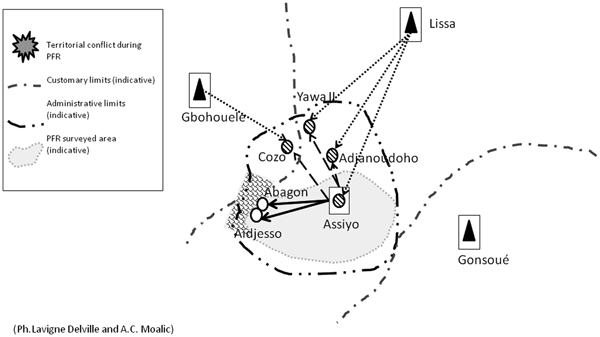
Following PFR operations, some migrants in Aïdjesso, whose cultivated lands were registered under the PFR by their Assiyo trustees, were denied access to the land as a result of those trustees selling the land without prior notice to the farmers. The territorial inequality caused by the exclusion of the hamlets of Yawa II, Adjanoudoho and Cozo from the surveys was compounded by inequalities between those who managed to negotiate registration in their name (in Abagon and Aïdjesso), those who could not register, and those whose lands were registered in the name of their former owner. As a result, Assiyo inhabitants gained full control over the land they cultivate and Assiyo now has its own cultivated territory, comprising the plots that have been recorded in its PFR (Figure 6). However, this territory is limited to the lands situated around the village and does not cover its administrative territory.
Territories and PFR in Assiyo.

Conclusion
The territoriality strategies engaged around PFRs in Central Benin reveal social and political challenges. Struggles to be registered (or to forbid others from being registered) are shaped by territorialities and contribute to the shaping of territories, reorganizing existing ones and creating new ones.
As an area that was previously a refuge from enslavement raids, that was resettled after the end of the slave trade, and that became a site of emigration and later of immigration, the Département des Collines is typical of territorial configurations based on intricate political affiliations and dependency relations in land tenure. For centuries, the territorial construction in Central Benin – and particularly in the Département des Collines – resulted from the mobility of social groups and successive settlements framing composite customary territories with unclear or negotiated borders. State territorialities and local political negotiations lead to evolving administrative divisions that confirm, reconstitute or seek to dislocate these customary territories. Customary and state territorialization strategies follow different logics and interact with each other, sometimes reinforcing and sometimes contradicting each other.
With the aim of registering customary land rights, PFR operations rely on a simplistic design based on: (1) a topographical and legal representation of land tenure – an individual or collective landowner, and family farmers or delegated rights holders; and (2) a representation of the village as a homogeneous entity, made up of juxtaposed farm holdings, and covering a terroir composed of the lands exploited by its inhabitants. Such a design is challenged by concrete land and territorial configurations, made up of blurred boundaries, micro-regional power networks between villages and hamlets, the crossing of territorial and ethnic/family ties, superimposed rights, tutorat relations, hamlets with varying land autonomy and disjunctions between territorial and customary frames. Registering rights to land means defining, in these multiple chains, who can claim (individual or collective) ‘ownership’ at the risk of undermining the rights of other people. This issue is particularly significant for migrants, especially long-established ones, who have consolidated permanent and transferable rights, but not full and complete ownership rights. Depending on the power balance, PFRs may allow these rights to be fully recognized by the state, or they may allow autochthonous lineages to reaffirm control over lands where they no longer exercise power, thus weakening migrants’ rights.
But struggles over PFRs are not only an issue of property rights. They also engage territorialities, contradictory strategies to control a geographical area. Territories are heterogeneous, and the specific location of one plot is not neutral vis-à-vis the rights at stake and the political issues of land rights formalization. In the case of hamlets, the registration issues surrounding land rights are compounded by political challenges and territorial issues: reasserting customary control over territorial margins, checking the hamlets’ attempts at gaining political autonomy. PFRs encourage contradictory territorialities; they lead to struggles and negotiations over the parts of territories that can be surveyed and in whose name this can be done.
During PFR operations, the possibility for hamlets to have their lands registered has led to discussions and negotiations. Conflicts have broken out, delaying or blocking the operations. These renegotiations have had various outcomes, but have generally led to a strengthening of the dichotomy between autochthons and migrants. Families in autochthon hamlets have had no difficulties in being registered. The lands exploited by households in recent migrant hamlets have been registered in the name of the autochthonous lineages that settled them there, with sometimes a renegotiation of the rules (for instance, strict acceptance of a ban on tree planting, which was hitherto unclear). Exceptionally, migrants whose situation has been consolidated, who have planted trees a long time ago and/or who have strong political ties have succeeded in being recognized as landholders and have registered in their name the lands they were cultivating at the time of the investigations. Savalou Doho, a recent migrant hamlet where inhabitants have been offered registration, is a very specific case: that offer, in fact, contributed to autochthonous lineages’ strategies of territorial control over marginal land with uncertain status.
In numerous cases, land around migrants’ hamlets has been registered in the name of autochthonous lineages much more easily, as they concern parcels of fallow land that were not being cultivated at the time of the PFR operations. PFRs thus allowed such lineages to regain rights that had been diluted over time. Where the situation of the migrants was sufficiently consolidated to prevent the survey allocating rights to autochthons, the parcels have not been registered in anybody's name, leading to blank spaces on the maps.
The PFR process thus encourages a partial renegotiation of land rights, generally to the benefit of autochthonous lineages. The balance of power between migrants and autochthons, between customary hamlets and the central village, depends on migrants’ location within customary and administrative territories.
Territorialities and disjunctions between administrative and customary territories contribute to shaping the impacts of PFRs. They explain why violent conflicts arise in specific locations, and why parts of the village (administrative) territory surrounding these locations could not be registered. Conversely, PFRs open up a space for territorialization strategies and contribute to the reorganization of territories when migrants succeed in using these disjunctions to strengthen their political and tenurial autonomy. In Miniffi, the struggle led to the establishment of migrants’ hamlets as administrative villages, strongly reducing Miniffi's administrative territory and challenging customary control on these new territories. In the Assiyo example of an administrative village that was formerly a customary hamlet, PFR resulted in the creation of a village territory.Footnote 21
As PFRs are unable to cover the full village territory, they also create a new and unexpected territory: the ‘PFR registered territory’, or the area that has been surveyed. Having one's plot registered in one's name on the PFR (and later being able – or not being able – to obtain a land certificateFootnote 22) is a new source of division in the landscape that cuts across the autochthon–migrant divide. This new territory is the result of the competing territorializing strategies opened up by PFR operations, which result in new categories of migrants in terms of land rights: those whose land has been registered in their own name, those whose land has not been registered, and those whose land has been registered in the name of autochthonous lineages. These new categories increase social differentiation and identity on a territorialized basis. And within the category of registered people, being able or unable to obtain a land certificate creates a new source of differentiation.
PFRs are based on recognizing legitimate existing rights, while favouring autochthon conceptions in practice, and on considering the administrative village as the unit of intervention, rather than addressing the issue of spatial inequalities and their challenges. They ultimately fall in line with the state's long-term attempt to strengthen its local foothold and redefine local power and territorial authorities around administrative villages. However, as with other state reforms (Bierschenk Reference Bierschenk, Bierschenk and Olivier de Sardan2014), they cannot achieve their ambition. They thus contribute to fragmenting the territories and creating new spatial inequalities in terms of access to rights.
A few years after the PFR operations, rural land certificates have been suppressed by the 2013 Land Code and only individual titles are now possible. Village land management committees are dormant. Thus farmers’ access to legal documents will remain an exception and registered rights will continue to be semi-formal, written in maps and books, but probably not updated (Lavigne Delville Reference Lavigne Delville2014b). Whether – and to what extent – these new territories and land rights produced by the PFRs will have concrete and lasting impacts on land relations between autochthons and migrants remains to be seen.
Acknowledgements
Fieldwork for this research was partly funded by the French National Agency for Research (ANR), within the research project ‘Une action publique éclatée’. The authors would like to thank Thomas Bassett, Denis Gautier, Baptiste Hautdidier and the anonymous reviewers for their comments on previous versions of this article.