Introduction
Aleiodes Wesmael (Hymenoptera: Braconidae: Rogadinae) is the most common and species rich rogadine genus worldwide. There are 212 species described to the New World, of which 143 occur in the Nearctic and 89 in the Neotropical Region (Yu et al. Reference Yu, van Achterberg and Horstmann2012; Shimbori and Shaw Reference Shimbori and Shaw2014). The larger number of species in Nearctic Region is most likely due to more research effort in this region, rather than any biological process (Quicke Reference Quicke2012). Previous research is exemplified by the revisionary series of Aleiodes species groups (Shaw et al. Reference Shaw, Marsh and Fortier1997, Reference Shaw, Marsh and Fortier1998a, Reference Shaw, Marsh and Fortier1998b, Reference Shaw, Marsh and Fortier2006, Reference Shaw, Marsh and Talluto2013; Marsh and Shaw Reference Marsh and Shaw1998, Reference Marsh and Shaw1999, Reference Marsh and Shaw2001, Reference Marsh and Shaw2003; Fortier Reference Fortier2009).
Shaw et al. (Reference Shaw, Marsh and Fortier1997) divided Aleiodes into 15 species-groups, with three additional groups being proposed after additional phylogenetic analyses (Fortier and Shaw Reference Fortier and Shaw1999). However, species of the A. gastritor (Thunberg) and A. circumscriptus (Nees) species-groups from the Neotropical Region are difficult to separate, and have sometimes been treated as a single group (Townsend and Shaw Reference Townsend and Shaw2009). Of the 17 species-groups, six are not previously recorded from the Neotropical Region, including the A. compressor (Herrich-Schaeffer) group (Marsh and Shaw Reference Marsh and Shaw2003). This paper presents two new species and the first records of species of A. compressor species-group from New World.
The A. compressor species-group is a small assemblage, with only four species described. Some are known to attack concealed or semi-concealed hosts that are leaf-folders (Shaw Reference Shaw1994). The only recorded Asian species, Aleiodes aligharensi (Quadri), attacks several pest caterpillars on cotton bolls. That species, and Aleiodes compressor, are the only two in this group known from the Old World. Nevertheless, they are relatively frequently collected, especially by rearing, from a number of different hosts (e.g., Patel and Patel Reference Patel and Patel1981; Shaw Reference Shaw1983). The other two previously named species are from North America. Aleiodes palmatus (Walley) is known to attack two noctuid (Lepidoptera: Noctuidae) caterpillars on trembling aspen – Populus tremuloides Michaux (Salicaceae) in Canada (Wong and Melvin Reference Wong and Melvin1976; Shaw Reference Shaw2006), while Aleiodes palmatoides Marsh and Shaw is known only from trap-collections. Parasitising concealed hosts is a basal trait within Rogadinae, unusual within Aleiodes. Most species of this genus parasitise caterpillars that are external feeders (Zaldívar-Riverón et al. Reference Zaldívar–Riverón, Shaw, Sáez, Mori, Belokoblylskij and Shaw2008).
Methods
Type specimens of the newly described species are deposited at the Departamento de Ecologia e Biologia Evolutiva, Universidade Federal de São Carlos, São Carlos, SP, Brazil (DCBU). Type specimens of North American species are deposited at National Museum of Natural History, Smithsonian Institution, Washington, District of Columbia, United States of America (USNM), University of Wyoming Insect Museum, University of Wyoming, Laramie, Wyoming, United States of America (UWIM), Canadian National Collection, Ottawa, Ontario, Canada (CNC), and North Carolina Department of Agriculture, Raleigh, North Carolina, United States of America. The non-type material of Aleiodes palmatus examined was previously compared with the holotype. Specimens of the Old World species Aleiodes aligharensi and Aleiodes compressor, deposited at UWIM collection, were also compared with type specimens and examined for discussion of the definition of the A. compressor species group.
For recognition of the subfamily Rogadinae see van Achterberg (Reference van Achtergberg1993) and Sharkey (Reference Sharkey1997). The definition of Aleiodes follows that of van Achterberg (Reference van Achterberg1991) and Shaw (Reference Shaw1993). Species-group definitions follow Shaw et al. (Reference Shaw, Marsh and Fortier1997), Fortier and Shaw (Reference Fortier and Shaw1999), and Townsend and Shaw (Reference Townsend and Shaw2009). Terminology follows Sharkey and Wharton (Reference Sharkey and Wharton1997) and Shaw et al. (Reference Shaw, Marsh and Fortier1997). Microsculpture terminology follows that of Harris (Reference Harris1979). Wing vein terminology follows the system adopted by Sharkey and Wharton (Reference Sharkey and Wharton1997).
Images were captured with a 3 MP Leica video camera and a Leica M205C stereomicroscope running Leica Application Suite (LAS) software (Leica Microsystems GmbH, Wetzlar, Hesse, Germany), and focus-stacked using the same software. Some minor adjustments in images and plate preparation were performed in Adobe Photoshop version CS6 (Adobe Systems Inc., San Jose, California, United States of America).
Aleiodes compressor (Herrich-Shaeffer) species group
Included species. Aleiodes compressor (Herrich-Schaeffer) (Europe); A. aligharensi (Quadri) (India, Spain, Chad); A. palmatus (Walley) (North America – Canada and United States of America); A. palmatoides Marsh and Shaw (United States of America – Virginia and North Carolina); A. marinonii new species (Brazil); A. mantiqueirensis new species (Brazil).
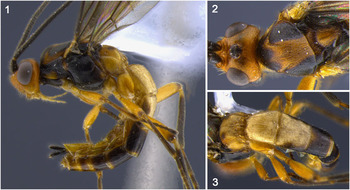
Aleiodes mantiqueirensis new species. 1. habitus; 2. head and mesoscutum, dorsal; 3. metasoma, dorsal.

Diagnosis. Antenna relatively short and stout (Figs. 4, 7), with 29–35 antennomeres, most flagellomeres only slightly longer than wide, antenna always shorter than fore wing, body about 1.5 times the antenna, except in A. aligharensi; vein RS of hind wing sinuate, marginal cell narrowest at middle; T1 more or less parallel sided, apical/basal width proportion ranges from about 1.1–1.4; metasoma not receded posteriorly, T4–T7 always visible (Figs. 6, 9, 10); female apical segments of metasoma sometimes compressed laterally (Fig. 10); ovipositor sheaths relatively long and thick, with characteristic shape – enlarged subapically and rounded at tip (Fig. 10); tarsal claws not pectinate, or pectinate only basally.

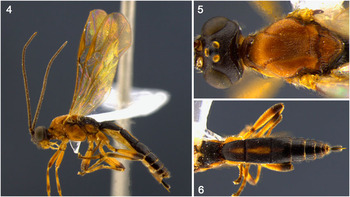
Aleidoes marinonii new species. 4. habitus; 5. head and mesoscutum, dorsal; 6. metasoma, dorsal.

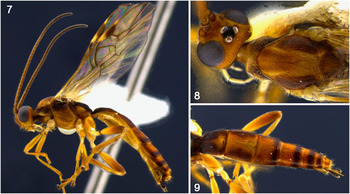
Aleiodes palmatoides Marsh and Shaw. 7. habitus; 8. head and mesoscutum, dorsal; 9. metasoma, dorsal.

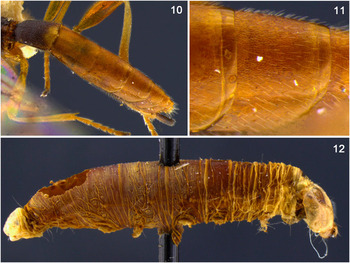
Aleiodes palmatus (Walley). 10. metasoma, dorsal; 11. metasomal tergum 4; 12. host mummy Enargia decolor (Walker) after parasitoid emergence.

Aleiodes mantiqueirensis Shimbori, Shaw, and Penteado-Dias, new species
Material examined. Holotype (DCBU)—♀, top label: “Bom Repouso, MG, Brasil/S 22°27'01,8" W 46°13'36,7"/Armadilha Malaise I/02.IX.2009/I.F. Melo e eq. col.” Paratype (DCBU)—1 ♀, Bom Repouso, Minas Gerais, Brazil, Serra dos Garcias, Armadilha Malaise, 22°29'25.6''S, 46°11'25.8''W, 17.X.2009, I.F. Melo and team.
Diagnosis. Very small ocelli, ocell-ocular distance at least two times longer than diameter of lateral ocellus; occipital carina complete but weak dorsally; metasoma only slightly laterally compressed from apical T3; head colour mostly orangish yellow with dark brown stemmaticum, colour of metasoma mostly black with T1 and mostly T2 contrasting pale yellow.
Description. Female. Body length: 5.3–5.8 mm; fore wing length: 3.8–4.7 mm; antenna length 3.3–3.4 mm. Body length 1.6–1.7× longer than antenna.
Colour (Fig. 1). Antenna black; head orangish yellow, stemmaticum and tips of mandibles dark brown; pronotum black dorsally and yellow to mostly black ventrally with yellow spot ventrally; propleuron black, mesoscutum orangish yellow with lateral lobes and mid lobe anteriorly black, mesonotum black, scutellum yellow, mesopleurom mostly black, propodeum and metapleuron pale yellow, propodeum with a pair of dark spots mid-laterally; ovipositor sheaths black; T1 and T2 pale yellow, one specimen with lateral brown marking on T2, remainder terga brown lightening apically to honey brown at the apex and with small to large honey yellow spots medially; wings weakly infuscate with dark brown veins and stigma, fore wing costal vein black; all legs with coxa, trochanter, trochantellus, and most of femur honey yellow, femur with dorsoapical dark brown mark, tibia and tarsi dark brown, hind legs darker compared with front legs; hind tibia and basitarsus with lighter basal band.
Head. Antenna with 29 antennomeres, flagellomeres only slightly longer than wide; malar space moderate, length 1.25× basal width of mandible, and about 0.5× eye height; in dorsal view eye height about 2× temples (Fig. 2); occipital carina complete but slightly weaker at vertex, ventrally touching hypostomal carina; oral space small and circular, maximum width slightly smaller than basal width of mandible; clypeus weakly swollen; ocell–ocular distance 2.0–2.3× diameter of lateral ocellus; maxillary palp not swollen. Frons weakly excavated, with short lateral ridges. Head surface finely granular, occiput smooth and shiny; mandibles tips touching when closed.
Mesosoma. Sculpturing mostly granular; pronotum granular, rugose medially; mesopleuron rugose anterodorsally, with some weak rugosity medially; notauli shallowly scrobiculate anteriorly, meeting posteriorly in a depressed longitudinally striated area; posterior margin of mesoscutum bordered by complete carina; propodeum coarsely granulate, mid-longitudinal carina complete, but irregular posteriorly.
Legs. Tarsal claw basally pectinate; hind basitarsus 3.0× length of inner apical spur of hind tibia; hind coxa finely granulate dorsally.
Wings. Forewing: vein r 0.8–1.0× vein 2RS, 1.0–1.2× vein RS+Mb, and about 0.7× as long as vein m-cu; vein 3RSa 0.44× vein 3RSb, and 0.9× vein 2M; vein 1CUa as long as vein 1cu-a; vein 1CUb about 2.4–3.0× vein 1CUa; vein 1M virtually straight. Hind wing: m-cu indicated as short nebulose vein antefurcal to vein r-m; vein M+CU about 1.2× vein 1M; vein 1M 1.7–1.9× vein r-m; vein RS sinuate, marginal cell narrowest at middle.
Metasoma (Fig. 3). First tergum costate, apical width only slightly greater than basal width, median carina complete; second tergum costate, apical width slightly smaller than basal width, median carina complete; third tergum costate on basal 1/2, smooth on apical 1/2, median carina absent; reminder terga smooth; ovipositor sheaths about 0.7–0.8× length of hind basitarsus.
Male. Unknown.
Etymology. The species is named after the Mantiqueira Mountain range (Serra da Mantiqueira, Minas Gerais, Brazil) where the material was collected.
Distribution. Brazil: Minas Gerais State, Bom Repouso municipality; Atlantic rainforest vegetation in the Mantiqueira Mountain range.
Comments. This species is similar to A. palmatoides in the darker colour of lateral mesoscutal lobes, the smooth and tapering metasomal terga 4–7, and the weakly laterally compressed metasomal apex. The occipital carina in Aleiodes mantiqueirensis is complete, as in A. marinonii, but slightly weaker at the vertex. In Aleiodes mantiqueirensis the propodeum, and first and second terga are pale yellow, contrasting with brown in A. palmatoides and dark-brown in A. marinonii. The antenna, propleuron, hind tibia, and costal vein on fore wing are black in A. mantiqueirensis, as compared with brown in A. palmatoides and dark-brown in A. marinonii. The eyes and ocelli in A. mantiqueirensis are distinctly smaller than any other New World species in A. compressor group.
Aleiodes marinonii Shimbori, Shaw, and Penteado-Dias, new species (Figs. 4–6)
Material examined. Holotype (UFPR) – ♀, top label: “Fênix, PR, Brasil/Res. Est. ITCF/Arm. Luminosa/2.X.1996/Projeto PROFAUPAR”. Paratypes – 2♀ (DCBU, UFPR), same data as holotype, one ♀ different date: 5.x.1996.
Diagnosis. Ocell-ocular distance about as long as diameter of lateral ocellus; occipital carina complete; metasomal apex tapering from T3, not laterally compressed; head colour mostly dark brown with pale yellow gena, colour of metasomal terga dark brown with a brown mid-longitudinal spot on T1–T2.
Description. Female. Body length: 5.0–5.7 mm; fore wing length: 3.7–4.1 mm; antenna length: 3.3–3.8 mm. Body length 1.5× longer than antenna.
Colour (Fig. 4). Antenna dark brown; head dark brown with gena, mandibles and palpi pale yellow; mesosoma mostly honey brown, metanotum and propodeum dark brown; metasomal terga mostly dark brown to black with mid-longitudinal reddish brown spot on apical half of T1 throughout T2; ovipositor sheaths black; wings hyaline with brown veins, stigma yellow; all legs mostly honey yellow, proximally lighter, with one apical dark brown band on femur and two dark brown bands on tibia, one apical and other sub-basal, bands fainter on front legs, tarsi brown.
Head. Antenna with 31 antennomeres, flagellomeres slightly longer than wide; malar space short, about as long as basal width of mandible 0.36–0.38× eye height; in dorsal view eye height 2.1–2.7× temples (Fig. 5); occipital carina complete at vertex, ventrally touching hypostomal carina; oral space small and circular, maximum width slightly smaller than basal width of mandible; clypeus swollen; ocell-ocular distance about as long as diameter of lateral ocellus; maxillary palp not swollen. Frons weakly excavated, with short lateral ridges. Head surface granular, occiput smooth and shiny; mandibles tips touching when closed.
Mesosoma. Sculpturing mostly granulate; pronotum granulate dorsally, rugose, smooth background ventrally; mesopleuron rugose anterodorsally, some weak rugosity medially; notauli scrobiculate anteriorly, meeting posteriorly in a depressed longitudinally striated area; posterior margin of mesoscutum with carina anterior to scutellar sulcus shortly interrupted laterally; propodeum mostly rugose, anterior ¼ granulate, mid-longitudinal carina incomplete posteriorly.
Legs. Tarsal claw not pectinate; hind basitarsus 3.0–3.3× length of inner apical spur of hind tibia; hind coxa granulate dorsally, with weak rugosity.
Wings. Forewing: vein r 0.71–0.75× vein 2RS, about as long as vein RS+Mb, and 0.72–0.77× as long as vein m-cu; vein 3RSa 0.46–0.48× vein 3RSb, and about 0.9× vein 2M; vein 1CUa as long as vein 1cu-a; vein 1CUb about 2.6–2.7× vein 1CUa; vein 1M virtually straight. Hind wing: m-cu indicated as short nebulose vein, antefurcal to vein r-m; vein M+CU 1.3–1.4× vein 1M; vein 1M 1.4–1.6× vein r-m; vein RS sinuate, marginal cell narrowest at middle.
Metasoma (Fig. 6). T1 costate, apical width only slightly greater than basal width, median carina complete; T2 costate, apical width 1.2–1.3× basal width, median carina complete; T3 costate on basal 4/5, smooth on apical 1/5, median carina absent or weakly present on basal half; reminder terga smooth, T4 with weak costae at base; ovipositor sheaths about 0.7× length of hind basitarsus.
Male. Unknown.
Etymology. This species is named after Renato Contin Marinoni in memoriam (Sakakibara et al. Reference Sakakibara, Napp and Bonatto2011), an exponent of Brazilian entomology, who headed the project Survey of the entomological fauna in Paraná State (PROFAUPAR), during which the type specimens were collected.
Distribution. Brazil: Paraná State, Fênix municipality, Reserva Estadual ITCF, approximate coordinates: 23°55'0.05"S, 51°57'38.26"W; Atlantic rainforest
Comments. This species is similar to A. palmatoides in sharing the smooth-shiny metasomal terga 4–7, and less laterally compressed and tapering metasomal apex. Aleiodes marinonii differs by the mainly dark-brown to black metasoma (mostly honey brown with brown marks in A. palmatoides), dark brown head with pale yellow gena (honey yellow in A. palmatoides), mesoscutum honey brown (brown lateral lobes in A. palmatoides), and the entirely honey yellow stigma (infuscate with extreme base and apex yellow in A. palmatoides). The occipital carina is complete at the vertex in A. marinonii, but weak or absent in A. palmatoides.
Aleiodes palmatoides Marsh and Shaw (Figs. 7–9)
Aleiodes palmatoides Marsh and Shaw, Reference Marsh and Shaw2003: 700. Holotype ♀, United States of America: Virginia (USNM).
Type material examined. Paratypes, three females and one male (UWIM), Louisa County, Virginia, United States of America; Malaise trap; dates: 1 ♀, 19.vii–3.viii.1989; 1 ♀, 1 ♂, 23.viii–11.ix.1989; 1 ♀ 12.ix–6.x.1989.
Diagnosis. Body mostly honey yellow (Fig. 7); stemmaticum black; pronotum, lateral lobes of mesoscutum, mesopleuron, and propodeum brown; first and second terga brown laterally, terga 3–5 brown apically; wings hyaline, stigma bicoloured brown with apex and base yellow; body length 4.0–5.5 mm; 33–35 antennomeres; occipital carina weak or absent at vertex; ocell-ocular distance slightly shorter than diameter of lateral ocellus (Fig. 8); mandible tips touching when closed; propodeum granular-rugose, median carina complete; first metasomal tergum apical width 1.2–1.4 times basal width, length about 1.3 times apical width; second tergum basal width equal to slightly more than apical width; first and second terga costate, median carina complete; third tergum weakly costate at basal 3/4, apically smooth, median carina absent to weakly present on basal 1/2; reminder terga smooth, or occasional weak costa present at base of fourth tergum; metasoma tapering from third tergum toward tip (Fig. 9); tarsal claws not pectinate.
Distribution. Southern United States of America – Virginia and North Carolina.
Comments. Aleiodes palmatoides is more similar to the two South American species, A. marinonii and A. mantiqueirensis, than to A. palmatus, in terms of the shape and sculpturing of metasoma. Aleiodes palmatoides can be distinguished from A. marinonii by the yellow head and hind tibia (mostly dark brown head and hind tibia with two black bands in A. marinonii), and the brown lateral lobes on mesoscutum (mesoscutum entirely pale yellow in A. marinonii). Aleiodes palmatoides and A. mantiqueirensis differ in the relative size of the ocelli: slightly larger than ocell-ocular distance in A. palmatoides as compared to about half in A. mantiqueirensis. They also differ in colour patterns (see discussion under A. mantiqueirensis).
Aleiodes palmatus (Walley) (Figs. 10–12)
Petalodes palmatus Walley, Reference Walley1941: 214. Holotype ♀, Canada, British Columbia (CNC)
Aleiodes palmatus: Marsh and Shaw Reference Marsh and Shaw2003: 701, new combination.
Material examined. One female and one male (UWIM), Quibel, Ontario, Canada: 1♀, “Petalodes palmatus Det. W.R.M. Mason, July 1960, 1EQ5 #1”, Ex. Enargia decolor (Walker) (Lepidoptera, Noctuidae), 29.vi.1959, Forest Insect Survey; 1♂, same as female, 22.vi.1959. 2 ♀ (CNC), Elkwater, Alberta, Canada, 11vi.1956. 1 ♀ (UWIM), Northern Highland State Forest, Vilas County, Wisconsin, United States of America, 3.vii.1957, ex. microplepidoptera on Populus tremuloides.
Diagnosis. Body honey yellow, propodeum and basal 2/3 to 4/5 of first tergum brown, stemmaticum dark brown, wings hyaline, stigma bicoloured, brown apically and yellow at base; body length 6.0–7.0 mm; 33–35 antennomeres; occipital carina incomplete, widely weakened at vertex; ocell-ocular distance slightly shorter than diameter of lateral ocellus; propodeum mostly granular, rugose posteriorly, median carina complete; first metasomal tergum apical width 1.1–1.4 times basal width, length 1.5–1.8 times apical width; second tergum basal width slightly more than apical width; first and second terga costate; median carina on first tergum complete to absent on apical half, on second tergum absent apically to completely absent; third tergum weakly costate basally, apically granular coriaceous, without median carina; reminder terga granular-coriaceous (Fig. 11); metasoma strongly compressed laterally from apical half of second tergum towards tip (Fig. 10); tarsal claws with 3–4 thin spines.
Distribution. Canada and United States of America (northwestern to British Columbia, northeastern to Ontario, southwestern to Utah and Northern California, and southeastern to Wisconsin), forested lands, probably related with the trembling aspen distribution.
Natural history. Reared as solitary parasitoid on two noctuid species, Nycteola cinereana Neumoegen and Dyar and Enargia decolor (Walker) (Lepidoptera: Noctuidae) (Fig. 12), and one undetermined microlepidotera. All host caterpillars were found feeding on Populus tremuloides (trembling aspen).
Comments. Aleiodes palmatus most closely resembles the European species Aleiodes compressor, which shares the mostly yellow body, the granular-coriaceous sculpturing on fourth tergum, and the strongly laterally compressed metasoma beyond the second tergum. Aleiodes palmatus can be distinguished from A. compressor in the two-coloured stigma, which is entirely yellow in A. compressor, and the widely weakened occipital carina at vertex, which is very shortly interrupted mid-dorsally in A. compressor. The metasoma, laterally compressed, mostly yellow and granular-coriaceous apically from apical half of third tergum distinguishes A. palmatus from all other New World species.
Discussion
The A. compressor species group is a small, monophyletic group (Fortier and Shaw Reference Fortier and Shaw1999). Its phylogenetic position in the genus is relatively apical based on molecular data (Zaldívar-Riverón et al. Reference Zaldívar–Riverón, Shaw, Sáez, Mori, Belokoblylskij and Shaw2008), contrasting with a previous study based on morphological data that recovered A. compressor as a basal group (Fortier and Shaw Reference Fortier and Shaw1999). In both studies however, A. compressor appears close to the A. gastritor species group. Indeed, males are not easily distinguished from A. gastritor species group because one of the most important diagnostic characters, the compressed metasoma, is found only in females of some species. Also, the newly proposed diagnostic features (i.e., the short antenna and shape of ovipositor sheaths) are also found only in females. The most reliable ways to identify males of this group are association with a female or rearing from a known host. From North America, Aleiodes palmatus displays a laterally compressed metasoma, however, Aleiodes palmatoides does not. The former is morphologically very similar to Aleiodes compressor, from Europe, while the second resembles the new species from South America. As a rarely collected group, we do not have enough information to draw conclusions on its worldwide distribution. The distribution of this parasitoid species group in Brazil is associated with transitional areas between the mixed rain forests with Araucaria angustifolia (Bertoloni) Kuntze (Araucariaceae) and semi-deciduous forests. Both habitats are within the Atlantic rainforest domain and subtropical humid climate (Melo Reference Melo2011; Marinoni and Dutra Reference Marinoni and Dutra1991). In the intensively sampled areas of Costa Rica, we could not find specimens of this group. If the compressed metasoma of some species of this group (i.e., A. compressor and A. palmatus) is a possible adaptation to access concealed hosts (Shaw Reference Shaw1994; Marsh and Shaw Reference Marsh and Shaw2003) as, for example, Enargia decolor (Walker) (Lepidoptera: Noctuidae) (Wong and Melvin Reference Wong and Melvin1976), the most southernly distributed North American species, A. palmatoides, and the species from Brazil may represent a subset within the A. compressor group adapted to parasitise hosts with different habits. Aleiodes aligharensi is the only species assigned to this group with a relatively short metasoma, that is not elongated as much as the other species, and consequently having a different proportion between body and antenna length.
Acknowledgements
Financial support was provided by the Science Without Borders Program (213182/2013-0) of CNPq (Conselho Nacional de Desenvolvimento Científico e Tecnológico), FAPESP (Fundação de Amparo à Pesquisa do Estado de São Paulo), CAPES (Coordenação de Aperfeiçoamento de Pessoal de Nível Superior), and INCT-HYMPAR/ SUDESTE (Instituto Nacional de Ciência e Tecnologia dos Hymenoptera Parasitoides da Região Sudeste Brasileira). This research was also supported by the United States National Science Foundation grants DEB-10-20751 and DEB-1442110. Thanks to the anonymous referees and the subject editor Michael Sharkey for their helpful reviews. Finally, the authors are grateful to their colleague Ivy Frizo de Melo for the information on the collecting sites.