Introduction
Competition between species for shared resources generally increases differential resource utilization and decreases niche overlap between species (Amorim et al., Reference Amorim, Ramos, Elliott and Bordalo2016). Sympatric species that interact are theoretically expected to evolve niche separation and resource partitioning to reduce competition (Araújo et al., Reference Araújo, Dantas and Pessanha2016). Thus, ecological resource partitioning mechanisms, such as prey and habitat selection and time segregation, minimize competition and allow these species to coexist (Carvalho & Tejerina-Garro, Reference Carvalho and Tejerina-Garro2014).
Closely related fish species often co-occur in the same habitat (Murie, Reference Murie1995). The mutton snapper Lutjanus analis (Cuvier, 1828), Brazilian snapper Lutjanus alexandrei (Moura & Lindeman, 2007), dog snapper Lutjanus jocu (Bloch & Schneider, 1801) and lane snapper Lutjanus synagris (Linnaeus, 1758) are four of the most common snapper species along the north-eastern coast of Brazil (Resende et al., Reference Resende, Ferreira and Frédou2003; Frédou et al., Reference Frédou, Ferreira and Letourneur2009; Teixeira et al., Reference Teixeira, Duarte and Ferreira2010; Previero et al., Reference Previero, Minte-Vera, Freitas, Moura and Tos2011). These species form an important resource for artisanal fishing in the reef fish community. They have a similar morphology that contributes to the diet overlap and consequently increases the competition for prey (Kamukuru & Mgaya, Reference Kamukuru and Mgaya2004; Kadison et al., Reference Kadison, Nemeth and Blondeau2009). The juveniles of these species inhabit estuaries benefiting from optimal conditions for growth, including high food availability, water temperature and low predation risk (Aschenbrenner & Marques, Reference Aschenbrenner and Marques2016). The use of hypersaline habitats by early life stages snappers is related to the benefits associated with microhabitat quality, which may directly influence fish recruitment, growth and survival (Osório et al., Reference Osório, Godinho and Lotufo2011; Sales et al., Reference Sales, Dias, Baeta, Lima and Pessanha2018).
Diet composition data can play an important role in the research on some ecological issues, such as resource partitioning, which occurs during the early stages of fish life history (Castillo-Vargasmachuca et al., Reference Castillo-Vargasmachuca, Ponce-Palafox, Arredondo-Figueroa, Chávez-Ortiz, Rodríguez-Chávez and Seidavi2013). Determining the feeding ecology of a particular organism is essential to understand its role in the ecosystem. Snappers are often classified as carnivorous fishes in marine ecosystems (Freitas et al., Reference Freitas, Abilhoa and Silva2011), although there are significant differences in the diets between species in this family (Mueller et al., Reference Mueller, Dennis, Eggleston and Wicklund1994; Monteiro et al., Reference Monteiro, Giarrizzo and Isaac2009; Pimentel & Joyeux, Reference Pimentel and Joyeux2010). Snappers are opportunistic feeders and present ontogenetic shifts in diet coupled with changes in jaw morphology and feeding strategies (Case et al., Reference Case, Westneat and Marshall2008). Juvenile snappers consume primarily Crustacea, including shrimps and crabs, while adults consume mainly fish (Franks & Vanderkooy, Reference Franks and VanderKooy2000; Wells et al., Reference Wells, Cowan and Fry2008; Monteiro et al., Reference Monteiro, Giarrizzo and Isaac2009; Tarnecki & Patterson, Reference Tarnecki and Patterson2015).
One of the strategies to avoid intra- and inter-specific competition is segregation. This may include segregation by diet and feeding strategies and/or use of microhabitats. Many studies indicate a significant absence of competition in tropical regions due to resource partitioning, directly related to high feeding plasticity associated with high availability of food resources (Harrison & Whitfield, Reference Harrison and Whitfield2012; França et al., Reference França, Vasconcelos, Cabral, Costa, Fonseca, Reis-Santos and Tanner2012). Despite the importance of studies on feeding habits and overlap in all stages of fish life for a better understanding of ecosystems, available studies on juvenile snappers are limited in comparison with adult populations (Sheaves, Reference Sheaves1995; Monteiro et al., Reference Monteiro, Giarrizzo and Isaac2009; Pimentel & Joyeux, Reference Pimentel and Joyeux2010; Marshak & Heck, Reference Marshak and Heck2017, Reference Marshak and Heck2019; Marshak et al., Reference Marshak, Heck and Jud2018).
The objectives of the current study were to provide information on the distribution pattern and ontogenetic shifts in the diets of four juvenile snappers in a tropical hypersaline environment. We intend to address the following: (1) describe the patterns of habitat use by juveniles in a tropical hypersaline environment; and (2) verify the existence of ontogenetic shifts in food resource utilization by these snappers.
Material and methods
Study area
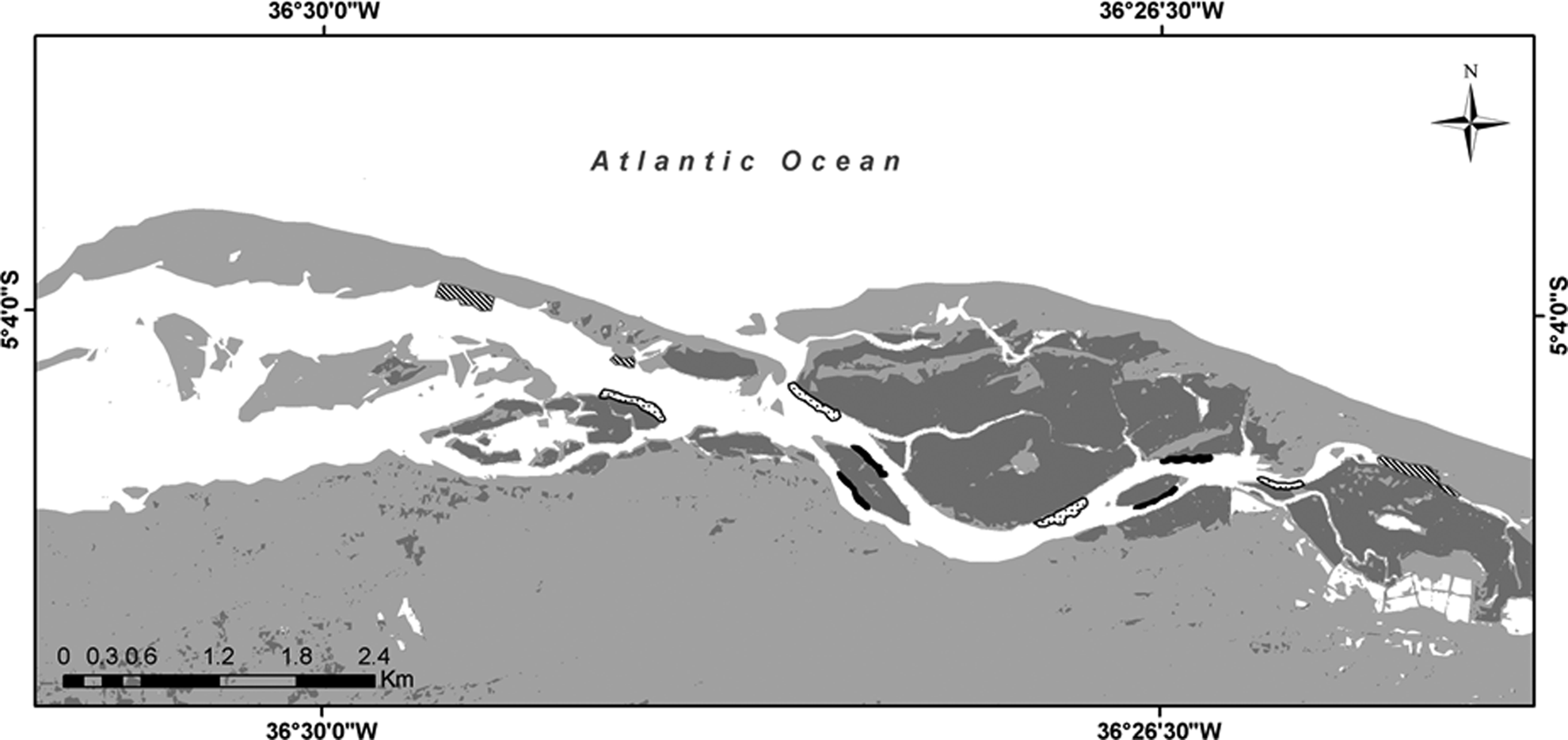
The Tubarão estuary is 10 km long and is located on the northern coast of the state of Rio Grande do Norte state, north-eastern Brazil (5°04′37″S 36°27′24″W), within the limits of Ponta do Tubarão Sustainable Development Reserve – RDSEPT (Figure 1). The main channel of the river is between 1 and 8 m deep, and is connected to tidal creeks and other shallower channels (Queiroz & Dias, Reference Queiroz and Dias2014). This ecosystem is located in a region of semi-arid climate (BSh according to Köppen climate classification; Alvares et al., Reference Alvares, Stape, Sentelhas, Gonçalves and Sparovek2013), the typical climate of north-eastern Brazil, characterized as very low rainfall (annual average = 537.5 mm) with a tendency to high temperatures throughout the year. This area has a severe dry season, the driest month has precipitation below 20 mm with intense evaporation due to the high solar radiation (7.1 h of sunlight/day) and greater influence of constant trade winds, mainly from the south-east, east and north-east quadrants (IDEMA, 1999). The estuary is not fed by a freshwater spring, and only receives fresh water from subjacent groundwater and the rains that occur mainly from March to May (Queiroz & Dias, Reference Queiroz and Dias2014). The most upstream areas of the estuary showed hypersaline conditions due to the largest evaporation during all year (Sales et al., Reference Sales, Dias, Baeta, Lima and Pessanha2018).
Map highlighting the Tubarão River estuary, north-eastern Brazil. The sampling sites for each habitat are indicated: SNV (lines), MM (black) and MFM (black dots). Habitats: SNV = non-vegetated habitat with sand bottom, MM = mangrove fringe with mud bottom; MFM = vegetated habitat with macroalgae and mud bottom.

The environment is bordered almost completely by mangroves, composed of Black mangrove Avicennia germinans L. and Avicennia schaueriana Stapf & Leechman, Button mangrove Conocarpus erectus L., White mangrove Laguncularia racemosa Gaerton and Red mangrove Rhizophora mangle L., which function as natural protection between the coastline and mainland. The soft-bottom flora of the channel is dominated by the macroalgae Dictyota sp., Solieria filiformes (Kützing), Gracilaria cearensis (Joly & Pinheiro), and Gracilaria domingensis (Kützing). Other common vegetation consists of seagrass as Halodule wrightii Ascherson and algae as Hypnea musciformis (Wulfen). These habitats provide a rich source of food while also offering refuge from predation for fish and invertebrates.
Sampling and laboratory procedures
The Tubarão estuary was sampled during the rainy (April and July 2012) and dry (September and November 2012) seasons. All sampling was restricted to daylight (06:00–17:00 h) on the low water spring tide due to logistic restrictions of sampling with seine nets. Sampling was undertaken in different subtidal microhabitats according to the following: non-vegetated habitat with sand bottom – bare sand (SNV); narrow intertidal flat adjacent to mangrove fringe and mud bottom (MM); and broad intertidal flat non-adjacent to fringe and containing expansive macroalgae (Gracilaria domigensis, Hypnea musciformes) and seagrass (Halodule wrightii) beds, and mud bottom (MFM) (Figure 1). Four sites were sampled for each habitat and three replicates were collected at each microhabitat by pulling a beach-seine net (10 m long and 1.5 m high, with a stretched mesh size of 5 mm) across 30 m parallel to the coast, to a maximum depth of 1.5 m (4 sites × 3 microhabitats × 3 replicates × 4 months = 144 samples). The collected fish were fixed immediately after capture for later identification in the laboratory. The total length (TL, mm) was measured for each individual.
Food resources found in stomachs were quantified using the following indices: frequency of occurrence (%F), the percentage number (%N) and the volume (%V) of different food items (Hyslop, Reference Hyslop1980). These indices (%F, %N, %V) were combined into the Index of Relative Importance of Pinkas et al. (Reference Pinkas, Oliphant and Iverson1971) with the following formula: IRI = %F × (%N + %V), which was computed for each food item. Each dietary item was identified to the lowest possible taxon. For items that could not be counted, a value of 0.1 was given for their number (%N) to offset distortions in the index (Abdurahiman et al., Reference Abdurahiman, Nayak, Mohamed and Zacharia2010). The volumes of each item were verified in a way similar to that used by Bemvenuti (Reference Bemvenuti1990) and analysed by displacement methods. The total volumes of each item were obtained by summing individual volumes across all samples. The volumetric proportion of each item was then calculated based on the total volume of food eaten per consumer. Although the volumes of unidentifiable materials were also calculated, these were not considered valid dietary categories and were not included in subsequent dietary analysis (Abdurahiman et al., Reference Abdurahiman, Nayak, Mohamed and Zacharia2010).
The body length intervals to each size class varied among species. These intervals were applied to ensure that each class included enough individuals to estimate the diet composition. The individuals were grouped into the following three size classes: small juveniles (TL1: <70 mm), medium-sized juveniles (TL2: 71–125 mm) and large juveniles (TL3: >126 mm). The asymptotic length was obtained from Teixeira et al. (Reference Teixeira, Duarte and Ferreira2010), Freitas et al. (Reference Freitas, Abilhoa and Silva2011) and Previero et al. (Reference Previero, Minte-Vera, Freitas, Moura and Tos2011). This method was applied to standardize the size classes for all species getting a better comparison between them. Quantifying the abundance and distribution of size classes is fundamental to understand how different habitats influence the fish populations throughout estuarine systems.
The morphological measurements used were related to feed structure: mouth height (M H) is the height of the mouth fully open; mouth width (M w) is the width of the mouth fully open. The mouth area (M A) (assuming an elliptical shape) was described by: M A = 0.25 π (M HM w) (Karpouzi & Stergiou, Reference Karpouzi and Stergiou2003).
Statistical analyses
Two-way permutational multivariate analysis of variance (PERMANOVA) was used to test for differences in fish abundance and biomass between the three habitats (SNV, MM and MFM) and seasons (dry and rainy). In all analyses, the same two-factor design (season and habitat) was used. Pair-wise test comparisons were used to determine which groups differed within factors based on 9999 permutations performed for each test (Anderson, Reference Anderson2001; Anderson et al., Reference Anderson, Gorley and Clarke2008).
The IRI contribution of each prey taxon by species and size classes was square-root transformed and converted into a triangular matrix of similarities between all the samples (Schafer et al., Reference Schafer, Platell, Potter and Valesini2002). Hierarchical cluster analysis, using group-averaged linking, was used to examine potential diet groupings based on species and size classes. The Similarity Profile Analysis (SIMPROF) is performed when it is used to objectively identify the members of the ‘real’ groups present in the results returned from a classical agglomerative hierarchical clustering method. This provides a compelling alternative to more traditional methods that rely on subjective assignment of arbitrary cut-off levels (Clarke et al., Reference Clarke, Somerfield and Gorley2008). The Similarity Percentage (SIMPER) procedure was applied in SIMPROF groups to detect prey that contribute to within-group similarity. The Cluster analysis, SIMPROF and SIMPER procedures were performed with the PRIMER software package, version 6.0 (Clarke & Warwick, Reference Clarke and Warwick2001).
Trophic strategy
The trophic strategy was analysed graphically with the method proposed by Amundsen et al. (Reference Amundsen, Gabler and Staldvik1996), which incorporated the prey-specific abundance (volume) into Costello (Reference Costello1990) analysis. The Amundsen method is based on a two-dimensional representation wherein each point relates the %F of a prey to its prey-specific volume %V. The vertical axis represents the feeding strategy of the predator in terms of specialization or generalization. Predators are specialized when prey are positioned in the upper part of the graph, whereas prey positioned in the lower part were eaten occasionally (generalization).
The Shannon–Wiener diversity index using a natural logarithm (Krebs, Reference Krebs1989), which corresponds to dietary breadth, was calculated for each species using the volumetric data of feeding. The Simplified Morisita Index Modified (Krebs, Reference Krebs1989) was used to assess niche overlap among species and size classes. Niche overlap was considered significant when it exceeded the value of 0.6 (Labroupoulou & Eleftheriou, Reference Labroupoulou and Eleftheriou1997; Mendoza-Carranza & Vieira, Reference Mendoza-Carranza and Vieira2009). For this calculation, the values of volume were also used.
Results
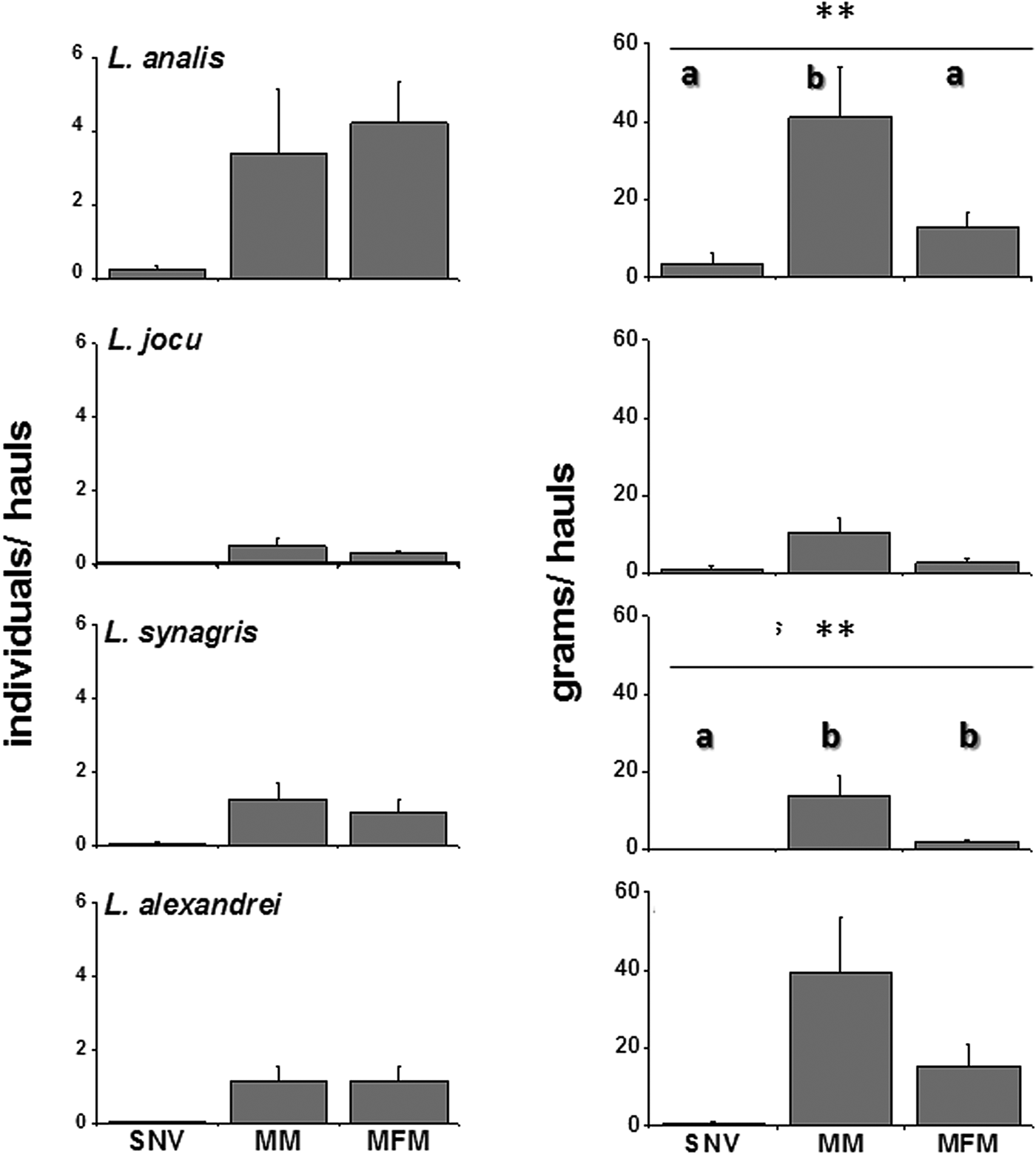
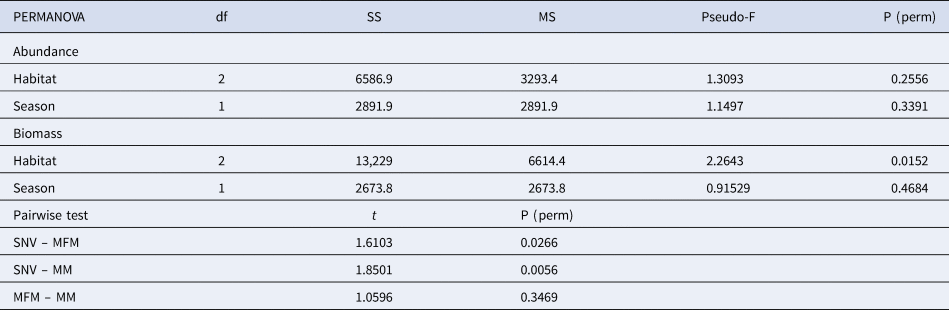
A total of 796 juvenile snappers were collected during the study. Lutjanus analis was the most abundant species accounting for 59.3% of the total catch. It was followed by L. alexandrei (17.6%), L. synagris (17.1%) and L. jocu (6.0%). Overall, PERMANOVA revealed significant differences between estuarine habitats in the biomass (PERMANOVA, F 2,144 = 2.26, P = 0.0152), but not in the number of individual juvenile snappers (PERMANOVA, F 2,144 = 1.30, P = 0.2556) (Figure 2) (Table 1). On the other hand, there were no significant temporal differences for number (PERMANOVA, F 2,144 = 1.14, P = 0.338) and biomass (PERMANOVA, F 2,144 = 0.91, P = 0.468) (Figure 2) (Table 1). MM estuarine habitat had the highest number of individuals (1.7 ± 0.32 individuals/haul) followed by MFM (1.6 ± 0.51) and SNV (0.1 ± 0.03). Spatial patterns in fish biomass showed similar trends to the number of individuals: the mean biomass in the MFM habitat (8.36 ± 1.68 g haul−1) was about five times lower than in the MM estuary (26.15 ± 5.21 g haul−1).
Variations of abundance (number of individuals per haul – CPUE) and Biomass (grams per haul) of four snappers in the estuary of the Tubarão River, north-eastern Brazil (average ± SE). Habitats: SNV = non-vegetated habitat with sand bottom, MM = mangrove fringe with mud bottom; MFM = vegetated habitat with macroalgae and mud bottom. The double asterisk indicates a highly statistically significant difference (P < 0.01). Within each graph, bars sharing the same letter are not significantly different (PERMANOVA, pairwise tests, P > 0.05).

Results from the multivariate permutational analysis (PERMANOVA) of differences in total abundance and biomass between habitat and season

SNV, non-vegetated habitat with sand bottom; MM, mangrove fringe with mud bottom; MFM, vegetated habitat with macroalgae and mud bottom.
Juvenile L. analis were present in all habitats, and the highest abundance was recorded at MM and MFM habitats whilst biomass was highest in the MM habitat. Lutjanus jocu juveniles were collected in higher abundance and biomass in MM habitat. Higher catches of L. synagris occurred at MM and MFM habitats, while L. alexandrei was often caught in high abundance and biomass in the same habitats (Figure 2). No clear trend was shown for L. alexandrei and L. jocu (PERMANOVA, P > 0.05). Only L. synagris and L. analis showed significant differences (PERMANOVA, P < 0.05) in biomass, with highest values being recorded in MM and MFM habitats, respectively (Figure 2).
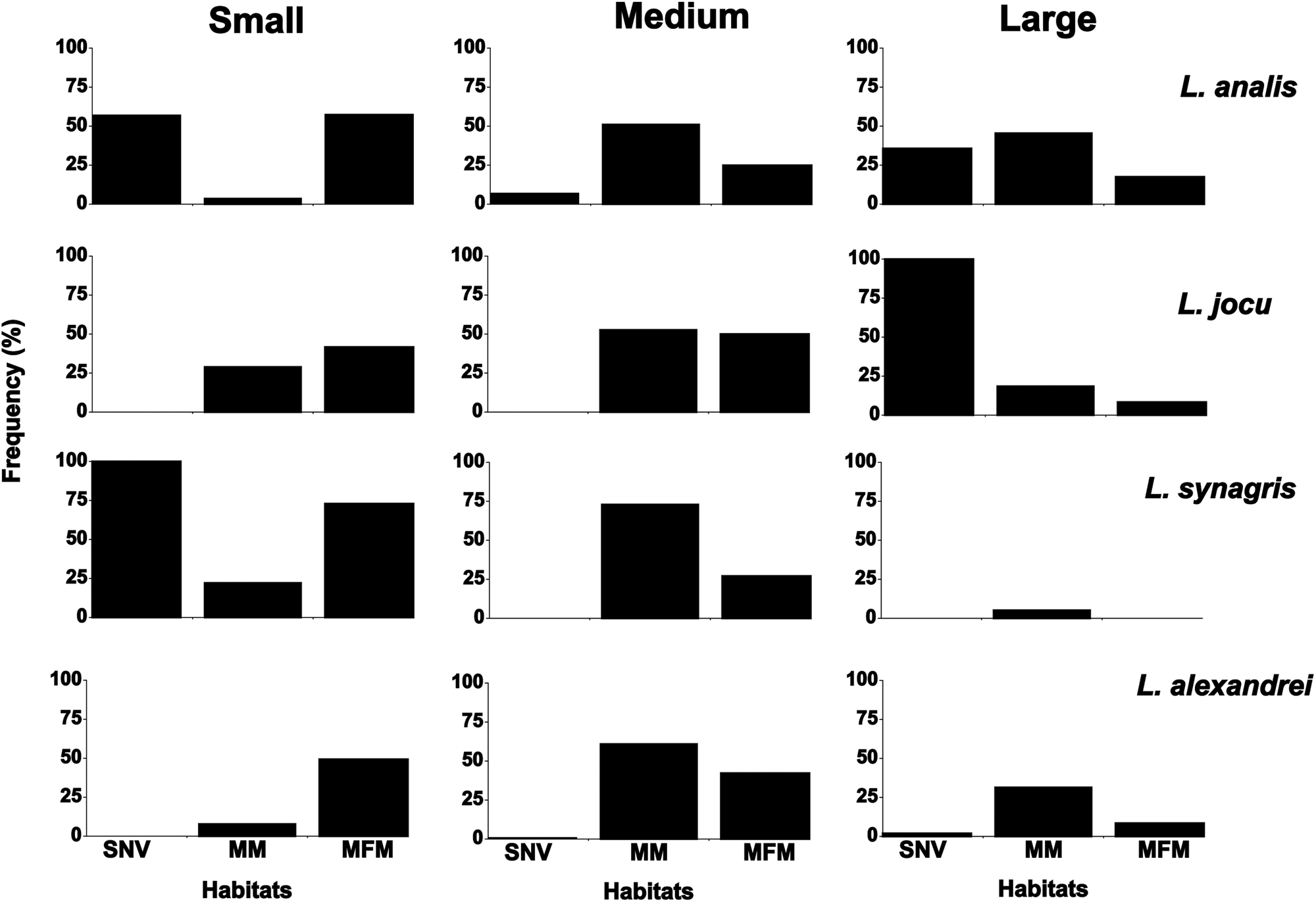
The snapper species corresponded to immature size classes ranging from 11 to 205 mm TL. In relation to fish size distribution in the estuary, the smallest and medium-sized individuals of snappers of all species were observed in high frequency especially in MM and MFM habitats. Large individuals of L. jocu were observed with higher frequency in SNV habitat (Figure 3).
Distributions of size classes (small, medium and large juveniles) in relation to habitats registered in Tubarão River estuary, north-eastern Brazil. Habitats: SNV = non-vegetated habitat with sand bottom, MM = mangrove fringe with mud bottom; MFM = vegetated habitat with macroalgae and mud bottom.

Diet
Stomach contents were found in 112 of the 122 L. alexandrei (92%), 49 of the 52 L. jocu (94%), 106 of the 117 L. synagris (91%) and 401 of the 440 L. analis (91%). Crustaceans were dominant in the diet of snapper species, being found in over 90% of the stomachs, followed by fish and molluscs. Crustaceans were mainly represented by decapods and microcrustaceans (Calanoida, Cyclopoida and Amphipoda) (Table S1 and Table S2).
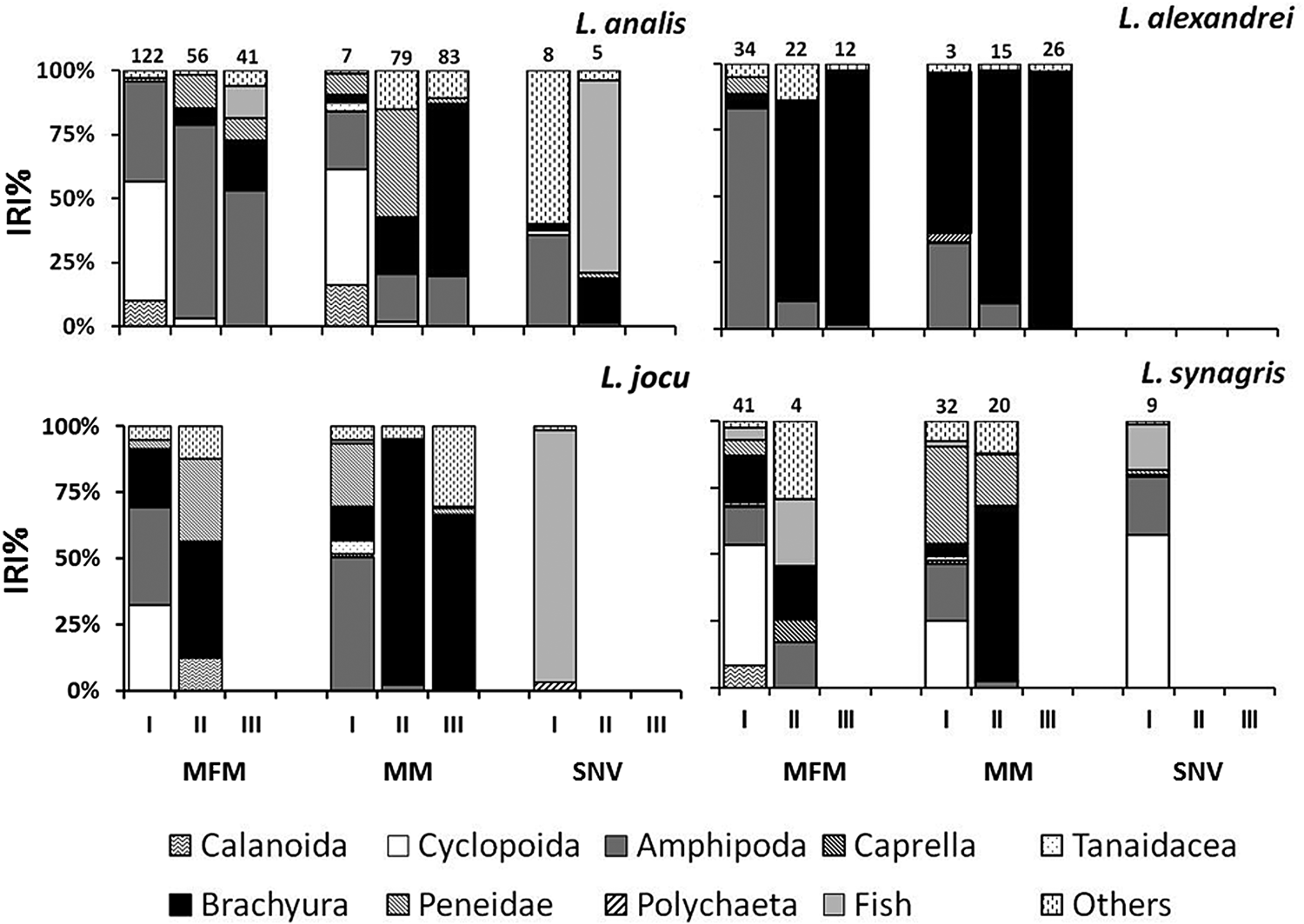
In general, the diet composition in terms of the main prey items differed between habitats. In SNV habitat, the diet of L. analis and L. synagris consisted of microcrustaceans (Amphipoda and Cyclopoida), and the diet of L. jocu was predominantly fish. The contributions of Brachyura and Peneidae to the diet of all snappers increased in MM habitat; contributions made by microcrustaceans increased in L. analis and L. synagris in MFM habitat, whereas that of Brachyura remained very high in the diet of L. alexandrei and L. jocu (Figure 4).
Index of Relative Importance (% IRI) in relation to habitats and size classes registered in Tubarão River estuary, north-eastern Brazil. Habitats: SNV = non-vegetated habitat with sand bottom, MM = mangrove fringe with mud bottom; MFM = vegetated habitat with macroalgae and mud bottom. Numbers of stomachs analysed are indicated above the bars.

Ontogenetic variation in diet of the four snapper species was evident (Figure 5). The contributions made by Amphipoda to the diet of L. alexandrei and L. jocu declined progressively from nearly 60–80% IRI in the smallest juvenile to zero in large juveniles. The relative importance of Brachyura tended to increase with size class (medium and large juveniles), whereas, in contrast, L. synagris and L. analis consumed far greater volumes of Cyclopoida (71 and 47% IRI, respectively) and Amphipoda (42% and 54% IRI, respectively) by small juveniles, whereas large juveniles ingested Brachyura (51% and 52% IRI, respectively) (Figure 4).
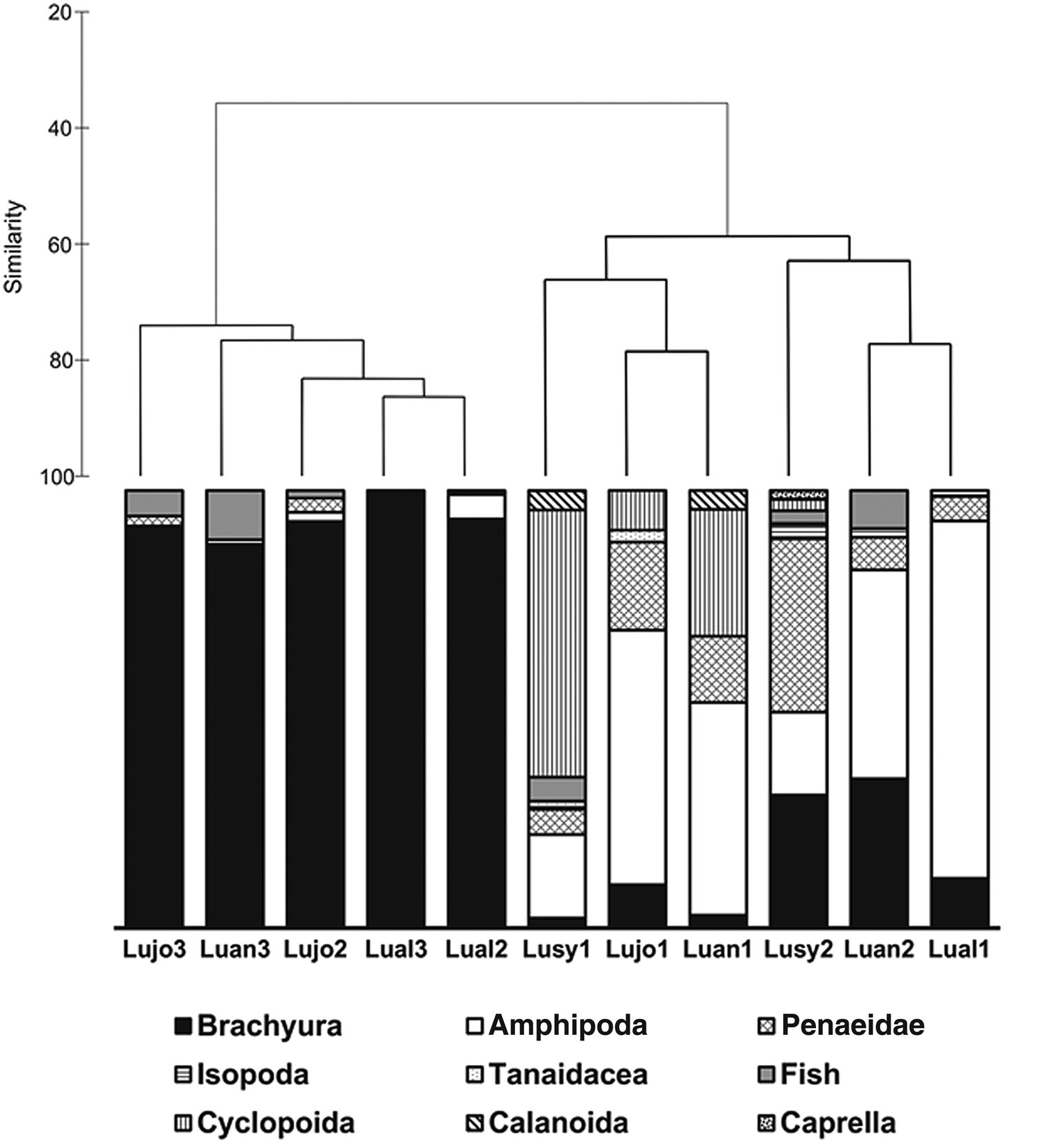
Classification of % IRI data for size classes of four snapper species in the Tubarão River estuary, north-eastern Brazil. Small (1); medium (2) and large juveniles (3). Luan = Lutjanus analis, Lujo = Lutjanus jocu, Lusy = Lutjanus synagris and Lual = Lutjanus alexandrei.

When the IRI data of each size class were plotted in a dendrogram, samples from smaller size classes (small juveniles) appeared on the left side of the dendrogram and samples of larger-size (medium and large juveniles) were shown on the right side (Figure 5). SIMPROF showed that dietary compositions of different size classes in each pairwise comparison were significantly different (π = 5.4, P < 0.05). SIMPER analysis showed that the main prey of group A were Amphipoda, Penaeidae and Cyclopoida (average similarity = 62.74) and of group B were Brachyura and fish (average similarity = 77.83).
Feeding strategy and mouth area
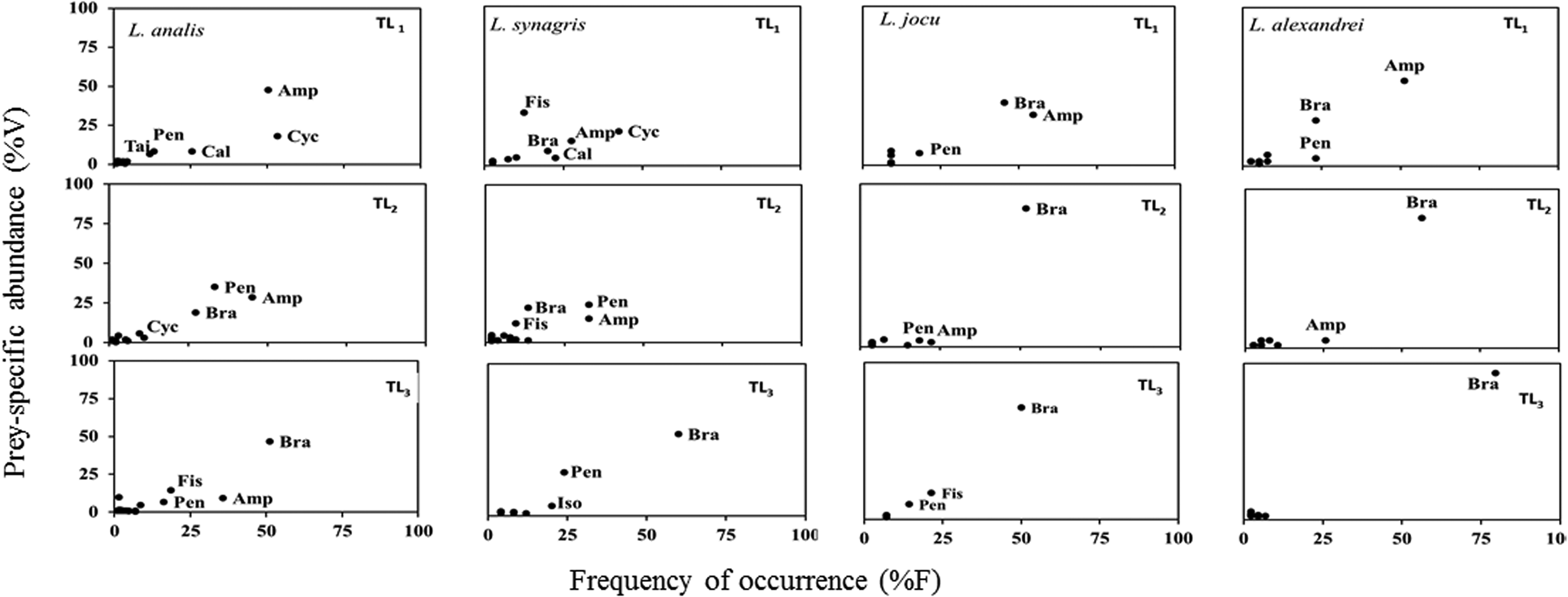
The feeding strategy observed in the size classes of the four species of snappers is summarized in the Amundsen plots. From the prey importance axis, the smallest size class for L. synagris, L. jocu and L. analis showed a diet mostly based on rare prey taxa that were eaten occasionally and in relatively small- to medium-volume, such as Amphipoda, Cyclopoida and Brachyura (Figure 6). In the other size classes there were differences between species: for L. synagris and L. analis the generalist feeding strategy was continued with predation on Amphipoda and Brachyura, while L. jocu and L. alexandrei demonstrated a more specialized feeding strategy on Brachyura (Figure 6).
Feeding strategy for the size classes of four snappers in the Tubarão River estuary, north-eastern Brazil. Food items: Amp, Amphipoda; Bra, Brachyura; Cal, Calanoida; Cyc, Cyclopoida; Fis, Fish; Iso, Isopoda; Pen, Penaeidae; Tai, Tanaidacea. Small (TL1), medium (TL2) and large juveniles (TL3).

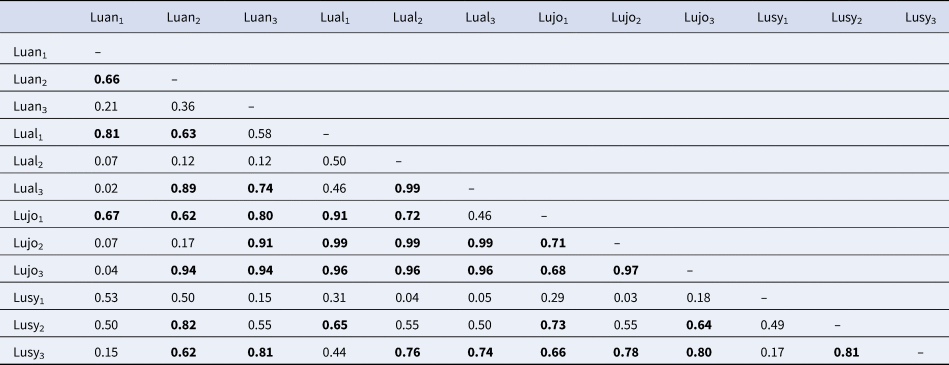
Niche breadth for the four co-occurring snappers presented higher values for L. synagris and L. analis (H’ = 0.19 and H’ = 0.21, respectively), and lower values for L. jocu and L. alexandrei (H’ = 0.18 and H’ = 0.14, respectively). Similarly, the Shannon-Wiener index values also showed changes of niche breadth according to size classes of snappers, with it being inversely proportional to body length in all species. Inter-specific niche overlap occurred at smallest sizes of four snapper species, and intra-specific niche overlap between the largest sizes (Table 2).
Niche overlap index per size class (TL) for the four fish species (Luan = Lutjanus analis, Lujo = Lutjanus jocu, Lusy = Lutjanus synagris and Lual = Lutjanus alexandrei) in the Tubarão River estuary, north-eastern Brazil

Values in bold indicate biologically significant overlap (>0.6) according to Labroupoulou & Eleftheriou (Reference Labroupoulou and Eleftheriou1997). Small (TL1) Medium (TL2) and Large juveniles (TL3).
When the mouth area of different size classes was analysed among species, it was observed that L. synagris and L. analis presented lower ranges (Lusy1 = 6.58 mm2, Lusy2 = 54.65; Luan1 = 3.48 mm2, Luan2 = 28.62 mm2, Luan3 = 120.60 mm2), compared with L. jocu and L. alexandrei (Lujo1 = 20.05 mm2, Lujo2 = 80.75 mm2, Lujo3 = 177.32 mm2; Lual1 = 37.36 mm2, Lual2 = 65.94 mm2, Lual3 = 173.78 mm2).
Discussion
The greater abundance and degree of inter-specific food partitioning of snapper fishes suggested that this hypersaline environment provides an important nursery area and feeding ground habitats. Habitats that support high juvenile densities, and may contribute juveniles to adult populations, have historically been referred to as nurseries (Beck et al., Reference Beck, Heck, Able, Childers, Eggleston, Gillanders, Halpern, Hays, Hoshino, Minello, Orth, Sheridan and Weinstein2001). There are a few tropical estuaries on the borders of semi-arid regions in north-eastern Brazil, which provide good shelter for juvenile snappers and other juvenile reef fish, as proposed by Sales et al. (Reference Sales, Dias, Baeta and Pessanha2016). The results presented here could be due to (1) habitat use by species and (2) differences in trophic strategy and mouth area, resulting in resource partitioning. For example, Adite & Winemiller (Reference Adite and Winemiller1997) and Boyle & Horn (Reference Boyle and Horn2006) showed that the sharing of food resources by congeners is facilitated through differences in habitat use, in response to environmental heterogeneity in ecosystems.
The results point to clear differences in utilization of different habitat types by juvenile snappers in the Tubarão estuary. The higher abundance of snappers registered in the MFM and MM habitats of the Tubarão estuary was demonstrated, revealing the structural complexity provided by proximity to habitats (such as seagrass and mangrove roots) as an important factor. Similar results were found by Sales et al. (Reference Sales, Dias, Baeta and Pessanha2016) who argued that the greater abundance and fish richness in this estuary might depend on the substratum type and more complex and heterogeneous habitats, such as mangrove fringe and macroalgae beds. Aschenbrenner et al. (Reference Aschenbrenner, Hackradt and Ferreira2016) also found that habitat selection by snapper species in Brazilian estuaries is related to higher densities of juveniles in mangrove areas. Habitat selection among snapper species has been very evident, mainly due to formation of schools of conspecifics in order to improve safety while foraging (Igulu et al., Reference Igulu, Nagelkerken, Fraaije, Ligtenberg, Mgaya and Van Hintum2011). These results support the hypothesis that the hypersaline ecosystems are potential or alternative nursery grounds for these juvenile fish to minimize mortality and maximize growth.
The results show the importance of different habitats as nurseries for snapper species. Despite the differences between habitats in abundance of snappers, juveniles of L. analis and L. synagris showed some degree of similarity in habitat utilization, with highest biomass in the MM habitat, due to the presence of medium- and large-sized individuals close to the mangrove fringes. It is important to note that small individuals of these species were caught predominantly in SNV habitats. Differences in the distribution of size classes among different habitats in our study can be used to infer about the discontinuity hypothesis –resources are patchily distributed so their availability varies among spatial scales. Greater use of mangrove fringes by L. analis and L. synagris is as reported in other studies (Ley et al., Reference Ley, McIvor and Montague1999; Doncel & Paramo, Reference Doncel and Paramo2010), and suggests that distribution of snappers was influenced by food resources which may be over-abundant and also dependent on abiotic factors. Nagelkerken et al. (Reference Nagelkerken, Van der Velde, Gorissen, Meijer, Van't Hof and Den Hartog2000) have described a clear spatial separation in seagrass and mangrove utilization among closely related fish species and among different size groups within species, suggesting avoidance of competition. Burke (Reference Burke1995) suggested that biotic and abiotic gradients interact to create and guide fishes to species-specific nursery habitats. In a number of studies, a greater abundance of snapper species has been found in habitats with higher complexity (mangrove roots and seagrass) (Mueller et al., Reference Mueller, Dennis, Eggleston and Wicklund1994; Monteiro et al., Reference Monteiro, Giarrizzo and Isaac2009; Freitas et al., Reference Freitas, Abilhoa and Silva2011); these confer strong advantages for young stages, such as a reduction of predation risk and access to different prey species (Szedlmayer & Lee, Reference Szedlmayer and Lee2004), with potential consequences for growth rate (Aschenbrenner & Marques, Reference Aschenbrenner and Marques2018).
In the present study we found that the four juvenile snapper species were exclusively carnivorous, feeding mainly on microcrustaceans and benthic crustaceans. The importance of these items in the diet of snappers is highlighted here and corroborated by earlier studies in tropical estuaries and mangroves (Dorenbosch et al., Reference Dorenbosch, Vanriel, Gelkerken and Van der Velde2004; Kamukuru & Mgaya, Reference Kamukuru and Mgaya2004), evidencing the ability of these species to exploit them. In our study, the segregations in diet among species were related to the habitat types and relative abundances of their potential prey, and this strategy contributes to species coexisting by facilitating resource partitioning. For example, L. synagris and L. analis forage in the water column and seagrass, feeding on Cyclopoida and Amphipoda in a generalist way according to prey availability, whereas L. alexandrei and L. jocu forage near the substrate feeding on Brachyura, behaving more like a specialist. This difference was due to choice of the way to feed in response to patterns of food density: a higher abundance of macroinvertebrates was recorded by Queiroz & Dias (Reference Queiroz and Dias2014) and Medeiros et al. (Reference Medeiros, Costa, Lima, Oliveira, Júnior, Silva, Gouveia, De Melo, Dias and Molozzi2016) in Tubarão estuary in association with algae beds, sandy and muddy bottoms, while the abundance of Brachyura and Penaeidae increased as they approached mangroves. Similar diet shifts related to habitat changes have been reported for Lutjanus campechanus in the north-east Gulf of Mexico (Szedlmayer & Lee, Reference Szedlmayer and Lee2004).
The cluster analysis demonstrated that diet composition of snappers is different between size classes, suggesting resource partitioning. The diet shifts gradually between size classes of L. synagris, L. alexandrei and L. analis from predominantly microcrustaceans to Brachyura, fish and molluscs. This result was corroborated by studies on diet of two of these species in oceanic islands and reefs (Doncel & Paramo, Reference Doncel and Paramo2010). On the other hand, L. jocu ate Brachyura and Penaeidae at all size classes, which has been noted in other studies in tropical estuaries (Monteiro et al., Reference Monteiro, Giarrizzo and Isaac2009; Pimentel & Joyeux, Reference Pimentel and Joyeux2010). The juvenile reef fish presented ontogenetic dietary changes once they were in the nursery habitats (Cocheret de la Moriniére et al., Reference Cocheret de la Moriniére, Pollux, Nagelkerken and Van der Velde2003; Wells et al., Reference Wells, Cowan and Fry2008). The switch of a diet based on microcrustaceans to a Brachyura- or Penaeidae-based diet probably occurred because these items are more energetically profitable for larger individuals, maximizing energy input (Yeager et al., Reference Yeager, Layman and Hammerschlag-Peyer2014). Ross (Reference Ross1986) suggested that changes in dietary preferences due to ontogeny may reduce competition for resources between different life history stages.
Other aspects of the ontogenetic shifts in diet were related in changes in mouth area. Snapper range size increased with size classes accompanied by a switch from microcrustacean prey in small juveniles to Brachyura in larger juveniles, which supports the hypothesis that optimal prey size is related to the opening of the predator's mouth. In addition, these changes indicated that predator performance becomes more efficient, with hard prey, such as crabs and molluscs, being incorporated into the diet as the fish grow. For instance, Case et al. (Reference Case, Westneat and Marshall2008) found that ontogenetic change in the mouth morphology allowed large juvenile red snapper (Lutjanus campechanus) to explore harder types of prey. Previous studies also suggest that the progressive increase of larger prey in the diet could be related to increase in mouth size and ability to handle and crush prey in Lutjanidae (Szedlmayer & Lee, Reference Szedlmayer and Lee2004; Yeager et al., Reference Yeager, Layman and Hammerschlag-Peyer2014) and other carnivorous fish such as Sparidae (Sarre et al., Reference Sarre, Platell and Potter2000) and Serranidae (Labroupoulou & Eleftheriou, Reference Labroupoulou and Eleftheriou1997).
Significant overlaps between size classes were observed due to the prevalence of particular items in the diets of snappers. However, segregation along two resource axes (habitat and trophic) may have played an important role in niche segregation of snappers, to avoid potential inter-specific food competition among size classes. Furthermore, snappers adopted different strategies among and within species to reduce competition; thus L. synagris and L. analis tended to have broader diets while L. jocu and L. alexandrei were more specialists. Our study supports the hypothesis that resource partitioning between congeneric fish species is related to spatial patterns of habitat use and ontogenetic diet shifts, and also highlights the importance of hypersaline ecosystems as nursery grounds for snappers.
Supplementary material
The supplementary material for this article can be found at https://doi.org/10.1017/S0025315420000375.
Acknowledgements
The authors thank the members of the Laboratório de Ecologia de Peixes, Universidade Estadual da Paraíba (UEPB) for their invaluable assistance with fieldwork.
Financial support
This work was partially supported by the CNPq – Brazilian National Agency for Scientific and Technological Development (Proc. 477663/2011-7); and UEPB/PROPESQ (Proc. 115/2011).