From learning the names of things to understanding mathematical equations, children rely on information provided by others during conversation. To participate in conversations children must have some elements of pragmatic competence in place, including providing topic contingent information and being sensitive to others' knowledge states. Previous research has revealed that children become more proficient conversationalists during the preschool period (e.g. Bloom, Rocissano & Hood, Reference Bloom, Rocissano and Hood1976; Garvey & Hogan, Reference Garvey and Hogan1973; Shapiro & Hudson, Reference Shapiro and Hudson1991). In addition, as they near age five children begin to accurately judge the quality of others' contributions to conversations by identifying speakers who adhere to Gricean maxims (Ackerman, Reference Ackerman1981; Conti & Camras, Reference Conti and Camras1984; Eskritt, Whalen & Lee, Reference Eskritt, Whalen and Lee2008; Siegal, Reference Siegal1999). To acquire information during conversations children must make judgments about whether information offered by someone is true (Koenig & Harris, Reference Koenig and Harris2005). Previous research has demonstrated that preschoolers use a range of cues including prior history of truthful labeling (Koenig, Clement & Harris, Reference Koenig, Clement and Harris2004; Koenig & Harris, Reference Koenig and Harris2005; Pasquini, Corriveau, Koenig & Harris, Reference Pasquini, Corriveau, Koenig and Harris2007), providing credible information (Birch, Vauthier & Bloom, Reference Birch, Vauthier and Bloom2008), consensus among on-lookers (Fusaro & Harris, Reference Fusaro and Harris2008), and evidence of knowledge or ignorance (Sabbagh & Baldwin, Reference Sabbagh and Baldwin2001; Birch & Bloom, Reference Birch and Bloom2002) to determine whether someone is likely to offer veridical information about labels. In the present research, we ask whether these skill sets converge during development. Particularly, do children use past pragmatic competence to make inferences about speaker reliability?
As children become efficient communicators they must acquire proficiency in different aspects of conversation. For example, they need to learn that others often expect new rather than old information and that their speech partners will know about different things. Preschoolers become increasingly able to tailor their conversations to suit the needs of speech partners. In one study, five-year-olds were more likely than three-year-olds to tell a naive listener about parts of a videotaped event she missed rather than parts of the event they watched together (Saylor, Baird & Gallerani, Reference Saylor, Baird and Gallerani2006; see also Menig-Peterson, Reference Menig-Peterson1975; Perner & Leekam, Reference Perner and Leekam1986). Other work has shown that children offer increasing amounts of topic relevant information during conversations across the preschool period (e.g. Bloom et al., Reference Bloom, Rocissano and Hood1976; Brown, Reference Brown and Olson1980). These and other studies suggest that during this period children are able to engage in knowledge building conversations.
Another facet of pragmatic competence involves the metalinguistic awareness that there are unstated rules of conversation that others can choose to adhere to (Ackerman, Reference Ackerman1981; Eskritt et al., Reference Eskritt, Whalen and Lee2008). One classic view is that communication is guided by a set of assumptions (or maxims) that interlocutors make about one another (Grice, Reference Grice1957; Reference Grice, Cole and Morgan1975). On this view, each conversation partner assumes that the other will follow a set of rules that make the communicative act cooperative. Grice's original conceptualization encompassed four maxims that allow discourse to proceed smoothly: quality (be truthful), relation (be relevant), quantity (provide as much information as is required) and manner (be unambiguous, brief and orderly). As long as they continue to be cooperative, speech partners can violate the maxims to communicate their intentions during conversation (e.g. to convey sarcasm or to be polite). However, it is also possible for speech partners to violate maxims because they are being uncooperative. This can occur because they are unable to adhere to the maxims (because they don't understand them) or because they are being inattentive. The ability to recognize that maxims are being violated and to determine why they are being violated is hence a critical developmental achievement that enables children to discern others' communicative intent.
Previous research suggests that the ability to identify violations of some Gricean maxims emerges during early childhood. Ackerman (Reference Ackerman1981) investigated this by presenting five- to seven-year-olds with short vignettes that ended in an utterance that violated or conformed to a Gricean maxim (quality or relation). Six- and seven-year-olds correctly chose who was likely to have produced the final utterance: Saucy Sally (for rule violating utterances) or Honest Alice (for rule conforming utterances). In a similar study, Conti and Camras (Reference Conti and Camras1984) presented three- to nine-year-olds with recorded vignettes that contained two possible endings, one conforming to Gricean maxims of quality, relation or quantity and one violating a maxim. Only children aged six and older were able to identify the ‘silly’ (rule-violating) endings. Together this research suggests that children identify violations to Gricean maxims by the age of six. However, because both of these studies used short vignettes as stimuli, it is not clear whether children can make inferences about Gricean maxim adherence when observing everyday conversations in which interactions proceed in real time between two or more individuals. Moreover, children younger than six years of age did not recognize character adherence to Gricean maxims in the vignettes, raising questions about younger children's competence. One possibility is that preschoolers' judgments of maxim adherence may be facilitated through observation of conversations that may provide richer cues to speaker competence. For example, when two people are engaged in conversation involving question–answer sequences it may be clearer how one person's contribution relates or does not relate to another's because it is not necessary to extrapolate what the conversation ‘looked like’ from a story context.
One more recent study adds support to this possibility, but features of the study design make it unclear whether the give-and-take of conversation or some other feature of the study facilitated younger children's performance. In particular, Eskritt et al. (Reference Eskritt, Whalen and Lee2008) found evidence that three- to five-year-old children who observed an experimenter request information from two puppets, consistently asked for information about the location of a hidden sticker from the puppet who had adhered to Gricean maxims. This finding indicates that preschoolers are sensitive to uncooperative violations of Gricean maxims and that they subsequently use this information to avoid requesting information from a violating puppet. However, as highlighted by the authors, children were offered a great deal of extralinguistic contextual support in the form of an analogous set of practice trials to help them identify which puppet would be more likely to know about the location of the stickers. In addition, a feature of their design – children kept the stickers they found – may have acted as an incentive for them to perform well. As a result, it is not clear whether preschoolers can judge pragmatic competence when observing everyday conversations between adults when children are offered neither practice nor incentives.
In addition to facilitating communication, an understanding of conversation rules may help children evaluate the quality of information provided by others. For instance, one of the maxims (quality) concerns the truth of information being offered. As a result, there may be a relatively transparent link between adherence to the maxim and the usefulness of the information offered. In addition, it is possible that children also believe that people are consistent in their communicative abilities. On this view, if a person is likely to be uncooperative during conversation (because they are inattentive or unable to adhere to maxims) her future contributions should not be trusted either. One question is whether children use pragmatic competence to determine whether to learn from someone.
There are good reasons to think that they might. A flourishing body of work has established that children use many cues including a speaker's past labeling of objects and consensus among on-lookers to make judgments about his/her reliability (Birch & Bloom, Reference Birch and Bloom2002; Brosseau-Liard & Birch, Reference Brosseau-Liard and Birch2010; Clément, Koenig & Harris, Reference Clément, Koenig and Harris2004; Fusaro & Harris, Reference Fusaro and Harris2008; Koenig et al., Reference Koenig, Clement and Harris2004; Koenig & Jaswal, Reference Koenig and Jaswal2011; Koenig & Harris, Reference Koenig and Harris2005; Sabbagh & Baldwin, Reference Sabbagh and Baldwin2001). To investigate children's use of pragmatic competence as a cue to speaker reliability, we used a methodology that is similar to that used in these previous studies. We first presented children with competent and incompetent speakers and asked whether children recognize maxim adherence in observed conversations. We then tested children's relative trust of the information provided by the two speakers. Our prediction was that children would trust information provided by the speaker who adhered to the maxim. The focus of this work is on the maxims of quality (be truthful) and relation (be relevant), as children seem to understand these maxims first (Eskritt et al., Reference Eskritt, Whalen and Lee2008), thus offering them the best chance of using maxim adherence to guide their learning.
Our procedure differs from previous studies in an important way. In the previous studies in which children have seen interactions between individuals, the format has not matched a typical conversation. Instead, children were presented with interactions between speakers that resemble the question and answer format of an interview, in which one person requests truthful answers to the same question from two individuals in a sequence (e.g. ‘Can you tell me what this is called?’; e.g. Clément et al., Reference Clément, Koenig and Harris2004; Corriveau & Harris, Reference Corriveau and Harris2009a; Reference Corriveau and Harris2009b; Corriveau, Meints & Harris, Reference Corriveau, Meints and Harris2008; Koenig et al., Reference Koenig, Clement and Harris2004; Koenig & Harris, Reference Koenig and Harris2005; Nurmsoo & Robinson, Reference Nurmsoo and Robinson2009; Sobel & Corriveau, Reference Sobel and Corriveau2010). In the current study, in contrast, children are presented with two separate conversations between two individuals. We believe this format makes the interaction closer to an observed conversation, in which pragmatic conventions may be followed or not. A format that is closer to what children might witness in their observations of others' conversations may increase the likelihood that they can detect violations of pragmatic conventions.
METHOD
Participants
Ninety children were divided into an older (six-year-olds, N = 32, M = 6 ; 6, range: 6 ; 0 to 7 ; 0, 13 males) and younger (four-year-olds, N = 58, M = 4 ; 8, range: 4 ; 3 to 5 ; 5, 27 males) age group. All children were English speaking and typically developing. Five additional children participated but their data were excluded for non-compliance (two four-year-olds) and experimenter error (two four- and one six-year-old).
Materials
Two 13-inch televisions were placed on a table in front of a couch. Participants sat in the middle of the couch equidistant from the television sets. When no video was playing, each television displayed an image of the actor whose video would be shown. The experimenter always sat to the right of the participants. Sessions were recorded with a digital camera.
A box containing novel objects for the labeling trials was placed out of view from the child. The novel objects were purchased at a crafts store or made by removing parts from larger objects until an unrecognizable part was left and they would be unnamable by children. They were paired based on similarity (e.g. size, material; see Figure 1). Each pair was associated with one of four novel labels (i.e. dake, teg, glap and trome).
Test object pairs.

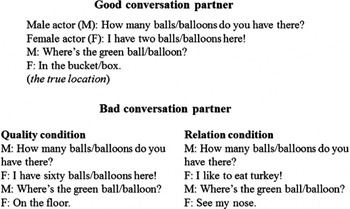
Thirty-second video clips introduced participants to two female speakers (a good and a bad conversation partner). Each female speaker interacted with the same male actor in a naturalistic conversation. One of the female actors played with balls and the other played with balloons. The good conversation partner reliably followed a conversation maxim, while the bad conversation partner violated the maxim. In the quality condition the bad conversation partner violated the Gricean maxims of quality by stating something untrue when answering questions. In the relation condition the bad conversation partner gave irrelevant answers, violating the maxim of relation (for scripts see Figure 2). To maintain consistency across conditions, the good conversation partners followed the same script in both conditions. The bad conversation partner scripts differed to produce the appropriate maxim violation. The male actor responded in the same neutral fashion to both partners' contributions.
Video scripts.

Design and procedure
Children were tested individually in either the quality (29 four-year-olds, M = 4 ; 8, 15 males, and 16 six-year-olds, M = 6 ; 6, 7 males) or relation (29 four-year-olds, M = 4 ; 7, 12 males, and 16 six-year-olds, M = 6 ; 6, 6 males) condition. The experiment consisted of two phases: familiarization and word learning.
Familiarization phase
During familiarization, participants were introduced to the conversation partners and children's awareness of maxim adherence was tested. All participants viewed the good and bad conversation partners as they interacted with the same individual in separate video clips shown on different televisions.
To begin the session, the experimenter introduced the female actors saying, ‘Today we're going to watch some of my friends on TV. One of them is wearing a red shirt and the other one is wearing a pink shirt. Can you point to the girl with the red shirt? Can you point to the girl with the pink shirt?’ Children then watched the first video and, to highlight the importance of attending to the videos, were asked two comprehension questions. For example, after the balloon video the experimenter asked, ‘When he asked her how many balloons she had, what did she say?’ and ‘When he asked her where the red balloon was, what did she say?’ Children received no feedback on their answers and the questions were asked only once. The procedure continued regardless of children's responses.
After viewing the video a second time, children were asked the conversation partner assessment question: ‘Was she good at answering questions or was she not very good at answering questions?’ This procedure was repeated with the second video. After both videos children were asked the conversation partner comparison question: ‘Who was better at answering questions?’ If children did not respond to the question the experimenter repeated it, stating the two possible answers: ‘the girl in the red shirt or the girl in the pink shirt?’
The word-learning phase began when the experimenter held up the box containing the novel objects saying, ‘They were both here yesterday and I asked them some questions about the toys in this box. I asked them to tell me the names of the toys.’
Word-learning phase
The word-learning phase assessed children's willingness to learn new labels from each conversation partner. In each of four trials, the conversation partners provided contrasting information about the referent of a novel label and participants had to decide which was correct. As in some previous studies (Birch et al., Reference Birch, Vauthier and Bloom2008; Scofield & Behrend, Reference Scofield and Behrend2008), one of the four novel labels was presented in each trial and participants determined its referent. The labels were presented in one of four preset orders.
All word-learning trials followed the same format: the experimenter introduced the first object by placing it in front of a picture (displayed on one television) of a conversation partner while saying, ‘The girl in the red shirt said this was a dake’. She then placed the second object in front of a picture of the other conversation partner (displayed on the other television) while saying, ‘The girl in the pink shirt said this was a dake’. She then looked at the participant and said, ‘They can't both be dakes! Only one is a dake. Which one is the dake?’ Children selected an object by pointing to it or describing it (e.g. ‘the red one’). If a child failed to select an object after being asked once, the experimenter reminded her that ‘The girl in the pink shirt said this was a dake and the girl with the red shirt said this was a dake. Which one is the dake?’
The actor who played the good conversation partner, the television displaying the good partner video, and the order in which the videos were presented were roughly counterbalanced across participants (there was one extra four-year-old in each condition). Similarly, the order in which the answer options were presented in the conversation partner assessment questions was roughly counterbalanced across participants. The objects labeled by the conversation partner introduced first during the familiarization phase (the good for half of the children) were presented first in word-learning trials 1 and 4. All objects served as a target for roughly half the children.
Coding
Comprehension questions
The four video comprehension questions that participants responded to after the initial viewing of each video clip received a score of 1 for a correct answer and 0 for an incorrect answer. The questions were open-ended (rather than two alternative forced choice) and some children did not provide answers to one or more of them (e.g. saying ‘I don't know’, or remaining quiet). To be sure we were not underestimating children's ability to follow the procedure, these responses were not included in the analyses. Since the total number of coded responses differed by child, the scores were converted to proportions (total number correct/number of answers provided).
Conversation partner assessment and comparison questions
Children were given 1 point for each question they answered correctly (for a total possible score of 3). Stating that the good conversation partner was good and that the bad conversation partner was bad at answering questions were the correct responses to the assessment questions. For the conversation partner comparison question, stating that the good conversation partner was better at answering questions was considered correct.
Word-learning trials
Children received a score of 1 for a word-learning trial if the good conversation partner's referent was selected and a score of 0 if the bad conversation partner's referent was selected. Participants selected an object by pointing or referring to it by stating an identifying characteristic (e.g. ‘the yellow one’). The total word-learning test score for individual participants ranged from 0 to 4.
RESULTS
We first report children's performance on the comprehension questions to assess children's ability to report on what they saw in the videos. Next, we analyze the conversation partner assessment and comparison questions, which tested children's ability to recognize adherence to conversation maxims. Third, children's use of past pragmatic competence to make inferences about speaker reliability was assessed in the word-learning phase. Finally, we ask whether children's responses to comprehension questions or conversation partner assessment and comparison questions predicted their ability to choose the reliable speaker's object in the word-learning phase.
Comprehension questions
During the familiarization phase, participants were asked two comprehension questions after the first viewing of each video clip to ensure that participants were attending to the presentations. A two-way ANOVA (age group × condition) for participants' proportion correct on the four comprehension questions revealed a main effect of condition (F(1, 86) = 12·67, p < 0·001, ηp2 = 0·13), indicating that participants in the relation condition (M = 0·76, SD = 0·25) were less likely to provide correct responses to the comprehension questions than participants in the quality condition (M = 0·93, SD = 0·14). There was no main effect of age group (F(1, 86) = 1·45, p = 0·32, ηp2 = 0·02) and no age group by condition interaction (F(1, 86) = 2·40, p = 0·13, ηp2 = 0·03). Because we had specific predictions about differences in children's responding by age and condition, we conducted follow-up comparisons (using a simple effect analysis) to investigate the condition effect separately by age. The analyses revealed that only four-year-olds showed a significant tendency to give fewer correct answers in the relation (M = 0·71, SD = 0·27) than quality condition (M = 0·94, SD = 0·12), (t(56) = 4·40, p < 0·001). Six-year-olds' responding did not differ significantly between conditions (relation: M = 0·83, SD = 0·19; quality: M = 0·92, SD = 0·18), (t(30) = 1·29, p = 0·21). One possible reason for the difference in four-year-old children's performance is that to answer the comprehension questions correctly in the relation condition they sometimes had to report something that was unrelated to what they were seeing.
Conversation partner assessment and comparison questions
A goal of the present study was to investigate children's awareness of others' adherence to conversation maxims when observing everyday conversations. The measure of this was children's answers to two conversation partner assessment questions and one conversation partner comparison question. A two-way ANOVA (age group × condition) for the number of questions participants answered correctly revealed a main effect of age group (F(1, 86) = 8·22, p = 0·005, ηp2 = 0·09). Six-year-olds answered more questions correctly than four-year-olds. There was no main effect of condition (F(1, 86) = 2·35, p = 0·13, ηp2 = 0·03), and no condition by age group interaction (F(1, 86) = 0·60, p = 0·44, ηp2 = 0·01). However, as above, because we had predictions about performance across age groups, we conducted condition comparisons separately by age. Six-year-olds showed no differences in their ability to identify the maxim recognizer in the quality (M = 3·00, SD = 0) and relation (M = 2·87, SD = 0·34) conditions (t(30) = 0·47, p = 0·64), whereas four-year-olds showed a non-significant trend to offer more correct answers in the quality (M = 2·66, SD = 0·81) than relation (M = 2·28, SD = 1·00) condition (t(56) = 1·93, p = 0·06).
Tests against chance (=1·50) were also conducted on the partner assessment and comparison questions. All six-year-olds in the quality condition provided correct answers to all the questions (M = 3·00 out of 3, SD = 0) so the test was not conducted for this group. Participants in the remaining three groups also provided more correct responses to the assessment and comparison questions than would be predicted by chance (six-year-olds, relation: M = 2·88, SD = 0·34, t(15) = 16·10, p < 0·001; four-year-olds, quality: M = 2·66, SD = 0·81, t(28) = 7·64, p < 0·001, relation: M = 2·28, SD = 1·00, t(28) = 4·19, p < 0·001).
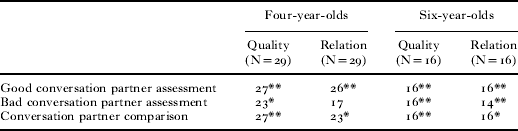
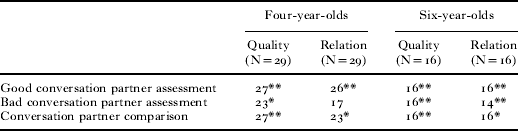
An analysis of individual questions revealed differences in children's responding across age. In particular, six-year-olds were likely to get the correct answer for all three of the questions (quality condition: 16 out of 16 children responded correctly; relation: 14 out of 16, binomial test, p < 0·01). However, four-year-olds were likely to get the correct answer for all three questions in the quality (23 out of 29, p < 0·01) but not in the relation condition (16 out of 29, p = 0·71). Further examination of four-year-olds' responses to the individual questions in the relation condition revealed that they provided correct responses to the good partner assessment question (26 out of 29, p < 0·001) and the partner comparison question (23 out of 29, p < 0·01), but not the bad partner assessment question (17 out of 29, p = 0·46). It seems unlikely that this is a problem with the question itself (since children in the quality condition did not have a similar problem). See Table 1 for a summary of responding by question.
Number of children who responded correctly to the speaker assessment and comparison questions by age and condition
notes:
** p < 0·01, ** p < 0·001, binomial tests.
Word-learning test
The word-learning phase tested children's relative trust of the conversation partners. We predicted that children would select the label–referent pairs that were endorsed by the good conversation partner.
A two-way ANOVA (age group × condition) with word-learning test scores as the dependent variable revealed a main effect of age group (F(1, 86) = 6·31, p = 0·01, ηp2 = 0·07), indicating that six-year-olds were more likely than four-year-olds to select referents that had been labeled by the good conversation partner. There was no main effect of condition (F(1, 86) = 0·64, p = 0·42, ηp2 = 0·01), or significant age group by condition interaction (F(1, 86) = 2·94, p = 0·09, ηp2 = 0·03). As above, we conducted simple-effects analyses to investigate condition differences separately by age group. Six-year-olds showed no difference in their word-learning scores between conditions (t(30) = 0·60, p = 0·57), but four-year-olds were more likely to choose the target objects in the quality than in the relation condition (t(56) = 2·11, p = 0·04).
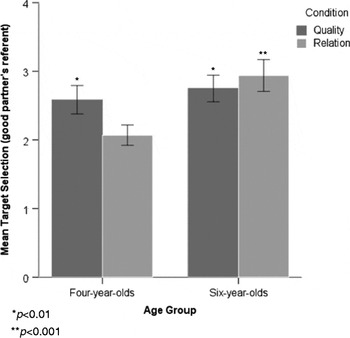
Scores for the word-learning phase were also tested against chance to evaluate the reliability of children's responding (see Figure 3). Six-year-olds selected the good conversation partner's referent at above chance levels in both the quality (M = 2·75 out of 4, SD = 0·78, t(15) = 3·87, p = 0·002) and relation (M = 2·94, SD = 0·93, t(15) = 4·04, p < 0·001) conditions. Four-year-olds performed above chance in the quality (M = 2·59, SD = 1·12, t(28) = 2·82, p = 0·009) but not the relation condition (M = 2·07, SD = 0·80, t(28) = 0·47, p = 0·65).
Mean target selection (error bars = standard error).

What accounts for children's selection of the good conversation partner's objects?
To investigate whether it was children's understanding of the procedure (as indexed by the comprehension questions) or children's ability to identify the person who adhered to the maxims (as indexed by the assessment questions) that predicted their performance, we conducted a linear regression with comprehension score, partner assessment score and age in months as independent variables, and the word-learning test score as the dependent variable. The full regression model was significant (F(3,86) = 3·97, p = 0·01), with the partner assessment score emerging as the only independent predictor of children's word-learning scores (t(1) = 2·43, p = 0·02). See Table 2 for a summary of raw correlations and the regression table. This suggests that children's ability to identify the person who violated or adhered to pragmatic conventions is the best predictor of their ability to choose the correct referent during word-learning trials.
Raw correlations and regression analysis of word-learning test score (N = 90)

notes: R2 = 0·12, Adjusted R2 = 0·09, R = 0·35.
* p < 0·05, ** p < 0·01.
DISCUSSION
In the present study we asked whether children use a person's pragmatic history to judge the reliability of their naming behavior. We also investigated whether children were able to recognize maxim adherence in observed everyday conversation contexts. Six-year-olds demonstrated the ability to recognize maxim violations of both quality and relation. They then also used this information to trust the labels offered by the person who adhered to the maxim. Four-year-olds showed an overall tendency to recognize violations of both of the maxims (but showed somewhat weaker understanding for relation), and used violations of the maxim of quality to determine whom to trust. Importantly, children's ability to choose the person who adhered to a maxim predicted their selection of the correct object during word-learning trials, independently of age in months and children's overall understanding of the procedure. Taken together, these finding indicate not only that children can recognize when adults adhere to Gricean maxims in observed conversations, but also that children use this information to make inferences about the reliability of information provided by different speakers.
What have we learned about children's knowledge of Gricean maxims?
This research extends previous findings about children's awareness of adherence to Gricean maxims in several ways. Previous studies indicated that six-year-olds recognized adherence to the Gricean maxim of relation when they are presented with short vignettes (Ackerman, Reference Ackerman1981; Conti & Camras, Reference Conti and Camras1984), and four-year-olds can recognize adherence to quality and relation in information-rich contexts that include practice and incentives (Eskritt et al., Reference Eskritt, Whalen and Lee2008). The present study confirmed six-year-olds' ability to recognize maxim adherence but extends this by demonstrating that they can extract information about pragmatic competence from observed conversations. Four-year-olds also recognized adherence to the maxims of quality and relation, and they were able to do this without practice or incentives, a situation that is similar to what children would encounter when observing an everyday conversation between adults. This suggests that even four-year-old children can evaluate third party interactions to gather evidence of pragmatic competence (see also Floor & Akhtar, Reference Floor and Akhtar2006). This ability had previously been found in six-year-olds (Ackerman, Reference Ackerman1981; Conti & Camras, Reference Conti and Camras1984).
Relation to children's trust in information sources
Previous studies have found that children use the truthfulness of speakers' labels and whether they are knowledgeable to determine whether they will provide accurate information about novel objects (Birch & Bloom, Reference Birch and Bloom2002; Birch et al., Reference Birch, Vauthier and Bloom2008; Brosseau-Liard & Birch, Reference Brosseau-Liard and Birch2010; Clément et al., Reference Clément, Koenig and Harris2004; Corriveau & Harris, Reference Corriveau and Harris2009a; Reference Corriveau and Harris2009b; Corriveau et al., Reference Corriveau, Meints and Harris2008; Koenig et al., Reference Koenig, Clement and Harris2004; Koenig & Harris, Reference Koenig and Harris2005; Pasquini et al., Reference Pasquini, Corriveau, Koenig and Harris2007; Koenig et al., Reference Koenig, Clement and Harris2004; Koenig & Jaswal, Reference Koenig and Jaswal2011; Nurmsoo & Robinson, Reference Nurmsoo and Robinson2009). The current findings indicate that children can similarly use a speaker's pragmatic ability, even when it is unrelated to the provision of correct information about objects. In the relation condition, children used judgments about utterance relevance to decide which of two speakers would provide valid labels for objects even though utterance relevance was unrelated to whether the speakers would know the names for objects. To our knowledge, this has not been explicitly tested in previous studies on children's trust in testimony.
What accounts for four-year-olds' difficulty with the maxim of relation?
One interesting finding is that four-year-olds in the relation condition did not endorse the labels provided by the maxim adherer. An investigation of their responding to individual questions suggests that they had more difficulty identifying the maxim violator than older children. One possibility is that relation violations may be somewhat harder to detect. The quality violation used in the present study produced an utterance with a truth-value that could be evaluated on its own without considering the discourse context. Saying you have sixty balloons when holding two is patently false. In contrast, the relation violation could only be judged as a violation in the context of the conversation. For example, ‘I like turkey’ can be true and is a perfectly valid response to some questions (e.g. ‘What do you like?’) but not others (e.g. ‘How many balloons do you have?’).
One way that children may begin to make more reliable judgments about the maxim of relation is by determining whether a given utterance fits within the flow of a conversation. As children become more competent conversationalists, they may be more likely to expect that contributions to conversations be relevant to what has already been said. It is possible that four-year-olds recognized a speaker's failure to adhere to the maxim of relation yet believed that it was somehow relevant. Future research could include a situation in which children are provided with information about a speaker's intentions when responding to questions to help them notice uncooperative contributions to the conversation.
Another possible explanation for four-year-olds' relatively poor performance in the relation condition may involve their willingness to generalize reliability across areas of expertise. Previous research has established that preschoolers are willing to accept that a person who does not know the correct names of common objects will not know the name of a novel object (Koenig et al., Reference Koenig, Clement and Harris2004; Koenig & Harris, Reference Koenig and Harris2005; Pasquini et al., Reference Pasquini, Corriveau, Koenig and Harris2007). In addition, other studies have shown that three- and four-year-olds trust novel object functions endorsed by speakers who have a history of correctly labeling common objects (Birch et al., Reference Birch, Vauthier and Bloom2008; Koenig & Harris, Reference Koenig and Harris2005; Rakoczy, Warneken & Tomasello, Reference Rakoczy, Warneken and Tomasello2009) and novel labels endorsed by speakers who have a history of knowing about objects (Sobel & Corriveau, Reference Sobel and Corriveau2010). In both cases, the underlying area of expertise may be knowledge of object properties (including names and functions). The link between the areas of expertise in the present study (conversational competence and knowledge of object properties) may be less transparent. This is especially true in the relation condition in which the violations did not have a clear link to object properties. The conceptual distance between the evidence offered in the familiarization trials and word-learning trials may have made it more difficult for the youngest group of children to use expertise in one area to inform another.
SUMMARY
In the current study, children used another person's pragmatic competence to decide whether they would provide valid labels for objects. This work dovetails nicely with research on young infants' language competence. As one example, there are well-established links between early pragmatic competence and label knowledge. In particular, researchers have found links between infants' participation in joint attention episodes (in terms of the sheer amount of participation and in their use of facets of joint attention, including gaze and gesture) and their vocabulary size later in development (e.g. Akhtar, Dunham & Dunham, Reference Akhtar, Dunham and Dunham1991; Brooks & Meltzoff, Reference Brooks and Meltzoff2005; Carpenter, Nagell & Tomasello, Reference Carpenter, Nagell and Tomasello1998). The ability to make judgments about the quality of a contribution in conversation may be a natural extension of these early skills, because it shows that correct application of social–pragmatic information may guide children's label learning. The present investigation found that children are not only aware of pragmatic conventions, but that they are more likely to trust information provided by pragmatically competent individuals.