The mollusc Patella ferruginea Gmelin, 1791, endemic to the Mediterranean, is the most endangered marine species on the list of the European Council Directive 92/43/EEC and it is presently in serious risk of extinction (Laborel-Deguen & Laborel, Reference Laborel-Deguen, Laborel, Boudouresque, Avon and Gravez1991; Ramos, Reference Ramos1998; Espinosa et al., Reference Espinosa, Guerra-García, Fa and Garcia-Gomez2006). Although there were several papers that referred to the protandrous hermaphroditism of the species (Laborel-Deguen & Laborel, Reference Laborel-Deguen and Laborel1990; Guerra-García et al., Reference Guerra-García, Corzo, Espinosa and García-Gómez2004; Templado et al., Reference Templado, Calvo, Garvía, Luque, Maldonado and Mozo2004; Espinosa et al., Reference Espinosa, Guerra-García, Fa and Garcia-Gomez2006) based on sexual dimorphism in size–frequency of limpets (Orton, Reference Orton1928; Branch, Reference Branch1974; Thompson, Reference Thompson1979), there have been no previous direct observations of protandry in this species. In this sense, in the superfamily Patellidae there are no direct records of protandry in spite of the numerous suggestions of its occurrence, except for Patella vulgata (Le Quesne & Hawkins, Reference Le Quesne and Hawkins2006), and Lottia gigantea within the order Patellogastropoda (Wright & Lindberg, Reference Wright and Lindberg1982). Furthermore, some authors argue that Patella ferruginea could be a gonochoric species (Guallart et al., Reference Guallart, Calvo, Cabezas, Ballesteros, Palacin and Turon2006a,Reference Guallart, Templado, Calvo, Cabezas, Acevedo, Machordom and Luqueb), even though the sex ratios diverged from the expected Fisher 1:1 for dioecious species (Fisher, Reference Fisher1930). The knowledge of the reproductive strategy in this highly endangered species is crucial to the management and conservation of populations.
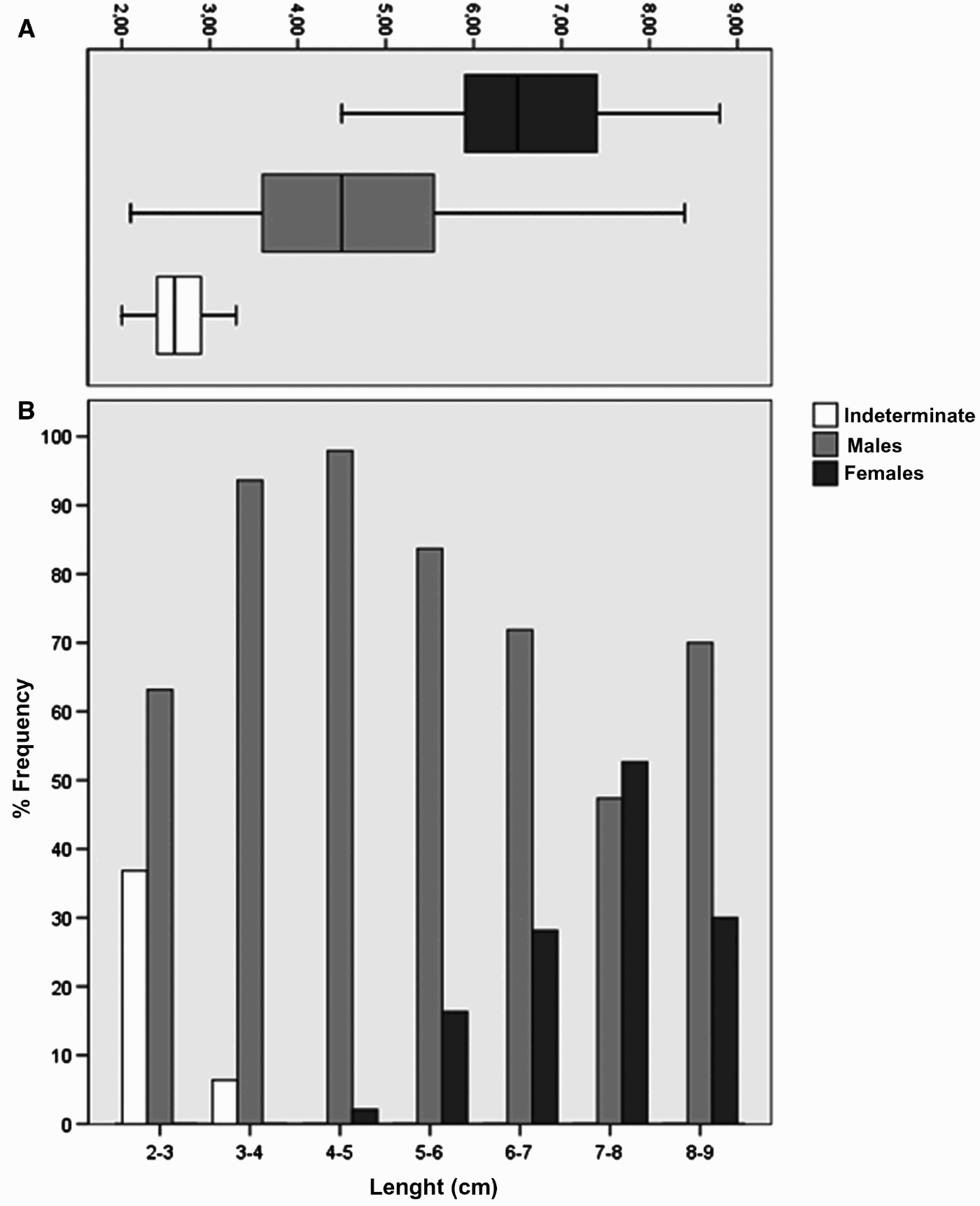
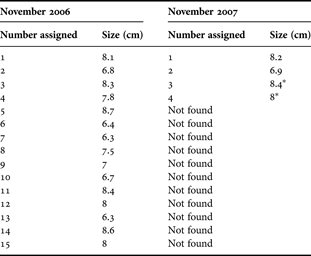
In November 2006, 243 individuals of P. ferruginea were sexed as part of a separate study in different sites along the shoreline of Ceuta, North Africa (35°54′N 5°19′W), measured to the nearest mm and sexed by non-fatal method of Wright & Lindberg (Reference Wright and Lindberg1979) (Figure 1). The observed size–frequency indicated a clear separation between the mean size of males and females, whereas the females became more abundant the larger they became, as Espinosa et al. (Reference Espinosa, Guerra-García, Fa and Garcia-Gomez2006) reported previously for the species based on Ceuta's harbour population. However, an important proportion of males could be found in the larger size-group, and presumably, these individuals might start the sex change in the near future or remain as males if the cues that lead to sex change never appear. In order to check this hypothesis 15 males (previously sexed as explained above), always falling into the group of 6 cm or larger, in which females start to appear or represent an important percentage (see Espinosa et al., Reference Espinosa, Guerra-García, Fa and Garcia-Gomez2006; Figure 1), were marked inside the harbour of Ceuta in November 2006 (Table 1; overlapping with the spawning season, see Frenkiel, Reference Frenkiel1975) with epoxy resin and an individual number was stamped directly onto it (see Espinosa et al., Reference Espinosa, Guerra-García, Fa and Garcia-Gomez2006, Reference Espinosa, González, Maestre, Fa, Guerra-García and García-Gómez2008). Of this sample, four marked limpets were found, collected and equally sexed during the following spawning season in November 2007. The low number of individuals collected may be the result of increased mortality due to the biopsy procedure and mark loss, in addition to natural mortality as pointed out by Le Quesne & Hawkins (Reference Le Quesne and Hawkins2006) for Patella vulgata. In this sense, Espinosa et al. (Reference Espinosa, González, Maestre, Fa, Guerra-García and García-Gómez2008) recorded a high mortality rate in Patella ferruginea with a temporal study performed in Ceuta. Two of the four limpets that had initially been male were female at the time of the second observation. Taking into account these preliminary results, we can suggest that Patella ferruginea is a protandrous hermaphrodite instead of a gonochoric species. Nevertheless, it could be possible that some specimens never change sex. However, a more extensive study would be necessary to obtain a significant statistical percentage of sex change and to check the possibility of two-way sex change (from female again to male) as Le Quesne & Hawkins (Reference Le Quesne and Hawkins2006) found for Patella vulgata based on a single observation. These preliminary results could be useful in a conservation context. Thus, the sex distribution through sizes in Patella ferruginea makes this species extremely vulnerable to poaching (see Espinosa et al., Reference Espinosa, Guerra-García, Fa and Garcia-Gomez2006), taking into account that the depletion of larger and more fecund individuals, and also females in a higher percentage could bias the reproductive output to a complete collapse. The differences in the length specific sex ratios and the evidence of protandry in the species indicate that there are cues involved in the process. Further studies in this field would be of great interest.
(A) Mean sizes (cm) and range of variation for the three groups considered; (B) length specific sex ratios of Patella ferruginea collected from Ceuta.

Sizes and numbers assigned to the marked male limpets.

*, sex change recorded from male to female.