I. CAREERISM AND PROFESSIONALISM: PATHS TO LEGISLATIVE CAPACITY
What were the extent, timing, and trajectory of state legislative careerism and professionalism over the course of the twentieth century? The sheer number of states and the difficulty of gathering data over long stretches of time have made this a difficult question to answer comprehensively. Here we offer new answers to old questions and also attempt to open up new avenues for future study. We consider multiple facets of legislative capacity to build an argument about its jagged, piecemeal development, and about the ways that legislative practice can make even small amounts of expertise valuable. Most U.S. state legislatures, we contend, have been neither amateur nor professional, but have existed somewhere in between. This in-between status means that state legislatures have been able to have some kinds of voice and not others in U.S. political development.
These findings complicate our understanding of state legislative “development” and they have wide implications for thinking about how and when state legislatures matter. Consider the roles that legislatures play in state politics—as agenda-setters, as gatekeepers, as sources of oversight and public discourse—and the particular capacities required for those roles. Most legislators in most years of our sample could not play all of those roles for all policy domains. Nevertheless, most legislators in most years had pockets of expertise that allowed them to do at least some of these things. In documenting this legislative diversity, we set forth a new, multidimensional framework for evaluating state legislative power.
The scope and depth of such pockets of expertise seem important to us for understanding policy outcomes more broadly. Of course, policy involves “multiple hands on the wheel.”Footnote 1 If there are pockets of expertise in amateur legislatures, then such legislatures have the capacity for influence, the opportunity to have “a hand on the wheel.” Just what this influence looks like varies. It can involve the sorts of investigative tools Eric Schickler's entrepreneurs used to undercut incursions by the executive.Footnote 2 It can be agenda-setting, policy-initiating control, of the sort that Dan Carpenter's bureaucrats developed.Footnote 3 We imagine that—while the emergent expertise we document is valuable in battles with other state or societal interests—the most important role it plays is in allowing legislators to think up ideas that can play a role in the policy process. As Nordlinger puts it, “governing is in large part an intellectual exercise,”Footnote 4 and the ideas for this exercise come in serious part from “civil servants reacting to what they see as the deficiencies of existing policies, taking the initiative in formulating remedial changes, and promoting and orchestrating support for their preferred policy corrections.”Footnote 5 The pockets of expertise we point to here—supplying staffing, marshalling leadership, and so on—give the legislature in general and legislators in particular the capacity for this intellectual work. Without these pockets, legislatures might only be reactive bodies. We are anxious to see these ideas about emergent expertise put to use in understanding policy development over time and space, and we make a start on this here.
Legislative Capacity
Legislative capacity is the ability of the legislature “to perform its role in the policy-making process with an expertise, seriousness, and effort comparable to other actors in that process.”Footnote 6 It is the possibility of autonomous voice in the political process.
We differentiate between two possible sources of such capacity: the members and the institution. Both the cumulative experience of legislators—what others have called careerism—and features of legislative institutions such as staff or time in session—what others have called professionalism—can endow a legislature with knowledge, skills, and abilities that enable it to play a stronger, more independent role in lawmaking.
With respect to legislative experience, the features of legislative careers that matter here are the expertise legislators can build up over multiple terms in office and the extent to which they identify with and prioritize their work as legislators.Footnote 7 Both of these dimensions have consequence, of course, for the capacity of the legislative institution. Without long-serving members, there may not be the expertise necessary for serious policymaking.Footnote 8 Jewell notes that “in many states it is even common for the chairman to be a new member of a committee. The result is that the committees usually fail to develop a nucleus of men with detailed knowledge.”Footnote 9 Inexperienced members lack not only policy knowledge, but also a myriad of skills necessary for political struggle.Footnote 10 Jewell, observing legislatures filled with amateurs, concludes that these state legislators had “little incentive to learn the rules and techniques of the legislative game”—meaning those who did not identify with legislating as a career were unlikely to engage in a way that strengthened the place of the legislature in the politics of policymaking.Footnote 11
The accumulation of individual members' experience and commitment is not the only way for a legislature to build capacity. The legislative institution itself may be structured to enable such capacity. In his classic 1968 work on this process, Polsby offers an account in which professionalism is embedded in the details of practice and procedure—an account that embraces the notion of “routinization.”Footnote 12 Polsby's intuition was that routinization would be evident in a whole host of measures, ranging from seniority systems to established committees with defined jurisdictions and detailed differentiation, to “personnel, facilities, and money.” The accoutrements of professionalism give legislatures a substantial, autonomous voice in policymaking. Heard, for instance, points out that “most state legislatures … lack space, clerical staffing, professional assistance … [T]hey are prey to special interests … [T]hey sometimes cannot even get copies of bills on which they must vote.”Footnote 13 Moncrief, Thompson, and Kurtz report the sentiment of an Idaho legislator, “that ‘[m]ore staff support has given legislators a better chance to know the issues more thoroughly.’”Footnote 14 Without professionalism, legislatures may simply serve as a rubber stamp for more powerful bureaucracies, interests, or governors. With professionalism, it can be otherwise, even for legislatures filled with amateur legislators.
State politics scholars have captured the parts of Polsby's concerns with “personnel, facilities, and money” that can be relatively easily measured. A professional legislature has come to mean a legislature that meets full time; a legislature with staffing, offices, and few constitutional limits on session length and pay; a legislature with a seniority system; or a legislature with a constellation of long sessions, decent pay, and staffing.Footnote 15 More intricate details of legislative organization that might enable capacity, however, have been largely missing from systematic measurement strategies (for a similar critique, see Rosenthal).Footnote 16
With this article, we attempt to offer a more nuanced account of the development of legislative capacity, one that provides new tools for understanding the place of these state legislatures in politics and policymaking over the course of the twentieth century. Without such an account in hand, we could easily misunderstand just how much autonomous influence these legislatures had; we might underestimate legislative power and overestimate interest group or executive power in U.S. political development.Footnote 17
II. DATA
The data in this paper are drawn from the experiences of the lower houses in thirteen American states: Alabama, California, Illinois, Massachusetts, Michigan, Minnesota, Montana, Nebraska, New York, Texas, Vermont, Virginia, and Washington. We selected these states to represent the diversity of regions, industrial development, urbanization, and levels of legislative professionalism that characterize the American states generally. Collecting data from these states has led us, in other work, through all the legislative business conducted in these states at twenty-year intervals and to the nature of interactions between state governments and local governments.
For this project, we focused on the same twenty-year intervals, collecting data, whenever possible, for legislatures meeting in 1881, 1901, 1921, 1941, 1961, 1981, and 1997. There were some states whose legislatures did not meet in these specific years, so for these states we collected and report data for the closest year where data exist.Footnote 18 Our data included information on lawmakers, their careers, and key institutional features of legislative bodies. We collected our data on individual legislators principally from individual biographies for virtually every legislator who served in these thirteen states in these seven sessions. Where biographies did not exist, we examined rosters going back, in many cases, to the 1860s, in order to track long-term patterns of legislative service, enabling us to measure membership turnover, average length of service, and occupations.Footnote 19 To capture institutional features, we collected data on legislative salaries, session length, and committee service from a number of sources, mainly legislative manuals and journals.
III. CAREERISM
Scholars have emphasized that state politics is dominated by amateurs and have long documented the high rates of turnover that have characterized the memberships of state legislatures, leaving them without the substantial capacity-building resources of experience and expertise.Footnote 20
Despite this common knowledge about expertise lodged in members, the measures of legislative careerism that have been examined in the existing scholarship have been surprisingly limited. Two studies examine all fifty states at a single point in time, and a third study examines the fifty states over a brief period of time.Footnote 21 Two other studies examine all fifty states over long periods of time, but these studies report data only on the number of first-year legislators.Footnote 22 Another study presents data on legislative careerism over a long period of time, but focuses on only three states, while Hyneman's landmark study examines an array of data for ten states, but only for a ten-year period.Footnote 23 The existing work, then, does not actually contain a compelling time-series measure of careerism. We provide that here. Our findings show careerism emerging much earlier, in many more states, than previous scholarship has indicated, suggesting a greater institutional capacity than previously imagined.
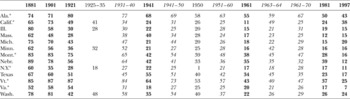
How prevalent is the expertise that comes from long service in the legislature? Drawing on our new data set, we examine rates of turnover in the thirteen states. The general pattern is clear and unsurprising. Over the last 125 years, the numbers of first-term legislators have fallen in every state legislature in our sample. This pattern is clear in Table 1a, which identifies legislators with no prior service, and it is just as clear in Table 1b, which identifies legislators who were not in the chamber at the start of the preceding session of the legislature.Footnote 24 In Michigan, the percentage of legislators with no prior service fell steadily from 75 percent in 1881 to 15 percent in 1981, with a slight rise to 20 percent in 1997. In Vermont, the percentage fell from 85–87 percent in 1881–1921 to 25 percent in 1997. And in Washington State, the percentage fell from 42 percent in 1921 to 22 percent in 1961, and was in the 24–26 percent range in 1981 and 1997. The one notable exception is California, where the number of freshman legislators shot up suddenly in the 1990s as a consequence of term limits.Footnote 25
Percent of Lower-House Legislators in Their First Terms

Percent of Lower-House Legislators Who Did Not Serve at the Start of the Previous Session

Bold: Data we have collected Italics and roman: Data from prior studies (see footnote 24 for details)
* For these states, data are reported for a year other than 1881, 1901, 1921, 1941, 1961, 1981, or 1997. The exceptional years for Alabama are 1880, 1907, 1919, 1939, 1959, and 1979; for California, 1903; for Montana, 1923 and 1963; for New York, 1883; for Vermont, 1886 and 1900; and for Virginia, 1920, 1942, and 1960. For a discussion of sources, see the section titled “Data Sources.”
Although turnover fell in every state legislature over the course of the twentieth century, other patterns show significant differences between states. Two legislatures stand out in 1901 for unusually low numbers of first-term members. At a time when only small minorities of legislators in other states could claim previous legislative experience, in Massachusetts and New York a majority of legislators had already served at least one term. In 1921, these two states, along with Illinois, continued to stand out in sharp relief from the rest of the pack: fewer than 30 percent of the legislators in these states in 1921 were in their first term. Length of service appears to have begun growing in these three legislatures at the end of the nineteenth century, at exactly the same time as the growth of careerism in the U.S. Congress. Turnover in the three states had fallen sharply in the twenty years before 1901. In Illinois, the percentage of first-time legislators fell from 80 to 58 between 1881 and 1901. In Massachusetts and New York, the declines were just as dramatic—from 62 to 48 percent in Massachusetts, and from 60 to 35 percent in New York.
Between 1921 and 1961, patterns of lengthier service emerged in several other state legislatures. By 1961, in eight of the thirteen states, first-term legislators composed no more than a quarter of the membership. In that year, in just one state, Alabama, did freshmen still make up a majority of the legislative body. In four other states—Montana, Nebraska, Texas, and Vermont—freshmen made up at least one-third of their chambers. By the end of the twentieth century, legislators everywhere, except those restricted by term limits, were pursuing multiple terms of office. First-term legislators, who were common in most states in the first half of the twentieth century, had become exceptional by the end of the century.
Previous studies of legislative turnover capture the general downward trend that we discuss here, but they seem to have overestimated the numbers of first-term legislators throughout most of the twentieth century. That earlier studies systematically exaggerated levels of turnover could be due, in part, to the difficulty in working with The Book of the States as a data source. Unlike the biographies, which usually report previous service for each legislator, working with The Book of the States requires comparing each state's legislative roster in one year to its rosters in many previous years, searching earlier rosters to see if particular names occur more than once.Footnote 26 This is tedious and difficult work, and nearly all errors would logically result from failing to find a legislator's name in an earlier roster rather than mistakenly coding a true first-term legislator as someone with previous service. Such errors, accumulated over multiple sessions, could explain what appear to be inflated counts of first-term legislators in earlier work. The overestimation of freshman legislators could be exacerbated by the large numbers of legislators in the mid-twentieth century who served nonconsecutive terms, which are more difficult to track in rosters than legislators serving consecutive terms.
Tables 1a and 1b display, in bold print, the data that we have collected directly from the legislator biographies. They also display, in italic and roman print, data previously reported by other scholars. Italicized numbers come from scholars who surveyed rosters of legislator names appearing in The Book of the States, while numbers in roman come from Hyneman and Zeller, both of whom appear to have collected their data directly from clerks in the legislatures they studied.Footnote 27
The numbers that we report (in bold) are generally lower, sometimes much lower, than the numbers (in italics) reported by previous scholars who have relied on The Book of the States.Footnote 28 This is especially true for the pre-1970 period. Compare, for example, the 1941 figure (based on our analysis of the biographies) to the 1931–40 and 1941–50 averages (based on the work of others relying exclusively on The Book of the States): our 1941 figure is lower than both of the italicized figures for ten of the thirteen states, and often much lower.Footnote 29 Or consider the 1961 figure, which is lower than all three of the nearby italicized figures (for 1951–60, 1963–64, and 1961–70) for eleven of the thirteen states.Footnote 30
Moreover, as a comparison of Table 1a to Table 1b suggests, significant numbers of legislators arrived with prior experience, though not as measured by service at the start of the preceding session. In Alabama's 1880 session, for example, 26 percent of the members had prior service in the legislature, although just 10 percent had been members in the preceding session. Especially in the years before 1961, the memberships of state legislatures included significant numbers of returning members whose service was not continuous. And, by 1961, large numbers of state legislatures were dominated by returning members. In short, prior work appears to have underestimated the degree of experience, and thus the potential sources of expertise, in twentieth-century state legislatures.
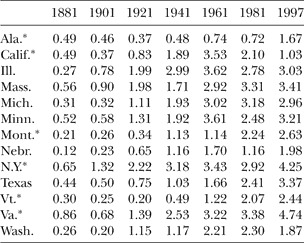
Exactly how much experience legislators were accumulating, however, is not apparent in either of these first measures of careerism. We therefore also counted the number of previous terms served by each legislator, and report the average for each legislature in Table 2.Footnote 31 Although none of the legislatures had significant reservoirs of previous legislative experience in the late nineteenth century, by 1921 experience was on the rise—particularly in New York, Massachusetts, and Illinois. The average member in those three legislatures in 1921 had already served two previous terms.
Average Number of Terms of Previous Service for Lower-House Legislators

* For these states, data are reported for a year other than 1881, 1901, 1921, 1941, 1961, 1981, or 1997. Either legislatures did not meet in these years, or we could not locate biographical data for these years. Thus we substituted the closest year for which we could find data. The exceptional years for Alabama are 1880, 1907, 1919, 1939, 1959, and 1979; for California, 1903; for Montana, 1923 and 1963; for New York, 1883; for Vermont, 1886 and 1900; and for Virginia, 1920, 1942, and 1960. For a discussion of sources, see the section titled “Data Sources.”
In both Massachusetts and New York in 1921, more than one in seven legislators had served at least five previous terms. Martin Lomasney, the colorful and legendary boss of Boston's West End Democratic machine, listed his occupation simply as “real estate”; he was serving his fourteenth term that year, having sat in the house on and off since the 1899 session. In addition to his time in the lower house, Lomasney noted that he had also sat on the Boston Board of Aldermen, represented his district to the state's recent constitutional convention, and, for good measure, served two terms in the state senate. Seven other Massachusetts men were in at least their tenth term in 1921: Henry Achin, Jr., of Lowell (who worked in “fire insurance” and had previously sat on the Lowell City Council); Andrew P. Doyle of New Bedford (“manufacturer soda water” and formerly an alderman as well as a member of the Lowell Common Council); Edward F. Harrington of Fall River (a grocer, who had served as both a Fall River councilman and alderman before coming to the State House); Victor Jewett of Lowell (“vinegar manufacturer” and former member and president of the Lowell City Council); John Mitchell of Springfield (“flour and grain dealer” and a delegate to the constitutional convention); Chauncey Pepin of Salem (a watchmaker, who had served three terms on the Salem City Council); and Jerome S. Smith of Provincetown, on Cape Cod (“dairy business”). Not only were the Massachusetts House and New York Assembly filled in 1921 with large numbers of returning legislators, but, as these examples suggest, even first-term legislators arrived with backgrounds in city, town, county, and village governments.
By 1961, the average number of previous terms of service had risen to 2.9 terms or greater in seven states.Footnote 32 By 1997, differences among the thirteen states had diminished—with the exception of California, where term limits changed the pattern altogether.
In short, we find a more experienced set of members by the early 1960s than the literature suggests. By the middle of the twentieth century, legislative dabblers had been edged out by a more experienced mode of legislator. With previous experiences, legislators had opportunities to accumulate expertise and incentives to organize legislatures in ways that relied on expertise. Thus, we see the first of many channels through which legislatures could carve out an autonomous voice in the political process.
IV. CAPACITY IN INSTITUTIONS
Professional practices have been built into the legislative process even when careerism is not a typical characteristic of the members. We examine multiple dimensions of professionalization and routinization. These measures suggest that legislative “development” is ragged and piecemeal and not at all a steady march to institutional capacity. In fact, legislative organization allows for the concentration of expertise—and the possibility of autonomous voice—even in legislatures that lack most other markers of careerism and professionalism.
The creation of professional practices is particularly crucial given what we know about legislative workloads—they can be incredibly high even in the least careerist legislative bodies. The Alabama House, for example, which has never developed careerist tendencies, has regularly faced well over one thousand bills in a session. From 1921 onward in our sample, the lower houses in Montana, Nebraska, and Vermont usually faced at least five hundred bills a session. We take up several institutional features that might enable legislators who are sorting through a thick stack of bills to draw on experience and specialized knowledge, whether or not the average legislator has much of either.
Professionalization: Session Length
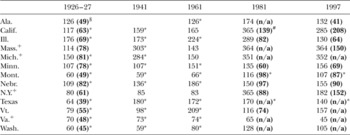
A key institutional feature that can facilitate—or stymie—legislators’ abilities to both gain and exercise legislative experience is the time allowed for their legislative work. While the vast majority of state legislatures now meet in annual sessions, this was not the case for most of the twentieth century. Even rarer have been legislatures that meet for most of the year when they are in session. Table 3 demonstrates this with data on legislative-session length and frequency for our thirteen states. In the 1920s, just two legislatures, those in Massachusetts and New York, met every year. Ten of the other legislatures met every other year—and Alabama's legislature met just once every four years. Moreover, most of the legislatures were meeting for just two or three months. By 1941, just two states, Massachusetts and Michigan, had sessions that stretched over most of the year, and in both cases the legislatures met just every other year.Footnote 33 Annual sessions had become the norm by 1981, but many states continued to meet for just fractions of the year. In fact, by 1997, only four states, which had all also been early movers to annual sessions, were in session for more than half the calendar year. Long sessions do not appear to be a very commonly used tool for accumulating expertise.
Length of Legislative Sessions

Bold: actual days in session Roman: calendar days in session
* Legislature met once every two years.
§ Legislature met once every four years.
# Legislative days reported in table equal half of the days in California's two-year session, 1980–82.
+ Data reported for Virginia are from 1942 and 1960, for Massachusetts, 1993, Michigan, 1995, and New York, 1993.
Note and sources: In all cases, we report data for a single year, including days spent in regular and special sessions. In 1926–27, a time when state legislatures generally met every other year, we report data for the year the legislature met in regular session. The Book of the States 1935 (62–63), 1943–44 (138–39), 1962–63 (42–43, 56–57), 1984–85 (104–10), and 1998–99 (64–67, 105–9).
Professionalization: Salary
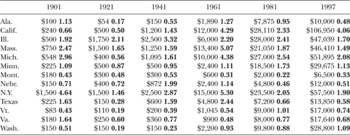
Scholars have long assumed that state legislative salaries were generally low until the reforms of the 1960s, when the movement for professionalization raised salaries in many states. Thus Squire finds that salaries were generally miniscule, that “state legislative salaries lagged far behind” congressional salaries in the first half of the twentieth century.Footnote 34 But perhaps congressional salaries are not the best benchmark for state legislative salaries, particularly given the often drastic differences across states' economies. We revisit this issue by calculating legislator pay as the sum of salaries, per diems, and living expenses, and comparing pay to per capita income in each state, as reported in Table 4. By scaling legislator pay to the state's contemporaneous per capita income, we have a way to make comparisons across both space and time.
Legislator Pay in Lower Chamber (as nominal dollar amount and as proportion of state per capita income in that year)

Bold: legislator pay as a proportion of state per capita income Roman: legislator pay in current dollars.
Note and Sources: Where states specify a salary over two years, we report half of the two-year salary. Where states specify a per diem rather than annual salary, we multiply the per diem rate by the maximum number of days allowed for a regular session, then divide that number by two if the legislature meets every other year. We also include living expenses in the cases where these form at least one-quarter of total compensation. Michigan Official Directory and Legislative Manual, 1895, 1901–1902 (318–19), 1921; The Book of the States, 1943–44 (137–39), 1960–61 (38–39), 1962–63 (42–45), 1980–81 (90–91, 108–9), 1998–99 (80–81); Richard M. Easterlin, “State Income Estimates,” in Population Redistribution and Economic Growth: United States, 1870–1950, vol.1 (The American Philosophical Society, 1957), 753; Statistical Abstract of the United States, 1964 (329), 1984 (457), 1999 (468).
Analysis of the pay data suggests that at least some state legislators were earning enough from their legislative positions to rely upon this income as their primary means of support at a remarkably early date. As early as 1901, state legislators were earning notable sums for their government service in Massachusetts, Michigan, and New York. Compensation declined or remained stagnant over the next generation. By the 1920s, legislators in ten states had faced either literal pay cuts or depreciation of pay in real dollars. Over the next four decades, the situation changed. As a proportion of per capita income, legislative income peaked in most states in 1961. In that year, legislator compensation was more than four times the state's per capita income in four states and more than two times the state's per capita income in two other states. With one exception (California in 1997), salaries did not approach such high levels after 1961.Footnote 35
Professionalization: Staffing
The literature suggests that legislators at the turn of the century had little staffing to draw upon. Speaking of the U.S. Congress in the Grant era, Thompson and Silbey describe the legislators as “overworked and underinformed, with almost no staff assistance and little effective guidance available.”Footnote 36 We find this condition common in state legislatures through the twentieth century. In 1981, Alabama, Illinois, Montana, and Vermont provided no personal staff to legislators. By the mid-1990s, Alabama, Montana, and Vermont still had no personal staff in the capitol, and Minnesota had eliminated personal staff for members of its lower house.Footnote 37
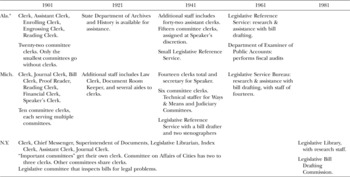
We suspect that this matters a little less than scholars have imagined. There are aspects of staffing even more central to the development of professional procedure in legislatures: the types and extent of staffing provided specifically for bill drafting. We focus on this type of staff—instead of on the general lack of staffing—because it creates the structural conditions for legislative work to matter. We sought to examine staff support for bill drafting in three kinds of state legislatures: ones that exhibited careerism early on, ones that have never been careerist, and ones that fall in between the two extremes. In the end, we were able to locate detailed staffing information over time for three states that vary in such a way: New York (very careerist), Alabama (decidedly not careerist), and Michigan (in between). Table 5 presents our findings.
Staff To Help with Bill Drafting in Three States

*Alabama data are from 1907, 1919, 1935/39, and 1961.
Sources: Michigan Legislative Handbook; Michigan Manual; New York Clerk's Manual; New York Red Book; Alabama Official and Statistical Register.
Comparing Michigan and Alabama, we find that this type of staffing varies over time and space. At the beginning of the twentieth century, Michigan's legislature provided ten committee clerks, a proofreader, and five primary clerks serving the body as a whole. As of 1921, there was also a law clerk and a document room with three staffers. By 1941, the Michigan legislature included fewer total committee clerks, but had a statistician for the Ways and Means Committee and a law clerk for the Judiciary Committee. Also, there was more staff support serving the body as a whole: fourteen clerks total, a document room, and a small Legislative Reference Service Committee. By 1961, the Legislative Service Bureau had a staff of fourteen. And in 1963, Michigan's constitutional revisions included a provision that formally institutionalized bill-drafting assistance for the legislature in the form of a Legislative Council.
In contrast, Alabama began the twentieth century with even more staffing for its legislature; twenty-two of the thirty standing committees of the lower house were supplied with a clerk, and five clerks served the body at-large. By 1919, the State Department of Archives and History made itself available to assist legislators. In 1935, the number of clerks at-large in the Alabama legislature had grown to six, with forty-two assistant clerks, and fifteen of the twenty-eight standing committees retained a clerk for their assistance. A small Legislative Reference Service was in place. Similar to the Legislative Council in Michigan, by 1961 Alabama's Legislative Reference Service was available to perform research on policy issues for legislators and assist in the drafting of bills, and an Examiner of Public Accounts was available to perform financial audits.
Notice the equal or greater provisions for this type of staffing in Alabama in comparison to Michigan at each of these points in time, despite the consistent lack of careerist legislators in Alabama and the steady march of Michigan's legislature toward careerism over these years. Here we find evidence that expertise and professional legislative practice can be developed, at least to some extent, in places where such expertise and professionalism are not being brought to the body through the service of its elected members.
New York legislators had access to staff from an early date: in 1901, committee rosters include clerks. While there was not the sort of bill-drafting service that Michigan legislators would be able to rely upon later in the century, there was a document room, a legislative library, and four principal clerks serving the body as a whole. Also, there was a committee charged with inspecting bills for contradiction, legal problems, and the like. The committee was chaired by a legislator with experience, in his fourth term in the New York Assembly. Furthermore, the body as a whole was served by a Chief Messenger, who had worked for the legislature for twenty-two years. The New York Red Book noted that “this title illy gives the manifold nature of [Chief Messenger Anderson Lawrence's] duties. … Mr. Lawrence, years ago, began to preserve the bills introduced in one session and put them at the command of the members of the Legislature the succeeding year.”Footnote 38 In 1921, clerks continued to be assigned to particular committees, although the New York Clerk's Manual noted that “(t)he majority of committee clerks at each session of the Legislature are new appointees, unfamiliar with their duties” and thus were very dependent on the four key clerks' assistance.Footnote 39 By 1981, the assembly members had access to a fully staffed legislative library, filled with research clerks, and they had access to a Legislative Bill Drafting Commission filled with attorneys, data processors, and technical staff.
Indeed, New York and Massachusetts were pioneers in the creation of legislative staffs. “State legislatures actually created institutional staff resources in advance of Congress,” Squire finds.Footnote 40 Massachusetts and New York created legislative libraries in the early 1890s, as the number of experienced legislators began rising. Not until 1914 did Congress establish its Legislative Reference Service, forerunner to the Congressional Research Service.Footnote 41
Practice: Seniority and Committees
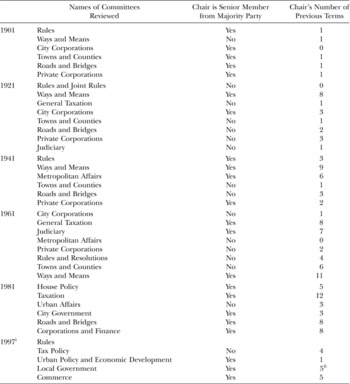
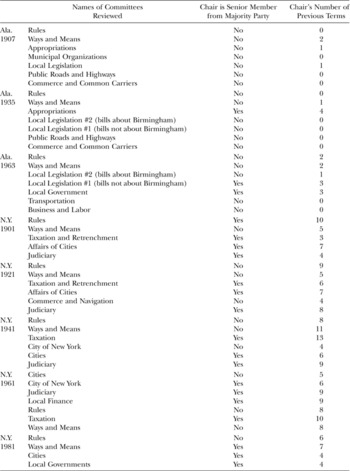
Another aspect of professionalization—one that is explicitly coupled with expertise—is seniority. Legislatures with few careerist members may choose to concentrate their experience and expertise in a few especially consequential committees or to distribute these members across committees in leadership positions. Thus seniority systems—or systems advantaging seniority—may well add another strategy to the list of ways that legislatures can build pockets of expertise. Tables 6a and 6b show seniority practices in Michigan, Alabama, and New York.
Seniority and Experience of Committee Chairs—Michigan

i In the Senate, there is explicit mention of seniority in the rules.
ii Note that, unlike the other numbers in the table, these numbers are calculated from a listing of members who served from 1987 on. This likely understates the number of terms served in the Michigan legislature for 1997 chairs.
Source: Michigan Manual.
Seniority and Experience of Committee Chairs—Alabama and New York

Sources: New York Red Book; Alabama Official and Statistical Register.
While it is clear that some form of seniority system existed in New York throughout the twentieth century, even in this relatively professionalized state legislature the practice was inconsistent.Footnote 42 In 1901 the most senior majority members chaired the committees on Judiciary, Taxation and Retrenchment, Affairs of Cities, and Rules, but not the Ways and Means Committee. In 1961 four committees that we examined (City of New York, Judiciary, Local Finance, and Taxation) were chaired by their most senior majority members, but three others (Cities, Rules, and Ways and Means) were not. In almost every case, however, the committee chairman was a long-serving member of the assembly.
In Michigan in 1901, chairs were the most senior majority members on all but one of the committees that we examined. Given the short tenure in office of all these chairs, though—all the “senior” chairs had served no more than one prior term—we are reluctant to infer that any seniority practices were in place. Indeed, senior majority members did not predominate as chairs again until 1981 and 1997. Alabama shows no indication of seniority practices in 1907, 1935, or 1963.
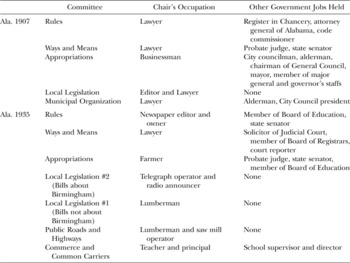
Of course, we would not want to assume that these Alabama committee chairs with short legislative tenures were political ingénues. As shown in Table 7, in 1907 and 1935, the chairs of Ways and Means, Appropriations, and Rules all had substantial experience in other state and local government positions. Among the chairs of other committees examined, some had political experience outside the legislature, but others did not.
Profiles of Alabama Committee Chairs

Source: Alabama Official and Statistical Register.
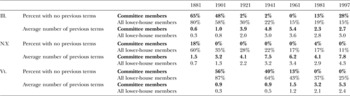
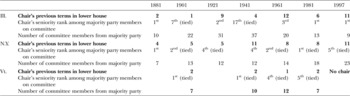
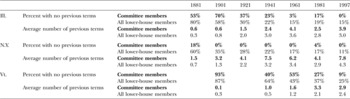
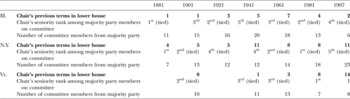
We turn next to look at whether legislatures concentrated expertise. That is, did the members appointed to two of the most important committees—the committees overseeing taxation and appropriations—have especially lengthy experiences in the house? In other words, did these legislatures develop key committees that were pockets of expertise? To find out, we examined committee service in Illinois, New York, and Vermont at twenty-year intervals from 1881 to 1997. The data are presented in Tables 8a, 8b, 9a, and 9b. We selected these three states because of how dramatically they have differed in terms of legislative professionalism and careerism. New York has had the most consistently careerist and professionalized legislature in the country, while Vermont has been a state with a prototypical amateur legislature. Illinois, while historically a professional legislature, lagged New York in legislative development and represents a different region of the country.
Legislative Experience of Members on Appropriations Committees

Seniority of Chairs of Appropriations Committees

Sources: We compared committee rosters to individual-level data collected (and reported above) for legislators in each of these states. Data from Illinois are for the Appropriations Committee (1881, 1901, 1921, 1941, 1961, 1981) and the Appropriations/Education Committee (1997). Data from New York are for the Ways and Means Committee (1883, 1901, 1921, 1941, 1961, 1981, 1997), which has long functioned as both an appropriations and a taxation committee. Data from Vermont are for the Ways and Means Committee (1900) and the Appropriations Committee (1941, 1961, 1981, 1997).
Legislative Experience of Members on Taxation Committees

Seniority of Chairs of Taxation Committees

Sources: We compared committee rosters to individual-level data collected (and reported above) for legislators in each of these states. Data for Illinois are from the Revenue Committee (1881, 1901, 1921, 1941, 1961, 1981, 1997). Data for New York are from the Ways and Means Committee (1883, 1901, 1921, 1941, 1961, 1981, 1997), which has long functioned as both an appropriations and a revenue committee. Data for Vermont are from the Land Taxes Committee (1900) and the Ways and Means Committee (1941, 1961, 1981, 1997).
In all three states expertise was powerfully concentrated in at least one of the money committees.Footnote 43 For example, in 1883, when 60 percent of New York's assembly members were in their first term, just 18 percent of the members of the Committee on Ways and Means were in their first term. Of the eleven assemblymen on this committee, nine had served previously in the chamber. The committee included two members, Thomas E. Benedict and Francis B. Spinola, who were in their fourth terms in Albany. Erastus Brooks, of Staten Island, who chaired the committee, was in his fifth term. In his 1883 biographical sketch, Brooks was described as “the acknowledged leader of the Democratic party in the lower house,” evidence of a clear strategy by members to concentrate experience, expertise, and leadership on the chamber's most consequential committee. Brooks was a journalist by trade, a farmer by avocation, who had earlier served four terms in the state senate.
The same pattern was evident in Illinois and Vermont. When, in 1981, 37 percent of Vermont's legislators were first-termers, no first-termers sat on the Appropriations Committee. Again, in 1997, when 25 percent of the Vermont legislature was made up of new members, none sat on this committee. In almost every instance, the membership of the Appropriations Committee was much more experienced than the membership of the chamber as a whole. This pattern is not as strong for the taxation committees as for the appropriations committees, evidence that perhaps the taxation committees in these states were not nearly as important as the appropriations committees.Footnote 44
These findings suggest the degree to which expertise was systematically concentrated in critical committees. At least in these three states, the appropriations committees were pockets of expertise—even in the earliest years for New York and Illinois (although, ironically, not for the most recent years in Illinois), even in the amateur legislature of Vermont. In 1901, for example, the average member of the New York Ways and Means Committee had served in the legislature 2.4 times as long as the average assembly member. And, in 1900, the average member of the Vermont Ways and Means Committee had three times as much legislative service as the average Vermont legislator. A century later, these patterns persist. The mean member of New York's Ways and Means Committee in 1997 had served 7.8 previous terms in the legislature (1.8 times as many terms as the average member of the assembly), while the mean member of Vermont's Appropriations Committee had served 5.3 previous terms (2.2 times that of the average legislator). Robert Kinsey, who sat on the Vermont Appropriations Committee in 1997, was in his fourteenth term in the legislature; in a chamber of 149 members, just two others had spent as many years in Montpelier. He had served previously as the House Republican leader and had sat for many years on the Republican Steering Committee. For his occupation, Kinsey listed “farmer/legislator,” the only person in the entire chamber to state outright that service in the legislature had become his career.
Whether in a longstanding professionalized state like New York or in Vermont—a state with tremendous member turnover, weakly established seniority systems, and only partial routinization of the committee systems—legislatures have built the expertise they can. There is no single answer for how the details of partial professionalism and routinization may work, or for how these forces do and don't change over time. Even the least careerist legislatures in our sample developed institutional capacity, ways to draw on expertise.
V. CONCLUSION
While many state legislatures might not be considered professional on the basis of blunt indicators, we have found that these legislatures possess pockets of professionalism, ways they use expertise. Legislators, we imagine, have incentives to marshal what expertise they have simply to make their way through the legislative workload. Thus, our account suggests ways that small amounts of expertise develop in the absence of other markers of careerism or professionalism.
We draw two key conclusions from our new data and from our focus on opportunities to marshal expertise. The first conclusion is that careerism has had an impact on capacity in a handful of legislatures, especially in Illinois, Massachusetts, and New York, and that careerism and salaries had already advanced by the early 1960s. A full century ago, members of two state legislatures—New York and Massachusetts—began seeking reelection on a regular basis, and, at nearly the same time, both legislatures began adopting professional practices.
The second conclusion is that even legislatures that were not as fully institutionalized as others still had noteworthy institutional capacities. In most states, even noncareerist legislators could still draw on some previous experiences in office for basic sources of expertise.Footnote 45 In imperfectly routinized legislatures, opportunities were made available by institutional designs that took advantage of what little expertise was available. High pay, extensive staffing, and the selective use of seniority systems all appeared in legislatures that were not commonly considered professionalized. These resources allowed such legislatures to have an autonomous voice in the policymaking process. Whether this means that these legislatures had positive or negative impacts on the policy process and whether such impacts were systematic should be the next area of inquiry. Our initial sense, of course, is that these pockets of professionalism give legislatures positive power.
One could use these data to ask whether careerism drives professionalization or whether professionalization leads to the development of longer careers. Our answer is that the question is more complicated, and more interesting, than that. By standard measurement strategies, professionalism comes first in these data.Footnote 46 When we look beyond those standard measures, we see something altogether different. Long careers are themselves indicators of available pools of expertise. And, absent long careers, legislators develop alternative ways to develop and use expertise. Indeed, these data warn us that we should distinguish constrained expertise from the wholesale absence of expertise. Legislators in more constrained circumstances—with fewer terms served, less staffing, and serving in bodies with less routinization—still seem to scratch out some places where they can turn for help in legislating.
Ultimately, the study of legislative capacity is a study of legislative autonomy. Throughout the twentieth century, there was no one, simple story about the tools that enable legislative capacity. Different state legislatures assembled different packages of tools. We suspect that, in times and places with constrained institutionalization, legislatures probably wielded greater capacity on particular tasks or in specific policy areas. In essence, pockets of expertise translated into pockets of autonomy, and one wouldn't necessarily find the same pockets of autonomy in all states, or even in one state over time.
Practices that built incentives for long legislative tenure and that channeled long-serving members into key decision-making positions no doubt resulted in a variety of policy consequences. Especially in eras before a professionalized civil service, a long-serving legislator might have been the best source of institutional memory in state government. Most fundamentally, the legislature can be a venue that cultivates and deploys unique forms of expertise. Of course, the legislative branch provides the formal bridge between local and statewide interests; it is a key firewall against the overreach of centralized power. Federalist 53 argues that experienced legislators could understand both local places and statewide interests, bringing unique perspective to decision making. Absent such experience, members could lose sight of broader issues and focus exclusively on local needs. Also, “the greater the proportion of new members, and the less the information of the bulk of the members, the more apt will they be to fall into the snares that may be laid for them.”Footnote 47
John Kingdon argues that well-informed legislators generate a particular form of “blended” expertise. “Congressional information is not the type of expertise that comes from undertaking a detailed study or being on an operational firing line. Rather, its major characteristic is a blend of the substantive and the political. … Members and staffers are exposed to an impressive variety of information … and the combination of these various communications is different from the perspectives of others in the system.”Footnote 48 The implication of Kingdon and Federalist 53 is this: when legislators lack expertise, or when expert legislators aren't well positioned to influence policy, it isn't just that fewer voices inform the process. The consequence is bigger than that: a blended, encompassing expertise is lost. Just what that means for the intellectual enterprise of governance in the American states is a crucial next question.
Data Sources
Most data presented in this paper are drawn from individual legislator biographies. In cases where years of prior service are not reported in biographies, we consulted the lists of legislator names that have appeared in The Book of the States, which has been published continuously since 1935. For years earlier than 1935, in cases where legislator biographies do not exist or do not report years of prior service, we located annual rosters of state legislators not only for the year in question but for many years previous (in order to track long-term patterns of service). We generally report data for the following years: 1881, 1901, 1921, 1941, 1961, 1981, 1997. When no records from those years are available—either because no legislature met that year or because no biographies were created or survive—we instead gathered and report data from the closest available year. The reference books we consulted are listed below. Locating and coding these biographies and legislative rosters was a mammoth task, and we are deeply indebted to Chris Lee, formerly an undergraduate at the University of Rochester, for performing this work.
Alabama
Alabama Official and Statistical Register, 1907, 1919, 1923, 1927, 1931, 1935, 1939, 1959, 1963, 1967, 1971, 1975, 1979.
Manual for Alabama State Legislators, 1955, 1959.
Owen, Thomas McAdory. 1921. History of Alabama and Dictionary of Alabama Biography, vols. 1–2. Chicago: S. J. Clarke Publishing Company.
“1979 Legislative Directory.” 1979. Alabama News Magazine, vol. 45, no. 1 (January).
Laws (and Joint Resolutions) of the Legislature of Alabama Passed at the Regular Session, 1983, 1987, 1991, 1995.
Alabama Source Book, 1997.
Alabama Legislature, Official Website of the. 2003. <http://www.legislature.state.al.us>.
California
The Government of the State of California, 1903.
California Legislature. Assembly Final History, 1911, 1913, 1915, 1917, 1919, 1921.
California Blue Book, 1942, 1961, 2000.
California Legislature at Sacramento. Biographies and Photographs of Senate and Assembly Members and Officers, 1981–82, 1997–98.
Illinois
Official Directory of the Forty-second General Assembly of Illinois, Session of 1901.
Blue Book of the State of Illinois, 1921–1922, 1941–1942, 1961–1962, 1981–1982, 1997–1998.
Clayton, John. 1970. The Illinois Fact Book and Historical Almanac, 1673–1968. Carbondale and Edwardsville: Southern Illinois University Press.
Massachusetts
A Souvenir of Massachusetts Legislators, 1901.
Public Officials of Massachusetts, 1921–1922, 1941–1942.
Public Officers of the Commonwealth of Massachusetts, 1961–1962, 1981–1982, 1997–1998.
Michigan
Legislative Manual of the State of Michigan for the Year 1881.
Michigan Legislative Handbook, 1921–1922, 1941–1942, 1943–1944, 1961–1962.
Michigan Official Directory and Legislative Manual, 1901–1902, 1921–1922, 1941–1942.
Michigan Manual, 1961–1962, 1981–1982, 1997–1998.
Minnesota
The Legislative Manual of the State of Minnesota, 1880, 1901, 1921, 1941.
The Minnesota Legislative Manual, 1961–1962, 1981–1982, 1997–1998.
Montana
Territory of Montana. Council Journal of the [nth] Legislative Assembly of Montana Territory, 1st through 16th Sessions.
Historical Library of the State of Montana. “Biographical Sketch of the Members of the 18th Legislative Assembly of Montana, convened at Helena, Jan. 1, 1923.” Individual handwritten sheets, available for 47 (of 100) members of the legislature. Sheets prepared and signed in June–July 1931. (Library and Archives, Montana Historical Society)
Historical Library of the State of Montana. “Biographical Sketch of the Members of the Twenty-seventh Legislative Assembly of Montana, convened at Helena, January 6, 1941.” Individual handwritten sheets, available for 102 (of 102) members of the legislature. Sheets prepared and signed in January 1941. (Library and Archives, Montana Historical Society)
State of Montana. Telephone Directory, Thirty-seventh Legislature, 1961.
Lawmakers of Montana, Legislative Sessions of 1963, 1981, 1997.
Waldron, Ellis, and Paul B. Wilson. 1978. Atlas of Montana Elections, 1889-1976. Missoula: University of Montana.
Nebraska
Nebraska Blue Book, 1901–1902, 1922, 1942, 1960, 1980–1981, 1996–1997.
New York
The Public Service of the State of New York during the Year 1883.
New York Clerk's Manual, 1901, 1920.
New York Red Book, 1901, 1921, 1941, 1961–1962, 1981–1982, 1997–1998.
Texas
Members of the Texas Congress, 1836–1845.
Members of the Texas Legislature, 1846–1992.
State of Texas. Legislative Manual, Thirty-seventh Legislature, 1921.
Legislative Reference Library of Texas. “Members and Leaders of the Texas Legislature: Members of the 47th R.S. (1941).” <http://www.lrl.state.tx.us/legis/members/roster.cfm>
Texas State Directory, 1961, 1981, 1997.
Vermont
Comstock, John M. 1918. A List of the Principal Civil Officers of Vermont from 1777 to 1918. St. Albans, VT: St. Messenger Co., Publishers.
Vermont Legislative Directory, Biennial Session, 1886, 1900, 1921, 1941, 1961, 1981–1982, 1997–1998.
Virginia
Leonard, Cynthia Miller. 1978. The General Assembly of Virginia, July 30, 1619—January 11, 1978: A Bicentennial Register of Members.
The General Assembly of the Commonwealth of Virginia: Register and Biographies, 1919–1939, 1940–1960, 1962–1981.
General Assembly of Virginia: Manual, 1996–1997.
Washington
Joint Rules, Rules of the Senate, and Rules of the House of the State Legislature of Washington, 1901, 1921, 1941, 1961, 1981–1982.
1997–98 Legislative Manual, State of Washington, Fifty-fifth Legislature.
State of Washington. Members of the State Legislature by Districts: From 1889 to 2005 Inclusive (With Name Index). Originally compiled and published in 1962 by S. R. Holcomb. Revised and published in 2005 by Thomas C. Hoemann and Richard Nafziger. <http://www.leg.wa.gov/documents/common/historypage/2005_Members_of_the_Legislature.pdf>