


Introduction
Background
Preparation for citizenship was the original purpose of public education, motivating the establishment of “common schools” in the early decades of the nation. Americans pay taxes to support public schools in part because an educated citizenry is essential to the health of democracy. Current fractures in our political environment suggest that education for citizenship might be even more important now than in the past.
Early advocates of public education postulated a relationship between democratic governance and democratic outcomes: common schools, operated by elected officials in each community, would naturally inculcate the knowledge, values, and skills needed for effective citizenship. Many modern educational theorists argue that traditional public schools, directly controlled by the government, are best suited to develop democratic citizens (Campbell Reference Campbell, Campbell, Levinson and Hess2012; Gutmann Reference Gutmann1999). Today, charter schools represent a new kind of “uncommon” public school: publicly authorized, publicly funded, publicly regulated, and open to the public while operating autonomously, outside the direct control of elected officials. They implicitly challenge the idea that public operation is necessary to serve education’s public purpose.
Some charter schools have made this challenge explicit, asserting preparation for citizenship a primary goal (Lake and Miller Reference Lake and Miller2012; Schmitt and Miller Reference Schmitt and Miller2015). Democracy Prep was launched in 2006 as a single charter school in New York City and now educates more than 6,000 students in five states. Democracy Prep’s mission is “to educate responsible citizen scholars for success in the college of their choice and a life of active citizenship.” Democracy Prep promotes students’ civic preparation in various ways including visiting legislators, attending public meetings, testifying before legislative bodies, and discussing readings on civics and government. On Election Day, students participate in a “Get Out the Vote” campaign (Lake and Miller Reference Lake and Miller2012). As seniors, students enroll in a capstone course in which they develop a “Change the World” project to investigate and address a real-world social problem (Tripodo and Pondiscio Reference Tripodo and Pondiscio2017).
In this study, we measure the impact of Democracy Prep on voter registration and participation in the 2016 election. We use Democracy Prep’s randomized admissions lotteries to conduct an experimental analysis that distinguishes Democracy Prep’s effects from those of families, students, and other outside factors. This is the first study to rigorously measure the causal effect of charter schools on the civic participation of their students.Footnote 1 We cannot claim that Democracy Prep’s effects would generalize to other charter schools or to different student populations.Footnote 2 However, this study provides an opportunity to assess whether charter schools can produce positive effects on civic outcomes and more generally whether a school focused on civic preparation can improve voter participation.
Democracy Prep serves a disadvantaged student population. In the 2008–2009 through 2013–2014 academic years, 76% of Democracy Prep middle school students qualified for free or reduced-price meals, 69% were black, 30% were Hispanic, 23% did not speak English at home, and 17% received special education services (Corcoran and Cordes Reference Corcoran and Cordes2015). Many of these characteristics are associated (in adults) with lower rates of voter registration and election participation (File Reference File2015). Among families applying to Democracy Prep for admission, the prior voter registration rate of parents was 60%, about 10 percentage points below the national average (authors’ calculations and U.S. Census Bureau 2017).
Prior Literature
Education might lead to a more engaged citizenry through a variety of mechanisms, including a firmer understanding of political institutions and processes and improved cognitive skills to actively participate in civic society. Many studies using quasi-experimental designs or natural experiments have assessed the impact of education on civic outcomes, with mixed results. For example, Tenn (Reference Tenn2007) found little evidence that an additional year of education increases voter registration or participation, Kam and Palmer (Reference Kam and Palmer2008) found no effect of college attendance on civic participation, and Berinsky and Lenz (Reference Berinsky and Lenz2011) found no effect of college on voting. Other studies, however, have found that increased exposure to education has a positive impact on civic participation (Dinesen et al. Reference Dinesen, Dawes, Johannesson, Klemmensen, Magnusson, Nørgaard, Petersen and Oskarsson2016) and voting (Henderson Reference Henderson2018), and that high school graduation increases voting and other civic behaviors (Milligan, Moretti, and Oreopoulos Reference Milligan, Moretti and Oreopoulos2004; Sondheimer and Green Reference Sondheimer and Green2010). Dee (Reference Dee2004) found additional years of secondary schooling and college enrollment increase voting and civic engagement, and Mayer (Reference Mayer2011) found a positive effect of postsecondary education on voting and other civic outcomes. One descriptive study concluded civics coursework is positively related to voting (Bachner Reference Bachner2010).
A few studies have attempted to measure the effect of private school attendance on registration and voting. Dee (Reference Dee2005) found that students who attended tenth grade at Catholic high schools were more likely to vote as adults, while Carlson, Chingos, and Campbell (Reference Carlson, Chingos and Campbell2017) conducted an experimental analysis of randomized lotteries from a voucher program in New York City, finding little evidence of an impact of private schooling on registration or voting.
There is some prior evidence related to civic outcomes and charter schools. In a descriptive analysis of parent telephone survey data, Buckley and Schneider (Reference Buckley and Schneider2004) found that charter students in Washington DC had higher levels of civic activity and training in civic skills and comparable levels of political tolerance compared with traditional public school students. In a quasi-experimental study in North Carolina, McEachin et al. (Reference McEachin, Lauen, Fuller and Perera2020) found that students switching to a charter school in ninth grade had higher registration and voting rates than similar students who remained in a traditional high school.
In sum, the existing literature suggests that schools may positively affect registration and voting, but none of the favorable evidence comes from experimental studies that would permit strong causal inferences. Further, no random assignment study has examined the effects of charter schools. This study provides the first evidence on whether a charter school model specifically focused on civic preparation can improve students’ civic participation.
Research Design and Data
Using the Admissions Lottery to Assess Impact
Since its inception, Democracy Prep has conducted randomized lotteries to admit applicants. We use Democracy Prep’s admissions lotteries to identify treatment and control groups for a randomized experimental evaluation of its effects. We begin by conducting an intent-to-treat (ITT) analysis that compares voter registration rates and election participation of treatment and control groups, controlling for any random differences between the groups in terms of age and gender. This enables us to rigorously estimate the impact of an offer of admission to Democracy Prep.
More than half of those receiving offers enrolled elsewhere (and a few lottery losers eventually enrolled, perhaps through the wait list), which means the impact of an admissions offer understates that of enrolling. We therefore also use the lottery as an instrument in a two-stage analysis that estimates the impact of enrolling in a Democracy Prep school, also known as the effect of treatment on the treated (TOT).Footnote 3
In addition to traditional ITT and TOT estimates, we report Bayesian-adjusted estimates that incorporate relevant information from existing studies of the influence of education on civic engagement. This approach allows us to assess the probability that Democracy Prep truly has positive effects and to estimate the likely size of those effects. Additional details for these and all estimated models are provided in Appendix A.
Data and Sample
Democracy Prep provided admissions lottery data, including applicants’ names, date of birth, gender, lottery priorities,Footnote 4 lottery results, parent names, and contact information. We matched lottery and enrollment records provided by Democracy Prep to outcome data provided by Catalist, which maintains a national database on registration and voting.Footnote 5
The sample for this study includes students who entered the lottery to attend any Democracy Prep school in New York City from 2007–2008 through 2015–2016. To be included in the analytic sample, a student must be a first-time applicant in the family and at least 18 years old by the 2016 election. The analytic sample includes 1,060 students, 35% of whom received an admissions offer through the lottery. The sample includes students who applied to enroll in Democracy Prep in grades 6 through 11; 72% of students receiving lottery offers in our sample were applicants to 6th grade.Footnote 6
Results
We begin by reporting the baseline (pre-lottery) characteristics of the treatment and control groups and differences in the enrollment rates of lottery winners and losers. We then present results of the causal analyses, beginning with the (ITT) effect of being offered admission to Democracy Prep through the lottery, followed by the (TOT) effect of enrolling in Democracy Prep. Finally, we present our preferred impact estimates from the Bayesian analysis, describing the probability that the impact of Democracy Prep is truly positive and the estimated magnitude of its effects.
Baseline Equivalence of Treatment and Control Groups
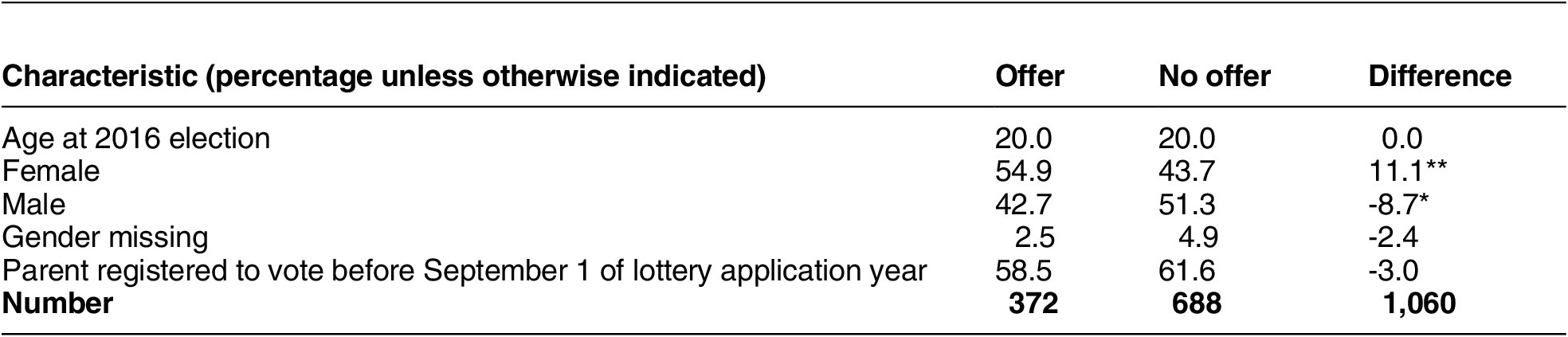
Even with randomized admissions lotteries, some baseline differences between treatment and control groups could exist by chance. The student sample provides baseline data that enable us to compare pre-lottery characteristics in terms of age, gender, and the pre-application voter registration status of the student’s parent. As indicated in Table 1, we find no statistically significant baseline differences between treatment and control groups in terms of age or parent’s prior registration status. In contrast, there is a statistically significant gender difference: girls are in the treatment group at a rate 11 percentage points higher than in the control group. A deep dive into the data and consultations with Democracy Prep and its lottery auditor uncovered no reason other than chance that would explain this difference. An analysis of baseline equivalence in a subset of students for whom additional data are available finds no statistically significant differences between treatment and control groups in prior test scores, English language learner status, special education status, or eligibility for free or reduced-price lunch (details in Appendix B). To ensure that chance baseline differences do not bias results, we include gender, age, and parent baseline voter registration as controls in our analyses.Footnote 7
Baseline Equivalence

Note: The sample size for pre-application voting behavior is 1,453 parents of offered students and 1,399 parents of students who did not receive an offer. Estimated differences are from a regression model with lottery weights and lottery fixed effects. * p < 0.05, ** p < 0.01.
Enrollment Rates by Treatment Status
Using the lottery to estimate effects requires that lottery winners enroll in Democracy Prep at higher rates than lottery losers. As shown in Table 2, lottery winners were 26 percentage points more likely to enroll in Democracy Prep than were lottery losers, in both the year of application and at any point following initial application.
Enrollment Rates by Treatment Status

Note: * p < 0.05, ** p < 0.01.
Impact of Democracy Prep on Registration and Voting
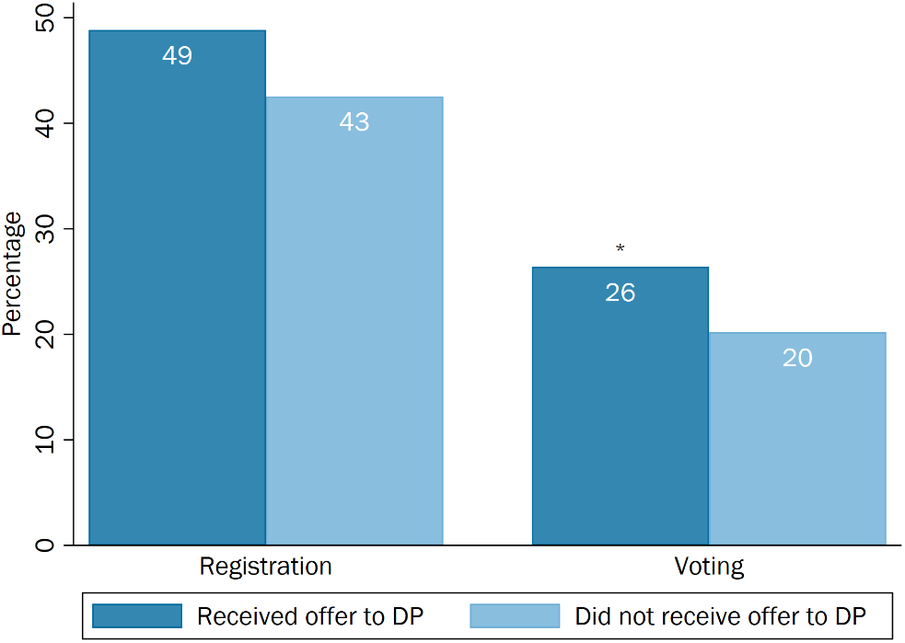
We first estimate the ITT impact of receiving an offer on registration and voting in the 2016 election. Receiving a lottery offer of admission to Democracy Prep leads to an increase in both registration and voting of about 6 percentage points. Only the effect on voting is statistically significant. Figure 1 illustrates the effect of receiving an admissions offer, comparing the actual registration and voting rates of the treatment group with the expected rates if they had not been offered admission (the regression-adjusted registration and voting rates of the control group).
Student ITT Results: Impact of Receiving an Admissions Offer

We use receiving an offer through the lottery as an instrument to estimate the TOT impact of enrollment, based on the assumption that any effect of the admissions offer could occur only by affecting the subset of lottery winners who actually enrolled. The TOT analysis scales up the estimated ITT impact by a factor that depends on the difference in the actual enrollment rates of lottery winners and losers. Because that difference is only 26 percentage points, the TOT estimate is nearly four times that of the ITT estimate. The statistical uncertainty around the estimate similarly scales up, creating a confidence interval that is four times as large as the confidence interval for the ITT impact estimate.
The TOT impact estimates (about 24 percentage points for both registration and voting: see Appendix B) are surprisingly large, especially for voting, implying that Democracy Prep more than doubled the expected voting rates of its students. Because the uncertainty around the TOT impact estimates is quite large, it is plausible they overestimate the true influence of Democracy Prep. To assess this possibility systematically, we conduct a Bayesian analysis.
Bayesian-Adjusted Estimates of Democracy Prep’s Impact on Civic Outcomes
In this section, we present our Bayesian estimate of the probability that the true effect of Democracy Prep is positive, given: (1) the TOT effects we estimated in this study and (2) 29 published estimates of the effects of education on voting and registration.Footnote 8 We then use the same framework to estimate the true effect of enrollment in Democracy Prep, grounding the original TOT estimates in the published effects of the relevant literature. Following Gelman (Reference Gelman2015), we define the Bayesian prior in terms of information rather than beliefs, and we examine the sensitivity of findings to the selection of prior information.
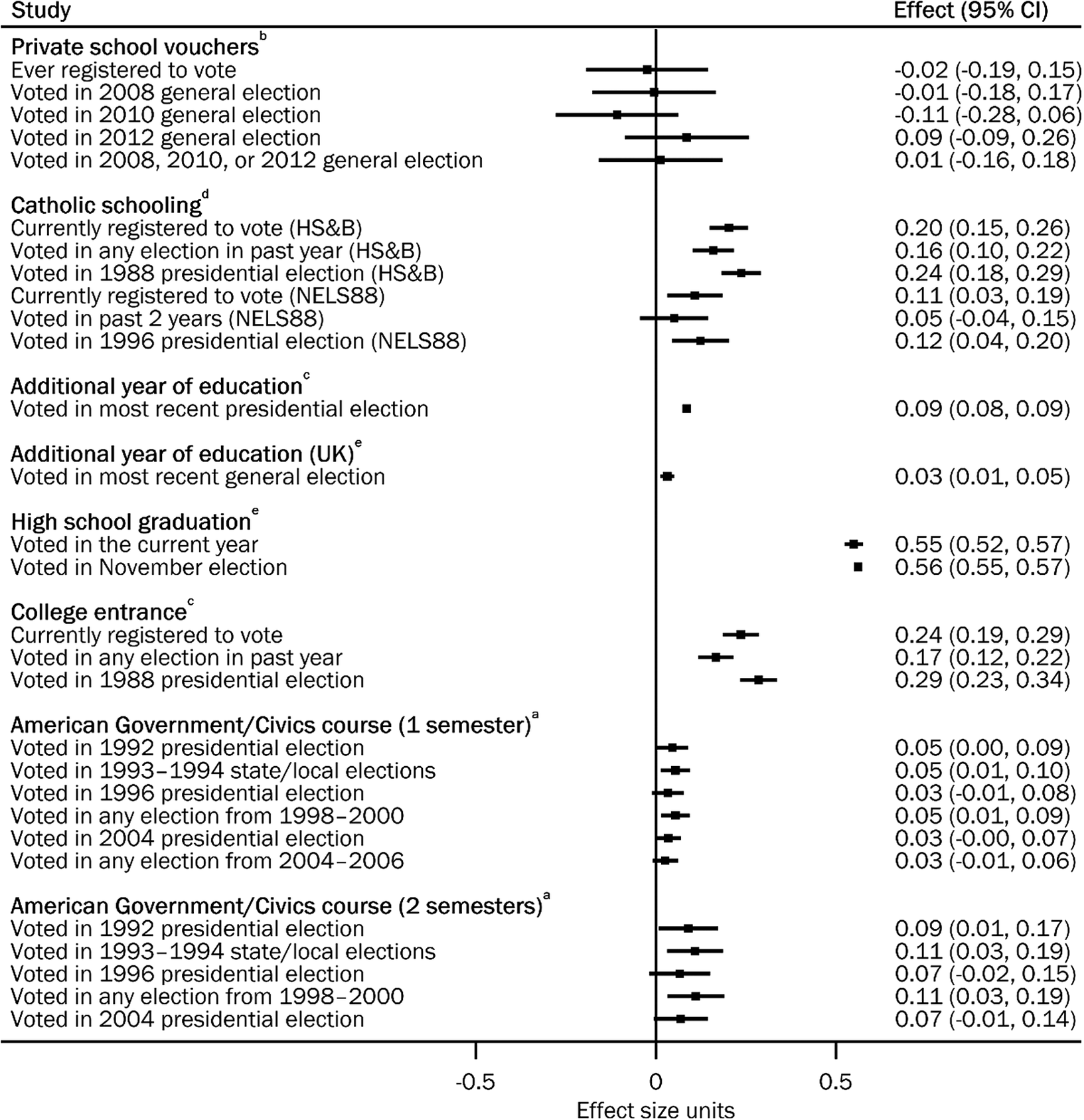
Almost all of the prior effect estimates in the literature are positive (Figure 2). Because these are estimated and not true effects, it could be unwise to take them entirely at face value. These estimates could be influenced by random chance differences between treatment and control groups or systematic errors such as publication bias (the tendency of journals to publish only findings that are statistically significant). To prevent these biases from propagating through to the current analysis, our Bayesian approach incorporates an assumption that the prior estimates are exaggerated by a factor of two, on average. We also conduct two sensitivity analyses: (1) assuming that on average, the effects of previous similar interventions are zero and (2) taking estimates from prior studies at face value.Footnote 9
Prior Estimates of the Impact of Education on Voting

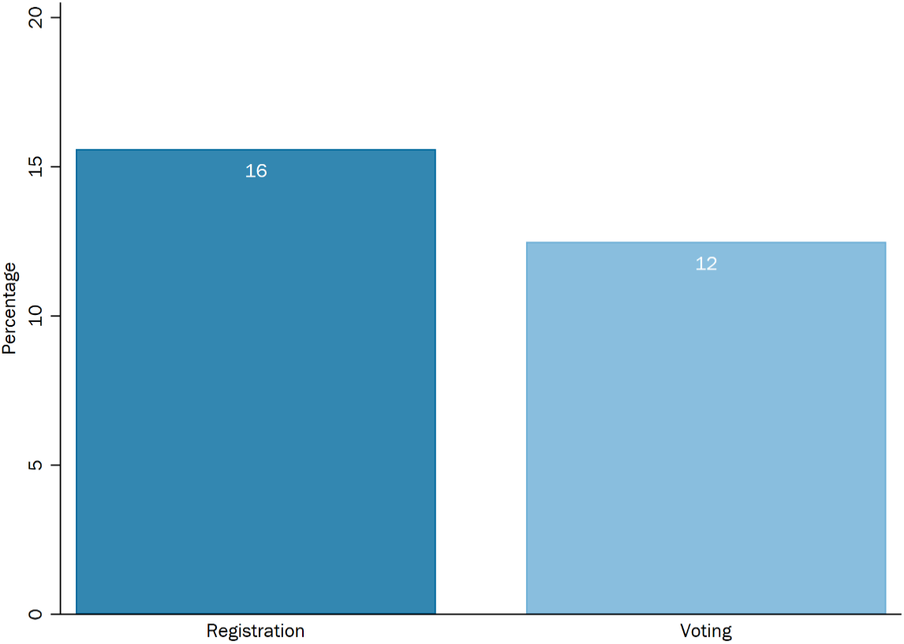
Combining evidence from past studies and the TOT impact estimate for Democracy Prep from this study, we estimate a 98% probability that enrolling in Democracy Prep increased voter registration and voting in the 2016 election. Using the same (Bayesian) framework and correcting for potential biases in the magnitude of reported effects in the literature as described above, we find that Democracy Prep increases the voter registration rate of its students by about 16 percentage points and increases the voting rate of its students by about 12 percentage points (Figure 3). Our results are robust to the selection of prior information.
Impact of Enrolling in Democracy Prep on Registration and Voting (Bayesian Estimates)

Conclusion
Democracy Prep provides a test case of whether charter schools operating outside the direct control of elected officials can successfully serve the foundational purpose of public education—preparation for citizenship. More broadly, these results indicate that the public education system—the public institution that arguably has the most direct, ongoing contact with families and children—plays an important role in developing an active citizenry. As indicated by students’ eventual registration and voting, Democracy Prep outperforms local alternatives in preparing its students for citizenship. Enrolling in Democracy Prep substantially increases the probability that students will vote when they reach adulthood. The effect on voter registration is likewise large, though not statistically significant in conventional terms. The traditional TOT estimates for both registration and voting are sizable 24 percentage points. Furthermore, a Bayesian analysis that adjusts our TOT estimate by incorporating information from prior studies indicates a 98% probability that Democracy Prep positively affected registration and voting in the 2016 election; the Bayesian-estimated effects (means of the posterior distributions) remain sizable at 16 and 12 percentage points, respectively.
These effects are notable given the consistently low voter turnout of young adults. In most presidential elections in the past half century, voter turnout has been 10 to 25 percentage points lower for young adults (18 to 24 years old) than for older groups (File Reference File2014). Other available evidence finds that voting rates are difficult to increase more than a few points, suggesting Democracy Prep’s effects are especially impressive. For example, text message voting reminders increased the likelihood of voting in the 2006 election by approximately 3 percentage points (Dale and Strauss Reference Dale and Strauss2009). A review by Burden and colleagues (Reference Burden, Canon, Mayer and Moynihan2014) finds that election-day registration policies increase voter participation by approximately 5 percentage points; similarly, McDonald (Reference McDonald2009) found that preregistration increased youth voting rates by nearly 5 percentage points.
While our study cannot provide direct evidence of the mechanisms through which Democracy Prep improves voting outcomes, a school culture built around a civics-oriented mission appears critical. Democracy Prep founder Seth Andrew (Reference Andrew2019) and education writer Robert Pondiscio (Reference Pondiscio2018) each describe how an emphasis on “active and engaged citizenship” saturates the school’s curriculum and activities, noting that a key differentiator is Democracy Prep’s valorization of citizenship. Perhaps more than evaluations of specific curricula or programs, research on the role of a civics-focused mission would meaningfully advance the knowledge base around schools’ role in developing active citizens. Outside the context of schools, other interventions that reach beyond instilling civic knowledge to developing children’s identities as engaged citizens may be similarly effective at improving civic behaviors.
Democracy Prep is not typical of all charter schools, and the students who choose to apply to Democracy Prep may be especially receptive to the network’s approach. Nonetheless, its success in promoting registration and voting among the low-income, minority students it serves provides a proof point for charter schools and conventional public schools alike: an education focused on preparation for citizenship can increase students’ civic participation when they reach adulthood. Renewed attention to the foundational purpose of public schools therefore has the potential to broadly increase civic participation.
Supplementary Materials
To view supplementary material for this article, please visit http://dx.doi.org/10.1017/S000305542000057X.





Comments
No Comments have been published for this article.