Introduction
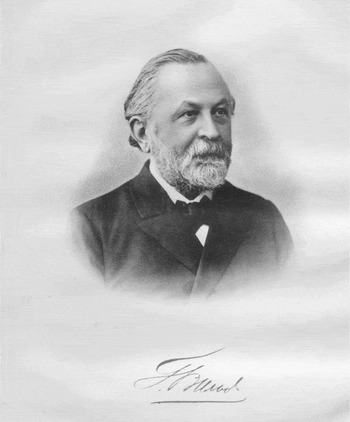
The first International Polar Year (IPY) took place in 1882–1883. It represented the first major experiment in international collaboration in the field of scientific research. The history of the IPY has been treated in several scholarly works in different languages (Rykachev Reference Rykachev1889; Breitfuss Reference Breitfuss1930; Vize Reference Vize1931; Klado 1959; Baker Reference Baker1982; Corby Reference Corby1982; Paseckii Reference Paseckii1982; Barr Reference Barr2008; Lüdecke Reference Lüdecke2002; Andreev and others Reference Andreev, Dukal'skaya and Frolov2007). The role of Russia in the organisation of the IPY, in which the contribution of Heinrich Wild (1833–1902) (Fig. 1), second chairman of the International Polar Commission (IPC), and a member of the St Petersburg Academy of Sciences and of the Russian Geographical Society (RGS), was particularly significant, has been described in articles written in Russian (Klado 1959; Paseckii 1983). The important role of Russian scholars in this undertaking has also been acknowledged by the German polar historian Reinhard Krause (Krause Reference Krause2008). The articles of the above authors are, however, not based on a great variety of sources and the role of the Russian empire and of its scholars in this undertaking deserves more thorough analysis. Robert Lenz (1833–1903), the chairman of the polar commission of the RGS and a member of the IPC, assessed the role of the RGS in the organisation of the IPY in a document devoted to the studies of Nikolai Yurgens (1847–1898), the head of the Russian IPY station on Ostrov Sagastyr in the Lena delta. On the basis of this analysis, the latter was awarded the gold medal of the RGS:
Heinrich Wild (1833–1902).

Anyone studying the history of this international undertaking, will learn that Imperial Geographical Society took a very prominent place in it. And I dare to state, without fear of being contradicted, that the academic world is indebted to the keen interest of our Society for the fact that the above undertaking was such a success (Lenz Reference Lenz1886: 3).
Was Lenz fully aware of the facts or did he overestimate the role of the RGS and of the Russian empire in the organisation of the IPY? The father of the IPY was the Austrian naval officer Carl Weyprecht (1838–1881) whose organisational activities in the first stage of the planning for it, together with those of the German geophysicist Georg Neumayer (1826–1909), the first chairman of the IPC, were very important. The objective of the present study is to assess how decisive were the roles of Wild, of the RGS and of the St Petersburg academy of sciences in the organisation and execution of the first IPY.
Carl Weyprecht and his plan for international collaboration in polar research
The well known Austro-Hungarian expedition under the leadership of Carl Weyprecht took place in 1872–1874 (Holland Reference Holland1994: 290–291). Its importance in the history of polar exploration lay not only in the discovery of Zemlya Frantsa-Iosifa [Franz Josef Land]. Thanks to the results of the investigations conducted during the expedition, Weyprecht came to appreciate the need for systematic and synchronised observations in the polar regions (with a minimum duration of one year) that could be realised only through international collaboration. According to Weyprecht, single expeditions required enormous means, and might be productive of good results, but there could be no synchronised observations from one area to another.
He revealed this idea in his report on the results of the expedition presented at the academy of sciences in Vienna on 18 January 1875. The first to publish the report was the German geographer and publicist August Petermann (1822–1878) (Weyprecht Reference Weyprecht1875a; Weyprecht Reference Weyprecht1875b (English version)). From the correspondence between Weyprecht and Petermann, published in 2008, it appears that Weyprecht had had numerous offprints made of the published report which he distributed himself and with the help of Petermann, and also of his friend Maecenas, Count Hans Wilczek (1837–1922), who had partly financed the expedition (Berger and others Reference Berger, Besser and Krause2008: 17, 430–433). Thus, Weyprecht hoped to popularise the idea of international co-operation in polar areas in the scientific community. So Weyprecht's attempts to spread his idea of the organisation of an IPY started at the beginning of 1875.
Weyprecht conducted an extensive correspondence with Wilczek in which they considered in detail all questions relating to international collaboration in polar areas. By the summer of 1875, it had become clear that those scholars who had received the text of the Vienna report, approved Weyprecht's ideas in principle. Encouraged by this and in order to secure more support for the concept, Weyprecht decided to spread it widely throughout the whole European academic community. Logically, the next step was to explain the idea in more detail. Keeping that in view, he compiled a special explanatory Mémoire in German under the title Grundzüge der arctischen Forschung, to be circulated by the end of June, or at the beginning of July 1875. This was printed lithographically. Up to the present, only one re-written copy of this has been discovered (Weyprecht Reference Weyprecht1875c). At the end of July, a second lithographic print of the memorandum was completed. Weyprecht also had it translated into English, French and Italian. By the end of July, the Italian and French versions were ready. The number of copies published in French (Weyprecht Reference Weyprecht1875d) was 500, and these were distributed by Count Wilczek at the international congress of geographers in Paris held in early August 1875 (Hochstetter Reference Hochstetter1875: 404; Berger and others Reference Berger, Besser and Krause2008: 440, 447–448).
However, the number of copies of the German version that Weyprecht sent to German speaking scholars all over Europe at the beginning of July, is not known. From a letter to Wilczek, it appears that by 25 July, at least 21 researchers and institutions had contacted him. As could be concluded from the replies, several scholars considered some of Weyprecht's viewpoints in the memorandum too prescriptive (for example his attitude to the descriptive geography and discoveries of new countries). That is why Weyprecht announced to Wilczek that to guarantee the realisation of his project, he had to soften the style of the explanatory letter. The best opportunity for making the softer version of the Mémoire known was presented to Weyprecht with an invitation to report on his plan at the 48th congress of German doctors and naturalists which was to be held at Graz on 18–20 September 1875. As the presentation at Graz differed from Grundzüge. . . not in content but in style, Weyprecht still called it a Mémoire. To stress the message, he changed the title of the presentation at Graz which, in the complete version, reads Grundprinzipien der arktischen Forschung. It was the report presented at the congress (Weyprecht Reference Weyprecht, Frischauf, Graber and Klemensiewicz1875e), in which Weyprecht had made changes following the remarks made about the first Mémoire, that became the basis of different articles in German (for example Weyprecht Reference Weyprecht1875f, Reference Weyprecht1875g) outlining the main items of his plan (compare Berger and others Reference Berger, Besser and Krause2008: 561–562). The English language explanatory letter to Weyprecht's project (started in July 1875 but finished only at the end of January 1876), as well as the second French version of the text, were, supposedly, also based more on the Graz report than on the preliminary version of the Mémoire. Several hints concerning this can be found in Weyprecht's letters (Berger and others Reference Berger, Besser and Krause2008: 452, 459, 466, 489).
In a memorandum written in summer 1875 and in his report at Graz, Weyprecht presented a survey of practical experience in polar research up to that date, which had mainly consisted in the discovery of new lands and their description. This was totally different from his current ideas, the realisation of which he expected to provide rich observational data enabling thorough studies in polar areas (for example covering such topics as the influence of polar areas on the climate on the earth, on earth magnetism etc) (Weyprecht Reference Weyprecht1875a, Reference Weyprecht1875c, Reference Weyprecht, Frischauf, Graber and Klemensiewicz1875e). Weyprecht understood that one year of observations was insufficient to provide answers to numerous questions in the field of meteorology and geomagnetism in the Arctic (Wilczek and Weyprecht Reference Wilczek and Weyprecht1876a; Weyprecht and Wilczek Reference Weyprecht and Wilczek1877). However, in order to avoid too large expense, that he realised could discourage the participation of some countries in the project, he decided that it should be limited to observations during one year. For the same reason, he did not, at first, include in his plan the idea of setting up a network of observation stations in the southern polar areas. He intended to make this idea public when several countries had already declared their decision to participate in the observations (Berger and others Reference Berger, Besser and Krause2008: 433, 442, 447). But it was at just this point at which Neumayer, later the first chairman of the IPC, violently criticised Weyprect's project.
The spread of Weyprecht's plan in the Russian empire
Weyprecht sent his plan for the organisation of polar stations in Arctic areas to Russia among other countries. In July, this reached the famous scientists Karl Ernst von Baer (1792–1876), Alexander Theodor von Middendorff (1815–1894) and Friedrich Benjamin Lütke (1797–1882) and, in September 1875, his plan reached Heinrich Wild and Friedrich Reinhold von der Osten-Sacken (1832–1916) via a lecture published in Graz. The replies sent to Weyprecht, in which the researchers set out their views, have been preserved in the Austrian state archives in Vienna. The plan was considered to be very important from the scientific point of view, but it was admitted that the realisation of it would be very complicated. The contents of the letters sometimes exceeded the strict scope of the matter in question and provided a broad spectrum of opinion.
Lütke, then president of the St Petersburg Academy of Sciences and well known polar researcher, wrote at the beginning of August 1875 that Weyprecht's principles ‘concerning the organisation of investigations in his Mémoire Grundzüge der arktischen Forschung were evidently correct . . . observations carried out simultaneously in different points of high latitudes, using the same method, provide a general picture of the physical phenomena and material for the explanation of them.’ But, in his opinion, observations obtained in different stations during only a year would be insufficient to understand all the factors having an effect on the nature of polar areas (Lütke Reference Lütke1875).
In July 1875, Middendorff, explorer, zoologist, and an honorary member of the St Petersburg academy of sciences (Tammiksaar and Stone Reference Tammiksaar and Stone2007), sent a lengthy response. He made, to his regret, the commonplace observation that the exploration of new lands, or the adventures that took place during an expedition, appeared to be more intriguing to the general public than did serious projects promoting science. He admitted that the time was ripe for the popularisation of the plan for polar investigations as joint activities on an international scale. Middendorff also wrote that he, having contacts with the members of the imperial family, wanted to be of help in the realisation of Weyprecht's plan as outlined in his explanatory letter (Middendorff Reference Middendorff1875).
Osten-Sacken, the head of the department of physical geography of the RGS, in his letter dated 20 November 1875, emphasised the importance of scientific investigations in the Russian empire including its large polar areas. According to him, the ‘scientific evenings and celebrations’ devoted to the expedition of Adolf-Erik Nordenskiöld (1832–1901), who had reached the mouth of the river Yenisei, lasted for a whole week in St Petersburg. Osten-Sacken understood that this circumstance should be taken advantage of in order to raise money for the establishment of a scientific station in Novaya Zemlya (Osten-Sacken Reference Osten-Sacken1875).
Wild, a member of the academy of sciences and director of the St Petersburg main physical observatory, in his letter of 25 October 1875 confirmed that he completely agreed with the views that Weyprecht had put forward in his lecture at Graz and that he would do everything to help realise his plan. Wild also discussed the plan with Lütke and Konstantin Stepanovich Veselovsky (1819–1901), permanent secretary of the academy of sciences, who both promised to support the plan. Lütke had the duty of explaining the plan to the Grand Duke Konstantin Nikolaevich (1827–1892), president of the RGS, and Veselovsky to Petr Petrovich Semenov (1827–1914), vice-president of the society. ‘As the chairman of the meteorological commission of the Geographical Society, I am doing everything possible’ Wild wrote. ‘This undertaking will be fastest and most reliable if the Imperial RGS puts its shoulder to the wheel’ (Wild Reference Wild1875). Wild suggested that Weyprecht should apply to Semenov and request that Russia should set up at a minimum two stations on the northern coast of the empire, and to inform him that it was only agreement in principle that was expected from the society at that juncture.
As is evident from the memoirs of Wild's wife, Wild was an extraordinarily talented organiser and good at generating new ideas, but he was also able to put his ideas into practice (Wild Reference Wild1913). Wild's proposal was completely different from those contained in the other responses that Weyprecht had received. Weyprecht was convinced that Germany would join the international polar investigations and the probability that Sweden, Norway and Denmark would do so was encouraging. At the same time, it was not apparent which institutions in these countries would take the responsibility for organising their expeditions and how they would be funded. Wild in his letter, however, proposed definite methods concerning how to include the RGS in the IPY project. The society with the support of the government, was already carrying out expeditions in the Russian empire. From a letter to Wilczek, it appears that Weyprecht understood the importance of Wild's letter. Having received Wilczek's approval, he started immediately on the compilation of a proposal for the RGS (Berger and others Reference Berger, Besser and Krause2008: 450, 451). Such a very detailed proposal required a correction of Weyprecht's own plans, which in the two Mémoires had been too general. What kind of observations should be carried out and which methods should be adopted in the established stations, when should observations be started, and what would be the destination of the Austro-Hungarian expedition in the event that the Russians joined the project? These were the questions to which Weyprecht now turned his attention.
In his first two Mémoires, Weyprecht had suggested that there should be five stations in the northern polar areas (Novaya Zemlya 76°N, Spitsbergen 78°N, the eastern or western coast of Greenland between 76°N and 78°N, to the northeast of the Bering Strait at 71°N, and in Siberia at 70°N (the Lena delta) (Weyprecht Reference Weyprecht1875c: 174v, Reference Weyprecht, Frischauf, Graber and Klemensiewicz1875e: 41). Wild suggested that Weyprecht ask the RGS to set up at least two polar stations in the coastal areas of Siberia. Probably he had in mind the Lena delta and Novaya Zemlya, stations that Weyprecht had mentioned in his Mémoires. However, if Germany, Norway, Denmark and Sweden also joined the project, then, taking into account the current political borders, the only region in which Austria could set up a station would have been around the Bering Strait. In such a circumstance, Weyprecht, probably, decided that it would be more useful for the Austrians to go to Novaya Zemlya, which Wilczek and Weyprecht had visited in 1872 (Kinsky-Wilczek Reference Kinsky-Wilczek1933: 197–228). Thus, it was necessary to make a new proposal to Russia concerning an alternative destination for the Austro-Hungarian expedition instead of Novaya Zemlya. Weyprecht and Wilczek, in their letter to the RGS put forward such a recommendation, including the list of observations to be carried out, and the determination that observations should begin in autumn 1877. They considered the foundation of a branch station on the New Siberian Islands as ‘far more important’ than one in the Lena delta (Wilczek and Weyprecht Reference Wilczek and Weyprecht1876a; 195 Berger and others Reference Berger, Besser and Krause2008: 443). The letter for the RGS explaining the viewpoints presented in Weyprecht's Mémoire was ready by the end of December 1875. Weyprecht and Wilczek decided that they would not distribute this paper to other organisations before having received an answer from St Petersburg (Berger and others Reference Berger, Besser and Krause2008: 442–446, 453).
Since the letter with the research programme forwarded to the RGS was developed from the 1875 summer project for polar stations, Weyprecht decided to make a lithograph copy of it. From his letters, it is clear that he had sent the copied letter by different routes to several researchers and institutions in Russia, Norway, Sweden, Denmark and America, and he also distributed it in Germany and Austria. This letter, after a few minor amendments had been made, was also sent to the geographical society in Paris. He asked that the letter be not made public at first and that it be regarded as a development of a preliminary project of which to be take notice. Later, however, the text was published in German and in French (Wilczek and Weyprecht Reference Wilczek and Weyprecht1876a, Reference Wilczek and Weyprecht1876b).
Russia joins the project for an IPY
Weyprecht sent his preliminary telegram to St Petersburg through the Austrian embassy, which, in turn, passed it to the ministry of foreign affairs. On 8 February Nikolay Karlovich Girs (1820–1895), then the assistant to the minister, sent the telegram to the vice-president of the RGS, Semenov. In the accompanying letter Girs remarked that it would be necessary for all states that were interested in Arctic exploration to take part in the establishment of stations that would cover, if possible, all areas of polar region accessible to observations. The Russian part would be to establish one or two stations on the northern coast of Russia (Girs Reference Girs1876).
Before Girs communicated with the RGS, to which he also sent a copy of the letter of Weyprecht and Wilczek, the society had already discussed the matter. From Wild's letter of 9 February 1876 to Weyprecht, it appears, according to Semenov, that the participation of Russia in the project had been decided by the beginning of February 1876. The positive decision in favour of the project came so speedily, not because of Weyprecht's letter but because Carl Alexander, the Grand Duke of Weimar (1818–1901), known personally to Weyprecht and Wilczek, had family ties with the Russian imperial house, and directly with Grand Duke Konstantin Nikolayevich, president of the RGS. Wild in a letter informed Weyprecht that he as the president of the meteorological commission of the society was compiling a preliminary plan and a budget of necessary expenses for the Russian expedition to the Lena delta and the New Siberian Islands and this indicates that the Russians had decided to join the project (Berger and others Reference Berger, Besser and Krause2008: 461; Sukhova and Tammiksaar Reference Sukhova and Tammiksaar2008). He also announced that he had received Weyprecht's research programme, of which he, in general, approved.
On 20 March 1876 at the meeting of the RGS council it was announced that the committee of the mathematical and physical geography departments together with the meteorological committee had compiled a ‘detailed project for the establishment of polar stations according to the suggestions of Weyprecht and Count Wilczek.’ In this project it was stated that it was extremely difficult to reach the New Siberian Islands. This was considered a heroic act, and the delivery of equipment there and the building of observation stations were difficult tasks. Such complications can ‘influence in the most harmful way the success of the whole enterprise’. Therefore the committee suggested that it would be better ‘to choose the place for the main station in the Lena estuary’ (underlined in the text) (Programme [1876]: 23).
The programme, compiled in the RGS, is very comprehensive. It includes the time of start and the length of the observations, for how many hours a day they should be taken, the necessary equipment and premises, and the number of the observers. A budget statement was also included. The programme was based on Wild's suggestions. In his archive file of the polar committee of the RGS there is a note written by Wild, and with it estimated expenses and a scheme of premises and position of the equipment in the Lena estuary. This is dated 15 September 1876 (Wild Reference Wild1876).
In April 1876, the society's council decided that other states should be informed that Russia was ready to take part in this international undertaking. Semenov was entrusted to ascertain what part other countries would take in the creation of polar stations. On receipt of answers, the RGS would appeal for funds to the Russian government in order to proceed.
At the end of 1876, the Society received a published report of the committee that had discussed issues relating to the third German polar expedition, on the suggestion of the Bremen polar society, in Berlin 4–12 October 1875. The first German polar expedition (1868) had been organised under leadership of Carl Koldewey (1837–1908) to visit the east coast of Greenland and Spitsbergen and the second (1870–1871) under leadership of Theodor von Heuglin (1824–1876) had studied Spitsbergen and west coast of Novaya Zemlya (see Krause Reference Krause1992: 128–133, 225–230).
During the work of this committee Weyprecht's plan was also discussed, on the initiative of the meteorologist Heinrich Wilhelm Dove (1803–1879) (unfortunately, Weyprecht's name was not mentioned), and it was approved (Krause Reference Krause1992: 286–299, Reference Krause2008: 21).
The development of Weyprecht's project in 1876–1879. Wild's proposals for the successful realisation of the IPY
Weyprecht planned to start the polar expeditions in the autumn of 1877. Before this, the participating countries were to establish unified observation methods and to determine the instruments to be used. Both Weyprecht and Wild assumed that these necessary preparations necessitated the convening of one international congress at least. From the covering letters to the first version of the Memoiré, written in July 1875, it appears that Weyprecht intended to realise his idea of the polar year through the academies of sciences of participating countries, which would appoint representatives to the international committee which, in its turn, would specify the details connected with the observations (Weyprecht Reference Weyprecht1875c: 175, Berger and others Reference Berger, Besser and Krause2008: 439, 442). As Wild had not received the first Mémoire, he was, probably, not aware of Weyprecht's plan. But in February 1876, Wild wrote to Weyprecht that he was convinced that the observations could not be started earlier than 1878 when the participating countries would send their representatives to a joint conference. Wild proposed to Weyprecht a different way of organising the conference. Wild was a member of the permanent committee named the International Meteorological Committee, elected by the International Meteorological Congress (IMC). It was to meet in London in April 1876. To start observations as planned by Weyprecht, Wild suggested that Weyprecht discuss the matter with those delegates of the countries participating in the polar year, who had the mandates of their countries, through this organisation (Berger and others Reference Berger, Besser and Krause2008: 462).
From a letter dated 15 February 1876, of Weyprecht to Wilczek, it appears that he agreed with Wild's proposal (Berger and others Reference Berger, Besser and Krause2008: 461). In London, Weyprecht's plan was discussed and some important changes were made in it, including one that increased the number of stations from five to eight. This change was mainly based on optimism that many countries would participate in the undertaking. It was also decided that Weyprecht's plan should be discussed in more detail at the next congress of meteorologists to be held in Rome in 1877 (compare Protokolle 1876: 11). Consequently, the beginning of observations would be postponed until 1878 and Weyprecht accepted this as he expected more effective support for the realisation of his plan from the IMC. According to Weyprecht, it had to be clear by the spring of 1877, which countries would participate in the undertaking. To ascertain that, Weyprecht intended to make a visit to those European countries which were potential participants in the expedition (Russia, Sweden, Norway, Denmark, Germany, Great Britain and France) in autumn 1876. Nothing came of this however, because of the political tension in Europe and the war that broke out, in 1877, between Russia and the Ottoman Empire as a result.
Such a situation placed Weyprecht in a very complicated position. The congress in Rome was still planned to take place. However, Weyprecht understood that the delegates to the congress would, in fact, have no mandates from their countries to take responsibility for his project. It was too late to convene in Rome persons who actually had mandates to pass resolutions. The only possibility was to send the participant meteorologists a detailed research plan prepared for the stations (Weyprecht and Wilczek Reference Weyprecht and Wilczek1877). In this situation, Weyprecht made an important decision and wrote a letter to the secretary of the meteorological committee. In the letter he announced that he was prepared to hand over the management of his project to the committee if the latter established, within three years, polar stations in the northern and southern polar areas with the assistance of different countries as he had done himself, together with Wilczek, in Novaya Zemlya (Berger and others Reference Berger, Besser and Krause2008: 496–497). Weyprecht also sent official documentation of the project to Christoph Hendrik Diederik Buys-Ballot (1817–1890), then the president of the meteorological committee. From that time, the destiny of Weyprecht's project depended on the IMC and particularly on its permanent committee, leaving Weyprecht simply the right to propagate the project individually.
However, because of the war, the congress in Rome did not take place. In spite of that, different elements of the RGS took considerable interest in Weyprecht's plan and were willing to take steps for participation in the polar year. In 1877, on reading an RGS report for the previous year, an audit committee enquired concerning the state of affairs regarding the society's participation in the international project. According to its reply, the society's committee for the creation of polar stations developed a special document covering this matter. With the help of this document the committee hoped to finalise the preliminary work in order to discuss the issue at the then forthcoming meteorological congress in Rome in September that year, 1877, on the agenda of which was the final decision on the question of the polar stations (Deistviya 1877: 120). The council of the RGS also received a programme of Weyprecht and Wilzcek (Reference Weyprecht and Wilczek1877), which they planned to offer for discussion during the congress in Rome. Having looked into the report of the geographical society for 1877, the audit committee, in 1878, again became interested in the status of the question regarding the creation of polar stations. The council of the society replied that this question had not been resolved, as the congress in Rome had not taken place, and the programme of Weyprecht and Wilzcek required the approval of geographical societies of those countries which could take part in the project. It was also noted that in 1878 the society had provided assistance to two enterprises, to A.-E. Nordenskjöld's expedition in Vega and to E.A. Tyagin, who should have gone to Novaya Zemlya, where it was planned to establish an outpost of the life boat institution.
In the event, and with the conclusion of the Russo-Turkish War in 1878, the second IMC took place in Rome in April 1879. At this congress, Wild was elected new president of the permanent meteorological committee, of which, until then, he had been a member. In the presence of Weyprecht, the congress discussed his plan and it was decided that a special international polar conference should convene under the auspices of the permanent committee to discuss Weyprecht's plan in more detail. It was intended that the conference should gather in Hamburg at the beginning of October. This decision was made due to pressure from Weyprecht who wanted a quick decision from the meteorological congress either in support or non-support of his project, as the time, three years that he had given the meteorological committee in 1877 for a decision was almost over. To exert more pressure on the delegates of the congress, he informed them that he had decided to start an expedition to Novaya Zemlya in 1880. The congress agreed with this (Bericht Reference Bericht1880a: 20–21, 81–82).
Nine persons (representing eight countries) gathered in the building of the naval observatory of Hamburg on 1 October 1879. They were Buys-Ballot himself, who was director of the Dutch meteorological institute in Utrecht; Captain Niels Henrik Cordulus Hoffmeyer (1836–1884), director of the meteorological institute of Denmark in Copenhagen; Elenthere Mascart (1837–1899), director of the central meteorological bureau in Paris; Henrik Mohn (1835–1916), the director of the meteorological institute of Norway in Christiania (Oslo); Neumayer, director of the Hamburg naval observatory; R. Lenz, professor of physics at the university of St Petersburg, representing the RGS; August Wijkander (1849–1913), professor of physics of the Chalmers institute, representing the Swedish academy of sciences; naval captain Georg Freiherr von Schleinitz (1834–1910) representing the naval ministry of Prussia, and Weyprecht himself. Those present established the IPC and elected Neumayer to chair it. It is interesting to mention that Neumayer, Buys-Ballot, Mascart and Mohn were at the same time also members of the permanent meteorological committee (Rapport 1882: 5).
The IPC discussed Weyprecht's and Wilczek's programme of 1877, made the necessary amendments, and worked out a plan for future investigations by the international polar expeditions. In order to secure reliable observations, it was decided that at least eight stations were required in the Arctic zone of the northern hemisphere as had been proposed in London in 1876. According to Weyprecht, the stations were to be established in the highlands of Finnmark, in Svalbard, in Novaya Zemlya, in the delta of the Lena river and Uppernavik on the western coast of Greenland. In addition, the following localities were selected for polar stations, Point Barrow, Jan Mayen or the eastern coast of Greenland, and the islands of the Canadian Arctic. The countries, which would organise observations there, however, were not established. It was decided that observations would start in autumn 1881 (Bericht Reference Bericht1880b: 1–13; Die Internationale 1879).
Having returned from Hamburg, Lenz reported that the programme regarding the activity of polar stations, approved by the conference, was similar to the one developed by the RGS as long ago as 1878 (Deistviya 1880: 37). Lenz was pleased to discover that ‘similarity exists not only in the general points, but also can be found in all details’ (Paseckii 1983: 10).
Russia takes the initiative in the organisation and execution of the IPY
The resolutions drawn up at the Hamburg conference, permitted the expectation that Weyprecht's idea would be realised very soon. The chairman of the IPC, Neumayer, was of the same opinion. At his recommendation, the polar committee declared itself independent of the permanent meteorological committee, although Weyprecht had delegated organisational responsibility to it, and the first conference of the IPC was held under its auspices. The background for this decision was multi-faceted according to Neumayer. In his opinion, the meteorological committee had little experience with geomagnetic observations, and he did not agree that the meteorological committee had considered it necessary to establish the IPC according to the principles of the IMC. This would have hindered the inclusion of new members interested in polar expeditions into the work of the commission without the introduction of complicated procedures (see Tammiksaar and others Reference Tammiksaar, Sukhova, Lüdecke, Barr and Lüdecke2009). There was another, personal, reason why Neumayer wanted to be independent of the permanent meteorological committee, or its president, Wild, who feared that the inclusion of southern polar areas in the research plan might deter countries from participation in the IPY for financial reasons. Neumayer, however, had long dreamt of the investigation of southern polar areas (Bericht Reference Bericht1880a: 81–82). The conflict of views, as is apparent from the correspondence of Neumayer and Wild, threatened the realisation of Weyprecht's ideas. A change had also taken place in the list of countries which, in 1876, were eager to participate in the expeditions of the polar year. By 1879, the number of the supporters of Weyprecht's idea had fallen. Those maintaining their decision were Austria, Russia, Denmark and Norway. By the beginning of 1880, the Germans and French had not received funding for the proposed expeditions, the Swedes were hesitating, while the British and the Americans had not yet manifested interest in the undertaking. In such a complicated situation, Wild and Neymayer found a compromise. Wild became a member of the IPC and was elected to chair it at the second international polar conference in Bern in August 1880. Neumayer resigned from the post (compare Tammiksaar and others Reference Tammiksaar, Sukhova, Lüdecke, Barr and Lüdecke2009).
As chairman of the IPC, Wild began to take active steps towards the realisation of the polar year. However, by the beginning of 1881, the situation had not developed when compared with the period before the Bern conference. The states that were ready to launch expeditions were the same (Austria, Russia, Denmark and Norway). According to the Hamburg resolution, the number of stations had to be eight. Proceeding from such a situation, Wild decided to suggest to Weyprecht that a station be set up in Point Barrow, which was vacant, instead of at Novaya Zemlya. In this way, he hoped to secure one more station as the Russians could, themselves, establish a station in Novaya Zemlya, and to encourage those hesitating and the countries which still lacked the necessary finance. Weyprecht was of the same opinion, but he could not inform Wild about it, as he had unexpectedly died. Wilczek considered the realisation of Weyprecht's idea more important than the location of the Austrian station and thus agreed to Wild's proposal. This had the desired result, because by August 1881, when the third international polar conference was held in St Petersburg under Wild's leadership, the number of countries willing to join the polar year had grown so much that it was possible to establish the eight stations as decided in Hamburg (Tammiksaar and others Reference Tammiksaar, Sukhova, Lüdecke, Barr and Lüdecke2009). The final programme of observations for the IPY, and the instruments to be used, were co-ordinated, and the dates for the beginning and the end of observations were determined in St Petersburg. Consequently, all the conditions were created for the realisation of the programme of observations. In addition, the St Petersburg academy of sciences founded a special publication Communications from the International Polar Commission, in order to ensure that all the participating countries would be equally informed about the preparations taking place (Bericht Reference Bericht1881).
The IPY took place from August 1882 to September 1883. Observations were performed at 14 stations, twelve of them in the northern hemisphere and two in the southern hemisphere. Polar stations were located at Point Barrow and in the Lady Franklin Bay (by the USA), Fort Rae on the coast of Great Slave Lake (by Canada and UK), South Georgia in the Antarctic and Cumberland Sound on Baffin Island (by Germany), in Godthab on the western coast of Greenland (by Denmark), Cape Thordsen in Spitsbergen (by Sweden), in Bossekop in northern Scandinavia (by Norway), Dickson Island (by the Netherlands), Jan Mayen (by Austria-Hungary), in Cape Horn at the tip of Latin America (by France) and in Sodankyla (by Finland). There were also the two Russian stations at Malyye Karmakuly on Novaya Zempla and on Ostrov Sagastyr in the Lena delta. The Dutch expedition could not land on Dickson Island as the ship was frozen into the ice in the Kara Sea, and thus observations were performed on the ice surface. In addition, data were received from 33 meteorological and magnetic observatories, from the observers of minor observation stations and amateur observers from different countries of the world (Protokolle 1884: 271). As a result, the large number of results secured during the IPY was diverse covering not only meteorological and magnetic phenomena from the polar areas, but also information arising from many other areas of science.
On Wild's initiative, the fourth International Polar Conference was held in Vienna in April 1884. The members of the IPC as well as the heads of all the stations were invited to take part in it. At the conference, unified methods of processing the magnetic and meteorological data, as well as how to publish them, were discussed (Programme 1884). An instruction arising therefrom was published in German, French and Russian. It was decided that the observations would be published during the following year at the expense of the countries which had set up the stations. The term of one year, however, was unrealistically optimistic for processing the data and the first papers including the results of meteorological and magnetic observations were only issued in 1886.
The members of the IPC gathered for the last time in Munich in 1891. At Neumayer's suggestion, the problem discussed was how to generalise the data obtained. With this in mind two special committees, one for meteorology and one for magnetism, were founded at the behest of the IPC, which had to carry on the work and invite researchers to take part in it. In Munich, the St Petersburg academy of sciences was thanked for the work it had done in the organisation of investigations during the polar year. The academy was asked to act as the depository for the manuscripts of all the polar expeditions. Neumayer took the opportunity of drawing the attention of his colleagues to the importance of the future extension of the work to the Antarctic areas (Protokoll 1891). Thus the IPC had finished its work successfully.
Conclusions
The development and realisation of the idea for the first IPY that took place from 1875 to 1882 shows that it was a long process and not so simple as the initiator of it, Weyprecht, had originally imagined. Scholars lacked experience of collaboration in preparation and simultaneous performance of an international project. For that reason, the preliminary plan by Weyprecht was very general and particularly imprecise concerning the organisational side of the operation and with regard to the arrangement of the necessary meetings. The idea was sound, but organisation was needed for the realisation of it. Wild had a decisive role in the solution of these problems. His proposal for the inclusion of the Russian empire in Weyprecht's project in 1875 led, as a result, to the establishment of the programme of observations of the IPY and settled the problem concerning the location of the Austrian station. After that, the other countries could also decide where to set up their stations. The idea for the unification of Weyprecht's plan with the work of the IMC and its permanent committee, being the only organisation linking natural scientists in Europe at that time to which delegates had mandates to represent their countries, was also Wild's. This was the linkage, which in 1879 called into being the IPC, and had a decisive role in the realisation of Weyprecht's scheme. Both these organisations were headed by Wild during the most complicated period, in 1880, from the point of view of achieving overall success. It was Wild's organisational capabilities that guaranteed the successful preparation and undertaking of the plan itself and of the publication of the results of the IPY. However, this would have been impossible without the remarkable support of, and funding from, the RGS and the St Petersburg academy of sciences. Thus, the Russian empire, its organisations and persons in its service, undoubtedly, had a decisive role in the success of the IPY, from the presentation of the idea until the end. Wild had a key position in the whole process. It is quite probable that without Wild's support, Weyprecht's idea would have remained only a dream.
Acknowledgement
The authors are grateful to the Estonian Science Foundation for a grant (No 7381) in support of this research.