


I. Introduction
This article examines a question of sentencing law and procedure that ought to preoccupy law reformers in the coming years: should offenders convicted of murder in England and Wales who are serving lengthy minimum tariffs have access to a mechanism for tariff review – and, if so, what might such a procedure look like in law? In doing so, the article shifts the focus of life sentence reviewability away from whole life orders and towards increasingly lengthy determinate minimum terms. The Law Commission of England and Wales has embarked on a major review of homicide, including the sentencing regime for murder established in Sentencing Act 2020, Sched. 21.Footnote 1 The time is ripe to grapple with this question, and to imagine one possible, if contested, answer. The argument advanced is that the absence of a structured mechanism for reviewing lengthy determinate minimum tariffs for murder represents a growing deficiency in English sentencing law – one that has become increasingly difficult to justify in light of the inflation of minimum terms, evolving penal norms and comparative practice.
Yet not all will agree that this is a desirable pursuit. Law reformers already face a formidable task if their aim is to recalibrate Sentencing Act 2020, Sched. 21 so that it aligns more coherently with principles of retributivism. For government, any reform that appears less retributivist or deterrent and more rehabilitative in orientation, particularly in the context of the mandatory life sentence for murder, risks proving politically toxic.Footnote 2 For lawyers, the big show in town – the compatibility of the whole life order with European Convention on Human Rights (“ECHR”), art. 3 – came with Vinter v United Kingdom Footnote 3 and went with Hutchinson v United Kingdom.Footnote 4 After much political heat in London, and lingering consternation in Strasbourg, the European Court of Human Rights (“ECtHR”) ultimately accepted that England and Wales’s executive-led, highly restrictive review articulated around compassionate release satisfies the requirements of ECHR, art. 3.Footnote 5 Against this background, and despite the flourishing scholarship on the “right to hope”,Footnote 6 it might be thought the question of life sentence review is, finally, settled.
Why, then, return to lengthy but determinate minimum tariffs? There are two reasons. The first is principled. The review of life sentence tariffs has become a constituent feature of humane, liberal penal policy. The vast majority of Council of Europe Member States provide for such review, as does international criminal law.Footnote 7 In this respect, England and Wales has become an outlier – a status that warrants closer examination through the lens of comparative law. This divergence has intensified with dramatic sentence inflation: since the enactment of Criminal Justice Act 2003, Sched. 21, the average minimum term has increased from approximately 13 years to 21 years – an increase of more than 60 per cent.Footnote 8 The second reason is epistemic. The reviewability of long minimum tariffs remains a relative blind spot in sentencing law scholarship. Attention has overwhelmingly focused on irreducible life sentences and life without parole, particularly in debates about hope, rehabilitation and human dignity.Footnote 9 By contrast, considerably less attention has been paid to reducible life sentence regimes, where release is possible by the Parole Board, but where long minimum terms structure punishment over decades. Likewise, the internal coherence of Sentencing Act 2020, Sched. 21 – its starting points, aggravating and mitigating factors and age-based distinctions – has been well critiqued,Footnote 10 but the legal and institutional issues of a “faint hope” mechanism for tariff review have received scant attention.
This article’s endeavour is not an entirely lonely one, though. In 2024, five senior members of the judiciary – including four former Lord Chief Justices and the former President of the Queen’s Bench Division (as it was then) – concluded that the trajectory of sentence inflation was financially unsustainable and penologically unprincipled, recommending review mechanisms for all prisoners serving more than 10 years.Footnote 11 The Howard League for Penal Reform has likewise advocated the introduction of a “faint hope” mechanism, drawing on comparative experience in jurisdictions such as Canada, Portugal and the Netherlands, as part of its response to what it characterises as a crisis of long sentences.Footnote 12 Similarly, Roberts and Saunders have mooted the idea of a narrowly tailored mechanism for late sentence review as a principled corrective to the inflationary effects of Sentencing Act 2020, Sched. 21.Footnote 13
The analysis proceeds as follows. Section II begins from current sentencing practice, documenting – through case law and official statistics – the inflation of minimum tariffs for murder over at least the past decade. Section III examines how the ECtHR’s jurisprudence under ECHR, art. 3 bears on the reviewability of lengthy determinate minimum terms, distinguishing between the court’s settled doctrinal position under ECHR, art. 3 and the more aspirational principles it has articulated concerning sentence review. With domestic law operating within the letter, if not the spirit, of the ECtHR’s requirements and political resistance to closer alignment with European norms, Section IV turns to Canada – a common law jurisdiction that introduced, operated and ultimately abolished a “faint hope” review – to assess the lessons of that experience. Section V concludes by considering what a carefully calibrated “faint hope” clause for England and Wales might look like, informed by Strasbourg principles and comparative insight.
II. Murder Tariffs in England and Wales
A. The Law: The Reducibility of Life Sentences
This section examines the legal structure governing the imposition and potential reduction of life sentences for murder in England and Wales. It focuses in particular on the status of the minimum term, asking whether – and in what limited circumstances – the punitive element of a life sentence is capable of being revisited once fixed at sentence. The analysis proceeds in three stages: first, by setting out the contemporary legal framework; second, by identifying the narrow and exceptional routes through which early release may occur; and third, by tracing both a historical and a contemporary recognition, confined to specific categories of offender, that penological justifications for continued detention may shift over time.
Following the abolition of capital punishment in 1965, life imprisonment became the sole available sentence for murder in England and Wales.Footnote 14 Where the offender is aged 18 but under 21, the mandatory life sentence is referred to as custody for life.Footnote 15 For those under 18, it is referred to as “Detention at His Majesty’s pleasure”.Footnote 16 The life sentence comprises three components. First, the minimum term must be served in full in custody before the offender can apply for release; this is determined primarily by the seriousness of the offence, though deterrence may also be relevant.Footnote 17 The minimum tariff acknowledges that although the life sentence is mandatory, the offence of murder spans a broad range of culpability, as well as harm inflicted in the course of killing.Footnote 18 Second, once the minimum term set by the trial judge has expired, the Parole Board has the power to direct release of the offender, determined on the basis of the dangerousness of the offender.Footnote 19 Third, upon release, the offender remains on licence for life, subject to conditions, the breach of which may result in recall to prison. After 10 years of successful resettlement, the supervisory conditions may be suspended.Footnote 20
The question that follows is not whether life sentences are theoretically reducible at the stage of release (stage two), but whether, and if so how, the punitive element of the sentence, embodied in the minimum term itself (stage one), is capable of being revisited over time. Life sentence prisoners may be subject to Parole Board processes prior to tariff expiry, including pre-tariff assessments relating to progression or transfer to open conditions.Footnote 21 Although these processes are conducted by the Parole Board, they are confined to risk management and sentence administration; they do not permit any reconsideration of the length of the minimum term itself, which remains fixed until expiry. Ultimately, the only basis on which a life sentence prisoner can be released on licence during the tariff period is where the Secretary of State exercises the discretionary power to release a prisoner on licence, contained in Crime (Sentences) Act 1997, s. 30. The governing policy, issued by the Ministry of Justice and HM Prison and Probation Service, states that the Secretary of State may release a prisoner if they are satisfied that “exceptional circumstances exist which justify the prisoner’s release on compassionate grounds”.Footnote 22 Release is typically for prisoners who are terminally ill or severely incapacitated and, even then, the risk of reoffending must be minimal and their continued imprisonment must reduce life expectancy. This position will be returned to in Section III, as it must now be understood in light of the jurisprudence of the Grand Chamber of the ECtHR on the “reducibility” of life sentences, under which compatibility with ECHR, art. 3 now requires both a prospect of release and a possibility of review.Footnote 23
The contemporary absence of any mechanism for reviewing lengthy minimum terms represents a departure from an earlier, and now largely overlooked, feature of English sentencing policy. Prior to the enactment of Criminal Justice Act 2003, Sched. 21, English law did recognise a limited form of sentence review in relation to minimum terms and whole life orders, albeit one confined to executive decision-making. The origins of this practice lie in a policy announcement made by the then Home Secretary, Michael Howard, in 1994, as part of a written answer to Parliament.Footnote 24 The policy was that ministerial review took place at the ten-year point of the sentence, the purpose of which was to consider whether there were any grounds for bringing forward the date of the first Parole Board review. In that limited sense, the Home Secretary could have regard to whether the requirements of retribution and deterrence continued to justify deferring parole consideration. For prisoners sentenced to whole life orders, an additional ministerial review was mandated after 25 years in custody, confined expressly to whether the whole life order should be converted into a determinate minimum term, based on the requirements of retribution and deterrence.Footnote 25
That position was refined by the policy statement issued by the subsequent Secretary of State, Jack Straw, in 1997.Footnote 26 While reiterating that the tariff represented the period necessary to satisfy retribution and deterrence, Mr. Straw accepted that, exceptionally, the minimum term might be revised after sentence, either increased or reduced, on the basis of a reassessment of penal justification, expressly putting questions of risk to one side.Footnote 27 In relation to reductions, the policy acknowledged that exceptional progress in custody might warrant reconsideration of the tariff itself, and that such considerations would be taken into account when reviewing whole life cases at the 25-year point. This statement in 1997 did not establish a structured mechanism for tariff review, nor did it generate any regular practice of revisiting determinate minimum terms. It did, though, reflect a significant point of penal principle: that the justification for punishment fixed at sentence might not remain stable over time, and that continued detention should, at least in principle, remain open to reassessment on penal grounds. That insight, tentatively recognised in policy, would later be displaced by the statutory entrenchment of fixed minimum terms under Criminal Justice Act 2003, Sched. 21.
The 1997 policy changes were tested in R. v Secretary of State for the Home Department, ex parte Hindley,Footnote 28 arising from a challenge to the prisoner’s whole life order. In the Divisional Court, Lord Bingham C.J. held that the original 1994 policy, with its confinement to retribution and deterrence, was unlawful, but that the defect had been cured by the 1997 modification, which permitted consideration of exceptional progress in custody. On appeal, counsel for the Home Secretary went further, making clear that the executive was prepared to reconsider a whole life order even in the absence of exceptional circumstances. Approving the legality of the revised approach, the House of Lords recorded this clarification in emphatic terms: the imposition of a whole life order merely expressed “the current view of the Secretary of State that the requirements of retribution and deterrence make it inappropriate ever to release such a prisoner. It does not foreclose reconsideration”.Footnote 29 The Secretary of State envisaged the possibility of release in the event of exceptional progress in prison and, “even in the absence of such progress”, was prepared to reconsider any whole life order decision from time to time.Footnote 30 The significance of this earlier review practice was later noted by the ECtHR in Vinter v United Kingdom. The Grand Chamber observed that, under the previous statutory system in England and Wales, “a review of the need for a whole life order took place after the prisoner had served twenty five years of his or her sentence” and emphasised that “no explanation had been provided for the failure to include that review mechanism in the current legislation, the 2003 Act”.Footnote 31 The applicants, the Grand Chamber recorded, had argued that the Government “could give no principled reason for the failure to include a twenty-five year review in the 2003 Act” – a point that had not been addressed either in the Government’s submissions to the Grand Chamber, or when a statutory amendment to reintroduce such a review was proposed and defeated in the House of Lords in 2012.Footnote 32
There remains, though, one important respect in which English sentencing law already recognises the principle that a sentence which is proportionate when imposed may not remain justified after many years, or even decades, of imprisonment. That recognition applies in cases where the offender was sentenced for murder while under the age of 18. The Police, Crime, Sentencing and Courts Act 2022 introduced a statutory right to review the minimum term for offenders sentenced for murder while under 18. Under this scheme, an eligible offender may apply for review after serving half of the minimum term, with the possibility of further applications at two-year intervals thereafter.Footnote 33 Where such an application is made, the Secretary of State must consider it and, unless satisfied that it is frivolous or vexatious, refer it to the High Court. The review is governed by defined statutory criteria, including exceptional rehabilitation or a serious risk to the offender’s welfare or continued rehabilitation, and culminates in a judicial determination as to whether a reduction in the minimum term is appropriate.Footnote 34 It might be objected that this asymmetry is unproblematic, on the basis that children are categorically different from adults in their moral culpability and developmental capacity.Footnote 35 That distinction is not disputed here. The significance of the under-18 review mechanism lies elsewhere. It demonstrates that English sentencing law already accepts, as a matter of principle, that a minimum term which was proportionate at the point of sentence may cease to be justified after prolonged imprisonment; that such reassessment can be structured through a statutory scheme with predefined criteria; and that it may appropriately be subject to judicial oversight. The question raised by lengthy determinate minimum tariffs for adult offenders is therefore not whether children and adults should be treated alike, but why this underlying principle of revisability, legal clarity and judicial supervision disappears altogether once the offender is aged 18 or over at the time of the offence.
Taken together, these developments show that English law has, at different points, accepted in principle that even the most severe forms of punishment may require reassessment after prolonged periods of imprisonment. What is striking is that this recognition now survives only in relation to offenders sentenced as children and has otherwise receded at the point at which determinate minimum tariffs for murder have lengthened most dramatically. The significance of this becomes clear when it is placed alongside contemporary sentencing practice, which we turn to now.
B. Schedule 21: Longer Tariffs, Older Prisoners
Schedule 21 was enacted following R. (on the application of Anderson) v Secretary of State for the Home Department,Footnote 36 which held that the Home Secretary’s power to set the minimum term for mandatory life sentences was incompatible with the right to an independent and impartial tribunal under ECHR, art. 6. Parliament responded by transferring the responsibility for fixing minimum terms to the judiciary. Criminal Justice Act 2003, Sched. 21 (now consolidated as Sentencing Act 2020, Sched. 21) laid down a statutory framework of starting points intended to guide judicial discretion and to raise the minimum terms for murder that discretion would produce. The point is best seen by tracing the judicial guidance it replaced, before detailing Schedule 21’s starting points.
On 15 March 2002, the Sentencing Advisory Panel published its advice to the Court of Appeal, Minimum Terms in Murder Cases.Footnote 37 The consultation had exposed a division over whether sentencing should proceed from a single starting point or from a framework of grouped cases. The panel favoured three tiers (a lower, middle and higher starting point), each to be adjusted for aggravating and mitigating factors. The appropriate level of the middle starting point also split the panel. The majority, reasoning by comparison with sentencing levels for other offences, put it at 12 years, with a lower point of eight or nine years and a higher point of 15 or 16 years. A minority, more concerned with preserving public confidence in the criminal justice system, favoured a middle starting point of 14 years, with lower and higher points of 10 or 11 and 17 or 18 years respectively.Footnote 38 Lord Woolf C.J. did not adopt the panel’s three-tier scheme. In the Practice Statement (Crime: Life Sentences) of 31 May 2002,Footnote 39 Lord Woolf C.J. retained a single-normal-starting-point structure but recast it as a two-tier model: the former normal period of 14 years was lowered to a normal starting point of 12 years, sitting below a higher starting point of 15 or 16 years.
As Lord Judge C.J. later observed, Parliament’s intention was clear in enacting Criminal Justice Act 2003, Sched. 21: “[C]rimes which result in death should be treated more seriously and dealt with more severely than before.”Footnote 40 Schedule 21 provides four starting points. At the apex sits the whole life order, available only for offenders aged 21 or over (or, in exceptional circumstances, those aged 18 to 20).Footnote 41 The Court of Appeal has made clear that the threshold of seriousness to warrant a whole life order is exceptionally high.Footnote 42 Below the whole life order, a 30-year starting point applies to adult offenders in cases including murders involving firearms or explosives, murders for gain, killings intended to obstruct justice, sexually or sadistically motivated murders, multiple murders not meeting the whole life threshold and hate-aggravated murders.Footnote 43 A 25-year starting point applies where the offender took a knife or other weapon to the scene intending to commit an offence or to have it available for use, and subsequently used it in the killing.Footnote 44 The residual category – where the case does not fall within the higher categories – carries a 15-year starting point for adult offenders.Footnote 45 Having identified the appropriate starting point, the court must then consider aggravating and mitigating factors to the extent these have not already informed the choice of starting point.Footnote 46
The Sentencing Council has identified Schedule 21 as one of the most significant legislative drivers of prison population growth, noting that “sentences for the vast majority of murder cases increased substantially” as a result.Footnote 47 The empirical evidence bears this out. The recalibration of minimum terms upwards has resulted in pronounced changes across the life-sentenced population. The average minimum term rose from 13 years in 2000 to 21 years in 2021, representing an increase of over 60 per cent.Footnote 48 This upward shift has translated into longer periods of incarceration prior to release. The average time actually served by those released from mandatory life sentences increased from around 13 years in 2001 to approximately 18 years by 2021.Footnote 49 These changes are not confined to outliers at the upper end of the sentencing range but reflect a generalised elevation of minimum terms across murder cases. Drawing on published Ministry of Justice sentencing and custody data, these changes can be observed across three interrelated dimensions, set out in Figures 1–3: first, the distribution of minimum terms imposed across the life-sentenced population; second, the time served by those released; and third, the age profile of those currently in custody. Together they reveal how longer minimum terms have become the norm, with substantial knock-on effects for time served and for who is found in custody at any given moment.
Distribution of pre-tariff life sentences by minimum tariff length, England and Wales, June 2015 – June 2025.

Figure 1 Long description
Panel A: A line graph shows the percentage share of the pre-tariff life-sentenced population by tariff band from 2015 to 2025. The x-axis represents the year (June snapshot), and the y-axis represents the share in percent. The graph includes four lines representing different tariff bands: <=10 years, 10-20 years, >20 years, and Whole life. The share of <=10 years decreases slightly, while the share of >20 years increases significantly, crossing the 10-20 years share around 2024. Panel B: Another line graph shows the absolute counts of pre-tariff life-sentenced prisoners by tariff band from 2015 to 2025. The x-axis represents the year (June snapshot), and the y-axis represents the number of prisoners. The graph includes the same four lines as Panel A. The count of <=10 years declines by more than a third, while the count of >20 years increases steadily, surpassing the 10-20 years count around 2024.
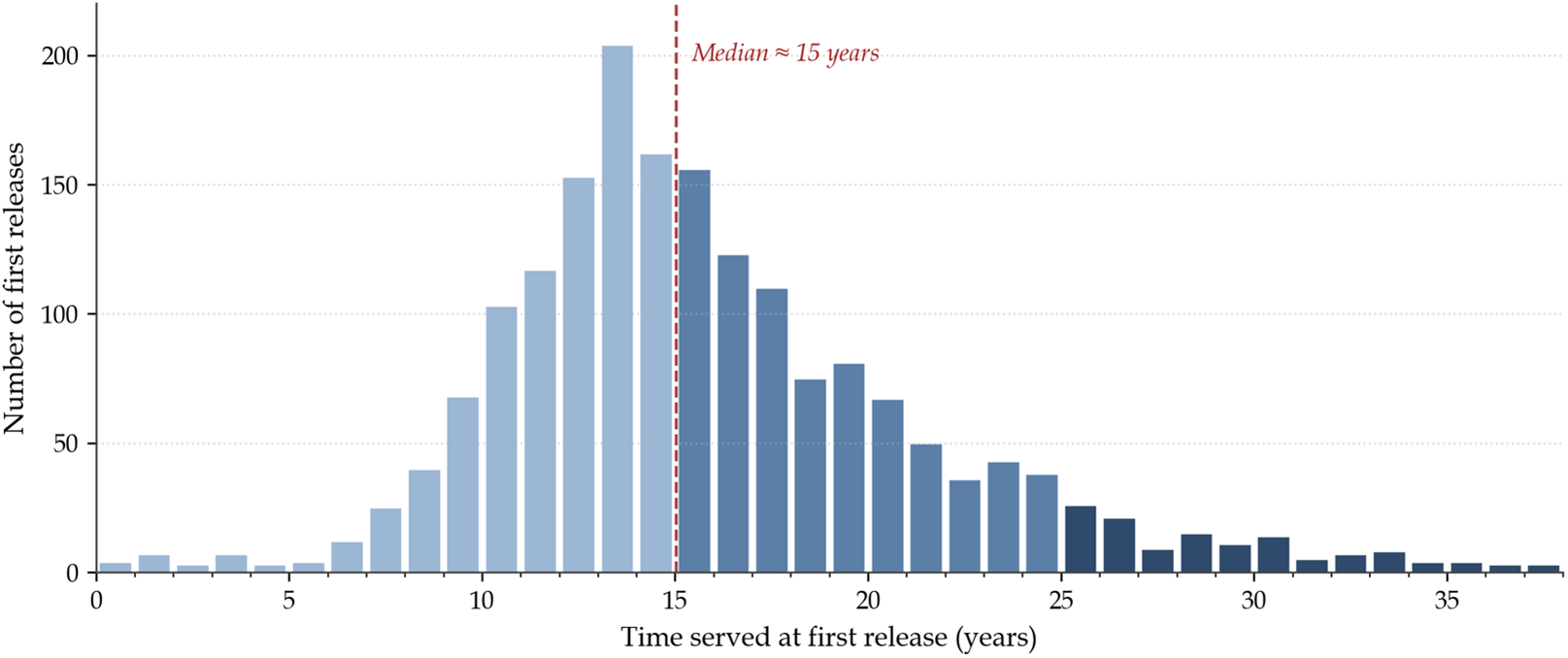
Time served at first release from mandatory life sentences, England and Wales, 2010–2018 (n = 1,832).

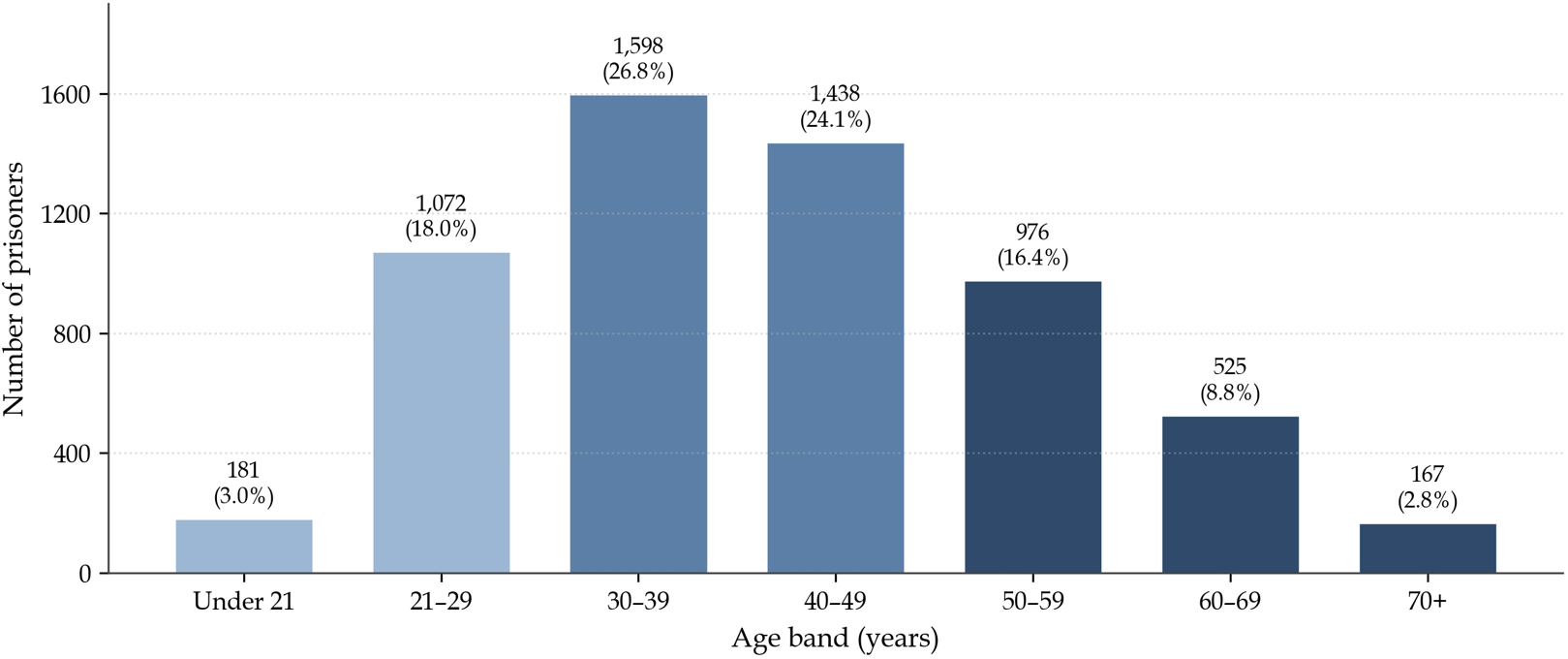
Age of prisoners serving mandatory life sentences for murder, England and Wales, 30 June 2025 (n = 5,957).

The first dimension is the distribution of minimum terms imposed across the life-sentenced population. Based on Ministry of Justice data disaggregated by minimum tariff band, and using annual snapshots from 2015 to 2025, it is possible to track how the distribution of imposed minimum terms has evolved. To isolate contemporary sentencing patterns from the residue of historical sentencing decisions, the analysis is restricted to the pre-tariff (“tariff not expired”) population – those still serving their minimum term.Footnote 50 Figure 1 sets out the resulting picture both in relative terms (panel A) and in absolute headcounts (panel B). The pattern is one of sustained and progressive movement towards longer minimum terms.Footnote 51 In 2015, 27.8 per cent. of pre-tariff life-sentenced prisoners were serving minimum terms of more than 20 years; by 2025, that share had risen to 49.3 per cent. – nearly half of all pre-tariff lifers; the 10- to 20-year band, while remaining a substantial category, declined from 62.9 per cent. to 45.1 per cent. The absolute counts in panel B sharpen the picture. The pre-tariff life population grew modestly across the decade, from 4,909 to 5,773 – an increase of around 18 per cent. But that aggregate growth conceals a sharper internal shift: the cohort serving minimum terms of more than 20 years more than doubled, from 1,365 to 2,848 prisoners, while the 10- to 20-year cohort fell by a sixth and the ≤10-year cohort by more than a third. Long-tariff prisoners are not simply being added to the lifer population but progressively displacing shorter-tariff prisoners within it.
The second dimension is the time served by those released. The lengthening distribution documented in Figure 1 translates, at the back end, into substantial time served before any prospect of release. Figure 2 shows the distribution of time served at first release for the 1,832 mandatory life sentence prisoners first released in England and Wales between 2010 and 2018. The median time served was approximately 15 years, with the modal release band falling between 13 and 15 years.Footnote 52 The distribution is markedly right-skewed: roughly one in five first releases occurred only after 20 or more years in custody, and around 130 cases (just over seven per cent.) occurred only at 25 years served or more. Figure 2 is a pooled snapshot of the 2010–18 release cohort rather than a time series, and it is therefore the level and shape of time served at release – not change over time – that the figure documents. The 2010–18 cohort is also one that was, for the most part, sentenced before Schedule 21 had fully taken effect; the time-served picture is best read as a baseline against which the still longer durations implied by Figure 1’s composition shift will be measured as more recent cohorts reach the back end of their sentences.Footnote 53
The third dimension is the age profile of those currently in custody, in which the cumulative effect of these developments is mirrored. As shown in Figure 3, the population is concentrated in the middle age bands: prisoners aged 30–39 form the single largest cohort (27 per cent.), with those aged 40–49 accounting for a further 24 per cent. and those aged 50–59 a further 16 per cent. More than one in nine prisoners, some 692 individuals, are aged 60 or above, with 167 already aged 70 or over. Figure 3 is itself a snapshot on 30 June 2025, but the underlying ageing trend is documented by Figure 1: as longer minimum terms have come to dominate the pre-tariff life population over the past decade, those prisoners necessarily age in custody before any prospect of release.
Pulling the analysis together, a growing proportion of life-sentenced prisoners are serving minimum tariffs which, in the words of Crewe et al., “until recently, were not only extremely uncommon, but were also considered more or less unsurvivable”.Footnote 54 How prisoners actually live through such sentences has become the subject of a growing empirical literature on long-sentenced imprisonment. Wright et al.’s interviews with men and women serving mandatory life sentences for murder, received when aged 25 or under, capture the early stages of such sentences as marked by “entry shock”, “temporal vertigo” and “intrusive recollection” – conditions in which prisoners initially possess “no cognitive blueprint” for sentences longer than they have been alive.Footnote 55 The defensive responses they document – suppression, denial, sublimation – are reactive strategies for surviving an offence-time nexus that existing frameworks of the pains of imprisonment do not fully capture.Footnote 56 Vannier’s research further reveals how lifers’ old age, ill-health and institutionalisation can erode the very capacities through which they are expected to evidence change, rendering extended tariffs qualitatively different as they are lived over time.Footnote 57
Collectively, these figures sketch a sentencing regime in which the punitive element of the life sentence is structurally fixed at the point of imposition, while the human experience of serving it unfolds across decades that prisoners themselves struggle to render intelligible.
III. The “Reducibility” of Life Sentences in Europe
It is within this realm of lengthening minimum terms, and the absence of a specific mechanism for tariff review, that the compatibility of English law with the principles articulated by the ECtHR can now be assessed. Specifically, this section seeks to distil, in a way yet to be done, the purchase human rights law does, and crucially does not, bring to an analysis of the reducibility of lengthy minimum tariffs. This requires a foray into the whole life tariff litigation that culminated in the Grand Chamber’s decisions in Vinter v United Kingdom and Hutchinson v United Kingdom on the reducibility of life sentences for the purposes of ECHR, art. 3, specifically its so-called “right to hope”. This is well-worn terrain but I want to retrace it with the lengthy minimum tariffs as the reference point, rather than the whole life tariff, to illuminate how, doctrinally, lengthy minimum terms will, almost certainly, never fall foul of ECHR, art. 3, and to nevertheless suggest that the Grand Chamber has left principled markers that offer a normative basis for the reducibility of lengthy minimum tariffs.
A. Reducibility and Compliance with ECHR, art. 3
As a matter of sentencing law and penal practice, a violation of ECHR, art. 3 is typically confined to “grossly disproportionate” sentences, reflecting the minimal level of severity for inhuman or degrading punishment protected by ECHR, art. 3.Footnote 58 In a series of Strasbourg cases, which began with Kafkaris v Cyprus,Footnote 59 the Grand Chamber has grappled with life sentences with no specified minimum review period. In Kafkaris v Cyprus, it was observed that the imposition of an irreducible life sentence on an adult may raise an issue under ECHR, art. 3 and that a system providing for consideration of the possibility of release is a relevant factor in assessing the compatibility of a particular life sentence with ECHR, art. 3. In Vinter v United Kingdom, the Grand Chamber re-examined the determination of whether a life sentence could be regarded as reducible, developing Kafkaris v Cyprus. In its assessment of the executive review of the whole life orders in England and Wales, the Grand Chamber broke with the “grossly disproportionate” standard and chose to examine life sentences on “other grounds” that ECHR, art. 3 was said by the court to reflect.Footnote 60 Principally, these grounds were, first, the dynamic nature of penological justifications for punishment that could shift over the life course of a sentenceFootnote 61 and, second, the principle of rehabilitation as a lodestar to guide even the most serious punishments in Europe.Footnote 62 Ultimately, both principles led the Grand Chamber in Vinter v United Kingdom to conclude that a life sentence could remain compatible with ECHR, art. 3 only if there was both a prospect of release and a possibility of review, because a prisoner could not be detained unless there were legitimate penological grounds for incarceration.Footnote 63
Leaving aside the judicial craft at play in infusing ECHR, art. 3 with these “other grounds”, the features of review that ensure a sentence’s reducibility for the purposes of ECHR, art. 3 compliance have now crystallised in the ECtHR’s jurisprudence. While it is well-established by the court that a state’s choice of a specific criminal justice system, including sentence review and release arrangements, is in principle outside the ECtHR’s scope of supervision, the domestic system must “not contravene the principles set forth in the Convention”.Footnote 64 The Grand Chamber has identified several core components of the reviewability of life sentences that constitute compliance with ECHR, art. 3: first, the scope of review: a review must extend to whether there are legitimate penological grounds for continued incarceration, specifically the progress the prisoner has made towards rehabilitation – a review limited to compassionate grounds is insufficient; second, the nature of the reviewer: a life sentence review can be conducted by either the executive or the judiciary, albeit the latter is preferable in the eyes of the ECtHR;Footnote 65 third, the articulation of the criteria and conditions of review: these must satisfy a threshold of sufficient clarity and precision, which, the ECtHR explains, promotes the rule of law and the prospects of rehabilitation; fourth, the time frame of review: generally, providing for an automatic review of sentence after a specified minimum term represents an important safeguard, but its absence is not, in itself, a violation of ECHR, art. 3.Footnote 66
What, if anything, are the implications of these components of reviewability for lengthy minimum tariffs, rather than whole life orders? Might failure to abide by these amount to a violation in that context?
A Convention challenge to the non-reviewability of a minimum tariff for murder under Sentencing Act 2020, Sched. 21 on ECHR, art. 3 grounds has not, to the author’s knowledge, arisen, but it is submitted that such a challenge would likely fall at the first hurdle. As established by the Grand Chamber in Kafkaris v Cyprus and confirmed in the case law, for a life sentence to enter the protective orbit of ECHR, art. 3 to begin with, it must, in the ECtHR’s language, be “irreducible” – that is, the prisoner cannot be said to have any “prospect”, “possibility” or “hope” of release.Footnote 67 The key word is “any”. As affirmed in Vinter v United Kingdom, ECHR, art. 3 will be satisfied where national law “affords the possibility of review of a life sentence with a view to its commutation, remission, termination or the conditional release of the prisoner”.Footnote 68 Even where detention is subject to review for the purposes of parole after the expiry of the minimum term for serving the life sentence, the ECtHR is clear that it cannot be said the prisoner has been deprived of any hope of release.Footnote 69 What it would require, doctrinally, is for the ECtHR to widen its concept of “irreducibility” to mean not just incapable of reduction on any grounds but, more demandingly, that the tariff be incapable of being reviewed on legitimate penological grounds for continued incarceration, including the progress the prisoner has made towards rehabilitation. Such a development is highly unlikely. The Grand Chamber has consistently held that just because a life sentence can be served in full does not mean it is irreducible.Footnote 70 Moreover, in respecting Member States’ margin of appreciation, the court has reiterated that, aside from the four principles listed above, the specific arrangements, including minimum tariffs prior to review, are a matter for domestic law.Footnote 71
Indeed, even if lengthy minimum tariffs had to comply with the four principles of sentence review, this would, institutionally, result in little more than the status quo arrangements. It will be recalled that in England and Wales, Crime (Sentences) Act 1997, s. 30 empowers the Secretary of State to release a life prisoner at any time where exceptional circumstances justify compassionate release. The Lifer Manual defines strict criteria for compassionate release, centred on terminal illness or severe incapacity and minimal risk. In Vinter v United Kingdom, the Grand Chamber held that even if, in principle, Crime (Sentences) Act 1997, s. 30 and the Lifer Manual could be construed in a manner consistent with the notion of reducibility in Kafkaris v Cyprus, English law was insufficiently certain and too restrictive. It thus violated ECHR, art. 3. In R. v Newell; R. v McLoughlin,Footnote 72 a special composition Court of Appeal convened to assess the decision in Vinter v United Kingdom. It explained how the statutory duty of the Secretary of State to exercise the power of prisoner release can, and must, be exercised in a manner compliant with ECHR, art. 3 and domestic administrative law.Footnote 73 In deciding whether such circumstances justify release on compassionate grounds, the Secretary of State must, the Court of Appeal explained, consider all relevant factors and cannot lawfully confine the assessment to the restrictive criteria in the Lifer Manual. Accordingly, the term “compassionate grounds” had to be interpreted broadly and compatibly with ECHR, art. 3, developing on a case-by-case basis rather than being limited to policy guidance. Any refusal or grant of release must, the court reminded, be properly reasoned by reference to the individual circumstances and remains subject to judicial review. The Court of Appeal concluded that domestic law “does provide to an offender ‘hope’ or the ‘possibility’ of release in exceptional circumstances which render the just punishment originally imposed no longer justifiable”.Footnote 74 In Hutchinson v United Kingdom, the Grand Chamber agreed, when it held that R. v Newell; R. v McLoughlin had brought the necessary clarity to the content of domestic law, apparently resolving the discrepancy identified in Vinter v United Kingdom.
What emerges, then, is a position of doctrinal closure. Following Hutchinson v United Kingdom, lengthy minimum tariffs, even those measured in decades, are reducible in Strasbourg terms and therefore need only satisfy the minimum requirements inherent in an art. 3-compliant sentence review. On that account, the highly restrictive and discretionary power of compassionate release exercised by the Secretary of State – grounded in statutory provisions and policy that have remained largely unchanged for over three decades – will suffice. So far, this offers little, if any, legal impetus for reform. Yet compliance at that level should not be mistaken for the full realisation of the principles that the Grand Chamber has repeatedly identified as giving content to the notion of reducibility. By turning from doctrine to principle, the Grand Chamber’s jurisprudence provides fertile ground from which to consider what a procedurally clearer, more coherent review mechanism might look like and why a commitment to reassessing penological justifications remains important many years, sometimes decades, after sentence. This normative picture should not be lost merely because the question of reviewability is, in formal doctrinal terms, settled by Hutchinson v United Kingdom.
B. Reducibility as a Penal Principle
Two interlocking principles can be distilled from the court’s case law. The first concerns the substantive justification for continued detention and, in particular, the role of rehabilitation and the shifting balance of penological aims over time. The second concerns the procedural structure of review, expressed through requirements of legal clarity and fairness. Together, these principles point beyond the bare question of reducibility and towards the qualitative features that any meaningful review mechanism must possess.
On the first point, the Grand Chamber has now repeatedly emphasised that continued detention must rest on legitimate penological grounds, and that those grounds are not static.Footnote 75 Sentencing theory has long been dominated by what recent scholarship calls “static retributivism”,Footnote 76 most prominently associated with von Hirsch, whereby the components of a crime’s seriousness (harm and culpability) are crystallised at the time of the offence and fully known at sentencing. On this account, nothing the offender does after the offence can aggravate or mitigate sentence severity, because the elements of proportional sanction have been exhausted at the moment of conviction. Against this stands “dynamic retributivism”, which conceptualises the moral weight of punishment as evolving over the course of a sentence rather than fixed at its start.Footnote 77 It is on the dynamic side of this distinction that the Grand Chamber has, in substance, placed itself.
The point emerges most clearly in the Grand Chamber’s insistence that continued detention must rest on legitimate penological grounds, and – crucially – that those grounds are not static. In Vinter v United Kingdom, the court stated in terms that have since become canonical that “it is axiomatic that a prisoner cannot be detained unless there are legitimate penological grounds for that detention”, including punishment, deterrence, public protection and rehabilitation.Footnote 78 While many of these justifications may be present when a life sentence is imposed, their relative weight “is not necessarily static and may shift in the course of the sentence”.Footnote 79 What justifies continued detention at the outset may cease to do so after a lengthy period of imprisonment, and it is only by reviewing detention “at an appropriate point in the sentence” that such shifts can properly be evaluated.Footnote 80 As Summers clarifies, an irreducible life sentence may pursue a legitimate aim at sentencing, but “it is very probable that with time the sentence will lose its connection to that initial aim”.Footnote 81 The court’s concern, then, is with arbitrariness that arises once the rational connection between the purpose of a sentence and its continuing interference with the individual has dissolved.Footnote 82
If Strasbourg has committed itself to the dynamic view, the scholarship helps explain why the moral weight of punishment should be thought to evolve at all – for the mechanism is contested.Footnote 83 For some, the passage of lengthy periods weakens the connection between the offender’s past and present self, such that the person before the Parole Board is no longer the person whose desert was fixed at sentencing.Footnote 84 For others, what matters is the offender’s responsive engagement with penal censure – sincere remorse, reparative action, demonstrated moral change – which itself bears on the continuing need for the censure originally delivered.Footnote 85 Others locate the dynamic element in the unforeseen severity of penal suffering, or in the gradual diminution of the retributive impulse itself as societal memory of the offence recedes.Footnote 86 However their grounding differs, these theories converge on the premise underlying the Grand Chamber’s position that the retributive justification for punishment is not exhausted at the moment of sentencing, and that institutional mechanisms must therefore remain open to its reassessment.
In addition to this substantive point of sentencing principle, the Grand Chamber has developed a second, formal principle: sentence review must be governed by law of sufficient quality. A mechanism that exists only in theory, or that operates through unfettered or opaque discretion, will not satisfy ECHR, art. 3. In Vinter v United Kingdom, the Grand Chamber stressed that any assessment of continued detention “must be based on rules having a sufficient degree of clarity and certainty”.Footnote 87 This requirement has been elaborated in subsequent cases. In László Magyar v Hungary, the court criticised the absence of any guidance as to the criteria governing review, noting that the law provided no indication of what “personal particulars” were relevant or how they would be assessed.Footnote 88 As a result, prisoners were left without knowledge of what was required of them in order to be considered for release. In Harakchiev and Tolumov v Bulgaria, the court similarly faulted a clemency regime for its opacity, the want of publicly available policy, the lack of reasons for individual decisions and the absence of formal or informal safeguards.Footnote 89 In Trabelsi v Belgium, the Chamber emphasised that review must operate on the basis of “objective, pre-established criteria of which the prisoner had precise cognisance at the time of imposition of the life sentence”.Footnote 90
What unites these strands of the case law is the Grand Chamber’s emphasis on a degree of foreseeability and transparency. Certainty in this area, the Grand Chamber has made clear, is not merely a general requirement of the rule of law. It also underpins the rehabilitative function of imprisonment itself. As the decision in Vinter v United Kingdom explains, prisoners must know from the outset what they must do to be considered for release and under what conditions, including when a review will take place or may be sought; otherwise, the prospect of rehabilitation risks being undermined rather than supported.Footnote 91 Access to reasons, objective criteria and some form of judicial oversight are therefore not ancillary safeguards, but integral features of a lawful review mechanism. The court’s subsequent clarification in Hutchinson v United Kingdom qualifies, but does not displace, these requirements. Referring to Vinter v United Kingdom, László Magyar v Hungary and Harakchiev and Tolumov v Bulgaria, the Grand Chamber observed that “a high degree of precision is not required in order to satisfy the Convention”.Footnote 92 The point was not that legal clarity is dispensable, but that ECHR, art. 3 does not mandate a rigid or exhaustively codified framework for sentence review. What remains required is a mechanism that is sufficiently foreseeable in practice to enable the prisoner to understand the nature of the review, the matters that may be taken into account and the possibility – however limited – of release. The rejection of a “high degree” of precision thus marks the outer limit of the Convention’s demands; it does not negate the underlying insistence that continued detention must be open to principled reassessment on the basis of intelligible criteria and within a framework capable of supporting rehabilitation.
As already alluded to above, these principles are reflected, with consistency, in European penal practice. From the mid-1970s onwards, European institutions have treated sentence review as a structural safeguard accompanying life imprisonment.Footnote 93 As early as 1976, the Council of Europe’s Committee of Ministers recommended that life sentences be subject to review after a defined period of detention, with further reviews at regular intervals, and rejected reliance on general prevention alone to justify continued incarceration.Footnote 94 That orientation is echoed across European and international frameworks: EU law permits execution of a European arrest warrant for a life sentence to be made conditional on the availability of sentence review within a defined time frame,Footnote 95 while international criminal law mandates review of life sentences after 25 years.Footnote 96
At the level of national laws, the overwhelming majority of Council of Europe Member States provide for a dedicated mechanism to review life sentences after a minimum period fixed by law – most commonly between 15 and 25 years.Footnote 97 One example is Italy.Footnote 98 A life-sentenced prisoner becomes eligible to apply for parole (liberazione condizionale) after 26 years, on proof of settled repentance (sicuro ravvedimento) assessed by a specialist Supervision Tribunal against articulated criteria including the evolution of the prisoner’s behaviour and his conduct towards the victim.Footnote 99 Further still, under liberazione anticipata, that threshold is itself reducible: a prisoner who actively engages with the rehabilitative regime earns a 45-day discount for every six months served, bringing the parole eligibility point forward from 26 to 21 years.Footnote 100 Another illustration is France. A life-sentenced prisoner becomes eligible to apply for conditional release (libération conditionnelle) after 18 years, on proof of serious efforts to readjust to society, with the decision taken in adversarial proceedings by a specialist post-sentencing court (tribunal de l’application des peines) composed of three judges.Footnote 101 Beyond Europe, the American Law Institute’s Model Penal Code: Sentencing provides, in section 305.6, for a “second look” at long custodial sentences after 15 years served. The application is determined by a judicial panel and the test, expressly framed in penological terms, is whether the purposes of sentencing set out in section 1.02 would be better served by modification than by completion of the original sentence.Footnote 102
It is because Strasbourg doctrine establishes a set of core principles, while stopping short of prescribing a single institutional model, that comparative experience becomes instructive. Although the court has made clear that a state’s choice of criminal justice system, including the form of sentence review, lies in principle outside its supervisory remit,Footnote 103 that discretion is bounded by requirements that have now crystallised in the case law. Review must extend to the continued existence of legitimate penological grounds, including progress towards rehabilitation; it must operate within a framework governed by sufficiently clear and intelligible criteria; and it must offer a genuine prospect of reassessment after a substantial period of detention. Within those constraints, however, domestic systems retain a measure of choice as to how review is structured and operationalised. It is to one such attempt – designed to give concrete institutional form to these principles, yet ultimately abandoned – that the analysis now turns. The following section examines Canada’s former “faint hope” clause, which offers instructive lessons.
IV. A Comparative Case Study: Canada’s “Faint Hope” Clause
The Canadian experience is instructive not because it supplies a ready-made model for legal transplantation, but because it shows how a penal system can give concrete institutional form to the idea that penological justifications may legitimately be reassessed long after the sentence is first determined. Prior to its abolition in 2011, Canadian law provided a structured “faint hope” mechanism that permitted individuals serving life sentences for murder to seek judicial review of their parole ineligibility after 15 years. Introduced in 1976 alongside the abolition of capital punishment, the provision was explicitly framed as a safeguard against the finality of very long sentences.Footnote 104 The penological rationale, described by those involved in the “faint hope” clause’s administration, was to give prisoners “a glimmer of hope”.Footnote 105 It offered an incentive for prisoners to adopt conduct making their application more likely to succeed and to “better cope with the despair caused by sentencing someone to life imprisonment, because of the realistic possibility available to them of reintegrating into society before their life is over”.Footnote 106 In this respect, the Canadian scheme gave institutional effect to the Grand Chamber’s observation in Vinter v United Kingdom that rehabilitation risks becoming illusory where prisoners have no intelligible prospect of reassessment.
The design of the “faint hope” review is worth unpacking in some detail. It combined judicial gatekeeping at the threshold, an adversarial hearing before a judge and jury, a directed framework of considerations, a tiered set of decisional options and a deliberate separation between the penological question of continued punishment and the risk-based question of release. Twelve months before eligibility, a parole officer met with the offender to discuss whether an application for tariff review was intended and advised the offender to obtain full disclosure of the file, and to ensure that psychological assessments were completed. A comprehensive report was then prepared covering the offender’s background, institutional conduct, disciplinary history, assessments and personal development.Footnote 107 At that point, an applicant had to satisfy a superior court judge that the application had a reasonable prospect of success.Footnote 108 Only then would a full (adversarial) hearing proceed before a judge and jury, with the prisoner represented by counsel and the application opposed by Crown prosecutors.Footnote 109
At the hearing stage, the jury was directed to consider the offender’s character, conduct while serving the sentence, the nature of the offence, information provided by the victim’s family members about how the crime had affected them, and any other matters the presiding judge considered relevant.Footnote 110 The jury had a range of options according to which it could: refuse any reduction; reduce the period by a specified number of years up to the statutory maximum of 10; or make the applicant immediately eligible to apply for parole. The decision-making process of the jury was tiered. First, there was the threshold decision that the parole ineligibility period should be reduced, which had to be unanimous. Second, there was the subordinate decision on how many years the reduction should be, which required a two-thirds majority.Footnote 111 Where a reduction was refused, the jury then had to decide either to fix a date at which a fresh application could be brought or bar any further application before the statutory point (25 years for first-degree murder); if it set no date and did not bar reapplication, the default rule required the prisoner to wait two years before applying again.Footnote 112 Even a successful applicant did not secure release – a favourable jury decision only permitted an earlier application to the Parole Board, which retained full discretion to determine release.
Empirical evaluation bears out the scheme’s selectivity at the point of application. Drawing on official data from 1997–2010, Zhang and Ha report that although 741 offenders had reached the fifteen-year eligibility threshold, only 276 (37 per cent.) applied for review, and of those, just over half secured a reduction in parole ineligibility.Footnote 113 Earlier data tell a comparable story for the 1987–2000 period: of 488 prisoners then eligible, only 103 (21 per cent.) had progressed to a hearing.Footnote 114 These figures point to a self-screening process in which only a minority of eligible prisoners pursued review – a pattern that undermines the fear that such mechanisms inevitably generate routine or opportunistic applications. Post-release outcomes further complicate an easy common assumption that early review compromises public safety. Zhang and Ha distinguish between technical breaches of parole conditions and reconvictions for new offences. At six years post-release, those released following a successful “faint hope” application had the lowest breach rate of all comparison groups. More significantly, reconvictions for new offences were rare: at five years post-release, only five of 131 individuals released early under the “faint hope” clause had been reconvicted of an offence.Footnote 115
A complementary dimension of the Canadian experience emerges from Roberts’ empirical analysis of jury decision-making. Survey research from the late 1980s indicated overwhelmingly punitive public attitudes towards parole for those convicted of murder.Footnote 116 Yet when citizens served as jurors confronted with individual cases, reductions in parole ineligibility were granted in approximately 80 per cent. of the 105 hearings conducted between 1987 and 2000.Footnote 117 The reductions juries granted varied significantly. Roberts’ distribution of outcomes reveals that of 105 hearings, 21 resulted in no reduction at all; 20 (19 per cent.) attracted the maximum ten-year reduction; and the remainder fell across a range of one to nine years.Footnote 118 The contemporaneous figures collated by Stein and Antonowicz tell the same story, with successful applicants having their ineligibility periods reduced from a 25-year baseline to anywhere between 15 and 24 years, and from 20-year baselines to between 15 and 18 years.Footnote 119 This distribution captures a version of “dynamic retributivism”: the jury was calibrating the size of the reduction to the particular case – doing, in effect, the differentiating work that a sentencing court performs at first instance.Footnote 120 Consistent with this account, the average reduction in first-degree murder cases (6.7 years) exceeded that in second-degree cases (4.6 years), reflecting, in part, the greater headroom for reduction in first-degree cases arising from lengthier tariffs in the first place.Footnote 121
A gendered dimension to Canada’s “faint hope” clause is also discernible, even if the sample of female lifers is a small one. Among the 741 prisoners who reached eligibility in Zhang and Ha’s dataset, 16 were women. Of those women, 56 per cent. applied for review, compared with 37 per cent. of eligible men; 67 per cent. of women’s applications succeeded, compared with 51 per cent. of men’s; and the average reduction granted was 8.5 years for women, compared with 6.3 years for men.Footnote 122 The sample is small enough that the comparison must be treated cautiously, but the direction of the disparity is consistent with the broader picture that jurors engaged with the specifics of individual cases – including, plausibly, gendered patterns in offending pathways, abuse and abjection in the community, pains of imprisonment and rehabilitative prospects.Footnote 123
Alas, the “faint hope” clause was consigned to legislative history in 2011. This was not, crucially, down to policy failure. As Roberts observes from the repeal debates, calls for abolition tended to coincide with high-profile cases rather than failures in risk management or because public safety outcomes proved unsatisfactory.Footnote 124 In fact, the Barreau du Québec, representing professors, Crown prosecutors and defence counsel, stated that “the process set out in section 745.6 was working perfectly and did not need any legislative amendment […] because ultimately only the most deserving have been able to pass the review”.Footnote 125 This is not to deny the real burdens the process imposed, particularly on victims’ families and friends. Roberts acknowledged that “faint hope” hearings could be traumatic and resource-intensive, but two features are worth underscoring.Footnote 126 First, only a minority of eligible prisoners applied – around one in five over 13 years – illustrating that review was reserved for exceptional cases.Footnote 127 Second, the Canadian framework enabled victim participation at critical junctures in the process, something returned to below. For present purposes, the Canadian experience matters as a proof of concept. It demonstrates that a review mechanism can be designed to address the concerns articulated by the Grand Chamber: reassessment of penological justifications, intelligible criteria and a clear separation between sentence review and risk-based release. It further illustrates that such mechanisms can operate with restraint, legitimacy and public safety over decades. It is against this experience that a “faint hope” clause in England and Wales can now be imagined.
V. Imagining a “Faint Hope” Clause in England and Wales
Turning to the core issue of where power for tariff review ought to lie, at least three broad institutional models emerge from the preceding discussion. Review authority could be vested in the judiciary; extended to the Parole Board; or structured through a hybrid mechanism combining judicial determination of penological shift with subsequent parole-based risk assessment. Each reflects a different balance between legal expertise, institutional competence and legitimacy. The Canadian model adds a further, distinctive element: limited lay participation through jury determination of the penological question. Under the Criminal Code 1985, s. 745.6, the jury was not asked whether the offender should be released, but whether the original justifications for continued detention – retributivism, denunciation, deterrence – still carried sufficient weight after many years of imprisonment. The Parole Board retained exclusive responsibility for assessing public safety and managing reintegration. Transposed to England and Wales, that separation would allow the punitive element of the life sentence – the minimum term – to be revisited without collapsing sentence review into parole decision-making, and without displacing the Parole Board’s established expertise in risk assessment. It also creates space for a form of civic judgment that is neither populist nor abstract, but grounded in the evaluation of individual cases over time. A “faint hope” mechanism would therefore operate upstream of parole, addressing whether continued detention remains justified on penological grounds, rather than whether the prisoner is immediately safe to release.
Any such mechanism must be calibrated to reflect the gravity of murder and the doctrinal limits established by Hutchinson v United Kingdom. Review should occur only after very substantial punishment has been served. A threshold of two-thirds of the minimum term, or 20 years’ imprisonment (whichever is greater), for example, would ensure that review is exceptional rather than routine, while avoiding applications so late as to collapse into ordinary parole eligibility. This responds directly to concerns identified in the Canadian experience about hearings occurring too close to the original parole ineligibility date. It is also in keeping with the Council of Europe norm, which, based on the data collated in Vinter v United Kingdom, puts the average point of review at 19.4 years.Footnote 128 The reviewing body – whether judicial or hybrid – would not operate under a presumption of release. Its task would be narrowly defined to determine whether the penological grounds that justified the original minimum term continue to do so. Relevant considerations would include sustained evidence of rehabilitation, the extent to which punishment and deterrence have been exhausted, and whether continued detention meaningfully advances any remaining penological purpose.Footnote 129 The burden would remain squarely on the prisoner. An unsuccessful application should preclude reapplication for a substantial period, reflecting the slow and incremental nature of penological change and minimising repeated intrusion on victims and the system.
The importance of such procedural clarity reflects the findings of empirical work on long-term and late-stage life-sentenced prisoners. As captured by Wright et al.’s research with prisoners at the “late stage” of a non-“whole life” life sentence in England and Wales, the capacity to sustain hope is tied not only to optimism about outcome, but also to confidence in process.Footnote 130 Where prisoners come to believe that their route to release is not merely difficult but unintelligible or foreclosed, agency collapses and engagement with rehabilitative goals diminishes. By contrast, hope appears more resilient where institutions provide clear pathways, intelligible criteria and credible signals that progress will be meaningfully assessed over time. Jarman and Vince’s findings from their consultation with around one hundred long-sentenced prisoners speak to the same institutional deficit, but at the middle stretches of the sentence – the years that one of their respondents described as “nothing time”.Footnote 131 Their respondents reported substantial periods, often after offending behaviour work was completed or had been deemed unsuitable, in which the sentence felt “purposeless and stagnant”,Footnote 132 with no specified pathway by which personal development might be recognised and translated into formal progression. Compounding this, Jarman and Vince document a pervasive confusion over what “risk” meant in respondents’ cases, what they were being asked to reduce and how – a confusion exacerbated by the absence of regular, individualised review by those with day-to-day knowledge of the prisoner.Footnote 133 What emerges from their research is that the problem lies in the process itself, specifically the absence of intelligible criteria, the lack of structured assessment at regular intervals and the disjunction between what prisoners experienced as their own development and what the institution would credit.
Taken together, the empirical work paints a picture in which extended minimum tariffs are lived under conditions of procedural opacity that erode capacities – agency, engagement, rehabilitative orientation – on which sentence progression is said to depend. These findings reinforce the Strasbourg emphasis on legal clarity and foreseeability, and underscore why a “faint hope” mechanism must be structured as a principled, intelligible stage of sentence review rather than absorbed into discretionary parole decision-making. A successful review would not mandate release. The Parole Board would retain full discretion to refuse release, impose graduated conditions and recall where necessary. In this respect, the proposal aligns closely with Strasbourg’s insistence that reviewability concerns the justification for detention, not the automatic entitlement to release. Properly understood, a “faint hope” clause would not weaken the life sentence for murder. It would acknowledge what English sentencing law used to accept prior to the Criminal Justice Act 2003, and already accepts in the context of young murderers: that sentences which are proportionate when imposed may, after decades of imprisonment, require principled reassessment. The proposal seeks to respond to the deeper penal principles articulated by the Grand Chamber – principles that English law currently satisfies only at their outer edge.
Finally, the Canadian experience offers insights into how victim participation might be accommodated in an English and Welsh “faint hope” mechanism. Three features of the Canadian framework for victims merit emphasis. First, victims were given a structured route into the sentence tariff hearing itself. The jury was directed to take into account any information provided by a victim, whether at the original sentencing hearing or at the review, and latterly, victim impact statements from family members became an embedded feature of the process.Footnote 134 Second, victim engagement was accompanied by support and notification arrangements administered by the Correctional Service of Canada and the National Parole Board, and underpinned by an obligation on the trial judge at original sentencing to inform the community that the convicted person might in time apply for review, thus pre-empting later surprise at the existence of the procedure.Footnote 135 Third, research suggests that giving victims a structured voice did not produce reflexive jury hostility towards applicants. Roberts found no perceptible decline in success rates following the systematic introduction of victim impact statements in 1996, a finding consistent with the wider literature on the limited outcome-effect of victim impact statements at sentencing.Footnote 136 The Canadian experience demonstrates, then, that the prospect of victim distress can be, to some extent, mitigated by routes for participation and support.
VI. Conclusion
Minimum terms for murder in England and Wales now routinely extend over 20-plus years. The absence of any structured mechanism to revisit lengthy determinate minimum tariffs is increasingly difficult to justify. To be clear, European human rights law does not compel such a review mechanism. Lengthy minimum tariffs are most unlikely to be characterised by the ECtHR as “irreducible” in the first place. Unlike a prisoner subject to a whole life order, a prisoner serving a lengthy minimum tariff has a parole date, however distant, on the horizon. And even if reducibility principles were engaged, Hutchinson v United Kingdom confirms that English law’s executive power of compassionate release, interpreted in light of R. v Newell; R. v McLoughlin, is legally sufficient. That settled doctrinal position should not, however, be mistaken for the proper realisation of the principles the Grand Chamber has repeatedly identified as giving content to reducibility.
Those principles – shifting penological justification, the centrality of rehabilitation and the requirement of clarity – acquire particular salience in a sentencing system with increasingly long minimum tariffs, and in which the life-sentenced population is ageing in custody without any mechanism for structured reassessment of the punitive element of the sentence itself. A late-stage tariff review does not depend on sympathy for those convicted of murder. With the exception of those convicted on the basis of complicity, offenders have taken life with intent to kill or cause really serious harm; the mandatory life sentence reflects the gravity of that wrongdoing. The point is that when the state imposes unprecedentedly long imprisonment, it ought to remain justified on penological grounds for the entirety of the sentence.
The Canadian “faint hope” clause is an insightful example of late-stage review. It shows, on the one hand, that the public are not implacably opposed to “dynamic retributivism”: the penal justifications for punishment were perceived as diminishing with time, in some cases significantly so, as evidenced in sentencing reductions. On the other hand, it displays a process designed and administered to filter meritorious cases and subject them to careful scrutiny, strengthened by lay participation. A carefully calibrated “faint hope” mechanism for England and Wales would adopt the same separation between sentence review and release, set a demanding threshold reflecting the gravity of murder, and leave release decisions to the Parole Board. The question for law reform is not whether murderers deserve reconsideration. It is whether a sentencing system committed to proportionality, legality and public protection can continue to treat decades-long minimum terms as beyond structured reassessment.


 Open access

