

Introduction
Endotracheal intubation (ETI) is a complex clinical skill and an important part of the care of critically ill and injured patients. In out-of-hospital settings, ETI performed by paramedics has been demonstrated to be associated with worse outcomes when compared to hospital settings.Reference Bischof, Panchal, Finnegan and Terndrup 1 - Reference Bochicchio, Ilahi, Joshi, Bochicchio and Scalea 3 This may be due to multiple factors, including environmental factors (poor lighting or suboptimal treatment area on scene), patient factors (patient habitus and airway characteristics, occult illness and injury, or co-morbidities) and personnel factors (inexperienced or incompletely trained providers). Many of these factors are inherent to the prehospital setting making them difficult to modify. However, improving prehospital practitioners’ comfort and training in airway management can optimize ETI performance in the prehospital setting.Reference Davis, Fakhry and Wang 4
There is significant variability in the training and exposure of prehospital providers to ETI and advanced airway management. On an average, prehospital providers may be called to perform ETI in the field only one to four times per year.Reference Bochicchio, Ilahi, Joshi, Bochicchio and Scalea 3 As would be expected from this low rate, errors in placement of endotracheal tubes (ETTs) are higher in rural ambulance counties where fewer opportunities for ETI experience exist when compared to those in urban counties with higher rates of ETI.Reference Bochicchio, Ilahi, Joshi, Bochicchio and Scalea 3 It is estimated that 6%-25% of patients intubated in the field may have had unrecognized esophageal ETI placement.Reference Lecky, Bryden, Little, Tong and Moulton 5 - Reference Jones, Murphy, Dickson, Somerville and Brizendine 7 Given the significant morbidity and mortality associated with suboptimal airway management and modest prehospital clinical exposure, there is a distinct need for reliable, valid, inexpensive, and reproducible training simulators to augment prehospital skills in airway management.Reference Silvestri, Ralls and Krauss 8 , Reference Terndrup, Cherry, Madden, Cantor and McCabe 9
In this study, the development of a mobile simulation laboratory (MSL) designed to augment prehospital provider training in difficult airway management is described. As configured, this MSL is a mobile training environment for further clinical skill improvement allowing for both in situ observations and assessment of prehospital provider performance when challenged with a difficult airway scenario.
Methods
Rationale for a Prehospital Airway Simulator
The diverse prehospital environment challenges the ability to employ traditional simulation settings to train and assess prehospital providers. Traditional airway training is often conducted in controlled settings similar to that experienced in a hospital environment rather than in a prehospital setting. To better simulate real-life situations faced by prehospital providers, a simulator that mirrors the prehospital experience is essential. To this end, three distinct characteristics were defined for an appropriate prehospital airway simulator: (1) the simulation environment should provide a representative prehospital setting; (2) the simulator should be easily and rapidly deployable to locations representative of prehospital practice settings in both rural and urban areas; and (3) the simulation environment must function as an in situ experimental setting facilitating the fidelity of the training scenarios.
Initial experiments were performed in a laboratory in order confirm the level of difficulty of the prehospital airway simulator. With the mannequin placed in a rigid cervical collar, tongue pressures were increased incrementally to demonstrate the ability to reproducibly create high-grade Cormack-Lehane (CL) views of the larynx (Grade 3 and 4).Reference Terndrup, Kanter and Cherry 10 , Reference Phelan, Moscati, D’Aprix and Miller 11 Following this, the Difficult Airway Simulator was tested in the MSL. All studies were approved by the Institutional Review Board of The Ohio State University (Columbus, Ohio USA) and informed consent was obtained for all trainees and airway experts.
Description of Mobile Simulation Laboratory
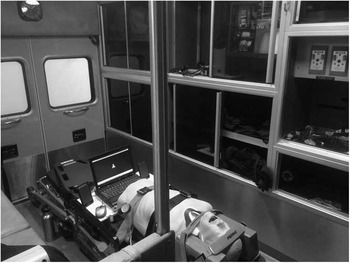
The MSL was comprised of four parts: ambulance, patient monitor, patient simulant, and an audiovisual recording system. The MSL was a Type 3 ambulance whose patient care area was converted into a simulation environment while the rest of the ambulance still maintained its complete functionality. The patient care area was standardized to mimic the box-type service ambulances employed by the prehospital providers. The MSL contained a standard patient stretcher with the simulator mannequin strapped to it and the supplies needed to successfully complete a full patient care simulation. Supplies provided in the ambulance included all equipment required to manage a difficult airway: ETT, ETT holders, tape, airway adjuncts, bag-valve-mask, backup airways, oxygen masks and cannula, capnography, and suction catheters. A training computer was placed at the foot of the simulant patient stretcher to simulate typical monitors available to prehospital providers and to display predetermined vital signs and monitor waveforms of the simulator mannequin as the scenario progresses.
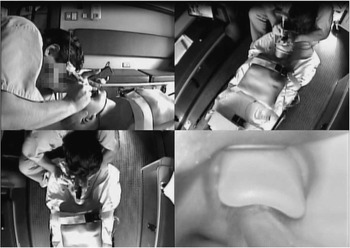
The ambulance was modified to accept four moveable bullet type-recording cameras in the patient care area of the ambulance (Figure 1). The four camera views allowed for an increased likelihood that essential video images of patient care were captured in a systematic fashion for possible review in the future by a trainee or an expert simulation proctor. The four views included views of the trainee, mannequin, and equipment layout. The video system in the MSL consisted of a closed loop television security system equipped with two scene cameras mounted perpendicular and above the mannequin to allow for visualization of the trainee and the mannequin in both a horizontal and vertical plane. The camera placed horizontally and perpendicularly to the sagittal plane of the mannequin allowed for the observation of the trainee’s body position and the force applied to the mannequin during intubation. The second vertical camera allowed for monitoring of the trainee’s hand positioning during procedures, such as during ventilation and lateral movement during intubation. A third scene camera provided a view of the equipment layout with the remaining camera capturing the view from a video laryngoscope. All video feeds were processed through a digital video recorder producing a 2X2 matrix (Figure 2) allowing for the presentation of all four cameras simultaneously in real time on one screen.
View of Interior of Mobile Simulation Laboratory.

Four Quadrant View Obtained in the Mobile Simulation Lab. Left upper panel, from intubator’s right side. Right upper panel, from left upper side. Right lower panel, from above. Right lower panel from video-laryngoscope. Note: the intubator seated at head and airway equipment to the intubator’s right hand side.

Development of the Prehospital Difficult Airway Simulator
To create a difficult airway simulation on which to test trainees, the Deluxe Difficult Airway Trainer (Laerdal Medical As; Stavanger, Norway) was selected and placed in the patient care area of the MSL.Reference Cormack and Lehane 12 The mannequin was placed on a backboard with a rigid cervical collar (Laerdal Stifneck) to limit neck flexion and jaw movement, thus partially simulating a difficult airway setting.Reference Jordan, Silsby, Bayley and Cook 13 A second variable, increased mannequin tongue pressure creating a greater obstruction of the airway, was also used to increase the difficulty of the simulated airway. The mannequin was modified to include a pressure gage allowing for the accurate measurement of tongue inflation pressure.
In order to assess the difficulty of ETI in the simulated scenario, experts in airway assessment and ETI performed ETI on the mannequin. A direct layngoscopy device (C-MAC 8402ZX, KARL STORZ; GmbH & Co. KG; Tuttlingen, Germany) was used by the experts during ETI to allow for the documentation of the laryngeal view obtained during the simulation and to closely simulate the view obtained by traditional direct laryngoscopy using a curved blade. The laryngoscopy views were not shown to the airway experts or paramedics during their attempts allowing for a reasonably close approximation of prehospital clinical performance in airway management.
To standardize the difficulty of the airway, run trials were performed by 19 airway experts (who were a convenience sample of experienced anesthesiologists and emergency physicians), at three different resting tongue pressures (60 mm Hg, 95 mm Hg, and 130 mm Hg). Each expert sequentially performed an intubation at each tongue pressure with decreasing level of inflation. After each attempt, the experts and video records were used to rate the CL view and the difficulty of successful airway intubation prior to proceeding to the next intubation attempt. The run trials were performed on the mannequin with cervical-spine immobilization maintained by a collar and placed on a cart at a standing height to simulate optimal intubation conditions in an attempt to limit confounding factors by mimicking ideal ETI conditions.
Validation of the MSL Difficult Airway Simulator
The MSL Difficult Airway Simulator was validated by a convenience sample of 18 prehospital providers at the 2012 Emergency Medical Services (EMS) Safety Conference (Erie, Pennsylvania USA). Volunteer, certified paramedics were recruited by study personnel to attempt intubation of the experimental setup described above with a tongue inflation pressure to allow an approximate first pass success of 50%. After informed consent was obtained, and basic demographic information also was obtained, each volunteer was asked to attempt intubation and allowed up to three attempts at successful intubation. One attempt was defined as any maneuver involving the placement of an ETT tube inside the oral cavity of the mannequin.
Statistical Analysis
Means and standard deviations, along with medians and interquartile ranges, were calculated using Stata 11 (StataCorp LP; College Station, Texas USA) to assess participant characteristics and for determination of the appropriate tongue pressure of difficult airway model. Analysis of variance was used to evaluate for differences in the level of difficulty of the various tongue pressures.
Results
Development of Difficult Airway Simulator
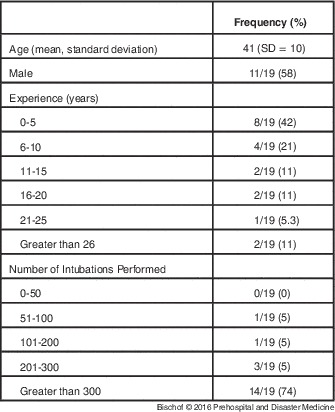
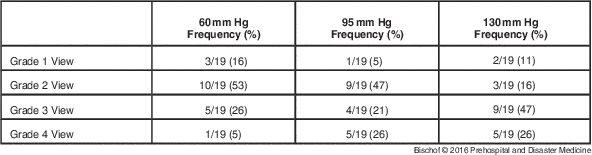
The airway simulator was designed to provide prehospital practitioners with a reliably challenging airway that was deemed to be “difficult” to intubate per expert assessment. To confirm the level of this simulator difficulty, 19 airway experts performed 57 ETI attempts (Table 1) to determine the appropriate tongue inflation pressure that simulated a difficult airway. Demographic data concerning the airway experts demonstrated a significant experience with ETI with the majority having greater than 300 career intubations (Table 1). Assessment of the CL grade view for the three tongue pressures tested (60, 90, and 130 mm Hg) is noted in Table 2. As tongue pressure was increased, a higher proportion of airway experts noted Grade 3 and Grade 4 airway views. At the 130 mm Hg tongue pressure, 73% of practitioners observed a Grade 3 or 4 view compared to 47% for 95 mm Hg tongue pressure and 31% at 60 mm Hg tongue pressure.
Demographic Data of Airway Expert Characteristics Involved in the Validation of the Difficult Airway Simulator

Endotracheal Intubation View (Cormack-Lehane view) Obtained by Airway Experts on the Difficult Airway Simulator at Varying Tongue Pressures

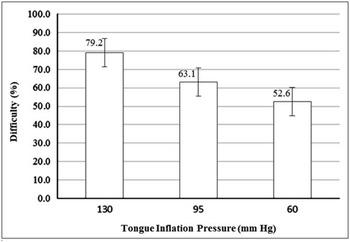
Airway experts were also asked to judge the overall level of difficulty of the simulated ETI at the different tongue pressures (Figure 3). Experts noted that with increasing tongue pressures, there was a proportional increase in the level of difficulty of the ETI with 130 mm Hg tongue pressure demonstrating a rating of 79% on a scale of 0-100 (with 100 being the most difficult airway experienced). Based on this data, a tongue pressure of 60 mm Hg was chosen for the prehospital trials since 31% of participants noted a Grade 3 or 4 view with a level of difficulty of 53%.
Level of Difficulty of Endotracheal Intubation as Rated by Airway Experts on the Difficult Airway Simulator at Varying Tongue Pressures. Airway difficulty was rated from 0 to 100 with 100 being most difficult.

Validation of MSL Difficult Airway Simulator
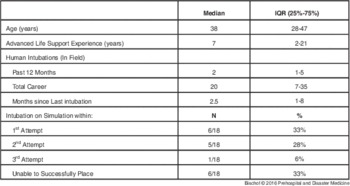
To validate the MSL Difficult Airway Simulator at a tongue pressure of 60 mm Hg, 18 volunteer certified paramedics were recruited to perform ETI in the MSL. Demographic data of these providers is noted in Table 3. Paramedics had a median reported years of Advanced Life Support experience of seven years (IQR 25%-75%: 2.25-20.5) with a median number of field intubations in their career of 20 (IQR 25%-75%: 7-35). Among this population of prehospital providers, 33% successfully intubated the mannequin on the first attempt, with an additional one-third successfully completing the task within a total of three attempts. The remaining six of 18 (33%) failed to intubated the mannequin within three attempts.
Demographics of Certified Paramedics’ (N=18) Endotracheal Intubation Experience and their MSL Simulation Results

Abbreviation: MSL, mobile simulation laboratory.
Discussion
The prehospital environment can be a difficult clinical setting where successful ETI rates often are lower than those noted in more controlled hospital ED settings.Reference Bischof, Panchal, Finnegan and Terndrup 1 - Reference Bochicchio, Ilahi, Joshi, Bochicchio and Scalea 3 One aspect of this issue is the low human clinical exposure of prehospital practitioners to airway management and ETI. In general, ETI errors have been shown to be higher in rural ambulance providers where fewer opportunities for ETI experience exist when compared to attempts conducted in urban providers with higher rates of ETI.Reference Bochicchio, Ilahi, Joshi, Bochicchio and Scalea 3 To combat this issue, a MSL was developed with a prehospital airway simulator whose goal was to: (1) mimic the prehospital setting; (2) be easily and rapidly deployable to prehospital practice settings; and (3) provide a simulation environment that was an in situ prehospital experience.
The developed MSL satisfies these goals, and the generated training environment standardizes a critical prehospital clinical situation: a difficult airway management experience. The prehospital airway simulator was tested by 19 airway experts and determined to have an expected level of difficulty of 50% when the tongue pressure was 60 mm Hg. This generated a Grade 3 or 4 CL laryngeal view in 31% of ETI’s when attempted by airway experts, making this a well-defined, difficult prehospital airway to manage. When prehospital providers attempted ETI in the MSL with the prehospital airway simulator, first pass success rates expectedly were low at 33%. Further, another 33% of providers were unable to intubate within three attempts. Consequently, the trial confirmed that the MSL setup presented in this report presents a difficult airway scenario to prehospital providers
The development of a mobile validated, prehospital specific, Difficult Airway Simulator (the MSL) particularly is important for improvement of training for providers. The varied settings in which prehospital providers reside and train render it difficult to perform sufficient continuing education to maintain proficiency of difficult psychomotor skills, such as ETI. Simulators have been shown to be effective in improving the training of acute care skills, but ETI in simple, uncomplicated mannequins does not improve measures of human ETI proficiency.Reference Voyagis, Kyriakis, Roussaki-Danou and Bastounis 14 - Reference Ilgen, Sherbino and Cook 16 This makes the need for mobile, high fidelity simulators critical for training.
The mobility of the MSL provides three distinct advantages: the simulation environment is standardized; the simulator is easily and rapidly deployed in locations representative of prehospital care; and the MSL is an in situ experimental setting facilitating the fidelity of the training scenarios. It was estimated the expenses of modifying a box-type vehicle to be approximately US $1,500 (not including ETI bedside equipment or mannequin). The modified ambulance could be adapted for human clinical use and further validation, including recording airway management episodes in the ambulance as described in the experimental setup.
The MSL can be tailored to address specific needs of prehospital providers’ training in a variety of regions. The MSL can be driven to both local and remote locations, allowing transport of facilitators and recording of observable behaviors such as laryngeal visualization. Additionally, the type of supplies and products utilized in the MSL are customizable to the local prehospital practice protocols allowing for regionally directed training. The MSL could also be transitioned easily to allow similar assessments of actual human care in the real-time environment of each EMS system by modifying the components found in the simulator to mirror the local resources, thus improving the fidelity of the simulation. The multiple views captured by the MSL allows for review of individual trainees by a trained proctor in real-time or during review sessions of captured video images. The capability of capturing training sessions allows for consistent review and debriefing by a trained expert, limiting the possibility of “negative learning” where the learner imprints an incorrect technique because of an imperfect simulation. The presence of a clinical expert proctor reinforces the correct management of the clinical scenario. Further, the in situ simulation allows learners to process information as it is presented in real-time and in relation to its activity, context, and culture, reinforcing the learner’s natural practice patterns.Reference Barsuk, Ziv and Lin 17
Limitations
Despite the numerous advantages of the MSL, certain limitations remain, including the modest financial barriers to establishing a MSL, or the expenses of modifying an ambulance to accommodate the experimental design. However, the versatility of the MSL allows for this burden to be shared by multiple prehospital agencies, limiting the direct financial burden on any one EMS system. Further, as vehicles are transitioned out of clinical service, they can be reconfigured for the simulation environment, mitigating the overall cost. These studies are limited to adult-like simulants and have not yet addressed issues with the provider managing fluids around or in the airway, such as blood, vomitus, or secretions. Additional limitations include the inherent need for a trainer to conduct the observed educational sessions and the need for this individual to be competent in providing directed feedback to prehospital providers, both of which are present in any educational intervention. This article reports the use of the MSL with a single Difficult Airway Simulator; additional testing with simulators of other critical care scenarios would be beneficial to further validate the utility and versatility of the MSL.
Conclusion
The MSL created was configured to deliver, record, and assess prehospital airway management behaviors with a difficult airway simulation. The MSL created a reproducible, high fidelity, mobile learning environment for assessment of simulated ETI performance by prehospital providers. The MSL potentially may provide a means to allow trainers to test and identify knowledge deficits of a prehospital provider, to derive future educational interventions addressing these deficits, and to standardize clinical skill assessment metrics in the prehospital setting.
Acknowledgements
The authors thank the many Penn State (Hershey, Pennsylvania USA) medical students; W. Bosseau Murray, MB,ChB, MD; and David Lindstrom, MA,CIPP/G for their many contributions to these studies.