INTRODUCTION
The muzzled blenny, Omobranchus punctatus (Valenciennes, 1836, in Cuvier & Valenciennes, Reference Cuvier and Valenciennes1836) (Blenniidae), is native to the Indo-Pacific, mainly occurring in intertidal habitats from the Persian Gulf through to South-East Asia, Japan, Australia and the Fiji Islands (Springer & Gomon, Reference Springer and Gomon1975; Chargulaf et al., Reference Chargulaf, Townsend and Tibetts2011). Introductions of the species have been reported in the Atlantic Ocean and the Mediterranean Sea. The first record of the species in the Atlantic Ocean was in 1931 on the coast of Trinidad (Cervigon, Reference Cervigon1966). Subsequently, the species spread rapidly along the South-Western Atlantic Ocean coast and was recorded in Venezuela, Colombia and Brazil (de Costa et al., Reference de Costa, Souza-Conceição, Schwingel and Spach2011; Lasso-Alcalá et al., Reference Lasso-Alcalá, Nunes, Lasso, Posada, Robertson, Piorski, Tassell, Giarrizzo and Gondolo2011). Although the species has been recorded from the northern to southern coast of Brazil (Table 1), there are several, and some large, gaps among its records, such as between the Ilha Grande Bay (South-East Brazil) and Babitonga (South Brazil), a distance of about 500 km. To improve the pattern of the species’ non-native distribution, our study partially fills this gap, reporting the first record of O. punctatus from the coast of São Paulo (~140 km south of Ilha Grande Bay).
Records of Omobranchus punctatus from different localities and respective data of habitat characteristics, water temperature (T), salinity (S) and dissolved oxygen (O2).

a Ichthyoplankton samples; –, not available.
MATERIALS AND METHODS
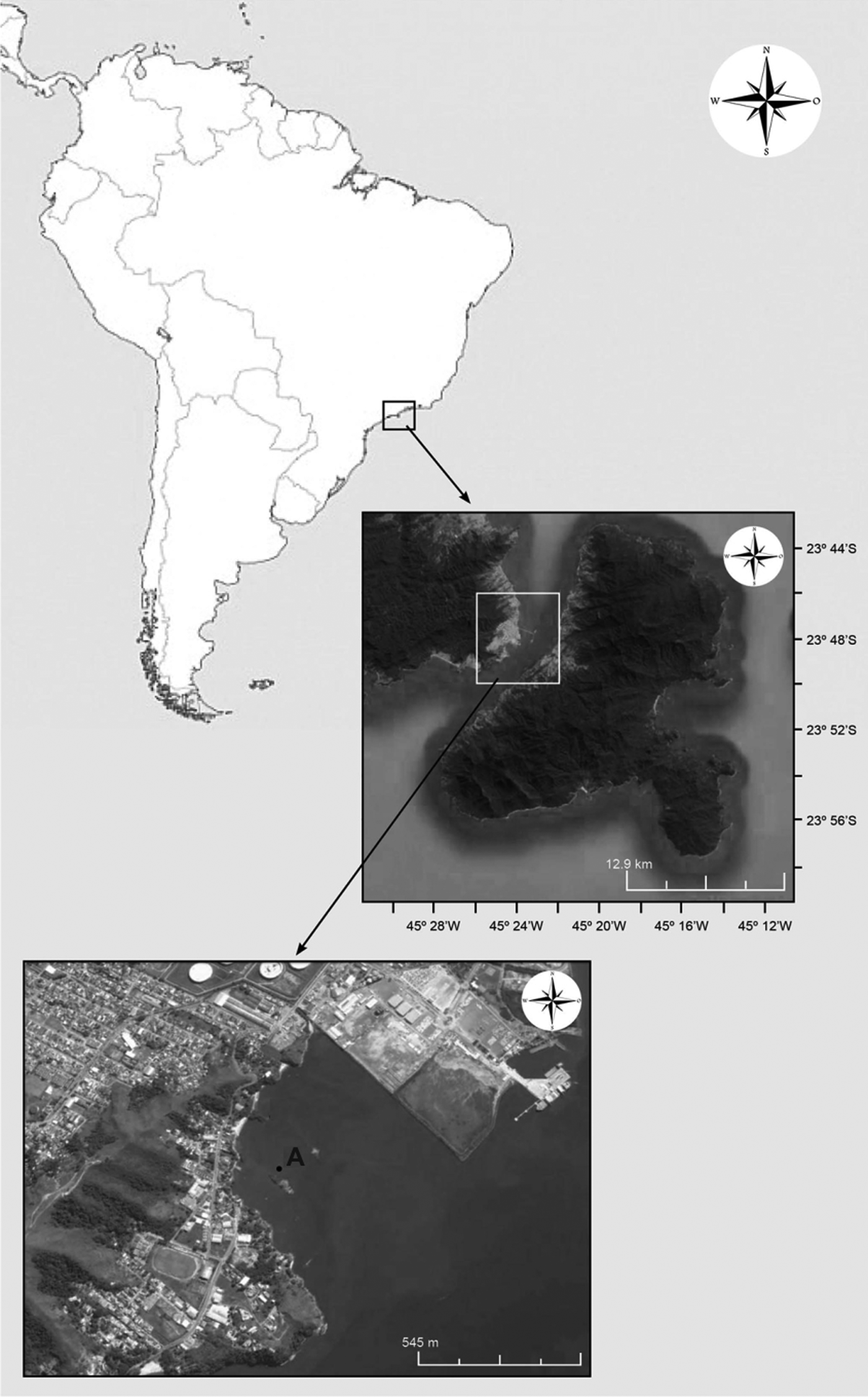
We captured one individual during a tide pool fish survey in Araçá Bay (23°48.874′S 45°24.322′W, São Sebastião Channel, northern coast of São Paulo state; Figure 1). Araçá Bay is a large tidal flat area, adjacent to the international port of São Sebastião and PETROBRAS (Brazilian Petroleum) oil and gas terminal (Figure 1; for details of the Araçá ecosystem, see Amaral et al., Reference Amaral, Migotto, Turra and Schaeffer-Novelli2010). For a habitat description, we characterized the pools’ physical attributes (depth, type of benthic habitat, sediment and algae) and obtained the water's physical-chemical variables: temperature (°C), salinity and dissolved oxygen (mg/l). We also gathered information on the characteristics of habitats in other localities where the species also occurred to compare them with those found in Araçá.
Map of South America (source: Creative Commons Attribution-Noncommercial license © 2008, Erin Dill) and, in detail, the channel of São Sebastião (South-Eastern coast of Brazil) and Araça Bay (source: Google Earth). A in the Araçá Bay map indicates the locality where Omobranchus punctatus was captured.

We caught the individual with hand-nets after the dissolving of clove-oil solutions (4% in alcohol) in the pools. The specimen was preserved in formalin (4%) and deposited in the collection of the Zoology Museum of the University of São Paulo (voucher number: MZUSP 115282). We identified Omobranchus punctatus using Williams (Reference Williams and Carpenter2002) and Rangel & Guimarães (Reference Rangel and Guimarães2010). Meristic and morphological data, total length (TL), standard length (SL) and the weight of the specimen were recorded. The animal was not sexed. Coexisting species were listed.
RESULTS
SYSTEMATICS
Order PERCIFORMES
Family BLENNIIDAE
Subfamily BLENNIINAE
Genus Omobranchus
Omobranchus punctatus (Valenciennes, 1836)
(Figure 2)
The meristic and morphological data for the specimen are as follows: D1 XII + 20, A II + 21; all rays in caudal fin simple (unbranched); gill opening restricted to side of head above dorsalmost level of pectoral-fin base; segmented pelvic-fin rays two and no cirri on head. The fish measured 19 mm TL, 17 mm SL and weighed 0.059 g.
Omobranchus punctatus (Valenciennes, 1836) from Araçá Bay (south-eastern coast of Brazil).
The specimen was captured on 16 June 2014 (austral winter). The pool had sand-bottoms and was formed around rock outcrops. Litter (such as bottles, plastic bags, parts of planks), rubble and mangrove leaf litter were also present in the pool. Omobranchus punctatus was captured along with the following native species: Bathygobius soporator (Gobiidae; N = 9), Ctenogobius boleosoma (Gobiidae; N = 23) and Myrophis punctatus (Ophichtidae; N = 1). The pool where we captured O. punctatus had a temperature of 28.50°C ± 0.48 (standard deviation), salinity = 34.00 ± 0.82, dissolved oxygen = 8.66 mg/l ± 1.69 and mean depth = 0.05 m ± 0.03. The species was found in a cryptic benthic habitat, which occurs in both their native and other non-native habitats (Table 1).The temperature, salinity and dissolved oxygen where the species was caught in Araçá Bay were within the ranges of such parameters previously reported for this species (Table 1).
DISCUSSION
In this study, we reported the first occurrence of Omobranchus punctatus on the São Paulo coast, filling a record gap within its expected distribution in Brazil.
Ismail & Clayton (Reference Ismail and Clayton1990) considered 20–25 mm TL individuals as newly settled recruits, so our 19 mm TL specimen may be a newly settled juvenile. It may have come from Ilha Grande Bay via larval dispersion by local, southwards flowing, near-shore currents (Castro, Reference Castro2014). However, to date, there is no evidence of a stable population in Ilha Grande (Gerhardinger et al., Reference Gerhardinger, Freitas, Andrade and Rangel2006) to support this hypothesis. Alternatively, this individual may have been introduced in the Araçá Bay by ships’ biofouling and their ballast water that is dumped adjacent to the bay. The species live in a wide array of habitats that provide burrows and refuges (i.e. cryptic benthic habitats), including biofouling. Outside of its native range, O. punctatus was found in the biofouling of a ship hull in Santa Catarina, Brazil (Gerhardinger et al., Reference Gerhardinger, Freitas, Andrade and Rangel2006) and inside structures of aquaculture tanks in Israel (Golani, Reference Golani2004). Loebmann et al. (Reference Loebmann, Mai and Lee2010) and Gerhardinger et al. (Reference Gerhardinger, Freitas, Andrade and Rangel2006) suggested that biofouling may be an important mechanism for the recently observed expansion of the range of this species along the Brazilian coast. The port of São Sebastião and the PETROBRAS terminal have heavy cargo ship traffic, which may have favoured the species’ introduction.
The habitat characteristics of this species in Araçá and other localities (Table 1) reveal its high specialization to harsh intertidal conditions and their high invasive potential, as it tolerates a wide range of salinities, temperatures and dissolved oxygen, and may inhabit a large array of cryptic benthic habitats. For example, the O. punctatus can withstand polyhaline conditions ranging from a salinity of 19 to as high as 45 (Table 1). Such attributes are, most likely, strongly tied to the species’ invasive success worldwide (Wonham et al., Reference Wonham, Carlton, Ruiz and Smith2000).
The establishment of alien species populations can cause dramatic native species loss, food web changes and fishery productivity loss (Grosholz, Reference Grosholz2002). Omobranchus punctatus is omnivorous, feeding on algae, diatoms and small invertebrates (Ismail & Clayton, Reference Ismail and Clayton1990), such as Ctenogobius boleosoma (R.F. Contente, unpublished data; Contente et al., Reference Contente, Stefanoni and Spach2012). Because these native gobies were found together with O. punctatus in the Araçá, in the case of the local population established, this alien species may compete with this similar-niche species. Assuming an introduction by biofouling and ballast water, the risk of a future population establishment of O. punctatus in the local habitat is potentially high. The Araçá Bay is adjacent to ports with heavy cargo ship traffic (i.e. a potential entry route/source for new individuals), whose intensity (in tonnage/year) is expected to increase by approximately 50 times when the projected expansion of the port of São Sebastião is completed (Miranda, Reference Miranda, Esterci and Rabinovici2010). Therefore, a monitoring program of the fish fauna of Araçá Bay, concomitant with the future port expansion near the bay, is strongly recommended to assess the potential increase in the population size of this non-indigenous species, thus supporting, if necessary, measures to prevent, control and eradicate it locally.
ACKNOWLEDGEMENTS
We thank Carmen Rossi-Wongtschowski and two anonymous referees for a critical review of the manuscript, Alexandre Arackawa for editing the photos, the Laboratory of Ichthyology and Growth's team, Neemias Borges and Marcelo Alves for the fieldwork, the Centre for Marine Biology of the University of São Paulo for granting us the use of laboratories, São Paulo Research Foundation (FAPESP) for financial support (Thematic Project grant number: 2011/50317-5) (Riguel Feltrin Contente (RFC) grant number: 2013/19435-7) and the Chico Mendes Institute for Biodiversity Conservation for the authorization of capture and transport of the fishes (permit no.: 5574607). This work was conducted in accordance with national and international guidelines concerning the use of animals in research under a permit approved by the IOUSP Ethics Commission.