Introduction
Over the past two decades, India has made impressive progress in malaria control. The malaria burden has declined by 59% (from 2.08 million cases in 2001 to 0.84 million in 2017) and malaria deaths by 89% (from 1005 deaths in 2001 to 105 in 2017) (Ministry of Health and Family Welfare, 2018). The National Vector Borne Disease Control Programme (NVBDCP) of India has developed a comprehensive framework to achieve the overarching vision of a ‘Malaria-free India by 2030’. The National Strategic Plan for malaria elimination (2017–2022) identifies early diagnosis and complete treatment as one of the key strategies for malaria elimination (Ministry of Health and Family Welfare, 2017). Perceptions of disease aetiology, mode of transmission and its consequences may affect people’s approach and attitude towards disease remedial practices (Mubyazi et al., Reference Mubyazi, Barongo, Kamugisha and Njunwa2013).
The success of malaria control programmes and elimination goals is greatly influenced by the social, cultural and behavioural factors of a community in relation to health beliefs, disease prevention practices and treatment-seeking behaviours. In addition, inappropriate knowledge about disease transmission, symptoms, the consequences of delaying in seeking treatment and non-adherence to treatment protocols are major challenges for malaria control and elimination goals (Osero et al., Reference Osero, Otieno and Orayo2006; Ajayi et al., Reference Ajayi, Falade, Bamgboye, Oduola and Kale2008). These social and cultural practices may adversely influence the choice, acceptance and use of malaria control interventions (Winch et al., Reference Winch, Makemba, Kamazima, Lwihula, Lubega, Minjas and Shiff1994; Adongo et al., Reference Adongo, Kirkwood and Kendall2005; Ng’ang’a et al., Reference Ng’ang’a, Jayasinghe, Kimani, Shililu, Kabutha and Kabuage2009). Thus, effective implementation of malaria control strategies requires an adequate synergy between supply (service provider) and demand (community response) (Tyagi et al., Reference Tyagi, Roy and Malhotra2005; WHO, 2008).
It is evident from the literature that an ignorance of social, behavioural and cultural factors can result in sub-optimal utilization of interventions by a community (Dunn, Reference Dunn1979; Jones & Williams, Reference Jones and Williams2004; Pell et al., Reference Pell, Straus, Andrew, Meñaca and Pool2011). In any case, knowledge and awareness about any disease are important factors in the improvement of a community’s health status. Disease prevention practices are important for the attainment of self-reliance in disease-endemic countries (Iriemenam et al., Reference Iriemenam, Dosunmu, Oyibo and Fagbenro-Beyioku2011). Therefore, a better understanding of the social perceptions about a disease and its cultural context is important for the adoption or management of existing health interventions (Tanner & Vlassof, Reference Tanner and Vlassof1998; Glanz, Reference Glanz2012).
A considerable number of studies have reported on community knowledge and perception, attitude, behaviour and treatment practices related to the malaria illness in different parts of the world (Ahorlu et al., Reference Ahorlu, Dunyo, Afari, Koram and Nkrumah1997; Miguel et al., Reference Miguel, Tallo, Manderson and Lansang1999; Kimbi et al., Reference Kimbi, Nkesa, Ndamukong-Nyanga, Sumbele, Atashili and Atanga2014; Serengbe et al., Reference Serengbe, Moyen, Fioboy, Beyam, Kango, Bangue and Manirakiza2015), including different epidemiological settings, ecological zones and populations in India (Matta et al., Reference Matta, Khokhar and Sachdev2004; Sabin et al., Reference Sabin, Rizal, Brooks, Singh, Tuchman and Wylie2010; Das & Ravindran, Reference Das and Ravindran2011; Das et al., Reference Das, Das Gupta, Friedman, Pradhan, Mohapatra and Sandhibigraha2013; Dhawan et al., Reference Dhawan, Joseph, Pekow, Rogers, Poudel and Bulzacchelli2014; Saha et al., Reference Saha, Sharma, Mishra, Verma, Tiwari and Singh2015; Shivalli et al., Reference Shivalli, Pai, Akshaya and D’Souza2016; Singh et al., Reference Singh, Saha, Chand and Anvikar2017). Most of these studies have explored misconceptions and inappropriate malaria treatment practices, which are major concerns for disease control programmes. However, potential predictors of people’s knowledge, perception and practices related to malaria in different epidemiological settings are less well documented (Sharma et al., Reference Sharma, Bhasin and Chaturvedi2007). Therefore, the present study was undertaken with the dual aims of assessing community knowledge and practices related to malaria, and their determinants in high- and low-transmission areas of central India.
Methods
Study design and participants
The community-based cross-sectional study was carried out between August 2015 and January 2016 in four districts of Madhya Pradesh (MP) state in central India with different malaria endemicities. The districts of Balaghat and Jhabua have an Annual Parasite Incidence (API – number of malaria cases per 1000 population in one calendar year) of 2.0 and 5.5, respectively, and are high-malaria-transmission districts. The APIs in Jabalpur and Chhindwara are 0.3 and 1.1, respectively, and are considered low-transmission districts on the basis of malaria epidemiological data from the past 5 years (2010–2014). The main tribal ethnic groups in these areas are: the Gond in Jabalpur; the Gond and Bharia in Chhindwara; the Baiga in Balaghat; and the Bhil in Jhabua. Lists of microscopically confirmed malaria cases during the 3 months preceding the survey were obtained from community health centres. Interviews were conducted in households in which at least one member suffered from microscopically confirmed malaria, and which were willing to participate. The interview was conducted with the head of the household or an elderly family member (in the absence of the head of the household) using a pre-tested structured interview schedule.
Data collection and analysis
For household interviews, the interview schedule included questions related to the household head’s knowledge about the symptoms of malaria and severe malaria, modes of transmission, preventive practices for mosquito bites and the diagnosis and treatment of malaria. Interviews were conducted by field staff with graduate qualifications who were employed and provided with one week of training. The interview schedule was standardized by pilot testing. Informed consent was obtained before conducting the interviews. Back-checks and spot-checks were done regularly in the field to assure completeness and identify inappropriate or illogical responses, which were recorded and edited before leaving the field site. Data were double key entered in CSPro 6.3 (US Census Bureau) – a built-in data entry application with edit checks for quality control and to detect inconsistencies and illogical entries, which were resolved before data analysis. Analysis was performed using R v3.0.1 for Windows (R project for statistical computing). Numerically coded categorical variables were tabulated as frequency distributions with percentages, and continuous variables were summarized as means and standard deviations (mean±SD). Multivariate logistic regression analysis was used to calculate the adjusted Odds Ratio (aOR) with 95% confidence intervals (CI) to understand the controlled effects of socioeconomic predictors associated with the knowledge and practices of the respondents. A standard of living index (SLI) was computed with weighted frequency of the socioeconomic status (SES) of the household. This was a proxy variable that was used as an indicator of the economic condition of the household.
Results
Socio-demographic characteristics
Overall 1470 participants were interviewed. The majority (1149/1470; 78%) of the respondents belonged to tribal groups, i.e. Gond, Bharia, Baiga and Bhil. Most respondents (1323/1470; 90%) were males as most of the households in the study area were headed by men. The mean age of the respondents was 45.0±12.6 years, with 49% (714/1470) having no formal schooling. The main occupation of respondents was agriculture. The average monthly income of the households was INR 7000. Average family size was 6.0 (±2.3 SD) persons per household. Literacy among the Gond tribe was considerably higher than that of other tribes (p<0.0001). The Bhil and Gond tribes were economically better off than other tribes (p<0.01). Furthermore, the Baiga and Bharia tribes are classified as particularly vulnerable based on their poor levels of development.
Knowledge of malaria aetiology and symptoms
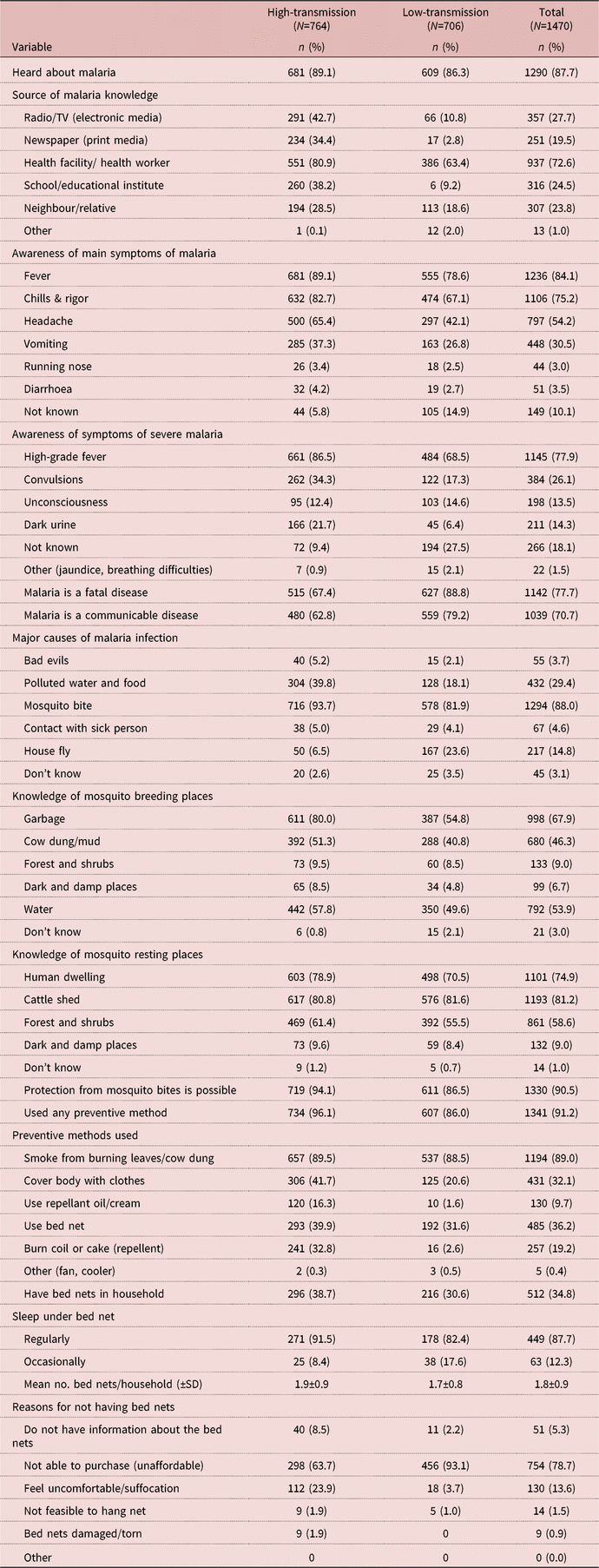
The majority of the respondents (1290/1470; 88%) had heard about malaria, and the primary source of this information was a health facility and/or health worker (937/1290; 73%). Fever as a main symptom of malaria was reported by 84% of respondents (1236/1470), followed by chills and rigor (1106/1470; 75%), headaches (797/1470; 54%) and vomiting (448/1470; 30%). Only 10% (149/1470) of the respondents were not aware of the symptoms of malaria. High-grade fever, as the main symptom of severe malaria, was reported by 78% of respondents (1145/1470), and convulsions by 26% (384/1470), while 18% (266/1470) had no understanding of the symptoms of severe malaria. About three-quarters (1142/1470; 78%) of the respondents reported that malaria was a communicable and fatal disease (Table 1).
Knowledge and practices related to malaria of heads of households in high- and low-transmission areas of central India

Most of the respondents (1294/1470; 88%) mentioned that malaria was caused by mosquito bites. However, some (432/1470; 29%) stated that consumption of polluted water and food was a cause of malaria, and another 15% (217/1470) thought malaria was spread by house flies. Regarding mosquito breeding sites, 54% (792/1470) of the respondents were aware that mosquitoes breed in water. Yet, 68% of the respondents mentioned garbage, cow dung or mud (680/1470; 46%) and 8% stated the forest (133/1470) as a breeding site. More than three-quarters of the respondents believed that mosquitoes rested inside human dwellings (1101/1470; 75%) and cattle sheds (1193/1470; 81%). Some of the respondents also reported that forest, shrubs (861/1470; 59%) and dark, damp places (132/1470; 9%) were other resting places of mosquitoes (Table 1).
Preventive practices against mosquito bites
Awareness of any preventive practice to protect from mosquito bites was high at 90% (1341/1470). Most of the respondents (1194/1341; 89%) reported that producing smoke by burning leaves or dried cow dung helped to keep mosquitoes away. Only 36% (485/1341) of households possessed bed nets, but those respondents reporting having them used them regularly for personal protection from mosquitoes. On average households possessed 1.8±0.9 bed nets and most (378/485; 78%) of these had been provided by a government agency under the NVBDCP, which preferentially distributes them in high-transmission areas. A household’s poor economic status (754/856; 88%) was the main reason given for not owning a bed net (Table 1).
Predictors of knowledge on malaria
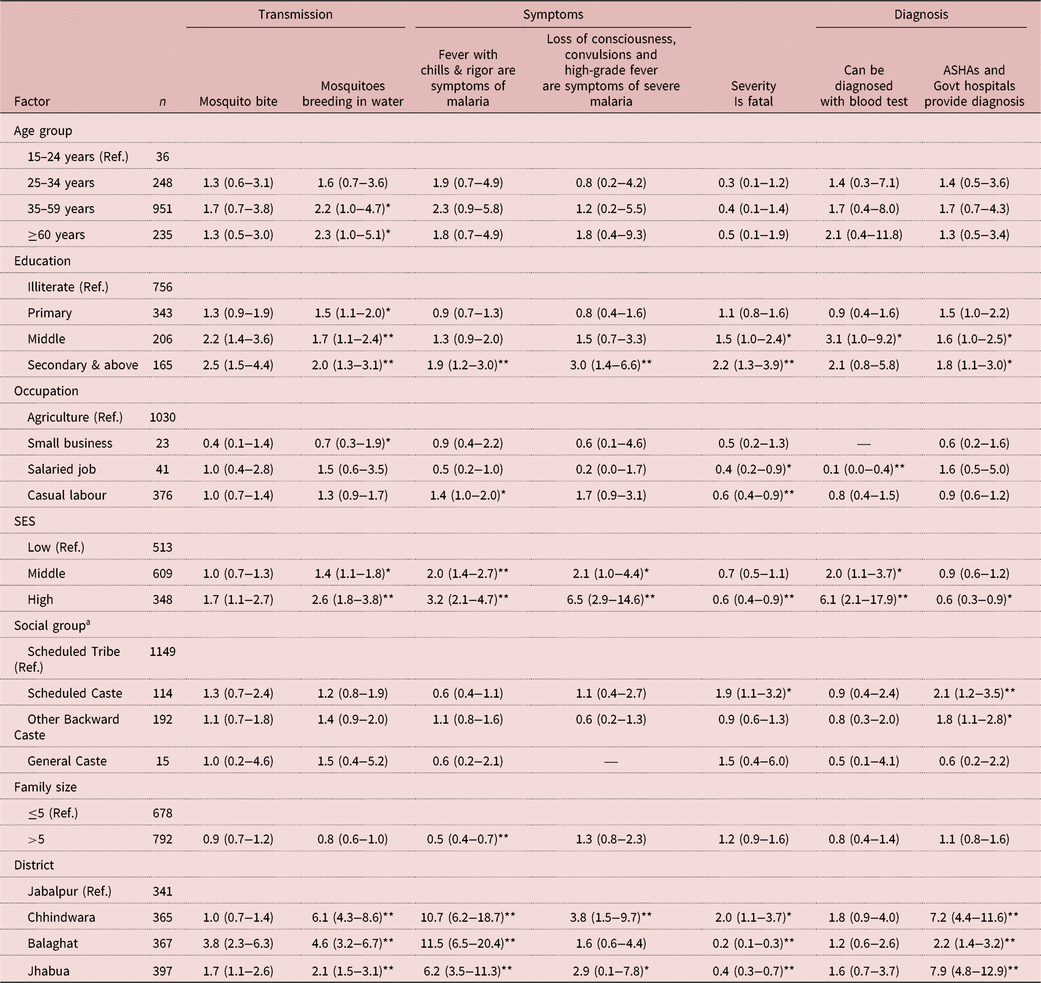
The multivariate regression analysis showed that respondents who had a secondary or higher level of education (aOR 1.9), casual labourers (aOR 1.4), those of middle (aOR 2.0) and high (aOR 3.2) socioeconomic status (SES) and those residing in Chhindwara (aOR 10.7), Balaghat (aOR 18.7) and Jhabua (aOR 20.4) districts had significantly better knowledge of the symptoms of malaria than their counterparts. Households with more than five family members tended to have a poor knowledge of the symptoms of malaria (aOR 0.5). Similarly, respondents with secondary and higher levels of education (aOR 3.0), those of middle (aOR 2.1) and high (aOR 6.5) SES, and those living in Chhindwara (aOR 3.8) and Jhabua (aOR 2.9) districts had significantly higher knowledge of the symptoms of severe malaria compared with their counterparts. Respondents with a higher level of education had a greater tendency to believe that malaria was a fatal disease (aOR 2.2). Knowing that malaria can be diagnosed by blood test was found to be significantly associated with a better SES (aOR 6.1). Educated and tribal respondents from Chhindwara, Balaghat and Jhabua districts had better information about the malaria diagnosis facilities provided by the Accredited Social Health Activists (ASHAs) and government hospitals. Age, educational status, SES and respondent’s area (district) of residence were found to be predictors of knowledge regarding the places where mosquitoes breed (Table 2).
Multivariate analysis [adjusted OR (95% CI)] of factors associated with knowledge about malaria transmission, clinical manifestations and diagnosis by household heads

a Scheduled Tribes are the indigenous population, Scheduled Castes are primarily the historically lower castes, Other Backward Castes are considered socially and educationally marginalized diverse groups and the General Caste is the traditionally higher caste.
*p<0.05; **p<0.01.
Predictors of malaria preventive practices
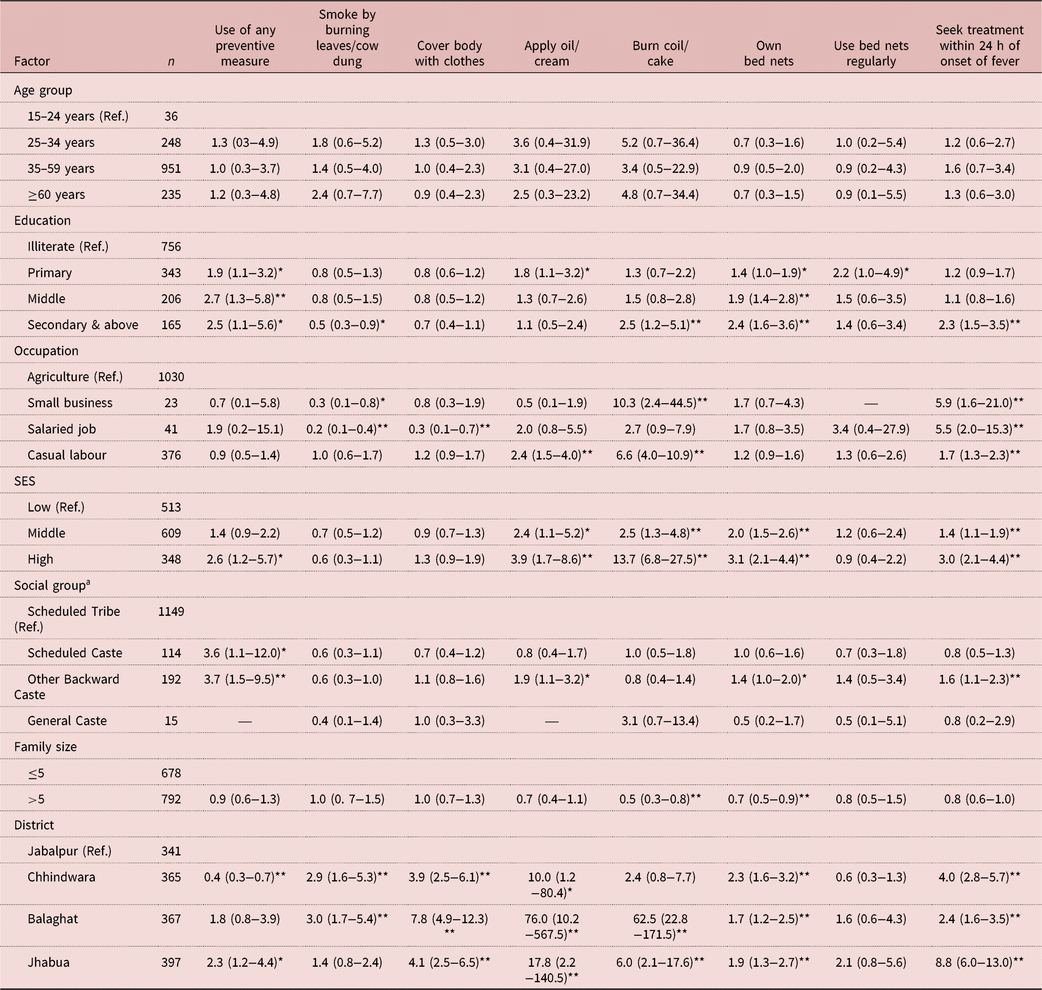
The multivariate model suggested that a respondent’s higher literacy level (aOR 2.5) and better SES (aOR 2.6) were positively associated with the practise of any preventive measure. The literacy level of respondents (aOR 0.5) and better SES (aOR 0.6) were inversely associated with practices such as smoke production by the burning of leaves or cow dung for protection against mosquito bites. However, tribal ethnic groups were largely associated with producing smoke to repel mosquitoes. Respondents with a better literacy level, a non-agriculture occupation, better SES and residing in high-transmission districts were found to be using more repellant oils and creams and burning mosquito coils/cakes, and largely owned bed nets to protect themselves from mosquito bites. However, the use of repellant oils and creams, mosquito coils/cakes and bed nets was lower in tribal households and in households with more family members. Similarly, respondents with a better literacy level, a non-agriculture occupation, higher SES and residing in high-malaria-transmission districts were more careful and sought treatment within 24 hours of sickness, while such prompt seeking treatment was less frequent amongst tribal households and those with more family members (Table 3).
Multivariate analysis [adjusted OR (95%CI)] of the factors associated with malaria preventive practices and treatment behaviours by household heads

a Scheduled Tribes are the indigenous population, Scheduled Castes are primarily the historically lower castes, Other Backward Castes are considered socially and educationally marginalized diverse groups and the General Caste is the traditionally higher caste.
*p<0.05; **p<0.01.
Discussion
The study results show that the respondents’ knowledge about malaria disease aetiology and its modes of transmission was reasonably good, and this agrees with other studies by Adedotun et al. (Reference Adedotun, Morenikeji and Odaibo2010), Iriemenam et al. (Reference Iriemenam, Dosunmu, Oyibo and Fagbenro-Beyioku2011) and Abate et al. (Reference Abate, Degarege and Erko2013), but it contradicts the findings of similar studies by Adongo et al. (Reference Adongo, Kirkwood and Kendall2005), Mazigo et al. (Reference Mazigo, Obasy, Mauka, Manyiri, Zinga and Kweka2010) and Chovatiya et al. (Reference Chovatiya, Gajera and Soni2013). About 88% (1290/1470) of the respondents knew about malaria, and they reported that a health facility and/or health worker was their primary source of information. The study’s findings are similar to those of Hlongwana et al. (Reference Hlongwana, Zitha, Mabuza and Maharaj2011) but in contrast to those of the other studies, where mass media (television/newspaper) and individuals’ experiences of malaria were found to be the primary sources of information (Singh et al., Reference Singh, Musa, Singh and Ebere2014; Gupta et al., Reference Gupta, Raina, Shora, Jan, Sharma and Hussain2016).
The respondents in the present study knew that fever with chills and rigor were the main symptoms of malaria, and that high-grade fever and convulsions were the major symptoms of severe malaria infection. Although most of the respondents (88%) knew that the mosquito bite was the primary mode of malaria transmission, there were misconceptions about the breeding of mosquitoes in garbage, cow dung, mud and forest instead of water. Producing smoke by burning leaves and cow dung was the most common practice used by respondents to repel mosquitoes. However, this practice may be a respiratory health hazard and could result in adverse birth outcomes in pregnant women (Wylie et al., Reference Wylie, Coull, Hamer, Singh, Jack and Yeboah-Antwi2014, Reference Wylie, Singh, Coull, Quinn, Yeboah-Antwi and Sabin2015, Reference Wylie, Kishashu, Matechi, Zhou, Coull, Abioye and Dionisio2017a, b; Quinn et al., Reference Quinn, Ae-Ngibise, Jack, Boamah, Enuameh and Mujtaba2016; Carter et al., Reference Carter, Norris, Dionisio, Balakrishnan, Checkley and Clark2017; Lee et al., Reference Lee, Kaali, Quinn, Delimini, Burkart and Opoku-Mensah2018). The poor economic status of a household was the major reason given for not having bed nets. As a preventive practice, the use of bed nets was not high, with very few (36%) households possessing them, and with average number per household being only two. However, most of households who possessed bed nets reported using them regularly, and by all household members.
It was observed that tribal households and those of bigger family size were, by and large, less educated and of lower SES, and this prohibited them from exploring modern preventive measures. A higher level of literacy among the respondents were strongly associated with their knowledge and perception of malaria disease aetiology, prevention and treatment practices. Respondents with higher literacy, with higher SES and residing in high-transmission areas were practising comparatively more modern malaria preventive measures. The findings from another study conducted in 21 states of India and thirteen endemic districts of Bangladesh also suggested that improved knowledge about the aetiology and clinical features of malaria were strongly associated with a higher level of education of the households (Sharma et al., Reference Sharma, Bhasin and Chaturvedi2007; Ahmed et al., Reference Ahmed, Haque, Haque and Hossain2009).
In conclusion, although most of the study respondents were aware of malaria, their use of modern preventive measures was low due to their poor economic condition. A low level of literacy and low SES were the major constraints on the acquisition of knowledge about malaria’s aetiology/clinical features, its preventive practices and the promptness of seeking treatment. Malaria intervention tools such as electronic and print media (television, radio and newspapers) had poor coverage and sub-optimal utilization among the less-literate population, particularly those living in remote areas. Therefore, sensitization of the masses through these media remains an ineffective and a distant dream. Hence it is suggested that cost-effective sensitization strategies be introduced in these areas, such as regular camps in the villages using IEC culture-based tools. Local weekly markets in tribal areas are points of interaction for many people, and could act as places where malaria awareness could be generated. In addition, students can act as powerful agents of change in awareness programmes, so middle and high school students could be trained in awareness raising.
Acknowledgments
The authors are grateful to Dr Neena Valecha, director of the ICMR-National Institute of Malaria Research, New Delhi, for providing support for this study. They also thank Dr Mantosh S. Malhotra, consultant at the ICMR-National Institute of Malaria Research, New Delhi, for critically reviewing the interview schedule.
Funding
This research did not receive any specific grant from funding agencies in the public, commercial, or not-for-profit sectors.
Conflicts of Interest
The authors have no conflicts of interest to declare.
Ethical Approval
The study was approved by the institutional ethics committee of the ICMR-National Institute of Malaria Research, New Delhi, India.