

INTRODUCTION
Racism is part of the fabric of life for African Americans and is among the causes of enduring negative health outcomes. There is really nothing new or startling in the assertion that social circumstances encountered as part of day-to-day experience influence physical health. At the turn of the last century, W. E. B. Du Bois (Reference Du Bois1906) and Kelly Miller (Reference Miller1897) proposed in separate manuscripts that oppressive social conditions encroaching on the lives of African Americans contributed to poor health and premature death. Fifty years later, Frantz Fanon's classic studies (Reference Fanon1967, Reference Fanon1968) examined the effects of oppression and included a recognition of “psychosomatic”—that is physical—consequences. Currently, social epidemiologists, health psychologists, and medical sociologists have extended the insights of these important early scholars by showing how racism generates systems and practices that contribute to persistent disparities in health outcomes (Paradies Reference Paradies2006a; Pascoe and Richman, Reference Pascoe and Richman2009; Williams Reference Williams1997). Estimates indicate that the failure to erase these disparities costs tens of thousands of African American lives each year (Levine et al., Reference Levine, Foster, Fullilove, Fullilove, Briggs, Hull, Husaini and Hennekens2001; Williams and Mohammed, Reference Williams and Mohammed2009). As long as the rates of the leading causes of death differ along racial lines (Centers For Disease Control and Prevention, 2008), the specter of racism will haunt the United States. The persistence of racial health disparities and of racism in any form calls scholars, therapists, activists, and political leaders to vigorous action.
Racism may impact health directly and indirectly. It can contribute to negative health outcomes indirectly by shaping the health-related behavior of oppressed groups. An important and growing body of research reveals that frustration and social upheaval stemming from racism lead to high rates of smoking, drug use, and overeating, and that these behaviors may mediate the relationship between discrimination and racial health disparities (Jackson and Knight, Reference Jackson, Knight, Carstensen and Schaie2006). This paper focuses on a more direct path, specifically psychophysiological processes that connect racism and disease. First we discuss expanded definitions of racism that have emerged in recent decades. Then these conceptualizations are considered in light of research in social neuroscience, a relatively new discipline which identifies the biological concomitants of complex human actions (Cacioppo et al., Reference Cacioppo, Berntson, Adolphs, Carter, Davidson, McClintock, McEwen, Meaney, Schacter, Sternberg, Soumi and Taylor2002). Based on these findings, we chart several chains of psychophysiological events that link racism to health. Finally, we conclude by identifying briefly interventions that may reduce racism's impact on health.
CONCEPTUALIZING RACISM
Nearly forty years ago, James Jones (Reference Jones1972) in Prejudice and Racism challenged definitions of racism that minimized the important issue of power differentials by focusing primarily on attitudes, distorted ideologies, and unfair treatment. Jones argued that racism involves assertions of power that are expressed on individual, institutional, or cultural levels. Recent conceptual advances have underscored the significant limitations of cognitive and behavioral views of racism and have included critical discussions of its systemic foundations. Two particularly comprehensive conceptualizations of racism were developed by Paradies (Reference Paradies2006b) and Harrell (Reference Harrell2000). They described racism as a system where power is unevenly distributed along racial lines resulting in the oppression and exclusion of non-White groups. These conceptual advances are critical to a comprehensive understanding of the breadth and persistence of racism (Baker Reference Baker2008; Bell Reference Bell2004) and to the success of ameliorative policies and therapeutic interventions.
Just as multidimensional and complex forms of racism can be incorporated into the individual's cognitive structures, they are woven into the fabric of the society. Indeed, racism emanates from individual, cultural, institutional, and structural domains and has psychological and physiological effects. Thus, according to Paradies (Reference Paradies2006b), racism transcends the incorrect or irrational behavior of individuals because “nonhuman actors such as laws and institutions can perpetuate systemic racism” (p. 146). Through values and practices, social institutions support the efforts of dominant groups to maintain power and privilege (Bonilla-Silva Reference Bonilla-Silva1997, Reference Bonilla-Silva2001, Reference Bonilla-Silva2006). Bonilla-Silva's (Reference Bonilla-Silva1997) structural approach to racism provided a critical challenge to the assumption that racism is a “free-floating” ideology. He proposed that racism is a central organizing principle that governs the arrangement of the society. Structural racism encompasses social mechanisms that have made the privileges associated with being White and the disadvantages associated with being a person of color relatively permanent characteristics of Western societies. It fostered the “color-blind” policy racism that permeated public policy in the last two decades of the twentieth century (Walters Reference Walters2003) and constitutes the foundation upon which all other forms of racism are built. Essentially, structural racism energizes and drives the ways in which racism is sustained via interpersonal, cultural, and institutional actions (Bonilla-Silva Reference Bonilla-Silva2006).
MEDIATORS OF PHYSIOLOGICAL ACTIVATION AND ALTERATIONS
Racism as Stressful
In considering racism's impact on health, the most straightforward case is that racism makes the lives of the disadvantaged more stressful and thus leads to negative mental and physical health consequences (Clark et al., Reference Clark, Anderson, Clark and Williams1999; Harrell et al., Reference Harrell, Merritt, Kalu and Jones1998; Krieger Reference Krieger1994). Clark et al. (Reference Clark, Anderson, Clark and Williams1999) propose that perceiving an experience as racist initiates a series of processes that results in negative emotional reactions and physiological changes. Physiological arousal includes activation of the hypothalamic pituitary adrenal cortical (HPA) system, which involves the release of the stress hormone cortisol, and also entails changes in immune and cardiovascular functioning. Cardiovascular changes and a myriad of responses including respiratory functions and pupil size come under increased control of the sympathetic branch of the autonomic nervous system during emergencies. These physiological adjustments constitute the sympathetic adrenal medullary axis (SAM) of the stress response. Investigators have marshaled laboratory and survey evidence (Brondolo et al., Reference Brondolo, Rieppi, Kelly and Gerin2003; Harrell et al., Reference Harrell, Hall and Taliaferro2003) linking experiences with individual and institutional racism to physiological changes.
One irony that early psychophysiological studies revealed is that striving to actively control stressors actually increases activation within the cardiac sympathetic nervous system and disrupts autonomic balance (Obrist Reference Obrist1981). Thus, the findings cautioned that those who recognize racism and attempt to control it may be particularly vulnerable to its negative physiological effects. Similarly, increased physiological activation is a possible mediator of poorer performance on tasks that occurs when individuals believe their efforts could potentially confirm racist stereotypes (Blascovich et al., Reference Blascovich, Spencer, Quinn and Steele2001; Schmader et al., Reference Schmader, Johns and Forbes2008). Though striving to come to grips with racism or to disconfirm its mythology may result in increased physiological activation, passivity and acquiescence are not healthy alternatives. Rather, those who actively confront racism should be armed always with behavioral strategies, discussed below, that will allow them to control levels of physiological arousal.
Though currently much of the research on racism and health is grounded in the stress model, it applies most appropriately where institutional and individual racism generate discrete and perceivable toxic situations and social encounters. However, racism encompasses more than encounters with strident, unenlightened people and oppressive, constraining institutions. Conceptualizing racism within the stress and coping paradigm leads to the conclusion that if one does not perceive circumstances as racist or appraise events as stressful, the physiological reactions to them will not occur. There is evidence that the conscious perception of threatening events is but one of several pathways leading to the disruption of physiological regulation. Limitations of the traditional stress model encourage the search for other mechanisms that mediate racism's impact.
Prenatal Effects of Racism
In a provocative article, Kuzawa and Sweet (Reference Kuzawa and Sweet2009) show how racism potentially affects the uterine environment and epigenetic activity, and thus contributes to negative health. The study of epigenetic processes considers an array of factors that influence how genes are expressed (Jaenisch and Bird, Reference Jaenisch and Bird2003). A growing consensus holds that environmental and genetic events constantly interact and are best conceptualized as interdependent (Harrell et al., Reference Harrell, Neblett, Onyewuenyi, Swanson, Spencer and Edwards2010; Moore Reference Moore2001). Thus, the mapping of the human genome was simply one step toward understanding the complex interplay between biological and environmental events that govern the unfolding genetic potential. In addition, mounting evidence from animal and human research suggests that during the prenatal period there are epochs where health outcomes are singularly vulnerable to nutritional and psychosocial factors (Barker Reference Barker1998, Reference Barker2002). Remarkably, the model Kuzawa and Sweet (Reference Kuzawa and Sweet2009) developed proposed the prenatal effects of racism are potentially transgenerational. The effects of stressful environments on the fetus can potentially cause lingering metabolic alterations during adulthood, which in females will impact the uterine environment of offspring.
Racism troubles the entire fabric of life in oppressed communities creating encounters with environmental toxins (Greene and Morris, Reference Greene and Morris2006) and poor nutrition, as well as noxious and damaging social and psychological exchanges and circumstances. The uterine environment is adapted to maintain conditions that lead to optimal fetal growth and development. However, chronic psychosocial stressors experienced by the mother during various periods of gestation can threaten the well-being of the fetus. In many respects then, racism is encountered long before the brain of its victim is developed enough to appraise any particular manifestation of it. Low birth weight would be among the more ostensible effects of these insults (Giscombe and Lobel, Reference Giscombe and Lobel2005; Collins et al., Reference Collins, David, Symons, Handler, Wall and Dwyer2000, Reference Collins, David, Handler and Andes2004; Hobel and Culhane, Reference Hobel and Culhane2003; Lauderdale Reference Lauderdale2006; Mustillo et al., Reference Mustillo, Krieger, Gunderson, Sidney, McCreath and Kiefe2004), but the harmful impact may be subtle and less apparent at birth. Programmed effects of racism on health, which may include altered neural development, may not become evident until much later in life.
Racism's Unconscious Pathway
Two sets of studies highlight another route through which racism influences physiological activity and health outcomes. Experiments using animals have revealed that stress responses can activate a pair of distinct neural circuits in the brain (LeDoux Reference LeDoux1996, Reference LeDoux2002). Normally, information from the environment moves from the senses to a structure at the base of the brain called the thalamus and from there to the cerebral cortex. In the cortex the sensory input is integrated with previous input, appraised, and evaluated. Ultimately, as the stress and coping model details, the cerebral cortex is where information is represented as the conscious emotional and cognitive events that are experienced when the organism is threatened or placed in danger.
LeDoux (Reference LeDoux1996) has shown that information about stress in the environment can take an alternate neural path. The thalamus not only receives and transmits sensory input to the cortex, it also connects with a second set of neural circuits that reside within the amygdala, a neighboring structure at the base of the brain. The amygdala initiates a cascade of neural events that activate lower brain centers and cause stress responses in the HPA and SAM systems. For example, the central nucleus of the amygdala (CeA) activates pathways to the lateral hypothalamus and brainstem to stimulate HPA and SAM responses. Connections between the hippocampus and lateral amygdala mediate contextual information that modulates fear responses. Thus, subcortical structures provide a rapid route to physiological activation, but this activation is not dependent on conscious perception of the stimulus. Conscious perception occurs through the separate stream of neural events involving higher cortical activity, but the unconscious subcortical pathways of stress are worthy of further study.
A second line of research, human classical conditioning studies, provides additional evidence that physiological systems can be activated unconsciously. Experimental studies have demonstrated that conditioned autonomic responses take place even when the conditioned stimuli are made unrecognizable by masking techniques (Soares and Ohman, Reference Soares and Ohman1993). Additionally, clinical neuropsychological research has shown that conditioned activation occurs in patients whose severe brain damage renders them incapable of generating new episodic memories (Daum et al., Reference Daum, Channon, Polkey and Gray1991). These patients are not able to remember when an unpleasant event—for example, a shock or loud noise—was associated with a particular color. Still, if given a choice, they will subsequently avoid that particular color. Clearly, humans do not have to recognize a conditioned stimulus or consciously process its link to a negative event for the stimulus to elicit physiological arousal.
Thus, conscious awareness of elements of racism is not a necessary condition for physiological activation to take place. The brain initiates early rapid physiological arousal unconsciously that prepares the individual for action, sometimes before the stressor is fully perceived. Accordingly, it is likely that repeated encounters with individual or institutional racism and its context can elicit physiological reactions of which the individual is unaware. The setting or social environs where reactions have occurred may also result in physiological activation. For example, negative interpersonal encounters need not happen on the job or in schools on a daily basis. The work site or the classroom alone might be quite capable of eliciting physiological arousal, unconsciously, because of their connection to aversive events.
Emotion Regulation and Racism
Another avenue by which racism may trigger strong physiological reactions is activated when individuals attempt to manage the anticipatory responses and subsequent reactions to socially racist stressors. This process is called emotion regulation. Emotion regulation refers to the ability to increase, maintain, or inhibit the expression and experience of an emotional response. The alteration in emotional responding occurs in milliseconds and can be voluntary or automatic (Golden et al., Reference Golden, McRae, Rand and Gross2008; Gross and John, Reference Gross and John2003; Ochsner and Gross, Reference Ochsner and Gross2005). Suppression, the inhibition of one's emotional response, takes place when the emotion is denied admission into consciousness. Successful suppression of an emotion reduces the reported or observed experience of subjective experience, though the physiological arousal may persist (Jackson et al., Reference Jackson, Malmstedt, Larson and Davidson2000). It was noted earlier that active coping can enhance responses to stress. Ironically, several studies report that those who deny or suppress the existence of racism experience higher systolic blood pressure than individuals who confront and actively cope with racially noxious situations (Krieger Reference Krieger1990; Krieger and Sidney, Reference Krieger and Sidney1996).
There is strong evidence that individual differences in prefrontal activation play an essential role in emotion regulation. In particular, individuals who report persistent negative affect and who show increased physiological reactivity to stressful events are more likely to have a difficult time regulating the intensity and duration of a negative emotion once it has been activated (Davidson Reference Davidson2000; Davidson et al., Reference Davidson, Putnam and Larson2000). Indeed, the emotional response to social rejection or social pain can be very intense, especially in the case of individual or institutional racism. Social pain may activate brain regions that are responsive to physical pain. Eisenberger et al. (Reference Eisenberger, Lieberman and Williams2003) provide evidence that the prefrontal cortex, in particular the anterior cingulate cortex and right ventral prefrontal cortex, are active when social pain is experienced. These noxious events are likely to engage and often tax emotion regulatory and restorative processes. Important progress in the study of the effects of racism on health will result from studies of brain mechanisms involved in regulating reactions to intensely distressing social experiences.
Racism, Worry, and Autonomic Balance
Some social neuroscientists who study human adaptation to complex and demanding environments have made the activity of the vagus nerve their central focus (Porges Reference Porges1995, Reference Porges2001; Thayer and Friedman, Reference Thayer, Friedman, Anderson, Bulatao and Cohen2004). The vagus nerve is part of the parasympathetic branch of the autonomic nervous system and in many instances reduces activation while assisting in building resources in the body. For example, one division of the vagus nerve reduces the energy demands by slowing heart rate, while other branches increase digestive activities that allow us to store energy that may be needed later (Porges Reference Porges2001). Neural circuitry coursing from the frontal cortical regions connects with the vagal circuits in the brain stem and facilitates flexible cardiac adaptation to a changing environment (Thayer and Friedman, Reference Thayer, Friedman, Anderson, Bulatao and Cohen2004). While increased vagal activation slows the heart, the vagus can speed heart rate by withdrawing its effects. Thayer and Friedman (Reference Thayer, Friedman, Anderson, Bulatao and Cohen2004) note that changes in vagal activity take place on a second-by-second basis, and facilitate rapid behavioral and cognitive adjustments as environmental demands require them. Further, dysregulation of vagal functions signals the presence of chronic diseases and is potentially lethal (Thayer and Lane, Reference Thayer and Lane2007).
Research suggests that the frontal lobes, which contain brain centers responsible for some of the most complex human cognitive functions, also house neural pathways that mediate the calming influences of the vagus on the heart. Failures in several higher-order “executive” cognitive processes that reside in the frontal lobes interfere with vagal functioning. For example, when well-ordered and coherent cognitive processing is replaced by perseverative thinking that includes worry and rumination, vagal control of the heart is reduced and a variety of other stress responses occur (Brosschot et al., Reference Brosschot, Gerin and Thayer2006). Perseverative thinking, which can be conscious as well as unconscious, extends the time course of stress reactions (Brosschot et al., Reference Brosschot, Verkuil and Thayer2010). Normally, the frontal lobes are the source neural input that constantly inhibits the excitatory activity in lower brain centers that are responsible for peripheral stress responses. Thayer and Friedman (Reference Thayer, Friedman, Anderson, Bulatao and Cohen2004) argued that chronic threats and aversive events stemming from racism can ultimately interrupt the calming impact of the vagus nerve on cardiac functions by inducing worry and rumination. Therefore, vagal dysregulation resulting from disturbances in executive cognitive functions is an alternate mechanism through which several forms of racism might disrupt physiological activity.
Racism and Cognitive Schema
Cognitive structures that racism generates are the source of the final alternative path along which physiological effects may be mediated. Various forms of racism can be represented in the mind (Harrell Reference Harrell1999; Jones Reference Jones2000; Taylor et al., Reference Taylor, Obiechina, Harrison and Jones1998) as unpleasant memories as well as cognitive schemata that deprecate non-Western ethos, history, and practices and, by extension, people of color themselves. These mental dispositions threaten psychological well-being and, in the case of cultural racism, block the positive emotional states that normally arise when one embraces one's cultural heritage and lineage (Daniels et al., Reference Daniels, Harrell, Floyd and Bell2001; Dressler and Bindon, Reference Dressler and Bindon2000; Eckersly Reference Eckersly2005). Research suggests that interrupting processes that bring about positive emotions may be particularly threatening to physiological regulation. Fredrickson has shown that pleasant emotions undo the cardiovascular activation that accompanies negative emotional states (Fredrickson Reference Fredrickson2001, Reference Fredrickson1998).
Research using functional magnetic resonance imaging has started to identify the neural underpinnings of racist schema, though these studies are in their infancy. In both Black and White participants, perceiving Black faces, but not verbal race labels, caused greater amygdala activation than the perceiving White faces (Lieberman et al., Reference Lieberman, Hariri, Jarcho, Eisenberger and Bookheimer2005). As noted earlier, the amygdala is sensitive to the presence of a threat; African Americans showing activation in this region in the presence of Black faces reveals signs of self-deprecation. It is not unreasonable to posit that for people of color, isolation and alienation resulting from racial schemata that disparage Black people and culture lead to increased levels of negative emotions and contribute to a general sense of defeat. The presence of these unpleasant mental states is likely to be associated with elevated blood pressure in Black populations (Chae et al., Reference Chae, Lincoln, Adler and Dyme2010; Daniels et al., Reference Daniels, Harrell, Floyd and Bell2001; Dressler and Bindon, Reference Dressler and Bindon2000) and HPA activation in general (Kemeny Reference Kemeny2009).
Allostasis: From Physiological Changes to Disease
Ultimately, investigators who propose that the social environment influences health must explain how temporary fluctuations in physiological activity lead to more permanent alterations associated with disease. Traditionally, homeostasis has been recognized as the process by which physiological systems regulate their levels of activity around fixed optimal set points (Cannon Reference Cannon1929). More recently, the focus has shifted to allostasis (McEwen Reference McEwen1998), a concept that encompasses the capacity of the body to achieve “other” levels of activity in response to environmental changes and demands. The ability to maintain stability within systems conserves energy and thus has had an evolutionary advantage, as long as the organism did not confront extraordinary circumstances. However, through allostasis, the adaptable organism was able to make physiological adjustments when they were required. Sometimes, by the process of allodynamism (Berntson and Cacioppo, Reference Berntson, Cacioppo, Cacioppo, Tassinary and Berntson2000) appropriate alterations were achieved through changes in the underlying mechanisms controlling physiological activity. However, the adjustments in physiological levels may shade toward pathology when they are extreme, sustained, or both. Researchers use measures of allostatic load (Seeman et al., Reference Seeman, Epel, Gruenewald, Karlamangla and McEwen2010) as an index of cumulative demands placed on several physiological systems that may result in enduring unhealthy physiological changes.
The concepts of allostasis and allodynamism constitute a final common pathway for models that link racism to poor health outcomes. These models discuss racism's health effects in terms of environments that fail to nurture psychological and physical well-being (Jones Reference Jones2000), weathering effects on organs and physiological systems (Geronimus Reference Geronimus1992), and the embodiment of inequitable social systems (Krieger Reference Krieger1999, Reference Krieger2005). Racism threatens health when it produces physiological changes that through any of the paths we have enumerated are extensive, occur repeatedly, or take place during certain critical developmental periods. For example, mounting evidence suggests that the nocturnal blood-pressure levels of African Americans who report encounters with discrimination fail to dip, that is, reach a normal nadir during sleep (Barksdale et al., Reference Barksdale, Farrug and Harkness2009; Beatty and Matthews, Reference Beatty and Matthews2009; Brondolo et al., Reference Brondolo, Libby, Denton, Thompson, Beatty, Schwartz, Sweeney, Tobin, Cassells, Pickering and Gerin2008; Lewis et al., Reference Lewis, Barnes, Bienias, Lackland, Evans and De Leon2009). This may constitute an allostatic adjustment that portends the onset of hypertension. Important research on allostasis and allodynamism is specifying the brain centers and peripheral physiological mechanisms that make permanent and pathological the fluctuations in physiological activity that are intended to help one cope with environmental demands (McEwen and Gianaros, Reference McEwen and Gianaros2010). In so doing, these studies contribute important details to maps that chart the physiological paths leading from racism to poor health.
FORMS OF RACISM AND PSYCHOPHYSIOLOGICAL CHANNELS
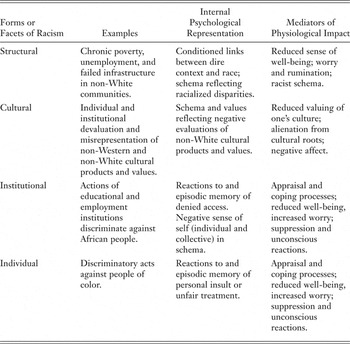
Various manifestations of racism will show distinct affinities for one or more of the pathways through which environmental circumstances influence physiological outcomes. Table 1 posits how four forms of racism are mediated psychologically and translated into physiological outcomes. Each kind of racism generates internal representations, specified in the third column, that give rise to psychological mediators of physiological changes. The psychological mediators are presented in the fourth column.
Mechanisms That Mediate the Psychological and Physiological Effects of Five Forms of Racism

Table 1 argues that the indirect effects of structural racism are experienced primarily in terms of racialized outcomes. Often the disparities it produces are processed outside of awareness, and are represented cognitively in the form of classically conditioned associations between race and negative circumstances or by more complex racist cognitive structures. Structural racism contributes strongly to implicit associations between Black people and crime, poverty, and destitution. In contrast, institutional and individual forms of racism are more likely to be encoded as episodic memory, sometimes consciously. Here racism often takes the form of stressful events that elicit appraisal and coping processes. As the table states, in some instances racism operates through classically conditioned processes which drive many of the emotional components of responses.
Figure 1 conceptualizes an approach to the study of racism and health outcomes. We placed the forms from Table 1 at the first level, with the next row specifying the conceptual model that fits the mechanisms through which each type of racism operates. Brain mechanisms critical to the effects of each manifestation of racism are then described. The next level shows two resulting psychological processes that are critical to the impact of racism, transient changes in emotional and cognitive states and relatively permanent alterations in well-being and cognitive schema. The physiological outcomes on the last level represent the changes racism causes in peripheral physiological and brain activity, as well as the early markers of disease. This illustration is a map of human suffering, with many of the paths representing conduits through which racism impacts social, psychological and biological domains.
Proposed models, psychological processes, and physiological pathways that link four forms of racism to health-related physiological changes

Interventions
Evidence suggests that several interventions may reduce the physiological impact of racism. While we will describe a number of these, more extensive reviews of racism-related treatment strategies are available (Paradies et al., Reference Paradies, Chandrakumar, Klocker, Frere, Webster, Burrell and McLean2009). Therapeutic strategies are any corrective actions that interrupt one or more of the paths between the events and processes depicted in Figure 1. We will identify the pathway of focus for each of the interventions under discussion. Cutler (Reference Cutler, Anderson, Bulatao and Cohen2004) argued that interventions focusing on improving public health emanate from the individual, community, and national levels. His tone was decidedly hopeful, as he noted that several national programs have already achieved remarkable success in changing smoking and drunk-driving behaviors. Thus, there is no reason to shrink from developing a therapeutic agenda for mitigating the effects racism has on biological systems.
Individualized approaches to intervening offer promising strategies for reducing physiological activation represented at the bottom of Figure 1. Mindfulness meditation and progressive relaxation are self-controlling techniques that influence autonomic, neuroendocrine, and immune function (Conrad and Roth, Reference Conrad and Roth2007; Davidson et al., Reference Davidson, Kabat-Zinn, Schumacher, Rosenkranz, Muller, Santorelli, Urbanowski, Harrington, Bonus and Sheridan2003; Pawlow and Jones, Reference Pawlow and Jones2002). It would be wise for clinical professionals to make training in these techniques readily available to populations vulnerable to racism's impact. They should be provided routinely for women during pregnancy. The procedures may mitigate physiological activation traceable to acute and chronic stressors or conditioned to contextual stimuli of which the individual may or may not be aware. Stress management procedures that include cognitive behavioral therapy also influence physiological reactions (Phillips et al., Reference Phillips, Antoni, Lechner, Blomberg, Llabre, Avisar, Glück, DerHagopian and Carver2008). These therapeutic techniques have the added advantage of restructuring nonproductive and self-deprecating racist cognitive schemata. Cognitive therapies also help individuals confront their emotional and behavioral responses to racism including tendencies to suppress, worry, or ruminate.
Community and national strategies have the potential to launch a proactive attack on cultural racism and the racist cognitive schemata it nurtures. In the United States, African Americans, First Nations People, and Hispanic groups continue to be stereotyped or play restricted roles in film, television, and Internet sources of entertainment. Misrepresentations are a major source of cognitive schemata that associate these groups with crime, vagrancy, and incompetence. Internationally, researchers have expressed concern about the impact of such portrayals on the health of people of color and women (Estacio Reference Estacio2009). Properly funded by local and national agencies, indigenous writers and artists are capable of developing a rich cultural milieu that counters the negative media images plaguing people of color today. Positive emotional states accrue when racially oppressed groups are brought into contact with authentic images, activities, and cultural products rooted in their traditional culture. These positive emotional states improve one's sense of well-being and usher in healing physiological effects.
Finally, the structural aspects of racism must be eliminated and only an extensive, long-term national commitment will do this. Unemployment, crime, high rates of incarceration, inadequate schools and housing, and rampant poor health outcomes stem from neglected infrastructure in communities of color. Worry and rumination in the face of persistent neglect (Hall et al., Reference Hall, Cassidy and Stevenson2008)—though predictable responses—pose physiological hazards. Structural and policy-based forms of racism affect the lives of people of color silently and deeply, perhaps because they function subtly in a color blind fashion (Walters Reference Walters2003). Erasing racial disparities in health outcomes is wedded to providing the racially oppressed with prospects for improved employment, access to quality health care with minimal discrimination, a positive sense of well-being, and knowledge of the world and skills to navigate it successfully. These salutary conditions can be achieved through a national commitment to revitalize the economic, medical, and educational structures in communities of color.
CONCLUSION
The strides the United States has made against interpersonal racism should invigorate efforts to “mitigate, resist, and undo” (Geronimus Reference Geronimus2000) the effects of other more insidious manifestations of racism on health. The required interventions will range from multimodal individual psychotherapy to neighborhood and national movements that demand change in cultural institutions and social structures. Ultimately, the marker of progress against the dire forces racism has unleashed will be the reduction of the rates of virulent diseases in historically oppressed communities.