Introduction
‘Healthy ageing’ has become a major concern given current and prospective demographic changes. It is well established that population ageing is occurring in almost all world regions (World Health Organization (WHO) 2008), and that projections of rising health-care and long-term care costs have prompted more and more national governments to adopt ‘healthy ageing’ policies (‘healthy ageing’ is used in this paper to represent also the various cognate concepts such as ‘successful ageing’, ‘active ageing’, ‘positive ageing’, ‘robust ageing’ and ‘ageing well’). These policies aim not only to prolong the duration of later life, but also to improve the quality of life of older people (Hansen-Kyle Reference Hansen-Kyle2005; Peel Reference Peel2004). What exactly does ‘healthy ageing’ mean? Does it refer merely to longer life expectancy with relatively intact physical, mental and social functioning, or to better active life expectancy, or is it an expression for a good quality of life in old age? Is ‘healthy ageing’ a ‘state of mind’ or a ‘dynamic adaptation process’? (Bowling and Dieppe Reference Bowling and Dieppe2005; Depp, Glatt and Jeste Reference Depp, Glatt and Jeste2007; Peel Reference Peel2004). So far and despite decades of academic studies in different disciplines, such as geriatrics, psychology, sociology and gerontology, no consensual definitions or operational criteria for ‘healthy ageing’ exist and few of the definitions have been well explicated (Bowling Reference Bowling2006, Reference Bowling2007; Depp and Jeste Reference Depp and Jeste2006; Phelan et al. Reference Phelan, Anderson, Lacroix and Larson2004). Furthermore, culturally-sensitive definitions of health ageing have not yet been fully explored (Uotinen, Suutama and Ruoppila Reference Uotinen, Suutama and Ruoppila2003).
Geographically, the ‘aged countries’ (defined by the United Nations Organization as countries where people aged 65 or more years constitute at least 7 per cent of the population) and countries where people have life expectances at birth over 70 years, are mainly situated in the western world with a few in (East) Asia (WHO 2008). Accordingly, most of the published research about definitions or concepts of healthy ageing have been conducted in these areas: North America (e.g. Berkman et al. Reference Berkman, Seeman, Albert, Blazer, Kahn, Mohs, Finch, Schneider, Cotman, McClearn, Nesselroade, Featherman, Garmezy, McKhann, Brim, Prager and Rowe1993; Burke et al. Reference Burke, Arnold, Bild, Cushman, Fried, Newman, Nunn and Robbins2001; Ford et al. Reference Ford, Haug, Stange, Gaines, Noelker and Jones2000; Garfein and Herzog Reference Garfein and Herzog1995; Guralnik and Kaplan Reference Guralnik and Kaplan1989; Palmore Reference Palmore1979; Phelan et al. Reference Phelan, Anderson, Lacroix and Larson2004; Reed et al. Reference Reed, Foley, White, Heimovitz, Burchfiel and Masaki1998; Roos and Havens Reference Roos and Havens1991; Rowe and Kahn Reference Rowe and Kahn1997; Strawbridge et al. Reference Strawbridge, Cohen, Shema and Kaplan1996; Tate, Lah and Cuddy Reference Tate, Lah and Cuddy2003; Tyas et al. Reference Tyas, Snowdon, Desrosiers, Riley and Markesbery2007; Valliant and Western Reference Vaillant and Western2001), Western Europe (e.g. Avlund et al. Reference Avlund, Holstein, Mortensen and Schroll1999; Baltes and Baltes Reference Baltes, Baltes, Baltes and Baltes1990; Bowling Reference Bowling2008; Bowling and Iliffe Reference Bowling and Iliffe2006; von Faber et al. Reference von Faber, Bootsma-van der Wiel, van Exel, Gussekloo, Lagaay, van Dongen, Knook, van der Geest and Westendorp2001), and Australia (e.g. Almeida et al. Reference Almeida, Norman, Hankey, Jamrozik and Flicker2006; Knight and Ricciardelli Reference Knight and Ricciardelli2003). Only a handful of studies have focused on (East) Asia (Chou and Chi Reference Chou and Chi2002; Hsu Reference Hsu2007; Hsu and Chang Reference Hsu and Chang2004; Lamb and Myers Reference Lamb and Myers1999; Li et al. Reference Li, Wu, Jin, Zhang, Xue, He, Xiao, Jeste and Zhang2006; Matsubayashi et al. Reference Matsubayashi, Ishine, Wada and Okumiya2006). Hardly any healthy ageing studies have been conducted in other parts of the world, such as Africa. As similar demographic ageing trends occur in the rest of the world, especially in Asian countries (WHO 2008), it becomes increasingly important for these areas to conceptualise and understand healthy ageing from their own cultural perspectives, as their concerns might be different from the established western views. It would be very informative to compare these studies to see if there exist any similarities or differences on healthy ageing concepts from different cultural perspectives.
Moreover, many current definitions of healthy ageing reflect only the academic point of view. Only a few published studies have considered the older people's own views of healthy ageing (Bowling Reference Bowling2006, Reference Bowling2008; Fernández-Ballesteros et al. Reference Fernández-Ballesteros, García, Abarca, Blanc, Efklides, Kornfeld, Lerma, Mendoza-Nuñez, Mendoza-Ruvalcaba, Orosa, Paúl and Patricia2008, Reference Fernández-Ballesteros, García, Abarca, Blanc, Efklides, Moraitou, Kornfeld, Lerma, Mendoza-Núñes, Mendoza-Ruvalcaba, Fraíz, Paúl and Patricia2010; Hsu Reference Hsu2007; Knight and Ricciardelli Reference Knight and Ricciardelli2003; Lin Reference Lin2006; Matsubayashi et al. Reference Matsubayashi, Ishine, Wada and Okumiya2006; Phelan et al. Reference Phelan, Anderson, Lacroix and Larson2004; Tate, Lah and Cuddy Reference Tate, Lah and Cuddy2003; von Faber et al. Reference von Faber, Bootsma-van der Wiel, van Exel, Gussekloo, Lagaay, van Dongen, Knook, van der Geest and Westendorp2001). A definition or conceptualisation of healthy ageing that includes the subjective and more qualitative perceptions of older people themselves would be valuable for effective public-health policy in order to improve their quality of late life (Bowling Reference Bowling2006; Phelan and Larson Reference Phelan and Larson2002). Furthermore, studies have shown that older people's norms, perceptions and self-awareness of the reality of ageing vary among different cultures. Attitudes and behaviours relevant for healthy ageing are greatly influenced by traditions, religious beliefs and values derived from different individual cultural backgrounds (Kickbusch Reference Kickbusch2005; Moberg Reference Moberg2005). Whereas older lay people's definitions of healthy ageing (and their perception of health status) reflect culturally-specific views, academic definitions seem to be independent of cultural identity (cf. Garroutte et al. Reference Garroutte, Arguelles, Goldberg and Buchwald2006).
In summary, a better view of lay (versus academic) definitions of healthy ageing and of cultural variations is needed. This paper presents a literature review of the concept of ‘healthy ageing’ across different cultural perspectives, derived from both the western and non-western world, with the intention of identifying cross-cultural consistency or diversity. In addition, we have compared the views of academic researchers and older lay people on healthy ageing. The combination of cultural influences and academic versus older people's views are then examined in order to provide a more comprehensive inventory of various concepts and definitions of healthy ageing.
Methods, sources and search strategy
We conducted a literature review to map conceptually the different definitions of ‘healthy ageing’. The literature search included the key databases from different domains (biomedicine, public health, psychology, and gerontology). We searched for published studies in PubMed, MEDLINE, EMBASE, CINAHL, PsycINFO and AGELINE, from the inception date of each database up to 24 October 2008. In addition, we also utilised the PubMed ‘related articles’ function to identify relevant papers. The umbrella concept of ‘healthy ageing’ and related terms including ‘successful ageing’, ‘positive ageing’, ‘active ageing’, ‘robust ageing’ and ‘ageing well’, combined with ‘definitions of’, ‘concepts of’ and ‘cultural aspects’ were entered as search terms. We selected papers with these words in either title or abstract. Full papers for each selected abstract were obtained. We manually scanned the reference lists of all retrieved full papers and included further relevant papers. Studies were included if they:
1. Aimed to conceptualise or define ‘healthy ageing’ (the ‘umbrella term’ used in this paper so as to include concepts such as ‘successful ageing’, ‘active ageing’, ‘positive ageing’, ‘robust ageing’ and ‘ageing well’).
2. Included ‘academic definitions’ (i.e. studies which did not adopt the definitions directly from old lay people) or old lay people's perceptions of healthy ageing (i.e. studies which directly included old people's subjective perceptions of healthy ageing, using questions such as ‘What do you think are the things associated with healthy ageing?’).
3. Developed operational or prototype definitions of healthy ageing.
4. Were published in peer-reviewed journals.
Studies were excluded if they:
1. Had no explicit conceptualisation of healthy ageing (same as above, an umbrella term).
2. Recruited lay study participants (if applicable) younger than 50 years of age.
3. Were review papers, not original articles.
4. Were not available as full papers in English or Chinese (traditional characters).
The data-extraction process had three steps. First, we included or excluded all articles generated from the electronic databases and manual searches based on whether their titles contained relevant ‘healthy ageing’ terms. If the title was not a clear reason for exclusion, we included the paper. Next, we read the abstracts of all selected titles to decide whether the paper was relevant or not. Finally, full papers of all the selected abstracts were obtained and reviewed for content to determine whether the paper met the inclusion criteria and no exclusion criterion. From the selected papers, we extracted the explicit prototype definitions of healthy ageing and other key information (such as first author, published year, country of research, name of study, and terms used). Afterwards, working from on the original, literal expression of the prototype definitions, we extracted the key components of the prototype definitions, and then classified the definitions into domains. For example, the definition ‘healthy ageing was defined as an optimal state: only minor physical disabilities, regular social activities, good psycho-cognitive function, and high feelings of well-being and also a process – the healthy adaptation to physical limitation; successful in the sense of satisfactory to the person concerned’ from von Faber et al. (Reference von Faber, Bootsma-van der Wiel, van Exel, Gussekloo, Lagaay, van Dongen, Knook, van der Geest and Westendorp2001: 2699) was categorised or coded for six domains: physical function, mental function, social function, life satisfaction, happiness/wellbeing, and adaptation.
Results
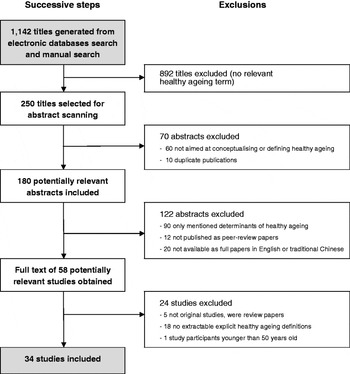
The steps in the identification and selection of papers for review are summarised in Figure 1. The electronic database searches and subsequent reference-list searches yielded 1,142 titles, and we considered that 250 abstracts required to be read. The review of the abstracts identified 70 papers as irrelevant, because they did not define or conceptualise healthy ageing. Of the remaining 180 abstracts, 58 indicated that the papers met all the inclusion criteria and so the full papers were obtained. Appraisal of the full papers found that 24 did not in fact meet all the criteria, leaving 34 for close analysis.
Steps in identifying the papers for review.

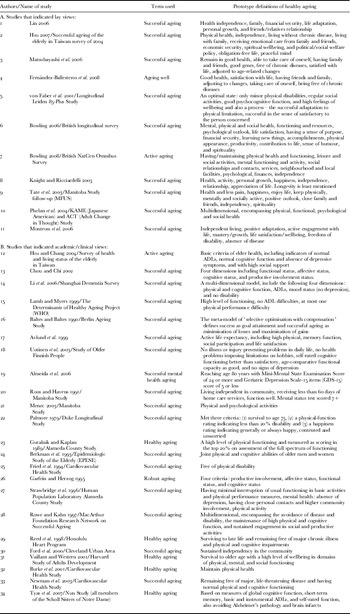
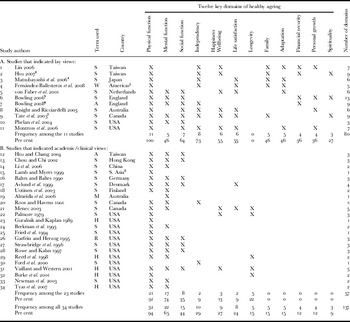
The prototype definitions of healthy ageing identified in the selected 34 studies are presented in Table 1, together with the first author, published year, country of research, name of study (if applicable), and terms used. Depending on whether the studies drew on academic definitions or lay perspectives (see ‘Methods’), we labelled the selected studies as ‘academic-perspective study’ or ‘lay-perspective study’. The key components of the definitions of healthy ageing are shown in Table 2. After literally examining the 34 papers, the key components of the prototype definitions were categorised into 12 domains. In Table 2, the first 11 studies address lay views.
The definitions of healthy ageing and use of cognate terms in the 34 papers

Notes: The table presents all the reviewed studies, beginning with those that used lay views, followed by those using academic views. Within each block, the studies are ordered by geographical area and publication year. ADLs: activities of daily living.
The key domains of healthy ageing identified in the 34 studies

Notes: Key to central terms: S: successful ageing; W: ageing well; H: healthy ageing; A: active ageing; R: robust ageing; M: successful mental health ageing.
1. Includes: Ecuador, Uruguay, Chile, Columbia, Mexico, Cuba, and Brazil and Spain, Portugal, and Greece. 2. Includes: Indonesia, Sri Lanka, and Thailand. 3. Includes other domains: receiving emotional care from family and friends, political and social-welfare policy, obligation-free late life, and peaceful mind. 4. Includes good genes as domain. 5. Includes other domains: psychological and physical outlook, sense of purpose, accomplishments, productivity, contribution to life, and sense of humour. 6. Includes other domains: leisure activities; service, neighbourhood, and local facilities. 7. Includes positive outlook as domain.
Of the 34 selected studies, two were cross-national. Lamb and Myers (Reference Lamb and Myers1999) included three East South Asian countries: Indonesia, Sri Lanka, and Thailand. Fernández-Ballesteros et al. (Reference Fernández-Ballesteros, García, Abarca, Blanc, Efklides, Kornfeld, Lerma, Mendoza-Nuñez, Mendoza-Ruvalcaba, Orosa, Paúl and Patricia2008) examined data from seven Latin/Southern American countries: Ecuador, Uruguay, Chile, Columbia, Mexico, Cuba, and Brazil and three European countries: Spain, Portugal, and Greece. The other 32 studies were conducted in a single country: six in Asia (three in Taiwan, one in Hong Kong, one in China, and one in Japan); six in Western Europe (one in The Netherlands, two in England, one in Germany, one in Demark, and one in Finland), two in Australia, and 18 in North America (three in Canada, 15 in the United States of America).
Terminology for the key domains
As arrayed in Table 2 (column ‘terms used’), 24 of the 34 studies used the term and concept ‘successful ageing’, five used ‘healthy ageing’, and two used ‘active ageing’, while ‘successful mental health ageing’, ‘robust ageing’ and ‘ageing well’ were each used in one study. Twelve domains or key components in the definitions of healthy ageing were identified: physical functioning (32 studies), mental/cognitive functioning (22), social functioning (15), independency (10), happiness/wellbeing (9), life satisfaction (8), longevity (5), living with/close to family (5), adaptation (5), financial security (4), personal growth (4), and spirituality (3). Twenty-nine of the 34 studies had multi-domain definitions and five included only one key domain (one used ‘mental/cognitive functioning’ only, one ‘independency’ only, and three ‘physical function’ only).
Cross-national/cultural patterns
As shown in Table 2, among the 12 key identified domains of healthy ageing, ‘physical function’, ‘mental function’ and ‘social function’ were the three most frequently described in all continents. ‘Mental function’ was mentioned in all Canadian and six European studies but in less than one-half (45.5%) of the Asian studies. Only one American study included ‘life satisfaction’, and none of the American and Australian studies mentioned the ‘family’ domain. On the other hand, ‘financial security’ was used in only two of the seven Asian studies and in one from England. ‘Longevity’ was only mentioned (to a variable extent) in the American and Canadian studies.
Lay perceptions versus academic views
Of the 34 analysed studies, 11 described ‘lay-people's views’ (see Table 2). These referred to a greater number and variety of domains or key components than the studies that used academic definitions of healthy ageing. As Table 2 illustrates, the lay definitions usually included domains over and above physical, mental/cognitive, and social functioning. The number of domains in lay definitions of healthy ageing ranged from three to 13, whereas the number of domains in the academic definitions varied from one to five. The mean numbers of domains were 7.3 (lay) and 2.5 (academic). There were notable differences in the domain composition of the lay and academic definitions of healthy ageing. ‘Longevity’ was not mentioned in any of the lay-view studies, but appeared in five of the 23 academic-view studies. Some domains mentioned by the 11 lay informants were not included in any of the academic-view studies, namely ‘family’, ‘adaptation’, ‘financial security’, ‘personal growth’ and ‘spirituality’.
Discussion
This review paper has examined reported conceptualisations of ‘healthy ageing’ from the perspectives of both academic and clinical researchers and older lay people. In addition, a comparison of concepts of healthy ageing from different national and cultural backgrounds was made. As compared to previous studies, our study adds value to the literature in focusing on these two dimensions, and has allowed us to identify domains of healthy ageing that have been deemed important by lay people but not addressed by researchers. It also allows us to examine how healthy ageing domains are viewed and valued across cultures.
The review has revealed both variations and consistencies. Considerable variations in the domains of healthy ageing were found among the 34 selected studies. Across the different cultures and countries, majorities of both academic researchers and lay older people nominated physical health, mental health and (to a lesser extent) social functioning as important aspects of healthy ageing. Compared to the academic views, lay concepts of healthy ageing included many more domains, regardless of the country and study design. Cross-culturally, older people hold comprehensive views of healthy ageing which go beyond mere functional independency and introduce aspects such as family, adaptation to age-related changes, financial security, personal growth, positive spirituality, and positive outlook. We dichotomised the selected studies into those that were informed by ‘academic views’ and those that drew on ‘lay views’. Surprisingly, we did not find any paper among the 34 that included definitions of healthy ageing from both academic and lay people. Therefore we had to compare between definitions in different studies rather than between different response groups within the same study.
As previously reported by Peel (Reference Peel2004), we found that ‘successful ageing’ is the most common term in the literature, although there is also substantial variation in terminology. Since Rowe and Kahn (Reference Rowe and Kahn1987, Reference Rowe and Kahn1997) proposed the concept of ‘successful ageing’ as distinct from ‘usual ageing’ and elaborated the concept in 1997, the term has prevailed in the literature. There has, however, been criticism that ‘success’ in western culture is usually associated with economic and/or material achievement (Peel Reference Peel2004). Furthermore, the concept of ageing should be better placed on a continuum of achievement, rather than being dichotomised into success or failure (Bowling Reference Bowling1993, Reference Bowling and Dieppe2005). Some researchers have proposed that ‘healthy ageing’ is a more appropriate term by which to recognise positive health outcomes in later life (Kendig and Browning Reference Kendig and Browning1997; Peel Reference Peel2004; Schulz and Heckhausen Reference Schulz and Heckhausen1996). In addition, ‘healthy ageing’ is probably clearer and more widely understood than ‘successful ageing’, and has the merit of engaging with the broad WHO definition that was formulated in 1948 and not since been changed: ‘health is a state of complete physical, mental and social well-being and not merely the absence of disease or infirmity’ (WHO 1948: 100).
We recommend ‘healthy ageing’ as the most useful umbrella term to cover the overlapping ideas denoted by the cognate terms ‘active ageing’, ‘successful ageing’, ‘positive ageing’ (the term used by Chong et al. (Reference Chong, Ng, Woo and Kwan2006) to incorporate the economic aspects of ageing), and ‘ageing well’. Although one might expect that the different terms focus on different aspects of wellbeing, as shown in Table 2 no clear pattern of variation was observed. The various terms all seem to refer to quality of life aspects of ageing. Healthy ageing in our view is the more appropriate term by which to recognise positive health outcomes in later life and to cover the broad WHO definition of health. Whichever term is used, the concept ‘healthy ageing’ should differentiate those older people who experience positive outcomes in old age, not only in maintaining good physical health and functioning, but also in coping and remaining in control of later life and to age well in accordance with the values of their own cultures (see alsoBowling Reference Bowling2007; Depp, Glatt and Jest Reference Depp, Glatt and Jeste2007; Strawbridge, Wallhagen and Cohen Reference Strawbridge, Wallhagen and Cohen2002).
Of the 12 key domains of healthy ageing identified by this review, ‘independency’, ‘longevity’, ‘family’, ‘adaptation’, ‘financial security’, ‘personal growth’, and ‘spirituality’ were rated differently by academic and lay older people. Our study shows that the majority of the latter (i.e. 73% of the lay-view studies) included the term ‘independence’, indicating that older people place great weight on being in control and responsible for their lives (i.e. being independent, and to maintain good health and to make their own decisions in daily life). Other independence-related domains of healthy ageing, such as ‘family’, ‘adaptation’, ‘financial security’, ‘personal growth’ and ‘spirituality’, were mentioned only in the lay-view studies and in none of the studies using academic definitions. It should be noted, however, that how lay older people perceive ‘personal growth’ and ‘spirituality’ has not yet been fully explicated in literature and invites further investigation.
It is possible that academic researchers use different dimensions in their healthy ageing definitions than older lay people because of the differing perspectives generated by various professional responsibilities and backgrounds (e.g. medical doctors, psychologists and social scientists). Bowling's (Reference Bowling2007) review identified 170 papers on healthy ageing, revealed a wide range of definitions and suggested that the different usages ‘generally reflect the academic discipline of the investigator’ (Bowling Reference Bowling2007: 263). Glass (Reference Glass2003) pointed out that two schools can be distinguished in the definition of healthy ageing: the biomedical and the psychosocial. In our 34 selected studies, the domains of healthy ageing defined by academic researchers with a background in medicine (as derived from their affiliations) tended to stress physical functioning in healthy ageing; the additional dimensions in lay people's definitions reflect more on psychosocial concepts. The differences between biomedical and the more psychosocial-oriented lay definitions perhaps underline the need for more qualitative studies of healthy ageing to explore the different dimensions used by academic and lay old people (Depp, Glatt and Jeste Reference Depp, Glatt and Jeste2007).
Particularly in Asia, lay older people perceived ‘family’ and ‘financial security’ as integral parts of healthy ageing, in contrast to lay views in other geographic areas. This could be profoundly influenced by shared traditional values in Taiwan, Japan and China (Hsu Reference Hsu2007), as epitomised in such phrases as ‘the more off-spring, the more blessings’ and ‘the big happy family’ (at least three generations in one household). Older people in these countries prefer living with their extended families rather than living alone, partly thereby to secure finances (Chong et al. Reference Chong, Ng, Woo and Kwan2006; Hsu Reference Hsu2007). Maintaining close contact with and being supported by their extended families and enjoying a leisurely late life are perceived as more important components of healthy ageing than ‘social functioning’ or ‘active social participation’, while on the contrary, having no filial children and needing to work in old age to support oneself are regarded as a recipe for a miserable late life (Hsu Reference Hsu2007). As for financial security, adequate income, sufficient pension, social security, other benefits and discounted social services are considered key ingredients of a financial safety net, particularly for the groups of lay older people in Asia and in England whose views were reported in the selected studies (Bowling Reference Bowling2006, Reference Bowling2008; Hsu Reference Hsu2007; Lin Reference Lin2006).
Some limitations of the present study need to be mentioned. First, although this review has examined cross-cultural differences of healthy ageing concepts, its scope has been limited to published peer-reviewed papers in English or Chinese (traditional characters), possibly omitting relevant literature in other languages. Future studies should include more concepts derived from papers in other languages. Another limitation of this study could arise from the search strategy. Although we used healthy ageing as an umbrella concept (and included the related terms ‘successful ageing’, ‘active ageing’, ‘positive ageing’, ‘robust ageing’ and ‘ageing well’), we might have missed other cognate terms.
The findings point to certain areas and questions that require future research. First, some domains such as ‘family’, ‘adaptation’, ‘financial security’, ‘personal growth’ and ‘spirituality’ were only mentioned in the lay older people view studies. Future research could investigate these domains in more depth to learn why older people perceive these domains as important aspects of healthy ageing. Furthermore, as the ageing issues might become more complicated in the coming decades (Lee and Fan Reference Lee and Fan2008), it would be valuable to study how older people in the future (presently younger than 50 years of age) perceive healthy ageing, in order to provide some indication on how the concept of healthy ageing might evolve in the near future and how the younger generation prepares for healthy ageing (Chong et al. Reference Chong, Ng, Woo and Kwan2006).
In conclusion, this review has confirmed that healthy ageing is a multi-dimensional and complex concept, and that different views on healthy ageing exist between different cultures and between academic and older lay people. The variation between older lay people and academic researchers is more robust than across cultures. As shown in this review, older lay people all over the world include more components in their perceptions of healthy ageing than their academic counterparts. As the ultimate goal of health and social policies is to increase the quality not just the quantity or length of later life, subjective experiences or perceptions of quality of life need to be taken into account by professional or objective definitions. Academic researchers should broaden their classical ‘physical–mental–social’ view on healthy ageing, by incorporating more holistic perspectives of older lay people from different cultural settings, in order to construct a more comprehensive and culturally-sensitive concept of healthy ageing and to develop more realistic and effective measurements of healthy ageing.
Acknowledgements
The first author would like to thank the Ministry of Education, Taiwan, for awarding her a scholarship to conduct this study at Maastricht University in The Netherlands. The authors would like to express their appreciation to the editor and the anonymous reviewers for their valuable comments on an earlier draft of this article.