

The Portland cement industry is the third largest source of anthropogenic CO2 emissions, accounting for ∼8–9% of global emissions (Monteiro et al., Reference Monteiro, Miller and Horvath2017). The main sources of CO2 during the manufacture of ordinary Portland cement (OPC) are the decarbonation of carbonate raw materials and fuel combustion during clinker calcination (Locher, Reference Locher2006). Consequently, the development of alternative binders with a reduced environmental footprint has become an important global research objective.
This study focuses on the synthesis of alkali-activated cement from a clay-rich industrial by-product, gravel wash mud (GWM). Unlike carbonate rocks, clays do not release CO2 during calcination, and their thermal activation requires significantly lower temperatures than those used for Portland cement clinker production. GWM is a sludge generated during the washing of sand and gravel aggregates. After washing, the sludge is discharged into settling tanks, where it forms a relatively homogeneous, water-saturated body several metres thick, and it is commonly disposed of in decantation basins (Thapa et al., Reference Thapa, Waldmann, Wagner and Lecomte2018). It is estimated that ∼2500 such sites exist in Central Europe, with a total annual deposition of ∼50 million tonnes of GWM. In Germany alone, annual deposition is estimated at ∼15 million tonnes (Schmitz et al., Reference Schmitz, Röhling and Dohrmann2011). The recycling of GWM as raw materials for alternative binders would reduce land consumption associated with waste disposal and lead to significant energy savings.
OPC clinker production requires calcination temperatures of up to 1450°C (Monteiro et al., Reference Monteiro, Miller and Horvath2017), whereas thermal activation of kaolinite-rich clays can be achieved at much lower temperatures, typically ∼750°C for soak calcination and up to 1000°C for flash calcination (Teklay et al., Reference Teklay, Yin, Rosendahl and Køhler2015, Reference Teklay, Yin and Rosendahl2016).
During the hydration of OPC, a calcium–aluminium–silicate–hydrate (C–A–S–H) gel is formed (Yip et al., Reference Yip, Lukey and van Deventer2005). This phase is fundamentally different from a metakaolin-based geopolymer gel. In geopolymer systems, the negative charge of the aluminosilicate network is balanced by alkali cations (Na+ or K+) supplied by the activating solution (Künzel et al., Reference Künzel, Vandeperre, Donatello, Boccaccini, Cheeseman and Brown2012; Longhi et al., Reference Longhi, Zhang, Rodríguez, Kirchheim and Wang2019), leading to the formation of sodium–aluminium–silicate–hydrate (N–A–S–H) or potassium–aluminium–silicate–hydrate (K–A–S–H) gels (Künzel et al., Reference Künzel, Vandeperre, Donatello, Boccaccini, Cheeseman and Brown2012).
To tailor the properties of geopolymers and alkali-activated binders, considerable effort has been devoted to defining optimal mix designs using elemental ratios such as Si/Al (Duxson et al., Reference Duxson, Provis, Lukey, Mallicoat, Kriven and van Deventer2005b, Reference Duxson, Mallicoat, Lukey, Kriven and van Deventer2007; Perera et al., Reference Perera, Uchida, Vance and Finnie2007; Lahoti et al., Reference Lahoti, Narang, Tan and Yang2017; Wan et al., Reference Wan, Rao, Song, García, Estrella, Patiño and Zhang2017), Na/Al (Duxson et al., Reference Duxson, Provis, Lukey, Mallicoat, Kriven and van Deventer2005b; Perera et al., Reference Perera, Uchida, Vance and Finnie2007; Yunsheng et al., Reference Yunsheng, Wei and Zongjin2010; Lahoti et al., Reference Lahoti, Narang, Tan and Yang2017; Riahi et al., Reference Riahi, Nemati, Khodabandeh and Baghshahi2020) and Ca/(Si + Al) (Li et al., Reference Li, Shi, Wang, Zhang and Ou2017). Adjustment of the Si/Al ratio is often achieved through the addition of soluble silicates, most commonly sodium silicate due to its availability and cost-effectiveness (Dimas et al., Reference Dimas, Giannopoulou and Panias2009).
For metakaolin-based alkali-activated binders, Si/Al ratios ranging from ∼1.04 (Subaer & Fansuri, Reference Subaer and Fansuri2018) to 2.15 (Duxson et al., Reference Duxson, Provis, Lukey, Mallicoat, Kriven and van Deventer2005b) have been reported, with optimal mechanical performance typically observed at Si/Al ratios of 1.9–2.0 (Duxson et al., Reference Duxson, Provis, Lukey, Mallicoat, Kriven and van Deventer2005b, Reference Duxson, Mallicoat, Lukey, Kriven and van Deventer2007; Perera et al., Reference Perera, Uchida, Vance and Finnie2007; Lahoti et al., Reference Lahoti, Narang, Tan and Yang2017; Wan et al., Reference Wan, Rao, Song, García, Estrella, Patiño and Zhang2017). Low Si/Al and low or high Na/Al ratios may promote zeolite formation rather than geopolymer gel development (Rowles & O’Connor, Reference Rowles and O’Connor2003; Subaer & Fansuri, Reference Subaer and Fansuri2018). Low Si/Al ratios result in limited geopolymer gel formation and increased porosity, whereas a Si/Al ratio of 1.9 leads to a homogeneous microstructure dominated by geopolymer gel (Duxson et al., Reference Duxson, Provis, Lukey, Mallicoat, Kriven and van Deventer2005b). Sodium ions within the geopolymer gel structure are associated with aluminium tetrahedra (Duxson et al., Reference Duxson, Lukey, Separovic and van Deventer2005a). The stoichiometrically optimal Na/Al ratio is close to 1.0 (Künzel et al., Reference Künzel, Vandeperre, Donatello, Boccaccini, Cheeseman and Brown2012), which is supported by experimental studies reporting the optimal range at between 0.9 and 1.0 (Duxson et al., Reference Duxson, Provis, Lukey, Mallicoat, Kriven and van Deventer2005b; Perera et al., Reference Perera, Uchida, Vance and Finnie2007; Yunsheng et al., Reference Yunsheng, Wei and Zongjin2010; Lahoti et al., Reference Lahoti, Narang, Tan and Yang2017; Riahi et al., Reference Riahi, Nemati, Khodabandeh and Baghshahi2020). It has been proposed to use the term ‘geopolymer’ only when no carbonate source is added and when precise Si/Al and Na/Al ratios – prerequisites for geopolymer gel formation – are maintained (Davidovits, Reference Davidovits2018).
A wide range of industrial by-products and secondary raw materials have been investigated for use in geopolymer and alkali-activated binder systems, including sawdust (Duan et al., Reference Duan, Yan, Zhou and Luo2016), waste glass (Alvarenga et al., Reference Alvarenga, Sales, Caldas, Cetlin and Aguilar2022), blast furnace slag (Buchwald et al., Reference Buchwald, Hilbig and Kaps2007; Yip et al., Reference Yip, Lukey, Provis and van Deventer2008), fly ash (Ranjbar et al., Reference Ranjbar, Mehrali, Behnia, Alengaram and Jumaat2014; Ziegler et al., Reference Ziegler, Formia, Tulliani and Palmero2016), palm oil fuel ash (Ranjbar et al., Reference Ranjbar, Mehrali, Behnia, Alengaram and Jumaat2014), sewage sludge ash (Wagner, Reference Wagner2022) and rice husk ash (Ziegler et al., Reference Ziegler, Formia, Tulliani and Palmero2016). The addition of mineral fillers such as quartz or chamotte reduces porosity and improves compressive strength in metakaolin-based geopolymer cements (Buchwald et al., Reference Buchwald, Vicent, Kriegel, Kaps, Monzó and Barba2009).
Curing conditions play a crucial role in geopolymerization and strongly influence the mechanical properties of alkali-activated materials. Hydrothermal curing at temperatures of ∼65–70°C yields high compressive strengths (Heah et al., Reference Heah, Kamarudin, Bakri, Binhussain, Luqman and Nizar2011; Allahverdi et al., Reference Allahverdi, Najafi Kani, Hossain, Lachemi, Pacheco-Torgal, Labrincha, Leonelli, Palomo and Chindaprasirt2015). However, although elevated curing temperatures accelerate early strength development, long-term mechanical properties may be superior for samples cured at ambient or slightly reduced temperatures (Rovnaník, Reference Rovnaník2010).
Recently, increasing attention has been paid to cementitious materials with electrically conductive additives for applications such as grounding, lightning protection, resistance heating, electromagnetic shielding, self-sensing and thermal energy storage (Chung, Reference Chung2004; Mingqing et al., Reference Mingqing, Xinying, Xiaoying, Zuofu and Zhuoqiu2008; Fiala et al., Reference Fiala, Petříková, Lin, Podolka and Černý2019; Rovnaník et al., Reference Rovnaník, Kusák, Bayer, Schmid and Fiala2019; Rahjoo et al., Reference Rahjoo, Goracci, Martauz, Rojas and Dolado2022). The formation of conductive pathways within the cement matrix can reduce electrical resistivity by several orders of magnitude once the percolation threshold of the composite material is exceeded. The presence of non-conductive fillers, such as quartz sand, may increase the percolation threshold. However, dielectric quartz grains embedded in a conductive cement matrix result in electrical tortuosity, which causes dissipation of electric field energy and corresponding heat generation due to volumetric conductor wiring within the conductor–insulator composite material (Soliman et al., Reference Soliman, Chanut, Deman, Lallas and Ulm2020).
The electrical conductivity of such composites is influenced by the intrinsic conductivity of the additive, its dispersion within the matrix and the interfacial electrical resistance between the additive and the binder (Chung, Reference Chung2004). Portland cement typically exhibits high electrical resistivity (105–106 Ω⋅cm), necessitating the use of conductive additives such as steel fibres, carbon fibres, graphite powder, coke powder, steel dust, carbon black or carbon nanotubes (Chung, Reference Chung2004; Mingqing et al., Reference Mingqing, Xinying, Xiaoying, Zuofu and Zhuoqiu2008; Fiala et al., Reference Fiala, Petříková, Lin, Podolka and Černý2019; Soliman et al., Reference Soliman, Chanut, Deman, Lallas and Ulm2020).
Resistance (Joule) heating could be an alternative solution for heating applications in buildings. Although resistance heating has lower efficiency in comparison with heat pumps, it can still be considered an alternative due to its simplicity and ease of integration into buildings, where it can function both as a construction material and a heating element. For instance, Mingqing et al. (Reference Mingqing, Xinying, Xiaoying, Zuofu and Zhuoqiu2008) developed carbon black-doped mortar slabs for indoor heating applications. Fiala et al. (Reference Fiala, Petříková, Lin, Podolka and Černý2019) investigated the self-heating ability of cement made from alkali-activated blast furnace slag and carbon black. The study showed that increasing the carbon black content significantly reduced the mechanical properties of the cement. Alkali-activated cement exhibited a compressive strength of 83.45 MPa, whereas the addition of 2.25 wt.% carbon black reduced the compressive strength to only 7.31 MPa. However, this composition demonstrated the best self-heating performance (Fiala et al., Reference Fiala, Petříková, Lin, Podolka and Černý2019).
Geopolymer and alkali-activated binders offer additional advantages for electrically conductive heating elements due to their higher thermal stability and elevated electrical conductivity resulting from mobile alkali ions (Rovnaník et al., Reference Rovnaník, Kusák, Bayer, Schmid and Fiala2019). While Portland cement-based materials are typically limited to operating temperatures of 400–500°C (Rahjoo et al., Reference Rahjoo, Goracci, Martauz, Rojas and Dolado2022), geopolymers can maintain structural stability and functional performance at temperatures exceeding 1000°C, with metakaolin-based formulations reported to remain thermally resistant up to 1150–1300°C depending on composition and alkali activation chemistry (Lila et al., Reference Lila, Gharzouni, Naït-Ali, Jouin, Babule Guillaume and Duport2023; Cligny et al., Reference Cligny, Hyvernaud, Gharzouni, Brandt and Rossignol2024). These properties make geopolymers particularly attractive for thermal energy-storage systems and other high-temperature applications. Geopolymer concretes outperform Portland cement systems in thermal energy-storage applications due to their broader operational temperature range (Rahjoo et al., Reference Rahjoo, Goracci, Martauz, Rojas and Dolado2022).
Recent research has primarily focused on maximizing geopolymer gel formation through highly reactive aluminosilicate precursors, optimization of Si/Al and Na/Al ratios and the use of soluble silicate activators (Castillo et al., Reference Castillo, Collado, Droguett, Sánchez, Vesely, Garrido and Palma2021; Matsimbe et al., Reference Matsimbe, Dinka, Olukanni and Musonda2022; Segura et al., Reference Segura, Jensen, Damø, Ranjbar, Jensen and Canut2022). In contrast, the present study demonstrates that high-strength alkali-activated cements can be synthesized directly from industrial by-products such as GWM and quartzite dust using only NaOH activation, without the addition of soluble silicates. This approach provides both economic and environmental advantages, since sodium and potassium silicate solutions are among the most energy-intensive and costly components of geopolymer systems (Dimas et al., Reference Dimas, Giannopoulou and Panias2009).
Furthermore, the curing regime was specifically optimized for this material system, enabling compressive strengths exceeding 70 MPa to be achieved despite the presence of only a very small fraction of reactive metakaolinite (∼5 wt.%). Previous NaOH-activated metakaolin systems with Si/Al ratios of ∼1 have reported compressive strengths of only 0.4–4.4 MPa (Castillo et al., Reference Castillo, Collado, Droguett, Sánchez, Vesely, Garrido and Palma2021). Even though compressive strengths exceeding 70 MPa have been achieved in metakaolin geopolymers containing soluble silicates and substantially higher reactive precursor contents (Duxson et al., Reference Duxson, Provis, Lukey, Mallicoat, Kriven and van Deventer2005b; Statkauskas et al., Reference Statkauskas, Vaičiukynienė, Grinys and Bajare2025), these systems generally rely on significantly larger amounts of alkali activator and soluble silica sources.
Another notable finding is that a high quartzite dust content significantly reduced the liquid demand of the mixtures, allowing liquid-to-solid ratios as low as 0.22 mL g–1 to be achieved. This value is considerably lower than those commonly reported for metakaolin-based geopolymer systems, and it approaches values typical for Portland cement and alkali-activated slag systems (Buchwald et al., Reference Buchwald, Hilbig and Kaps2007; Lahoti et al., Reference Lahoti, Narang, Tan and Yang2017; Ahmed et al., Reference Ahmed, Mohammed and Mohammed2022).
In addition, this study demonstrates the conversion of the developed alkali-activated cement into an effective resistance-heating material through the incorporation of a low-cost graphite additive. Remarkably, quartzite filler plays a crucial role in reducing electrical resistivity, with specific filler contents decreasing resistivity by approximately five orders of magnitude. Simultaneously, the graphite additive may preserve or even slightly improve compressive strength at specific quartzite contents. This behaviour contrasts with previous studies on electrically conductive alkali-activated binders, where carbon additives frequently caused severe deterioration of mechanical performance (Fiala et al., Reference Fiala, Petříková, Lin, Podolka and Černý2019). The presented results therefore provide new insights into the combined mechanical, electrical and thermal functionality of alkali-activated cement systems.
Materials and methods
Raw materials
Industrial by-products originating from the mining industry in south-western Germany were used for the synthesis of alkali-activated cements. GWM was obtained from gravel quarries operated by Rech Kies-GmbH (Germany), and quartzite dust was collected from a quartzite quarry operated by Gebr. Arweiler GmbH & Co. KG (Germany). The graphite additive was supplied by ProGraphite GmbH (Germany) and is marketed as a low-cost additive suitable for composites and coatings to improve thermal conductivity, antistatic behaviour and mechanical properties.
The grain-size distribution of the raw materials (except for the grain-size data for GrafAdd 7-99 that were provided by the supplier) was determined by wet sieving and sedimentation analysis according to DIN 18123 (Fig. 1). The GWM is characterized by high fineness, with a substantial clay fraction (43% <0.002 mm and 90% <0.063 mm). In contrast, quartzite dust is significantly coarser, with dominant silt and sand fractions (2% <0.002 mm and 47% <0.063 mm). The graphite additive (GrafAdd 7-99) is narrowly graded, with 3.68% <0.002 mm and ∼80% <0.01 mm.
Particle-size distribution of GWM, quartzite dust and graphite additive GrafAdd 7-99.

Mixture design of the alkali-activated cement formulations.

Table 1 Long description
Two side by side sections list mixture compositions for alkali activated cement samples without graphite and with graphite. Columns report sample ID, GWM in wt.%, quartzite dust in wt.%, and L/S ratio in milliliters per gram; the graphite section adds graphite in wt.%. Without graphite, sample IDs run from GWM 100 to GWM 10/Q90, with GWM decreasing from 100 to 10 wt.% and quartzite dust increasing from 0.0 to 90 wt.%, while L/S ratio decreases from 0.40 to 0.22. Intermediate rows without graphite include GWM 90/Q10 at 90 wt.% GWM, 10 wt.% quartzite dust, L/S ratio 0.38, and GWM 50/Q50 at 50 wt.% GWM, 50 wt.% quartzite dust, L/S ratio 0.30. With graphite, sample IDs run from GWM 94/G6 to GWM9/Q85/G6, and graphite is 6.1 wt.% in every row. In the graphite section, GWM decreases from 93.9 to 9.4 wt.% and quartzite dust increases from 0.0 to 84.5 wt.%, while L/S ratio decreases from 0.50 to 0.30. Examples with graphite include GWM85/Q9/G6 at 84.5 wt.% GWM, 9.4 wt.% quartzite dust, 6.1 wt.% graphite, L/S ratio 0.48, and GWM47/Q47/G6 at 47.0 wt.% GWM, 47.0 wt.% quartzite dust, 6.1 wt.% graphite, L/S ratio 0.39.
Mineralogical analysis
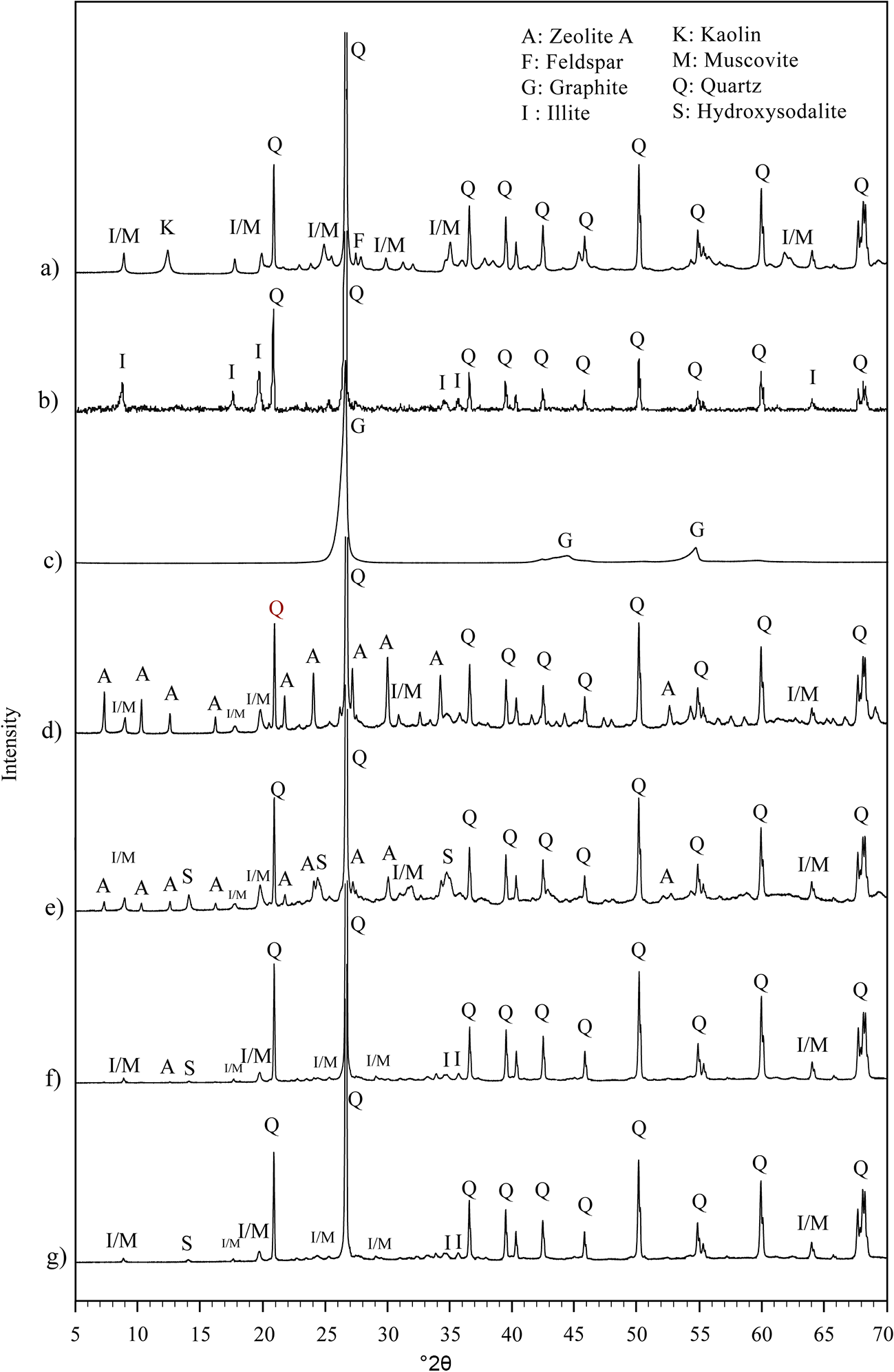
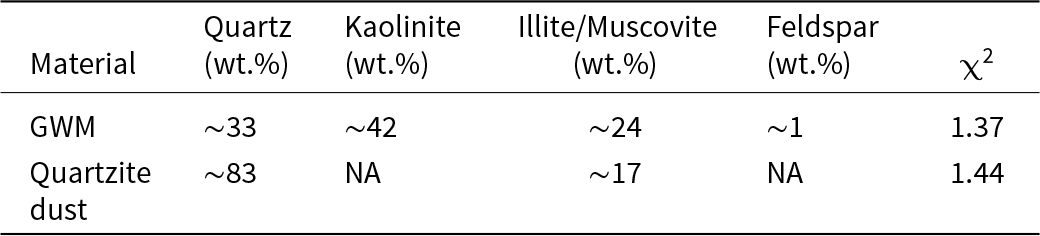
The mineralogical composition of the raw materials and cured cement samples was determined by X-ray diffraction (XRD) using a Bruker D6 Phaser diffractometer (Fig. 2). XRD analysis of cured cement samples was performed only on the samples with the lowest strength (pure GWM cement activated with 6 and 10 mol L–1 NaOH solutions) and on the samples with the highest strength (90 wt.% quartzite dust activated with 6 and 10 mol L–1 NaOH solutions). Powder samples were analysed, and the XRD traces were processed using Profex 5.0 software for phase identification and Rietveld refinement (Döbelin, Reference Döbelin2016). Peak broadening effects caused by crystallite size and lattice deformation were refined, and a second-order spherical harmonics function was applied to clay minerals to account for the preferential orientation of clay platelets (Döbelin, Reference Döbelin2016). These refinements improved the accuracy of phase quantification, expressed by χ2 values (Table 2).
XRD traces of the raw materials – (a) GWM, (b) quartzite dust and (c) graphite additive GrafAdd 7-99 – and cured cement samples: (d) GWM100 activated with 6 mol L–1 NaOH, (e) GWM100 activated with 10 mol L–1 NaOH, (f) GWM10/Q90 activated with 6 mol L–1 NaOH and (g) GWM10/Q90 activated with 10 mol L–1 NaOH.

Figure 2 Long description
Seven stacked line plots labeled a), b), c), d), e), f) and g). A legend at the top lists phase labels: A: Zeolite A, F: Feldspar, G: Graphite, I: Illite, K: Kaolin, M: Muscovite, Q: Quartz, S: Hydroxysodalite. The x-axis is labeled, 2 theta, with tick labels from 5 to 70 in increments of 5. The y-axis is labeled, Intensity, with no numeric tick labels. a) A line trace with multiple narrow peaks. Peak annotations include I slash M near about 10, K near about 13, I slash M near about 17 and several peaks labeled Q across the mid and right side, including near about 26, about 40, about 50, about 60 and about 67. Additional annotations include M and F near the mid range. b) A line trace with a very tall peak labeled Q near about 26. Several smaller peaks labeled Q appear from about 35 to about 65 and a label Q appears near about 69. c) A line trace with a very tall peak labeled Q near about 26. Two peaks are labeled G, one near about 45 and one near about 55. d) A line trace with many peaks. Several low-angle peaks are annotated with A and multiple peaks are annotated I slash M. A very tall peak labeled Q is near about 26. Additional peaks labeled Q appear across the mid and right side, including near about 40, about 50, about 60 and about 67. e) A line trace with many low-angle peaks annotated with I slash M, A and S. A very tall peak labeled Q is near about 26. Several peaks labeled Q appear from about 35 to about 65. f) A line trace with low-angle annotations including I slash M and S. A very tall peak labeled Q is near about 26. Several peaks labeled Q appear from about 35 to about 65 and I slash M appears near about 67. g) A line trace with low-angle annotations including I slash M and S. A very tall peak labeled Q is near about 26. Several peaks labeled Q appear from about 35 to about 65 and I slash M appears near about 67.
Dissolution tests
The dissolution test procedure was adapted from Khalifa et al. (Reference Khalifa, Pontikes, Elsen and Ö2019) and was conducted to determine the amounts of leachable silica and aluminium from calcined GWM and quartzite dust in order to evaluate their suitability as precursor materials for alkali-activated cement synthesis. NaOH solutions with molarities of 6 and 10 mol L–1 were used. Prior to testing, the materials were ground for 10 min in disc mills (filling ratio 50%) and calcined at 750°C for 1 h in a muffle furnace. Subsequently, 0.25 g of calcined material was mixed with 20 mL of NaOH solution and shaken continuously at room temperature for 24 h. After centrifugation, the concentrations of dissolved silica and aluminium were measured using a high-resolution continuum source atomic absorption spectrometer (HR-CS AAS, contrAA®, Analytik Jena, Germany) equipped with a xenon short-arc lamp as a continuum radiation source and a charge-coupled device array detector.
Preparation of the samples
Ten different cement formulations based on varying proportions of GWM and quartzite dust were prepared. The GWM content was reduced stepwise from 100 to 10 wt.%, while the quartzite dust content was increased correspondingly from 0 to 90 wt.% (Table 1). For each formulation, two NaOH molarities (6 and 10 mol L–1) were used to investigate the effect of alkali concentration.
The liquid-to-solid (L/S) ratios (mL g–1) were set to 0.40 for GWM, 0.20 for quartzite dust and 2.0 for the graphite additive. Consequently, the overall L/S ratio was adjusted according to the relative proportions of GWM, quartzite dust and graphite in each mixture (Table 1). These ratios were determined through preliminary trials to ensure adequate workability while minimizing liquid consumption.
To increase electrical conductivity, a constant fraction of 6.1 wt.% graphite additive (GrafAdd 7-99) was incorporated into selected mixtures (Table 1). In these formulations, the graphite replaced an equivalent mass fraction of the GWM–quartzite dust blend.
In contrast to previous studies (e.g. Duxson et al. Reference Duxson, Mallicoat, Lukey, Kriven and van Deventer2007; Perera et al. Reference Perera, Uchida, Vance and Finnie2007, Lahoti et al. Reference Lahoti, Narang, Tan and Yang2017; Wan et al. Reference Wan, Rao, Song, García, Estrella, Patiño and Zhang2017), no soluble silica source (e.g. sodium or potassium silicate) was added to adjust the optimum Si/Al ratio (∼1.9–2.0), relying instead on the inherent silica content of the raw materials.
The raw materials (GWM and quartzite dust) were ground together for 10 min in ring mills (filling ratio 50%) and calcined at 750°C for 1 h in a muffle furnace. The NaOH activating solutions (6 and 10 mol L–1) were prepared by dissolving NaOH pellets (purity 99%) in demineralized water. Mixing was performed using a standard 5 L laboratory mortar mixer. The calcined GWM–quartzite dust blends were mixed with the activating solution for 5 min: 1 min of pre-mixing at 140 rpm followed by 4 min at 285 ± 10 rpm.
The fresh pastes were cast into 2 × 2 × 4 cm3 steel moulds. Two curing conditions were applied to the cement samples: (1) curing at room temperature without cover; and (2) curing at elevated temperature, which was optimized through trials and consisted of 18 days of sealed curing at 65°C, followed by 10 days of unsealed curing at 65°C in a drying oven.
For density measurements, the dimensions of two prismatic specimens (2.0 × 2.0 × 16.1 cm3) were measured with a calliper, and the mass was determined using a digital scale with a precision of 0.01 g. The average density was calculated from the measured volume and mass.
Linear shrinkage measurements were performed on two elongated specimens with an initial length of 16.1 cm. After curing at elevated temperature, the final specimen length was measured with a calliper, and the linear shrinkage was obtained from application of Equation 1:
 \begin{equation}
\text{Shrinkage}\,(\% )\, = \,\frac{{{L_0} - L}}{{{L_0}}} \times 100\end{equation}
where  ${L_0}$ is the initial specimen length and
 $L$ is the length after curing.
For compressive strength testing, four specimens with dimensions of 2 × 2 × 4 cm3 were prepared for each formulation. The compressive strength was determined using a ‘Strassentest’ universal testing machine in accordance with DIN 51223.
Electrical resistivity and self-heating tests
For electrical resistivity measurements, stainless-steel gauze electrodes (mesh size 1 mm) were embedded at both ends of the prismatic specimens (2 × 2 × 4 cm3) to enable direct current (DC) resistivity measurements to be obtained and resistance heating tests to be performed (Fig. 3). Both graphite-free and alkali-activated cement samples with graphite additive were tested.
Photograph and schematic illustration of alkali-activated cement with graphite additive specimen (dimensions in millimetres).

Preparation and curing of specimens with graphite additive followed the same procedure as for the reference samples, except that 6.1 wt.% of the GWM–quartzite dust blend was replaced by graphite. The liquid demand was adjusted to account for the high liquid absorption capacity of graphite (∼200 wt.% of its mass). Two specimens from each formulation were prepared for resistivity measurements.
Electrical resistance (Ω) was measured using a METRAHIT PM EXTRA digital multimeter. Electrical resistivity (Ω·m) was calculated according to Equation 2:
 \begin{equation}\unicode{x03C1} = R\frac{A}{L}\end{equation}
where L is the distance between the electrodes (m), R is the electrical resistance (Ω) and A is the electrode area (m2).
For self-heating experiments, a thermocouple was installed in a pre-drilled hole at the centre of the cured specimen. The sensor was fixed using alkali-activated cement with graphite additive to ensure good thermal contact. The thermocouple was connected to the METRAHIT PM EXTRA multimeter via a 4 mm plug, and simultaneously a DC voltage of 40 V was applied to the embedded gauze electrodes.
Results
Analysis of raw materials
The main mineral phases identified in the GWM are kaolinite, quartz, illite/muscovite and feldspar (Fig. 2a & Table 2). The quartzite dust consists predominantly of quartz, with a smaller amount of illite (Fig. 2b & Table 2). XRD analysis of the graphite additive GrafAdd 7-99 indicates the presence of graphite only (Fig. 2c).
The cured cement sample consisting of 100 wt.% GWM activated with a 6 mol L–1 NaOH solution consists of zeolite A in addition to quartz and illite/muscovite (Fig. 2d). The 100 wt.% GWM cement activated with a 10 mol L–1 NaOH solution without zeolite A also contains hydroxysodalite (Fig. 2e). The sample with 10 wt.% GWM and 90 wt.% quartzite dust activated with a 6 mol L–1 NaOH solution contains quartz, illite/muscovite and a minor amount of hydroxysodalite (Fig. 2f) Similarly, the cement sample with 10 wt.% GWM and 90 wt.% quartzite dust activated with a 10 mol L–1 NaOH solution shows a similar mineralogical composition, consisting of quartz, illite/muscovite and a minor amount of hydroxysodalite (Fig. 2g).
Mineral phases quantified by Rietveld refinement.

Table 2 Long description
Mineral phases are reported as approximate weight percent for quartz, kaolinite, illite or muscovite, and feldspar, along with a chi squared value for each material. For GWM, quartz is about 33 wt.%, kaolinite about 42 wt.%, illite or muscovite about 24 wt.%, and feldspar about 1 wt.%, with chi squared 1.37. For quartzite dust, quartz is about 83 wt.% and illite or muscovite about 17 wt.%. Kaolinite and feldspar are marked as not applicable for quartzite dust. Chi squared for quartzite dust is 1.44.
NA = not applicable.
Dissolution behaviour of the raw materials
To evaluate the suitability of the investigated materials for alkali-activated cement synthesis, dissolution tests were conducted on calcined and ground GWM and quartzite dust (Fig. 4).
NaOH-leachable Si and Al contents of the materials used for cement synthesis.

The dissolution tests quantified the amounts of leachable silica and aluminium in 6 and 10 mol L–1 NaOH solutions. The highest concentrations of dissolved Si and Al were obtained from pure GWM, whereas quartzite dust exhibited very low dissolution values. The amounts of dissolved Si and Al were only weakly dependent on the NaOH concentration, indicating limited sensitivity of dissolution behaviour to activator molarity under the applied test conditions.
Physical properties and mechanical performance
Two curing regimes were investigated: (1) curing at elevated temperature with covered specimens during the initial curing phase followed by uncovered drying during the second phase; and (2) curing at room temperature without cover. The additional room-temperature curing series was included to evaluate the influence of curing conditions on compressive strength development.
Samples treated under elevated-temperature curing conditions (Fig. 5b–d) were compared with samples cured at room temperature (Fig. 5a). Room-temperature curing caused severe efflorescence, whereas samples cured at elevated temperature exhibited almost no efflorescence, indicating substantially different reaction dynamics. A noticeable difference in length was also observed between the cured GWM10/Q90 and GWM100 specimens, indicating severe shrinkage of the formulation containing 90 wt.% quartzite (Fig. 5c, d).
Samples of GWM–quartzite dust formulations cured (a) at room temperature and (b–d) at elevated temperature. The extended specimens of (c) formulation GWM10/Q90 and (d) formulation GWM100.

Density and linear shrinkage were measured for the GWM100 and GWM10/Q90 formulations cured at elevated temperature, representing the maximum and minimum quartzite dust contents, respectively (Table 3).
Density and linear shrinkage values of the GWM100 and GWM10/Q90 formulations.

Table 3 Long description
Two formulations are compared using density in grams per cubic centimeter and linear shrinkage in percent. For GWM100, density is 1.66 plus or minus 0.008 and linear shrinkage is 3.42 percent. For GWM10/Q90, density is 2.11 plus or minus 0.003 and linear shrinkage is 5.81 percent. Density is higher for GWM10/Q90 than for GWM100. Linear shrinkage is also higher for GWM10/Q90 than for GWM100.
As expected, the GWM10/Q90 samples exhibited significantly higher density than the pure GWM samples due to the elevated content of dense quartz particles. Both samples showed surprisingly high linear shrinkage, which was particularly pronounced for the GWM10/Q90 formulation (Fig. 5c,d & Table 3).
Compressive strength testing was conducted on alkali-activated cements containing quartzite dust filler in proportions ranging from 0 to 90 wt.%. When comparing the compressive strength results of samples activated with 10 M NaOH and cured at room temperature, the highest average compressive strength was observed for the GWM80/Q20 sample, reaching 7.79 MPa. In contrast, the lowest strength was measured for the GWM10/Q90 formulation, with a value of 2.07 MPa. This behaviour strongly contrasts with the elevated-temperature curing regime, under which the same formulation exhibited the highest compressive strength (72.6 MPa), ∼35 times higher than the value obtained after room-temperature curing. The compressive strength results for the elevated-temperature curing regime revealed that cements produced solely from GWM exhibited significantly lower strength compared with mixtures containing both GWM and quartzite dust (Fig. 6).
Compressive strength values (R c; MPa) of the cement formulations and liquid-to-solid ratios.

Figure 6 Long description
A combined plot with grouped vertical bars and dot markers. The horizontal axis lists nine categories: GWM, GWM 90 over Q10, GWM 80 over Q20, GWM 70 over Q30, GWM 60 over Q40, GWM 50 over Q50, GWM 40 over Q60, GWM 30 over Q70, GWM 10 over Q90. The left vertical axis label is Liquid to solid ratio, with tick labels 0.2, 0.25, 0.3, 0.35, 0.4, 0.45. The right vertical axis label is R c, with unit megapascal, with tick labels 0.00, 10.00, 20.00, 30.00, 40.00, 50.00, 60.00, 70.00, 80.00. Each category contains three adjacent bars and one dot marker. Dot markers for Liquid to solid ratio by category: GWM 0.40. GWM 90 over Q10 0.38. GWM 80 over Q20 0.36. GWM 70 over Q30 0.34. GWM 60 over Q40 0.34. GWM 50 over Q50 0.31. GWM 40 over Q60 0.30. GWM 30 over Q70 0.26. GWM 10 over Q90 0.22. Legend entries at the bottom: R c, 60 mol L superscript minus 1. R c, 10 mol L superscript minus 1. R c, 10 mol L superscript minus 1, room temp. Liquid to solid. Bar heights for R c are shown against the right axis, with error bars on the bars. GWM: three bars near 25, 15 and 10 megapascal. GWM 90 over Q10: three bars near 35, 25 and 15 megapascal. GWM 80 over Q20: three bars near 35, 30 and 20 megapascal. GWM 70 over Q30: three bars near 30, 25 and 15 megapascal. GWM 60 over Q40: three bars near 35, 30 and 20 megapascal. GWM 50 over Q50: three bars near 30, 25 and 15 megapascal. GWM 40 over Q60: three bars near 35, 30 and 20 megapascal. GWM 30 over Q70: three bars near 40, 30 and 20 megapascal. GWM 10 over Q90: three bars near 75, 45 and 25 megapascal.
All mixtures activated with 10 mol L–1 NaOH and cured at elevated temperature exhibited higher compressive strengths than those activated with 6 mol L–1 NaOH. The maximum average compressive strength of 72.6 MPa was achieved for the mixture containing 90 wt.% quartzite dust activated with 10 mol L–1 NaOH. In contrast, the mixture composed of 100 wt.% GWM activated with 6 mol L–1 NaOH attained a low compressive strength of 26.5 MPa. The liquid-to-solid ratio decreased significantly with increasing quartzite dust content, from 0.40 for pure GWM to 0.22 for the mixture containing 10 wt.% GWM, which probably contributed to the observed compressive strength differences.
Electrical resistivity of the alkali-activated cements
Electrical resistivity was determined for cured alkali-activated cement specimens to assess the influence of cement composition on electrical behaviour. Initially, resistance was measured for mixtures without graphite additive, activated with 10 mol L–1 NaOH, and electrical resistivity was then calculated. The background resistivity of the quartzite dust–GWM alkali-activated cement without conductive additives ranged from 1.05 × 10⁵ to 6.32 × 10⁵ Ω·m. The relatively large scatter is attributed to the high intrinsic resistivity of the material, leading to very low measurement currents and increased sensitivity to electrode polarization, moisture distribution and instrumental noise. At the highest quartzite dust content (formulation ID GWM10/Q90), the composite became effectively non-conductive.
In contrast, a fundamentally different resistivity distribution was observed when 6.1 wt.% graphite additive was incorporated into the same cement formulations activated with 10 mol L–1 NaOH (Fig. 7).
Electrical resistivity of the alkali-activated cements with 6.1 wt.% graphite additive and varying quartzite dust content.

Electrical resistivity decreased by approximately five orders of magnitude, from 2.16 × 10⁵ Ω·m at 18.8 wt.% quartzite dust (formulation ID: GWM72/Q19/G6) to 2 Ω·m at 75.2 wt.% quartzite dust (formulation ID: GWM19/Q75/G6).
Resistive heating behaviour
Figure 8 illustrates a resistive heating experiment conducted on the alkali-activated cement with 75.2 wt.% quartzite dust and 6.1 wt.% graphite additive, activated with 10 mol L–1 NaOH.
Resistive-heating of an alkali-activated cement sample with 6.1 wt.% graphite additive (formulation ID: GWM19/Q75/G6) under a 40 V DC potential.

Upon application of a 40 V DC potential, the sample temperature increased from 23.3°C to 79.9°C within 2 min and 20 s, demonstrating effective self-heating capability.
Mechanical performance of the cements with graphite additive
The compressive strength of GWM–quartzite dust cements with graphite additive activated with 10 mol L–1 NaOH is presented in Fig. 9.
Compressive strengths of alkali-activated cements with 6.1 wt.% graphite additive and varying quartzite dust contents.

The highest compressive strength (61.68 MPa) was obtained for the mixture containing 65.8 wt.% quartzite dust (formulation ID GWM28/Q66/G6). At very high quartzite dust contents, compressive strength decreased to 32.74 MPa. Similarly, low quartzite dust contents also resulted in reduced strength.
Discussion
Industrial by-products such as GWM and quartzite dust demonstrate significant potential for valorization in high-strength alkali-activated cement systems. As these materials do not contain carbonate phases, CO2 emissions from raw material decarbonation during calcination are eliminated. In addition, lower calcination and grinding energy requirements compared with Portland cement clinker production contribute to improved environmental performance.
Dissolution tests indicate that GWM provides nearly an order of magnitude higher amounts of leachable Si and Al than quartzite dust, confirming its suitability as a reactive precursor for alkali-activated binders and geopolymers. In contrast, quartzite dust dissolves only marginally and primarily acts as a filler. Nevertheless, no direct correlation between the quantity of dissolved Si and Al and compressive strength could be identified. This suggests that laboratory dissolution tests may not fully represent the dissolution and reaction processes occurring during cement hardening. This is further supported by the observation that the dissolution values obtained using 6 and 10 mol L–1 NaOH were similar, whereas the compressive strength values differed significantly between these activator concentrations.
The GWM10/Q90 formulation cured at elevated temperature exhibited a significantly higher density (2.11 ± 0.003 g cm–3) than the GWM100 formulation (1.66 ± 0.008 g cm–3) due to the high content of dense quartzite particles. Both formulations showed relatively high linear shrinkage values, with shrinkage being substantially higher for the GWM10/Q90 sample (5.81%) than for the GWM100 sample (3.42%). This behaviour may be attributed to the very fine quartzite dust particles, which probably promoted closer particle packing and increased densification during curing, resulting in increased shrinkage.
The low compressive strength values obtained for samples cured at room temperature are consistent with literature reports for poorly reacting alkali-activated aluminosilicate systems. Castillo et al. (Reference Castillo, Collado, Droguett, Sánchez, Vesely, Garrido and Palma2021) reported that systems with Si/Al ratios of ∼1 generally exhibited compressive strengths of only 0.4–4.4 MPa, which corresponds well with the low strengths observed in the present study, particularly for the GWM10/Q90 formulation. In addition, samples cured at room temperature exhibited severe efflorescence, indicating incomplete or inefficient geopolymerization reactions and the migration of unreacted alkali species to the surface.
Despite its low reactivity, quartzite dust exerted a pronounced positive effect on compressive strength at elevated curing temperature. Remarkably, the mixture containing 90 wt.% quartzite dust exhibited the highest compressive strength (72.6 MPa) when activated with 10 mol L–1 NaOH. Given that GWM contains ∼42 wt.% kaolinite, this formulation contains only ∼5 wt.% reactive metakaolinite and ∼95 wt.% inert filler. Although quartz is generally considered to be chemically inert, limited surface interaction or dissolution under highly alkaline conditions over extended curing periods cannot be excluded. In contrast to the short-duration dissolution tests, the cement specimens were cured for 18 days under strongly alkaline conditions, which may allow for minor surface reactivity or interfacial bonding effects.
Previous NaOH-activated metakaolin systems with Si/Al ratios of ∼1 generally exhibited compressive strength values of only 0.4–4.4 MPa (Castillo et al., Reference Castillo, Collado, Droguett, Sánchez, Vesely, Garrido and Palma2021). Even though compressive strength values exceeding 70 MPa have been reported for metakaolin geopolymers containing soluble silicates and substantially higher reactive precursor contents (Duxson et al., Reference Duxson, Provis, Lukey, Mallicoat, Kriven and van Deventer2005b; Statkauskas et al., Reference Statkauskas, Vaičiukynienė, Grinys and Bajare2025), these systems rely on large amounts of soluble silica activators.
The use of a single-component NaOH activator in the present study avoids the need for sodium or potassium silicate solutions, which are among the most energy-intensive and costly components of geopolymer systems (Dimas et al., Reference Dimas, Giannopoulou and Panias2009). Furthermore, quartzite dust exhibited substantially lower liquid demand than GWM, enabling a reduction of the L/S ratio down to 0.22 mL g–1. Such low liquid demand is uncommon for metakaolin-based geopolymer systems and approaches values more typical for Portland cement and alkali-activated slag systems. The mineralogical composition of the cement samples with the lowest compressive strength when cured at elevated temperature (100 wt.% GWM) indicates the presence of zeolites, which may result from a low Si/Al ratio, a high Na/Al ratio and elevated curing temperatures. Zeolite formation is commonly associated with a reduction in the mechanical strength of geopolymers and alkali-activated binders (Rowles & O’Connor, Reference Rowles and O’Connor2003; Subaer & Fansuri, Reference Subaer and Fansuri2018). This observation is further supported by the XRD measurements of the highest-strength samples (90 wt.% quartzite dust), in which only a low quantity of zeolite phases is present.
The curing regime proved to be a critical factor in achieving high mechanical performance. Extended sealed pre-curing at elevated temperature preserved the alkali activator and may have enhanced the dissolution of reactive species. Subsequent unsealed curing at elevated temperature promoted drying associated with shrinkage, densification and rapid strength development. Similar effects of curing optimization on geopolymer microstructure and strength evolution have been reported in previous works (Rovnaník, Reference Rovnaník2010; Heah et al., Reference Heah, Kamarudin, Bakri, Binhussain, Luqman and Nizar2011).
Despite the high mechanical performance and environmental advantages, large-scale structural application of this cement system remains challenging. Low Si/Al ratios are associated with increased porosity, zeolite formation and high cement water solubility. Additionally, high quartz content and low L/S ratios reduce workability, favouring applications in prefabricated elements such as bricks, slabs or masonry units, particularly under dry conditions. The use of soluble silicates could mitigate these issues but would significantly increase production costs. Furthermore, the handling of concentrated alkali activators requires specialized manufacturing conditions.
Given these constraints, the potential of this cement system for resistance heating applications was explored. Conductive cementitious composites have previously been investigated for applications such as floor heating, de-icing systems, electromagnetic shielding and thermal energy storage (Chung, Reference Chung2004; Mingqing et al., Reference Mingqing, Xinying, Xiaoying, Zuofu and Zhuoqiu2008; Rovnaník et al., Reference Rovnaník, Kusák, Bayer, Schmid and Fiala2019; Rahjoo et al., Reference Rahjoo, Goracci, Martauz, Rojas and Dolado2022). However, electrically conductive alkali-activated systems often exhibit a trade-off between conductivity and mechanical strength, because conductive carbon additives may disrupt matrix continuity and increase porosity.
In the present study, incorporation of only 6.1 wt.% graphite reduced electrical resistance by approximately five orders of magnitude at high quartzite dust contents while simultaneously maintaining high compressive strength values exceeding 60 MPa at intermediate filler contents. This behaviour differs markedly from previous studies on conductive alkali-activated binders. For example, Fiala et al. (Reference Fiala, Petříková, Lin, Podolka and Černý2019) reported that the addition of carbon black to alkali-activated slag cement reduced compressive strength from 83.45 to only 7.31 MPa at the conductive additive contents required for effective self-heating behaviour.
Remarkably, quartzite dust played a crucial role in the electrical behaviour of the investigated composites. Although quartz itself acts as an insulator, increasing quartzite dust content strongly reduced electrical resistance in systems with graphite additives. This effect may result from several combined mechanisms, including matrix densification, improved graphite particle packing and increased volumetric graphite concentration due to the higher density and lower liquid demand of quartzite-rich mixtures. In addition, reduced consumption of Na+ ions by reactive aluminosilicates at low GWM contents might have increased ionic mobility within the pore solution, further contributing to conductivity.
Finally, resistance heating experiments demonstrated a rapid temperature increase of the cement sample containing 6.1 wt.% graphite and 75.2 wt.% quartzite dust (formulation ID: GWM19/Q75/G6), which exhibited the lowest electrical resistance, reaching a temperature increase of 56.6°C within less than 3 min. This confirms the feasibility of using alkali-activated GWM–quartzite dust cements with graphite additive as electrically self-heating materials.
Summary and conclusions
This study demonstrates that high-strength alkali-activated cements can be synthesized from calcined GWM and quartzite dust using a single-component NaOH activator. The results highlight the high binding efficiency of calcined kaolinitic clays, as the cement formulation with the highest compressive strength contained only a very small fraction of reactive metakaolinite. The severe efflorescence observed in the room temperature-cured samples suggests a limited extent of geopolymerization and poor microstructural development, which probably contributed to the low compressive strength values observed. In contrast, elevated-temperature curing significantly increased the reaction extent and mechanical performance, resulting in compressive strengths up to ∼35 times higher for the GWM10/Q90 formulation compared with room-temperature curing. Although quartzite dust dissolves only marginally in NaOH solution, it acted as a highly effective filler within the cement matrix at elevated curing temperatures.
Linear shrinkage is extraordinarily high for these cementitious systems, being more typical of ceramic materials undergoing densification than conventional cement-based binders. The increase in density observed for the quartzite-rich formulation is consistent with improved particle packing and correlates with the higher mechanical strength of the mixture. However, this densification is accompanied by significant shrinkage, indicating a strong coupling between packing density, shrinkage and mechanical performance in the investigated alkali-activated systems.
Compared with OPC production, the proposed cement system avoids CO2 emissions from raw material decarbonation and requires substantially lower energy input for thermal and mechanical processing. Despite these advantages, large-scale substitution of Portland cement remains challenging due to the use of aggressive alkali activators, the need for specific curing regimes and potential issues related to rheology and durability. Nevertheless, the results indicate that this cement system is particularly promising for niche applications requiring high thermal resistance, where alkali-activated binders already offer recognized advantages over Portland cement.
To explore such applications, a separate test series investigated the use of GWM–quartzite dust–graphite composites as electrically conductive materials for resistance heating. The addition of 6.1 wt.% graphite additive in combination with elevated quartzite content led to a pronounced reduction in electrical resistivity, with the lowest resistivity observed for the formulation containing 75.2 wt.% quartzite (formulation ID: GWM19/Q75/G6). This behaviour is attributed to several combined effects, including higher volumetric graphite concentration due to the greater density of quartzite, the densification and increased mechanical strength of the cement matrix and a higher concentration of mobile hydrated Na+ ions at elevated quartzite dust contents.
Graphite was incorporated effectively into the alkali-activated cement matrix, as it did not compromise structural performance and even contributed to improved compressive strength under suitable mixture conditions. These results indicate good integration of the conductive additive within the cement matrix, highlighting its compatibility with the alkali-activated system and its potential for multifunctional applications. Resistance heating experiments performed on the sample with graphite additive suggests that conductive clay matrices surrounding fine quartz particles facilitate the establishment of efficient volumetric electrical pathways.
This work indicates that tailoring the aggregate composition enables the development of multifunctional cement systems with coupled mechanical and electrical properties. In particular, the combination of conductive additives with an optimized matrix design facilitates the formation of effective conductive networks, enabling applications such as resistance heating. These results demonstrate the potential of the material for multifunctional applications combining structural and thermal performance.
Financial support
This research was co-funded by the German Federal Environmental Foundation (Deutsche Bundesstiftung Umwelt, DBU), grant number 39187/01-23.
Competing interests
The authors declare none.
Use of AI tools
The phrasing, grammar and clarity of expression of the manuscript’s text were partially improved with artificial intelligence language model (OpenAI’s ChatGPT). All substantive ideas, arguments and research content are the authors’ own, and the final text was reviewed and edited by the authors.








 Open access

