Clinical Implications
• Attentional bias should be discussed with substance abusing patients as a component of psychosocial interventions. They should be advised that it may function as an “early warning signal” for imminent relapse, so that they can act accordingly (for example, distancing themselves from a high-risk situation) if they become aware of it.
• Based on the ambiguous evidence to date, we do not recommend assessing attentional bias in treatment settings for clinical purposes (for example, in order to identify those who are at risk of treatment dropout or relapse).
• Based on the available evidence, we do not recommend incorporating attentional bias modification (ABM) into treatment programs, until the intervention has been evaluated in a large-scale clinical trial.
Introduction
Motivationally salient cues attract and hold selective attention, and this “attentional bias” is related to individual differences in appetitive and aversive motivation. For example, anxious emotional states and anxiety disorders are reliably characterized by an attentional bias for threatening information.Reference Cisler and Koster1 Attentional biases for substance-related cues are seen in those with substance use disorders, and the strength of attentional bias for alcohol cues is proportional to individual differences in alcohol consumption in nondependent alcohol consumers.Reference Field and Cox2 The purpose of this review is to explain the theoretical context of attentional bias research related to substance use disorder, describe some of the ways in which it is measured, and provide a critical discussion of the relevance of attentional bias in clinical settings.
Theoretical Background
Attentional bias for drug-related cues is thought to develop as a consequence of a classical conditioning process. Repeated pairings of drug-related cues (conditioned stimuli) with the rewarding effects of those drugs (unconditioned stimuli) results in the elicitation of conditioned responses when exposed to those drug cues. Conditioned responses may include attentional orienting toward the cue, increased subjective craving, physiological arousal, and drug-seeking behavior. According to some theoretical models, the attentional orienting response (attentional bias) may directly modulate the other responses to drug-related cues.Reference Field and Cox2, Reference Franken3
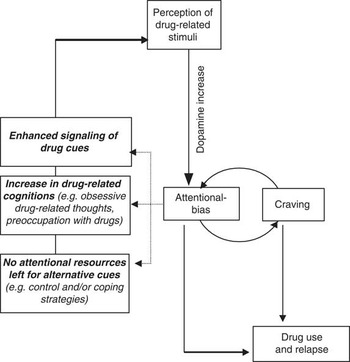
General models of addiction describe neuroadaptations and psychological changes that underlie the shift from recreational substance use to the loss of control over use that is arguably the defining feature of substance use disorders.4 For example, sensitization of dopamine function may occur in subcortical structures that govern reward and associative learning, resulting in strong cravings and an increase in the incentive-motivational “pull” of substance-related cues, such as the sight and smell of alcoholic drinks.Reference Robinson and Berridge5 In addition, hypoactivity in distinct subregions of the prefrontal cortex results in reduced inhibition of subcortical structures, which manifests as executive dysfunction and loss of control over behavior.Reference Goldstein and Volkow6 Cognitive models of addiction make predictions that can be overlaid on these neurobiological models. For example, dual-process modelsReference Stacy and Wiers7 posit that repeated substance use leads to an increase in automatic appetitive processing of substance cues, including attentional biases and automatic approach behavior directed toward those cues, combined with suppression of cognitive control processes that ordinarily mitigate the impact of automatic processes on behavior. Finally, a hybrid neurobiological–cognitive modelReference Franken3 proposes that “a drug stimulus produces an increase in dopamine levels in the corticostriatal circuit … which in turn serves to draw the subject's attention toward a perceived drug stimulus. This process results in motor preparation and a hyper-attentive state towards drug-related stimuli that, ultimately, promotes further craving and relapse” (p. 563). A schematic overview of this model is shown in Figure 1.
Schematic illustrating the activation of attentional bias and its possible relationship with craving, drug use, and relapse. A drug-related cue is perceived and evokes an increase in dopaminergic activity in subcortical structures, causing it to be flagged as “salient,” and thereby grabbing the attention. The individual then ruminates on drug use, is unable to engage coping mechanisms, finds it difficult to disengage from the cue, and experiences an increase in craving. This causes further increases in craving, creating a vicious cycle that may ultimately result in relapse. Reproduced with permission from Franken (2003)(3).

When we combine these theoretical models, the following predictions emerge:
1. Attentional bias for substance-related cues is a characteristic of substance use disorders.
2. The bias is associated with the strength of craving at that moment in time.
3. Strong attentional bias increases the risk of relapse to substance use in those who are attempting to remain abstinent or to reduce their substance use.
These predictions will be evaluated in this article.
Measurement of Attentional Bias
Attentional bias for substance-related cues can be measured directly (for example, by monitoring eye movements), or it can be indirectly inferred with reaction time or other measures. Indirect measures of attentional bias, particularly the modified Stroop and visual probe tasks, are the most commonly used tasks in part because of their ease of administration. In the word version of the addiction Stroop task, participants are presented with words that are printed in different colors and they are required to name the ink color in which the words are printed while ignoring the semantic content of the words. Substance abusers, but not control subjects, are generally slower to name the color of substance-related words (eg, “pipe,” “crack”) compared to matched neutral words (eg, “desk,” “chair”), which is interpreted as involuntary automatic processing of the drug-related words.Reference Cox, Fadardi and Pothos8 In a typical visual probe task, a drug-related picture (eg, a pack of cigarettes) is presented alongside a matched neutral picture (eg, a pack of pens) on a computer screen for a short period (typically between 50 and 2000 milliseconds). The pictures are then removed from the display to be immediately replaced by a visual probe that appears on either the left or right of the screen, such that it appears either in the spatial location that had been occupied by the drug-related picture or on the opposite side of the screen. Participants are instructed to respond to this probe as quickly as possible: If they are consistently faster to respond to probes that replace drug pictures compared to neutral pictures, we assume that they were looking at the drug-related picture (ie, attentional bias). Studies using this task have generally revealed attentional bias for drug cues among those with tobacco, opiate, or cocaine dependence.Reference Field and Cox2 The picture in alcohol abusers is more complex: light drinkers show no bias, heavy drinkers who are not seeking treatment generally show attentional bias for alcohol cues, whereas alcohol-dependent patients who are receiving treatment may show overt attentional avoidance of alcohol cues.Reference Noël, Colmant and Van Der Linden9
In recent years, both of these tasks have been criticized owing to their poor internal reliability,Reference Ataya, Adams and Mullings10 and due to ambiguity about the attentional subprocesses that they measure.Reference Field and Cox2 These criticisms may not apply to more direct measurements of attentional bias, such as eye movement monitoring.Reference Field and Christiansen11 For example, direct measurement of participants’ eye movements while they complete a visual probe task reveals that substance abusers hold their gaze on substance-related cues for longer than on neutral cues, and this bias tends to be highly correlated with the reaction time index of attentional bias that is obtained from the task.Reference Mogg, Bradley, Field and De Houwer12 Although direct measurement of attentional biases using eye-tracking may be preferable to indirect measures due to the superior reliability and construct validity of eye-tracking, indirect measures may be preferred for practical purposes, including the high cost of eye-tracking equipment.
In addition to using reaction time tasks to measure attentional bias, investigators have recently studied the neural substrates of attentional bias using functional magnetic resonance imaging (fMRI) and electroencephalography (EEG) measures. Two specific electrophysiological indices of cognitive processing, the P300 and slow potential (SP) components of the event-related brain potential (ERP), are associated with the deployment of attentional resources to visual stimuli. A recent meta-analysisReference Littel, Euser, Munafò and Franken13 showed that the P300 and SP amplitudes in response to substance cues are typically larger in substance abusers than controls. In addition, some recent fMRI studies showed that activation in the anterior cingulate cortex,Reference Luijten, Veltman and den Brink14–Reference Vollstädt-Klein, Loeber and Richter18 dorsolateral prefrontal cortex,Reference Luijten, Veltman and Hester15, Reference Vollstädt-Klein, Loeber and Richter18, Reference Hester and Garavan19 insula,Reference Luijten, Veltman and den Brink14, Reference Janes, Pizzagalli and Richardt16, Reference Vollstädt-Klein, Loeber and Richter18 nucleus accumbens,Reference Nestor, McCabe, Jones, Clancy and Garavan17 and amygdalaReference Janes, Pizzagalli and Richardt16, Reference Vollstädt-Klein, Loeber and Richter18, Reference Janes, Pizzagalli and Richardt20 is associated with attentional bias for substance-relevant stimuli as compared to neutral stimuli. Therefore, these specific EEG and fMRI indices of brain activation could also be used as indirect measures of attentional bias.
Does Attentional Bias Predict Who Will Relapse?
In addition to the numerous studies that show cross-sectional associations between attentional bias and substance use, one study revealed that individual differences in attentional bias for alcohol cues predicted future drinking behavior in a sample of heavy drinkers who were not seeking treatment. In this study, participants in whom attentional bias was low at baseline showed larger reductions in drinking at 6-month follow-up compared to participants in whom attentional bias was high at baseline.Reference Cox, Pothos and Hosier21 Based on this, we might expect that attentional bias, assessed during or shortly after treatment for substance dependence, would be a useful predictor of the likelihood that patients could maintain abstinence in the long-term. Individuals with elevated attentional bias should be less likely to maintain abstinence in the long-term.
Some studies appear to support this prediction: Individual differences in drug Stroop interference assessed in the clinic predict the likelihood of remaining abstinent after discharge.Reference Janes, Pizzagalli and Richardt16, Reference Carpenter, Schreiber, Church and McDowell22–Reference Powell, Dawkins, West, Powell and Pickering26 However, several studies that used either the visual probe task or the modified Stroop (or both) failed to find this relationship between behavioral measures of attentional bias assessed in the clinic and subsequent relapse.Reference Waters, Shiffman, Bradley and Mogg27–Reference Marhe, Luitjen, van de Wetering, Smits and Franken29 The inconsistency may be partly attributable to variations in methods (eg, attentional bias measure used, duration of follow-up) and populations studied. For example, closer inspection of individual studies suggests that attentional bias may be a more robust predictor of relapse in the first few days after treatment, but at longer follow-up periods (typically, several months), this predictive relationship is more inconsistent. Overall, the evidence that attentional bias for drug cues assessed during treatment is a reliable predictor of subsequent relapse is equivocal, and more studies are needed before synthesizing this research in a systematic review.
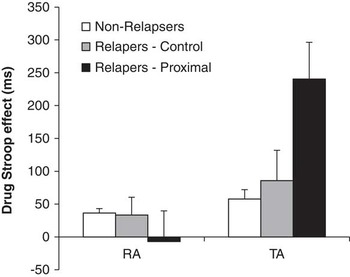
Some recent findings suggest a resolution to this issue. For example, a recent study showed that anterior cingulate cortex activation during performance of a cocaine Stroop task predicted cocaine use at 3 month follow-up, whereas behavioral performance on the cocaine Stroop task did not.Reference Marhe, Luitjen, van de Wetering, Smits and Franken29 This suggests that patterns of brain activity that are correlated with attentional bias may be more sensitive predictors of future drug use than behavioral measures of the bias. In addition, two recent studies measured attentional bias using experience sampling techniques, which involved participants completing a drug Stroop task on a handheld computer when prompted to do so at random intervals throughout the day, or when they experienced a temptation to use the drug. These studies revealed that attentional bias was elevated in the hours before participants reported being tempted to use heroin and cocaine,Reference Waters, Marhe and Franken30 and elevated attentional bias preceded relapse.Reference Marhe, Waters, van de Wetering and Franken31 See Figure 2. We await replication of these findings, but they suggest that attentional bias for drug cues may peak in the days before participants relapse, which would be consistent with the theoretical model depicted in Figure 1.Reference Franken3 On the other hand, when attentional bias is assessed in a treatment setting using only behavioral measures, this may not be a robust predictor of relapse to drug use several months later. We address this topic in the following section.
Attentional bias for drug cues assessed with a modified Stroop task administered on a handheld device to participants while they were in their first week of residential treatment. Participants completed the task at randomly prompted intervals (RAs) or when tempted to use the drug (TAs). Participants who relapsed versus those who did not were distinguished. During TAs (but not RAs), attentional bias was elevated in those who subsequently relapsed versus those who did not. Furthermore, there was a marked peak in attentional bias when assessed soon before participants relapsed (proximal assessment) compared to when assessed at other times (control assessment). Overall, this study shows that attentional bias is elevated in participants who relapse compared to participants who do not, and bias is particularly high in the days that precede a relapse. Reproduced with permission from Marhe etal. (2013)(31).

Attentional Bias Fluctuates with Motivational State
There is much debate about the conceptualization of subjective drug craving, its measurement, and its clinical significance.Reference Franken3, Reference Robinson and Berridge5 As predicted by FrankenReference Franken3 (see Figure 1), there is a small but robust association between the magnitude of attentional bias and the strength of subjective craving for the drug.Reference Field, Munafò and Franken32 Importantly, the magnitude of the correlation between the two increases when attention is measured directly (for example, with eye movements) rather than being indirectly inferred from reaction time measures (such as the drug Stroop task). Therefore, attentional bias seems to be associated with the strength of drug craving, but the two are not synonymous. Given that craving fluctuates within individuals over time,Reference Preston, Vahabzadeh and Schmittner33 we might expect attentional bias to do the same, and indeed the aforementioned experience sampling studies suggest a large degree of within-subject variation in the magnitude of attentional bias.Reference Waters, Marhe and Franken30, Reference Marhe, Waters, van de Wetering and Franken31 Experimental studies with heavy drinkers and tobacco smokers reveal that attentional biases are increased as a consequence of stress,Reference Field and Powell34 alcohol intoxication,Reference Schoenmakers, Wiers and Field35, Reference Fernie, Christiansen, Cole, Rose and Field36 withdrawal (from tobacco),Reference Field, Mogg and Bradley37 exposure to drug cues,Reference Field, Rush, Cole and Goudie38, Reference Cox, Yeates and Regan39 and having an imminent opportunity to consume the substance.Reference Field, Hogarth and Bleasdale40, Reference Jones, Hogarth and Christiansen41
Each of these factors (eg, stress, alcohol intoxication, opportunity) is known to increase the desire in the laboratory to consume the drug. Furthermore, self-report data from patients who relapsed indicate that these factors can be a trigger for relapse after a period of abstinence. Therefore, when considered alongside recent experience sampling studies,Reference Waters, Marhe and Franken30, Reference Marhe, Waters, van de Wetering and Franken31 attentional bias may peak during “high-risk” situations for relapse alongside increases in subjective craving. This may also clarify why we see mixed findings regarding the predictive validity of attentional bias when assessed in treatment contexts. In these contexts, most of these triggers are likely to be absent: Withdrawal symptoms are likely to be well managed (by pharmacotherapy), and there are no drug cues or opportunities to use the drug within the treatment facility. Furthermore, when patients are tested during or shortly after completing a treatment program, they are likely to view their drug use negatively, which may explain why alcoholic inpatients show attentional avoidance of alcohol cues in these circumstances.Reference Noël, Colmant and Van Der Linden9 Considering these observations, we would not predict any robust predictive relationship between attentional bias and relapse if attentional bias is assessed in a treatment context, but relapse occurs weeks or months later in very different contexts. We await experience sampling studies in naturalistic settings that can address these issues.
Treatment Implications
Attentional bias is a feature of substance use disorders, it fluctuates in line with motivational state, and it may peak in the days before people relapse to substance use after a period of abstinence. It is important to consider whether attentional bias could be a viable target for novel treatment interventions. In order to answer this question, we must first ask whether attentional bias has a causal influence on the risk of relapse or the strength of drug craving. A number of studies investigated this issue by first experimentally manipulating attentional bias for alcohol or tobacco cues in the laboratory, and then exploring the effects of these manipulations on subjective craving and drug-seeking behaviors that were measured immediately after the training. Despite some promising initial findings,Reference Field and Eastwood42 a series of studies have failed to demonstrate robust effects of attentional bias modification (ABM) on craving or drug-seeking assessed in the laboratory.Reference Field, Duka and Eastwood43–Reference McHugh, Murray, Hearon, Calkins and Otto46 However, these studies involved only a single session of ABM that was administered to college students who were not motivated to reduce their drinking or smoking behavior, which leaves open the possibility that ABM may be an effective treatment for substance abusers who are motivated to reduce their substance use, or abstain altogether. Two studies investigated the efficacy of multiple sessions of ABM in alcohol abusers. One studyReference Fadardi and Cox47 investigated a Stroop-based ABM procedure and reported that heavy drinkers who received it reported reductions in alcohol consumption at follow-up. However, the absence of a control group or any kind of mediation analysis in this study makes it impossible to rule out nonspecific effects as an explanation for the observed reduction in drinking. Another studyReference Schoenmakers, de Bruin and Lux48 administered a visual probe–based ABM procedure or a suitably matched control intervention to alcohol-dependent patients who were attempting to remain abstinent from alcohol. Groups did not differ on overall relapse rates at follow-up, although time-to-relapse was delayed in the group receiving ABM compared to the control group. However this was a small pilot study. A well-powered clinical trial (using a similar methodology) is required to obtain a more conclusive answer on the potential clinical effectiveness of ABM as a treatment intervention for substance use disorders. In this context, it is notable that ABM for threat-related information has shown some promise as an adjunct treatment for anxiety disorders.Reference MacLeod and Mathews49 One suggestion for future research is to investigate the effectiveness of ABM if delivered via handheld devices such as smartphones, so that patients can benefit from a brief session of ABM if they feel tempted to use the drug.Reference Waters, Marhe and Franken30
Conclusions
Attentional bias for drug-related cues is a reliable feature of substance use disorders. The bias fluctuates in line with motivational state: It is correlated with the strength of craving, and it increases in response to manipulations such as stress, withdrawal, and cue exposure, which are known to increase the risk of relapse to drug use after a period of abstinence. If we assess attentional bias in a treatment setting, it does not seem to be a reliable predictor of relapse several months later. However, moment-by-moment fluctuations in attentional bias are meaningful, because substance abusers are more likely to be tempted to use drugs, and to relapse, when attentional bias is high. At present, there is no convincing evidence to recommend the use of attentional bias modification as an adjunct treatment for substance use disorders, although larger trials and alternative methodologies are required to investigate this issue.
Disclosures
The authors do not have anything to disclose.