Introduction
Lithopanspermia is the transfer, between planets, of life in rocks ejected from the surface of planets following impact events (Melosh Reference Melosh2003; Wainwright Reference Wainwright2003). Since it is unlikely that large organisms could withstand the acceleration associated with such impact events, lithopanspermia is likely to be largely restricted to microorganisms. Assuming they survive the journey and arrival on the surface (Burchell et al. Reference Burchell, Mann, Bunch and Branao2001), such ejected microorganisms could then colonize new planets; the chance of surviving such a journey is likely to be increased by the protection (from lethal factors such as ultraviolet) provided by entrapment in rocks (Mileikowsky et al. Reference Mileikowsky, Cucinotto, Wilson, Gladman and Horneck2000).
An obvious prerequisite of the theory of lithopanspermia, when it applies to ejection of rocks from Earth, is that microorganisms should be present in terrestrial rocks (Geraci et al. Reference Geraci, Del Gaudio and Argenio2001). Although bacteria have recently been found deep in the Earth's crust (Sankaran Reference Sankaran1997), here we concentrate on determining if rocks close to the Earth's surface contain bacteria. Such materials were chosen because a) previous reports suggest that rocks contain microorganisms; and b) they are unlikely to be exposed to the high compression normally associated with impact events, which would kill the microorganisms found in rocks at greater depth (Melosh Reference Melosh2003).
The aim of the work reported here was to use a novel approach, which ensures sterility, to determine if amber, boulder clay and coal contain bacteria which could be ejected from Earth during impact events.
Materials and methods
Isolation of bacteria from amber
Twenty samples of Baltic amber, containing insect inclusions, were obtained from a variety of suppliers. The authenticity of the individual amber samples was confirmed by the ‘salt water test’, i.e. the ability to float in a saturated solution of sodium chloride (Ross Reference Ross1998), and by the fact that they emitted a pine resin odour when exposed to a hot wire or when scored with a serrated blade. The absence of surface cracks in the amber was confirmed using a hand lens and low-power microscope.
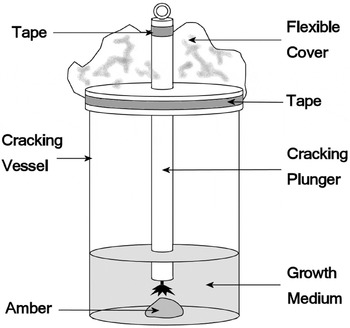
In order to release the inclusions into media, the amber was cracked open and broken into small pieces using the vessel shown in Fig. 1. This consisted of a thick glass-walled tissue homogenizing vessel (9 cm×2.5 cm; volume 30 ml), sealed with a metal cap. A plunger passed through the cap and touched the bottom of the vessel. The top of the cap was covered with part of an autoclave bag (using a corner cut from a large autoclave bag), attached and sealed closed using autoclave tape, attached to the cap and the top of the plunger. The sterilized amber was cracked in situ in the cracking vessel by placing the bottom of the plunger into a surface indentation and applying a sharp tap to the top of the plunger with a light-weight hammer (Fig. 1). The force cracked the amber to expose any fossilized insects inside. In order to facilitate cracking, a shallow central indentation was made in the surface of the amber and four shallow grooves (1 mm) were scored (with a serrated knife) from this indentation around the amber; further crushing of the amber was then achieved by manually applying force to the top of the plunger. Any leaks in the system were checked for by placing filter paper strips inside the autoclave bag cover prior to autoclaving. When a bacterium was isolated, after sample cracking, the whole cracking vessel was immersed into a solution of coloured (red) food dye. The absence, on the filter papers, of coloured food dye demonstrated that the system was leak-free; claims that bacteria were isolated from the cracked samples were only made if no leaks were observed.
The cracking vessel.

For the isolation of bacteria, nutrient broth (Oxoid, 10 ml) was added to the cracking vessel which was then autoclaved for 20 minutes at 120°C. The amber was immersed in domestic bleach (10% v/v) for 20 minutes and then transferred to a closed bottle containing sterile distilled water (500 ml) and washed vigorously. The amber was then removed and immersed in membrane-filtered (0.22 μm) alcohol and transferred to a flame, using flame-sterilized forceps; the residual alcohol was then ignited. The sterilized amber was finally transferred to the growth medium (10 ml) in the cracking vessel.
After inserting the sterile amber, the cracking vessel was left for four days at 25°C. All vessels in which bacteria grew in the medium were considered to be contaminated and therefore discarded. Where no bacterial growth appeared in the medium, the vessels were opened in a laminar air-flow cabinet and a small amount of medium was poured onto a nutrient agar (Oxoid) plate; this was then incubated at 25°C for a further four days. If no bacteria appeared on the nutrient agar, or in the nutrient broth, over this time period the amber was cracked in situ in the vessel. If, following this period of incubation, bacterial growth appeared in the nutrient broth the vessel was opened, the neck of the vessel was thoroughly flame sterilized and a small amount of broth was aseptically transferred to nutrient agar; this was then incubated at 25°C until growth appeared. Any bacterial isolates were then purified by streaking and were independently identified (NCIMB, Aberdeen) using 16SrRNA analysis. All transfers were performed in a laminar air-flow cabinet, the sterility of which was checked periodically.
Isolation of bacteria from coal and clay
Coal samples were obtained from six different mining locations in the UK. The following coals (percentage carbon contents given in brackets; Richards Reference Richards2002) were examined: Cortonwood (87.2), Cynheidre (95.2), Nadins (80.2), Thoreby (85.1), Tilmantone (92.4). The clay used was a sample of boulder clay obtained from Filey Brig, North Yorkshire.
In order to release the organisms from the geosamples into nutrient broth (Oxoid), the samples were cracked and broken into small pieces using the cracking vessel as described for the amber samples.
Results and discussion
Studies on the isolation of bacteria from Baltic amber
Twenty different pieces of Baltic amber, containing unidentified insect inclusions, were studied. No growth appeared in any of the medium prior to cracking, showing that the amber was adequately surface sterilized before being cracked, and that all bacterial isolates originated from within the amber. After cracking, bacterial growth occurred in the medium in only one case; the media in the other 19 vessels remained clear. Two bacteria were isolated from the vessel in which growth occurred; these were independently identified by 16SrRNA analysis as Bacillus amyoliquifaciens or B. atrophaeus (these bacteria are too closely related to separate) and B. cereus. Since the medium was checked for sterility prior to cracking, and the tube remained sealed throughout the experiment, we conclude that these bacteria originated from within the amber. The question of contamination naturally arises in studies such as these, where apparently ordinary, modern bacteria are isolated from ancient or extreme environments. The advantage of the approach used here is that the system contains an internal control, in that the amber is only cracked if the medium is seen to be uncontaminated; any bacterial growth following cracking of the sample must, as a result, have come from inside the amber.
Other workers have isolated bacteria from amber (Cano & Borucki Reference Cano and Borucki1995; Cano & Borucki Reference Cano and Borucki1997; Cano Reference Cano, Greenblatt and Spiegleman2003). Although no attempt was made here to demonstrate the antiquity of our isolates, others (by using genome analysis) have claimed that bacteria isolated from amber are millions of years old. Cano & Borucki (Reference Cano and Borucki1997) for example, reported the isolation of B. sphaericus (a species phylogenetically close to B. amyoliquifaceans); Greenblatt et al. (Reference Greenblatt, Davis, Clement, Kitts, Cox and Cano2000) have also isolated a wide range of bacteria from Dominica, and from 120 million-year-old amber from Israel. Although the authors of these studies discount the possibility of contamination, their work has nevertheless been criticized on this basis (Bechanbach Reference Bechanbach1995; Abbot Reference Abbot2001). It might be assumed that any microorganisms isolated from amber must be able to grow under anaerobic conditions. However, survival, rather than growth, under anoxic conditions is the essential requirement. Since both bacterial species isolated here are facultative anaerobes, survival in the anaerobic environment assumed to be present deep in amber should not present a problem, at least in relation to this possible limitation. It is irrelevant, in relation to studies on panspermia, whether or not the bacteria isolated here is millions of years old, or entered the amber at a later time; the fact that amber contains bacteria is the salient point.
Isolation of bacteria from coal and clay
The clay sample contained large numbers of bacteria, mainly species of Bacillus. A single bacterium (B. subtilis) was isolated from a coal sample (Nadin), which agrees with previous reports from the literature. Farrell & Turner (Reference Farrell and Turner1932) for example, found that anthracite coal contains a range of bacteria; Lipman (Reference Lipman1931) claimed that living bacteria could be isolated from coals, ancient rocks and meteorites. He maintained that the bacteria he found in coals had survived from the Carboniferous period, when the coal measures had been first laid down, a claim that was criticized by Burke & Wiley (Reference Burke and Wiley1937).
The finding of a bacterium in coals suggests that this rock could act as a vehicle for lithopanspermia. However, since coal is somewhat fragile (some types of course are very soft, while anthracite is harder) and is readily burned (for example during re-entry into a planet possessing an atmosphere), it follows that coals would have to be encased in a coating of a more resistant rock; such encased coals might then act a suitable vehicle for lithopanspermia, and the bacteria contained in such coals might then be released during impact or subsequent weathering. Although harder than coal, amber is also inflammable; it is often associated with blue clay, which may act as protective cover during lithopanspermic transfer.
The geosamples used here were selected because previous studies have shown that surface rocks contain bacteria (Myers & McCready Reference Myers and McCready1966). Of course, it could be argued, since early reports on the presence of microbes in rocks did not involve the use of cracking vessels such as the one used here (designed to ensure non-contamination), that such findings are the result of laboratory contamination. Geraci et al. (Reference Geraci, Del Gaudio and Argenio2001) also found bacteria in meteorites and a variety of rocks, including limestone; although their techniques appear to have been sound, they did not use the closed cracking bottle approach used here and their work has been criticized (perhaps unfairly) on the basis of contamination.
Earlier reports on the bacteriology of coal and amber make the claim that the organisms that were isolated were ancient, having entered the amber at the time of its formation. Critics of this view could obviously claim that the bacteria isolated from amber and coal, in the studies reported here, are modern organisms, a possibility that is difficult to either substantiate or refute. The antiquity or otherwise of the organisms isolated here is not, however, central to our studies, which are directed towards determining if amber and coal contain viable bacteria which could act as the seeds involved in impact panspermia; the question of whether or not these bacteria are ancient or modern is of obvious interest, but it is not central to our main argument.