Introduction
Conventionally defined as non-localizing abnormalities without diagnostic specificity, neurological soft signs (NSS) involve observable defects in sensory integration, motor coordination and primitive reflexes in patients without neurological disorder (Dazzan & Murray, Reference Dazzan and Murray2002). NSS have been described in several psychiatric disorders such as schizophrenia (Whitty et al. Reference Whitty, Owoeye and Waddington2009; Chan et al. Reference Chan, Xu, Heinrichs, Yu and Wang2010b), bipolar disorder (Negash et al. Reference Negash, Kebede, Alem, Melaku, Deyessa, Shibire, Fekadu, Fekadu, Jacobsson and Kullgren2004; Whitty et al. Reference Whitty, Clarke, McTigue, Browne, Gervin, Kamali, Lane, Kinsella, Waddington, Larkin and O'Callaghan2006), substance misuse (Keenan et al. Reference Keenan, O'Donnell, Sinanan and O'Callaghan1997; Drvaux et al. 2010), antisocial personality disorder (Lindberg et al. Reference Lindberg, Tani, Stenberg, Appelberg, Porkka-Heiskanen and Virkkunen2004) and post-traumatic stress disorder (Gurvits et al. Reference Gurvits, Gilbertson, Lasko, Orr and Pitman1997).
In obsessive-compulsive disorder (OCD), a number of studies have explored NSS but the results have been relatively inconsistent. Some studies found a higher prevalence of NSS in OCD patients than in healthy controls (Conde López et al. Reference Conde López, de la Gándara Martin, Blanco Lozano, Cerezo Rodriguez, Martinez Roig and de Dios Francos1990; Hollander et al. Reference Hollander, Schiffman, Cohen, Rivera-Stein, Rosen, Gorman, Fyer, Papp and Liebowitz1990; Bihari et al. Reference Bihari, Pato, Hill and Murphy1991; Hymas et al. Reference Hymas, Lees, Bolton, Epps and Head1991; Nickoloff et al. Reference Nickoloff, Radant, Reichler and Hommer1991; Mataix-Cols et al. Reference Mataix-Cols, Alonso, Hernández, Deckersbach, Savage, Manuel Menchón and Vallejo2003; Guz & Aygun, Reference Guz and Aygun2004; Sevincok et al. Reference Sevincok, Akoglu and Arslantas2006; Salama et al. Reference Salama, Saad Allah and Mohamed2008), including impaired motor coordination (Hollander et al. Reference Hollander, Schiffman, Cohen, Rivera-Stein, Rosen, Gorman, Fyer, Papp and Liebowitz1990; Hymas et al. Reference Hymas, Lees, Bolton, Epps and Head1991; Bolton et al. Reference Bolton, Gibb, Lees, Raven, Gray, Chen and Shafran1998; Mataix-Cols et al. Reference Mataix-Cols, Alonso, Hernández, Deckersbach, Savage, Manuel Menchón and Vallejo2003), involuntary movements (Hollander et al. Reference Hollander, Schiffman, Cohen, Rivera-Stein, Rosen, Gorman, Fyer, Papp and Liebowitz1990; Bihari et al. Reference Bihari, Pato, Hill and Murphy1991), sensory integration abnormalities (Bolton et al. Reference Bolton, Gibb, Lees, Raven, Gray, Chen and Shafran1998; Mataix-Cols et al. Reference Mataix-Cols, Alonso, Hernández, Deckersbach, Savage, Manuel Menchón and Vallejo2003; Sevincok et al. Reference Sevincok, Akoglu and Arslantas2006) and presence of primitive reflexes (Bolton et al. Reference Bolton, Gibb, Lees, Raven, Gray, Chen and Shafran1998). However, other studies did not find any differences between OCD patients and controls in either total NSS scores (Stein et al. Reference Stein, Hollander, Simeon, Cohen, Islam and Aronowitz1994; Jaafari et al. Reference Jaafari, Baup, Bourdel, Olié, Rotge, Wassouf, Sharov, Millet and Krebs2011), or in specific NSS subdomains such as motor coordination (Stein et al. Reference Stein, Hollander, Simeon, Cohen, Islam and Aronowitz1994; Guz & Aygun, Reference Guz and Aygun2004; Sevincok et al. Reference Sevincok, Akoglu and Arslantas2006; Poyurovsky et al. Reference Poyurovsky, Faragian, Pashinian, Levi, Viosburd, Stryjer, Weizman, Fuchs and Weizman2007), sensory integration (Hollander et al. Reference Hollander, Schiffman, Cohen, Rivera-Stein, Rosen, Gorman, Fyer, Papp and Liebowitz1990; Stein et al. Reference Stein, Hollander, Simeon, Cohen, Islam and Aronowitz1994; Poyurovsky et al. Reference Poyurovsky, Faragian, Pashinian, Levi, Viosburd, Stryjer, Weizman, Fuchs and Weizman2007), involuntary movements (Stein et al. Reference Stein, Hollander, Simeon, Cohen, Islam and Aronowitz1994) or primitive reflexes (Mataix-Cols et al. Reference Mataix-Cols, Alonso, Hernández, Deckersbach, Savage, Manuel Menchón and Vallejo2003).
Detailed examination of these studies indicates that they are often characterized by relatively small sample sizes and various potential sources of heterogeneity. For example, in some studies patients were on medication (Bihari et al. Reference Bihari, Pato, Hill and Murphy1991; Hymas et al. Reference Hymas, Lees, Bolton, Epps and Head1991; Nickoloff et al. Reference Nickoloff, Radant, Reichler and Hommer1991; Bolton et al. Reference Bolton, Gibb, Lees, Raven, Gray, Chen and Shafran1998; Mataix-Cols et al. Reference Mataix-Cols, Alonso, Hernández, Deckersbach, Savage, Manuel Menchón and Vallejo2003; Guz & Aygun, Reference Guz and Aygun2004; Poyurovsky et al. Reference Poyurovsky, Faragian, Pashinian, Levi, Viosburd, Stryjer, Weizman, Fuchs and Weizman2007; Jaafari et al. Reference Jaafari, Baup, Bourdel, Olié, Rotge, Wassouf, Sharov, Millet and Krebs2011) whereas other studies recruited unmedicated patients (Hollander et al. Reference Hollander, Schiffman, Cohen, Rivera-Stein, Rosen, Gorman, Fyer, Papp and Liebowitz1990; Stein et al. Reference Stein, Hollander, Simeon, Cohen, Islam and Aronowitz1994; Sevincok et al. Reference Sevincok, Akoglu and Arslantas2006). Another source of heterogeneity is the use of different standardized instruments to measure NSS, with some studies employing clinical examinations rather than standardized instruments (e.g. Hymas et al. Reference Hymas, Lees, Bolton, Epps and Head1991; Caramelli et al. Reference Caramelli, de Lima, Stip and Bacheschi1996), thus making comparisons difficult.
Given the relative inconsistency of previous studies and the multiple sources of heterogeneity, the current study aimed to provide a more clear answer to the question of whether OCD patients are characterized by increased NSS compared with matched controls. This is clinically relevant in the light of emerging evidence that the presence of NSS in OCD may differentially predict treatment response to selective serotonin reuptake inhibitors (SSRIs) (Hollander et al. Reference Hollander, Kaplan, Schmeidler, Yang, Li, Koran and Barbato2005; Mergl et al. Reference Mergl, Mavrogiorgou, Juckel, Zaudig and Hegerl2005) but not cognitive behaviour therapy (Bolton et al. Reference Bolton, Raven, Madronal-Luque and Marks2000). To this end, we conducted two empirical studies across two specialist European centres using the same standardized instrument. We next conducted exhaustive literature searches and performed a meta-analysis of all existing NSS studies in OCD. We predicted higher NSS scores in patients compared with controls in the empirical studies and robust effect sizes in the same direction in the meta-analysis. Finally, we employed meta-regression methods to examine the potential moderating role of symptom severity, medication use, age of onset, illness duration and other variables of interest.
Method
Empirical studies
Two parallel studies were conducted in the UK and Spain. The UK sample consisted of 74 individuals (35 with OCD and 39 controls) and the Spanish sample of 99 individuals (50 with OCD and 49 controls). In both samples, trained raters administered the Cambridge Neurological Inventory (CNI; Chen et al. Reference Chen, Shapleske, Luque, McKenna, Hodges, Calloway, Hymas, Dening and Berrios1995). A complete description of the participants, materials and methods can be found in the online Supplementary Material.
Meta-analysis
Data sources and study selection
A three-stage strategy was implemented to identify studies suitable for inclusion in the meta-analysis. First, we conducted a systematic search of the databases Medline, PsycINFO, PsychARTICLES, EMBASE, SCOPUS and Google Scholar using the search terms ‘neurological soft signs’, ‘neurological signs’, ‘soft signs’, ‘neurological abnormalit*’, ‘motor coordination’, ‘sensory integration’, ‘complex motor sequencing’, ‘Luria task’, or ‘fist-edge-palm’ with ‘OCD’ or ‘obsessive compulsive disorder’. Second, we asked experts in the field to identify missing and unreported studies. Third, we conducted manual searches of reference lists of empirical studies and review articles. The inclusion criteria specified that the article must have included a control group and that the results must have been reported with sufficient detail for an effect size to be calculated.
Data extraction and synthesis
For each of the selected studies, two authors independently extracted the sample size of each group, the mean and standard deviation of the NSS scores, and the scores of the NSS subscales and the right and left NSS where available. Where possible, we also extracted information for a number of study characteristics. These variables were identified as potential sources of heterogeneity and were collected to be used as covariates in a meta-regression analysis.
Disagreement between the two authors concerning the extracted data was resolved via discussion until a consensus was reached. Any uncertainty regarding the extraction of data from a particular study was resolved via contact with the study authors.
Total NSS scores were not reported by Bolton et al. (Reference Bolton, Gibb, Lees, Raven, Gray, Chen and Shafran1998) and Poyurovsky et al. (Reference Poyurovsky, Faragian, Pashinian, Levi, Viosburd, Stryjer, Weizman, Fuchs and Weizman2007), so for these studies the NSS total score was calculated by summing the scores of the relevant subscales.
Standard deviations of the total NSS scores were not reported in three papers (Hollander et al. Reference Hollander, Schiffman, Cohen, Rivera-Stein, Rosen, Gorman, Fyer, Papp and Liebowitz1990; Bolton et al. Reference Bolton, Gibb, Lees, Raven, Gray, Chen and Shafran1998; Poyurovsky et al. Reference Poyurovsky, Faragian, Pashinian, Levi, Viosburd, Stryjer, Weizman, Fuchs and Weizman2007) and had to be indirectly obtained. In one study (Hollander et al. Reference Hollander, Schiffman, Cohen, Rivera-Stein, Rosen, Gorman, Fyer, Papp and Liebowitz1990), these could be calculated from the histograms plotted in the paper. In another study (Bolton et al. Reference Bolton, Gibb, Lees, Raven, Gray, Chen and Shafran1998), standard deviations could be estimated from the subscores using a basic property of the variance, namely:
 $$\sigma _{A \plus B} \equals \sqrt{ {\sigma _{A}^{\setnum{2}} \plus \sigma _{B}^{\setnum{2}} \plus 2\sigma _{A} \sigma _{B} \rho _{A\comma B} }}\hskip3pt\comma$$
where σA and σA are the standard deviations of two subscores and ρA,B is the correlation between them – as reported in the original validation study of the CNI (Chen et al. Reference Chen, Shapleske, Luque, McKenna, Hodges, Calloway, Hymas, Dening and Berrios1995). Finally, a similar method was used for the data in Poyurovsky et al. (Reference Poyurovsky, Faragian, Pashinian, Levi, Viosburd, Stryjer, Weizman, Fuchs and Weizman2007), though in this case the set of correlations reported in the original validation study of the Neurological Evaluation Scale (NES; Buchanan & Heinrichs, Reference Buchanan and Heinrichs1989) led to a quadratic equation with two close roots for patients (1.47 and 2.24) and none for controls. In order to apply the same estimations for patients and controls we considered the discriminant of the equation to be null – i.e. equivalent to using the mean of the two estimated standard deviations in patients (1.86) and the optimal standard deviation in controls (1.54).
Data analysis
Meta-analyses were conducted using Stata, version 11 (StataCorp LP, USA). Hedges' g was calculated for all measures; this method estimates the effect size as the standardized difference between group means, corrected for small sample size bias (Hunter & Schmidt, Reference Hunter and Schmidt2000). A random-effects model was implemented, which estimates an error term for between-study variance based on the assumption that effect size magnitude varies between studies; this method is a conservative effect size estimate, provides more accurate estimates for confidence intervals (CIs) and substantially reduces the possibility of type I error (Hunter & Schmidt, Reference Hunter and Schmidt2000; Field, Reference Field, Miles and Gilbert2005).
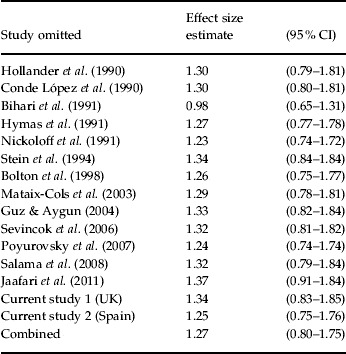
Next, a meta-influence analysis was conducted. The meta-influence analysis is a form of sensitivity analysis that allows examination of the possible influence of individual studies on the overall meta-analysis summary estimate. Using this method, an average effect size is calculated while leaving out one study at a time from the set of studies available for the meta-analysis.
In order to examine publication bias, we created a funnel plot and conducted Egger's test of publication bias (Egger et al. Reference Egger, Smith, Schneider and Minder1997) for each measure. If there is no evidence of publication bias, the individual studies should be symmetrically distributed within the funnel of the plot and Egger's test should be non-significant.
Heterogeneity was investigated using a meta-regression analysis, which examines potential moderators of the effect size (Higgins & Thompson, Reference Higgins and Thompson2002). A lack of moderator effect suggests that the moderator in question does not affect the average effect size estimate. We computed the χ2 statistic Q and the I 2 statistic in order to assess the homogeneity of effect sizes. Moderator analyses were conducted using random-effects meta-regression analyses with the study characteristics as covariates using the metan and metareg commands in Stata, version 11. Because of the increased risk of type I error when making multiple comparisons, we used a permutation tests approach (using 1000 Monte Carlo simulations) to calculate p values (Higgins & Thompson, Reference Higgins and Thompson2004).
Results
Empirical studies
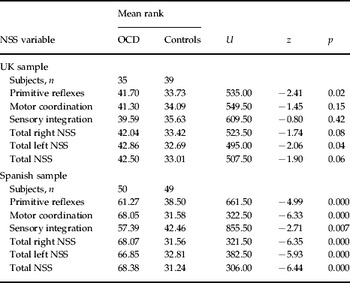
Compared with healthy controls, patients with OCD had elevated scores on most NSS subscales, particularly in the Spanish sample (Table 1). A detailed description of the results can be found in the Supplementary Material.
Mann–Whitney U tests scores showing group differences in NSS between OCD and control groups in the UK and Spanish samples

NSS, Neurological soft signs; OCD, obsessive-compulsive disorder.
Meta-analysis
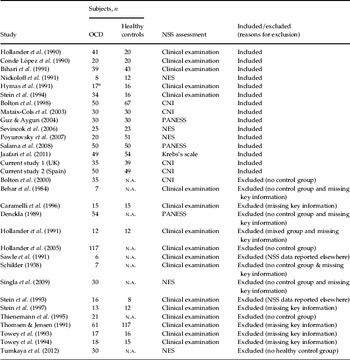
Our search strategy yielded 32 studies for potential inclusion. Of these, 15 met our inclusion criteria. Table 2 lists the included/excluded studies and reasons for exclusion.
Summary of the included and excluded studies in the meta-analysis

OCD, Obsessive-compulsive disorder; NSS, neurological soft signs; NES, Neurological Evaluation Scale; CNI, Cambridge Neurological Inventory; PANESS, Physical and Neurological Examination for Soft Signs; n.a., not applicable.
a All patients in this study were specifically selected and displayed obsessional slowness.
The combined number of participants in these studies was 1018 (498 OCD and 520 control participants). One of the studies included in the meta-analysis (Stein et al. Reference Stein, Hollander, Simeon, Cohen, Islam and Aronowitz1994) comprised 34 OCD subjects and 16 healthy controls, of which 16 OCD and eight control participants had been already reported in another of the included studies (Hollander et al. Reference Hollander, Schiffman, Cohen, Rivera-Stein, Rosen, Gorman, Fyer, Papp and Liebowitz1990). The analysis of the influence described in the methods controlled for this circumstance.
The combined sample characteristics were calculated taking into account the sample size and variances of each study. The combined sample consisted of individuals in their 30s (OCD: mean age=33.5 years, s.d.=9.7 years, range 28.5–36.9 years; controls: mean age=33.6 years, s.d.=10.2 years, range 29.6–38.2 years; 14 studies), with a similar gender distribution in both groups (OCD: mean percentage of females=52%; controls: mean percentage of females=45%; 14 studies), and similar years of education (OCD: mean=12.8 years, s.d.=3.9 years; controls: mean=13.7 years, s.d.=3.6 years; seven studies).
For the OCD participants, the severity of the disorder, measured with the Yale–Brown Obsessive Compulsive Scale (YBOCS), was in the moderate range (mean=23.7, s.d.=7.5, range 17.9–28.5; 10 studies). The duration of the illness ranged from 1 to 21 years (mean=12.1 years, s.d.=10.3 years; eight studies). The mean age of onset of the illness was 18.1 years (s.d.=7.5 years; five studies).
Study characteristics
Studies varied in terms of sample size (OCD: mean=33.2, s.d.=13.4, range 8–50 participants; controls: mean=34.7, s.d.=16.9, range 12–67 participants). Most of the studies were conducted in Europe (66.7%), 26.7% in the USA, and one in North Africa (6.7%).
Most studies employed structured NSS batteries. Of the included studies, 26.7% used the CNI (Bolton et al. Reference Bolton, Gibb, Lees, Raven, Gray, Chen and Shafran1998; Mataix-Cols et al. Reference Mataix-Cols, Alonso, Hernández, Deckersbach, Savage, Manuel Menchón and Vallejo2003; current studies), 20% used the NES (Nickoloff et al. Reference Nickoloff, Radant, Reichler and Hommer1991; Senincok et al. 2006; Poyurovsky et al. Reference Poyurovsky, Faragian, Pashinian, Levi, Viosburd, Stryjer, Weizman, Fuchs and Weizman2007) and 20% used other validated batteries [two studies used the Physical and Neurological Examination for Soft Signs (PANESS): Guz & Aygun, Reference Guz and Aygun2004; Salama et al. Reference Salama, Saad Allah and Mohamed2008; and one study used Krebs's scale: Jaafari et al. Reference Jaafari, Baup, Bourdel, Olié, Rotge, Wassouf, Sharov, Millet and Krebs2011]. Of the included studies, five studies (35.7%) used a NSS clinical examination (Conde López et al. Reference Conde López, de la Gándara Martin, Blanco Lozano, Cerezo Rodriguez, Martinez Roig and de Dios Francos1990; Hollander et al. Reference Hollander, Schiffman, Cohen, Rivera-Stein, Rosen, Gorman, Fyer, Papp and Liebowitz1990; Bihari et al. Reference Bihari, Pato, Hill and Murphy1991; Hymas et al. Reference Hymas, Lees, Bolton, Epps and Head1991; Stein et al. Reference Stein, Hollander, Simeon, Cohen, Islam and Aronowitz1994).
Only one of the included studies employed raters who were blind to the participants' patient or control status (Hollander et al. Reference Hollander, Schiffman, Cohen, Rivera-Stein, Rosen, Gorman, Fyer, Papp and Liebowitz1990).
Publication bias
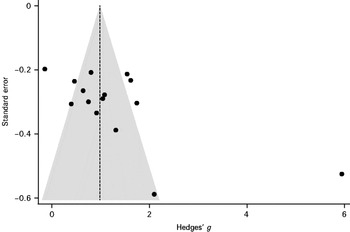
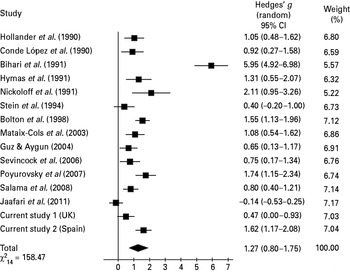
Examination of the funnel plot (Fig. 1) showed that the majority of studies were grouped symmetrically around the mean effect size (with the exception of the outlier on the right-hand side of the plot; Bihari et al. Reference Bihari, Pato, Hill and Murphy1991), suggesting no evidence of publication bias. Egger's test was significant (7.2, s.e.=2.8, p<0.05) but removal of the outlier study (Bihari et al. Reference Bihari, Pato, Hill and Murphy1991) from the analysis resulted in a non-significant Egger's test (3.3, s.e.=2.5; p>0.05) in line with the original appraisal of the funnel plot.
Funnel plot for the meta-analysis of total neurological soft signs score in obsessive-compulsive disorder patients versus healthy controls.

Effect sizes
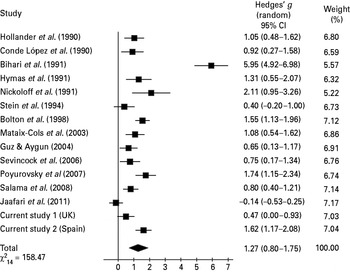
The effect size calculated for the total NSS was large at 1.27 [Q=158.5, degrees of freedom (df)=14, p<0.001; 15 studies] (Fig. 2). A total of five studies reported data for total left and total right NSS. The effect sizes calculated for both left and right NSS were large at 0.72 (Q=21.2, df=4, p<0.001) and 0.68 (Q=24.3, df=4, p<0.001), respectively. Where available, scores for the NSS subscales were also obtained. Effect sizes for the different subscales were large with an effect size of 0.81 (Q=6.9, df=3, p<0.075, n=4) for primitive reflexes, 0.67 (Q=33.2, df=7, p<0.000, n=8) for sensory integration and 0.61 (Q=104.3, df=8, p<0.000, n=10) for motor coordination (see Supplementary Material, Figs S1–S5).
Forest plot for total neurological soft signs score in obsessive-compulsive disorder patients versus healthy controls. CI, Confidence interval.
The sensitivity analysis that excluded each study at the time (influence analysis) indicated that none of the individual studies exerted particular influence on the average effect size (Table 3).
Results of the influence analysis in which the effect sizes are re-estimated omitting one study at the time

CI, Confidence interval.
Meta-regression analysis
For total NSS scores, variation in effect size that was attributable to heterogeneity was high (I 2=91.2%). Meta-regression analyses were therefore conducted in order to investigate possible sources of heterogeneity and their influence on NSS total findings. The potential moderator variables examined in reference to the study characteristics were the year of publication, the instrument used for the assessment of the NSS, and the continent where the study was done. The putative patient characteristic moderators also studied were gender, handedness, years of education, intelligence quotient (IQ), age of illness onset, duration of the illness, medication use, OCD severity and presence of depressive symptoms.
Of the potential moderator variables examined, none reached statistical significance, including YBOCS score (Supplementary Material, Fig. S6). However, there was a trend towards significance for year of publication (β=–0.60, p=0.15), such that the more recently a study was published the smaller its effect size but this was probably due to the effect of an outlier (Bihari et al. Reference Bihari, Pato, Hill and Murphy1991) (Supplementary Material, Fig. S7). A trend-level relationship was also found for the NSS instrument used (β=–0.42, p=0.13), such that studies that used a clinical examination yielded larger effect sizes followed by studies that used the NES battery, the CNI, and finally the PANESS (Supplementary Material, Fig. S8). However, this may be explained by the unusually large effect sizes reported by Bihari et al. (Reference Bihari, Pato, Hill and Murphy1991).
Discussion
This study examined the presence of NSS in two large European samples of OCD patients and conducted a meta-analysis of all published studies identified in the literature with the aim to provide a more definitive answer to the question of whether OCD patients are characterized by increased NSS compared with matched controls. Both empirical studies found elevated NSS scores in patients compared with matched controls, although the Spanish sample yielded more clearly significant results. The results of the meta-analysis revealed large effect sizes in the expected direction. The results were robust and remained largely unchanged in our reliability analyses, which controlled for possible outliers.
The results confirm the initial findings of Hollander et al. (Reference Hollander, Schiffman, Cohen, Rivera-Stein, Rosen, Gorman, Fyer, Papp and Liebowitz1990) and Conde López et al. (Reference Conde López, de la Gándara Martin, Blanco Lozano, Cerezo Rodriguez, Martinez Roig and de Dios Francos1990) and clarify some of the previous inconsistencies in the literature, such as the specific types of NSS that are implicated in OCD; our results confirm that patients have higher rates of NSS in the domains of motor coordination, sensory integration and primitive reflexes. The results further indicate that both sides of the body are implicated in OCD, although only five studies provided laterality information. Some previous studies had suggested a slight predominance of left-sided NSS in OCD (e.g. Hollander et al. Reference Hollander, Schiffman, Cohen, Rivera-Stein, Rosen, Gorman, Fyer, Papp and Liebowitz1990; Mataix-Cols et al. Reference Mataix-Cols, Alonso, Hernández, Deckersbach, Savage, Manuel Menchón and Vallejo2003) but both the empirical studies and the meta-analysis showed robust bilateral differences between patients and controls.
The results echo other complementary lines of research, such as kinematic analyses of handwriting and facial movements (Mavrogiorgou et al. Reference Mavrogiorgou, Mergl, Tigges, El Husseini, Schröter, Juckel, Zaudig and Hegerl2001; Mergl et al. Reference Mergl, Vogel, Mavrogiorgou, Göbel, Zaudig, Hegerl and Juckel2003) and performance on oculo-motor tasks (Jaafari et al. Reference Jaafari, Baup, Bourdel, Olié, Rotge, Wassouf, Sharov, Millet and Krebs2011). Together, these findings help reconcile previous inconsistencies in the literature, which may have been caused by small heterogeneous samples, and suggest subtle central nervous system alterations in OCD which are broadly consistent with current neurobiological models of the disorder (e.g. Saxena & Rauch, Reference Saxena and Rauch2000). However, alternative explanations are also possible (see below).
Of the two empirical studies, the Spanish sample yielded larger effect sizes and tighter CIs. These discrepancies may be due to differences in the patient or control characteristics, the smaller sample size or increased variability in the UK sample, or a combination of these factors. Also, the scoring of the CNI was slightly different in the two studies, with the Spanish study adding an additional ‘subthreshold’ option. However, the influence analyses clearly indicated that the overall results of the meta-analysis were largely unaffected by the contribution of any of the individual studies.
Whereas the Spanish study found a significant association between NSS scores and OCD severity (YBOCS scores), the UK study did not (see Supplementary Material). The previous literature is also mixed in this regard. While some studies found significant associations between NSS and YBOCS scores (e.g. Hollander et al. Reference Hollander, Schiffman, Cohen, Rivera-Stein, Rosen, Gorman, Fyer, Papp and Liebowitz1990; Bolton et al. Reference Bolton, Raven, Madronal-Luque and Marks2000; Salama et al. Reference Salama, Saad Allah and Mohamed2008), others did not (e.g. Stein et al. Reference Stein, Hollander, Simeon, Cohen, Islam and Aronowitz1994, Reference Stein, Coetzer, Lee, Davids and Bouwer1997; Sevincok et al. Reference Sevincok, Akoglu and Arslantas2006; Jaafari et al. Reference Jaafari, Baup, Bourdel, Olié, Rotge, Wassouf, Sharov, Millet and Krebs2011; Karadag et al. Reference Karadag, Tumkaya, Kırtaş, Efe, Alacam and Oguzhanoglu2011). Similarly, our meta-regression analysis also failed to confirm a significant association with symptom severity. This negative finding may be due to the relatively small variability in YBOCS scores across studies. Alternatively, NSS may be unrelated to fluctuations in OCD symptom severity and, rather, represent a trait marker of the disorder. As reviewed in the introduction, NSS are observed in multiple mental disorders, not just OCD. Thus, NSS may be non-specific markers of psychopathology in general. This raises the question of whether NSS may also be present in first-degree relatives of OCD patients and thus represent useful endophenotypes for OCD research, as has been suggested in schizophrenia (Chan et al. Reference Chan, Xu, Heinrichs, Yu and Gong2010a). Examination of NSS in unaffected first-degree relatives of OCD patients would be a worthwhile avenue for future research.
Interestingly, in both empirical studies, NSS scores significantly correlated with the severity of depressive symptoms (see Supplementary Material). Unfortunately, we did not have sufficient data to conduct a meta-regression analysis to confirm these findings. If confirmed, one parsimonious interpretation may be that low mood interferes with appropriate performance on the NSS tasks, rather than represent a marker of central nervous system dysfunction. Alternatively, NSS may be associated with an increased risk and severity of psychiatric symptoms in general, including depression, although the current design does not allow us to examine the direction of such findings. In any case, comparison of OCD patients with and without co-morbid depression is needed in order to further clarify this issue (in the current study, only seven patients in each of the empirical samples met diagnostic criteria for major depression and thus meaningful comparisons were not possible).
Years of education were significantly (negatively) correlated with NSS in both empirical studies (see Supplementary Material) but this variable could not be examined in the meta-regression due to the lack of sufficient data. The design of the current study does not permit causal interpretations but it is possible that individuals with subtle neurological deficits represent a particularly impaired subgroup of OCD patients, characterized by learning difficulties and cognitive impairment. For example, Hertzig (Reference Hertzig1981) found that children with soft signs were significantly more likely to have received special education and to have been referred for psychiatric consultation than were neurologically normal children. This is also consistent with a body of evidence that links increased NSS with poorer neuropsychological performance in OCD (Hollander et al. Reference Hollander, Schiffman, Cohen, Rivera-Stein, Rosen, Gorman, Fyer, Papp and Liebowitz1990; Bolton et al. Reference Bolton, Raven, Madronal-Luque and Marks2000; Mataix-Cols et al. Reference Mataix-Cols, Alonso, Hernández, Deckersbach, Savage, Manuel Menchón and Vallejo2003) and other psychiatric disorders (e.g. Flashman et al. Reference Flashman, Flaum, Gupta and Andreasen1996; Arango et al. Reference Arango, Bartko, Gold and Buchanan1999). Nevertheless, the alternative interpretation (i.e. that poorer educational attainment is responsible for the impaired NSS performance in OCD) cannot be fully ruled out at this stage.
None of the other potentially moderating variables we examined (i.e. gender, handedness, IQ, age of illness onset, duration of the illness, or medication use) was significantly associated with NSS in OCD. Regarding the lack of medication effects, the results are consistent with several studies that found no influence of medication on NSS in OCD (Bihari et al. Reference Bihari, Pato, Hill and Murphy1991; Hymas et al. Reference Hymas, Lees, Bolton, Epps and Head1991; Thienemann & Koran, Reference Thienemann and Koran1995; Caramelli et al. Reference Caramelli, de Lima, Stip and Bacheschi1996; Bolton et al. Reference Bolton, Gibb, Lees, Raven, Gray, Chen and Shafran1998; Guz & Aygun, Reference Guz and Aygun2004; Poyurovsky et al. Reference Poyurovsky, Faragian, Pashinian, Levi, Viosburd, Stryjer, Weizman, Fuchs and Weizman2007; Salama et al. Reference Salama, Saad Allah and Mohamed2008; Jaafari et al. Reference Jaafari, Baup, Bourdel, Olié, Rotge, Wassouf, Sharov, Millet and Krebs2011; Karadag et al. Reference Karadag, Tumkaya, Kırtaş, Efe, Alacam and Oguzhanoglu2011), or in other disorders such as schizophrenia (Heinrichs & Buchanan, Reference Heinrichs and Buchanan1988; Chan et al. Reference Chan, Xu, Heinrichs, Yu and Wang2010b) or bipolar disorder (Cherian & Kuruvilla, Reference Cherian and Kuruvilla1989; Noroozian et al. Reference Noroozian, Amini, Faridhosseini, Irandoost and Saghaie2009). Perhaps antipsychotics may have more clearly moderating effects on NSS, but only four studies included in this meta-analysis contained a small proportion of patients who were prescribed low doses of antipsychotics as an augmentation strategy (Hymas et al. Reference Hymas, Lees, Bolton, Epps and Head1991; Poyurovsky et al. Reference Poyurovsky, Faragian, Pashinian, Levi, Viosburd, Stryjer, Weizman, Fuchs and Weizman2007; Jaafari et al. Reference Jaafari, Baup, Bourdel, Olié, Rotge, Wassouf, Sharov, Millet and Krebs2011; current study – Spanish sample). In any case, a recent meta-analysis of NSS studies in schizophrenia concluded: ‘the majority of studies demonstrated no significant results suggesting that [antipsychotic] treatment might not be a significant moderator’ (Chan et al. 2010b; p. 1097). Thus, based on the available evidence, it appears unlikely that medication played a substantial role in the current results.
Directions for future research
As seen above, several important questions remain but the current findings point towards specific areas that require further research.
First, it is currently unclear whether NSS precede the development of OCD or are a consequence of the disorder. Prospective longitudinal studies are needed to fully address this question, although there are some indications in the literature that NSS may precede and represent a risk factor for OCD as well as other mental disorders. In a rare prospective study, Grisham et al. (Reference Grisham, Fullana, Mataix-Cols, Moffitt, Caspi and Poulton2011) examined childhood risk factors for an adult OCD diagnosis in a New Zealand birth cohort. They reported that poor motor skills in childhood (ages 3–9 years) specifically predicted the presence of OCD symptoms involving fears of harm and checking rituals. These results are consistent with a previous study by the same group, which demonstrated that deficits in visuospatial, visuoconstructive and visuomotor skills in childhood were specifically associated with an adult diagnosis of OCD (Grisham et al. Reference Grisham, Anderson, Poulton, Moffitt and Andrews2009). Other researchers have also reported that NSS in childhood are predictive of a variety of psychiatric disorders later in life (Shaffer et al. Reference Shaffer, O'Connor, Shafer, Prupis and Rutter1983; Hollander et al. Reference Hollander, DeCaria, Aronowitz, Klein, Liebowitz and Shaffer1991; Fish et al. Reference Fish, Marcus, Hans, Auerbach and Perdue1992; Pine et al. Reference Pine, Shaffer and Schonfeld1993; Jones et al. Reference Jones, Rodgers, Murray and Marmot1994). Therefore, NSS may represent neurodevelopmental risk factors for a variety of psychiatric conditions, including OCD. However, it cannot be entirely ruled out that at least some of the reported findings are secondary to OCD symptoms, as there is some evidence that NSS and other motor abnormalities can improve with successful treatment. For example, a study by Mergl et al. (Reference Mergl, Mavrogiorgou, Juckel, Zaudig and Hegerl2004) found that drawing speed was impaired in OCD compared with healthy controls but normalized after 10-week treatment with sertraline and behaviour therapy. Another potentially useful way to address the state versus trait question in OCD may be the comparison of symptomatic versus fully remitted patients or, as mentioned earlier, the study of unaffected first-degree relatives of OCD patients.
Another area of interest is whether the NSS have any prognostic value in OCD and therefore have a potential use in clinical settings. It has been suggested that NSS may be useful predictors of treatment response to SSRIs in OCD. For example, Hollander et al. (Reference Hollander, Kaplan, Schmeidler, Yang, Li, Koran and Barbato2005) found that left-sided visuospatial soft signs were significantly increased in non-responders compared with responders to SSRIs. Meanwhile, Mergl et al. (Reference Mergl, Mavrogiorgou, Juckel, Zaudig and Hegerl2005) found that non-responders to a combination of sertraline and behaviour therapy exhibited more motor soft signs at baseline, compared with treatment responders. However, Thienemann & Koran (Reference Thienemann and Koran1995) failed to find a link between NSS and response to SSRIs. Moreover, from the limited evidence, it does not seem that NSS are predictive of clinical response to behaviour therapy for OCD (Bolton et al. Reference Bolton, Raven, Madronal-Luque and Marks2000). Taken together, the findings of this limited body of research raise the intriguing possibility that NSS assessment may be useful to guide treatment strategies in OCD but clearly more research is needed to establish their potential clinical use.
Limitations
One of the main limitations of the two empirical studies and the vast majority of studies included in the meta-analysis (except Hollander et al. Reference Hollander, Schiffman, Cohen, Rivera-Stein, Rosen, Gorman, Fyer, Papp and Liebowitz1990) was that examiners, though trained in most cases, were not blind to diagnosis, thus potentially resulting in the over-rating of NSS in the patients. This was partially overcome in the UK study, where 40% of the participants were double scored by a second examiner and the inter-rater reliability was found to be generally excellent (see Supplementary Material). It is also noteworthy that the effect size obtained in the meta-analysis is very similar to that obtained in the original Hollander et al. (Reference Hollander, Schiffman, Cohen, Rivera-Stein, Rosen, Gorman, Fyer, Papp and Liebowitz1990) study, which did employ a blind methodology. Another important limitation is the cross-sectional nature of the research, which precludes firm conclusions regarding the nature and origin of NSS in OCD; prospective longitudinal studies are needed. Different studies employed different instruments to assess NSS but our meta-regression and subgroup analyses showed that the results were robust and independent of the instruments used. A similar meta-analysis in schizophrenia also found that the use of different instruments had no noticeable effect on the results (Chan et al. Reference Chan, Xu, Heinrichs, Yu and Wang2010b). Several important variables such as co-morbidity with tic disorders or depression, specific OCD symptom dimensions, obsessional slowness, or degree of insight were not systematically included in the original studies and therefore could not be investigated in the meta-analysis. It may be that NSS are particularly prominent in certain groups of patients and thus examination of these variables remains an objective for future research.
Conclusions
As a group, patients with OCD have elevated rates of subtle neurological signs, which rather than being specific to OCD, may represent markers of psychopathology in general. However, the origins and potential clinical importance of NSS in OCD remain to be clarified.
Supplementary material
For supplementary material accompanying this paper visit http://dx.doi.org/10.1017/S0033291712002012.
Acknowledgements
N.J. was supported by the Région Poitou-Charentes, ‘l’École Doctorale Biosanté du PRES Limousin-Poitou-Charentes', and the Centre hospitalier universitaire (CHU) de Poitiers. L.F.C. was supported by a fellowship from the Alicia Koplowitz Foundation.
Declaration of Interest
None.