INTRODUCTION
In the United States, girls and women now outperform boys and men in educational achievement and attainment (Buchmann and DiPrete, Reference Buchmann and DiPrete2006; Buchmann et al., Reference Buchmann, DiPrete and McDaniel2008; DiPrete and Buchmann Reference DiPrete and Buchmann2013). This is often described as the female advantage in education. Studies also find that gender disparities are evident as early as kindergarten (Buchmann et al., Reference Buchmann, DiPrete and McDaniel2008; DiPrete and Buchmann, Reference DiPrete and Buchmann2013; DiPrete and Jennings, Reference DiPrete and Jennings2012; Early et al. Reference Early, Iruka, Ritchie, Barbarin, Winn, Crawford, Frome, Clifford, Burchinal, Howes, Bryant and Pianta2010; Entwisle et al., Reference Entwisle, Alexander and Olson2007). Children’s noncognitive skills (e.g., students’ attention-level, disruptiveness, and/or persistence) are strong predictors of academic achievement. Studies have found that students’ noncognitive skills mediate gender disparities in early achievement (Bodovski and Youn, Reference Bodovski and Youn2011; DiPrete and Jennings, Reference DiPrete and Jennings2012; Ready et al., Reference Ready, LoGerfo, Burkam and Lee2005). However, research frequently neglects to consider the intersection of student race/ethnicity.
Theories of intersectionality, which emphasize the importance of jointly considering race, gender, and class, suggest that the social categories of race/ethnicity and gender, for example, converge to shape individuals’ life experiences (Clarke and McCall, Reference Clarke and McCall2013; Collins Reference Collins2000; Crenshaw Reference Crenshaw1991). From the perspective of intersectionality, social advantages and disadvantages based on race/ethnicity and gender are interdependent, rather than independent. Intersectional studies bring “multiple social dynamics” (e.g., race/ethnicity and gender inequalities in education) together simultaneously and often refine unidimensional studies (Clarke and McCall, Reference Clarke and McCall2013, p. 351). Given this framework, while gender disparities in education may be mediated by noncognitive skills, an intersectional approach has the potential to uncover a more complex relationship between teachers’ evaluation of children’s noncognitive skills and academic achievement. More specifically, it is possible that the relationship between children’s noncognitive skills and teachers’ ratings of academic ability varies between girls or boys of different racial/ethnic groups, just as it is likely that variation exists among racial/ethnic groups by gender.
Numerous studies show that racial/ethnic and/or gender biases continue to affect students’ and teachers’ perceptions of students’ noncognitive skills and academic abilities ( Downey and Pribesh, Reference Downey and Pribesh2004; Gunderson et al., Reference Gunderson, Ramirez, Levine and Beilock2012; Irizarry Reference Irizarry2015a; McGrady and Reynolds, Reference McGrady and Reynolds2013; Riegle-Crumb and Humphries, Reference Riegle-Crumb and Humphries2012). Scholars find that children exhibiting similar behaviors are treated differently based on race/ethnicity (Ferguson Reference Ferguson2001; Morris Reference Morris2005; Yates and Marcelo, Reference Yates and Marcelo2014). Studies also suggest that teachers perceive Black students more negatively than White students, and Asian students more positively than White students (Downey and Pribesh, Reference Downey and Pribesh2004; McGrady and Reynolds, Reference McGrady and Reynolds2013). Many argue that these disparities in perceptions are due to “cultural deficit thinking” about Black and Latino children and families, and the “model minority” myth regarding Asian children and families (Rosenbloom and Way Reference Rosenbloom and Way2004; Rudd Reference Rudd2014; Valdes Reference Valdes1996). Both frameworks suggest that racial/ethnic disparities in academic performance are due to cultural and behavioral differences. These arguments are heavily influenced by the work of “culture of poverty” and “oppositional culture” theorists (Lewis Reference Lewis1966; Ogbu Reference Ogbu, Gibson and Ogbu1991; Wilson Reference Wilson2009). Many scholars empirically refute the argument that Black and Latino students underperform due to anti-school values and behaviors (Ainsworth-Darnell and Downey, Reference Ainsworth-Darnell and Downey1998; Downey Reference Downey2008; Harris Reference Harris2006; Warikoo and Carter, Reference Warikoo and Carter2009). Yet scholars continue to debate the role of culture, compared to other more structural factors, for Asian Americans’ relative high-achievement, as compared to Whites (Byun and Park, Reference Byun and Park2012; Kao and Thompson, Reference Kao and Thompson2003; Kao Reference Kao1995; Schneider and Lee, Reference Schneider and Lee1990). Somewhat similar to studies of gender disparities in education, studies of racial disparities in education often neglect to consider the intersecting role of gender.
Unidimensional studies, while certainly important, can limit our ability to find complex interactions between children’s race/ethnicity, gender, and teachers’ perceptions. Our study examines whether the relationship between teachers’ perceptions of children’s noncognitive skills and teachers’ perceptions of academic ability differ based on the intersection of race/ethnicity and gender. We analyze data from the Early Childhood Longitudinal Study—Kindergarten Class of 2010-2011, finding significant unidimensional and intersectional disparities in the association between teachers’ perceptions of children’s noncognitive skills and teachers’ ratings of children’s academic ability. Overall, our findings suggest that there is a differential relationship by race/ethnicity and gender between children’s noncognitive skills and teacher perceptions of children’s academic ability. These disparities may have implications for children’s academic performance via teacher grading, teacher expectations, and student-teacher relationships.
PREVIOUS RESEARCH
Racial and Gender Disparities in Teachers’ Perceptions of Noncognitive Skills
Noncognitive skills play an important role in social stratification, including educational stratification (Farkas Reference Farkas2003). Across disciplines, many scholars are interested in the impact of children’s schooling behaviors on their academic achievement. Although scholars have used different terminology based on their disciplinary backgrounds, sociologists tend to use terms such as noncognitive skills, social/behavioral skills, or cultural capital. Although different terminology often has varying analytical purposes, many scholars agree that children’s behaviors in school play a role in educational outcomes (Bodovski and Youn, Reference Bodovski and Youn2011; Bulotsky-Shearer and Fantuzzo, Reference Bulotsky-Shearer and Fantuzzo2011; DiPrete and Jennings, Reference DiPrete and Jennings2012; Farkas Reference Farkas2003; Ready et al., Reference Ready, LoGerfo, Burkam and Lee2005). One behavioral construct that is consistently associated within academic performance in early childhood is children’s approaches to learning (Bodovski and Youn, Reference Bodovski and Youn2011; DiPrete and Jennings, Reference DiPrete and Jennings2012; Ready et al., Reference Ready, LoGerfo, Burkam and Lee2005). Children’s approaches to learning include behaviors such as effort, persistence, and motivation.
Scholars argue that differences in noncognitive skills mediate some inequities in early educational achievement such as the gender gap in education. In early childhood, girls tend to exhibit more pro-school behaviors than boys, such as self-regulation and persistence (Buchmann et al., Reference Buchmann, DiPrete and McDaniel2008). In contrast, boys tend to exhibit more problem behaviors than girls, such as not being attentive in class or lacking self-control (Buchmann et al., Reference Buchmann, DiPrete and McDaniel2008). Scholars find that these disparities in children’s early schooling behaviors are a large contributor to the gender gap in educational achievement (DiPrete and Jennings, Reference DiPrete and Jennings2012).
Racial/ethnic differences in noncognitive skills often moderate but do not mediate racial gaps in education. Often racial/gaps remain significant after taking noncognitive skills into account. Yet this does not mean that we should ignore the relationship between race/ethnicity and noncognitive skills. Scholars argue that racial biases may affect teachers’ perceptions of students’ noncognitive skills (Downey and Pribesh, Reference Downey and Pribesh2004; McGrady and Reynolds, Reference McGrady and Reynolds2013). Studies find that teachers rate Black students more negatively than Whites and Asian students more favorably than White students. There is inconsistent evidence for Latino students showing that teachers sometimes rate them similarly to Blacks, and other times they are evaluated similarly to Whites (Irizarry Reference Irizarry2015b; McGrady and Reynolds, Reference McGrady and Reynolds2013). More recently, Yasmiyn Irizarry (Reference Irizarry2015b) finds substantial variation within traditional racial categories by exploring the intersection of ethnicity and immigrant status. She finds substantial ethnic and immigrant status variation amongst Asian and Latino students, but also finds little variation amongst Black students.
Few studies link racial/ethnic differences in noncognitive skills to differences in academic outcomes. Studies that have attempted to gauge the relationship between race/ethnicity, noncognitive skills, and academic outcomes have not found sufficient evidence that racial/ethnic differences in noncognitive skills contribute to racial/ethnic gaps in education. Earlier, John U. Ogbu (Reference Ogbu, Gibson and Ogbu1991) made an effort to connect race/ethnicity, sociohistorical experience, cultural orientations, and academic achievement. He argued that involuntary and voluntary minorities have different cultural orientations towards schooling that affect their behaviors, and consequently academic success (Ogbu Reference Ogbu, Gibson and Ogbu1991). He posited that involuntary minorities—those who were subjects of conquest via colonialism or those who were enslaved—developed an “oppositional culture” towards schooling. They saw discrimination as a major impediment in their life chances in society, and thus, resisted pro-school values and behaviors. In contrast, voluntary minorities compared their situation to their origin country and sought to succeed academically to make a better life. Thus, voluntary minorities (such as Asian Americans) were more likely to engage in pro-school behaviors. However, many scholars found little empirical support of the oppositional culture framework for understanding racial/ethnic gaps in education (Carter Reference Carter2005; Downey and Ainsworth-Darnell, Reference Downey and Ainsworth-Darnell2002; Harris Reference Harris2006; Tyson Reference Tyson2011; Warikoo and Carter, Reference Warikoo and Carter2009).
Racial and Gender Disparities in Teachers’ Perceptions of Academic Skills
Studies demonstrate that significant disparities in teachers’ ratings of children’s academic ability exist by both child race/ethnicity and gender (Buchmann et al., Reference Buchmann, DiPrete and McDaniel2008; DiPrete and Jennings, Reference DiPrete and Jennings2012; Irizarry Reference Irizarry2015a; McGrady and Reynolds, Reference McGrady and Reynolds2013; Reardon and Galindo, Reference Reardon and Galindo2009; Robinson-Cimpian et al., Reference Robinson-Cimpian, Lubienski, Ganley and Copur-Gencturk2014; Sonnenschein and Galindo, Reference Sonnenschein and Galindo2015). Researchers have found support for the view that cultural/behavioral characteristics—specifically, academic effort—explain disparities in academic achievement when comparing Asian students and White students (Hsin and Xie, Reference Hsin and Xie2014). Still, scholars have long demonstrated that substantial variation in academic achievement exists between Asian American subgroups (Kao et al., Reference Kao, Vaquera and Goyette2013). Researchers find that social and structural characteristics, rather than cultural and behavioral characteristics, are more apt to explain Black-White and Latino-White gaps in academic skills (Ainsworth-Darnell and Downey, Reference Ainsworth-Darnell and Downey1998; Fryer and Levitt, Reference Fryer and Levitt2004; Reardon and Galindo, Reference Reardon and Galindo2009). Nevertheless, previous work suggests that racial/ethnic disparities in teachers’ assessments of children’s academic skills are largely explained by actual differences in achievement (Irizarry Reference Irizarry2015a; Jussim and Harber, Reference Jussim and Harber2005; Ready and Wright, Reference Ready and Wright2011). Other scholars have found some inaccuracies in teachers’ perceptions by race/ethnicity (Irizarry Reference Irizarry2015a; McGrady and Reynolds, Reference McGrady and Reynolds2013; Ready and Wright, Reference Ready and Wright2011).
Gender disparities are also evident as girls outperform boys in early childhood (Buchmann et al., Reference Buchmann, DiPrete and McDaniel2008; DiPrete and Jennings, Reference DiPrete and Jennings2012). Girls consistently outperform boys in reading/literacy (Buchmann et al., Reference Buchmann, DiPrete and McDaniel2008). Gender differences in math performance, however, are less consistent. Interestingly, as students get older, the gender math test score gap begins to slightly favor boys while girls continue to get better grades in math ( Buchmann et al., Reference Buchmann, DiPrete and McDaniel2008; Entwisle et al., Reference Entwisle, Alexander and Olson1994; Voyer and Voyer, Reference Voyer and Voyer2014). Studies suggest that gender socialization and stereotypes of boys as “naturally” better at math, particularly as they result from interactions with parents and teachers, contribute to gender disparities in children’s math performance (Gunderson et al., Reference Gunderson, Ramirez, Levine and Beilock2012). However, recently researchers have found that teachers tend to rate girls better than boys in math, even as boys outperform girls on standardized tests (Robinson-Cimpian et al., Reference Robinson-Cimpian, Lubienski, Ganley and Copur-Gencturk2014; Voyer and Voyer, Reference Voyer and Voyer2014). While one might assume that this means teachers overestimate girls’ math abilities, Joseph P. Robinson-Cimpian and colleagues (2014) find that teachers actually underestimate girls’ math ability after taking noncognitive skills into account. Thus, girls are rated lower in math when they exhibit similar behaviors and have similar test scores to boys.
There are few studies of disparities in teachers’ ratings of academic ability that consider the intersection of student race/ethnicity and gender. The work of Catherine Riegle-Crumb and Melissa Humphries (Reference Riegle-Crumb and Humphries2012) remains one of the only intersectional studies of teachers’ perceptions. In their study of teacher assessments of math ability, they find evidence of bias against White girls but not minority girls or boys, as compared to White boys, for teachers’ ratings of math ability in high school (Riegle-Crumb and Humphries, Reference Riegle-Crumb and Humphries2012). That is, though minority girls and boys were subject to less favorable teacher perceptions than White males, these differences were largely due to differences in test scores and grades (Riegle-Crumb and Humphries, Reference Riegle-Crumb and Humphries2012). More intersectional studies are necessary, especially because studies suggest that teachers’ perceptions and expectations of students affect students’ academic outcomes (McKown and Weinstein, Reference McKown and Weinstein2008). Furthermore, research in early childhood is needed because of the strong association between early math skills and later academic achievement (Watts et al., Reference Watts, Duncan, Siegler and Davis-Kean2014).
METHODS
Dataset
Data for this study come from the Early Childhood Longitudinal Study, Kindergarten Class of 2010-2011 (ECLS-K: 2011). The ECLS-K: 2011 is a nationally representative sample of children surveyed from the beginning of kindergarten through the end of fifth grade. The sampling frame is a three-stage design: U.S. counties, then schools within counties, and finally students within 968 schools. The scope of the data includes children’s social, emotional, cognitive, and physical development. Also, the survey contains questions on children’s home environment, home educational activities, school environment, classroom environment, classroom curriculum, teacher qualifications, and before- and after-school care. Analyses are limited to first grade students who fall into one of the eight race/gender subgroups and whose teachers provided ratings for the two measures of academic ability. This resulted in an analytic sample of approximately 12,610 students. Missing data for other independent variables were imputed in Stata using multivariate imputations with chained equations (Royston and White, Reference Royston and White2011).
Dependent Variables
Teacher-Rated Academic Ability
To examine teachers’ subjective ratings of student academic ability, we use two measures of academic ability from the spring of 2012: math skills and literacy skills. Both variables measure teacher perceptions of children’s skills as “below average, average, and above average.” “Average” serves as the base category in our analyses.
Approaches to Learning
In the spring of first grade teachers reported how often their students (1) follow classroom rules, (2) pay attention well, (3) keeps belongings organized, (4) persist in completing tasks, (5) show eagerness to learn new things, (6) work independently, and (7) easily adapt to changes in routine. Teachers rate each child from a 1 to 4 (1 = never, 2 = sometimes, 3 = often, and 4 = very often) on these seven questions. Each child’s score equals the average value across the seven questions. Higher scores denote a higher frequency of exhibiting positive classroom learning behaviors of students, according to teachers.
Race/Ethnicity, Gender, and Race-Gender
We create three separate indicators: racial/ethnic, gender, and race-gender. The racial/ethnic variable consists of the four major racial/ethnic groups (i.e., White, Black, Latino, and Asian). White children serve as the reference group. Secondly, we create the variable “male” in which if the child is a boy = 1 and girl = 0. Lastly, we construct a “race-gender” variable to combine both race/ethnicity and gender (i.e., White girls, Black boys, Black girls, Latino boys, Latino girls, Asian boys, and Asian girls) and White boys serve as the reference group.
Controls
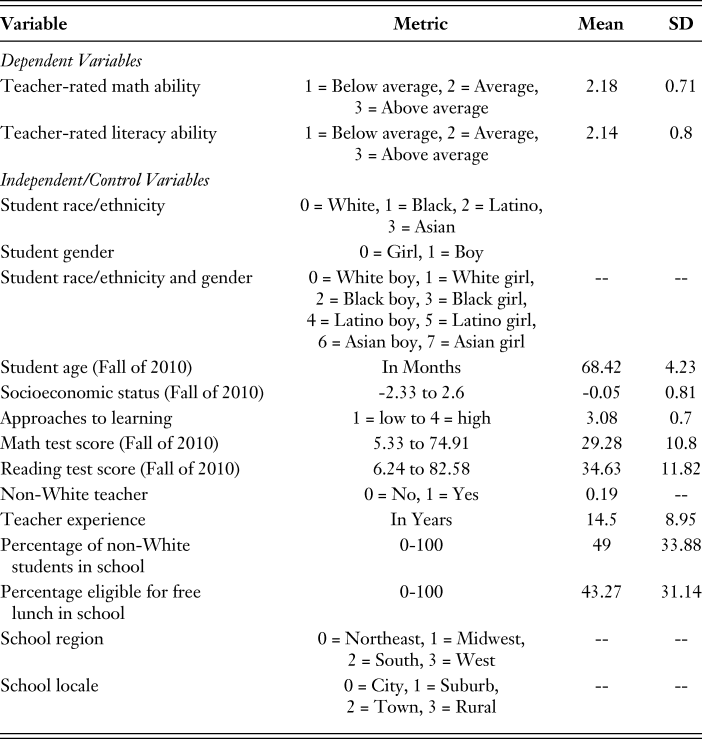
We also include additional student, teacher, and school characteristics in our model that may affect the relationship between teacher-rated approaches to learning and academic ability. Most importantly, we control for prior math and reading test scores. Empirically-based arguments about teacher biases in their assessments of children’s academic abilities must take into account students’ actual abilities in order to test for potential accuracies and inaccuracies (Ready and Wright, Reference Ready and Wright2011). Additional controls include child age and socioeconomic status (SES). Child age, particularly age of entry to kindergarten, has been shown to be related to children’s academic performance (NICHD Early Child Care Research Network 2007). Also, increases in SES are related to increases in academic achievement (Sirin Reference Sirin2005). Teacher-level covariates include whether the teacher is non-White and their years of teaching experience. Studies find evidence that teachers’ race matters for their ratings of students’ behaviors and academic ability (Downey and Pribesh, Reference Downey and Pribesh2004; McGrady and Reynolds, Reference McGrady and Reynolds2013). Length of teaching experience, particularly in the first few years of teaching, is shown to affect student performance (Rice Reference Rice2010). For school characteristics, we include the percentage of non-White students in the school (i.e., relative racial/ethnic school segregation) and the percentage of students eligible for free or reduced lunch (i.e., school population socioeconomic status). Research suggests that these school characteristics are associated with academic performance (Caldas and Bankston, Reference Caldas and Bankston1997; Goldsmith Reference Goldsmith2003). Lastly, like other researchers (Irizarry Reference Irizarry2015a), we also include school locality (i.e., city, suburb, town/rural) and school region. Table 1 presents descriptive statistics for all variables used in our analyses.
Metric, Means, and Standard Deviations for Variables Used in the Analysis: ECLS-K, 2010-2011

ANALYSES
We begin by evaluating average ratings on approaches to learning and academic ability by race/ethnicity and gender. We use Wilcoxon-Mann-Whitney tests to test for significant racial/ethnic and gender differences in means on teachers’ ratings of approaches to learning, math skills, and literacy skills. Next, we use multinomial logistic regression to examine how teachers’ perceptions of math and literacy skills vary by race/ethnicity and gender, net of student, teacher, and school characteristics, including teacher-rated approaches to learning. Our models predict the relative risk of a teacher rating of “below average” versus “average,” and “above average” versus “average.” Thus, “average” serves as the base category in the analyses. The first set of analyses examines racial/ethnic differences in teachers’ ratings, controlling for gender. The second set of analyses examines gender differences in teachers’ ratings, controlling for race. The third and final set of analyses examines differences in teachers’ ratings by the intersection of children’s race and gender. We run three sets of analyses to gauge whether using an intersectional approach gives us any additional insights that unidimensional analyses may obscure. Our first model includes all control variables and our second model includes the interaction between child race/ethnicity and/or gender and teacher-rated approaches to learning. We are primarily interested in the interaction between children’s ascriptive characteristics and teacher-rated noncognitive skills as it allows us to gauge whether there are significant differences in the effect of approaches to learning on teachers’ ratings of children’s academic skills. We use predicted probabilities to better understand statistically significant interactions and set the control variables at their means.
RESULTS
Teachers’ Ratings of Children’s Approaches to Learning and Academic Skills by Race/Ethnicity and Gender
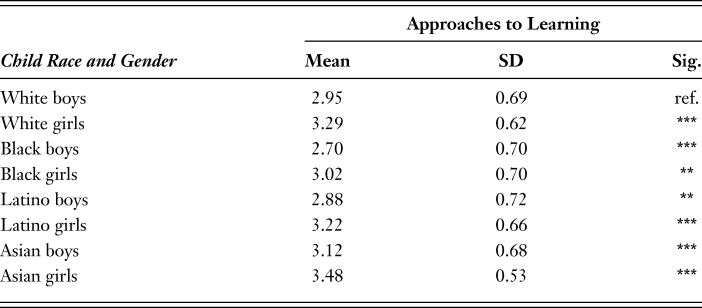
Table 2 reports the means on teacher-rated approaches to learning by each race and gender subgroup. In comparison to White boys, teachers rate Black and Latino boys lower on approaches to learning. In contrast, teachers rate Asian boys and girls of all four racial/ethnic categories higher on approaches to learning. We find that all differences, when compared to White boys, are statistically significant. Overall, these findings suggest that, on average, teachers perceive Black and Latino boys’ noncognitive skills more negatively than White boys, while they perceive Asian boys and girls of all racial/ethnic groups more positively than White boys.
Mann-Whitney-Wilcoxon Test for Differences in Means on Teacher-Rated Approaches to Learning by Child Race and Gender (Spring of First Grade)

* p<0.05; ** p<0.01; *** p<0.001
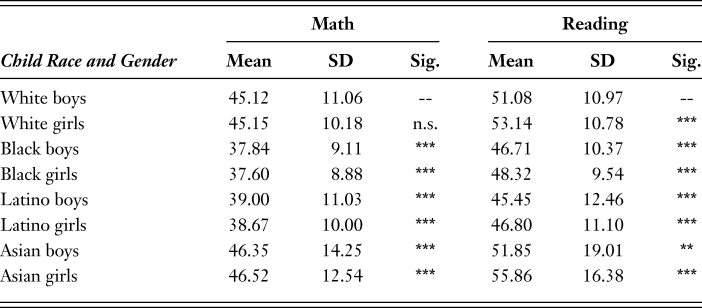
To examine racial/ethnic and gender differences in children’s prior test scores, Table 3 reports averages of children’s math and reading test scores from the spring of Kindergarten. We find that Black and Latino children, of both genders, scored lower than White boys in math and reading. Asian girls and boys scored higher than White boys in both math and reading. Lastly, in comparison to White boys, White girls scored higher in reading.
Mann-Whitney-Wilcoxon Tests for Differences in Means on Math and Reading Test Scores by Race/Ethnicity-Gender (Spring of Kindergarten)

* p<0.05; ** p<0.01; *** p<0.001; n.s. = not statistically significant
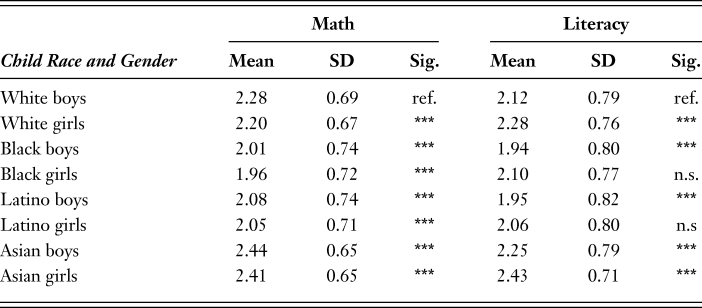
Table 4 reports averages on teachers’ ratings of children’s math and literacy skills. We find that teachers rate White girls, Black boys, Black girls, Latino boys, and Latino girls lower on math skills as compared to White boys. We also find that teachers rate Asian boys and girls better on math skills in comparison to White boys. For teachers’ ratings of children’s literacy skills, we find that teachers rate Black and Latino boys’ literacy skills lower than White boys’. We also find that teachers rate White girls’, Asian boys’, and Asian girls’ literacy skills higher than White boys’. We find no significant differences between White boys and Black or Latino girls. Overall, the findings from teachers’ average ratings of children’s math skills suggest that Asian boys and girls have better math skills than White boys, while all other racial/ethnic and gender subgroups have worse math skills. Additionally, our findings show that teachers perceive that Asian boys, Asian girls, and White girls have greater literacy skills than White boys, while Black and Latino boys have poorer literacy skills.
Mann-Whitney-Wilcoxon Tests for Differences in Means on Teachers’ Ratings of Children’s Math and Literacy Skills by Race/Ethnicity-Gender (Spring of First Grade)

* p<0.05; ** p<0.01; *** p<0.001
Children’s Race/Ethnicity and Gender, Approaches to Learning, and Academic Ability
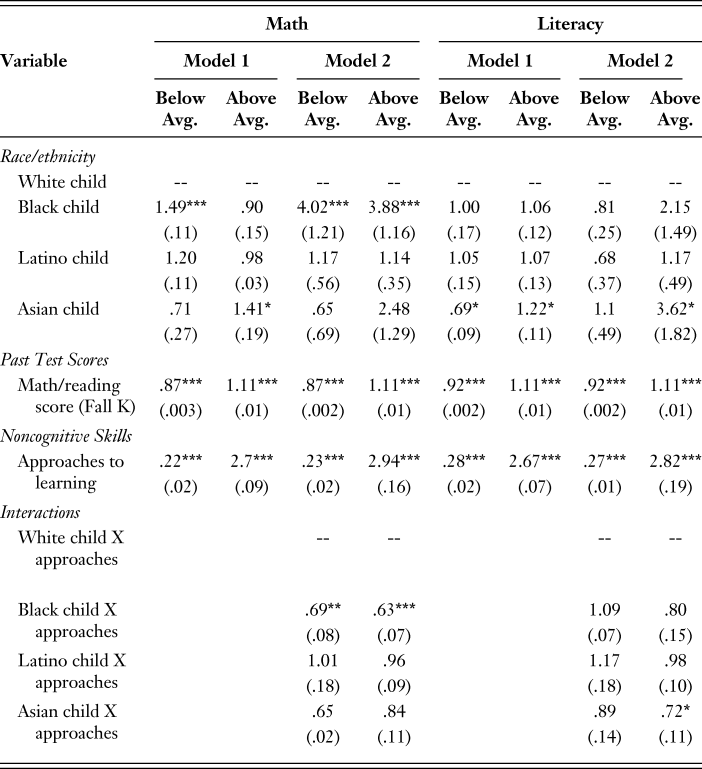
While the descriptive results above provide a general overview of teachers’ perceptions of children’s approaches to learning and academic ability by race/ethnicity and gender, it does not allow us to explore the relationship between these two. We explore this relationship by using multinomial logistic regression, controlling for a host of student, teacher, and school characteristics. Table 5 reports the results from regressions predicting teachers’ ratings of children’s math and literacy ability in first grade by race/ethnicity. Note that in all models, we control for children’s math or reading score in the fall of Kindergarten.
Relative Risk Ratios from Multinomial Logistic Regression Models Predicting Teachers’ Ratings of Children’s Math and Literacy Skills in First Grade, by Child Race/Ethnicity

Note: * p<0.05; ** p<0.01; *** p<0.001; The base for multinomial logistic regression models is “Average.” Model 1 controls not shown for presentation purposes include child gender, age, SES, teacher race, teacher’s experience (in years), percentage of non-White students in the school, percentage of students eligible for free or reduced lunch in the school, school locale, and school region.
Race/Ethnicity. In Model 1, we find that Black children have a greater risk of receiving a “below average” rating as compared to White children, controlling for student, teacher, and school characteristics. Compared to White children, Black children have 1.5 times the risk of being rated as below average in math as compared to average in math. For the risk of being rated above average in math as compared to average in math, we find that Asian children have 1.4 times the risk of being rated as above average in math compared to White students.
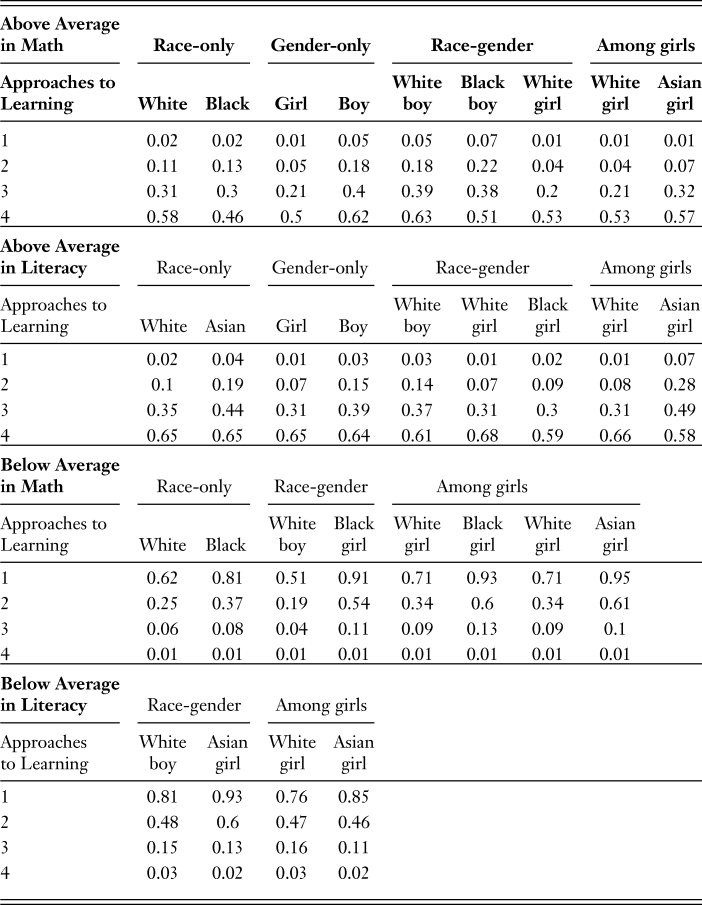
Next, we include the interaction between children’s race/ethnicity and teacher-rated approaches to learning in order to test whether there are significant racial/ethnic differences in the effects of children’s noncognitive skills on teachers’ ratings of children’s academic skills. We find statistically significant differences in the effect of teachers’ ratings of children’s noncognitive skills on their ratings of children’s math abilities when comparing Black and White children. We use predicted probabilities to better interpret these interactions. Table 9 presents all predicted probabilities of being rated as above average in math, above average in literacy, below average in math, and below average in literacy by teacher-rated approaches to learning. We find that Black children are more likely than White children to receive a rating of below average in math when teachers rate them below a three on approaches to learning. For example, Black children have a predicted probability of 0.81 of being rated as below average in math at an approaches-to-learning score of one, while, at the identical approaches-to-learning score, White children have a predicted probability of 0.62. Thus, when Black children exhibit subpar noncognitive skills we find that teachers penalize them more than White children who exhibit similar skills. Also, Black children are less likely to receive a rating of above average in math when teachers rate them as above a three on approaches to learning, in comparison to White children. At an approaches-to-learning score of four, Black children have a predicted probability of 0.46 of being rated as above average in math. In contrast, White children have a predicted probability of 0.58. Hence, we find that Black children with exceptional learning behaviors benefit less from such skills as compared to White children with similar skills.
For teachers’ ratings of literacy skills by children’s race/ethnicity, we find that White children have 1.4 times the risk of being rated as below average in literacy versus average in literacy as compared to Asian children. Additionally, in comparison to White children, Asian children have 1.2 times the risk of being rated as above average in literacy rather than average in literacy. Again, we conduct analyses that test for racial/ethnic differences in the effect of children’s noncognitive skills on teachers’ ratings of literacy skills. We find one statistically significant interaction and use predicted probabilities to understand this interaction.
Our results show that Asian children are more likely to be rated as above average in literacy unless they exhibit exceptional noncognitive skills. For example, at an approaches-to-learning score of three Asian children have a predicted probability of 0.44 of being rated as above average in literacy, while White children have a predicted probability of 0.35. At a rating of four on approaches to learning, we find that Asian children are no longer advantaged over White children. Thus, we find identical likelihoods of a teacher rating of above average in literacy for Asian and White children who demonstrate the best noncognitive skills.
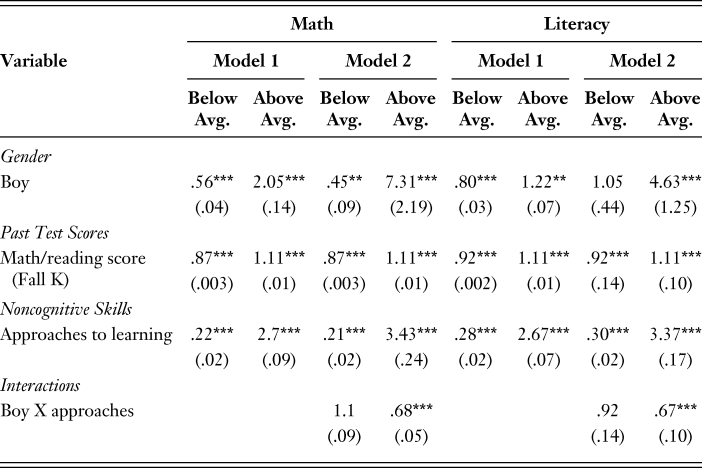
Gender. Table 6 reports the results from regressions predicting teachers’ ratings of children’s math and literacy ability in first grade by gender. In Model 1, for teachers’ ratings of children’s math abilities, we find that girls have 1.8 times the risk of being rated as below average in math versus average in math, in comparison to boys, net of individual, teacher, and school-level controls. We also find that boys have 2.1 times the risk of being rated as above average in math as compared to average in math. Thus, girls are more likely than boys to be rated as below average versus average in math, and girls are less likely than boys to be rated as above average versus average in math. We find a significant interaction between gender and approaches to learning for teachers’ ratings of being above average in math. Once again, we use predicted probabilities to better interpret these interactions. We find that, regardless of approaches to learning, teachers are more likely to rate boys as above average in math.
Relative Risk Ratios from Multinomial Logistic Regression Models Predicting Teachers’ Ratings of Children’s Math and Literacy Skills in First Grade, by Child Gender

Note: * p<0.05; ** p<0.01; *** p<0.001; The base for multinomial logistic regression models is “Average.” Model 1 controls not shown for presentation purposes include child race/ethnicity, age, SES, teacher race, teacher’s experience (in years), percentage of non-White students in the school, percentage of students eligible for free or reduced lunch in the school, school locale, and school region.
For teachers’ ratings of children’s literacy skills by gender, we find a similar pattern to the one we found for math. In comparison to boys, girls have 1.3 times the risk of being rated as below average in literacy as compared to average in literacy, controlling for student, teacher, and school characteristics. Further, boys have 1.2 times the risk of being rated as above average in literacy versus average as compared to girls. We find that the interaction between noncognitive skills and teacher-rated literacy skills is statistically significant for teachers’ ratings of above average students. We use predicted probabilities to interpret this significant interaction. The results demonstrate that, below an approaches-to-learning rating of about 3.5, boys are more likely than girls to receive a rating of above average in literacy skills. Thus, our findings suggest that teachers penalize girls in both math and literacy in comparison to boys who demonstrate identical approaches to learning. However, the one exception is that in literacy we find no difference between boys and girls with excellent noncognitive skills.
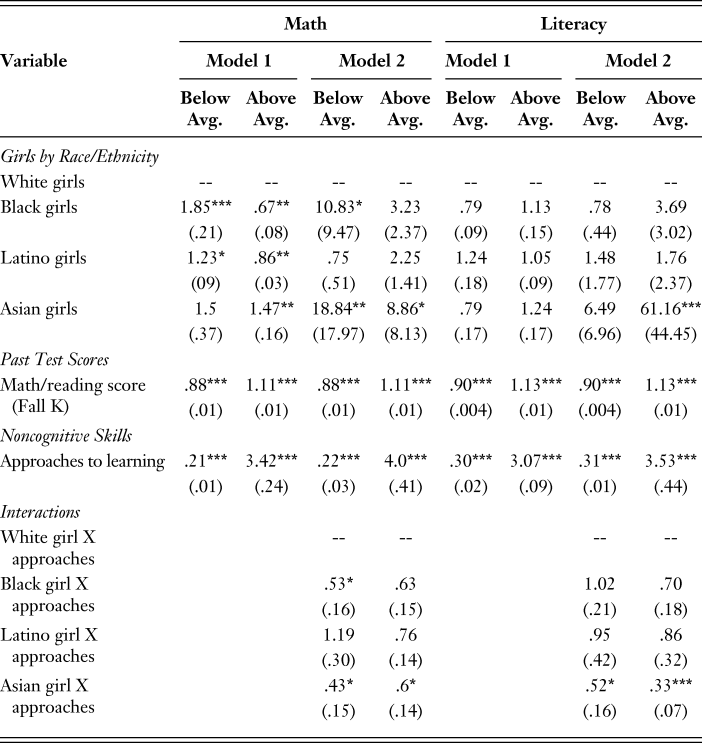
The Intersection of Race and Gender. Table 7 reports the results from regressions predicting teachers’ ratings of children’s math and literacy ability in first grade by race/ethnicity-gender. In Model 1, for teachers’ ratings of math ability, we find that many racial/ethnic and gender subgroups have a greater risk of receiving a “below average” rating as compared to White boys, controlling for student, teacher, and school characteristics. The variable for teacher-rated approaches to learning is highly significant as increases in approaches to learning result in lower risk of being rated as below average in math. Still, in comparison to White boys, White girls have 1.9 times the risk, Black boys have 1.5 times the risk, Black girls have 2.8 times the risk, Latino boys have 1.4 times the risk, Latino girls have two times the risk, and Asian girls have 2.3 times the risk of being rated as below average in math as compared to average in math. For the risk of being rated as above average as compared to average in math, we find several significant differences. White boys are about twice as likely as White girls or Latino girls to be rated above average rather than average in math. Similarly, in comparison to Black girls, White boys have 2.5 times the risk of being rated as above average compared to average even after all individual, teacher, and school characteristics are taken into account. Thus, White girls, Black girls, and Latino girls are less likely to be rated as above average in math, controlling for student, teacher, and school characteristics.
Relative Risk Ratios from Multinomial Logistic Regression Models Predicting Teachers’ Ratings of Children’s Math and Literacy Skills in First Grade, by Child Race/Ethnicity-Gender

Note: * p<0.05; ** p<0.01; *** p<0.001; The base for multinomial logistic regression models is “Average.” Model 1 controls not shown for presentation purposes include age, SES, teacher race, teacher’s experience (in years), percentage of non-White students in the school, percentage of students eligible for free or reduced lunch in the school, school locale, and school region.
Next, we include an interaction between children’s race/ethnicity and gender and teacher-rated approaches to learning. The interaction allows us to gauge whether there are significant racial/ethnic and gender differences in the effect of approaches to learning on teachers’ ratings of math and literacy skills. We discover several significant interaction effects by racial/ethnic and gender subgroup. For teachers’ ratings of children’s math skills, we find significant interactions for Black girls, White girls, and Black boys. We use predicted probabilities to interpret these significant interactions. We find that, as compared to White boys, Black girls are more likely to be rated as below average in math when teachers rate them at or below a three on approaches to learning. For example, at an approaches-to-learning score of two, Black girls have a predicted probability of 0.54 of being rated as below average, while White boys have a predicted probability of 0.19. Also, we find that Black boys are less likely to be rated as above average in math when teachers rate them above a three in approaches to learning, in comparison to White boys. At an approaches-to-learning score of four, Black boys have a predicted probability of 0.51 of being rated as above average in math. In contrast, White boys have a predicted probability of 0.63. Finally, for math we find that White girls are less likely than White boys to be rated as above average in math, regardless of approaches to learning. For example, at an approaches-to-learning score of three, White girls have a predicted probability of 0.2, while White boys have a predicted probability of 0.39. Overall, our findings for math suggest that Black girls, Black boys, and White girls are penalized in comparison to White boys, although in distinct ways. Teachers appear to penalize Black girls when their learning behaviors are less than stellar, Black boys when their behaviors are above average, and White girls regardless of their behaviors.
For teachers’ ratings of literacy skills, and in contrast to math, we find fewer significant racial/ethnic and gender disparities in Model 1. Our results show that Latino girls have 1.4 times the risk of teachers rating them as below average. Black girls have 0.8 times the risk of receiving a rating of above average in literacy as compared to White boys. These disparities are significant even as we control for approaches to learning and other student, teacher, and school characteristics in Model 1. We find significant interaction effects for Asian girls, White girls, and Black girls. We use predicted probabilities to better interpret these significant interactions. First, teachers are more likely to rate Asian girls compared to White boys as below average in literacy when they rate Asian girls below 2.5 on approaches to learning. For example, when they receive an approaches-to-learning rating of two, Asian girls have a predicted probability of 0.6 of being rated as below average, while White boys have a predicted probability of 0.5. Secondly, we find that White girls who receive an approaches-to-learning score below three are less likely than White boys to be rated as above average in literacy. Interestingly, teachers are more likely to rate White girls who receive an approaches-to-learning rating above about 3.5 above average in literacy. Third, we find that teachers are less likely to rate Black girls compared to White boys as above average in literacy regardless of their score on approaches to learning. Thus, our findings suggest that Asian girls are penalized in comparison to White boys when they exhibit subpar skills, White girls are penalized when their skills are below average but advantaged when their skills are above average, and Black girls are penalized regardless of their skills.
Among Girls by Race/Ethnicity. While the previous analyses provide important insight into racial/ethnic and gender differences in the relationship in teacher ratings, one limitation of using White boys as the reference group is that we cannot test for disparities among girls by race/ethnicity. Thus, we conduct a final set of analyses that examine teachers’ ratings of math and literacy ability among girls. Table 8 reports the results from these analyses. In our first model, which controls for student, teacher, and school-level characteristics, we find that Black girls and Latino girls have 1.9 and 1.2 times the risk, respectively, of being rated as below average in math versus average in math in comparison to White girls. Additionally, we find that Black girls and Latino girls have 0.7 and 0.9 times the risk, respectively, of being rated as above average in math in comparison to White girls, net of all control variables. In contrast, Asian girls have 1.5 times the risk of being rated as above average in math, rather than average in math, as compared to White girls. Thus, Black girls and Latino girls are more likely than White girls to be rated as below average in math, and less likely than White girls to be rated as above average in math, while Asian girls are more likely than White girls to be rated as above average in math.
Relative Risk Ratios from Multinomial Logistic Regression Models Predicting Teachers’ Ratings of Children’s Math and Literacy Skills in First Grade Among Girls, by Race/Ethnicity

Note: * p<0.05; ** p<0.01; *** p<0.001; The base for multinomial logistic regression models is “Average.” Model 1 controls not shown for presentation purposes include age, SES, teacher race, teacher’s experience (in years), percentage of non-White students in the school, percentage of students eligible for free or reduced lunch in the school, school locale, and school region.
Predicted Probabilities of Teacher Rating Child as Above Average in Math, Above Average in Literacy, Below Average in Math, and Below Average in Literacy, by Race-only, Gender-only, Race-gender, and Among girls

We find significant interaction effects for Asian girls and Black girls. We use predicted probabilities to better interpret these significant interactions. Findings suggest that Black girls and Asian girls are more likely than White girls to be rated as below average in math when their approaches-to-learning scores are below a three. For example, Black girls and Asian girls have predicted probabilities of 0.6 and 0.6, respectively, of being rated as below average in math when they score a two on approaches to learning. In contrast, White girls have a predicted probability of 0.3 at an approaches-to-learning score of two. Thus, it seems that teachers penalize both Black girls and Asian girls, as compared to White girls, when their learning behaviors are less than exceptional. Additionally, we find that Asian girls are more likely to be rated as above average in math when they receive an approaches-to-learning rating above a two. For example, at an approaches-to-learning score of three, Asian girls have a predicted probability of 0.32 while White girls have a predicted probability of 0.21 of being rated above average in math. This suggests that Asian girls benefit more than White girls with similar skills when considering an above average rating in math.
We find no significant racial/ethnic differences in our first model for teachers’ ratings of literacy among girls. However, when we include the interaction between approaches to learning and race/ethnicity we find significant interactions for Asian girls. Again, we use predicted probabilities to understand these interactions. Results demonstrate that Asian girls are more likely than White girls to be rated as below average in literacy when their approaches-to-learning scores are below two, while they less likely to be rated as below average when their approaches-to-learning scores are at three. When their approaches-to-learning score is at one, Asian girls and White girls have a predicted probability of 0.85 and 0.76, respectively. However, at a score of three, Asian girls have a predicted probability of 0.11 while White girls have a probability of 0.16. Thus, Asian girls are slightly disadvantaged when they have poor learning behaviors but they also have a slight advantage when their behaviors are around average as compared to White girls. Lastly, for the probability of being rated as above average in literacy, we find that Asian girls are more likely to be rated above average until about 3.75. For example, among those with an approaches-to-learning score of three, Asian girls have an predicted probability of 0.49 of being rated as above average while White girls have a probability of 0.31. Asian girls who are rated above a 3.75 for approaches to learning are less likely than White girls to be rated as above average in math. At an approaches-to-learning score of four, Asian girls have a predicted probability of 0.58 of being rated as above average in literacy. In contrast, White girls have a predicted probability of 0.66 with the same score. These results suggest that, depending on the circumstances, Asian girls are both penalized and advantaged in comparison to White girls with identical approaches to learning.
CONCLUSION
The purpose of this article is to understand the relationship between children’s race/ethnicity and gender, noncognitive skills, and teachers’ perceptions of children’s academic skills. There are two primary contributions of this research. First, we are interested in whether intersectional analyses reveal important findings that unidimensional analyses obscure. Secondly, we are interested in whether children’s noncognitive skills work differently by race/ethnicity and gender. It is often assumed that students’ noncognitive skills have a linear relationship to students’ academic outcomes. Unidimensional analyses reveal several important findings. We find that, in comparison to White children, teachers penalize Black children in math, while teachers’ perceptions benefit Asian children in literacy. We define this “penalty” or “advantage” as the unequal relationship between children’s noncognitive skills and teacher ratings of academic ability. For example, in comparison to White children with identical noncognitive skills, we find that teachers are more likely to rate Black children as below average in math when their noncognitive skills are below average. Thus, although they exhibit the same behaviors, teachers penalize Black children as compared to their White peers. In contrast, teachers advantage Asian children as compared to their White peers as they are more likely to rate Asian children, in comparison to White children, as above average in literacy when their skills are less than exceptional. Also, we find that teachers penalize girls in both math and literacy. These results alone are certainly revealing, particularly because these disparities remain even after taking into account student, teacher, and school characteristics including, most importantly, prior test scores. Thus, among students with similar test scores, social circumstances, and in similar schools, we still find racial/ethnic and gender disparities in teachers’ ratings of their students’ academic abilities.
Our intersectional analyses added further specificity that unidimensional analyses obscure as several questions remained after analyzing the unidimensional results. Namely, are Black boys and Black girls similarly penalized in math? Are Asian girls and Asian boys similarly advantaged in literacy? Are girls of all four racial/ethnic categories penalized similarly in both math and literacy? These questions can only be uncovered by utilizing an intersectional approach. We find that teachers differentially penalize Black girls and Black boys in math. Teachers are more likely to rate Black girls as below average in math when their learning behaviors are less than exemplary. In contrast, teachers are less likely to rate Black boys as above average in math when they exhibit the best learning behaviors. For teachers’ ratings of literacy, our results suggest that teachers penalize Asian girls, rather than Asian boys, in that Asian girls are more likely than White boys to be rated as below average in literacy when their learning behaviors are below average.
Among girls, for teachers’ ratings of math ability we find that Asian girls and Latino girls are not penalized by teachers, in comparison to White boys, while Black girls and White girls are penalized. However, as noted before, teachers penalize Black girls in that teachers are more likely to rate them as below average in math when their noncognitive skills are less than stellar. In contrast, teachers penalize White girls in that teachers are less likely to rate them as above average in math regardless of their noncognitive skills. Regarding teacher-rated literacy, in comparison to White boys, teachers penalize Asian girls, Black girls, and White girls. Teachers penalize Asian girls when their noncognitive skills are below average as they are more likely to rate them as below average in literacy. In contrast, teachers penalize Black girls as they are less likely to rate Black girls as above average in literacy as compared to White boys regardless of noncognitive skills. White girls, on the other hand, are penalized in that teachers are less likely to rate them as above average in literacy when their noncognitive skills are below average. However, teachers are less likely to penalize White girls when they exhibit noncognitive skills that are stellar as White girls are more likely than White boys to be rated as above average in literacy.
Left unanswered is how racial/ethnic minority girls fare in comparison to White girls. In math, we find that teachers penalize Asian girls and Black girls when their noncognitive skills are below average in that teachers are more likely to rate them as below average in math as compared to White girls with identical noncognitive skills. Also, our results suggest that, when rating students above average in math, teachers advantage Asian girls over White girls when their noncognitive skills are slightly below average, average, and above average as teachers are more likely to rate Asian girls as above average in math. In literacy, and as compared to White girls, teachers penalize Asian girls who exhibit noncognitive skills that are below average for teachers’ ratings of below average students. However, Asian girls have a slight advantage over White girls when their noncognitive skills are average. For teachers’ ratings of above average in literacy, teachers award an advantage to Asian girls over White girls unless their behaviors are above average. Teachers penalize Asian girls more than White girls when their noncognitive skills are above average. Overall, our findings suggest that the association between children’s noncognitive skills and teachers’ ratings of math and literacy skills differs by race/ethnicity and gender. Children’s work habits and persistence in the classroom, for example, appear to be unfairly rewarded or penalized in complex ways based on children’s race/ethnicity and gender.
Taken together, our findings indicate that an intersectional approach adds leverage to models that consider race/ethnicity-only or gender-only. While our findings suggest that teachers penalize Black children and Asian children in comparison to White children in math and literacy, respectively, adding the intersection of gender contributes to a more nuanced understanding of this racialized pattern. Similarly, adding the intersection of race/ethnicity improves our understanding of the gendered pattern in teachers’ ratings of math and literacy. Our findings might seem counterintuitive as scholars agree that girls and women currently outperform boys and men in terms of noncognitive skills, educational achievement, and educational attainment (Buchmann et al., Reference Buchmann, DiPrete and McDaniel2008). Yet as girls of three out of the four racial/ethnic categories are penalized, albeit in different ways, it appears that teachers hold girls and boys of different racial/ethnic backgrounds to different behavioral standards. Black boys remain an intersectional exception, as we find no other significant results among boys of other racial/ethnic categories. Also, our study suggests that Asian girls sometimes benefit from more favorable teacher perceptions in certain circumstances and less favorable perceptions in other circumstances. This complicates previous work that suggests that teachers perceive Asian children’s behavior and academic ability more favorably than White children (McGrady and Reynolds, Reference McGrady and Reynolds2013). Unidimensional analyses could not reveal these findings. In sum, our analyses demonstrate how “differential interpretations of the same facts” become available when using multidimensional analyses as compared to unidimensional analyses (Clarke and McCall, Reference Clarke and McCall2013, p. 350). As researchers, intersectionality enables us to have a more dynamic understanding of racial/ethnic and gendered inequalities, revealing complexities and contradictions that are often hidden and difficult to predict.
Many studies on gender inequalities in education find a “female advantage” in educational achievement and attainment. Noncognitive skills are a key predictor of the gender gap in education, particularly in early childhood (DiPrete and Jennings, Reference DiPrete and Jennings2012). Yet left obscured are racial/ethnic differences within traditional gender categories, and gender differences within traditional racial/ethnic categories. Our study presents evidence that there are unequal returns to children’s noncognitive skills, behaviors, and efforts in the classroom. In other words, our research suggests that children’s noncognitive skills, whether they meet or defy teacher expectations, have different effects on teacher perceptions of children’s academic ability across racial/ethnic and gender subgroups. Noncognitive skills are certainly important for social stratification processes (Farkas Reference Farkas2003), including educational stratification, but we must think more complexly about potentially unequal relationships between noncognitive skills, race/ethnicity, gender, and various social outcomes.