INTRODUCTION
Engagement in risky sexual behavior (RSB) is a significant public health concern. Negative consequences as a result of RSB include sexually transmitted infections (STIs) and unplanned pregnancies. Adolescents and young adults often fail to consistently use any type of protection against pregnancy or STIs (Kann et al., Reference Kann, Kinchen, Shanklin, Flint, Kawkins, Harris and Chyen2014). Although recent national trends suggest an increase in condom use over the last several decades (Kann et al., Reference Kann, Kinchen, Shanklin, Flint, Kawkins, Harris and Chyen2014), this population accounts for over half of the STIs in the United States (Satterwhite et al., Reference Satterwhite, Torrone, Meites, Dunne, Mahajan, Ocfemia and Weinstock2013). Several research studies have established that there is an association between substance use and RSB (Bellis et al., Reference Bellis, Hughes, Calafat, Juan, Ramon, Rodriguez and Phillips-Howard2008; Cooper, Reference Cooper2002), specifically substance use is associated with a greater number of sexual partners, less consistent condom use, and more STIs (Santelli, Brener, Lowry, Bhatt, & Zabin, Reference Santelli, Brener, Lowry, Bhatt and Zabin1998; Tapert, Aarons, Sedlar, & Brown, Reference Tapert, Aarons, Sedlar and Brown2001). RSB is also a vector for transmission of HIV, which causes a negative impact on the physical health of infected individuals.
Studies focusing on how neurocognitive functioning influences risky behaviors (including RSB) present a promising new area of inquiry and growth. Indeed, we think there is a role for neuropsychology to expand our knowledge on the determinants of RSB, which may help increase our understanding of contributing factors and provide additional clues for more effective prevention and intervention efforts. Although the role of brain structure, function, and neurocognitive abilities in RSB remains poorly understood, significant progress has been made in recent years. As such, we think it timely to present a review of this work. The goal of this review is twofold. First, we briefly describe literature examining brain systems and neurocognitive functions relevant to RSB focusing on executive function, as well as structural and functional neuroimaging studies. Second, and more importantly, we review and summarize the current literature on neuropsychological functioning and RSB.
BRAIN SYSTEMS AND FUNCTIONS RELEVANT TO RISKY SEXUAL BEHAVIOR
An exhaustive review of all the brain regions relevant to a behavior as complex as “sexual behavior” is beyond the scope of this study. However, here we briefly review some important brain systems and neurocognitive functions relevant to RSB, which include executive functioning, and functional and structural neuroimaging studies.
Executive Functions
The prefrontal-subcortical circuits innervating dorsolateral prefrontal, orbitofrontal, and anterior cingulate cortex are important for sexual behavior (Spinella, Reference Spinella2007) as well as executive functioning (Alvarez & Emory, Reference Alvarez and Emory2006; Masterman & Cummings, Reference Masterman and Cummings1997; Stuss & Levine, Reference Stuss and Levine2002; Tekin & Cummings, Reference Tekin and Cummings2002). Executive functions are the complex cognitive processes involved in goal-oriented, autonomous behavior (Elliott, Reference Elliott2003) as well as inhibiting responses. As presented by Spinella (Reference Spinella2007), human lesion and animal studies have shown that the orbitofrontal cortex, medial prefrontal cortex (including the anterior cingulate), striatum, nucleus accumbens, and the thalamus are likely implicated in RSB. Lesions to the orbitofrontal cortex (specifically ventromedial orbitofrontal cortex) and the thalamus can result in sexual disinhibition (Malloy, Bihrle, Duffy, & Cimino, Reference Malloy, Bihrle, Duffy and Cimino1993; Starkstein & Robinson, Reference Starkstein and Robinson1997). As discussed in Spinella (Reference Spinella2007), reward, punishment, initiation, and motivation—all processes relevant to sexual behavior—are influenced by functioning of orbitofrontal cortex, medial prefrontal cortex, striatum, nucleus accumbens, and thalamus. As such, disruptions of these regions have been found to be associated with either decreases or increases in sexual behavior.
Functional Neuroimaging Studies and RSB among Youth
Functional neuroimaging (fMRI; PET) techniques have been used with impulse control paradigms to specifically assess the association between neural response and RSB among adolescents. Response inhibition among sexually active youth was assessed with a Go/No-Go task by Feldstein Ewing, Houck, and Bryan (Reference Feldstein Ewing, Houck and Bryan2015) and heightened blood oxygenation level dependent (BOLD) response was found within the middle frontal gyrus (MFG), inferior parietal lobules (IPL), and insula to correlate with risk-taking behaviors (substance use; risky sex). Independently, hyperactivation observed in the right inferior frontal gyrus (rIFG) was positively correlated with recent RSB.
In contrast, a previously conducted study assessed neural responses in sexually active youth reporting varying levels of risky contraceptive use within an inhibition Go/No-Go paradigm (Goldenberg, Telzer, Lieberman, Fuligni, & Galván, Reference Goldenberg, Telzer, Lieberman, Fuligni and Galván2013). Within this sample, RSB (minimal contraceptive use) was associated with hypoactivation in the insula and rIFG, suggesting that frontal regions implicated in impulse control and emotion regulation were underemployed in individuals who engage in more RSB. These mixed results indicate that, despite relevance of IFG recruitment in risky sex decision-making, determining directionality and conclusions based on various levels of activation continues to be a challenge.
Feldstein Ewing and colleagues (Reference Feldstein Ewing, Ryman, Gillman, Weiland, Thayer and Bryan2016) recently proposed a unique neural network for adolescent sexual decision-making in a systematic review of extant functional neuroimaging studies on adolescent sexual riskiness (N=7). The authors suggest that adolescent sexual decision-making includes activation in the ventral tegmental area, striatum, prefrontal cortex, limbic system, insula and anterior cingulate cortex. Compared with other types of adolescent risk-taking, signaling between the mescorticolimbic, emotion-regulation (VTA, striatum, insula), prefrontal cortex, and gondal and stress hormone centers may facilitate increased RSB in adolescents. Studies using functional neuroimaging techniques suggest that brain regions associated with impulse control, emotion regulation, and reward are implicated in RSB. However, the mixed findings (i.e., hypoactivation and hyperactivation within the rIFG correlating with RSB) also demonstrate the need for more research on the neural substrates of RSB and the importance of reviewing the literature on the neuropsychology of RSB.
SEARCH STRATEGY FOR REVIEW OF LITERATURE ON NEUROPSYCHOLOGICAL FUNCTIONING AND RSB
In this study, we set out to review literature examining relationships between neuropsychological functioning and RSB. We conducted a literature review that focused solely on studies examining the association between neuropsychological functioning and RSB. RSB is defined, for the purposes of this study, as any sexual behavior that increases an individual’s risk for STIs or unwanted pregnancies. Broad definitions of RSB were included in this review because we wanted to be as inclusive as possible. Studies included in the review had varying definitions of RSB including not using a condom or other form of protection, younger age of sex initiation, and greater numbers of regular and casual sexual partners.
Our literature review was limited to studies conducted before August 2015 via Google Scholar and PubMed. Search terms were “risky sexual behavior” and “neurocognition” or “neuropsychology” and abstracts were reviewed to identify papers relating neuropsychological function and RSB. Lastly, we reviewed the reference sections of articles that met our inclusion criteria (located during the first literature review) to determine if any articles cited met our inclusion criteria. Inclusion criteria were: (1) English language, (2) peer-reviewed, (3) published before August 2015, (4) examined relationships between neuropsychological tests and RSB (i.e., number of partners, condom use, age of initiation), and (5) human participants. This manuscript did not require Institutional Review Board approval, and this research was conducted in accordance with the Helsinki Declaration.
REVIEW OF LITERATURE ON NEUROPSYCHOLOGICAL FUNCTIONING AND RSB
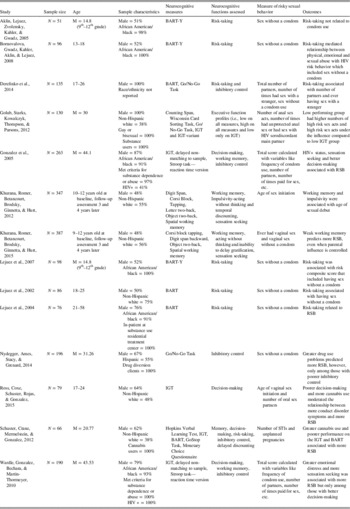
The sections below summarize the studies identified by our search, which are grouped by the age of the participant sample (i.e., adolescents, young adults, and adults). For the purposes of this review, we define adolescence as ages 12 to 18 and young adulthood as ages 18 to 25. Adolescence has been defined as beginning at puberty and ending when the individual takes on adult responsibilities; however, there are varying definitions of what constitutes the age of adolescence (Dahl, Reference Dahl2004; Spear, Reference Spear2000). Most definitions suggest that it spans in age from 10 to 25 (Dahl, Reference Dahl2004). The final section reviews studies that contain adult participant samples (ages 26 and older). However, it is important to note that there are no studies that evaluate the association of neuropsychological functioning and RSB in a normative sample of adults. Table 1 summarizes these studies.
Summary of studies assessing relationships between neuropsychological functioning and RSB

Adolescents
The Balloon Analogue Risk Task (BART) is a commonly used measure of risk-taking that has been used across numerous studies (Lejuez et al., Reference Lejuez, Read, Kahler, Richards, Ramsey, Stuart and Brown2002, Reference Lejuez, Aklin, Daughters, Zvolensky, Kahler and Gwadz2007). The BART is a computerized measure that evaluates propensity for risk-taking by presenting the participant with a situation where they can take increased risk for potential rewards, which is offset by increased risk to lose accumulated rewards on a given trial. Among a sample of high school students, poorer BART performance (i.e., more risk-taking) was associated with a greater frequency of sex without a condom (Lejuez et al., Reference Lejuez, Aklin, Daughters, Zvolensky, Kahler and Gwadz2007). Another study using the BART, reported that among 96 male and female black high school students, childhood physical, emotional, and sexual abuse was related to sexual intercourse without a condom and the relationship was mediated by BART performance and sensation-seeking (Bornovalova, Gwadz, Kahler, Aklin, & Lejuez, Reference Bornovalova, Gwadz, Kahler, Aklin and Lejuez2008).
However, one study found that condom use was not related to performance on the BART among a sample of 51 male and female black high school students. Of note, other measures of risk behavior have also been related to performance on the BART, including substance use, stealing, and gambling (Aklin, Lejuez, Zvolensky, Kahler, & Gwadz, Reference Aklin, Lejuez, Zvolensky, Kahler and Gwadz2005), suggesting that poor performance on this task may not specific to RSBs.
A notable study conducted by Khurana and colleagues (Reference Khurana, Romer, Betancourt, Brodsky, Giannetta and Hurt2012) examined whether several aspects of executive function, including working memory, and impulsivity, were related to age of sexual debut among 350 adolescents. Khurana and colleagues (Reference Khurana, Romer, Betancourt, Brodsky, Giannetta and Hurt2012) found that poorer working memory predicted younger age of sex initiation, but the relationship was entirely mediated by greater impulsivity (i.e., temporal discounting and “acting without thinking”). However, sensation seeking did not predict a younger age of sex initiation.
Importantly, the complex nature of RSB and the importance of socio-cultural factors, which are not covered in this review, are highlighted by the finding that low socioeconomic background also predicted age of sex initiation and the effect of low SES on age of sexual debut was partially mediated by temporal discounting and working memory, with each accounting for 53% and 47% of variance in the model, respectively. Khurana and colleagues (Reference Khurana, Romer, Betancourt, Brodsky, Giannetta and Hurt2015) conducted a follow-up study with the same participant sample and found that poorer working memory predicted a younger age of sexual initiation and more unprotected sex, even after controlling for parental influences in the analysis. These findings suggest that some neurocognitive abilities may continue to account for RSB even when controlling for relevant psychosocial factors.
Young Adults
Similar to studies among adolescents, the BART has also been commonly used in studies with young adults. Results of studies using the BART among young adults have reported that BART performance is associated with sex without a condom (Derefinko et al., Reference Derefinko, Peters, Eisenlohr-Moul, Walsh, Adams and Lynam2014; Lejuez et al., Reference Lejuez, Aklin, Daughters, Zvolensky, Kahler and Gwadz2007, Schuster, Crane, Mermelstein, & Gonzalez, Reference Schuster, Crane, Mermelstein and Gonzalez2012). More specifically, one study evaluated the association between BART performance and different indices of RSB (other than sex without a condom), which were total number of sexual partners and total number of sexual partners who the individual had known for less than 24 hours among 135 male undergraduate students. BART performance was a better predictor of number of sexual partners and casual sexual partners compared to the other behavior traits and characteristics evaluated, including skin conductance reactivity and self-report personality measures. However, in the same study, Go/No-go task performance (i.e., measure of response inhibition) was not associated with RSB (Derefinko et al., Reference Derefinko, Peters, Eisenlohr-Moul, Walsh, Adams and Lynam2014).
In addition to using the BART, Schuster and colleagues (Reference Schuster, Crane, Mermelstein and Gonzalez2012) also included the Iowa Gambling Task (IGT), and reported that more risk-taking and poorer decision-making was associated with more RSB among late adolescent and young adult participants who used cannabis. The IGT is a measure of decision-making under conditions of ambiguous risk and individuals with lesions to the ventromedial prefrontal cortex as well as individuals with drug addiction often perform poorly on this task. Furthermore, the interaction between greater amounts of recent cannabis use and poorer IGT performance was associated with more overall RSB, while the interaction between greater amounts of recent cannabis use and poorer BART performance was associated with more negative consequences from RSB (e.g., STIs and unplanned pregnancies). Among the same sample of young adult cannabis users, Ross, Coxe, Schuster, Rojas, and Gonzalez (Reference Ross, Coxe, Schuster, Rojas and Gonzalez2015) found that conduct disorder symptoms were related to number of oral sex partners and age of vaginal sex initiation. Furthermore, this relationship was moderated by decision-making performance (on the IGT) and amount of lifetime cannabis use. At high levels of cannabis use, more conduct disorder symptoms were associated with more oral sex partners when decision-making was poor and less oral sex partners when decision-making was better.
Adults
Unlike most studies conducted with adolescents and young adults, studies evaluating RSB in adult samples have typically focused on substance users. It has been well established that alcohol and drug use are associated with engagement in RSB (Bellis et al., Reference Bellis, Hughes, Calafat, Juan, Ramon, Rodriguez and Phillips-Howard2008; Brodbeck, Matter, & Moggi, Reference Brodbeck, Matter and Moggi2006; Cooper, Reference Cooper2002; Santelli et al., Reference Santelli, Brener, Lowry, Bhatt and Zabin1998; Tapert et al., Reference Tapert, Aarons, Sedlar and Brown2001). However, the role of neurocognition in the relationship between substance use and RSB is not well understood. There are several ways by which neurocognition may interact with substance use and RSB. First, individuals may be more likely to engage in RSB when intoxicated as the effects of many substances of abuse can impair judgment, thus increasing the likelihood of engaging in risk behaviors. Second, as substance use, per se, is often viewed as a risky behavior, it is likely that common underlying factors may contribute to both substance abuse and RSB (e.g., conduct disorder, and impulsivity; Giancola & Tarter, Reference Giancola and Tarter1999; Tarter, Reference Tarter2002; Tarter, Kirisci, Habeych, Reynolds, & Vanyukov, Reference Tarter, Kirisci, Habeych, Reynolds and Vanyukov2004). Finally, to the extent that neurocognitive functions influence RSB, it is also possible that adverse effects of substances of abuse on executive functions may make some individuals more likely to engage in RSB. Of these, it is the latter that has received the least attention in the scientific literature.
To date, several studies have used laboratory tasks to examine how neurocognition might influence the relationship between alcohol and/or drug use and RSB. Golub, Starks, Kowalczyk, Thompson, and Parsons (Reference Golub, Starks, Kowalczyk, Thompson and Parsons2012) found that performance on tasks of executive functions (IGT, Wisconsin Card Sorting Task, Counting Span and Go/No-Go Task) predicted engagement in RSB in a sample of 104 homosexual and substance-using adult men. Participants were divided into three groups based on executive function performance: high performing on all measures of executive function (n=26), low performing on all measures of executive function (n=52), and a group with low IGT performance but high performance on all other measures of executive function (n=22).
The low performing group had a significantly higher number of total sex acts compared to the other groups. Compared to the low IGT performance group, the low performing group had higher numbers of high-risk sex acts and high-risk sex acts under the influence of drugs. In addition, the low performing group had an association between the number of drug use days and increased high risk sex acts. Lastly, differences between the groups also emerged for sober sex acts; the high performing group had the least percentage of sober high-risk sex acts.
Others have also examined the influence of executive functions on RSB among substance users and have revealed additional psychosocial and neurocognitive variables relevant to RSB. In a sample of 76 adults who resided in a substance abuse treatment center, impulsivity, self-esteem, and risk-taking were independently related to RSB, with risk-taking evaluated by the BART (Lejuez, Simmons, Aklin, Daughters, & Dvir, Reference Lejuez, Simmons, Aklin, Daughters and Dvir2004). Among a sample of adult drug offenders, response inhibition, measured by the Go/No-Go task, moderated the relationship between problems related to drug use and RSB, such that the relationship between problematic drug use and less condom use as strongest for individuals with poorer inhibitory control (Nydegger, Ames, Stacy, & Grenard, Reference Nydegger, Ames, Stacy and Grenard2014).
Two additional studies on neurocognition and RSB in the context of substance use disorders have also included subsets of participants who are HIV seropositive (HIV+). Gonzalez and colleagues (Reference Gonzalez, Vassileva, Bechara, Grbesic, Sworowski, Novak and Martin2005) found that positive HIV serostatus, sensation seeking, and decision-making performance (assessed via the IGT) were associated with RSB. However, the relationship was not straightforward. Rather, decision-making performance and HIV serostatus moderated the relationship between sensation seeking and risky sex. Specifically, individuals who were HIV+ and had better decision-making abilities had a significant relationship between sensation seeking and RSB; however, this relationship was not present among those who performed more poorly on the decision-making task or among HIV- individuals.
Wardle, Gonzalez, Bechara, and Martin-Thormeyer (Reference Wardle, Gonzalez, Bechara and Martin-Thormeyer2010) also examined the influence of emotional distress (i.e., symptoms of depression and anxiety) in conjunction with decision-making among a sample of HIV+ and substance dependent individuals. Greater emotional distress was associated with greater sexual risk-taking, but only among those who performed better on decision-making tasks (also measured via the IGT). In these studies, the emergence of significant relationships between sensation-seeking or emotional distress and RSB only among those with more intact decision-making was speculated to be at least partially explained by the somatic marker hypothesis (Damasio, Everitt, & Bishop, Reference Damasio, Everitt and Bishop1996), which posits that the orbitofrontal cortex is essential for incorporating information from somatic states into cognitive processes. Thus, for emotional distress or sensation seeking to influence RSB an individual would need to have intact brain systems relevant for decision-making.
Summary
In summary, across most studies assessing the association of neuropsychological performance with RSB, poorer executive functioning was found to be associated with RSB, either directly or indirectly. More specifically, studies with adolescent participant samples suggest that working memory (Khuarana et al., 2012, 2015) and risk-taking propensity (Bornovola et al., 2008; Lejeuz et al., 2007) may contribute to RSB. Studies with young adult participant samples report that greater risk-taking propensity (Derefinko et al., Reference Derefinko, Peters, Eisenlohr-Moul, Walsh, Adams and Lynam2014; Lejuez et al., Reference Lejuez, Read, Kahler, Richards, Ramsey, Stuart and Brown2002; Schuster et al., Reference Schuster, Crane, Mermelstein and Gonzalez2012) and poorer decision-making performance (Ross et al., 2014; Schuster et al., Reference Schuster, Crane, Mermelstein and Gonzalez2012) is associated with RSB. Similar to findings among adolescents and young adults, various indices of executive functioning are associated with more RSB among adults. Specifically, response inhibition (Golub et al., Reference Golub, Starks, Kowalczyk, Thompson and Parsons2012; Nydegger et al., Reference Nydegger, Ames, Stacy and Grenard2014), working memory (Golub et al., Reference Golub, Starks, Kowalczyk, Thompson and Parsons2012), decision-making (Golub et al., Reference Golub, Starks, Kowalczyk, Thompson and Parsons2012), and risk-taking propensity (Lejuez et al., Reference Lejuez, Simmons, Aklin, Daughters and Dvir2004) are associated with more RSB among adults.
Although similar factors seem to influence RSB across studies, it is important to note that, to our knowledge, there are no studies that evaluate the association of neurocognition and RSB among a sample of non-substance using adults. Many questions remain to be answered, including whether individuals who use substances are more likely to engage in RSB because of an underlying propensity to make risky decisions, or whether the acute effects of alcohol and drugs reduces inhibitions or the long term effects of continued use reduce neurocognitive abilities. Future studies that address such questions may shed further light on the relationship between substance use and RSB.
CONCLUSIONS AND FUTURE DIRECTIONS
In this review, we argue that the study of neurocognition is relevant to our understanding of RSB. The recent, but growing body of literature we presented highlights neurocognitive constructs and underlying neural systems implicated in RSB. Executive functions, including constructs such as decision-making and risk-taking, appear to play an important role in RSB.
Given the focus of the reviewed studies on measures of executive functioning and their association with RSB, it is worth considering these findings in the context of the dual systems theory of risk-taking, which highlights the importance of the development of the cognitive control system (i.e., executive functioning) in influencing risk-taking behavior among adolescents (Steinberg, Reference Steinberg2007, Reference Steinberg2010). This theory focuses on the interplay between the cognitive control system with the drive and motivation system. Uneven development between the “cognitive control system” (which develops later) and the “socioemotional system” (which develops earlier) is theorized as the reason that increases in risk-taking behavior is often observed during adolescence (Steinberg, Reference Steinberg2007, Reference Steinberg2010). Taken together, the current literature supports that poorer executive functioning may lead to more RSB, which only partially supports the dual systems model. Drive and motivation, or the socioemotional system, has received far less attention in neuropsychological research on RSB.
However, there have been several criticisms to the dual systems theory of adolescent risk-taking which are relevant to this review. Specifically, these include evidence that suggests risk-taking actually peaks in young adulthood and may continue well beyond (Willoughby, Good, Adachi, Hamza, & Tavernier, Reference Willoughby, Good, Adachi, Hamza and Tavernier2013), findings inconsistent with poor executive functions being invariability associated with greater risk taking (Pfeifer & Allen, Reference Pfeifer and Allen2012), and the absence of considering the role of important psychosocial factors like early persistent life stressors (Romer, Reference Romer2010). Willoughby and colleagues (Reference Willoughby, Good, Adachi, Hamza and Tavernier2013) emphasize the importance of a lifespan perspective on risky behaviors due to epidemiological studies suggesting that risk-taking behaviors begin during adolescence and peak in young adulthood (e.g., binge drinking) and, at times, may continue into adulthood (e.g., RSB).
Several studies have been found to be inconsistent with the dual systems theory. For example, in a sample of adolescents, greater white matter integrity in the frontal subcortical regions is associated with more risk taking behavior (i.e., substance use, delinquency) compared to those with lower white matter integrity. Adolescents with greater white matter integrity in frontal subcortical structures more closely resemble adult frontal subcortical structures (Berns, Moore, & Gapra, Reference Berns, Moore and Capra2009; Squeglia, Jacobus, Brumback, Meloy, & Tapert, Reference Squeglia, Jacobus, Brumback, Meloy and Tapert2014). It is not surprising that any single and circumscribed theory for a complex and heterogeneous set of behaviors such as risk-taking or RSB may be overly simplistic.
We note that, although this study focuses on the neuropsychology of RSB, this is not meant to deemphasize the importance of established environmental and individual characteristics reported to be associated with engagement in RSB. RSB is incredibly complex such that it is likely that environmental, psychosocial, and neurocognitive factors influence each other and RSB. These include parenting style (Biglan et al., Reference Biglan, Metzler, Wirt, Ary, Noell, Ochs and Hood1990), cultural factors (Kann et al., Reference Kann, Kinchen, Shanklin, Flint, Kawkins, Harris and Chyen2014), and religiosity (Rostosky, Wilcox, Wright, & Randall, Reference Rostosky, Wilcox, Wright and Randall2004), which have been discussed in several excellent reviews (Buhi & Goodson, Reference Buhi and Goodson2007; Kotchick, Shaffer, Miller, & Forehand, Reference Kotchick, Shaffer, Miller and Forehand2001).
Another complexity in the study of the neuropsychology of RSB, is a fundamental limitation in the research of brain–behavior relationships. When neuropsychological measures are associated with behaviors, the behavior is, many times, not measured at the same time as the neuropsychological task. Unfortunately, it is difficult, particularly with a behavior like RSB, to measure neuropsychological functioning concurrently with the behavior.
Examining the role of neurocognitive factors and the brain systems involved in RSB not only elucidates why adolescents and young adults engage in greater amounts of RSB compared to other ages, but may also reveal avenues for successful intervention and prevention programs aimed at reducing RSB. The findings from this review suggest that improving executive functioning in adolescence as well as adults is one possible new route of intervention. For example, a pilot study implementing Goal Management Training and Mindfulness in combination has successfully improved executive functions (e.g., decision-making assessed by the IGT) in a sample of abstinent drug abusers (Alfonso, Caracuel, Delgado-Pastor, & Verdejo-García, Reference Alfonso, Caracuel, Delgado-Pastor and Verdejo-García2011).
Tang, Yang, Leve, and Harold, (Reference Tang, Yang, Leve and Harold2012) reviewed studies that assessed the impact of mindfulness-based techniques on different dimensions of executive functioning. Results suggest that mindfulness-based techniques improve sustained attention and emotion regulation. Additionally, these techniques have also been shown to improve academic performance and social behavior. As such, focusing on interventions known to improve executive functioning among individuals who engage in RSB may have a greater impact on reducing RSB. Attempts to improve executive functions in specific populations (e.g., individuals with attention deficit hyperactivity disorder who have executive control dysfunctions) may prove to be more difficult.
Moving forward, research in this area could benefit from several approaches. For example, longitudinal studies (particularly from adolescence into adulthood) on neuropsychological functioning and engagement in RSB are sorely needed. Such studies allow tracking how changes in neurocognitive functioning (through normal development, neurological trauma or heavy substance use) prospectively influences RSB. They may also be better poised to capture the complex interactions between the cognitive control and socioemotional systems from early adolescence to young adulthood. Advances in neuroscience research over the last decade have greatly increased our understanding of mechanisms that underlie various complex behaviors. Incorporating neuropsychological approaches into studies of RSB may help to further move this research forward and determine more effective approaches for preventing risky health behaviors and subsequent negative consequences. As this research continues to grow with stronger research designs, larger sample sizes, and more robust measures of brain functioning and sexual risk, we anticipate that this new knowledge will be applied to develop better intervention and prevention programs that will help reduce the spread of STIs and reduce negative consequences of RSBs particularly.
ACKNOWLEDGMENTS
This work was supported by grants R01 DA031176 and R01 DA033156 (PI: Gonzalez) from the National Institute on Drug Abuse. The content is solely the responsibility of the authors and does not necessarily represent the official views of the National Institutes of Health. The authors have no other conflicts of interest to declare.