Introduction
Trichinellosis is a significant global zoonotic disease caused by ingesting undercooked or raw meat infected with first-stage larvae of Trichinella (Murrell & Pozio, Reference Murrell and Pozio2000). Most human infections are accidental and caused by Trichinella spiralis (Dupouy-Camet & Brucshi, 2007; Mukaratirwa et al., Reference Mukaratirwa, La Grange and Pfukenyi2012). The disease continues to be an important public health concern and approximately 10 million people are at risk (Dupouy-Camet & Brucshi, 2007). The natural infection of Trichinella zimbabwensis has been observed in two reptile species (Crocodylus niloticus and Varanus niloticus) and a carnivorous mammal (Panthera leo) (Mukaratirwa et al., Reference Mukaratirwa, La Grange and Pfukenyi2012). Trichinella zimbabwensis is infective experimentally to caimans, varans, pythons and turtles (Pozio et al., Reference Pozio, Marucci, Casulli, Sacchi, Mukaratirwa, Foggin and Rossa2004), rodents and domestic pigs (Mukaratirwa & Foggin, Reference Mukaratirwa and Foggin1996), and non-human primates (Mukaratirwa et al., Reference Mukaratirwa, Dzoma, Matenga, Ruziwa, SacchI and Pozio2008).
There has been growing interest in the activity of natural compounds in disease control (Moneriz et al., Reference Moneriz, Mestres, Boutista and Puyet2011), and among these compounds is maslinic acid which is a natural olenane-type pentacycle triterpene found in the olive fruit and obtainable from olive pomace oil (Garcia-Granados et al., 1998). Recent studies reported that maslinic acid has multiple biological, anti-malarial, anti-microbial activities and also exerts inhibitory effects on the development of some Apicomplexans, including Eimeria, Toxoplasma and Neospora (De Pablos et al., Reference De Pablos, Gonzalez, Rodrigues, Granados, Parra and Osun2010). Furthermore, this compound has been reported to have anti-tumour, anti-inflammatory, anti-oxidant, HIV protease inhibitor, vaso-relaxation and anti-diabetic action (Moneriz et al., Reference Moneriz, Mestres, Boutista and Puyet2011). The Trichinella–mouse or –rat model has been used, with success, to determine the efficacy of fenbendazole and levamisole on T. zimbabwensis muscle larvae (Mukaratirwa et al., Reference Mukaratirwa, Magwedere, Matenga and Foggin2001; Soliman et al., Reference Soliman, Taher and Mahmoud2011). Trichinella zimbabwensis has been found to be the most prevalent species in southern Africa (Mukaratirwa et al., Reference Mukaratirwa, La Grange and Pfukenyi2012), with zoonotic potential (Mukaratirwa et al., Reference Mukaratirwa, Dzoma, Matenga, Ruziwa, SacchI and Pozio2008), and hence the objective of this study was to determine the efficacy of maslinic acid and fenbendazole and a combination of the two against T. zimbabwensis muscle larvae in Sprague–Dawley rats.
Materials and methods
Experimental infection in rats
The T. zimbabwensis strain was isolated from crocodiles (C. niloticus) and maintained in Sprague–Dawley rats at the University of KwaZulu-Natal Biomedical Research Unit (BRU). Carcasses of these rats were digested according to the method described by Pozio et al. (Reference Pozio, Foggin, Marucci, La, Sacchi, Corona, Rossi and Mukaratirwa2002). The infective dose for each experimental rat was 3 larvae/g animal body weight administered orally, as described by Mukaratirwa et al. (Reference Mukaratirwa, Magwedere, Matenga and Foggin2001).
Forty-two Sprague–Dawley rats, comprising an equal number of males and females and an average weight of 270 g and 180 g for males and females, respectively, were selected for the study and infected with T. zimbabwensis larvae. Infected rats were randomly assigned to three groups which were subjected to single treatments with each of maslinic acid, fenbendazole and a combination of both on day 25 post-infection (pi), and three groups which were subjected to double treatments with each of these drugs and a combination on days 25 and 32 days pi (see table 1). Maslinic acid was administered orally at 2.5 mg/kg body weight in solution, and fenbendazole (Panacur®BS 5%, batch number 310005, Intervet, South Africa) orally at 7.5 mg/kg body weight. The untreated control group received a placebo. All groups were monitored for side-effects and euthanized on day 46 pi following procedures by Beaver et al. (Reference Beaver, Reed, Leary, McKiernan, Bain, Schultz, Bennett, Pascoe, Shull, Cork, Francis-Floyd, Amass, Johnson, Schmidt, Underwood, Thornton and Kohn2001). The body weights of the rats were measured daily from day 21 pi until the end of the experiment on day 46 pi.
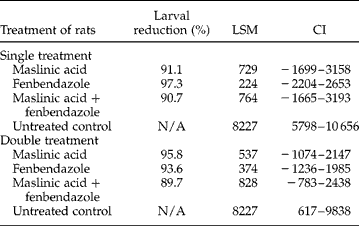
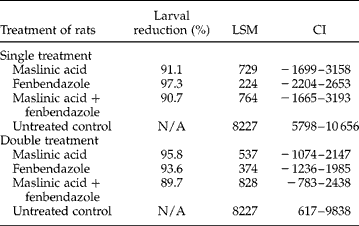
Log-transformed least square means (LSM) of Trichinella zimbabwensis larval counts and % reduction following a single (on day 25 pi) and a double (on days 25 and 32 pi) treatment regimen with maslinic acid, fenbendazole and a combination of the two. CI, 95% confidence intervals; N/A, not applicable.
Upon termination of the experiment, all experimental rats were sacrificed for the detection of Trichinella larvae in muscles as described by Pozio et al. (Reference Pozio, La Rosa, Rossi and Murrell1992).
Measurement of blood parameters
Blood was collected from the rats from day 0 pi on a weekly basis until the experiment was terminated, for the determination of glucose. Blood glucose was tested immediately at each collection using an Accu-Check® Active (Roche, Randburg, South Africa) glucometer (Smith & Marais, Reference Smith and Marais2004). Levels of creatine phosphokinase (CPK) and lactate dehydrogenase (LDH) from collected sera were determined using an automated chemistry analyser (Labmax Plenno, Lagoa Santa, Costa Brava, Brazil) in accordance with the manufacturer's recommendations.
Data analysis
Efficacy rates for each drug and combination were calculated as the percentage of recovered worms versus those recovered from control rats (De la Rosa et al., Reference De la Rosa, Álvarez and Gómez-Priego2007). The reproductive capacity index (RCI) for each group was calculated by dividing the recovered number of parasites by the number of muscle larvae given for infection (Fernandez & Wakelin, Reference Fernandez and Wakelin1989).
General Linear Models Procedure (Proc GLM) was implemented in the SAS program (SAS, 2004) to assess the differences of the efficacy of the six drug regimens against the control, using the log transformed mean larval counts. Subsequently, multiple pairwise Bonferroni comparison was used to assess the efficacy between the treatment regimens. Comparisons of the CPK and LDH levels were assessed using the regression procedure (Proc Reg) in SAS (SAS, 2004).
Results
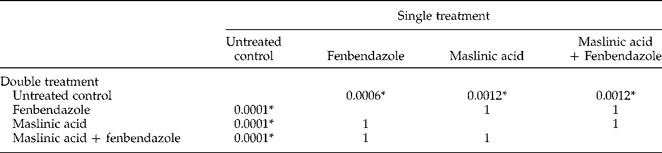
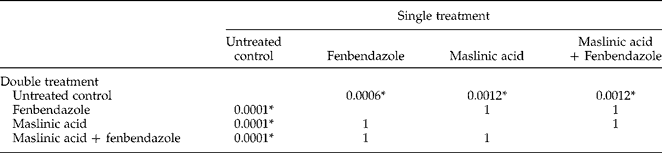
Maslinic acid, fenbendazole and combination single treatments cleared 91.1%, 97.3% and 90.7% of the larvae, respectively (table 1). Double treatments eliminated 95.8%, 93.6% and 89.7% of the larvae, respectively (table 1). Both single treatment on day 25 pi and double treatment on days 25 and 32 pi from each drug regimen reduced the larvae, although there was no significant difference in the reduction rate among the treated groups (P>0.05). The Bonferroni pairwise comparison of the efficacy of the six drug regimens in the single and double treatments showed a significant reduction in larval counts compared to the untreated control group (P< 0.01); however, there were no differences in the larval counts among the single-treated groups and those treated twice (P>0.05) (table 2). No apparent synergistic effect was observed on the combination of maslinic acid and fenbendazole in reducing larval burden in both single and double treatments (table 1). While there was no significant difference in efficacy among the six treatment regimens, maslinic acid was slightly more effective than fenbendazole at double treatment. There was no significant difference in RCI between the groups in both single and double treatments (P>0.05).
Multiple pairwise comparisons of least square means derived from the Bonferroni test of single (on day 25 pi) and double (on days 25 and 32 pi) treatment regimens of Trichinella zimbabwensis larvae in rats; * Significance at P<0.01.
Levels of LDH and CPK were reduced in rats treated with all drug regimens (P< 0.05) in comparison to the untreated control group. However, comparison of enzyme level among the six treatment regimens did not yield any significant difference (P>0.05). On day 21 pi, LDH and CPK levels were at maximum levels in all treated groups. When treatment was introduced on day 25 pi, the two enzyme levels decreased in all treated groups, and this trend continued until the experiment was terminated on day 46 pi. The untreated control group followed a similar trend as the treated groups, with a decrease of both enzyme activities after day 25 pi. The drop was not significantly different (P>0.05) when compared with the treated groups. CPK levels of the untreated control group were high between day 21 and 25 pi, whereas the fenbendazole-treated rats had the highest levels of LDH on day 21 pi.
Blood glucose levels were reduced in rats given maslinic acid single treatment and maslinic acid double treatment after day 32 pi. After fenbendazole single and double treatment, rats had increased blood glucose levels on days 28 and 35 pi. After combination single and double treatment, rats had increased blood glucose after day 35 pi. The untreated control group showed increased blood glucose after day 35 pi. The average weight of the rats increased for all treatment groups, including the untreated control, and there was no significant difference in the growth rates among the groups.
Discussion
Recently, attention has turned to medicinal plants or plant-based traditional medicines for the discovery and development of new pharmaceuticals (Fabricant & Farnsworth, Reference Fabricant and Farnsworth2001), and the potential of alternative drug formulations and/or molecules from medicinal plants for the treatment of helminth parasites (Shalaby et al., Reference Shalaby, El Namaky, Khalil and Kandil2011).
Our study showed that maslinic acid and fenbendazole are efficacious in significantly reducing the larval burden of T. zimbabwensis after a single or double treatment. However, the efficacy of the combination of the two drugs did not exceed the efficacy of the individual drugs after single and double treatments. This is in agreement with Mukaratirwa et al. (Reference Mukaratirwa, Magwedere, Matenga and Foggin2001) who showed that fenbendazole is efficacious after a single and double treatment in BALB/c mice. The current results for maslinic acid could not be compared to any previous studies since the compound has not been tested for anthelmintic effects in tissue-dwelling nematodes. The increased efficacy of maslinic acid after double treatment suggests that the compound may be more effective if the number of treatments is increased. An increased dosage of maslinic acid was not tested in this study, but the results suggest that increased dosage could also be effective in clearing the infection, provided there are no side-effects.
Infection of rats with T. zimbabwensis has been reported to significantly increase the levels of LDH and CPK, due to muscle damage induced by the migrating larvae (Soliman et al., Reference Soliman, Taher and Mahmoud2011). Increased levels of LDH and CPK are characteristic for Trichinella infection (Capo & Despommier, Reference Capo and Despommier1996). In our study, the reduction in the levels of LDH and CPK in the treated rats may be due to the larvicidal activity of the drugs used (Soliman et al., Reference Soliman, Taher and Mahmoud2011), especially at day 25 pi. The present findings were supported by those of previous studies (Koudela & Schanzel, 1980; Kociecka, Reference Kociecka2000; Soliman et al., Reference Soliman, Taher and Mahmoud2011).
Blood glucose levels in the maslinic acid treated groups were significantly reduced compared to those of the untreated control, fenbendazole and combination groups. In a previous study by Jun et al. (Reference Jun, Sun, Duan, Mu and Zhang2007), maslinic acid was reported to inhibit glycogen phosphorylase inhibitor and also contributed to glycogen metabolism (Liang et al., Reference Liang, Zhang, Li, Liu, Li, Zhang, Chen, Cheng, Zheng, Wen, Zhang, Hao, Gong, Zhang, Zhu, Chen, Liu, Jiang, Luo and Sun2011). Glycogen phosphorylase is an enzyme that catalyses the process of glycogenolysis (Liang et al., Reference Liang, Zhang, Li, Liu, Li, Zhang, Chen, Cheng, Zheng, Wen, Zhang, Hao, Gong, Zhang, Zhu, Chen, Liu, Jiang, Luo and Sun2011). A reduction in glycogenolysis via the inhibition of glycogen phosphorylase is one of the possible mechanisms of how blood glucose might have been lowered in the maslinic-treated groups in this study, confirming reports that this compound has potential in improving hyperinsulinaemia in type 2 diabetes (Liu et al., Reference Liu, Sun, Duan, Mu and Zhang2007).
To the best of our knowledge, this is the first report to show that maslinic acid exhibits anthelmintic effects on tissue-dwelling nematodes.
Acknowledgements
We would like to thank all the laboratory staff in the Parasitology Laboratory, School of Life Sciences, as well Biomedical Research Unit staff for looking after the animals.
Financial support
Financial support was from the National Research Foundation of South Africa (Incentive funding for rated researchers programme).
Conflict of interest
None.
Ethical considerations
Ethical approval for the study was obtained through the Animal Ethics Research Committee of the University of KwaZulu-Natal (reference number 08/13/Animal). Where applicable, we adhered to ARRIVE guidelines for reporting in vivo animal experiments (Kilkenny et al., Reference Kilkenny, Brown, Cuthill, Emerson and Altman2010).