“Of all the quadrupeds that have lived upon the earth, probably no other species has ever marshaled such innumerable hosts as those of the American bison. It would have been as easy to count or to estimate the number of leaves in a forest as to calculate the number of buffaloes living at any given time during the history of the species previous to 1870.” (Hornaday 1889)
Introduction
An estimated 40–60 million bison, Bison bison (L.), populated the plains of North America prior to European settlement (Soper Reference Soper1941). Based on estimates for cattle, Bos taurus L. (Marsh and Campling Reference Marsh and Campling1970), each animal deposited about 25 kg of fresh dung daily, providing an abundant, nutrient-rich, and moist habitat for coprophilous insects. In North America, for example, cattle dung supports more than 450 such species (Blume Reference Blume1985), and individual pats may contain several thousand insects (Mohr Reference Mohr1943; Merritt and Anderson Reference Merritt and Anderson1977). However, by the end of the 19th century, only a few hundred bison remained (Hornaday 1889; Isenberg Reference Isenberg2000).
With the demise of bison, what became of their dung-breeding insects? Bison and cattle are closely related species that hybridize to produce fertile offspring (Hornaday 1889; Peters Reference Peters1958; Freese et al. Reference Freese, Aune, Boyd, Derr, Forrest and Cormack Gates2007). Both species are generalist foragers that feed primarily on grasses (Poaceae) and sedges (Cyperaceae) (Vuren and Bray Reference Vuren and Bray1983; Plumb and Dodd Reference Plumb and Dodd1994). These genetic and dietary similarities are reflected in their dung, which is similar in shape and consistency. Prior to about 1640 there was an initial mass importation of cattle from Europe to the eastern United States of America, with a subsequent increase in their numbers and westward distribution into the historic range of bison (Bowling Reference Bowling1942). This co-occurrence allowed for the exchange of insects between dung of the two animal species, such that cattle dung now supports a mix of native and European taxa (Macqueen and Beirne Reference Macqueen and Beirne1974; Floate and Gill Reference Floate and Gill1998; Bertone et al. Reference Bertone, Green, Washburn, Poore, Sorenson and Watson2005). For these reasons, it is reasonable to hypothesize that all insect taxa from bison dung may have avoided co-extinction by persisting in cattle dung (the “extant” hypothesis).
Conversely, the diets of bison and cattle are not identical. Bison preferentially graze on warm-season (C4) grasses and do not normally browse on shrubs, whereas cattle prefer cool-season (C3) grasses and do feed on shrubs (Peden et al. Reference Peden, Dyne, Rice and Hansen1974; Vuren and Bray Reference Vuren and Bray1983; Plumb and Dodd Reference Plumb and Dodd1993). Furthermore, variation in dung quality can affect insect development. Coprophilous flies that develop in dung of pastured or hay-fed animals may be unable to breed in dung of cattle fed high levels of grain (Meyer et al. Reference Meyer, Christensen and Knapp1978; d'Amato et al. Reference D'Amato, Knapp and Dahlman1980). Changes in dung quality caused by seasonal variation in forage growth affect the size and (presumably) fecundity of dung-breeding flies (Diptera) (Greenham Reference Greenham1972; Easton and Lysyk Reference Easton and Lysyk1986) and beetles (Coleoptera) (Lee and Peng Reference Lee and Peng1982). Thus, there is some justification for hypothesizing that these dietary differences may have limited the suitability of cattle dung as habitat for insects that bred in bison dung, so some insect species may have gone extinct when cattle replaced bison. We formulate this as the “extinction” hypothesis.
We cannot directly test whether the near extinction of bison led to the extinction of insect taxa. After all, how does one identify the loss of species from an insect assemblage without complete knowledge of its original components? In the current study, however, we examine this question indirectly by providing (to our knowledge) the first experimental comparison of bison dung with cattle dung as habitat for coprophilous insects. In one experiment, we compared the level of attraction of insects to dung of the two host species. In the second experiment, we compared the development of insects in this dung. Lack of a host effect, or greater recovery of native species in cattle dung, was viewed as support for the extant hypothesis. Greater recovery of native species in bison dung was viewed as support for the extinction hypothesis.
Materials and methods
Dung was collected from bison fed mixed natural grass and hay (B) and from cattle fed hay supplemented with about 10% grain (C). Because we were unable to obtain dung from cattle and bison on identical diets, we also collected dung from cattle fed barley (Hordeum L., Poaceae) silage (CS). Treatments B versus C tested for an effect of host, largely unrelated to diet. Treatments C versus CS tested for an effect of diet, albeit limited to the cattle host. Dung was collected fresh (<6h old) from multiple pats, thoroughly mixed, and held at −20oC until used. To avoid the potential confounding effect of chemical residues in dung (Floate et al. Reference Floate, Wardhaugh, Boxall and Sherratt2005, Reference Floate, Bouchard, Holroyd, Poulin and Wellicome2008; Lumaret et al. Reference Lumaret, Errouissi, Floate, Römbke and Wardhaugh2011), source animals were untreated with veterinary products for at least 6 months prior to dung collection.
Water content and carbon and nitrogen levels were measured for each treatment. To calculate water content, samples of fresh dung (ca. 30g per sample, five samples per treatment) were weighed, freeze-dried, and reweighed. These samples were subsequently finely ground and subject to a modified Dumas combustion method to measure carbon and nitrogen contents.
Experiment 1
The effect of dung treatment on the attraction of coprophilous beetles was assessed using baited pitfall traps on unshaded native pasture near Purple Springs, Alberta (approximately 49°49′N, 111°53′W). Each trap comprised two plastic pails (1 L capacity), one nested inside the other, buried with the lip of the trap level with the soil surface. The outer pail prevented the hole from collapsing. The inner pail held a preservative (propylene glycol formulated in a commercial product sold as a nontoxic antifreeze) and was easily removed to recover insects collected during the trap period. A wire screen (ca. 6 mm grid) over the mouth of each trap supported a dung bait and excluded rodents and birds.
Traps were positioned in five clusters of three (n =15 traps). A minimum distance of 10m separated each cluster, with a distance of 2m between traps within clusters. Three traps per cluster were baited; one trap with B, one trap with C, and one trap with CS dung. Baits comprised dung (ca. 75g) wrapped in two layers of cheesecloth. Traps were emptied and rebaited twice weekly from 4 June to 11 August 2009 to obtain 19 trap-catches per treatment. Specimens were stored in 70% ethanol until sorted, counted, and identified.
Experiment 2
To assess the effect of dung type on insect development, artificially shaped pats (0.5 L per pat, 20 pats per treatment) were singly deposited on a 1 cm deep layer of sand (ca. 240mL) in a Styrofoam plate (23cm in diameter). Plates with their pats were placed outdoors at the Lethbridge Research Centre (approximately 49°42′N, 112°46′W) on 1 June 2009 on an unshaded level area adjacent to a pasture with grazing cattle. Pats were placed in a grid of 10 rows (5m between rows), with two pats per treatment placed in random sequence (3m between pats) in each row. In this manner, insects were provided with an equal opportunity to colonize and oviposit in the dung of each treatment. After 5 days, plates and their associated pats were brought indoors and placed in individual emergence cages held at room temperature (ca. 20°C) with a 16L:8D cycle.
Cages were 11 L pails (Product No. 723, ProWestern Plastics Ltd., St. Albert, Alberta) fitted with fine-mesh sleeves to prevent the escape of insects emerging from pats. Adult insects were removed from cages weekly until no further emergence was observed — a period of 6–12 weeks. Specimens were stored in 70% ethanol until sorted, counted, and identified. Distilled water (50mL) was added weekly to the sand in each plate to reduce insect mortality due to desiccation.
Adult beetles that had colonized dung pats in the field often remained in the pats when the pats were placed in emergence cages. These “colonists” were identified by their recovery in the first 3 weeks after pats were placed in cages, a period too short to allow egg-to-adult development in the pat. All other insects (“progeny”) were assumed to have developed from egg to adult in the pat (see Floate Reference Floate and Gill1998). Separate analyses were performed on colonists and on progeny.
Statistical analyses
Water content and carbon and nitrogen levels were normally distributed and compared among treatments using ANOVAs with Tukey's post-hoc tests. Data for experiments 1 and 2 were highly variable across samples and could not be corrected for normality. Hence, treatment effects were assessed using Kruskal–Wallis analyses with Mann–Whitney U post-hoc tests. Analyses were arbitrarily limited to taxa represented by at least 50 individuals. As a precaution against low statistical power, all analyses were performed with a critical P value of 0.05, modified with sequential Bonferroni corrections (Rice Reference Rice1989).
Results and discussion
Water content and nitrogen and carbon levels in dung varied with host species and diet (Table 1). Results for cattle were comparable with previous reports. The water content of fresh cattle dung is typically 80%–90% (Valiela Reference Valiela1969; Lysyk et al. Reference Lysyk, Easton and Evenson1985; Dickinson and Craig Reference Dickinson and Craig1990; Barth et al. Reference Barth, Karrer, Heinze-Mutz and Elster1994) but as low as 71% (e.g., Morgan and Graham Reference Morgan and Graham1966). Nitrogen levels typically range from 1% to 2% (e.g., Dickinson et al. Reference Dickinson, Underhay and Ross1981; Lysyk et al. Reference Lysyk, Easton and Evenson1985). We were unable to locate published reports on bison dung, for which values in our study fell within the range reported for cattle.
Water content and carbon and nitrogen levels in dung from bison fed mixed natural grass and hay (B), from cattle fed hay supplemented with about 10% grain (C), and from cattle fed barley silage (CS).

Note: Values are given as the mean ± SE (n =5). Values followed by a different letter within a row are significantly different (ANOVA, P = 0.05).
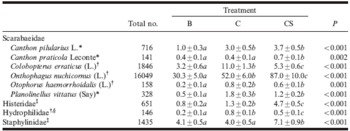
For experiment 1, analyses were performed on nine taxa that comprised 99.2% of the 21369 coprophilous beetles recovered (Table 2). Other taxa were represented by fewer than 50 individuals. Although the latter taxa were not identified, lists of species recovered from dung-baited pitfall traps at this site during an earlier study are provided in Floate (2007). Treatment affected pitfall catches in all cases, but neither native nor European taxa preferred bison dung (B) over cattle dung (C and CS). Six taxa differentiated between C and CS dung, illustrating a strong effect of host diet when host species was held constant. Because captured insects are unlikely to escape from pitfall traps, these patterns were interpreted as a response by insects to variation in long- and short-range odour cues associated with the different treatments.
Experiment 1: numbers of beetles (Coleoptera) collected in pitfall traps baited with dung from bison fed mixed natural grass and hay (B), from cattle fed hay supplemented with about 10% grain (C), and from cattle fed barley silage (CS).

Note: Values are given as the mean ± SE (n =19). Values followed by a different letter within a row are significantly different (Kruskal–Wallis test, P = 0.05).
* Native.
† Of European origin.
‡ Probable mix of native and European species.
§ One or more of Sphaeridium bipustulatum Fabricius, S. lunatum Fabricius, and S. scarabaeoides (L.).
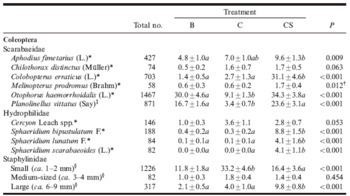
For experiment 2, 10659 insects were recovered from emergence cages, of which 5848 beetles (18 taxa) were identified as colonists. Analyses performed on 13 taxa of these colonists (5725 beetles) identified an effect of treatment in nine cases (Table 3), with results similar to those of experiment 1. No taxa preferred bison dung (B) over cattle dung (C and CS). Eight taxa differentiated between C and CS dung. Unlike experiment 1, insects that colonized treatment pats had the option of leaving during the period when the pats were exposed in the field. Hence, the latter patterns were attributed to variation in colonization and residency times among treatments.
Experiment 2 (colonists): numbers of coprophilous beetles attracted to artificial pats formed from dung from bison fed mixed natural grass and hay (B), from dung of cattle fed hay supplemented with about 10% grain (C), and from dung of cattle fed barley silage (CS).

Note: Values are given as the mean ± SE (n =20). Values followed by a different letter within a row are significantly different (Kruskal–Wallis test, P = 0.05).
* Of European origin.
† Not significant after sequential Bonferroni adjustments.
‡ Native.
§ Probable mix of native and European species.
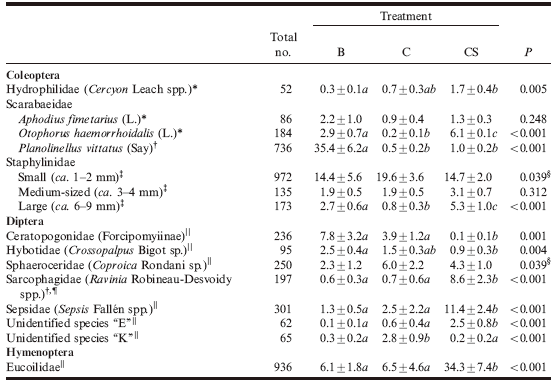
Progeny comprised 44 taxa (4811 individuals) for which analyses were performed on 15 taxa (=4480 individuals). The remaining taxa were not identified. However, a list of insects reared from cattle dung at this site during an earlier study is provided in Floate (1998). An effect of treatment was detected in 11 cases (Table 4). It is of particular interest that 96% of the progeny of the native species Planolinellus vittatus (Say) (Coleoptera: Scarabaeidae) were recovered from B dung, although similar numbers of colonizing adults were retrieved from B and CS pats (Table 3). These data appear to identify P. vittatus as a bison-dung specialist and, when viewed in isolation, provided the strongest evidence in the current study that populations of a dung-breeding insect may have declined with the demise of bison. However, Ratcliffe (1991) reported the recovery of larvae of P. vittatus from horse dung, Gordon (1983) classified it as a native generalist, Floate (1998) reared several thousand P. vittatus individuals from cattle dung, and North America currently houses 112 million cattle (Statistics Canada 2011; United States Department of Agriculture 2011). Thus, P. vittatus arguably may be more abundant now than prior to European settlement. Of the remaining 10 taxa whose progeny number varied with treatment, 6 were most abundant in CS dung, 2 in B and C dung, 1 in C dung, and 1 in C and CS dung.
Experiment 2 (progeny): numbers of insects completing egg-to-adult development in dung from bison fed mixed natural grass and hay (B), from dung of cattle fed hay supplemented with about 10% grain (C), and from dung of cattle fed barley silage (CS).
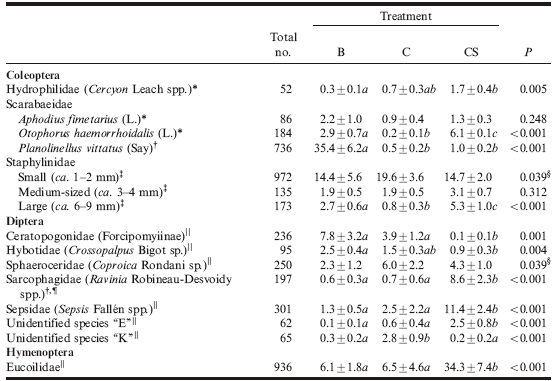
Note: Values are given as the mean ± SE (n =20). Values followed by a different letter within a row are significantly different (Kruskal–Wallis test, P = 0.05).
* Of European origin.
† Native.
‡ Probable mix of native and European species.
§ Not significant after sequential Bonferroni adjustments.
∥ Of unknown origin.
¶ Likely one or more of Ravinia anxia (Walker), R. planifrons (Aldrich), and R. querula (Walker) (see O'Hara et al. Reference O'Hara, Floate and Cooper2000).
The overall results of the current study support the hypothesis that those insect species once associated with bison dung are present today in cattle dung. Only 4 of 37 cases (combined across Tables (2–4)) indicated that taxa preferred dung of bison (B) to that of cattle on a similar diet (C). In three of these cases, however, equal (Table 3: Otophorus haemorrhoidalis (L.) (Coleoptera: Scarabaeidae)) or greater numbers (Table 3: P. vittatus; Table 4: O. haemorrhoidalis, Staphylinidae (Coleoptera) — large) of insects preferred dung from cattle fed silage (CS). The only apparent exception (Table 4; P. vittatus) is addressed in the preceding paragraph. In contrast, insects differentiated between dung of cattle on different diets in 22 cases. Thus, insects were much less affected by differences in host species (bison versus cattle) than by differences in host diet.
This does not preclude the possibility that some species may have gone extinct following the near extinction of American bison, but convincing evidence thus far is lacking. Extinction would require extreme adherence to bison dung in the presence of dung from a closely related species on the same diet. We are unaware of any coprophilous taxa demonstrating this level of discrimination. For example, Gordon (1983) identified a group of dung beetles (Scarabaeidae) associated with deer dung, but there was no suggestion that they discriminated among dung of different deer species, and many of its members readily use dung of other mammals, e.g., rabbit, horse, cow, sheep. Indeed, most taxa associated with cattle dung are not dung specialists per se, but rather predators and parasitoids on immature stages of taxa that feed on bacteria and (or) fungi in dung (e.g., see Mohr Reference Mohr1943; Laurence Reference Laurence1954; Skidmore Reference Skidmore1991). The latter taxa can be common in diverse non-dung habitats that provide suitable conditions for microbial growth. Perotti and Lysyk (2003) reared the coprophilous horn fly, Haematobia irritans (L.) (Diptera: Muscidae), on agar supplemented with nutrients and various combinations of bacteria. Fredeen and Glen (1970) reared the coprophilous fly Leptocera caenosa (Rondani) (Diptera: Sphaeroceridae) for 60 generations in an Erlenmeyer flask provisioned with different non-dung media.
A corollary to these findings is that the diversity of arthropod taxa that breed in bovine dung in North America has perhaps doubled with European settlement. Macqueen and Beirne (1974) reported that almost half of 55 beetle and fly species recovered from cattle dung in the interior of British Columbia were of European origin. In southern Alberta, Floate and Gill (1998) recovered 17 species of dung beetles, of which 8 were of exotic origin. The pest-species house fly (Musca domestica (L.)), stable fly (Stomoxys calcitrans (L.)), horn fly, and face fly (Musca autumnalis De Geer) (Diptera: Muscidae) are non-native. Known or likely exotic beetle species in cattle dung in Canada also include at least 7 species of Histeridae (Bousquet and Laplante Reference Bousquet and Laplante2006), 11 species of Hydrophilidae (Smetana Reference Smetana1978), and 15 species of Staphylinidae (Bousquet Reference Bousquet1991).
In summary, the current study is the only one of which we are aware to experimentally compare dung of bison with that of cattle as habitat for dung-breeding insects. Data for 15 native and European taxa show that each is able to complete development in dung of either host (Table 4). Although by no means conclusive, these results support the hypothesis that the native species of insects that once bred in bison dung remain extant in cattle dung. We do not deny that populations of some native species likely have declined since European settlement began. However, such declines are better attributed to the conversion of native prairies to agro-ecosystems than to the demise of bison.
Acknowledgements
Paul Coghlin, Laura Wilde, Roger and Irene Marsh (Tacarsey Bison Ranch), and Ken Smith are thanked for their assistance in the completion of this study. This is Lethbridge Research Centre Contribution No. 387-11021.