

1. Introduction
1.1. Perhaps the single-most important point in this paper is that liquidity has a cost. If it did not, all assets would be liquid. Indeed, it would be rather difficult to explain the seigniorageFootnote 1 collected by central banks from the issuance and distribution of money, or to devise explanations of the transmission channels through which central bank open market operations work if this were not the case. The cost of liquidity should be strictly non-negative.Footnote 2
1.2. Much actuarial literature considers it to be illiquidity that commands a premium; unfortunately, while it may be argued this is just a difference in terminology, viewing the world in this way can confuse or mislead. If liquidity comes without cost, we should demand ever more. The private sector would be most unlikely to provide liquidity on these terms; nor could the banking system, which faces many limitations such as regulation, practically create money or liquidity on this scale. Private money and credit are far larger than public,Footnote 3 but there are limits, and this has remained the case even in the post-crisis world of overgrown central bank balance sheets.
1.3. To be clear, when considering the relative price of assets, an “illiquidity premium” accruing to the investor is equivalent to a liquidity cost. Ceteris paribus, liquid assets cost more than illiquid ones. This is logical in that liquidity is an option on realisation for cash. In practice, it is convenient to compare prices with the most liquid, low risk asset (usually government bonds) as the market price of that asset is readily observable. However, this approach can obscure the mechanism that liquid asset prices are being driven up, in part, by the price of liquidity itself, rather than being a necessary compensation for investing in an illiquid asset. The liquid yield curve lies below the illiquid, to the extent that this can be observed, for any given credit standing. If investors were presented with the additional cost to them of holding their liquid assets, it might well prompt a more thorough consideration of the need for this liquidity. Of course, some holders of liquid securities are operating under regulatory encouragement or compulsion.
1.4. There is substantial empirical evidence that liquidity risk, which arises from changes in specific liquidity and liquidity conditions, is priced in markets (see e.g. Fontaine et al., Reference Fontaine, Garcia and Gungor2013). Whether such changes result in gains or losses for those exposed depends on the actual changes realised in the period considered. This view of the cost of liquidity does resolve the long-standing practitioner debate over the existence of a “liquidity risk premium” in equity markets.
1.5. There is something of a dichotomy in the academic literature on the question of liquidity. Most of the microstructure literature considers liquidity to be beneficial, whereas much of macroeconomics does not. Keynes’ (Reference Keynes1936) comments are worth quoting: “Of the maxims of orthodox finance none, surely, is more anti-social than the fetish of liquidity, the doctrine that it is a positive virtue on the part of investment institutions to concentrate their resources upon the holding of ‘liquid’ securities. It forgets that there is no such thing as liquidity of investment for the community as a whole”. In elementary modern finance, such as the capital asset pricing model, liquidity is both free and perfectly available. In such a world, credit would be available without limit, which it clearly is not.
1.6. Keynes’ reference to the illusion of liquidity, that it would not be possible for all to sell assets simultaneously in any market is most important. This is rather more than the usual relation where supply and demand are regulated by price and quantity. It requires us to recognise an inherent instability; that liquidity may disappear in an instant. This is the stuff of bank runs and market crashes. The illusion persists as long as we collectively observe the convention that it is adequate and do not seek to hoard cash. This is not a unique property of liquidity; it applies to many goods and services.
1.7. The need for liquidity management in practice arises from a lack of synchronicity between receipts and payments. With liquidity perfectly available without cost, this could never represent a problem; an institution could always simply borrow to make immediate payments. This characteristic could be expected to result in unlimited demand, whereas no incentive would exist to produce liquidity. Tobin (Reference Turner1963), the economics Nobel laureate, argued that banks do not possess such a “widow’s cruse”, referring to a biblical story in which a widow is able to miraculously refill a cruse (a pot or jar) of oil during a famine. There are self-evidently limits and constraints on the extent to which private banks may create monetary liquidity, but one of the open questions around quantitative easing is the extent to which this also applies to central banks.
1.8. One of the main issues with liquidity is systemic in nature; the willingness and ability of the banking system to distribute liquidity across financial markets and banks. This systemic commonality can have profound consequences for diversification effects in financial asset portfolios. It is also important in the context of the financialisation of our economy and society, but this aspect is not considered in this paper.
1.9. We shall describe liquidity as the “moneyness” of an asset;Footnote 4 the degree of inter-exchangeability of money and the asset. In section 2, we therefore start by providing some context on money itself, before then linking monetary theory to liquidity. We then examine alternative ways of organising exchange that do not rely on money, as well as considering the concepts of trust and confidence that underlie all markets (this is the convention of not challenging the illusion of liquidity), and which can be most noticeable by their absence. One key point for debate is the extent to which collateralised trades reduce liquidity flows and hence the consequences of the current direction of regulation for financial institutions. An important point to consider is whether the current regulatory drive on liquidity is likely to enhance or reduce liquidity for market participants and outsider users of markets.
1.10. In section 3, we move on to look at liquidity proper. Agents will be concerned with default; here cash is king and managing liquidity means providing assurance about having cash in the future. Market liquidity affords investors the luxury of a lack of commitment to their investments. A multiplicity of models has been devised to consider the liquidity of assets, asset classes and markets, and its evolution. This modelling requires measurement, and in section 3, we highlight the challenge faced by us. The sheer number of liquidity proxies highlights the limits of our current understanding.
1.11. Liquidity risk, or the change in the liquidity properties of an asset, also tends to be asymmetric; assets tend to become more liquid only slowly over time, whereas new information, as well as breakdowns in the illusion convention, can rapidly lead to a very swift destruction of liquidity in a given market or security.
1.12. In section 4, we consider liquidity of markets. We highlight how some terminology can cause confusion, for instance, with derivatives where liquidity of the contract does not necessarily lead to material flows of money between creditors and debtors, and hence does not encourage the flow of liquidity around the wider economy. To first order, markets do not create liquidity for economic actors, they simply allow for its redistribution.
1.13. In section 5, we view liquidity from an institutional viewpoint, covering both financial investors and wider corporate treasury functions. We try to raise the bar in common actuarial thinking about how we should aspire to model liquidity in asset portfolios, facilitating better decision making about the relative attractiveness of different assets with both differing yields and liquidities. We also comment on the role of liquidity acting as a risk management mechanism; sceptically stating that it facilitates speculation on price movements rather than fundamental assessment of the cash flows underlying long-term investment in assets.
1.14. In section 6, we take a tour of US bond markets in recent years, as a study in assessing liquidity in practice.
1.15. In section 7, we consider liquidity regulation and policy; a very active area given the evolution of Basel III and CRD IV. It is also highly topical given the continuing momentum towards mark-to-market regulatory models and the ensuing and undesirable pro-cyclicality this induces.
1.16. Finally, in section 8, we conclude and summarise the major questions actuaries and analysts should be asking themselves about liquidity, when implementing investment and asset liability management strategies.
2. Money Matters
2.1. Investors want liquidity as they value the option of liquidating an asset for money. This might be because they have liabilities that need to be met in cash, to finance discretionary spending or because they may wish to remove their economic exposure to that asset.
2.2. It is worth noting in passing here that there is a distinction between investor-specific reasons for crystallising the asset (e.g. liabilities of that investor) compared with broader market reasons (e.g. secular change in views on the attractiveness of an asset class). Where the investors’ motivation for selling the asset is due to changes in market views, liquidity can disappear when it is most desired.
2.3. However, in this chapter, we focus on money itself. We start with a definition of money in the modern world, before moving on to consider monetary theory, alternatives to money and then trust, confidence and guarantees, which are essential to the function of money in society as well as to markets. A key challenge for the current direction of regulation emerging from this chapter is the extent to which collateralisation actually reduces liquidity transfer through the financial system. Given the potential for a scarcity of collateral (Singh, Reference Singh2013), and the impact on these reduced liquidity flows, this is potentially a major issue. Although Hauser (Reference Hauser2014) claims that the idea of a collateral crunch is no more than a myth.
2.1. Money
2.1.1. Money is a type of IOU, but one that has been given special status (e.g. as legal tender),Footnote 5 so is trusted by everyone in an economy. There are three main types of money: currency, bank deposits and central bank reserves. Money is special because in most circumstances everyone in the economy trusts that it will be accepted as a form of payment (McLeay et al., Reference McLeay, Raida and Thomas2014).
2.1.2. Classically, we view a loan from a bank as creating the corresponding bank deposit; a purely inside and balanced activity.Footnote 6 There is no need for any pre-existing savings deposit to create this money. Indeed, if many savers choose to hold deposits, that is, to hoard liquidity, rather than make investments or consume, there would be a sub-optimal level of investment and concomitant lack of consumption demand.Footnote 7 This is a real economic cost. When inside money is created by banks in this way, it is extinguished by the discharge of the loan.
2.1.3. Werner (Reference Zhou2014) gave an insightful critique of the standard economic view of money creation and interest rates as a price of money. In particular, he expounded that in rationed markets (where supply or demand are limited), the short side (i.e. the side with the lower limit) had power to impose non-market costs on the long side; simply, there was no theoretical reason or empirical evidence that the market would clear any other way. Given that we might reasonably postulate that the demand for money is infinite, this makes the supply side the side with power, and as banks dominate the money supply through credit creation, the banks have the power and the corresponding responsibility of managing this public good.
2.1.4. We shall describe liquidity as the “moneyness” of an asset;Footnote 8 the degree of inter-exchangeability of money and the asset. These assets may be real or financial contracts. Money, of course, is to an extent self-referential. Money is what people accept as money (King, Reference King2006). Abstractly, it is a symbol of trust. Here, a little caution is needed, as the need for money will arise from distrust – we use money precisely because we will not accept private debts as money. “Distrust is the root of all money” (Kiyotake & Moore, Reference Kiyotake and Moore2001). In rather crude terms, we accept money because we trust that it will be accepted by others in future.
2.1.5. Liquidity is a broad concept that encompasses money. There are assets that we would not ordinarily consider as money which are liquid. However, liquidity is less a fundamental attribute of an asset and more a diagnostic of the state of the market in that asset; we can sell an asset only if there is a corresponding buyer. The price of any asset is driven by the supply and demand for it, and that is driven in turn by the attributes of the asset, as well as other factors such as the state of the economy, attitudes to risk, taxes and other government policies.
2.1.6. The standard taxonomy of money is that it serves as a unit of account, means of payment, medium of exchange and store of value. As a unit of account it is merely a record and need have no physical form. Its role as a means of payment is obvious in the legal tender context mentioned earlier. As a medium of exchange, it becomes more interesting as, by the simple process of deferring payment for an exchange, we may create money. As a store of value, it offers certainty in nominal terms, which no other financial instrument does. In result, flights to cash are well known in times of high uncertainty.
2.1.7. These roles may interfere with one another. Although it is obvious that we may always save and use money as a store of value, this restricts the use of this money in other roles, such as means of payment. Banking may be seen as a method of alleviating this interference issue.
2.1.8. The desirable properties of money, rather than the functions with which we are principally concerned, were enumerated by Jevons (Reference Jevons1875):
1. utility and value;
2. portability;
3. indestructibility;
4. homogeneity;
5. divisibility;
6. stability of value; and
7. cognizability.
This latter term, cognizability, refers to the ease of recognition or verification of an instrument.Footnote 9 Many of the design features of securities that enhance their liquidity can be seen as attempts to reproduce some aspect of these seven properties. The degree to which technological progress has altered the relative importance of these properties would be an interesting study for a historian.
2.1.9. The legal tender status of money assures payment finality in transaction completion. The difference between money in its role as a means of payment and as a medium of exchange is one of timing – in payment the exchange of money and good are usually simultaneous, but as a medium of exchange, they may be separated in time, and arranged through the acceptance of a financial instrument. When exchange is separated in time, the participants in the trade will be concerned with the creditworthiness of each other, an underwriting process that is a recurring theme through our considerations of liquidity. The confidence with which we believe others will make payments to us is intrinsically linked to how much liquidity we expect them to have in future. Credit is an expectation of liquidity.
2.1.10. For institutional liquidity, it is primarily the exchange of money and securities in electronic rather than physical form that is relevant; this motivates, in part, the consideration of the payment and settlement systems in section 4.2.
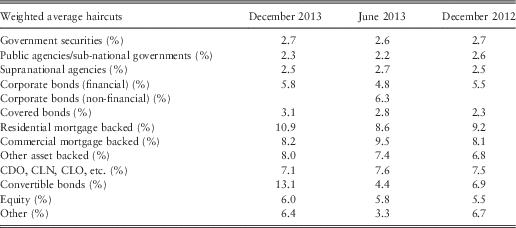
2.1.11. Money is the medium through which markets mainly operate. However, it is not uncommon for assets to be exchanged for other assets rather than their cash equivalent – in, for example, bulk annuitisation. This is transfer in specie. We will briefly discuss barter in section 2.3. Assets can also serve as collateral, though usually not at face value. The discount (“the haircut”) applied to collateral in, for example, repo transactions, is usually considered as a risk management device, but it has antecedents in the concept of Divisia money.Footnote 10
2.1.12. “Haircuts” also serve, in a manner similar to the deductible of an insurance policy, as a mitigant of moral hazard; they increase the likelihood of performance (i.e. repayment) by the borrower of funds under the repo contract.
2.1.13. The Bank of England produces a Divisia index for money, which weights the growth rate of each of the M4 component assets according to the extent to which they are estimated to provide transaction services. These weights are a function of the interest rate on the asset, such that assets with a higher interest rate are assumed to provide fewer transaction services. This weighting method could be subject to criticism. This could be viewed as an attempt to reconcile the immediate and the term structure properties of liquidity in current terms.
2.1.14. The US Federal Reserve used to publish a broad money index– the L series, which included some US Treasury securities. The US Centre for Financial Stability (AMFM). Makes the following observation: “Extensive published results demonstrate that the best monetary aggregate for almost all uses was the Federal Reserve’s former broadest aggregate, L, but only if computed as a properly weighted index number, such as the Divisia or Fisher-ideal index”.Footnote 11
2.1.15. It is clear that the recent crisis was much exacerbated by the decline in prices of many securities that were widely used as collateral in repo and other transactions. The widening of “haircuts” between 2007 and 2009 has been widely documented. Many securities, such as AA and lower-rated mortgage-backed securities (MBS) and structured products, became entirely ineligible as collateral security, even for the best counterparty credits. This contraction in broad money was very substantial and should have been expected to have the contractionary economic effects that came to pass.
2.1.16. In this light, the Bernanke statement in the summer of 2007 to the effect that the stock of sub-prime mortgages was insufficient to cause systemic banking issues was correct. He observed, accurately, that there were only $750 billion of these mortgages in existence, far less than the banking system’s capital resources, and they were indeed not very important in terms of monetary aggregates. (Equity in the banking system is a substitute for liquidity, which lowers the likelihood of confidence-based runs and permits lower liquidity buffer holdings.)
2.1.17. However, this omitted consideration of the $4 trillion nominal of inside mortgage derivatives are written mainly on the ABX-HE indices. When the prices of these index contracts and synthetic securities based upon them plummeted, they resulted in inside liquidity flows (i.e. flows among the banks, hedge funds and others) of the order of $1.5 trillion, under mark-to-market credit support agreements and other covenants. These ABX indices are syntheticFootnote 12 and, like all such products, magnify the consequence of an event in the referenced assets (Keating & Marshall, Reference Keating and Marshall2010a); to the extent that contracts are written on these indices, the losses experienced are larger than the actual losses on real mortgages.Footnote 13
2.1.18. This had pronounced effects in the distribution of liquidity within and among many financial system institutions, and resulted in collapsing market prices, as liquidity-constrained owners sought new and replacement liquidity to finance assets that now had far lower collateral value. One of the notable channels for these liquidity calls and pressures was under the lines of credit written by sponsors and other banks in support of earlier mortgage securitisations. We shall return to this later towards the end of section 2.3.
2.1.19. The changing nature of the monetary base became an issue during the early monetarist years of the Thatcher government, when targets for broad and narrow money were being set. Though originally formulated in 1975, Goodhart’s law is relevant: “As soon as the government attempts to regulate any particular set of financial assets, these become unreliable as indicators of economic trends”. This is because investors try to anticipate what the effect of the regulation will be, and invest so as to minimise the consequences or perhaps even to benefit from it.Footnote 14 However, the concept is considerably older, and closely related ideas are known under different names, for example, Campbell’s Law,Footnote 15 and the Lucas critique.Footnote 16 The Lucas critique is implicit in the economic idea of rational expectations. Although it originated in the context of market responses, the law has profound implications more generally for the selection of high-level targets in organisations.
2.2. Monetary Theory and Liquidity
2.2.1. Since at least Clower (Reference Clower1965), modern monetary theory has revolved around three propositions:
1. Money may buy goods and goods may buy money, but goods cannot buy goods.
2. Money is always a debt.
3. Default on debt is possible.Footnote 17
2.2.2. It should be realised that money is not a good that can be produced by labour. Furthermore, money does not directly satisfy the needs and desires that motivate the production of goods – in more popular expression: you can’t eat money.
2.2.3. Money as debt led Hyman Minsky to say that anyone can create money, but the problem is to get it accepted. There is no intrinsic economic barrier to private monies, no absolute requirement that it should be a state monopoly. Indeed, through much of history, public and private monies circulated alongside one another (Reference HoganHogan, 2012). Digital currencies, such as Bitcoin, are a current illustration as are “local” currencies such as the Brixton pound. This immediately raises questions of liquidity and default. As Charles Goodhart has argued, one of the reasons that general equilibrium economic models find no role for money is that their single representative agent has that agent as both creditor and debtor; a situation in which it would be profoundly irrational for default to occur. Werner (Reference Zhou2014) succinctly argued that actually looking at a general equilibrium model is the wrong place to start for any empirical insight given that no markets are ever likely to be in equilibrium.
2.2.4. Default is the failure to redeem a debt when validly presented for payment. One consequence is that, in these elementary economic models, all can borrow at the risk-free rate and there is never a liquidity constraint; another is that financial institutions such as banks, which perform credit assessment, intermediation and monitoring roles, are redundant.
2.2.5. Recent academic and regulatory work has focussed on increasing the realism of economic models, so that the role of banks and their associated networks are incorporated with liquidity being explicitly present and considered. We introduce some ideas of this nature in section 5.3.
2.2.6. The legal tender status of a (sovereign) currency is not in itself sufficient to establish demand for that currency; demand for a currency arises from the sovereign ability to levy and collect taxes, fees and fines payable in that currency. The other and more voluminous uses are incidental to this.
2.2.7. A sovereign debtor is unique in that it may discharge its debts by the further issuance of money, which is merely an extension of its own indebtedness. An individual or institution cannot, in general, discharge its own liabilities by the issuance of further liabilities; forbearance, or the acceptance of further debt in discharge of a maturing debt, requires the debtor to exhibit continuing good faith and usually requires the prospect of improved circumstances. For all other than the sovereign, it is usually necessary to exchange their obligations for this state money, and this is where liquidity enters into consideration; the inter-exchangeability of different assets for state money.
2.2.8. Several commentators have noted that monthly rollover of payday loans is now commonplace for some individuals. This is simply an instance of forbearance, and has clear limits, if secure and responsible lending is the objective. Ultimately, the discharge of these debts, as will all others, will require liquidity, though this may be greatly reduced in an insolvency or bankruptcy process. The common elements to such processes are that liquidity demands are stayed and schemes of rearrangement or liquidation imposed, which may result in receipt of far less than was previously contractually due.
2.2.9. This need to pay in state money leads to risk management practices such as the holding of high stocks of central bank reserves by banks, relative to their levels of loan creation, as cushions against the uncertainties of this exchange or conversion. This is liquidity hoarding and in excess can limit economic growth and activity. Both access to the central bank for high-powered money and deposit insurance serve as mitigants of this exchangeability uncertainty; in result, inside bank money is more widely accepted and used by the public than might otherwise be the case.
2.3. From Barter to Bitcoin
2.3.1. It is notable that from most elementary economic textbook expositions, it would be reasonable to assume that barter markets existed before markets utilising a monetary medium of exchange. However, there is no evidence that this was in fact the case, anywhere.
2.3.2. The traditional barter exposition of money purports that the production of goods arises before exchange enters the picture; money merely resolves the problems of uncertainty associated with the exchange of those finished goods. It fails to acknowledge that some working capital (money) is needed for the production process. The order of events is over-simplified; most production requires financing before it takes place.
2.3.3. As we shall see in section 4.3, there are analogies between barter markets and investor-only order-driven securities markets. Many electronic crossing networks use investor order-matching algorithms.
2.3.4. It is, of course, possible to organise markets for trade and investment under systems that are not liquidity based. Some, such as Amato & Fantacci (Reference Amato and Fantacci2012) have argued, loosely following Minsky, that liquidity is the bedrock of our current system of capitalism. This was the heart of Keynes’ original proposal of Bancor and an international clearing union, which was recently revived by Governor Zhou (Reference Zigrand2009) of the Peoples Bank of China. It is also evident that it is possible from the long-standing Swiss co-operative WIR (Z/Yen, Reference Turner2011), which manages and issues a private currency, the WIR franc.
2.3.5. Readers interested in financial systems, which eliminate money, would do well to commence by reading Silvio Gesell’s 1904 “Die Naturliche Wirtfschaft Ordnung” (The Natural Economic Order) and then proceeding to local exchange trading systems, which in fact exist quite widely in Canada, Australia and New Zealand, and are perhaps best known as the Danish and Swedish J.A.K. systems. This latter system operates through the Swedish Postal Service. Internationally, barter or countertrade is estimated by the World Trade Organisation and varies over time between 15% and 40% of all trade conducted.
2.3.6. The problems of the requirement for a double coincidence of wants in barter trade extend beyond merely finding some counterparty. For example, once you have found someone to trade with there is the question of the quantity each of you desire of each other’s goods and some goods are not divisible. Technology, such as the internet, can reduce the costs of finding a counterparty; a search cost. Untraded goods, such as haircuts, would be problematic, as indeed would be the method of paying employees. The tales of East Europeans being paid in tins of pickled fish or vegetables were not entirely apocryphal. Money really is our primary risk management tool.
2.3.7. It is notable that these systems, where formalised, were, from time to time, outlawed, such as during the 1930s depression in Germany and Denmark. We should also note that trust is as central an element to these systems as it is in conventional banking.
2.3.8. It is also notable that the spread of technology and the internet has seen the introduction of several virtual monies. Some, such as Mondex, have slipped from public memory. Currently, Bitcoin is the centre of much debate and controversy.
2.3.9. It is interesting that Milton Friedman foresaw such developments in 1999: “I think that the internet is going to be one of the major forces for reducing the role of government. The one thing that’s missing, but that will soon be developed, is a reliable e-cash, a method whereby on the Internet you can transfer funds from A to B without A knowing B or B knowing A. The way I can take a $20 bill hand it over to you and then there’s no record of where it came from”.
2.3.10. He also foresaw the potential for criminality: “You may get that without knowing who I am. That kind of thing will develop on the Internet and that will make it even easier for people using the Internet. Of course, it has its negative side. It means the gangsters, the people who are engaged in illegal transactions, will also have an easier way to carry on their business”.
2.3.11. With Bitcoin now the focus of attention, it is worth considering how well it satisfies Jevons’ earlier properties set out in 2.16.
2.3.12. The price and volatility of the Bitcoin crypto-currency fail any test of stability of value, let alone indestructibility, which would be required for widespread, everyday use. Indeed, the Economist has reported disparities in price between differing Bitcoin exchanges that have been as much as 50%.
2.3.13. FTAlphaville (2013, 2014) has a series of fascinating articles on Bitcoins, covering their use as a store of value, seignorage, and whether they are a way to break through the zero lower bound for interest rates. Among other things, Bitcoins offer an interesting empirical experiment into monetary theory.
2.4. Trust and Confidence
2.4.1. Trust and confidence are central elements to well-functioning markets. Trust in our money is obvious. As noted earlier; money is a symbol of trust. We also need to have trust in the represented quality of the goods or assets offered in markets. Standards have a role here both as benchmarks and as devices to minimise enforcement costs.
2.4.2. We should distinguish between trust and confidence, though both concepts refer to expectations that may lapse into disappointments. We trust that markets will function as we expect, but we have confidence in the ability of our doctor to cure our ills. The latter question of ability is a competence characteristic, whereas in the former the concern is with motivation or predisposition.Footnote 18 We can have confidence in the ability of the ATM to deliver cash, but we should also recognise that it does not have any functional flexibility, a characteristic of relations of trust.
2.4.3. A number of authors have diagnosed the financial crisis as a question of trust and proposed remedies accordingly;Footnote 19 by contrast, we might see this as the breakdown of the convention that in financial markets, we ignore much uncertainty and risk in pursuit of the gains from trade. This convention is sometimes known as “market confidence”, an absence of challenge to the liquidity illusion.
2.4.4. Some further distinction between convention and trust is necessary – a convention exists because it provides mutual benefit while trust is unnecessary unless there is a risk of loss, requiring commitment. Driving on the left is one illustration of a convention; it benefits all drivers. Conventions, which often involve simplification, are an enabler for price comparison and serve to reduce perceived information asymmetry.
2.4.5. In the early 1970s, with vivid imagery of “lemons”Footnote 20 in used car sales lots, George Akerlof gave us important insights into the effects of adverse selection and uncertainty in markets.Footnote 21 As we do not know the quality of the car as well as the selling owner, we are exposed to the possibility of exploitation, and reflect this in the price we offer to pay. As the potential information asymmetry mounts, distrust prevails and trade declines – then prices reflect only “lemons”, poor-quality cars.
2.4.6. This is a variant on Gresham’s law, that the bad drives out the good. In the absence of convention, this unfortunate situation, which is a question of trust, will prevail and markets cease to function.
2.4.7. When discussing market valuation in the General Theory, Keynes observed that “In practice we have tacitly agreed, as a rule, to fall back on what is, in truth, a convention.... Nevertheless the… conventional method… will be compatible with a considerable measure of continuity and stability in our affairs, so long as we can rely on the maintenance of the convention” (italics from the original).
2.4.8. The financial crisis has reminded us of this convention for market confidence. It is a behavioural regularity that sustains itself because this serves the interests of everyone involved. In more normal times, Chuck Prince’s infamous words on this subject would not have earned him such evident opprobrium. This is also why, before the onset of crisis, a risk manager’s cautions were usually disregarded and ignored, like Cassandra; these cautions were a challenge to the convention that allows the pursuit of the gains from trade.
2.4.9. The central insights for the analysis of convention and its problems of co-ordination have been known for at least as long as Akerlof’s “lemons”; Lewis’ (Reference Lewis[1969] 2002) seminal work and Aumann (Reference Aumann1976) gave a rigorous mathematical underpinning to the topic.
2.4.10. The analytic key to convention is the concept of common knowledge, where the members of a group have similar knowledge and understanding, and also know that all others possess this knowledge. The situation is the old chestnut where you know that I know that you know, and so on, and clearly is related to Keynes’ beauty contest analogy for markets, where to win the competition it is necessary to predict the face most attractive to others, rather than the face most attractive to ourselves.
2.4.11. Technology, by making price comparison easy, obviously resolves search issues. Moreover, by propagating common knowledge and enabling trust in the seller through more information disclosure, it may also enhance liquidity in some markets (e.g. buying used cars on eBay).
2.4.12. Transparency and disclosure are not necessarily unconditional goods, though they are often presented and promoted as such, usually in terms of providing a level playing field among market participants. If the advantage of an institutional investor relative to a retail investor came from the collection of data, then clearly disclosure could level the playing field. But, if as seems more likely, the relative advantage of the institutional investor came from their analysis, processing the data, then disclosure will exacerbate the inequality of the playing field. We return to this in more detail in section 7.5.
2.4.13. The iterated self-referential nature of the concept of common knowledge makes it complicated and best explained by simple example.
2.4.14. The time-honoured illustration is of an island inhabited by people who have either blue or green eyes. There are no mirrors on this island, so no one can know the colour of their own eyes, but of course, they can observe the colour of all other eyes. The etiquette is that people who know they have blue eyes should leave the island immediately and that discussion of eye colour among the inhabitants is taboo. No one will leave the island in this situation.
2.4.15. Now, we will introduce a truth-telling visitor who informs the island population that there is at least one blue-eyed islander present. This is hardly new information; all of the green-eyed islanders can see all of the blue-eyed present. Those who are blue eyed can also see the other blue-eyed islanders present. The information disparity is slight. If there is just one islander with blue eyes, he now knows immediately that he must have blue eyes as all other islanders are visibly green eyed, and immediately leaves.Footnote 22 If there are many (say, M) blue-eyed islanders present then they will leave together on the same day, after that many (M) days have elapsed.Footnote 23 The visitor is merely a catalyst, who induces the subsequent and later movement of islanders by the single statement.
2.4.16. This should resonate with market practitioners; how many times have we heard explanations for market movements and liquidity events that we thought were decidedly old news? The market movement only occurred after the news had become common knowledge, and was widely understood. We revisit this topic in section 3.5 when considering the breakdown of the floating rate note market in the mid-1980s.
2.4.17. The deteriorating condition of the sub-prime mortgage market was widely known long before the route set in; researchers from the Federal Reserve of St Louis (Demyanyk & Van Hemert, Reference Demyanyk and Van Hemert2008) have found that the quality of loans deteriorated for 6 consecutive years before the crisis and that securitisers were to some extent aware of it.
2.4.18. By the end of March 2007, the ABX (2006–2) BBB indices were trading (or not) at prices between 70% and 80% of notional value, and the slide down from there was precipitous. Academic studies (Fender & Scheicher, Reference Fender and Scheicher2009) of the pricing behaviour have concluded that the price declines suffered far exceeded those warranted by fundamental default experience. From being positively self-reinforcing markets became negatively self-destroying – and this was spread by practices such as mark-to-market valuation.
2.4.19. By summer 2007, continued denial of the problems and uncertainty, maintenance of the conventionFootnote 24 in pursuit of the gains from trade, was no longer viable for market participants, and market breakdown ultimately ensued. By year-end UBS, Citibank and Morgan Stanley had all cited the ABX indices when reporting their write-downs of mortgage assets. To the extent that these indices were reflecting more than default experience, this was a channel for contagionFootnote 25 and exaggerated loss marking, which lowered the banks’ perceived risk-bearing capacity. The question of contagion effects is an externality that impairs the public good value of liquidity; in earlier parlance, an economic externality was often referred to as a public nuisance.
2.4.20. These indices clearly conditioned the market for breakdown, but also served another purpose. They are contractible – derivatives may be based upon them and cash settled.Footnote 26 Like all indices, they greatly facilitate the writing of over-the-counter (OTC) derivatives as they lower the “lemons” problems of adverse selection and asymmetric information associated with specific tranches of specific mortgage securities that would usually reduce or eliminate trade. These derivatives were, by design, efficient devices for both hedging and speculative purposes, though the real underlying assets are subject to the “lemons” problem. The basis risk between an index and specific securities can also be considered as a form of insurance policy deductible, a risk mitigant to the writer.
2.4.21. There is evidence that these index-based contracts were used extensively; in the case of Goldman Sachs, mortgage short positions reached 53% of the firm’s total value at risk (Memorandum to Members of the Permanent Subcommittee on Investigations, 2010). Fender & Scheicher (Reference Fender and Scheicher2008) noted that “with markets reportedly overwhelmed by large speculative short positions, market liquidity… has been impaired…”.
2.4.22. Market confidence, the convention, requires that the fundamental soundness of counterparties is commonly believed by market participants. This is a highest common factor, which admits a role for research and information discovery in fundamental credit analysis, and indeed provides specific role for banks. Trust though is not necessarily the issue here.
2.4.23. Trust is redundant in the absence of a risk of loss. There may be nothing that we can do to rebuild trust, but there is much that we can do to enhance our own trustworthiness. The aspects of trustworthiness most relevant in the financial services sector are (O’Neill, Reference O’Neill2012):
∙ competence;
∙ reliability; and
∙ honesty.
2.4.24. The challenge is to prove our trustworthiness. Most of us can certainly improve our competence and reliability. Of course, we can practice, demonstrate and signal all of these, which should increase the willingness of others to place their trust in us. Information exchange between the parties allows them to surmount jointly the problems of interpretation of ambiguities.
2.4.25. Intelligible disclosure can reduce these problems, as can stating exogenous motivations. “Selling the car because I am moving to the West Coast” is an example. Analysis of web-based markets suggests that providing more information about your car, even if, on the whole, that discloses negative information, such as bump or scratches, tends to increase the price, all else being equal. Perceived uncertainty is reduced and trust encouraged in this example.
2.4.26. Communication is a critical element here if ambiguities in interpretation are to be avoided.
2.4.27. Reputation is important in the context of the trustworthiness of an institution; it encompasses all of the attributes listed above. The abuse of reputation is an obvious ill, but may be possible and repeatable when institutions have market power. However, we also saw actions in defence of reputation during the crisis, which in hindsight were probably misguided (the repurchase of securitised loans).
2.4.28. Some of these actions were undoubtedly intended to signal financial strength, but in general signalling, which must be costly to be effective, may be wastefully expensive. In the case of the asset-backed commercial paper (ABCP) conduits, the damage was already done to a large extent; these were interventions after the withdrawal of short-term funding – the run had already happened.
2.4.29. In markets we also introduce norms and conventions, which also serve the purpose of reducing costs. With norms and conventions all parties benefit. These are co-ordination-enhancing measures. Standardisation of quality and quantity for a good or commodity is perhaps the classic introduction of a convention. The emergence of formalised commodity exchanges in the nineteenth owe much to their ancillary role in verifying the quantity and quality of the commodity traded. Before this, costly verification was necessary at all points of delivery of the exchanged goods. Settlement could prove extremely problematic, even for the seller, as the buyer has incentives to reject adequate deliveries satisfying minimum standards. The independence of the verification was valuable to all.
2.5. Guarantees
2.5.1. Guarantees are substitutes for trust; they will not enhance it, though they may increase exchange activity. Reducing the hazard or consequence does not improve the degree of commitment or trust; rather it reduces it. The Stock or Commodity Exchange standing as central counterpart to all trading in its markets is an example, which increases confidence and enhances co-ordination by eliminating the need to verify the credit standing of a buyer.
2.5.2. Collateral, which lowers (risk) exposures, is another trust substitute. There are several problems with collateral security supporting a transaction. As collateral is, itself, a form of liquidity, collateralised transactions have lower effective net liquidity flows and higher costs. Collateral arrangements are substitutes for trust-based agreements and co-operation, and can be expected to crowd them out. They serve to increase our confidence rather than our trust; market liquidity based upon confidence-enhancing measures usually involves an increase in gross liquidity, with a simultaneous decrease in net liquidity flows.
2.5.3. The security grantor/supplier of collateral have a lower stock of unencumbered liquid assets; this is sometimes referred to as “hollowing out”. It is clear that the position of a senior unsecured creditor can be undermined by the excessive use of collateralised financing, and unfortunately, in a manner which is not immediately transparent.
3. Liquidity Risk
3.1. The liquidity of an instrument may be considered as a real option for the holder of the security to negotiate or sell that security at a market price, and in common with options, generally, this has a cost to the holder of the option. A non-negotiable, but otherwise similar, instrument will cost the holder of the security less and have a higher current yield. The value of that option to each investor will vary, and supply and demand mean that the market price of liquidity will vary over time.
3.2. As with any other scarce resource there is value in managing liquidity, including understanding how it might change and seeking to mitigate our exposure based on our requirements and appetite for liquidity risk. We go further and ask whether the current desire for liquidity is even attractive, compared with the benefits of encouraging long-term investment. Liquidity affords investors the luxury of a lack of commitment to their investments. We also note the risk asymmetry with liquidity, which leads to a large left tail exposure for those (often unknowingly, or at least subconsciously) relying on liquidity in particular markets.
3.3. In this chapter, we start by looking at liquidity management, before moving on to the wide range of market measures of liquidity, noting that some measures of liquidity which focus on flows inside markets overstate real liquidity flows in the broader economy. It is these latter flows that lead to wider economic benefits. We then consider financial depth and liquidity risk and change. We conclude by revisiting the statement from Keynes about the lack of liquidity for investors as a whole.
3.1. Liquidity Management
3.1.1. The fact that liquidity has a cost means that we should be parsimonious with it. This is not motivated by some Victorian notion of thrift as a virtue, but because of the cost to the economy in sub-optimal output if we are spendthrift with it. Here there is also a precautionary motivation, as under uncertainty the private sector may not produce sufficient liquidity. Liquidity regulation and its associated demands for stocks and hoards of liquidity, to which we shall return in section 7, is important in this regard, and raises further questions as to the proxies and metrics by which we may measure and assess liquidity.
3.1.2. Appropriate management of liquidity at the level of institutions is not the same as the management of liquidity at the level of the economy. Optimal management of institutional liquidity may result in sub-optimal liquidity at the level of the economy and fail to be supportive to the social ends; these externalities can justify regulation of liquidity.
3.1.3. In order to manage, it is necessary to measure and there is a challenge in that liquidity is not explicitly priced. In a world without uncertainty and change the cost of liquidity would be fixed and equivalent to the “carrying” cost. In financial markets, where uncertainty and change are dominant characteristics, it is not possible to observe the price of liquidity directly. The consequence is that, to a greater or lesser extent, all measures of liquidity rely on some arbitrary separation of liquidity and value effects.
3.1.4. A number of points arise here: first, the nebulous nature and use of the term liquidity means that it can easily be used by the unscrupulous when in difficulty, as a device to shift liability, accountability and blame. Second, and more importantly, this makes riskless arbitrage or hedging activity all but impossible; almost any hedging strategy will introduce secondary liquidity concerns. For example, the corporate bond hedged with a credit default swap (CDS) is exposed to the possibility of margin calls on the CDS.
3.1.5. Decomposition of credit spreads into expected default loss and its uncertainty, with the residual being interpreted as liquidity using a Merton model has become standard practice. Such analyses regularly appear in Bank of England publications, such as the Quarterly Bulletin. Over the past 20 years, the residual or liquidity term has varied from as little as ten basis points in the mid-1990s to as much as 80 basis points in times of market distress.
3.1.6. Although this decomposition has a number of limitations, it does serve to illustrate several points. The first point is that liquidity, and changes in liquidity, may from time to time be the dominant factor driving the overall level of credit spreads available in markets. The second point is that it provides one explanation for the fact that market credit spreads appear far more volatile than might be expected from any fundamental analysis of insolvency likelihoods and their uncertainty.
3.1.7. Furthermore, this decomposition goes a long way to explain the empirically observed fact that the returns from corporate bonds, after consideration of default and credit migration, usually exceed the returns from otherwise equivalent portfolios of government bonds.Footnote 27
3.1.8. As the liquidity term in this decomposition is merely the residual term, it may exhibit negative values and indeed did at points in time during the period of the Great Moderation before the crisis. This can be interpreted as the security in question trading at a premium to its fundamental value or as the security price reflecting risk-seeking behaviour on the part of market participants.
3.1.9. In a world where the liquidity cost is fixed, the longer the holding period of the liquid instrument the lower the experienced return drag will be. As a simple analogy, if you purchase insurance but do not claim against it then you lose your premium (which is not to say the premium was of no value to you at the point of purchase). However, it is notable that the buyer of liquid “on-the-run” securities can expect in a long term buy and hold strategy to lose some or all of the price premium that these securities initially commanded when issued or trading as benchmark securities. This is akin to buying insurance for a risk that you plan not to expose yourself to.
3.1.10. The cost of the negotiability option is time variant in markets. The prices of assets are measured in money, but money itself has a time-variant price. This affords traders of securities the opportunity to speculate in changes in liquidity value. However, this is not the optimal way in which to seek to profit from changing liquidity cost.
3.1.11. The cost of market liquidity is not a pure dead weight. It affords uninformed traders the opportunity to participate in markets without incurring the costs of research and information discovery. However, such uninformed traders lack commitment to the securities they own – these are speculators to the extent that they seek gains from changes in market price and not necessarily from changes in the obligor’s fundamental circumstances. By contrast, informed investors will tend to be active in and hold illiquid instruments, where their research and analysis can be expected to be rewarded.
3.1.12. There are related issues arising in the context of corporate governance; the management and board of a company should engage with committed long-term investors. These investors have chosen voice and influence over exit by sale, and signalled their commitment by buying illiquid securities.
3.2. Market Liquidity Measures
3.2.1. In a simple market context, liquidity is the degree of negotiability, which means that there are several possible dimensions to, and consequently measures of, market liquidity. The most widely cited are due to the late Sir Andrew Crockett, a past General Manager of the Bank for International Settlements (BIS):
1. market “depth”, or the ability to execute large transactions without influencing prices unduly;
2. “tightness”, or the gap between bid and offer prices;
3. “immediacy”, or the speed with which transactions can be executed; and
4. “resilience”, or the speed with which underlying prices are restored after a disturbance.
3.2.2. As in so much of economics, there is much confusion over stocks and flows. Assets are part of the stock, and their exchange the flow. In monetary economics, the quantity theory is the usual statement:
 $${\rm MV\,}{\equals}{\rm =PQ}$$
The product of a stock of money, M, and its flow, V or velocity, is equal to the product of the price, P and quantity of exchange, Q.Footnote 28 Many of the confusions over liquidity arise from the lack of distinction between a stock and a flow.
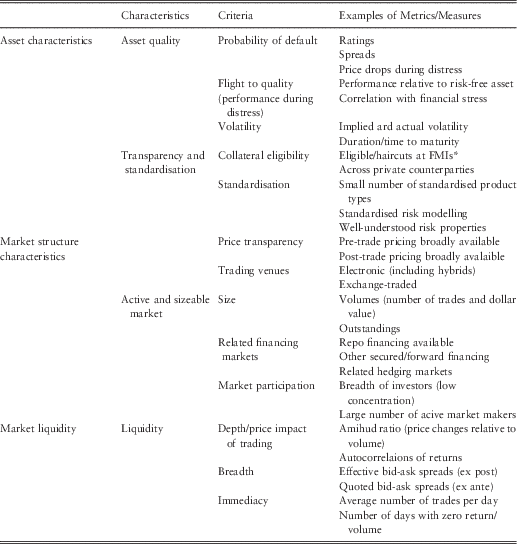
3.2.3. This relation also gives rise to the common classification of liquidity metrics as being either price or quantity in nature, but this taxonomy is incomplete. Many metrics, such as those related to volatility and resilience, defy such elementary classification. Figure 1 shows a taxonomy of market liquidity metrics (due to Holl & Winns, Reference Holl and Winn1995). It should be noted that many of these measures themselves have further issues – for example, how is market impact separated from execution costs. Box 1 discusses the range of metrics used in academic studies more fully. More than 80 different metrics have been used by academics.
A taxonomy of market liquidity measures – Holl & Winn (Reference Holl and Winn1995)

Some measures of market liquidity
Without digging particularly deeply into the existing literature on market liquidity measurement, we can find the following:
∙ Frequently used measures include the volume and frequency of trades, the turnover ratio, the bid-ask spread, the mean transaction size and the price impact of a trade (Fleming, Reference Fleming2003; D’Souza & Gaa, Reference D’Souza and Gaa2004).
∙ The negative of the auto-covariance in price changes (Bao et al., Reference Aumann2011).
∙ Latent liquidity using bond holdings data on buy-side clients (Mahanti et al., Reference Mahanti, Nashikkar, Subrahmanyam, Chacko and Mallik2008).
∙ Other measures, such as the number of trades and the number of market participants, are often regarded as readily observable proxies of market liquidity(BIS, 1999).
∙ A combination of three proxies for liquidity, which were (i) the bond’s age, (ii) the bid-offer spread and (iii) the amount of bonds outstanding (Nunn et al., Reference Nunn, Hill and Schneeweis1986).
∙ Examples of direct liquidity measures are quoted bid-ask spreads, effective bid-ask spreads, quote sizes, trade sizes, quote frequencies, trade frequencies and trading volume (Houweling et al., Reference Houweling, Mentink and Vorst2005). We quote: “ proxy this notion of liquidity with a yield dispersion statistic, which has not been used before in the literature”, and “define the yield dispersion … as the standard deviation of percentage yield differences relative to the mean”.
∙ In Ericsson & Renault (Reference Ericsson and Renault2001), a larger number of active traders competing for the same bond leads to a smaller price discount for illiquidity and thus a smaller yield premium. Alternatively, Gehr & Martell (Reference Gehr and Martell1992) and Jankowitsch et al. (Reference Jankowitsch, Mösenbacher and Pichler2006) argued that a larger number of market participants makes it easier to trade a bond, because it is easier to find a counterparty for a transaction and large orders can be split up into smaller parts without affecting the market price.
This survey is far from comprehensive and there are proxies for liquidity being elaborated at a faster pace today than at any time before the financial crisis. Given that caveat, the quotes above still yield 16 proxies for market liquidity; in summary, these are:
a. Number of market participants,
b. number of trades,
c. volume of trades,
d. frequency of trades,
e. turnover ratio,
f. bid-ask spread,
g. mean transaction size,
h. price impact of a trade,
i. negative auto-covariance of price changes,
j. latent liquidity,
k. number of the bond’s age,
l. amount of bonds outstanding,
m. effective bid-ask spreads,
n. quote sizes,
o. quote frequencies;,and finally
p. yield dispersion.
In combination, these proxies yield more than 80 variants which have been used in one or more studies.
3.2.4. There is an important distinction among types of market liquidity measure. These may be historic, based upon previous trading records (ex post metrics) or they may be based upon order flows, which can be considered current (real time) or possibly predictive in the short term. These can deliver markedly different information on liquidity conditions when estimated simultaneously at different points during evolving critical events. At these times, order-based measures can indicate diminished liquidity, whereas historic trade measures may indicate good or even improved liquidity. The classic example is that during crisis we may observe wide bid-offer spreads (an indicator of low liquidity) while simultaneously observing high transaction volumes.
3.2.5. Empirical comparison of different liquidity metrics shows them to be only weakly correlated with one another, which is to be expected to the extent that they are capturing different dimensions of liquidity. This weak correlation should not surprise as some relations such as those between price and quantity are expected to be negative. Meta-level analysis of samples of many different market liquidity metrics suggests that there are at least three different common factors present.
3.2.6. The cost of liquidity principally arises with the stock (M), while velocity (V) is concerned with the efficiency of recycling of that stock. Here payment systems and other market infrastructure may serve to limit what can be done, but velocity is, largely, a question of participants’ confidence and risk tolerance within a particular market infrastructure. Liquidity is a function of the velocity (V), but it is a condition of the stock (M).
3.2.7. Some of the confusion surrounding liquidity stems from the fact that it is related to both official liquidity and private liquidity, which interact with one another as is evident from the manners in which the private sector may amplify or damp official actions, and also to the endogenous nature of private liquidity. The dynamics of this endogenous private liquidity are important in both credit and liquidity cycles.
3.2.8. One metric that finds particular favour in official contexts, for example, the liquidity coverage ratio for banks, is the Amihud measure. This is the average of the ratio of the absolute price change to the volume traded. It is perhaps best considered as a price impact metric. It has been extended in some studies such that it may also be used as a spread metric.
3.2.9. Box 1 lists some of the more than 80 different measures of market liquidity that have been used in academic studies, and market liquidity is just one aspect of concern in this paper.
3.2.10. The multiplicity of measures of liquidity is partially explained by the dimensionality of equation (1). If we use a flow of real liquid, such as water in a river, as an analogy, we have a four-dimensional object; the cubic metre per second of a river flow.
3.2.11. The foreign exchange market is usually cited as the “most liquid” of all financial markets. The figures quoted are turnover or flow figures; approximately $4.5 trillion daily in early 2013. However, few ever pay much attention to the stock – in the case of US dollars, the external liabilities of the US banking system, which are approximately $4.5 trillion. All US liabilities held externally only amount to £12.2 trillion.
3.2.12. By any standard, this is a market with remarkable flow liquidity. Most of this flow is between dealer banks, and is exchange between insiders, which from the standpoint of the economy as a whole, is zero sum. The economic goal is to optimise outside exchange, so that all exchanges that are desired, and contribute to enhanced welfare, are accommodated. Put another way, very little of this activity is driven by any primary concern with trade or capital flows; some estimates place this real activity, the trade and investment capital flows, at <2% of the total.
3.2.13. As we may minimise the required stock of liquidity and its associated costs, by increasing the velocity of turnover, higher turnover in markets has been interpreted as unconditionally beneficial. However, there is an important caveat here; it is the velocity of outside liquidity exchange, which is the economic goal. We shall revisit this in section 4.5 in the context of high frequency trading.
3.2.14. We can also have large stocks of liquidity, but little exchange flow, and this has been part of the post-crisis problem, as central bank reserves have been hoarded. This is sometimes referred to as the problem of “pushing on a string”. The more usually problematic issue with money, its over-issuance resulting in price inflation, is concerned with money in circulation, and its velocity.
3.2.15. Liquidity does possess some aspects of a public good; it is our primary risk management tool in society. We should not leave the impression that the liquidity stock is fixed, though in normal times it is only slowly moving; in the fixed stock circumstance, liquidity risk could only arise from the circulation or velocity dimension.
3.2.16. In his discussion of liquidity-based regulation Zigrand (2014) observes: “As with stability, liquidity has a public good aspect and is therefore inadequately provided for in a laissez-faire setting. The central bank at the core of the monetary system plays the role of liquidity provider of last resort through its repo and haircut policies. Together with the regulator (say, through leverage constraints and the like that act like a tax), the central bank can therefore nudge the composition of the balance sheets of financial institutions towards the internalisation of these externalities”.
3.2.17. Liquidity is not created outside of the banking system, where this includes shadow banks. For example, listing private shares creates a liquid asset, but it does so by the exchange of liquidity in the IPO. The asset is liquid only in the sense that it may be realised for (greater) liquidity in the future.
3.2.18. Contrary to the belief held by some, and the analogy with water, there is no law of the conservation of liquidity. Far from it, liquidity is remarkably asymmetric, in that it is slow to improve but can be lost or destroyed in an instant, in much the same manner as can trust.
3.3. Financial Depth and Liquidity
3.3.1. Beyond the basic plumbing of payment and settlement systems infrastructure, the optimal quantum of liquidity depends on the financial depth and diversity of an economy and its investment institutions. Financial depth captures the importance of the financial sector relative to the economy. It is the size of banks, other financial institutions and financial markets in a country, taken together and compared with a measure of economic output. The composition and magnitude of financial depth of various countries and regions as estimated by the McKinsey Global Institute is shown in Figure 2.
Financial depth
3.3.2. To quote from that McKinsey study: “Expanded access to credit for households and businesses, more equity market listings by companies, and bonds issued to finance infrastructure projects are examples of healthy financial deepening. But financial depth can be also be inflated by such unproductive factors as equity market bubbles or unsustainable increases in debt and leverage. Overall growth in the value of financial assets does not automatically confer a positive effect on the real economy.Footnote 29 Looking back, we can see that several unsustainable trends that propelled most of the financial deepening that occurred prior to the crisis, in both advanced and developing economies. Chief among these factors was the growing leverage and size of the financial sector itself. Some of what appeared to be robust growth produced exuberance at the time but ultimately proved to be illusory”.
3.3.3. The degree of financial development is often confused by the amount of bank lending. Where bank lending is for infrastructure and new productive capital investment, it can be expected to increase economic output and have no effect on inflation. However, lending to wasteful projects – the notorious bridges to nowhere – will add to demand but not output, with the result that this introduces inflationary pressures to the economy.
3.3.4. Lending for the purchase of assets, either real or financial, will not directly introduce inflationary pressures – though it may through secondary routes such as wealth effects on consumption. This lending channel does little to increase the output of new goods or services, but asset prices may be chased ever higher. The art for the central banker is to curb this latter activity while maintaining the levels of productive investment.
3.3.5. Turner (Reference Werner2014) argues that financial theory over-simplifies the role of debt and consequent financial flows in facilitating growth. He demonstrates that in reality debt can be extended in excess, and does not actually finance new investment, and then in crisis leads to an overhang resulting from the asymmetric reaction of creditors and debtors in a recession. His debt classification is illustrated further in Figure 3.
UK debt classification 2009
3.3.6. When the assets created by bank lending cannot be sold (other than at impaired prices) or fully re-financed in money markets, a liquidity crisis is realised; the money previously advanced is recognised as lost.
3.3.7. It is generally believed that highly developed capital markets are highly complementary to a developed banking system; that these markets enhance the financial stability of the banking system. This could be the case if the banking system were simply selling assets or raising capital in these markets from time to time. However, there is evidence of a “seatbelt effect”; where drivers drive faster and more dangerously after the introduction of compulsory seatbelts. In this case, banks adopt larger, riskier balance sheet management strategies that rely upon access to the ongoing and continuous presence of markets rather than internally held provisions of capital and liquidity.
3.4. Liquidity and Liquidity Risk
3.4.1. Risk, of course, is all about change in a variable, and while liquidity itself has a cost, this may be compounded by liquidity risk, which can arise from either or both changes in the stock or the rate of its recycling or velocity.
3.4.2. There is a secondary aspect to this, which is that in the absence of reliable pricing models on which to construct hedges, highly liquid and persistent markets may serve to limit effectively the term of current position exposures. The dealer has the option to sell or liquidate the position in management of risk exposures, which is valuable to them.
3.4.3. Dealers may use active markets as a substitute for adequate pricing models. Active markets do not require commitment on the part of the dealer; to the dealer they constitute a real option on liquidity or nominal certainty. Adequate pricing models would admit effective hedging using factor components of the asset in question. This should not be confused with the dynamic hedging of options, based on dynamically trading the underlying. Even with option hedging, frictions and price discontinuities in trading the underlying asset introduce basis risk into the (option) hedging process.
3.4.4. Many derivative pricing models require trading in the direction of price change in their replication strategies. As the price of the underlying falls, so does the hedge ratio declines and some part (Gamma) of the hedging holding is sold. The converse is true of price increases.
3.4.5. These hedge processes can in effect be seen as momentum strategies. They are a feature of the development of bubbles and crashes. Here a fall in the price does not introduce new buyers but rather further sellers, or an increase in the price not sellers but further buyers, in marked contrast to the elementary theory of supply and demand. Departures from any notion of fundamental value may be pronounced. Hedging strategies differ from momentum strategies in that in order to maintain the hedge, the trend chasing behaviour is obligatory to maintain the hedge, whereas for momentum strategies it is voluntary.
3.4.6. Value investors tend to work in the opposite direction, buying at low prices and selling at high. So the stability of the market system depends, in part, upon the proportion of value and momentum investors present in it at any point in time.
3.4.7. It should also be realised that, for the development of a successful liquidity asset pricing model, strong commonality or systematic effects are necessary.
3.5. Liquidity Change
3.5.1. We should not forget that the link between previous liquidity and future liquidity in any security or class of securities may be extremely tenuous. However, we may observe that illiquid securities are usually extremely unlikely to become liquid; the few that achieve this status transition take a long time to do so. The transition from liquid to illiquid is far more common, and means that there is a risk asymmetry associated with liquidity.
3.5.2. Although the financial crisis offers some recent illustrations of such negative changes, there are many others. A prime example was the European floating rate note markets of the mid/late 1980s – these were predominantly subordinated bank debt, and very favourably treated in their recognition as regulatory capital. They traded in very large volumes at prices that were close to their par nominal values. There was little or no distinction between the creditworthiness of the issuer, or indeed the term of the securities. It was surprising but the majority of these securities came to be owned by banks, where they held these as part of the banks’ liquidity buffers.
3.2.3. The market slowly began to realise that these were in fact extremely risky bank capital instruments, and eventually there was a hiatus moment;Footnote 30 a day when prices collapsed and did not recover, and the note terms and institution-specific credit considerations came to the fore in pricing and trading. The quoted bid-offer trading spreads moved from having been around 0.1% in price to being 5.0% in price; round lot or normal trading size shrank as prices, in some instances, fell below 50% of nominal value. They moved from being the most liquid to being among the least liquid of all international bonds. This happened with no general securities market crisis or liquidity problems as a background.
3.5.4. Liquidity events for specific entities may also be triggered by actions in other corporate liabilities. Most outstanding unsecured bonds will decline markedly in price and liquidity when leveraged buy-outs are mooted. There is considerable debate as to the extent to which the returns to buy-outs have come from other creditors of the company in these situations.
3.5.5. Two recent official developments in the United States may prove important in this short-term liquidity regard and hold the prospect of significantly changing the US short-term securities markets: the issuance by the Treasury of 2-year floating rate notes, and the introduction of overnight reverse repo by the Federal Reserve.
3.6. Keynes Revisited
3.6.1. It is worth revisiting the Keynes quotation contained in the introduction and explaining what is meant by “It forgets that there is no such thing as liquidity of investment for the community as a whole”.
3.6.2. Obviously, the sale of a security for cash requires that there be a counterparty in the market who is prepared to buy that which we wish to sell. As we have seen during the crisis, this may not be the case, even after the price has already been adjusted dramatically downwards. If many wish simultaneously to achieve the nominal certainty of high-powered central bank money, asset prices must fall; the value of the stock of this money is far smaller than the market value of the stock of broader financial assets in normal confident times. The price falls in times of crisis are known as “fire sales”.
3.6.3. “Fire sales” may be motivated by fear, but are much more likely to arise as a consequence of regulation. Mark-to-market valuation of assets may induce fire sales of assets for insurance companies subject to a risk-based capital rules. During the recent crisis, some money market funds found themselves taking possession in default of the collateral securities supporting their repo advances, but found that these assets were equities and long bonds, which were not eligible investments for them, and of which they then became forced sellers.
3.6.4. The liquidity of markets permits an investor to realise assets in short-time scales; it is then no longer necessary to hold that bond or asset until receipt of coupons and principal is achieved. What matters now is not whether the bond can be expected to perform in due and contracted course, but the price at which it can be sold.
3.6.5. This has numerous consequences, from the decline in credit underwriting standards in the “originate and distribute” business model, to accounting, and even in central bank monetary operations, such as quantitative easing. Liquidity affords investors the luxury of a lack of commitment to their investments.
3.6.6. Liquidity is the mechanism that allows market value dominance to occur as it eliminates the time dimension, that is, the necessity to buy and hold, and relatedly, encourages speculation rather than investment. Selling a security reverses the maturity transformation undertaken by the investor. The difficulties that were observed with many proposed regulations, such as Solvency II for long-term guarantees, are rooted in this problem of time consistency and most evident at long time scales.
4. Liquidity and Markets
4.1. Liquidity is much concerned with realising assets for cash; and much trading happens in markets. Therefore, the natural next step in our journey is to look more closely at markets, how they operate and the impact this has on liquidity for investors.
4.2. Markets cannot create wealth, though they can be important in its redistribution. In any primary sense, they do not create liquidity, and financial markets are now principally concerned with the exchange of liquidity among participants. Liquidity is finally transferred when the transaction actually settles, and understanding those settlement processes and their limitations in a time of market stress is an important part of tail risk management. The growth of repo over unsecured interbank lending, despite regulatory pressures on balance sheet size, highlights how credit concerns among banks can lead to lower net liquidity flows.
4.3. In this section, we start by looking at liquidity in markets themselves, before moving on to consider how deals are settled through payment and settlement systems. From there we consider market makers and their role in providing liquidity both in normal times and at points of market stress, before having a more in-depth look at the highly important repo market and conclude this section by considering the information held in market prices.
4.1. Liquidity in Derivative and Cash Markets
4.1.1. We distinguish between two different types of market – cash markets, such as stock exchanges or bond markets, and derivatives market (futures and similar). Cash markets clearly are concerned with immediate liquidity – modified only by the clearing and settlement time cycle.
4.1.2. Derivative market are in fact concerned principally with future liquidity, that is, the insurance aspect of liquidity. The highly traded interest rate swaps, which so many refer to as extremely liquid, in fact involve no transfer of funds at contract inception (and usually also no transfer of collateral unless there is a material mismatch in the credit risk status of the counterparts) if the contract is fairly priced. This is a “liquid” market involving no immediate exchange or transfer of liquidity; were it not for counterparty credit considerations, we should expect such markets to expand almost without limit. As subsequent times, the swap will have an explicit value that reflects the changes in conditions since inception.
4.1.3. Many other markets, such as futures market, by design involve only trivial transfers of liquidity or collateral at transaction inception. These are the initial and subsequently variation margins. These contracts are all concerned with future liquidity and are driven by change in price – the liquidity flows occur under variation margin or credit support agreements. These are markets designed for speculation rather than investment.
4.1.4. The usual presentation of the origins of futures and derivatives market such as the futures exchanges for agricultural products is that they allow a transfer of risk from producer to consumer by means other than physical delivery. It seems that, in many instances, the transfer is in fact to the financial sector rather than consumer, but it is argued that this supports investment. Nonetheless, these instruments, which draw their value from changes in some underlying, are risk management tools.
4.1.5. However, the farmer hedging his crop in the field has already made the investment. It may be true that, in the absence of the ability to hedge this crop at later stages in its growth, the farmer may not have made the investment in planting crops in the first place, but that is a case of the farmer being prepared to make an investment only if it can be made short term.
4.1.6. To consider a further example, when the oil price underwent a large and sustained rise in recent years, airline hedging strategies merely delayed the inevitable. They may have lessened the immediate blow, but they could not mitigate the fact that the airline industry is highly exposed to the oil price. No airline could hedge that exposure out for its corporate lifetime. The decision on the hedging strategy was largely one around “value” of the price being locked into, which did have an impact on business plans and shareholder value, albeit not necessarily on the fundamental value of the airline and its strategy.
4.1.7. Markets are venues (real or virtual) for the negotiated exchange of property, where money is the medium of exchange. It is as well to remember that financial markets are quite limited in their potential – there is a tendency, as exemplified by James Carville’s desire to be reincarnated as the bond market,Footnote 31 to overstate what markets can do, usually anthropomorphising them in the process.
4.1.8. As noted earlier, markets cannot create wealth, though they can be important in its redistribution. They may facilitate through their exchanges the creation of wealth among outside actors, for example, by allowing greater specialisation in production among these actors. In any primary sense, they do not create liquidity – they are merely one of the conduits through which the economy’s monetary savings are brought to the users of those savings.
4.1.9. These users include households, government and industry. In a secondary and minor sense, markets may create liquidity through the higher prices that may prevail – the money stock would be higher. However, the majority of their action is through efficient organisation of the liquidity available, known in the economics jargon as co-ordination – a velocity or distribution effect.
4.1.10. The economic benefits, however, accrue from efficient outside allocation, not necessarily from increased activity among insiders. In fact, markets can only do what we, collectively, permit them to do. However, they can on occasion be the bearer of messages that are most unwelcome.
4.1.11. Markets have two closely related functions such as price discovery and co-ordination. Price discovery is theoretically concerned with the mechanism by which information is reflected and revealed, whereas co-ordination might alternately be described as liquidity transfer. As noted already, there is an identification problem here between information effects and liquidity. To give a concrete example, is the realisable price of the asset low because the fundamental value is low, or because it is illiquid and it is hard to find a seller. There is value in knowing the answer to this, particularly when many markets are concurrently illiquid, in terms of devising a trading strategy that meets liquidity requirements now with the minimum destruction of value.
4.1.12. In recent times, regulators in Europe have encouraged the development of new exchanges and competition between exchanges in the belief that this will correct some perceived trading cost problems. However, it should be realised that unless these competing markets bring new investors and sources of liquidity, this action will fragment liquidity and increase execution costs. Even the increased activity due to arbitrage between market venues is spurious in that this will only be undertaken if profitable to the arbitrageur.
4.1.13. The question of liquidity fragmentation across venues is highly contentious, revolving around the magnitude aspect, which is nonlinear in operation. This view holds that a market with liquidity of 2X will efficiently accommodate more exchange activity than two markets each having X. Order-matching algorithms and practices are important in this context. It also reflects a widely held trader belief that liquidity attracts liquidity.
4.1.14. Financial markets are now principally concerned with the exchange of liquidity among participants; their role in raising new money for investment has declined to subsidiary status in equity markets. Even most initial and later public offerings have the raised funds being used to “cash-out” existing investors rather than finance new projects. This refinancing role extends to the replacement of maturing debt, and was significant in the case of the European sovereign debt crisis. The inside exchange activity though may not fulfil a price discovery role for those external users of capital concerned with productive investment and consumer finance.
4.2. Payment and Settlement Systems
4.2.1. The place where liquidity in all its forms comes together is, of course, the payment and settlement system. Obviously, no transaction is complete in the sense of final liquidity transfer until it has settled. This is a nicety quite often overlooked by front office personnel.
4.2.2. The BIS Committee on Payment and Settlement Systems (CPSS) publishes periodically the standard reference work known as the “Red Book”, which covers, in its two volumes, details of the systems of the major economies. In the foreword to the most recent edition, it notes: “Properly functioning payment systems enhance the stability of the financial sector, reduce transaction costs in the economy, promote the efficient use of financial resources, improve financial market liquidity and facilitate the conduct of monetary policy. In recent years, issues relating to the economic efficiency and financial risks of all types of payment arrangement have come to the fore”. The Red Book includes coverage of clearing and securities settlement systems.
4.2.3. It is worth noting that a number of changes to systems and processes have been introduced in the post-Lehman period. The Red Book also covers salient features of a number of other international arrangements, such as American Express, SWIFT, Visa, Mastercard, CLS, Clearstream and Euroclear.
4.2.4. SWIFT is not strictly a payment system; it supplies secure messaging services and interface software to aid automation of financial transaction processes. It also constitutes a forum for financial institutions to address issues of mutual concern in financial communication.
4.2.5. For payments, almost 80 clearing and settlement systems rely on SWIFT for secure messaging connectivity and common message standards. SWIFT is used by market infrastructure systems for the clearing and settlement of both high-value interbank payments (such as Europe’s TARGET2 real-time gross settlement (RTGS)) and low-value payments (such as automated clearing houses). It is also used by the multicurrency continuous-linked settlement system (CLS).
4.2.6. In the securities sector, SWIFT is used particularly for securities reporting by the securities market clearing and settlement infrastructures. Exchanges, matching utilities, clearing houses (central counterparty clearing houses, CCPs) and (international) central securities depositories ((I)CSDs) all use SWIFT. It is also used for the exchange of information between market players and regulators or financial authorities.
4.2.7. SWIFT traffic flows are indicators of the level of global activity in financial services. Geographically its message flows are 67% Europe, Middle East and Africa, 20.4% Americas and 12.6% Asia. The type of message is 49.4% payment, 43.4% securities and 5.8% treasury – just 1.1% of messages are trade finance related.
4.2.8. Payment systems around the world are now predominantly overseen by central banks. It appears that this is in part because of their role as lender of last resort within a national system, with responsibilities for the integrity of the banking system. However, it should be recognised that bankers’ clearing houses have often arisen without that active participation of the central bank, as these improve the efficiency and profitability of banks that accept claims upon one another.
4.2.9. The BIS Committee on Payment and Settlement Systems and International Organisation of Securities Commissions (2012) have published a widely adopted set of principles for financial market infrastructures. The principles cover the legal basis, governance, comprehensive risk management, credit risk, collateral, margin, liquidity risk, settlement finality, money settlements, physical deliveries, CSDs, exchange of value settlement systems, participant default rules and procedures, segregation and portability, general business risk, operational risk, access and participation requirements, tiered (or correspondent) participation arrangements, financial market infrastructure links, efficiency and effectiveness, communication procedures and standards, disclosure of rules, key procedures and market data, and finally, disclosure of data by trade repositories.
4.2.10. As required by part 5 of the Banking Act 2009, the Bank of England publishes annually a Payment Systems Oversight Report. This covers the seven recognised payment systems operating in the United Kingdom. Box 2 contains descriptions of these systems and their functionality. Table 1 shows the average daily numbers of transactions and the average daily turnover value.
UK Payment Systems
CHAPS, clearing house automated payment system; BACS, bankers’ automated clearing services; FPS, faster payments service; CLS, continuous-linked settlement system.
Payment systems in the United Kingdom
4.2.11. To give these figures some context, UK GDP for 2012 was approximately £1.5 trillion, with private sector turnover approximately £3.5 trillion, and at year end 2012, reserves held by the commercial banking system amounted to £271 billion. Of course, this latter figure has been inflated by quantitative easing. The payment systems transactions volumes and values also do not take any account of transfers between clients within any bank (contra accounts). Private sector turnover represents only about 1.5% of published monetary flows or financial sector activity.
4.2.12. Approximately 45% of transactions are made by clearing house member banks on behalf of indirect participants, under correspondent banking arrangements. To limit the potential for systemic risk under these arrangements, new rules will require very large indirect participants to participate directly. These rules are as follows: if the daily activity exceeds 2% by value of the total processed by clearing house automated payment system (CHAPS) or if the indirect participant’s activity exceeds 40% of the direct participant bank, without sufficient mitigation of the risks created between the settlement bank and indirect participant.
4.2.13. CHAPS is a real-time gross settlement system, whereas bankers’ automated clearing services and faster payments service are deferred multilateral net settlements systems. Though deferred net payment systems require less liquidity than RTGS arrangements, they may also allow unacceptable exposures between members to develop in the course of a settlement cycle. Collateral is required to be posted to offset these exposures; for much of 2012, this amounted to £4.5 billion.
4.2.14. Given the need to recycle liquidity within any day, it is clear that the management of throughput is a major concern in RTGS systems. There are incentives for any participant settlement bank to receive payments at all times but not make any out until late in the day. These could result in clustering of payments around the end of day and increase vulnerability to operational events at those times. These problems are currently addressed by throughput targets, but further liquidity saving mechanisms are now being implemented in the UK CHAPS system. Known as the liquidity saving mechanism, this is an algorithm that matches and offsets flows; it is estimated to have reduced the liquidity float needed in CHAPS from slightly above £21 billion to a little more than £16 billion.
4.2.15. The United States operates a system of intraday liquidity pricing but the United Kingdom does not. However, there is evidence (Jurgilas & Zikes, Reference Jurgilas and Zikes2012) that intraday liquidity is priced in the European money markets, not just in the United Kingdom, but across Europe. Their work indicates that the price of intraday liquidity was low before the crisis but increased tenfold during it, lending support to the idea that the crisis was at least in part a liquidity crisis.
We quote: “Intraday liquidity can also be obtained from the central bank. The Bank of England provides interest free collateralised intraday overdrafts to settlement banks (direct participants of the UK large-value payment system (CHAPS)). But the implicit cost of pledging collateral with the Bank of England should provide the upper bound for the intraday liquidity cost. Since the opportunity cost of pledging collateral is not observed, the difference between interest rates charged for overnight loans at different points during the day can serve as an indicator of the opportunity cost of collateral used to obtain intraday liquidity from the Bank of England”.
4.2.16. It is clear that some high frequency trading strategies exploit the availability of effectively free intraday credit by taking gross positions that far exceed their available funds. These strategies rely upon reducing positions by close of business on any given day.
4.2.17. In the United States, there has been considerable discussion of the practice of tri-party repo (see section 4.4) managers unwinding positions at the beginning of each day, which can place strain upon payment system and securities settlement system flows.
4.2.18. The problem of settlements does not end with the cash movements; there is also the question of failures to deliver (or receive). These have been particularly problematic in the United States. High rates of “Fails” are usually associated with periods of high activity and declining prices, such as in the wake of the DotCom bust or indeed in the 2008/2009 period. However, it appears that one of the side effects of the lowering of rates under quantitative easing has been to encourage high fail rates – and this has been most noticeable in the US mortgage securities market.
4.2.19. Even though attempts have been made, such as the imposition of penalties on fails, to resolve these issues, they do not seem to have had much effect in countering the effects of very low interest rates. In April 2011, the European Central Bank published a report entitled “Settlement fails: report on security settlement systems (sss) measures to ensure timely settlement”, which discusses the issues and possible remedies extensively.
4.2.20. The potential difficulties with payments were highlighted by the failure of Bankhaus I.D. Herstatt, which was forced into liquidation by the Bundesbank in June 1974, at a time of day when a number of banks had made Deutschemark payments to Herstatt but were awaiting the payment of US dollars from it. The CLS can be seen as a solution to these foreign exchange payment issues.
4.3. Market Making
4.3.1. Most exchange rules and conventions can be seen as mechanisms to facilitate exchange – to minimise the costs and effort of overcoming of information imperfections and asymmetries. These are intended to improve co-ordination. As already noted, a market that was solely reliant upon outside order activity would be a poorly functioning market, suffering a variant of the double coincidence of wants that hamstrings barter trade. The response has been to introduce market makers (specialists, jobbers, primary dealers) as insiders to facilitate a higher level of transactions among outsiders. Market makers usually have responsibility for ensuring the orderly functioning of the market. They may be granted some privileges and concessions in return.
4.3.2. It is worth noting the roles that primary dealers in government securities are expected to fulfil. Ostensibly, their role is merely to ensure that government debt issuance is achieved in a cost-effective manner:
∙ acting as a channel between debt manager and investor in the primary market (e.g. by participating in auctions);
∙ performing as book makers and distributors by having dealers that canvas investors’ interest and distribute securities ahead of auctions through when-issued markets;
∙ acting as providers of immediacy of liquidity to primary and secondary markets;
∙ acting as providers of asset transformation and market-making services by being willing to hold inventories of government securities and allowing investors to swap between various outstanding issues of government securities on a continuous basis helps bring liquidity to the market;
∙ promoting continuous markets and efficient price discovery by organising dealers within an appropriate market structure that can encourage efficient price discovery;
∙ acting as agents and relationship managers educating investors about the attractiveness of government securities as an investment; and
∙ being advisors to the government by formulating and adopting appropriate strategies for the development of products and markets.
4.3.3. Some markets do exist seemingly without market makers. The old style open outcry trading pits of the futures and options markets were one example, though these had many participants, such as locals and “scalpers” whose primary function was to introduce liquidity. Many securities markets are now organised as computer network systems. In these markets, it is not uncommon for some participants to assume an active trading, quasi market-maker role.
4.3.4. Some fund managers seek to generate excess returns (alpha) by “providing” liquidity to the market; these managers can in fact only provide liquidity to the extent that they already have this liquidity in hand, or are able to create credit. In only too many cases, “providing liquidity” actually means hyperactive trading. There is a related literature on exploitative trading practices in times of financial instability, known as “cash in the market” pricing. Here the trader hoards liquidity in order to be able to profit from fire sales in times of distress. Baron Rothschild made a fortune buying in the panic following the battle of Waterloo, and apocryphally said “Buy when there is blood on the streets, even if the blood is your own”.
4.3.5. These computer-based markets are usually anonymous in nature, with the counterparty risk being accommodated by a central counterparty or the system sponsor. Anonymity is often a desirable characteristic from the perspective of dealers, who may not wish others to be aware of their activity and trading inventory positions. But such anonymous markets are usually inflexible and they do not enhance an important aspect of a flexible market – trust. With trust among market participants, unusual transactions may be accommodated at minimal cost and effort. Liquidity in these markets, which often involve bilateral undertakings, is in a sense broader than in the anonymous variant. One positive aspect of anonymous markets is that participants will not suffer discrimination, which we return to in section 4.5.
4.3.6. One of the ambitions of the European Markets in Financial Instruments Directive was to encourage the development of competing venues for financial securities exchange. The result has been a proliferation of (mainly equity) exchanges and crossing networks – and the introduction of a new lexicon, including “lit” markets and “dark pools”. It is clear that this fragments liquidity among the various venues, though it does bring arbitrage opportunity between venues for the swift and agile.
4.3.6. It appears that the clientele of crossing networks, or at least the orders that they show to these venues, differs substantially from that of the markets more broadly. For many networks, it is also far from obvious what proportion of orders submitted are successfully executed. The number of orders being submitted to the more developed bond networks has grown exponentially, but these orders have tended to be far smaller than are seen in the traditional government and corporate bond markets.
4.3.7. The recent closures of some electronic systems suggests strongly that not all have been successful in capturing business.
4.4. Repo Markets and Financing
4.4.1. The structure and form of ancillary markets can greatly influence what is traded in the real or virtual principal marketplace, and may be well illustrated by the European repo markets. In what follows, we draw heavily on the 26th International Capital Market Association Semi-Annual Survey (International Capital Market Association, 2014).
4.4.2. Repo markets facilitate trading and market liquidity in two distinct ways. They are sources of funding liquidity for long inventories held by dealers, and they are sources of securities borrowing, which is necessary for efficient settlement of short sales. This borrowing allows tight offer prices in market quotations. Securities serving as collateral in repo are outside of the formal bankruptcy process in most but not all jurisdictions, and the collateral can be sold on the event of a counterpart default.
4.4.3. Tight price quotations improve liquidity by lowering effective transaction costs. Although many think of liquidity as being only the ability to sell a security easily when desired, it is as important from an economic perspective that investors should also be able to buy, to deploy capital into productive investments in a speedy and cost-effective manner.
4.4.4. By any reckoning, these are very substantial markets – €5.5 trillion versus a pre-crisis peak of €6.8 trillion, with the current figure being made up as to 49.2% repo and 50.8% reverse repo.Footnote 32 As these secured interbank markets have grown, the markets in unsecured term deposits have tended to shrink. Approximately 10% of trading in recent times has been securities lending rather than repo or reverse repo. Trading takes place in one of three markets as shown in Table 2.
Repo Trading Analysis

ATS, automated trading systems.
4.4.5. This growth is an example of rivalrous “crowding out”. As concerns over the credit standing of banks has risen, notwithstanding a price differential in favour of unsecured deposits, the secured form of repo has dominated activity.
4.4.6. Repo takes two possible legal forms where either the securities are pledged or there is full transfer of title. It appears that new regulation will distinguish between these transaction forms to the detriment of the pledged form. The detail of the form is important if the fraudulent use of particular collateral to support multiple loans is to be avoided; this was an element of the Maxwell scandal and more recently in China, where warehouse deposit receipts have been used. This should be distinguished from rehypothecation, which is the recycling of the collateral by the lender of funds.
4.4.7. In Table 2, ATS refers to various automated trading systems, such as MTS, BrokerTec and Eurex Repo. In common with all surveys, this may not capture all aspects of market behaviour. For example, all tri-party repoFootnote 33 has been reported as growing at far faster rates than evident from this sample (22%) and is anecdotally reported as being driven by greater participation by a wider range of customers, notably non-bank financial institutions. It is also perhaps affected by the ability of the banks in this sample to tap the fixed rate full allotment facility at the ECB to satisfy their year-end requirements. It is clear that many dealer participants use many and even all of these venues, as is illustrated in Table 3.
Number of Participants in Different Trading Venues
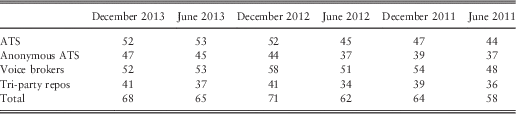
ATS, automated trading systems.
4.4.8. Repo is very much a cross-border and multicurrency business. The geographical analysis by venue is shown in Table 4, where WMBA is the share of voice brokers. It is evident that a greater share of cross-border activity takes place within electronic systems.
Geographic Spread of Activity by Venue

ATS, automated trading systems.
4.4.9. Some pronounced trends in the form of transaction have also been evident, notably the increasing use of CCPs, fostered by regulatory change, as is shown in Figure 4. The increasing use of CCPs is being promoted by regulatory action, although it is worth noting that the Bank of England’s Hauser (Reference Hauser2014) was keen to point out that it is a myth that regulators and central banks want to kill off repo.
Use of central counterparties clearing houses. ATS, automated trading systems
4.4.10. The differences between the various forms of trading venue are most evident in the maturity or term of repo undertaken, as is shown in Table 5. It is evident that some of these differences are due to the business model of the participant, for example, the high level of open repo undertaken by the tri-party repo agents. It is also evident that some more complex transactions, such as forward start transactions, require negotiation and human intervention and are poorly suited to automation. By contrast, overnight repo appears highly suited to automated systems, and these dominate activity in these systems.
Maturity Analysis in Different Venues
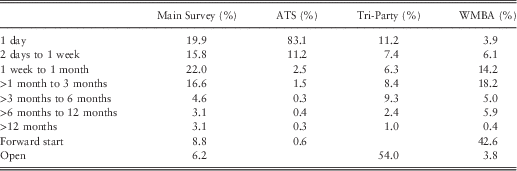
ATS, automated trading systems.
4.4.11. The ICMA survey also provides a tabulation of the average “haircut” by type of asset for activity undertaken by tri-party repo agents, which is reproduced in Table 6. These serve to limit the relative liquidity value equivalence of an asset, as this restricts the maximum cash that may be realised by financing rather than sale. A more complete analysis would also consider the interest rate applied to these different forms of asset, which would bring into consideration also general collateral and the degree of demand for specific securities.
Haircuts for Various Types of Collateral
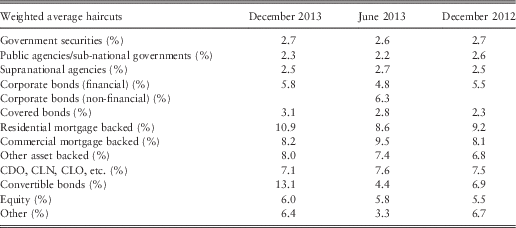
4.5. Market Prices and Information
4.5.1. Markets have advanced somewhat since Democritus described them as “places where men meet to deceive”. However, much of the activity in financial markets is concerned with price performance in the short term. This is predominantly a game against others, endogenous to the market. It is the primary source of market volatility, which is for many, risk. In passing, we would argue that risk management ought to include a wider appreciation of tail events. The long term, by contrast, is concerned with income streams from investments and is principally a game against nature. The short-term performance of markets is negatively correlated with real economic activity but the long term positively. In the long term, the volatility of performance declines to levels similar to those of economic activity.
4.5.2. With this in mind, it is surprising to see economic growth rates so widely advanced in support of analysts’ transaction recommendations. There is also the question of the degree to which economic growth translates to income and earnings as well as to distributions to investors.
4.5.3. Many outside institutional investors now utilise algorithms to execute their market orders in stock markets. The trend is less pronounced in government bond markets. This use of algorithms to spread orders and disguise them from the market apparently stems from dissatisfaction with previous limit order methods. In other words, the use of algorithms by institutional investors was prompted by a lack of trust in the market trading mechanism then prevailing, and this is an attempt to improve execution and lower transaction expense by lowering market impact.
4.5.4. The important point about these investor orders is that they, more than any other, should be carrying information that is price relevant – but to protect themselves, they are disguising these, or at the least, settling for complex averages of prices and volume. This hardly improves the functioning of markets in their economic context.
4.5.5. The rise of high frequency trading has been remarkable. By many reckonings, high frequency trading now accounts for 50% or more of all trading activity in many equity markets. Such algorithmic trading is also prevalent in foreign exchange markets. The defence of these automated strategies is that they improve execution for the investor and improve the liquidity of securities in these markets. It is far from clear that either is in fact true.
4.5.6. They certainly increase the number of transactions but the average transaction size has also decreased. The open question is whether they increase or decrease the volume of outside transactions, those that are economically relevant. There is also the question of the costs incurred by these outside investors in achieving their desired asset allocation – their use of algorithms to execute orders suggests that it has not improved them.
4.5.7. Much has been said about the occasional large and erratic price movements in equity markets and the role of high frequency trading. The “Flash Crash” was the doyenne of these until the recent 150-point drop triggered by a mischievous tweet about bombs having exploded in the White House, where algorithmic trading was apparently also prominent.
4.5.8. One of the defences to the criticism that algorithmic trading based upon price movements brought no new information to markets, but rather would distort that information present through exaggeration and amplification of noise, was that some of these algorithms are “intelligent”. By this, it was meant that some algorithms have been written to interpret textual news feeds. Apparently, these algorithms contributed to the most recent White House bomb-scare tweet episode.
4.5.9. Most high frequency traders are thinly capitalised – they do not bring any material liquidity stock to a market. Many, perhaps most, maintain no positions overnight. The claim of liquidity enhancement, if valid, must rest on the increased turnover velocity that they may bring. It is also notable that by the average trade size metric, which has declined, high frequency trading does not enhance liquidity.
4.5.10. It seems probable that small retail traders may benefit from the low-order sizes of high frequency traders. However, when an institutional pension fund wishes to trade, the high frequency traders do not provide enhanced liquidity for them.
4.5.11. However, as was noted earlier, it is possible that increasingly frenetic trading in an effectively fixed free float is what is occurring here, with little or no impact on outside investments, other than through the subsidiary and secondary price and valuation mechanisms.
4.5.12. Two questions really need answers:
∙ Where does the settlement cash liquidity come from?
∙ If high frequency traders bring liquidity to markets, why do they operate only in liquid stocks when the illiquid offer higher premiums?
It would seem likely that they operate in stocks that are already liquid precisely because they themselves have needs for liquidity in these trading strategies.
4.5.13. This focus upon hyperactive trading may seem excessive, but it is important in an information context. Quite apart from the question of whether this use of liquidity is crowding out other potential uses, there is the effect of increased noise in prices. If prices are to be informative to us, we need to be able to distinguish the signal from the noise.
4.5.14. Effectively to be able to do this at all requires that the signal is at least as large as the noise. This relation is illustrated in Figure 5 under the simplifying assumption that returns are normally distributed. The diagram surface represents the value of the threshold at which signal and noise are equal. It is evident that across most of the range of returns and volatilities that we observe in financial markets, it is not possible to distinguish the signal from the noise other than over very long time scales.
Signal equal to noise surface under normality
4.5.15. This analysis casts considerable doubt over the wisdom of solely using financial market prices as a basis for decisions, including in accounting statements. It also casts considerable doubt over exactly what is going on with high frequency trading algorithms.
4.5.16. This focus upon trading activity is relevant to liquidity inasmuch as it illustrates the possibility that a market (or economy) may have excessive liquidity. In this case, excessive short-term activity obscures the meaningful economic signal. In fact, markets that are dominated by short-term activity are slower to converge to fundamentals than markets that are dominated by long-term informed traders.
4.5.17. In this view, short-term speculation is noise trading. These results can be found in an experimental, laboratory context in a paper from Bloomfield et al. (Reference Bloomfield, O’Hara and Saar2006), or in a trading context in an empirical study, by Tetlock (Reference Tetlock2007), of financial prediction markets where fundamentals are observable. The absence of observable fundamentals makes the empirical analysis of this proposition difficult in conventional securities cash or futures market. Noise traders tend to congregate in highly liquid stocks, whereas informed traders are active in illiquid stocks.
4.5.18. Many derivatives market have been developed to facilitate the hedging of dealer inventories – for example, interest rate swaps or bond futures to hedge bond positions. This enables more transactions to be undertaken and higher gross volumes of inventory to be held by dealers. The hedges they provide are to changes in price – the net future price sensitivity of a bond and swap combined is lower than the naked.
4.5.19. This is the short-term speculative motivation discussed earlier. As noted there, interest rate swaps and most derivatives are concerned with future liquidity, not current, which makes them credit instruments, though economically equivalent to insurance.
4.5.20. The extent of the potential future exposure was very substantial in the run-up to crisis and substantially more than the net current credit exposures on which variation margin collateral requirements are based; this is discussed more fully and illustrated in Keating & Marshall (Reference Keating and Marshall2010b).
4.5.21. It is evident that some short-term speculative market activity facilitates the execution of welfare enhancing outside exchange, but it is also evident that there can be excessive volumes of short-term activity to the detriment of the outside welfare. This is a liquidity equivalent of the famous Laffer curve of tax effectiveness, trading of tax rates against tax receipts. This should come as no surprise as we know from banking markets that excessive liquidity is driven by, and drives excessive credit creation, and misallocations of capital – which usually end in tears.
5. Institutional Liquidity Management, Instrumental Liquidity and Market Microstructure
5.1. Institutions primarily need to be concerned with their liquidity at an organisational level, although fungibility of liquidity is as much a concern as fungibility of capital. Banks are well used to using liquidity ladder techniques to try to manage the term structure of liquidity of assets and deposits, although in the rapid escalation of reliance on short-term funding in the run up to the crisis this seems to have been temporarily forgotten. For insurers, liquidity management is as much about working out when (and why) assets may need to be crystallised “early” – this allows the cost of liquidity “insurance” to be fairly judged against the benefits of having that insurance.
5.2. Banks manage liquidity on both sides of their balance sheets, funding and asset market liquidity. As part of the banks’ recent liquidity management has been the shedding of illiquid assets, we consider briefly how insurers and pension schemes might begin to assess the relative attractiveness of the potential yield pick-up from standing in banks’ stead. For corporations the problem is more nuanced. We suggest that in all too many of the financial models actuaries commonly work with, the option or insurance value of liquidity is essentially ignored; ignoring material optionality in actuarial “best estimates” of cashflows comes with many perils. There is more to corporate decision making than maximising net present value (NPVs). Perhaps counter-intuitively, the liquidity of a market is not simply the sum of the instrumental liquidity; liquidity begets liquidity. We later introduce the concept of information insensitivity as being an essential characteristic of the liquidity of an asset; it means the asset will not change materially in monetary value over time.
5.3. In this section, we start by looking at bank funding risk, before moving on to briefly consider how institutions might take a more considered view of liquidity cost/benefit analysis than simply adopting a hurdle rate. From there we consider a theoretical detour into the requirement for liquidity from a corporate viewpoint (closely following Holmström & Tirole, Reference Holmström and Tirole2011). We then move on to consider instrumental liquidity, and then market microstructure before concluding by considering liquidity in both the short and long term.
5.1. Bank Funding Risk
5.1.1. In 2009, the Financial Stability Forum (now Board) called for a “joint research program to measure funding and liquidity risk attached to maturity transformation, enabling the pricing of liquidity risk in the financial system”. It is not obvious that this has progressed very far, though much work has been undertaken.
5.1.2. The relation between funding liquidity and market liquidity may be considered in terms of the side of the balance sheet to which these apply. Market liquidity is concerned with the asset side and discussed and illustrated extensively in this paper. Funding liquidity, by contrast, is concerned with the liability side. The direction of flow is from banking liquidity to market liquidity, from funding to market. If the banking system is illiquid, so too must be markets. “Soft” factors such as reputation and governance of the institution can be important here and motivate the discussions of trust and confidence in section 2.4. Though it can be an important tool in adverse conditions, we do not discuss liability renegotiation in this paper.
5.1.3. The funding risk of a financial institution depends on both its liquidity position and its risk management policies, as these serve to limit the consequences of exogenous events. Sometimes institutions are unaffected by asset market price movements, as, for example, in the case of the bond or loan bought and held to maturity (though long-term returns will diminish with increased volatility). More usually banks use hedging instruments such as interest rate swaps to reduce the impact of market price movements on a mark-to-market balance sheet. Accounting policies and practices can also be important here, and should be considered as part of risk management policy.
5.1.4. Some business strategies may simultaneously involve both sides of the balance sheet; for example, “originate to distribute” or securitisation may involve both the sale of assets and the creation of a contingent liability in the form of back-up lines of credit to the securitisation vehicle.
5.1.5. It is worth comparing credit creation and maturity transformation in both the banking sector and markets, we illustrate below (Figure 6) the relative magnitudes of these for the US market immediately before the crash, at which point in time markets were actually more important than the banking sector. In less mature economies, for example, the developing nations, it is usual for the banking sector, rather than capital markets, to dominate credit creation and maturity transformation.
Relative size of banks and financial markets (US) – Federal Reserve flow of funds. GSE, government-sponsored enterprises; ABS, asset-backed security
5.1.6. It is also notable how significant US government-sponsored enterprises (GSE) had become before the crash in terms of their capital market participation. Maturity transformation by these entities alone in capital markets exceeded 50% of the banking system. Though not shown in Figure 6, the duration of this transformation was also much longer than that undertaken by banks.
5.2. Liquidity for Pension Schemes and Insurers
5.2.1. Defined benefit pension schemes and insurers are often considered to have excess liquidity, that is, assets are more liquid than liabilities such that the probability that there is insufficient cash to meet obligations is very low. Liquidity policy in this context is usually around demonstrating this holds over periods of time (e.g. 1 day, 1 month, 1 year) and under certain stresses to markets which may give rise to collateral requirements.
5.2.2. On this basis, it is argued that pensions and insurance are natural homes for illiquid assets, particularly in an environment where there is less appetite in banks for such assets. However, traditional asset allocation studies historically have placed little emphasis on liquidity. Currently, there is a vogue for insurers and pension funds to acquire illiquid assets. However, with the cost of liquidity currently at a post-war low as a result of the active central bank interventions, highly liquid assets are in this regard cheap and the strategy of buying illiquid assets at present is questionable. As the cost of liquidity returns to normal, the relative value of illiquid securities seems likely to increase. Much of the analysis of pension funds is conducted in stocks, the size of the fund, when the relevant consideration is correctly their net flows – the contributions, coupons and dividends after disbursements, their liquidity.
5.2.3. The insurance provided by liquidity has a cost to an investor. However, if presented with the choice between two assets of differing liquidity and yields, how does an institution choose? In other words, what value should be placed on the insurance, relative to its cost? We believe it must place its own value (utility) on the liquidity options that are embedded in assets by considering the circumstances where it may be forced or want to sell assets before expiry. This value could be expressed as a haircut to yield in order to compare assets of differing liquidity. The elements of liquidity being considered are those of the term structure and the spreads and other costs of differing forms relative to this term structure. Importantly, this will depend on the overall liquidity of its entire portfolio, as well as the liquidity requirements to meet its obligations; that is, we need an enterprise-wide approach to liquidity risk management. This is illustrated in Figure 7.
Institutional liquidity
5.2.4. Although a pension scheme or insurer may be comfortable that there is excess liquidity in terms of withstanding shocks and meeting liability benefits, all other motivations for asset sales should be considered in evaluating the liquidity option. This should include the following:
∙ Increased capital required against an illiquid asset that is downgraded and cannot be sold.
∙ Opportunity cost of holding fewer liquid assets to take advantage of future market opportunities, dislocations and regulatory changes.
∙ Costs incurred upon asset sales for any other reason.
5.2.5. A simplified example might be a pension scheme whose sponsor may have a 2% probability of default per annum. Upon default, all illiquid assets are to be sold to fund an insured buy-out, and total costs of selling illiquid asset in terms of bid/offer may be 10%. Then this scheme may require additional yield to compensate for this risk of 2%×10%=20 bps/annum, on a best estimate basis. A more sophisticated model might take into account dependencies between defaults and the costs of realising illiquid assets, amongst other things.
5.2.6. In evaluating the likelihood of forced sales in the future, institutions may examine the extent to which asset cash flows match liability cash flows. However, this should examine actual net cash flows and so is different from analysis of interest rate matching, as interest rate swaps would be expected to provide little net cash flows to meet liability payments. In other words, much hedging is of the mark-to-market balance sheet position; genuine cash flow matching would be seeking to match actual cash in- and out-flows. The analysis here is known as dedication and contrasts with the immunisation of interest rate sensitivity hedging analysis.
5.3. Instrumental Liquidity
5.3.1. In the introduction, we described liquidity as the “moneyness” of an instrument rather than as the ease of financing. This latter definition is favoured by many banking supervisors. Of course, the two concepts are closely related. This description of instrumental liquidity as its value in transaction use is a money stock rather than flow concept. Of Crockett’s facets to liquidity set out in paragraph 3.16: depth, immediacy and tightness are related to the stock aspect and resilience to the flow.
5.3.2. The liquidity of a market is not usually the simple sum of the liquidity of the individual instruments present. This relates to the discussion of market fragmentation in paragraph 4.16 and the widely held belief that liquidity attracts liquidity. Arbitrage and other activities can greatly influence the aggregation (or not) of liquidity in markets, and its availability at an instrumental level, particularly when trading is fragmented across numerous venues.
5.3.3. The property that makes an instrument a good store, or hoard, of liquidity is that it should be information insensitive. In practical terms, this means that the instrument should typically be of very high quality and be short term in nature, for example, a Treasury bill. Money is, ideally, entirely insensitive to information, even though it may have failings as a store of real value.
5.3.4. For brevity, we will avoid reviewing the information theoretic literature beyond noting that information acquisition before transacting may put at risk even desirable insurance. So the effort to be expended on information acquisition should be proportional to the potential gain; we research high yield bonds, but not the credit status of the US treasury. The credit ratings provided by agencies are important in this regard as indicators of where to commit our scarce and costly analytic resources. The AAA ratings on mortgage securities, which proved so catastrophically wrong, had the pernicious effect of directing our research efforts away from them.
5.3.5. As with money, to be liquid, or exchange freely one for another, securities need to be fungible; the homogeneity property in Jevons’ taxonomy set out in 2.16. The property here is that one instrument should be indistinguishable from another,Footnote 34 and with that, there should also be no distinction based on the identity of participant in exchanges. One of the attractions of bearer bonds was precisely this form of anonymity.
5.3.6. Even seemingly innocuous differences can be important – for example: in the 1970s, Amax issued two bearer bonds with identical terms – one tranche of $25 million and another of $15 million – they differed only in the colour of the ink on the certificates, red and blue. However, the red bonds were not fungible with the blue, and red were not acceptable in discharge of the sinking fund obligations of the blue, or vice versa. The result was that these bonds could trade as much as 10 percentage points apart when the sinking fund was operating.Footnote 35
5.3.7. Simplicity in instrumental design is a further positive for liquidity – little verification is needed. Vanilla bullet issues are preferred to sinking fund debentures – complexity is inimical to liquidity. Similarly, greater size of issue enhances liquidity as it makes securities easier for dealers to find and buy or borrow, which tends to improve bid-offer spreads – that is increase tightness.
5.3.8. This brings into question the motivation of banks in bundling together simple products to offer complex instruments, which are not simple to analyse or value, let alone easily transferable.
5.3.9. The complex cash flows of amortising bonds, with call features and sinking funds, which characterised the sterling corporate bond market of the 1960s and 1970s, required much analysis to establish their value. This period also saw bond issues convertible to gold under various terms and even bonds that paid coupons in railway travel warrants. Such complex securities can be extremely attractive to long-term investors possessing analytic skills, and no need for interim liquidity. These securities were to a very large extent bought and held by institutional investors and indeed could usually be readily sold even though there was no active market in them. There is an argument, from the perspective of an investor, for defining liquidity solely in terms of the ability to sell a security; as we shall see later, active two-way markets do not exist for most bonds.
5.3.10. Securities that are accepted in open market operations and other central bank operations tend to be liquid because of their value to banks in this context. We will discuss banking liquidity regulation in section 7. Securities, which are accepted in repo subject only to low and stable haircuts, draw their liquidity from the wide audience of short-term transaction balance investors seeking yield enhancement above government securities.
5.4. Instrumental Liquidity: Time and Curves
5.4.1. The key property of liquid securities is that information asymmetries between seller and buyer, which include the obligor at issuance, are small and not subject to great change. The AAA-rated tranches of mortgage-backed securitisations were a signal failure in this regard – they proved to be hyper-sensitive to information as the US housing boom turned to bust. In the absence of this information insensitivity, the liquidity of an instrument may be highly time variant and profoundly asymmetric.
5.4.2. It is notable that government bond markets exhibit a phenomenon known as “on-the-run/off-the-run” spread where securities that differ in little other than their time since issuance, and perhaps issue size, trade at different prices and yields. It is usual practice to construct yield curves from the lower yielding more actively traded “on-the-run” issues, which are often referred to as “benchmark” securities. These on-the-run issues also tend to have tight bid-offer spreads and larger normal trade size quotation. It is immediately evident here that liquidity has a cost.
5.4.3. Older issues are often described as “seasoned”, meaning that the majority of the securities have found homes and purposes in investment institutions from which it may be difficult to dislodge them, to acquire or even borrow them. In consequence, in addition to the yield differential the bid to offer spreads of these issues may be wider than on benchmarks. These issues have a lower “free float” of securities readily available for trading. This concept is an illustration of the value of a security as part of the money stock. The dispersion of the “off-the-run to on-the-run” issue yields (or the dispersion of actual yields around the benchmark yield curve) is another more advanced measure of government bond market liquidity.
5.4.4. Bonds exhibit seasoning in the sense that the longer the time since an issue was originally placed, the less the proportional turnover. Turnover improves with larger issue sizes as these issuers are more prominent, often of higher credit standing, and market makers are more likely to be able to match the buyers and sellers in trades. In addition, market makers should find it easier to borrow bonds when the issue size is high. These phenomena are investigated in Hotchkiss & Jostova (Reference Hotchkiss and Jostova2007).
5.4.5. Many debt management offices go to considerable length to issue securities that have benchmark status. They seek to exploit the phenomenon that larger issues command higher prices, which is something of a challenge for elementary economics where lower prices for a good are usually expected in response to greater supply. It also runs contrary to usual market trading practice where the sale of larger positions typically achieves lower prices.
5.4.6. Some debt management offices explicitly reopen issues to increase their outstanding size and with that market liquidity, which, in this context, is measured as trading volume. The benefits that market insiders perceive of larger issues, and for which they pay a liquidity premium is that these securities will command tight bid-offer spreads and trade in larger than usual size.
5.4.7. This is extremely useful and valuable to dealers who have acquired short positions in the ordinary course of their market-making activities. It is also useful to speculators who need to rely upon future liquidity to realise the sale of a security to crystallise a particular performance.
5.4.8. In bond markets, the liquidity (in the sense of trading turnover) of a security is usually an exponentially declining function of the time since issuance – seasoning. In most cases, it is also a declining function of maturity – long maturity issues trade less frequently that short, other than in times of high speculative interest rate activity.
5.4.9. The lower volume of trading activity in long-dated fixed income securities is by no means universal. The level of activity is very closely related to the extent of speculative participation in a market. Long bonds are usually the most volatile in a market and as such ideally suited for speculative activity. At one point in the early 1990s, the US 30-year bond had an average holding period of just 5 days, while the 30-day bill had an average holding period of 29 days.
5.4.10. The practice in, for example, the Korean government bond market of reopening issues leads to peaks of trading activity, in that case some 4–6 months after the original issuance. One interpretation of this is that it increases the time necessary for a bond to have seasoned and found firm investor ownership.
5.4.11. Finally, no discussion of the liquidity of an asset would be complete without discussion of the counterpart liability. Some financial contracts may be either assets or liabilities depending upon the state of the world at the time of valuation – an interest rate swap is a prime example.
5.5. Market Microstructure and Liquidity
5.5.1. The design of market microstructureFootnote 36 can also influence the costs of issuance. These arrangements can include the form of issuance, such as underwritten syndication versus open market auction, with primary dealers having responsibilities that may vary significantly from country to country. Tap issuance can also markedly affect secondary market trading activity. Even the form of auction order matching, such as from uniform price allocation to discriminatory submitted bid price allocation, can influence the issuance cost.
5.5.2. It was notable that in the wake of the crisis many debt management offices reverted to the use of syndication rather than public auction for some types of issuance, such as ultra-long securities. Some debt managers have begun using security designs that they had not previously used; the United States use of floating rate notes and the Irish issuance of annuity bonds are examples. The US Treasury has changed from discriminatory price to uniform allocation in its auctions, which has been estimated to have reduced issuance costs from 0.59 basis points to 0.32 (3.5 cents/$100 to 1.3 cents/$100).
5.5.3. Such issuance discount costs tend to be largest when there is high uncertainty among dealers and investors. When-issued marketsFootnote 37 can go far in resolving uncertainty over demand and price, lowering these costs.
5.5.4. It is possible to examine the development of these turnover profiles over time. However, there is a problem of interpretation: does increased turnover really mean increased liquidity in any economically meaningful sense – these are existing securities and underlying capital investments. It may be that the variation in activity is entirely the result of intra-dealer activity, with no change in outside investor positions. It is also possible that these statistics mask a relatively stable set of long-term institutional holdings with a small free float that is frenetically traded. Notwithstanding these caveats, popular usage refers to securities and markets with high turnover as being highly liquid.
5.5.5. This does throw light on the much-discussed question of the risk-free rate of financial theory and many valuation techniques. The use of the on-the-run curve to derive “risk-free” rates is biased towards lower yields as it utilises the most actively traded securities. Indeed, the question goes beyond this as the risk free is being derived from observable market prices, which contain a liquidity premium. It is the most actively traded, most liquid securities where this liquidity premium is highest at any point in time.
5.5.6. Put another way, actively traded securities are those that are furthest from fundamental values. Illiquid securities tend to be purchased by longer-term investors who are prepared to conduct the necessary and costly research and analysis to inform themselves as to the merits of these securities. The prices of relatively illiquid securities can be more informative than the prices of active securities.
5.5.7. Notwithstanding this relation, many investors in illiquid markets do underwrite and price assets by reference to the spreads and ratings available in liquid credit markets.
5.5.8. The conceptual risk-free rate is a pure time preference rate; it is time preference for liquidity. It follows from this that low government bond yields are telling us more about expectations of liquidity at future times than about the investment returns we may achieve in any particular time span on other asset classes. However, government bonds may offer a floor to expectations, if not actual returns, when tradable spot or zero-coupon rates are used (coupon bonds contain reinvestment or convexity sensitivities), or indeed buy-and-hold investors invest in these low yields.
5.5.9. Credit is an expectation of future liquidity, and both default and inflation become relevant concerns. The range of insolvency likelihoods for AAA-rated securities is measured in a few basis points, whereas low-quality securities may have likelihoods of insolvency measured in many percentage points. The lower-quality securities are much more information sensitive than the high quality and their current liquidity is usually low and highly variable in result.
5.5.10. Yield curves that allow for these credit effects may slope downwards with maturity rather than have the usual positive slope of pure time preference, or risk free. Economic activity and arbitrage freeness are the prime determinants of the risk-free yield curve. A multiplicity of yield curve shapes may arise due to these dependencies.
5.5.11. It is sometimes argued that the haircuts applied in the repo market (or equivalently the initial margin in a Futures Exchange or Clearing House) are a measure of the short-term volatility of these securities. However, it should also be recognised that the regulatory treatment for capital adequacy purposes also materially affects the haircuts observed. The haircut is a form of over-collateralisation that in the event of default may permit the dealer to liquidate the position at no loss. This process takes place outside of the automatic stay feature of most bankruptcy systems. Any surplus arising from the liquidation would belong to the administrator of the defaulted. The haircut also provides an incentive for the borrower to perform and repay the loan.
5.6. Liquidity and the Short and Long Term
5.6.1. One approach to the analysis of the different securities and instruments issued by the corporate sector considers these in terms of their time priority. Commercial paper might have a time priority of 30 days, whereas bonds might have a tenor of 10 years, and equity represent the residual claim beyond the discharge of all dated claims. This is the counterpart to the corporate treasurer’s view, which is concerned with management of the asynchronicity of receipts and disbursements of cash.
5.6.2. It is possible for the duration of debt claims to exceed the duration of the equity claim. This can be illustrated by considering an equity that pays a constant 10% dividend and a 30-year bond paying 7% – at a 5% discount rate, the duration of equity is approximately 12 years and the duration of the debt 15 years. When considering the sustainability of an investment over its term, it is appropriate to consider the current position of the company in the life cycle of that company.
5.6.3. Bankruptcy operates on liquidity; it stays all payments, breaking the time priority. In liquidation, a form of acceleration, all creditors within a class are paid simultaneously, following class priority.
5.6.4. One way of distinguishing between the short and the long term is by looking to the source of ultimate liquidity. When we are relying solely on the performance of the contract, the source of liquidity is the obligor, and we may consider this long term. By contrast, reliance upon the market for ultimate liquidity is speculative. As always, there are echoes of such ideas in earlier economic work; Alfred Marshall considered the short term to be the situation of working with a given endowment of fixed capital and the long term to be concerned with variation of fixed capital resources.
5.6.5. It should be remembered that the majority of corporate liabilities are not negotiable – in many cases, they are incomplete contracts and arise only from the ability of the corporate to exhibit commitment. Nowhere is this truer than of long-term insurance and pension liabilities.
5.6.6. In the case of a tradable security issued by a corporate, the liquidity option of a market price does not rely directly on any performance by the obligor – it relies upon market liquidity and there is no recourse to the sponsor. Typically, the issuer will have incurred costs at issuance and have ongoing costs with respect to disclosure and servicing but there is no explicit requirement to fund the liquidity of the security (beyond coupon payments, or to a lesser extent, given their discretionary nature, dividends).
5.6.7. At issuance, the market price to an investor is higher than the cost to the obligor. Indeed, this relation is to be expected to persist unless liquidity is unconstrained. The issuer can always buy-back securities that trade below their cost to the obligor. In the early 1980s, this was not an uncommon practice; there was much activity in the defeasance of bonds that were trading at steep discounts to their nominal face value. It is also evident in the repurchases of debt by both Barclays and Lloyds in the aftermath of the recent crisis; in these cases, it was most likely further enhanced by the prior use of hedge accounting.
5.6.8. Defined benefit pension liabilities are by design not negotiable for cash. There is no equivalent traded security, nor can there be. Valuing long-term liabilities on the basis of market prices or rates introduces the liquidity premium of those traded securities into the valuation of the non-negotiable liability, overstating it on an ongoing basis.
5.6.9. The problem for pension schemes is compound. The use of market prices for liabilities usually overstates them, whereas the use of liquid assets as investments tends to depress their yields and returns. The only scenario, at least in the United Kingdom, where that degree of liquidity might be warranted would be in the event of sponsor default as discussed in section 5.2. These actions depress returns in normal circumstances in order to provide for the rare tail event of sponsor default.
5.6.10. In fact the use of market prices for portfolio valuation is profoundly problematic inasmuch as all securities cannot possibly be realised at these marginal prices, even large portfolios cannot be realised without a price impact. This echoes again Keynes’ point about lack of liquidity for the investment community as a whole.
5.6.11. The issue of the long term is further confounded by the nature of financial markets, which at short horizons are dominated by price concerns – that is to say inside speculative activity. This activity introduces volatility into prices which is simply absent from fundamentals.
5.6.12. The use of market prices is appropriate for the valuation of dealer trading books, and long-term liabilities should be valued on the basis of what the contract owner could claim at valuation date in an insolvency court proceeding.
5.6.13. This point is worth elaboration. If a company has issued two different zero coupon bonds maturing at the same date, one issued at a redemption yield of 5% and another issued at a redemption yield of 10%. On insolvency, creditors will have valid claims for the return of their principal and the accrued “coupon” to insolvency date. The claim on the 10% issue will be (slightly) lower. It is interesting to note that secondary trading prices for such securities recognise and reflect such differences in claim value.
5.6.14. It is inappropriate for any company to value their own issuance on the basis that it is credit impaired; the liability (and investor claim(s) over corporate liquidity) has not changed. However, this is exactly what we saw from many banks and dealers during the credit crisis. The use of mark-to-market valuation induces short termism and speculative behaviour. To argue the alternate view, from an equity holder perspective (who after all reporting is for), there is an argument that leveraging up does increase the value of the limited liability put option creating value and that this should be recognised. However, this accounting does not reflect the corporate position, it is an investor perspective. It does though highlight some limitations of current accounting and the single view that an ongoing basis provides, in an uncertain world.
5.6.15. Speculation is not entirely harmful. The deployment of funds into instruments that are longer in term than the horizon at which those funds are expected to be required is a form of maturity transformation. It reduces to a degree the conflict between money as a means of payment and a store of value – a principal role of banking. In this regard, the securities market facilitates a maturity transformation function that is very similar to that of banking. There are close similarities between funding liquidity and funding risk in banking and this maturity transformation role of markets. The institutions in markets though are usually not recognised banks. Surprisingly, the economic value of maturity transformation has not been widely investigated in the empirical economics literature, and in result it is presently impossible to quantify it.
5.6.16. It should be realised that if we cannot sell a security in a market, we cannot usually expect to be able to finance it by repo; the security’s value as liquidity stock can be severely impaired. Financial crises most often first manifest themselves as the inability to re-finance a position held.
6. Market Liquidity: A Case Study
6.1. In this section, we use the crisis to examine how liquidity has changed in recent times in a variety of, predominantly United States, fixed income markets. As noted earlier, the levels of secondary market turnover, even in highly developed markets, can vary markedly over time. Daily turnover values in US treasuries and MBS rose steadily from 1996 until 2007, whereas agency volumes languished as <$100 billion. Mortgage-backed activity rose from around $30 billion to around $350 billion is 2007, and US Treasury turnover from around $200 billion to around $550 billion. By contrast, activity in investment grade, high yield, asset backed and residential mortgage-backed securities showed little change over the period, at $12 billion, $5 billion, $2 billion and $5 billion daily, respectively. The most remarkable change occurred in the municipal markets where daily turnover rose from $9 billion to $25 billion in 2007 and then collapsed and has remained around $10 billion. After a sharp decline in 2008–2009, Treasury volumes regained their prior highs of $550 billion.
6.2. The main conclusions we would draw from this section are summed up in the market aphorism that liquidity is usually fine until it is needed and to the observation that efficient markets can foresee everything except the next crisis. Furthermore, the evidence is that liquidity did not transmit itself instantaneously or frictionlessly across sectors of the financial markets. This was perhaps the essence of the systemic crisis.
6.3. These turnover figures are perhaps surprising given the magnitude of the shocks experienced by markets in recent times. It is evident that achieved transaction volumes have held up rather better than press coverage might have led us to believe.
6.4. Though it has not received much attention internationally, the collapse in activity in municipal securities was the most profound among bond markets. This was driven by at least two sector-specific effects – the pre-crisis prevalence of auction (adjustable) rate municipal securities and the use of mono-line credit insurance. Before the crisis, credit enhancement by mono-line insurance was used by >50% of issuers, and is now <5%. Auction rate issuance has declined by almost 90% since 2007. In large part, these securities were predicated on the willingness of the sponsoring securities dealer to subscribe to them, that is, supply liquidity, if they were undersubscribed at any auction rate reset. These contingent liabilities were not recognised in the dealers’ accounting statements.
6.5. It should also be recognised that US bank lending rose markedly in the immediate aftermath of the Lehman failure, in large part because the corporate sector, with precautionary motivation, drew down their committed lines of credit.
6.6. The most startling observation on turnover in the crisis period was the decline in unsecured interbank lending. However, the timing of the start point for this decline is interesting as it occured in late 2007. Activity dropped from $480 billion to $120 billion. It is also notable that this market has not recovered. It is also evident that a very significant part of current activity (~30%) is arbitrage of the Federal Home Loan Banks.Footnote 38 This decline in interbank activity was even more pronounced in the European money markets.
6.7. This decline in activity cannot be explained by interest rate differentials, though the crisis did have the effect of separating the rates paid on unsecured deposits from repo rates.
6.8. The most abrupt decline in activity was that of the ABCP outstanding, which began in August of 2007, from $1.2 trillion to $400 billion by August 2009. It is notable that commercial paper issued by financial institutions did not begin to decline for another year, until after the insolvency of Lehman and the decline was more modest, from $800 billion to $550 billion. Corporate commercial paper outstanding peaked after the Lehman episode, at around $180 billion, and has only declined to around $120 billion.
6.9. Quite apart from the difficulties that these various figures may produce for dating the financial crisis, it is evident that liquidity did not transmit itself instantaneously or frictionlessly across sectors of the financial markets. This was perhaps the essence of the systemic crisis.
6.10. However, as was noted earlier, turnover is an incomplete measure of liquidity. When average yield spread differences between “off-the-run” and “on-the-run” US treasuries are compared, we can see that activity has adapted to an environment in which higher transaction costs are accepted. In other words, while government bond market turnover has held up, this has taken place in an environment where bond market trading liquidity has a greater cost. This is all the more surprising when we consider the decline in yields which has occurred since the crisis broke, and the generally lower cost of liquidity in that form to the banking system.
6.11. Bid-offer trading spreads can also be extremely volatile with a tendency to spike in response to news and activity. There are a number of possible measures of spread with the Roll-modelled bid-offer spread for corporate bonds being commonly used. The Roll (Reference Roll1984) measure of the implicit bid-ask spread is:
 $$Spread{\equals}=2\sqrt {{\minus}Cov\,(Price\,changes)} $$
where Cov is the first-order serial covariance of price changes.
6.12. Contrary to popular belief, most corporate bonds have never traded actively; activity is typically concentrated in a small number of bonds. Hotchkiss & Jostova (Reference Hotchkiss and Jostova2007) find that issue size and age are the prime determinants of trading; a US $150 million increase in the size of an investment grade issue increases the likelihood of trading in a month from 35.7% to 55.5%. The crisis does seem to have resulted in even greater concentration in this regard.
6.13. The tendency for corporate bonds not to be traded also exhibits the same characteristics with respect to time since issuance and seasoning discussed in section 5.4. At one point in time, international Eurobond securities, which were not eligible for sale in the United States until after they were seasoned, would tend to show flurries of trading activity after this ineligibility period had elapsed when they became available to US investors.
6.14. This concentration has been accompanied by a trend to smaller trade sizes – investment grade blocks >$5 million accounted for 90% of activity in 2005 and have declined to just 75% recently. In addition, the average size of those blocks has declined from $29 million in 2005 to $15 million recently. By this depth measure, secondary market liquidity has declined materially.
6.15. Comparison of the trade sizes shown here with the order sizes of electronic platform, such as MarketAxess, makes it evident that electronic platforms attract far smaller orders than are executed in other more traditional markets.
6.16. The question of the extent to which markets have been able to continue to fulfil their economic role of providing new finance for economic enterprise is not answered by considering secondary market turnover or these depth metrics. The relevant direct measure is the volume of new bond issues placed, and this has reached record new highs in the United States and Europe.
6.17. There are many possible non-exclusive explanations for the increase in new corporate bond issuance, from the low levels of interest rates to reduced availability of bank credit and even the effects of quantitative easing. However, it is clear that, by this measure, markets are performing their outside economic role better in the post-crisis period.
6.18. Participation in primary US Treasury auctions has changed in the post-crisis period. To quote from a Federal Reserve blog: “On December 12, 2012, primary government securities dealers bought just 33 percent of the new ten-year Treasury notes sold at auction. This was one of the lowest shares on record and far below the 68 percent average for ten-year notes reported in this 2007 study by Fleming”.
6.19. “The decline in the share of primary dealer purchases at auction has been offset by increased purchases by other dealers and brokers (from 4 percent to 8 percent), investment funds (from 8 percent to 18 percent), and foreign and international investors (from 11 percent to 13 percent). Other investors, including depository institutions, pension funds, and individuals, have consistently accounted for about 3 percent to 6 percent of purchases over time”.
6.20. This is not a result of a changing ownership of US Treasuries – dealers have increased their ownership. In early summer 2007, dealers were in fact net short of slightly more than 5% of outstanding Treasury issues. This pattern may be attributed to short positions in Treasury securities being employed by dealers to hedge other long positions in corporate, agency and mortgage bond exposures at that time.
6.21. The basis risk involved in hedging corporate positions with Treasuries has on occasion been the source of substantial losses. In 2008/2009, US Treasury yields fell while corporate bond spreads and yields moved higher, resulting in substantial losses for those who were long corporates (which declined in price) and short Treasuries (which rose in price) as hedges of those corporates.
6.22. A Federal Reserve study of this phenomenon, which examined a number of possible hypotheses concluded: “The evidence here is thus more consistent with other investors proactively increasing their participation at auction, and with the technical rule changeFootnote 39 perhaps having some effect, and not with dealers becoming more risk averse and demanding greater compensation for intermediating new supply. Results of the ten-year-note auction on December 12 also fit this pattern better. The note was sold at a yield of 1.65 percent, 2 basis points below the 1.67 percent yield in the secondary market at the time, suggesting that the low level of dealer purchases wasn’t attributable to low dealer demand, but rather to high demand by other investors”.
6.23. Perhaps the most important aspect of dealer corporate and agency positions is their pronounced decline post-2007 – from around $275 billion to just $50 billion. This is somewhat surprising given the high volumes of successful primary issuance.
6.24. The levels of trading activity in corporate bonds (both investment grade and high yield) have risen markedly in the post-crisis period while dealer inventories in these have declined. Increased velocity or flow has been accommodated using a smaller inventory or stock of liquidity. The turnover to inventory ratio, which may be considered an efficiency measure, has moved from the one to two times range to be now between five and six times. It is an open question as to whether this trading or intermediation strategy is more profitable for dealers than the previous proprietary trading and inventory strategy.
6.25. However, traded volumes as a proportion of outstanding have been falling for most bond classifications. The seeming discrepancy between the increased dollar volume of corporate bonds and the minor declines evident is explained by the very high issuance of corporate bonds in the post-crisis period.
6.26. It is worth remembering that even though US Treasury turnover has fallen, US Treasuries are still more heavily traded than any other category of bond and account for >50% of all activity.
6.27. When liquidity is measured as daily turnover, it is evident that, since the crisis, liquidity is converging on US Treasuries. Perhaps the greatest surprise in this data is the resilience of MBS, which were at the eye of the storm.
6.28. The advent of unconventional techniques in monetary policy, such as the use of quantitative easing by the Bank of England and the Federal Reserve, has to a degree inflated turnover figures in recent times. There is also the question as to whether these securities held by central banks should really be considered as part of the stock outstanding.
6.29. Globally, the issuance of financial securities net of these interventions has fallen significantly, from $4 to $1 trillion annually, with GSE and agencies now almost totally absent from markets. It is notable that government securities and corporate issuance have risen markedly. Equity issuance by contrast is once again negative with more equity being repurchased than issued.
6.30. The US primary dealers have also decreased their supply of short-term finance to others through reverse repo. The notable exception to this is their financing of MBS, which has increased from a post-crash low of US $400 billion to around US $ 600 billion recently.
6.31. Primary dealer financing of own inventories by repo has declined relative to turnover in the post-crisis period. Having maintained inventory financing by repo at a relatively stable, though increasing, ratio to daily turnover in the pre-crisis period, in the period since, turnover has been a higher proportion of inventory. From the pre-crisis high of US $6.5 trillion, US dealer financing by repo is now around US $4.5 trillion.
6.32. The distribution of holders of US dollar denominated bonds has varied markedly over the decades. Treasury holdings are now dominated by foreigners and the Federal Reserve, with most other classifications declining to accommodate these groups. The decline in household and corporate ownership has been stark – from 40% as recently as 1990 to around 15% in 2013. Foreigners have also been increasing their share of corporate bonds outstanding, but most noticeable has been the increase in household and corporate ownership.
6.33. Among the foreign investors, official accounts are highly significant. Households and pension funds have not kept pace and their proportional holdings have declined. Mutual funds have increased their exposure both absolutely and in proportion. Bank and broker holdings have increased since the crisis.
6.34. As the Federal Reserve withdraws from quantitative easing, there may be something of a challenge emerging. With China and the Asian reserve holders experiencing reduced surpluses with the United States, they are unlikely to pursue Treasuries on their previous scale. The oil-producing nations are already experiencing reduced sales to the United States, reflecting the supply of domestic shale gas and lower oil prices. These trends may require increased interest in Treasuries on the part of US domestic investors.
6.35. By contrast, households have been increasing their holdings of corporate bonds, as have mutual funds, which, of course, are predominantly held by households. Pension and insurance company holdings have not kept pace, and have declined in relative terms. Bank holdings have declined in the post-crisis period.
6.36. US retail investors have been moving away from US Treasuries and to credit-based investments even in the face of falling corporate bond yields – a relative yield game.
6.37. This retail trend does give rise to a liquidity concern. The decline in dealer inventories relative to the rapid increase in credit mutual funds suggests that these funds may be difficult and perhaps impossible to liquidate other than at fire sale prices into the street when retail investors wish to realise them. Credit mutual funds now amount to $900 billion and dealer credit inventories are just $50 billion. This leads us to reprise our statement from the start of this section that liquidity is fine until it is needed!
7. Policy and Regulation
7.1. Much liquidity transfer occurs in regulated markets, and as discussed in section 6, a high proportion of global assets are government bonds. Government policy and regulation are therefore crucial to how liquidity is transferred within the financial system and further on to the real economy.
7.2. Both transactional and capital flow mobility are important issues in the context of liquidity, and as we set out below the jury is still out on international movements in capital. Furthermore, in a world of uncertainty, the banking system may rationally not provide adequate liquidity. The flow of liquid funds possibly should be, and in any case is, constrained by national and international regulations and norms. Much of the flow between market participants is transformation of the term of liquidity needs. It is possible to debate the relative merits of maturity transformation in the banking sector versus financial markets, and indeed its absolute economic value. In the United States financial markets are responsible for far more transformation than the banking system (Figure 6 earlier). It is also worth remembering, as we consider whether liquidity regulation actually improves liquidity, Charles Goodhart’s note that “Required liquidity is not true liquidity”. As an aside, the same can be said for capital as a loss-absorbing buffer on a going concern basis.
7.3. In this final section, we start by looking further at the issuance of government debt, and the purchasers of this debt. We go on to consider global liquidity and regulation in general before considering regulation of liquidity in particular. Finally we look to the future of regulation, and consider how transparency may or may not help markets serve society, reprising the discussion we started in section 2 as it appears likely that concerns such as these will to a large extent determine whether or not the post-crisis regulatory liquidity regimes prove successful or not.
7.1. Liquidity and Primary Issuance
7.1.1. The maturity of the stock of government debt outstanding influences its liquidity. For any given change in term structure, the longer maturity will typically be more volatile and less liquid. There is considerable variation of maturity across countries with the United Kingdom having by far the longest average maturity (Figure 8).
Maturity of debt stock Source: OECD and Bangladesh Bank.
7.1.2. Debt management offices and central banks issue in a wide range of formats: conventional coupon, strippable, inflation linked, floating rate and term annuity. National savings may even have elements of gambling and lotteries attached to them – for example, Premium Bonds. The form of issuance is usually chosen to match perceived investor demand and manage the cost of issuance.
7.1.3. In addition, most countries offer some form of “national savings” instruments targeted at individuals, which are usually not tradable but may have early surrender or redemption features. In some countries, such as Bangladesh, these may cover material proportions of government borrowing.
7.1.4. From the perspective of the issuer, longer-term borrowing is attractive as it reduces the government’s refinancing costs, frequency and dependence upon financial markets, often referred to as “roll-over” risk. This was an issue in the recent sovereign crisis.
7.1.5. Many commentators then were actively comparing the marginal rate of market prices and applying this to the entire debt stock – a serious misrepresentation. The refinancing need of a sovereign borrower with a uniform 5-year average life is in fact just 10% of that stock in any year. New funding (to support current deficits) and this refinancing determine the rate at which the average cost of the entire debt stock rises.
7.1.6. The extent to which it is possible to borrow for long tenors is determined principally by two things: the degree of development of long-term savings institutions within the country; and the degree to which these long-term investors are subject to mark-to-market-based regulation of liabilities (based to some extent on a “risk-free” government yield curve). UK life insurance companies and increasingly UK pension schemes over the past two decades were historically the dominant holders of long-term UK government debt; UK pension schemes pre-1990 and German insurers who were not subject to mark-to-market measurement methodologies typically would not invest heavily in long-term government debt. In some circumstances, long-term issues may be targeted to appeal to short-term speculators, such as hedge funds and banks.
7.1.7. Short-term issuance is more heavily focussed upon the banking sector and general insurance. This is used as a form of liquidity hoarding and may be explicitly motivated by regulatory considerations. Corporate treasuries may also be active in this segment as these securities have good liquidity hoard properties.
7.1.8. The issue here is of the financial depth and diversity of the financial institutions present in a market. The section 3.3 simply considered depth as the volume of financial assets by class and purpose. There is a counterpart to that view of financial depth, which is concerned with the diversity of participants and the term of their investments. There are good arguments for considering the term of investments, including the proportion mismatch funded, in measures of financial depth.
7.1.9. In many developing nations, the financial system and securities markets may be absolutely dominated by banks, with few or no insurance companies, mutual funds or pension savings.
7.1.10. International investors have grown to be a very important factor in many developed markets. When they acquire the prominence evident in the United States or United Kingdom, if they are a homogenous group, they begin to reduce the diversity of the market. The Herfindahl concentration indexFootnote 40 for the US Treasury market has risen from 0.22 in 1990 to 0.30 recently. It should not be overlooked that overseas investors must first acquire the currency, which may be a result of trade flows or active portfolio decisions.
7.1.11. AIG was certainly the poster child for issues of homogeneity or effective concentration within a market, in that case the CDS market, but this situation is not unique. For example, the market for OTC interest rate swaps in the United States has a wide and diversified range of receivers, whereas the supply of payers is almost entirely dominated by hedge funds and dealers. Nor is it confined to derivatives market, the Chinese government bond market is 67% and is owned by the commercial banks and has a Herfindahl concentration index value of 0.59. In addition, the Chinese commercial banks account for over 75% of all secondary government bond trading.
7.2. Global Liquidity
7.2.1. In a global context, beyond central bank activities in liquidity provision, it is the overall demand for credit and the global supply of savings that determine systemic liquidity in practice.Footnote 41 The question is not simply of the volume of savings but also of their term relative to the investment demands in an economy.
7.2.2. The demands, of course, stem from industry, government and households. Where mismatches in term occur, they usually involve shorter terms for savings, for example, precautionary savings, than for the uses of funds. It is possible to debate the relative merits of maturity transformation in each of these sectors and indeed to debate whether the maturity transformation is better conducted in the banking sector or in financial markets. The difficulties here are compounded as some of the varieties of capitalism literature mistakenly assumes that the tenor of loans in the banking sector is longer than the tenor of issues in capital markets.
7.2.3. In section 4, we distinguished between financing productive investment and financing consumption (which of course includes most household mortgages). This is to some extent a false distinction in that both supply and demand may need financing in order to optimise growth; the question is overwhelmingly one of degree and the consequences for inflation. Sustainable consumption smoothing is usually desirable; it is a matter of some indifference whether this is financed from savings or borrowings. It is, though, certainly true that these different purposes, productive investment versus consumption smoothing, can represent very different risks in insolvency.
7.2.4. The crisis did throw up a related liquidity issue; that of lending in foreign currencies. As access to money markets became limited, the central banks co-operated and made currency swap lines available among themselves and in turn to banks within their jurisdictions. This is integrally related to the holding of foreign currency reserves and their role.
7.2.5. In recent times, capital controls have resurfaced as a mechanism for moderating international flows. This has largely stemmed from the earlier experiences of the Asian crisis of 1997–1998. Paradoxically, this was coincident with the IMF’s desire to amend its charter to include capital account liberalisation, which it failed to achieve. The IMF’s original charter prohibited controls only on international trade, interest payments and profits.
7.2.6. To quote from the Economist (October 2013): “The consensus in favour of capital mobility has always been less clear-cut than that in favour of free trade, for two main reasons. First, capital flows can push a currency far above its intrinsic value, widening the trade deficit and hollowing out domestic manufacturing. Second, they can fuel borrowing booms, especially in countries with underdeveloped financial systems, leading to devastating busts when the money flows out”.
7.2.7. The Committee on the Global Financial System observed “despite the numerous cross-country attempts to analyse the effects of capital account liberalisation, there appears to be only limited evidence that supports the notion that liberalisation enhances growth”.
7.2.8. Official account activity now has at least two differing purposes. There is activity on exchange reserve account, focussed on the need to liquidate the assets held when their exchange rate is pressured – much of this investment still follows the old Bretton Woods guidelines, and is principally confined to government securities with a maturity of less than five and a half years. Then there are the sovereign wealth funds and funds for future generations, which are long-term savings institutions and now utilise a very wide range of securities. The purpose here has not been articulated but in many countries it clearly includes support of all private sector foreign currency liabilities. The scale of international claims is daunting, having risen as high as $25 trillion, it has stabilised around 20 trillion in the post-crisis period.
7.2.9. Recent academic work, such as that of Helene Rey at London Business School, has argued that due to the size and volatility of portfolio capital flows, even with a flexible exchange rate, it is not possible to run an independent monetary policy without capital controls. This view resonates well with those of us who can remember the trials and tribulations of the United Kingdom in the 1960s and 1970s and the role of the overseas Sterling balances.
7.2.10. The effect (and arguably cause of the extent) of the crisis in this international dimension can be seen from the behaviour of international claims, which was markedly different from domestic. The growth rate of domestic claims moderated slightly but remained positive, whereas the growth rate of international claims fell from a high of plus 20% in the third quarter of 2007 to minus 10% in the first quarter of 2009.
7.2.11. The sovereign debt crisis that emerged in the wake of the sub-prime crisis threw up the question of sovereign default and indeed saw instances of restructuring of Greek government bonds. As this has been discussed and analysed elsewhere ad nauseam, we shall confine ourselves to just a few salient points.
7.2.12. The Eurozone nations were effectively borrowing in a foreign currency, as they could not create it when necessary; so unwilling default became possible. These nations also did not have control over the flows of funds across their national borders. In effect, many residents saw a Euro held in a German or French bank as superior to a Euro held in Spain, or Greece.
7.2.13. Although sovereign entities should not in general be modelled as if they are corporations or households, the analysis of their ability to service their debt follows some common strands. The ratio of debt to EBITDA is a primary indicator of financial stress for a corporate group, but this is net external debt and excludes inter-group loans. The debt to gross domestic product (GDP) ratio, which figured so prominently in the Maastricht criteria and in analyses of the peripheral sovereigns’ debt sustainability, is a gross debt figure. The net figure would be debt held externally, which is only a small proportion of the gross figure.
7.2.14. More salient metrics for sustainability might be external debt to national wealth, which might be complemented by debt service to national income, given a state’s regalian powers. With the publication of Piketty’s “Capital in the 21st century”, national wealth estimates for some countries are now more widely available.
7.2.15. In the wake of the crisis, there has been a heavy regulatory focus upon liquidity in a global context. The executive summary of the BIS Committee on the Global Financial System (2011) report is a good, if dense, introduction to the issue and questions of global liquidity. It covers the relation between official and private sector liquidity, and how this may be assessed and understood in both good times and bad.
7.2.16. Recalling the arguments in section 2, when a bank advances a loan it credits the debtor’s account with money and if the debtor’s use of these funds is confined to payments within the bank, the transaction requires no further action; these are simply all contra accounts within the bank. However, when the debtor wishes to make a payment to someone who holds his or her accounts at another bank, then the debtor’s bank must make this payment through the central bank using reserves at the central bank to that other bank. The question then arises as to whether the debtor’s bank has these reserve funds available – the one-to-one nature of inside and outside money becomes evident.
7.2.17. It is perfectly possible for imbalances among banks to arise in the holding of reserves at the central bank and for liquidity to be locally impaired. For example, one bank may be hoarding liquidity while another is short. The claims under the credit support agreements of sub-prime derivatives in the early crisis period were so substantial that the flows led to significant imbalances between banks and in turn fed back into market prices and dislocations.
7.2.18. Much recent academic and supervisory research has focussed upon the analysis of these problems using such methods as global flow of funds analysis and concepts such as core and non-core deposits. The flow of capital funds for the United States shows an abrupt correction after the crisis. It was not just world trade that declined sharply in the wake of the crisis. The effects of the crisis can be seen most clearly as flows reverted to the levels seen in the early 2000s. In addition to the smaller gross and net capital inflows post crisis, the decline of bank and non-bank claims on foreigners is noteworthy. In this cash or flow of funds world, the idea, though correct, that the advance of the loan creates the money, is sidelined to the view that advances are restricted by the amount of deposits already held, which some argue is closer to the manner in which bankers view the situation and operate. These newer approaches are quite severely constrained by incomplete and inadequate data. In part, this view was motivation for the net stable funding ratio (NSFR) introduced in the Basel III regulations (Figure 9).
Annual capital flows (US) – Federal Reserve
7.2.19. In a world of uncertainty, the banking system may rationally not provide adequate liquidity; for example, bankers may abandon projects to which they have advanced funds if developments occur requiring further funding from them where interim project returns are insufficient. The abandonment of the project involves the crystallisation of losses and capital wastage, as highlighted in section 5.3. Such shortfalls introduce an explicit role for central banks as liquidity insurers of last resort.
7.2.20. Although the money in circulation is the liquidity stock, in addition to these transaction balances, there is a further source of liquidity in the form of undrawn overdrafts and other facilities such as committed lines of credit. These credit elements also make it obvious that the money or liquidity stock is not some fixed and settled amount.
7.2.21. Obviously, idiosyncratic events can radically alter the value of a security as a store of value and hoard of liquidity. An event such as BP’s Gulf of Mexico oil spill and fire radically increased the sensitivity of its debt and equity to new information. Liquidity then dries up in this security. It is notable that such liquidity events are frequently accompanied by high levels of trading activity as those owners for whom the liquidity hoard characteristic was paramount sell and other investors and dealers buy.
7.2.22. System-wide events can also occur. Breakdowns in payments infrastructure can result in imbalances between banks and liquidity events occur. However, systemic events are usually the consequence of developments in the international dimension resulting from trade and capital flow movements. This is usually compounded by the requirement to have access to the foreign currency, and central bank interventions in the foreign exchange markets are commonplace. It is also usual for a central bank buying its own currency in the foreign exchanges to intervene also to sterilise the resultant liquidity in its own currency by, for example, the issuance of bills removing it.
7.2.23. It is notable that negative events can have near instantaneous effects while bubbles take time to build. It is usual to capture some aspects of these liquidity concerns with volatility-type measures, such as trading spreads. Volatility measures typically have low forecasting or predictive power; the efforts of the regulators and central bankers are now focussed on estimating the degree of development of bubble conditions. Whether the authorities will prove, when they have these measures in place, to have the willpower to take away the punchbowl is far from obvious.
7.2.24. Committed lines of credit and undrawn facilities are a form of liquidity insurance though written by a private bank rather than the central bank. The extent to which a bank may write these depends, in large part, on the extent to which this liquidity will flow outside of its depositor base to other banks, and the extent to which that bank is prepared when necessary to draw upon the central bank at the discount window.
7.2.25. For whatever reason such discount window borrowing is usually perceived to carry some stigma and possible contagion in inter-bank and other normal market operations. This stigma concern is also evident at the sovereign level, with many countries unwilling to call upon the IMF or other official liquidity facilities, or even to arrange these facilities.
7.2.26. Stigma or possible reputational damage was also an issue that was evident in the early stages of the crisis when a number of the sponsors of securitisations acquired or supported these vehicles even though there was no strict legal requirement for them to do so.
7.2.27. Discount window stigma was also relevant in the context of small and medium-sized enterprises (SME) financing in the United Kingdom. It used to be standard practice for SME working capital facilities to be called and re-financed by the issuance of bills when liquidity became tight for their lending banks. These bills were then endorsed by the lending bank and presented at the discount window. This made SME lending an attractive proposition to the banking sector as this lending could reliably be re-financed but the “modernisation” of the UK money markets saw the demise of the Discount Houses and the discontinuance of these practices. Access to bank lending by SMEs appears to have suffered in result.
7.2.28. Of course, the liquidity that changes hands in financial markets is all held in the banking system. The amount of liquidity available in any market arises from the extent to which market participants have access to this liquidity. The direction of travel is from the banking system to the capital markets.
7.2.29. What characterises financial markets is the greater diversity of participants and decision makers active in them, which in turn determines the liquidity available at any time. These participants vary from market segment to market segment, which might perhaps be expressed as “asset class”, predominantly because of the economic function of the institution; the contrast between banks and insurers is interesting in this regard. Banks transform liquid liabilities, which may run, into illiquid assets, whereas insurers transform illiquid liabilities, which may in general not run, into liquid assets.
7.2.30. Regulation may determine, directly or indirectly, the securities markets in which an institution participates. This may directly be a simple restriction on overseas investments, or it could be, indirect, as in the case of funded pension schemes. In this latter case, regulation focusses attention on the balance sheet and solvency rather than the cash flows that characterise them, with the result that these funds are now often present in hedging or speculative markets, such as derivatives, with an emphasis on the short term.
7.2.31. Different accounting standards can also affect market participation. Historic cost will usually result in institutions that may take profits but not losses; the result is greater activity when markets have done well. A solvency regime using mark-to-market accounting may induce pro-cyclical behaviour, requiring addition sales as market prices decline.
7.2.32. From a financial stability standpoint, the greatest single incentive for debt market participation by issuers is the deductibility from corporate income taxes of interest payments, which subsidises debt versus equity in most countries. It is arguable that removal of the interest cost deductibility concession would greatly enhance global financial stability.
7.3. Regulation
7.3.1. The regulatory response to the experiences of the crisis has been an avalanche of still largely proposed new regulation. This has been both instrumental and institutional, including markets. This cannot but have effects on liquidity, most of which appear to be negative in nature.
7.3.2. We shall preface our discussion with the caution offered by Charles Goodhart that for regulatory-mandated liquidity to be effective, it needs to be usable liquidity. “The most salient metaphor and fable in prudential regulation is of the weary traveller who arrives at the railway station late at night, and, to his delight, sees a taxi there who could take him to his distant destination. He hails the taxi, but the taxi driver replies that he cannot take him, since local bylaws require that there must always be one taxi standing ready at the station. Required liquidity is not true liquidity”.
7.3.3. This caution is concerned with more than the economic inefficiency of holding liquidity or a taxi unutilised; it highlights another point that is also evident in the insurance capital markets. The question is one of repeated events or policy reinstatements after an event. Clearly, any bank that draws upon its liquidity reserves cannot then meet the requirement, and similarly an insurance-linked security that has experienced a claim cannot, unless replenished in some way, provide afterwards the same cover as it originally had, and indeed, may be entirely unable to offer any cover.
7.3.4. Given the cost of holding liquidity, it is to be expected that, left to their own devices, financial institutions will tend to minimise their holdings of liquidity stores and under-provide for these contingencies. It should be recognised that these holding are a form of self-insurance, and insurance is costly. Adopting the attitude that the market will always provide results in under-provision of liquidity, with the consequence of an increased likelihood of exposure to illiquidity in times of market turmoil.
7.3.5. Over-providing is a symptom of poor corporate governance. Economically, the rationale for (good) corporate governance is that it maximises the quantity of future cash flows that may be pledged or, equivalently, that will be recognised in valuations.
7.4. Liquidity Regulation
7.4.1. Although this paper is concerned principally with aspects of liquidity, it should not be forgotten that the response to the crisis has included actions in many other areas, which include bank resolution, deposit insurance, supervision, transparency and disclosure requirements, as well as reserve and capital requirements and of course, central bank lender of last resort arrangements. Any or all of which may affect liquidity conditions, locally or globally.
7.4.2. Reserve and capital requirements can limit credit creation and depending upon the detail of their implementation can affect the distribution of credit and credit creation within an economy. The debates over central bank policies such as quantitative easing have been so widespread that we will not revisit them.
7.4.3. These detailed rules provide incentives not just for banks to hold particular types of asset, but also for the ways in which they manage their business. Figure 10 shows the estimated initial margin requirement for a variety of contracts of selected tenors. These have provided incentives for activity in swaps to migrate to futures, and to a much lesser extent for cash Treasury activity to migrate to futures. It is also evident that there are implicit costs arising from the term structure, which will in turn be reflected in the costs of maturity transformation.
Initial margin requirements by maturity
7.4.4. Regulatory definition of the risk weights of assets will similarly offer differential incentives for differing classes of assets to banks and other regulated institutions. This is particularly relevant in the context of the NSFR discussed later.
7.4.5. Given the centrality of influence over both the magnitude and composition of bank and other financial institutions’ balance sheets, it is perhaps surprising that the risk weights applicable have not become a direct decision and control variable for regulators and supervisors. This could also be applied to the liquidity dimension by specifying ex ante the total amounts and haircuts that would be applicable under central bank liquidity facilities.
7.4.6. For banks, regulation has introduced two principal liquidity measures, the liquidity coverage ratio and the NSFR, in addition to radically revising the risk-based solvency regime. In some jurisdictions, there have also been moves to lower the degree of bank involvement in secondary capital markets, through, for example, the Volcker rule.
7.4.7. The liquidity coverage ratio is defined as the ratio of high-quality liquid assets to total net cash outflows over the next 30 days in a liquidity stress scenario, which for management purposes must be greater than 1. High-quality liquid assets are themselves defined, and some assets are entirely excluded, whereas varying haircuts of market value (0%, 15%, 25%, 50%) are attributed to others. Table 7 shows the criteria, characteristics and metrics that are suggested by the Basel Committee on Banking Supervision.
Liquidity Criteria, Characteristics and Metrics
* Financial market infrastructures (FMIs) could include payment system, central securities depositories, securities settlement systems, trade repositories and central counterparties.
7.4.8. The NSFR is an attempt to capture the sensitivity or funding risk of a bank. It is defined as the ratio of the available amount of stable funding to the required amount of stable funding over a time horizon that extends to 1 year. The required amount is again determined by the composition and amount of bank assets and includes off-balance sheet items. It is concerned with funding tenor, type and counterparty. The behavioural characteristics of the counterparty are relevant as different types of counterparty can be expected to exhibit different degrees of deposit “stickiness”, with wholesale market funding being more flighty than retail deposits.
7.4.9. Although the details of assets follow closely the definitions and weightings of the liquidity coverage ratio, the available stable funding factor has weightings that are summarised in Table 8.
Components of ASF strategy
SME, small and medium-sized enterprises.
7.4.10. The Basel Committee for Banking Supervision offers a tiered checklist that may be considered as one way to operationalise the criteria and metrics of Table 7. This is reproduced below in Table 9. This matrix is partitioned somewhat arbitrarily into calculated metrics, data-dependent metrics, as well as basic and fundamental, while trying to capture asset and market characteristics.
Tiered Checklist of Market-Based Indicators of Liquidity
FMI, financial market infrastructures.
7.4.11. Even though the NSFR will undergo a lengthy period of observation before being introduced, it is clear that much more market attention will be focussed on liquidity and high-quality liquid assets than previously. Some have suggested that banks will face a shortage of high-quality short-term assets. Although it is true that the share of US Treasury Bills in total marketable stock has been declining (now between 10% and 15% of the total stock), and that commercial paper outstanding has also declined markedly the commercial banks have excess reserve assets at the central bank.
7.4.12. The relative shortage of high-quality liquid assets is most likely to be felt in other areas such as money market funds. However, here we can expect the new Federal Reserve overnight reverse repo facility to come into play; this is effectively an overnight deposit facility with the Fed. Although this facility was perhaps conceived as a sterilisation tool for the nearly $4 trillion of securities it holds, it is likely to have an even greater effect on money market flows.
7.5. Transparency and Liquidity
7.5.1. Though covering issues of trust in section 2.4, this paper has avoided any extensive discussion of transparency and its role in markets, but as it is clearly an important element in both the Basel Committee formulations, and European Commission pre- and post-trade disclosure rules, some discussion is appropriate.
7.5.2. O’Neill (Reference O’Neill2012) gave a highly insightful account of bilateral trust, and the potential role (or not) for transparency in increasing trust. O’Neill argues eloquently that the current approach to transparency is more defensive risk management than supportive of trade counterparts. As trust is key to liquidity transfer, so O’Neill’s analysis of trust is key to liquidity.
7.5.3. There are also further problems for the advocates of transparency. Disclosure might possibly level the playing field between retail and institutional investors if the disparity is rooted in information availability and collection. However, when the disparity between them arises not from the collection of data but from its processing and analysis, as seems far more likely with institutional investors and indeed is frequently claimed by them, then the information asymmetries between retail and institutional investors are increased by greater disclosure.
7.5.4. The Akerlof “lemons” problem of information asymmetry was discussed in section 2.4. Malherbe (Reference Malherbe2014) goes one step further and points out that market liquidity is affected not only by news about the overall quality of assets, but also by the market’s perceived motives for sellers.
7.5.5. Suppose that banks’ exact liquidity positions are not known by the market, as is usually the case. If market participants expected banks to hoard substantial liquidity, then the market may be subject to much adverse selection and breakdown when banks come to sell.
7.5.6. In this situation, the motive for a bank selling assets must be that they are of low quality, rather than that the banks really need cash. Liquidity hoarding is then self-fulfilling, as banks cannot count on securitisation to raise cash and must hoard liquid assets.
7.5.7. Conversely, a situation in which banks are expected to hoard little liquidity reduces the adverse selection (banks that need to raise cash and are expected to sell high-quality assets), and thus the prospect of a well-functioning securitisation market removes the need for banks to hoard costly liquidity.
7.5.8. It is usual when trying to sell something to attempt to counter this endogenous problem by citing an exogenous motive for the sale – e.g. stating that job relocation drives house sale.
7.5.9. One remedy for this problem is anonymous trading by the bank, but this issue should be taken into account by the central counterparty in margin and other requirements.
7.5.10. There is also a topsy-turvy principle here: appearing illiquid is a positive for a bank looking for market liquidity, but a handicap for one that wants to tap funding liquidity. However, it may also conflict with the concerns of the bank over stigma.
7.5.11. It appears likely that concerns such as these will to a large extent determine whether or not the post-crisis regulatory liquidity regimes prove successful or not.
8. Concluding Remarks
8.1. This paper has not considered at any length the fact that many financial institutions owe their existence to, and are designed to manage concerns with liquidity. The mutual fund pays some or all of its redemption claims from new receipts and can thereby maintain larger exposures to investments than might otherwise be the case. The subscription and redemption terms of private equity and of many hedge funds are also motivated by such concerns.
8.2. Perhaps the greatest omission is that of the corporate treasury in general, other than the cursory introduction in section 5.3. These would not exist were it not for the asynchronicity (and resultant costs) of the demands for and receipts of cash.
8.3. It is clear that research and analysis on the topic of liquidity is far from complete. Numerous aspects remain unaddressed, and that is not just by this paper. Motivated by regulatory concerns there is more work than ever before being conducted in academia and official institutions on this topic. However, it is also clear that we have come far in understanding liquidity and recognising it, and that we need no longer take solace in Justice Potter Stewart’s dictum (with respect to pornography) that “we will know when we see it”.
8.4. Perhaps the largest unresolved question concerning liquidity is not why, in its many incarnations, does it not appear to obey the law of one price, but rather how closely would we like our institutional arrangements to approach that circumstance.
8.5. Some of the other key questions that we have touched upon, and would like to highlight for debate include:
a. How might we better understand money creation and the business cycle, to ward off some of the worst excesses of financial booms and busts?
b. Does liquidity regulation enhance or reduce liquidity for outsiders?
c. How can markets be regulated better to serve outsiders over insiders?
d. How can the worst consequences of mark-to-market balance sheet management be mitigated to aid longer-term investment time horizons and reduce pro-cyclicality?
e. How might institutions better account for liquidity, its value and their needs when making investment decisions?
f. How can we better assess liquidity, so measures focus on its availability when required, rather than being dominated by analysis of conditions when liquidity is already in ample supply? For instance, does increased turnover really mean increased liquidity in any economically meaningful sense?
g. To what extent do some users of accounting information want to allow for the own likelihood of default on a debt to assess the fair value of their equity? In other words, is the going concern framework the most useful for shareholders?I have a real problem with this question and think we should remove it.
h. Do we sufficiently distinguish between a theoretical risk-free rate and an investible one based on liquid securities with an embedded liquidity premium in their price?
i. Do too many actuarial models ignore the option value of liquidity?
Acknowledgements
The working party would like to thank Jan-Peter Onstweddder, Paul Fulcher, David Bholat and Thomas Klepsch for valuable comments on the present work.