

Introduction
Physical activity provides substantial health benefits to older people. Participating in regular physical activity can delay age-associated morbidity and disability, thus improving quality of life and extending years of independent living (Taylor, Reference Taylor2014; Bauman et al., Reference Bauman, Merom, Bull, Buchner and Fiatarone Singh2016; Rhodes et al., Reference Rhodes, Janssen, Bredin, Warburton and Bauman2017). These benefits are reflected in physical activity guidelines recommending that older adults engage in at least 150 minutes of moderate-intensity physical activity or 75 minutes of vigorous-intensity physical activity per week, or an equivalent combination of moderate-to-vigorous physical activity (MVPA) (World Health Organization (WHO), 2010). However, older adults represent the least active segment of the population worldwide (Hallal et al., Reference Hallal, Andersen, Bull, Guthold, Haskell and Ekelund2012), and in Australia, the context of the present study, about two-thirds of those aged 65 years and older fail to meet the minimum physical activity recommendation (Australian Bureau of Statistics, 2015).
With rapid population ageing occurring throughout the world (United Nations, 2017), it is increasingly important to encourage older adults to be physically active to reduce the impact of age-related morbidity on individuals and societies (Goldman et al., Reference Goldman, Cutler, Rowe, Michaud, Sullivan, Peneva and Olshansky2013). Accordingly, physical activity promotion in this age group has become a high priority within health policy (WHO, 2015). Understanding the factors that motivate or undermine participation in this age group is essential for developing evidence-based public health interventions aimed to increase physical activity (Bauman et al., Reference Bauman, Reis, Sallis, Wells, Loos and Martin2012). Such interventions typically involve encouraging older people to take personal responsibility for their health and wellbeing by choosing to become more active (Timonen, Reference Timonen2016), which in turn involves providing them with the knowledge and motivation required to make this lifestyle change (Artinian et al., Reference Artinian, Fletcher, Mozaffarian, Kris-Etherton, Van Horn, Lichtenstein, Kumanyika, Kraus, Fleg, Redeker, Meininger, Banks, Stuart-Shor, Fletcher, Miller, Hughes, Braun, Kopin, Berra, Hayman, Ewing, Ades, J. Durstine, Houston-Miller and Burke2010).
Previous research has identified a range of barriers, motivators and facilitators that are relevant to older people's decisions to engage in physical activity. The barriers that are most frequently identified in this age group include: (a) individual barriers such as poor health and injuries (Chen, Reference Chen2010; Bauman et al., Reference Bauman, Reis, Sallis, Wells, Loos and Martin2012), lack of motivation or interest (Beck et al., Reference Beck, Gillison and Standage2010; Moschny et al., Reference Moschny, Platen, Klaaßen-Mielke, Trampisch and Hinrichs2011), time constraints (Costello et al., Reference Costello, Kafchinski, Vrazel and Sullivan2011; Dickinson et al., Reference Dickinson, Machen, Horton, Jain, Maddex and Cove2011), lack of social support (Jancey et al., Reference Jancey, Clarke, Howat, Maycock and Lee2009; Cassou et al., Reference Cassou, Fermino, Añez, Santos, Domingues and Reis2011), and feeling too old (Burton et al., Reference Burton, Lewin and Boldy2013; Mathews et al., Reference Mathews, Laditka, Laditka, Wilcox, Corwin, Liu, Friedman, Hunter, Winston and Logsdon2010); and (b) environmental barriers such as inclement weather (Chan and Ryan, Reference Chan and Ryan2009), lack of transport (Moschny et al., Reference Moschny, Platen, Klaaßen-Mielke, Trampisch and Hinrichs2011), lack of affordable and attractive local exercise programmes and facilities (Stathi et al., Reference Stathi, Gilbert, Fox, Coulson, Davis and Thompson2012; Pettigrew et al., Reference Pettigrew, Burton, Farrier, Hill, Bainbridge, Airey, Lewin and Hill2019), and safety issues (Gallagher et al., Reference Gallagher, Gretebeck, Robinson, Torres, Murphy and Martyn2010). Commonly reported motivators and facilitators are health benefits (Baert et al., Reference Baert, Gorus, Mets, Geerts and Bautmans2011; Burton et al., Reference Burton, Farrier, Lewin, Pettigrew, Hill, Airey, Bainbridge and Hill2017), social interaction (Devereux-Fitzgerald et al., 2010), enjoyment of physical activity (Burton et al., Reference Burton, Lewin and Boldy2013), encouragement from family and health professionals (Buman et al., Reference Buman, Yasova and Giacobbi2010; Franco et al., Reference Franco, Tong, Howard, Sherrington, Ferreira, Pinto and Ferreira2015) and self-efficacy (Dye and Wilcox, Reference Dye and Wilcox2006; Bauman et al., Reference Bauman, Reis, Sallis, Wells, Loos and Martin2012).
Although numerous factors influencing physical activity in older adults have been identified, adapting this information into useful recommendations for interventions to increase physical activity levels in this age group remains difficult. This process requires insights into older adults’ subjective experiences of physical activity and their personal circumstances and preferences (Munroe-Chandler, Reference Munroe-Chandler2005). There is a complex relationship between physical activity and the ageing process, necessitating efforts to understand the individual as a whole within this process to encourage changes in physical activity (Grant and Cousins, Reference Grant and Cousins2001). A qualitative approach is ideally suited to providing detailed accounts of specific influencing factors and the manner in which they interact with the ageing process (Cousins, Reference Cousins2001).
A small but growing body of qualitative work has been dedicated to exploring the experiential aspects of older people's involvement in physical activity. These studies have often focused on older adults who were part of a physical activity intervention (Devereux-Fitzgerald et al., Reference Devereux-Fitzgerald, Powell, Dewhurst and French2016) or who exercised regularly and were therefore already highly motivated (e.g. Masters athletes) (Langley and Knight, Reference Langley and Knight1999; Grant, Reference Grant2001; Ferrand et al., Reference Ferrand, Nasarre, Hautier and Bonnefoy2012; Dionigi et al., Reference Dionigi, Horton and Baker2013; Franke et al., Reference Franke, Tong, Ashe, McKay and Sims-Gould2013). The perspectives of motivated seniors are likely to differ from those of their inactive counterparts in important ways, yet there is little research focusing solely on inactive adults who are most likely to be in need of interventions to increase their activity levels. The limited work that has focused on older adults with low levels of MVPA has typically involved small samples with limited age ranges (Kolt et al., Reference Kolt, Paterson and Cheung2006; Buman et al., Reference Buman, Yasova and Giacobbi2010). These studies have also relied on self-reported activity levels, which may not be accurate given demonstrated differences between perceived and actual physical activity levels in older adults (Visser et al., Reference Visser, Brychta, Chen and Koster2014). The findings of these prior studies have typically been consistent with research conducted with older people in general, while also highlighting the particular importance of poor health as a barrier to physical activity and the need to address low levels of motivation (Kolt et al., Reference Kolt, Paterson and Cheung2006; Buman et al., Reference Buman, Yasova and Giacobbi2010).
To address the limitations of previous research, the present study examined perceptions of physical activity and explored barriers to participation among community-dwelling older adults who are very inactive. The low activity threshold applied was ⩽75 minutes of MVPA per week (as measured by accelerometers), which constitutes half or less of the recommended minimum level. A large qualitative sample comprising a diverse pool of seniors was accessed to facilitate explication of the broad range of factors that are likely to influence the complex decision-making processes involved in choices relating to physical activity among inactive older people. By examining participants’ lived experiences of physical (in)activity, the aim was to achieve a deeper understanding of the causes of very low levels of participation among this group to assist in developing future physical activity promotion interventions that are most suited to their needs.
Method
Study design
The study utilised data collected as part of a broader study that explored a wide range of issues that may influence whether individuals age well, including their participation in physical, social and cognitive pastimes (Pettigrew et al., Reference Pettigrew, Jongenelis, Newton, Warburton and Jackson2015). The focus of the present study was on the sub-sample of participants who reported very low levels of physical activity. The study was conducted in Perth, Western Australia, which has a temperate climate (average temperatures of 24°C in summer and 13°C in winter; Australian Bureau of Meteorology, 2017) that is generally favourable for physical activity (Badland et al., Reference Badland, Christian, Giles-Corti and Knuiman2011). Retired Western Australians aged 60+ years were recruited from the Perth metropolitan area using a range of methods including notices in newspapers, distribution of flyers at seniors’ events and retirement villages, radio announcements, and circulation of notices through local governmental and non-governmental organisations.
Study procedure and participants
Socio-demographic and health status variables were obtained via questionnaires that were either mailed to participants or accessed online. Body Mass Index (BMI) was calculated using height and weight measurements that were taken at an on-campus appointment, during which participants were also interviewed. The appointments could be made at one of two university campuses located in the north and south regions of the Perth metropolitan area. Physical activity was measured using GT3X accelerometers (ActiGraph, Pensacola, FL) that were worn for a period of seven consecutive days that commenced after the campus visit. Average minutes of MVPA per week were calculated using established vector-magnitude cut-points for older adults (⩾2,752 counts per minute; Santos-Lozano et al., Reference Santos-Lozano, Santin-Medeiros, Cardon, Torres-Luque, Bailon, Bergmeir, Ruiz, Lucia and Garatachea2013). Those participants who had complete accelerometer data and were found to have engaged in ⩽75 minutes of MVPA per week were included in the present study. Ethics approval for the study was obtained from the Curtin University Human Research Ethics Committee.
The data used in the present study were generated from semi-structured interviews conducted using a funnel approach that involved starting the interview with broad, open-ended questions to allow unprompted discussion of relevant topics, followed by more direct questioning on specific issues later in the interview (Gordon, Reference Gordon1969). The discussion topics that were relevant to the current study included types and amounts of current physical activity, general attitudes to physical activity, any factors that discouraged exercise and the participant's physical activity history. The data-set comprised one interview per participant, with an average interview duration of 20 minutes.
Analysis
The interviews were audio-recorded. The recordings were then transcribed verbatim and imported into NVivo 11 (QSR International, Melbourne) for coding and analysis. A grounded approach was adopted that involved the close examination of data prior to immersion in the literature to produce an interpretation based on the participants’ lived experiences rather than predetermined theoretical frameworks (Glaser and Strauss, Reference Glaser and Strauss1967; Goulding, Reference Goulding1998). This process allowed the study outcomes to reflect the issues of most importance to the participants, with minimal influence on the interpretation from the results of similar previous work.
Initially, all transcripts were read in their entirety and the nodes (i.e. the locations where data are stored during coding) were examined to gather detailed insights into the issues that arose. An inductive approach to data coding was used that involved progressively building a coding hierarchy that included topics from the extant literature combined with concepts that emerged from the data (Huberman and Miles, Reference Huberman, Miles, Denzin and Lincoln1994). Due to the need for emergent coding, a single coder (the first author) carried out the coding task. This approach is appropriate for situations where the analysis is not theory-driven and the objective is to develop new insights, which therefore precludes the use of a pre-specified coding framework from which inter-coder reliability can be assessed (Smith and McGannon, Reference Smith and McGannon2017). A reflexive approach to data analysis was utilised that involved the consideration of several alternative themes and explanations for the data (Mays and Pope, Reference Mays and Pope2000). The findings were discussed among the members of the research team, two of whom had conducted the interviews, to develop the interpretation.
Results
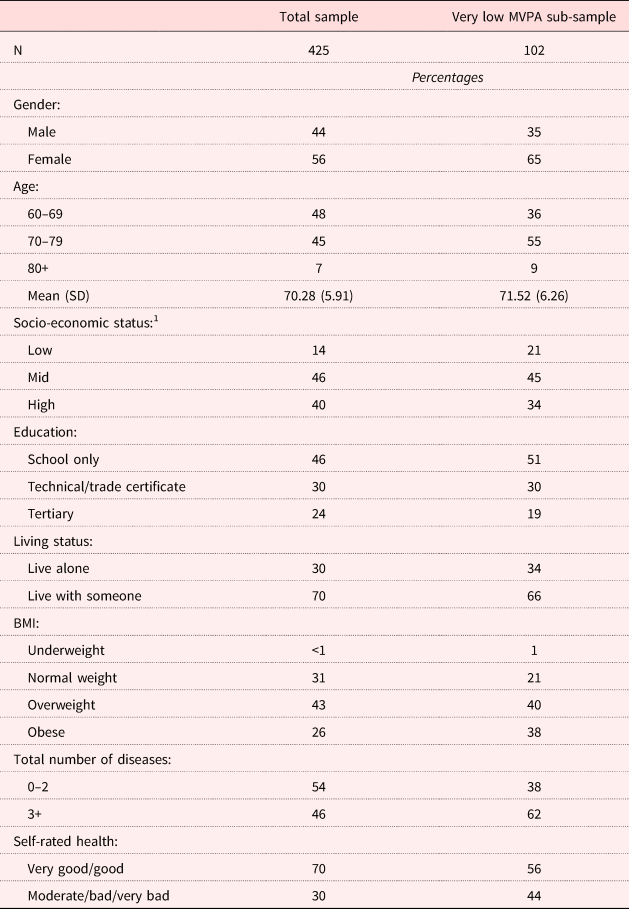
In total, 425 participants had complete accelerometer and interview data, 102 of whom had engaged in ⩽75 minutes of MVPA during the week they wore the accelerometer. The low-activity participants ranged in age from 60 to 92 years (mean = 71.52, standard deviation = 6.26). As shown in Table 1, when compared to the larger study sample the selected participants were more likely to be older, female, of lower socio-economic status and less educated. They were also more likely to be obese, suffer from three or more chronic diseases, and to rate their health as moderate, bad or very bad (rather than good or very good).
Sample profile

Notes: 1. Socio-economic status derived from residential postcode according to the Australian Bureau of Statistics’ (2016) Socio-Economic Indexes for Areas classification. MVPA: moderate-to-vigorous physical activity. SD: standard deviation.
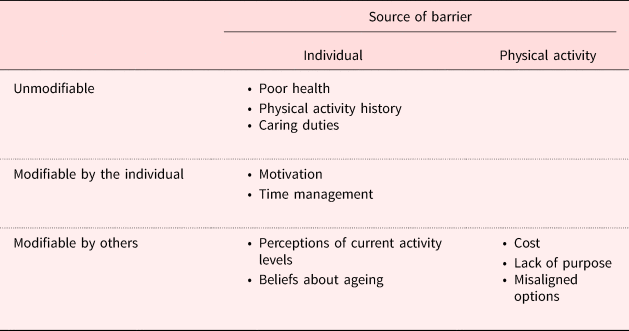
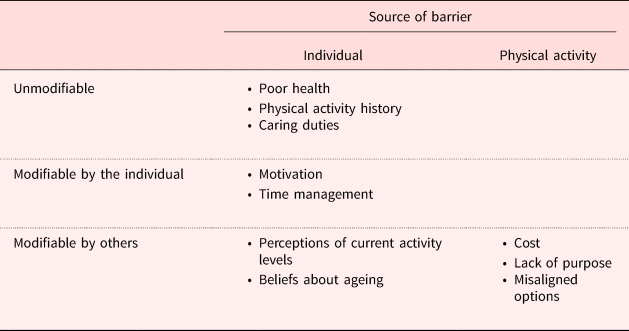
Analysis of the interview data revealed two higher-order dimensions that encompassed the factors that were most frequently described by the participants as discouraging their participation in physical activity. The first dimension related to locus of control and referred to whether the factor was presented as being unmodifiable, modifiable by the individual or modifiable by others (e.g. health practitioners, service providers or policy makers). Of note is that this classification related to the extent to which the factor itself was considered by participants to be modifiable, but this does not preclude the use of strategies designed to address the identified barriers. The second dimension related to the source of the barrier – whether it was due to the individual's attributes or circumstances, or whether it was a function of the nature and demands of physical activity. The factors are listed in Table 2 and described below in terms of the extent of their perceived modifiability. Illustrative quotes are provided and identified age and gender differences are noted where relevant.
Factors discouraging participation in physical activity
Unmodifiable factors
All of the identified unmodifiable factors were related to the individual and included health problems, lifetime activity habits and intensive caring commitments that were described as all-encompassing and therefore preclusive of engagement in other activities. Reflecting the intractable nature of these factors, they were considered by participants to be insurmountable barriers to engagement in regular physical activity.
Poor health
The most frequently nominated problems that prevented exercising were related to poor health. Around half of the participants identified health problems as a major barrier, and this was somewhat more prevalent among the males and older participants. Arthritis was by far the most commonly reported limiting condition, with other frequently mentioned diseases and symptoms including heart disease, cancer, high blood pressure, diabetes, asthma, breathlessness, giddiness and swollen legs:
I've got arthritis, especially in the right knee, and that gives me a lot of pain. So I'm limited really. (F (female), 60–69 years)
I had a nasty accident. As a result of that injury, I got arthritis in my ankle, which is very painful. I've also got arthritis in this shoulder. Also the result of a cycling accident and so on. I can't lift this arm further than that without a lot of effort. (M (male), 80+ years)
I find walking difficult. I get very short of breath. I'm a conformed smoker. (F, 80+ years)
I do have ticker [heart] problems, I do wear a pacemaker. Climbing stairs can be difficult, so I try to avoid them, which is naughty. I should really tackle them. I don't do any sort of planned physical exercise. I don't ride a bike anymore. (M, 80+ years)
In some cases the condition had been experienced in the past, but was still considered a substantial barrier to any present or future physical activity. For example, some participants discussed how hip or knee replacement surgery had left them very wary of exertion. Despite the fact that these operations had occurred some time ago (an average of around five years), fears relating to further problems with the joint constituted an ongoing obstacle to contemplating or enacting any form of physical activity:
I can't do as much exercise as I would like because, when is it, about seven, eight years ago now, nine years ago, I had a replacement knee, my left knee … There's some things which I am a little bit conscious of. I don't want to wear it out, if you know what I mean, so that in two years’ time I've got to do it again or replace the ‘cartilage’, whatever they put in there. I've got to be a bit careful. (M, 70–79 years)
Physical activity history
Some participants reported that since leaving school they had not engaged in regular physical activity, and they considered this to be a legitimate reason for maintaining their inactivity in their older years. Various reasons were given for this lack of exercise during adulthood. Some described themselves as never having been ‘a physical person’ or ‘a sporty person’, which was sometimes also discussed in terms of disliking their school sport experiences. Many of the females reported that they had quickly taken on family responsibilities that prevented them from having the time or opportunity to exercise regularly, and some of the females noted that they were too introverted to engage in activities that would draw attention to themselves:
I was hopeless at sports or anything at school, so I hated it. (F, 60–69 years)
I was too shy to play any sport because I thought people would look at me and I didn't want that to happen you see. (F, 70–79 years)
Once I got married I had five children, so that sort of kept me … round the home. (F, 70–79 years)
Male participants frequently reported that their physical activity levels declined after they started working. Some had sedentary jobs that took up most of their time, while others reported that their jobs were physically demanding so they had not needed to arrange additional exercise:
I used to spend all my time in a motor car, and of course I didn't get a lot of exercise. That's when I started to slow down physically. (M, 70–79 years)
I was working in a job that you have to walk, like visiting shops in one street. I had to walk, carry things with me and deliver them. So there was no need to do [exercise]. (M, 70–79 years)
Caring duties
A few participants had very ill spouses who required constant and intensive care. In these cases it was often not possible for the spouses to be regularly left unattended to enable the carer to maintain an exercise routine. Especially where the condition was terminal, the expectation was that the well spouse's needs would be secondary to those of the sick spouse:
The only reason [preventing me from being active], my wife has got cirrhosis of the liver and her legs are really swollen up big. She's had a couple of falls. She slipped on there and fell and she's been in agony ever since, and this happened about four years ago. So it stops me from doing too many things. I like to do lots of things. (M, 70–79 years)
It's just with his cancer and everything, everything was sort of put back and it wasn't about me anymore. (F, 60–69 years)
Factors that are potentially modifiable by the individual
Two factors were identified that were recognised by the participants as being potentially modifiable by themselves, both of which relate to the way in which they approach the idea of engaging in physical activity rather than relating to the nature of physical activity itself. These factors were a lack of motivation to exercise and a related failure to engage in the time management required to ensure opportunities are created for regular physical activity.
Motivation
Most of the participants acknowledged that they should be doing more exercise, indicating that lack of awareness was not the primary barrier to participation. Among those without major health problems or all-encompassing caring commitments, lack of motivation was frequently cited as a primary reason for physical inactivity. This was variably expressed in terms of laziness, disinterest and/or the dislike of the boredom experienced when exercising:
Yeah, just lazy really because I keep saying in here, ‘Yeah, I should, I should, I should’, and there's always some excuse. (F, 70–79 years)
I've got to get back into it, I suppose. I keep on promising myself. I keep on gaining weight. Well I don't know, just time and effort to get started up and laziness I think. (M, 60–69 years)
I'm not interested in being active to tell you the truth … I'm not a gym person. It's like the boredom of it. It's got to be really creative. (F, 60–69 years)
Time management
Related to this lack of motivation was the often-expressed view that physical activity is less important than other things in their lives. Some had personal interests or family commitments that were given priority over exercise. Examples of personal interests included sedentary hobbies (e.g. writing, crafts and woodwork) and membership of social clubs or having a vibrant personal social circle. Babysitting was the most common form of family commitment (other than caring for a sick spouse, as noted above) that was reported as occupying time that could otherwise be spent engaging in regular physical activity:
I'm trying to write a book at the moment, so most of the time is taken up with that. (M, 60–69 years)
There is nothing physically that stops me being active, it's just making the time to do it. I belong to the Men's Shed. I do work there, doing semi-physical work, doing woodwork and metalwork and things like that. (M, 70–79 years)
Too much things on ever since my wife has retired. We always seem to be very busy. She organises things for me. She's the social manager. (M, 60–69 years)
Currently most of my exercise is looking after my daughter's nine-month-old. So that keeps me pretty busy. (M, 70–79 years)
Joined a gym for a little while, but then with grandchildren and children wanting me to look after children while they went to the gym, it sort of didn't co-ordinate very well. I ran out of time. (F, 60–69 years)
Barriers that are modifiable by others
Unlike the factors outlined above, those identified in this category included those relating to both types of barrier sources (the characteristics of the individual and the nature of physical activity itself). This distinction is important because of the implications for the individuals/groups who would need to be recruited to address the identified issues. The commonality among the factors in this section of the framework related to the need for others to intervene to overcome either (a) individuals’ misperceptions of actual or appropriate levels of physical activity or (b) the way in which physical activity services are offered to seniors.
Perceptions of current activity levels
As noted above, there was a general understanding that it is important to stay active in later life, and many participants knew that it is important to avoid being too sedentary. However, the way in which ‘active’ was operationalised by the participants was often problematic because they underestimated the amount and intensity of activity required and/or they overestimated the contribution of their current activity levels to their daily activity needs. They often felt that they obtained adequate levels of exercise through incidental activities such as household chores, gardening and walking while shopping:
I do a lot. I do most of the gardening and I normally – because I'm a bit of a neat freak I like to vacuum through once a week. I do a few loads of washing. (F, 70–79 years)
My wife's a great shopper and I always go with her, so we get plenty of exercise. (M, 80+ years)
Beliefs about ageing
Some participants perceived that the ageing process inevitably brings about physical deterioration that caused people to ‘slow down’ and limits their ability to engage in regular physical activity. They also reported that as a result of ageing they found it ‘harder to do things’ and had lower energy levels. This was perceived as a barrier mainly by those aged 70 years and above:
You slow down, no matter how [committed] you are. (F, 70–79 years)
I'm getting old. It just comes with the territory. (F, 80+ years)
I think it's probably just I'm aware now that things – it's harder to do things, you know, because of my age. (F, 70–79 years)
Cost
For some, the expenditure associated with specific types of physical activity programmes served as a barrier to establishing and maintaining an exercise routine. This barrier was mainly mentioned by women and related to activities such as going to the gym and attending dance classes. They felt that the activities they enjoyed were too costly and the ones that were freely available were not suitable for them:
I used to go to the gym, but it was out of price range. It was costing me [Aus] $100 a week, so it was out of my price range. (F, 70–79 years)
I guess it's lots of money to do all these things that you'd really like to do, but you can't do it. There are no places where they say, this is just for pensioners and you don't have to pay so much. (F, 70–79 years)
Purposelessness
Several participants said that they did not find purpose in exercising just for the sake of fitness. They felt that exercise needed to be goal-oriented to be worthwhile. These participants were mostly aged 70 years and above:
To run for running's sake, no, don't want to know. (M, 70–79 years)
I don't mind exercising to do something. I'm not keen on exercising for the sake of exercising. (F, 70–79 years)
You need to have a goal at the end of it. If you don't have a goal at the end of it, I find it just too hard to keep doing. (F, 70–79 years)
Misaligned physical activity options
Participants often felt that available options fail to suit both the preferences and abilities of older people. For example, the males sometimes reminisced about their sporting activities in their younger years and bemoaned that the ageing process prevents ongoing participation in these favoured forms of exercise:
At 72 you can't run around a soccer field for 90 minutes. (M, 70–79 years)
You're not as agile as you used to be, and I wouldn't play footy anymore because it's just too hard for old blokes. (M, 70–79 years)
Some expressed the opinion that exercise options for older people tend to be developed for seniors as a homogenous group, and therefore fail to accommodate different ability levels. Some were concerned about being too slow and inconveniencing other participants, while others were very uncomfortable self-identifying as someone old enough to join programmes specifically designed for the elderly:
I packed up with the bushwalking club, I used to bushwalk … I suppose I was a bit apprehensive that I would hold the rest of the group up. There's quite a lot maybe ten years or so younger than myself. (M, 80+ years)
If I'm just stuck in with old people it's like, ‘Oh, I feel like so hemmed in’ … If I look at things for my age, I just wouldn't go to them. I wouldn't join in with them because there wouldn't be anything of my interest. (F, 60–69 years)
I feel I don't fit very well into categories because I don't really want to be playing something with 40 year olds I guess. [But] when I look at the sport for the seniors, I don't think I'm quite at that stage yet. (F, 60–69 years)
Discussion
Given low participation rates, intensive efforts are needed to encourage greater levels of physical activity among older people (Bauman et al., Reference Bauman, Merom, Bull, Buchner and Fiatarone Singh2016). The aim of the present study was to gain a deeper understanding of the causes of very low levels of physical activity in community-dwelling older adults to inform such efforts. Numerous barriers were identified that could be addressed in future interventions designed to encourage inactive seniors to engage in regular physical activity. Many of these barriers relate to factors at the level of the individual, and will therefore require approaches that educate, motivate and/or assist seniors to overcome issues that prevent them from being willing or able to exercise. Other barriers relate to the nature of the physical activity opportunities available to older people, and hence will require efforts to expand or modify these offerings to ensure they are available to and appropriate for members of this group. The categorisation of barriers according to their nature and the extent to which they can be modified and by whom can provide a framework for guiding intervention efforts, as outlined further below.
Many of the influencing factors that were identified in this study have been reported previously as being especially relevant to older people. In particular, poor health (Baert et al., Reference Baert, Gorus, Mets, Geerts and Bautmans2011; Bauman et al., Reference Bauman, Reis, Sallis, Wells, Loos and Martin2012), low motivation (Beck et al., Reference Beck, Gillison and Standage2010; Moschny et al., Reference Moschny, Platen, Klaaßen-Mielke, Trampisch and Hinrichs2011), accessibility and cost issues (Mathews et al., Reference Mathews, Laditka, Laditka, Wilcox, Corwin, Liu, Friedman, Hunter, Winston and Logsdon2010; Van Dyck et al., Reference Van Dyck, Mertens, Cardon, De Cocker and De Bourdeaudhuij2017) and a history of inactivity (Cousins and Keating, Reference Cousins and Keating1995; Friedman et al., Reference Friedman, Martin, Tucker, Criqui, Kern and Reynolds2008; Telama, Reference Telama2009; Buman et al., Reference Buman, Yasova and Giacobbi2010; Hirvensalo and Lintunen, Reference Hirvensalo and Lintunen2011) have been frequently reported to be fundamental barriers to physical activity participation among older people in general. To a lesser degree, overestimation of current activity levels (Booth et al., Reference Booth, Bauman and Owen2002), caring duties (Wilcox et al., Reference Wilcox, Castro, King, Housemann and Brownson2000; Buman et al., Reference Buman, Yasova and Giacobbi2010; Dickinson et al. Reference Dickinson, Machen, Horton, Jain, Maddex and Cove2011) and assumptions relating to the ‘natural’ cessation of more vigorous physical activity in later life (Mathews et al., Reference Mathews, Laditka, Laditka, Wilcox, Corwin, Liu, Friedman, Hunter, Winston and Logsdon2010; Burton et al., Reference Burton, Lewin and Boldy2013) have been identified as factors discouraging participation. Finally, the results are also consistent with the particular emphasis on health problems and the stated lack of motivation to exercise found in the few studies specifically focused on very inactive seniors (Kolt et al., Reference Kolt, Paterson and Cheung2006; Buman et al., Reference Buman, Yasova and Giacobbi2010; Moschny et al., Reference Moschny, Platen, Klaaßen-Mielke, Trampisch and Hinrichs2011).
Of note is that the social factors identified in previous studies as being influential as both a motivator (a way of meeting and interacting with people; Leavy and Åberg, Reference Leavy and Åberg2010; Devereux-Fitzgerald et al., Reference Devereux-Fitzgerald, Powell, Dewhurst and French2016) and a barrier (a lack of others with whom to exercise; Moschny et al., Reference Moschny, Platen, Klaaßen-Mielke, Trampisch and Hinrichs2011; Stathi et al., Reference Stathi, Gilbert, Fox, Coulson, Davis and Thompson2012) did not appear to be important to the inactive seniors participating in the present study. A possible explanation could be that the other identified barriers were overwhelming to the extent that participants had not even considered the social aspects of exercising because they had no intention of engaging in higher levels of MVPA anyway. Other issues of relevance to these inactive seniors that have had little recognition in previous research were (a) the belief that exercise needs to be functional and purposeful in its own right rather than just being associated with health benefits and (b) a reluctance to self-identify as an older person, resulting in available exercise options being perceived as inherently unsuitable.
Some gender differences were identified in the results. Following traditional gender roles, females were more likely to report low levels of physical activity due to family responsibilities, introversion and cost (the latter could reflect gender inequalities in financial security; Centre for Ageing Better, 2017). By comparison, males were more likely than females to attribute their inactivity to poor health.
The high level of consistency in findings between the present study and previous research with older people indicates that in many cases the same barriers may apply to very inactive seniors as their counterparts exhibiting varying levels of activity, and therefore similar intervention strategies may be effective across the age group. The additional issues identified provide further understanding of the specific circumstances of those with very low MVPA and suggest further barriers that can be addressed to improve intervention effectiveness among members of this group. The discussion below outlines the potential intervention implications of each identified factor according to the extent to which the factor was perceived to be modifiable.
Intervention implications
Unmodifiable factors
Although the existence of serious health problems, a lifetime of inactivity and intensive caring duties are unlikely to be directly modified via physical activity interventions, there are various strategies that can be employed to circumvent these issues to provide older people with the motivation and ability to engage in regular MVPA. In terms of health problems, there may be the potential to improve awareness of the types and intensities of physical activity that are possible and advisable for specific conditions. For example, those with arthritis could be better informed of the role of physical activity in pain management, disease treatment and prevention of disease progression to give them the confidence and motivation to establish and maintain a regular exercise routine. Health professionals have an important role to play in disseminating this kind of information (Crombie et al., Reference Crombie, Irvine, Williams, McGinnis, Slane, Alder and McMurdo2004). Similarly, the data suggest that post-surgical consultations could include more specific and extensive advice relating to the types of exercises that can be safely performed following joint replacement surgery (Westby et al., Reference Westby, Brittain and Backman2014).
Given the high prevalence of ill health among members of this group, the opportunity may exist for health practitioners to take advantage of medical diagnoses as ‘teachable moments’ during which the benefits of physical activity for treating and preventing further deterioration can be communicated (Lawson and Flocke, Reference Lawson and Flocke2009). Although the participants did not consider their serious health conditions to be modifiable, there is an established body of evidence demonstrating that ‘prescribing’ exercise is an effective form of treatment for many conditions, including arthritis (for a review, see Pedersen and Saltin, Reference Pedersen and Saltin2006). Advice from physicians has been found to be an important source of influence on older adults’ physical activity participation (Booth et al., Reference Booth, Bauman, Owen and Gore1997; King and King, Reference King and King2010). The ability of physicians to dispel unfounded myths and provide information about the benefits of physical activity could thus be important in alleviating perceived barriers.
Strategies to address long-term inactivity need to overcome the tendency for inactivity to track into adulthood to a greater extent than does activity (Telama, Reference Telama2009). Encouraging older people to engage in regular physical activity for the first time in their adult lives is challenging, highlighting the importance of a lifespan approach to fostering a positive attitude to exercise and providing accessible, affordable and attractive physical activity opportunities at all stages of the lifecourse (Ekelund, Reference Ekelund, Kuh, Cooper, Hardy, Richards and Ben-Shlomo2014).
Intensive caring duties can pose a substantial obstacle for physical activity participation (Wilcox et al., Reference Wilcox, Castro, King, Housemann and Brownson2000; Dickinson et al., Reference Dickinson, Machen, Horton, Jain, Maddex and Cove2011). In the case of the older participants in the present study, caring duties often related to extended end-of-life care that could last years. In this situation, long-term planning is needed to provide carers with opportunities to establish and maintain an exercise routine. This could involve the provision of regular respite care specifically for the purpose of enabling physical activity (Hill et al., Reference Hill, Smith, Fearn, Rydberg and Oliphant2007), and/or encouraging and facilitating home-based activities such as using instructional videos and affordable equipment (King and Brassington, Reference King and Brassington1997; Connell and Janevic, Reference Connell and Janevic2009).
Modifiable factors
The remaining nominated barriers appear more amenable to change, either by seniors themselves or other parties such as health practitioners, service providers and policy makers. While distinct, many of the identified barriers are likely to be highly interrelated. For example, the tendency for many participants to report low motivation and/or to fail to manage their time in such a manner as to permit regular physical activity seemed to be connected to their perceptions that (a) exercise lacks purpose, (b) they are already adequately active and/or (c) slowing down is a natural part of the ageing process that should be accepted.
Lack of motivation despite knowing the health benefits of exercise evident among many participants in this study indicates that alternative approaches to just focusing on improved health will be necessary to ensure coverage of the diverse cohort of inactive seniors. For example, messages may need to be framed around non-health priorities. The tendency for many of the study participants to discuss other priorities such as babysitting and sedentary hobbies as time-consuming pastimes suggests that remaining functional to participate in these activities for as long as possible may be a potential motivator around which to frame the benefits of exercise (Devereux-Fitzgerald et al., Reference Devereux-Fitzgerald, Powell, Dewhurst and French2016). This approach is consistent with socio-emotional selectivity theory that outlines the inverse association between chronological age and perceived time left in life, which in turn affects older people's motivations (Carstensen et al., Reference Carstensen, Isaacowitz and Charles1999). The perceived time limitations brought about by increasing age can result in a reprioritisation of goals such that those relating to deriving meaning from life and that are associated with positive emotions are ranked higher than long-term future-oriented goals such as improved health (Löckenhoff and Carstensen, Reference Löckenhoff and Carstensen2004). As such, the benefits of physical activity may need to be specifically framed around these other priorities to make them meaningful and motivating to seniors (Devereux-Fitzgerald et al., Reference Devereux-Fitzgerald, Powell, Dewhurst and French2016).
A further potential source of motivation is enjoyment of the activity itself. Experiencing enjoyment increases the likelihood of exercise routines being maintained over time, highlighting the importance of identifying and delivering forms of activity that are appealing to older people (Lewis et al., Reference Lewis, Williams, Frayeh and Marcus2016). Involvement in group-based exercise programmes has been found to be effective for increasing activity levels among older people by eliciting intrinsic motives to participate, such as fun and enjoyment (Harden et al., Reference Harden, McEwan, Sylvester, Kaulius, Ruissen, Burke, Estabrooks and Beauchamp2015; Pedersen et al., Reference Pedersen, Vorup, Nistrup, Wikman, Alstrøm, Melcher, Pfister and Bangsbo2017). Such outcomes can be especially likely where the activities cater for those of similar age profiles (Beauchamp et al., Reference Beauchamp, Ruissen, Dunlop, Estabrooks, Harden, Wolf, Liu, Schmader, Puterman, Sheel and Rhodes2018).
The desire for exercise to be purposeful was more frequently expressed by the older members of the sample. These participants in particular grew up in an era when physical activity was incorporated into daily life and was not undertaken intentionally (Grant, Reference Grant2012), resulting in the interpretation that exercise is merely a by-product of daily activities and not a purposeful activity in itself (McGowan et al., Reference McGowan, Devereux-Fitzgerald, Powell and French2017). This suggests that these individuals need specific information about physical activity guidelines and the reasons behind their formulation. Once again, this is likely to be most effectively accomplished via trusted health practitioners who have the opportunity to provide personalised information in the context of the individual's health status, including tailored prescriptions for specific forms, intensities and duration of physical activity to assist their patients meet these recommendations (Booth et al., Reference Booth, Bauman, Owen and Gore1997; Chase, Reference Chase2013). However, there is also likely to be an important role for population-level physical activity campaigns designed to influence social norms relating to exercising throughout the entire lifespan to encourage compliance with physical activity guidelines at any age (Pettigrew et al., Reference Pettigrew, Burton, Farrier, Hill, Bainbridge, Airey, Lewin and Hill2019). Similarly, common misperceptions relating to the adequacy of current levels of activity and assumptions relating to the normality of slowing down in later life require more effective communication of the guidelines, ideally via both individualised and mass media approaches. Innovative approaches such as the use of electronic activity monitors that provide instant objective feedback on activity levels could assist in dispelling misperceptions of the adequacy of current activity levels and increasing motivation (Kolt et al., Reference Kolt, Schofield, Kerse, Garrett, Ashton and Patel2012). Such devices have been shown to be effective in encouraging physical activity participation in older adults (Cooper et al., Reference Cooper, Gross, Brinkman, Pope, Allen, Hastings, Bogen and Goode2018; Jonkman et al., Reference Jonkman, van Schooten, Maier and Pijnappels2018).
The final barriers relating to the cost and availability of physical activity options that are considered attractive and appropriate by seniors can be addressed through either the more active provision of information about the alternatives already available in their local areas or the development of affordable options if none exist (Pettigrew et al., Reference Pettigrew, Burton, Farrier, Hill, Bainbridge, Airey, Lewin and Hill2019). The dissatisfaction with existing options expressed by many of the interviewees suggests that the provision of exercise facilities should be based on wide consultation to ensure the target group's preferences and expectations are adequately met to optimise the likelihood of patronage. Given the large economic costs to society of inactivity among older people (Ding et al., Reference Ding, Lawson, Kolbe-Alexander, Finkelstein, Katzmarzyk, Van Mechelen and Pratt2016), subsidising physical activity programmes that are attractive to seniors is likely to be a cost-effective method of encouraging participation and reducing long-term costs to health systems (Nguyen et al., Reference Nguyen, Ackermann, Maciejewski, Berke, Patrick, Williams and LoGerfo2008).
A further important issue when considering the implications of the present study is the need to move beyond a single focus on individual agency (Timonen, Reference Timonen2016). The framing of healthy ageing as the responsibility of the older person has emerged from discourses around ‘successful’ and ‘productive’ ageing (O'Reilly and Caro, Reference O'Reilly and Caro1995; Rowe and Kahn, Reference Rowe and Kahn1997). While initially intended to be used in efforts to improve older people's quality of life, these concepts have evolved over time to encompass issues relating to the economic and social consequences of ageing populations and a desire to alleviate the associated costs by encouraging individuals to take effective preventive action (Tulle, Reference Tulle2008; Bülow and Söderqvist, Reference Bülow and Söderqvist2014). In the process, these concepts have re-shaped ideas about ‘appropriate’ ageing and have been endorsed worldwide, including in Australia (Neilson, Reference Neilson2006; Pike, Reference Pike2011). In this context, the responsibility for health and a successful old age is placed on the individual, and older adults are now expected to make healthy lifestyle choices (Katz and Calasanti, Reference Katz and Calasanti2014; Rubinstein and de Medeiros, Reference Rubinstein and de Medeiros2014; Timonen, Reference Timonen2016).
The results of the present study indicate that for very inactive seniors, relying solely on efforts to convince them to deliberately choose to be more active is unlikely to be effective. Instead, the situations of these older people highlight the obligations of policy makers to adopt the principles of universal design that can facilitate greater levels of activity among entire populations as well as just older people (Preiser and Smith, Reference Preiser and Smith2011). Physical activity could be encouraged across the lifespan by using universal design principles to create inclusive environments that are conducive to physical activity among individuals of all ages and capabilities (Preiser and Smith, Reference Preiser and Smith2011; Carr et al., Reference Carr, Weir, Azar and Azar2013). Similarly, these principles could be utilised in developing physical activity options for older adults, such as being equitable, flexible, safe, comfortable and convenient, to overcome barriers identified in this study (costs, misaligned physical activity options and poor health).
Study limitations and strengths
The main limitation of the present study is the qualitative approach used, which limits the generalisability of the findings to the wider population of older adults. In addition, there was a gender skew towards females. However, this study is based on a sub-sample of inactive older adults derived from a larger study sample, and since female gender has been associated with both greater longevity and lower levels of physical activity in older people (Bauman et al., Reference Bauman, Reis, Sallis, Wells, Loos and Martin2012; WHO, 2014), the greater proportion of females is to be expected. A further issue was that the majority of participants were of mid to high socio-economic status, and therefore the views of those from lower socio-economic status might not have been adequately represented. Finally, although early life experiences with physical activity were identified as determinants of inactivity in this study, detailed lifecourse histories were not obtained. Future studies could use more in-depth narrative enquiries to investigate the mechanisms via which experiences across the lifespan influence activity levels in later life.
In terms of strengths, this study focused exclusively on inactive older adults, thereby accessing the perspectives of those in particular need of assistance in achieving higher levels of physical activity. The large sample size for a qualitative study provides some assurance that the results may be useful to inform interventions for inactive older adults in similar cultural contexts. Further, the inclusion of participants of varying education levels, living status, health and BMI status provided access to a broad range of perspectives about physical activity and contributes to the ecological validity of the study. Lastly, this is one of the few qualitative studies to use an objective measure of physical activity, ensuring that inclusion in the study was based on verified low levels of MVPA.
Conclusion
Numerous barriers of varying modifiability were identified as contributing to low levels of physical activity among the seniors participating in this study. Many of the barriers related to individual-level factors, the most important of which was poor health. This highlights the importance of ensuring health practitioners are willing and able to counsel older people on the benefits of MVPA for preventing and treating a wide range of health problems. In addition, the findings suggest that strategies are needed to raise awareness of current physical activity guidelines, normalise engagement in MVPA throughout the lifespan, develop initiatives to motivate participation, improve the availability of affordable physical activity programmes that are attractive to this population segment, provide assistance to those with intensive caring responsibilities and ensure universal design principles are implemented wherever possible.
Financial support
This work was supported by the Australian Research Council (grant number DP140100365). The funding source had no involvement in study design; in the collection, analysis and interpretation of data; in the writing of the article; and in the decision to submit the article for publication.
Conflict of interest
The authors declare no conflicts of interest.
Ethical standards
Ethics approval for the study was obtained from the Curtin University Human Research Ethics Committee.