Introduction
Older people are recognised as among the most vulnerable people in disasters. This is particularly true of earthquakes, for elderly people tend to be less mobile and more easily trapped, confined and injured than younger adults. Elderly populations also have significant co-morbidities that affect their resilience to acute trauma and ability to cope with its long-term consequences, including displacement, poor housing, crowded conditions and diminished access to health services (Ardalan et al. Reference Ardalan, Mazaheri, Rezaie, Holakouie Naieni and Teimouri2010; Chen et al. Reference Chen, Tan, Liao, Chen, Chan, Cheng, Chen and Lu2007; Fernandez et al. Reference Fernandez, Byard, Lin, Benson and Barbera2002; Gibson and Hayunga Reference Gibson and Hayunga2008; Lamb, O'Brien and Fenza Reference Lamb, O'Brien and Fenza2010; Lin et al. Reference Lin, Huang, Huang, Hwang, Tsai and Chiu2002; Tanida Reference Tanida1996). In the aftermath of major disasters, it is crucial to institute efforts that will maintain a high level of quality of life (QoL) among older citizens. The concept of QoL has been defined by the World Health Organization (WHO) as ‘an individual's perceptions of their position in life in the context of the culture and value systems in which they live and in relation to their goals, expectations, standards and concerns’ (WHO 1997). It has four domains, namely physical health, psychological state, social relationships and environment.
Earthquakes are particularly devastating disasters and have huge physical and psycho-social impacts on human life. The greater the severity or prevalence of the psychiatric impairment caused by the earthquake, the lower the survivors' expected QoL (Chou et al. Reference Chou, Chou, Lin, Su, Ou-Yang, Chien, Su, Lu and Chen2004a; Tsai et al. Reference Tsai, Chou, Chou, Su, Lin, Lu, Ou-Yang, Su, Chao, Huang, Wu, Sun, Su and Chen2007; Wang et al. Reference Wang, Gao, Zhang, Chengzhi, Shen and Shinfuku2000). While post-disaster QoL assessment can be used as an indicator in monitoring and for the evaluation of recovery plans (Chou et al. Reference Chou, Chou, Lin, Su, Ou-Yang, Chien, Su, Lu and Chen2004a, Reference Chou, Chou, Su, Ou-Yang, Chien, Lu and Huang2004b; Wang et al. Reference Wang, Gao, Zhang, Chengzhi, Shen and Shinfuku2000), few researchers have studied the multi-dimensional impacts of earthquakes on QoL. In an analysis of survivors of the Chi-Chi earthquake in Taiwan, Lin et al. (Reference Lin, Huang, Huang, Hwang, Tsai and Chiu2002) reported that older people experienced lower QoL in terms of physical capacity, psychological wellbeing and environmental quality 12 months after the earthquake as compared to the period before the earthquake. The extent of damage to the survivors' residences was related, however, to only one of the QoL dimensions: social relationships. In another study of the same earthquake conducted 21 months after the event, Chou et al. (Reference Chou, Chou, Su, Ou-Yang, Chien, Lu and Huang2004b) demonstrated that QoL was worse among females, older people and those who had experienced a major financial loss, social-network change and mental impairment. In a longer-term follow-up study of the Chi-Chi earthquake, Wu et al. (Reference Wu, Chou, Chou, Su, Tsai, Ou-Yang, Su, Chao, Sun and Chen2006) found age, female gender, economic problems and physical illness to be determinants of poor QoL. Finally, Ceyhan and Ceyhan's (Reference Ceyhan and Ceyhan2007) research on the QoL of university students six years after the earthquakes in Marmara, Turkey, showed that gender, age at the time of earthquake, and continuing financial difficulties were linked to decreased QoL. Among the above-mentioned studies on post-disaster QoL, only those by Lin et al. (Reference Lin, Huang, Huang, Hwang, Tsai and Chiu2002) and Chou et al. (Reference Chou, Chou, Su, Ou-Yang, Chien, Lu and Huang2004b) have focused on older people or included them in the analysis.
The Bam earthquake on 26 December 2003 measured 6.6 on the Richter scale, resulted in the deaths of more than 26,000 people, and left 30,000 injured and more than 45,000 homeless (Ardalan et al. Reference Ardalan, Holakouie Naieni, Aflatounian, Nekouie, LaPorte and Noji2005). Such events are not rare in Iran – the country sits astride active earthquake fault zones and lines. Iran is a disaster-prone country, and it is experiencing rapid population ageing. The percentage of the population aged 60 or more years is projected to increase from 5.2 in 2000 to 21.7 in 2050 (United Nations Organization 2007). As this proportion grows, so too does the population's risk of being affected by disaster.
Post-disaster QoL assessment can be considered appropriate for monitoring and evaluation recovery plans and interventions, with particular reference to both understanding various aspects of the disaster's impacts and establishing people's perceptions of their living circumstances and life chances after the event (Chou et al. Reference Chou, Chou, Lin, Su, Ou-Yang, Chien, Su, Lu and Chen2004a, Reference Chou, Chou, Su, Ou-Yang, Chien, Lu and Huang2004b; Wang et al. Reference Wang, Gao, Zhang, Chengzhi, Shen and Shinfuku2000). In addition, studying the determinants of QoL in a disaster-affected community provides aid donors and managers of recovery programmes with the evidence required for cost-effective planning. To this end, the purpose of this article is to assess the QoL of older survivors five years after the Bam earthquake in four domains: physical health, psychological state, social relationships and environment. The study examines also the associations among the four domains and their relationship to socio-demographic characteristics (gender, age, education and marital status), the earthquake's consequences (severe injury, damage to building, and death of a household member), abilities in the activities of daily living (ADL) at the time of study, current type of housing (connex or house) and satisfaction with the quality of housing. (A connex is a 9–12 m2 temporary, pre-fabricated living space as provided to the homeless in Bam after the earthquake; they have no toilet, bathroom or kitchen facilities.) This study was conducted in conjunction with the development of an appropriate service package for addressing the health and health-care needs of older people in disaster events.
Study design
A cross-sectional survey was performed in November and December 2008 in the Bam earthquake-stricken area in the Kerman province of Iran, which includes the urban districts of Bam and Baravat as well as their rural environs (including Poshtrood, Kerk, Chehel-Tokhm and Khaje-Asgar).
Participants
There were 210 participants (49.0% male and 51.0% female) and their ages ranged from 65 to 95 years (mean 71.8, standard deviation 7.2). Of the total, 182 (86.7%) lived in urban areas (60% in Bam and 26.7% in Baravat) and 28 (13.3%) in rural areas. The majority (69.5%) of the participants were illiterate and married (54.8%). Just 21 (10.0%) lived alone, while 189 persons (90.0%) lived with their spouse or relatives. As for the personal and socio-economic consequences of the earthquake, 192 people (91.4%) lost their houses, five (2.4%) lost their jobs, and 19 (9%) lost their job or working equipment. The participants were greatly affected by earthquake damage to their houses: 109 (51.9%) had their houses totally destroyed, for 80 (38.1%) they were moderately damaged, and for 21 (10%) their houses were slightly damaged. At the time of the study, most of the elderly survivors (87.6%) lived in their own houses, but 16 (7.6%) lived in connexes, two (1.0%) in rental houses and eight (3.8%) in relatives' homes. Fourteen (6.7%) described the quality of their current residence as ‘inappropriate’, while 77 (36.7%) rated it as ‘medium’ and 119 (56.7%) considered it ‘appropriate’. As for the direct earthquake consequences, 30 people (14.3%) had been hospitalised and/or underwent surgery, and 32 (15.2%) lost a member of their household.
The quality of life assessment instrument
QoL was assessed using a Persian translation of the WHO's Quality of Life (WHOQOL-BREF) instrument that had previously been adapted for administration in Iran (Nedjat et al. Reference Nedjat, Montazeri, Holakouie Naieni, Mohammad and Majdzadeh2008). It has 26 questions including: overall QoL (one item), overall health status (one item), four domains of physical health (seven items), psychological state (six items), social relationships (three items), and environment (eight items). Each is assessed using a five-point Likert scale. The raw scores of all domains were converted to transformed scores that ranged from ‘4’ to ‘20’. A higher score indicates a better expressed QoL.
The questionnaire
The questionnaire was designed to collect data on socio-demographic attributes (gender, age, education and marital status), earthquake consequences (severe injury defined by hospitalisation and/or undergoing surgery, damage to building, death of a household member), ADL score (or level of independence) at the time of study, and current living situation including type of housing (connex or house) and satisfaction with the quality of housing.
Procedure
A systematic sampling design was implemented, partly drawing on a household census carried out by the Bam District Health Centre. This selected 30 area clusters, each of which had seven elders. The sample numbers were proportionate to population size, with 126 participants (18 clusters) from Bam, 56 participants (eight clusters) from Baravat, and 28 participants (four clusters) from the rural environs. If a household included more than one eligible elder, one was randomly selected. For the eligible participants that were not at home at the initial visit by the survey team, a second or third call was made. Only six elders (2.9%) refused to participate, and they were replaced by the next eligible names. Eighteen elders were not ineligible for inclusion because they had stayed more than three months outside the earthquake-affected area. The survey team underwent extensive training on both the questionnaire and interview procedures. The survey instrument was piloted with seven elders from the region. Each interview lasted approximately 30 minutes. All participants were provided with information about the aim of the study and told their participation was voluntary and that they could withdraw from the interview at any time. All participants were assured of confidentiality, and analysis was conducted with the intention of maintaining the integrity of all persons who took part in the study. The research proposal was approved by the National Institute of Health Research (formerly the Institute of Public Health Research) of the Tehran University of Medical Sciences and University of Social Welfare and Rehabilitation.
General population comparison data
Budgetary constraints prevented surveying a comparison group of areas not affected by the earthquake, but we were interested in testing the hypothesis that QoL would differ between elders with and without a devastating earthquake experience. We therefore searched for an application of the WHOQOL-BERF to the general older population in Kerman province or other parts of Iran. No eligible study was found on the Kerman population, but we found two studies of the general population in Tehran. The first, conducted in 2008, assessed self-rated health in a sample of 2,464 persons and included the first question of the WHOQOL-BREF on overall quality of life (Nedjat et al. Reference Nedjat, Majdzadeh, Kheiltash and Jamshidi2009). The second study, carried out in 2006, used WHOQOL-BREF on a sample of 1,164 people (Nedjat et al. Reference Nedjat, Montazeri, Holakouie Naieni, Mohammad and Majdzadeh2008). With the original investigators' consent, raw data by gender and age was available from both studies. We acquired a sub-set of data from the first study of 516 subjects aged 60 or more years, and from the second, data on QoL in four domains were available for 84 subjects aged 60 or more years. The other studies that we identified used different instruments (Short Form Health Surveys, SF-12, SF-36) and none were conducted in Kerman province, which limited their comparability with the new survey (Ahmadi, Salar and Faghihzadeh Reference Ahmadi, Salar and Faghihzadeh2004; Nejati et al. Reference Nejati, Shirinbayan, Akbari Kamrani, Foroughan, Taheri and Sheikhvatan2008; Tajvar, Arab and Montazeri Reference Tajvar, Arab and Montazeri2008; Vahdaninia et al. Reference Vahdaninia, Goshtasebi, Montazeri and Maftoon2005).
Analysis
Descriptive statistics (mean, standard deviation, absolute and relative frequency) were used to describe the participants' background information and QoL domains. Bivariate analysis was done using the independent t-test and analyses of variance to compare the domains of QoL among different levels of each of the background variables. Linear multiple regression models were calibrated to investigate the determinants of QoL in four domains. Except for the continuous variable of age in years, all other predictors were treated as dichotomies in the regression models. Linear multiple regression analysis was also applied to compare the results of the current research with the elderly subsets of the two general population studies. The adopted decision level for statistical significance was 5 per cent (p<0.05). The data were analysed with the Statistical Package for the Social Sciences (SPSS) 13.0.1 and the survey commands (SVY) of the statistical package Stata 8.0.
Findings
Summary of QoL measures
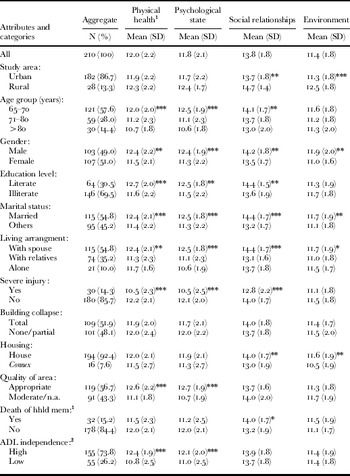
Among the 210 elderly participants in the study, 87 (41.4%) described their overall quality of life as ‘good or very good’, 21 (10.0%) believed it to be ‘poor or very poor’, and 102 (48.6%) regarded it ‘neither poor nor good’. As to their general health status, 48 participants (22.9%) were ‘dissatisfied or very dissatisfied’, 31 (14.8%) were ‘satisfied or very satisfied’ and the rest (62.4%) were ‘neither satisfied nor dissatisfied’. The means and standard deviations of the QoL domains were as follows: physical health 12.00 (2.23), psychological state 11.88 (2.19), social relationships 13.89 (1.83) and environment 11.48 (1.89).
Determinants of QoL domains: bivariate analysis
The results of the bivariate analyses that compared the four QoL domain scores among different sub-groups of the participants are shown in Table 1. Better physical and psychological health status significantly associated with younger age, male gender, being literate, being married, being satisfied with the quality of their living place at the time of study, no history of earthquake-related severe injury, and a higher level of functional independence in daily activities. Better social relationships were significantly related with living in a rural area, younger age, male gender, being literate, married, living in an ordinary house (not a prefabricated connex), death of a household member, and no history of earthquake-related severe injury. Finally, better QoL in the environmental domain significantly associated with living in a rural area, younger age, being married, and living in an ordinary house.
Quality of life scores in four domains, older Bam earthquake survivors

Notes: Sample size 210. 1. Household member. 2. Activities of daily living score. N: sample size. n.a.: not appropriate. SD: standard deviation.
Significance levels: * p⩽0.05, ** p⩽0.01, *** p⩽0.001.
Determinants of QoL domains: multivariate analysis
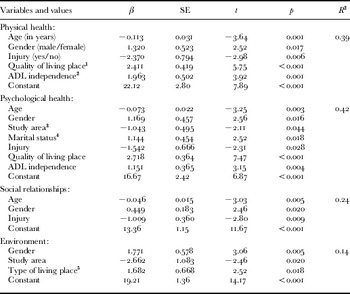
Table 2 presents the final linear multiple regression models of the determinants of the QoL domains. The results show that the determinants of better physical health were lower age, male gender, no history of earthquake-related severe injury, satisfaction with the quality of current living place and functional independence. Determinants of a good psychological state were lower age, male gender, living in a rural area, living with others, no history of earthquake-related injury, satisfaction with the quality of current living place and functional independence. Younger age, male gender and no history of injury were related to better social relationships. Adjusted for other variables, there were correlations between better environmental domain scores and male gender, living in a rural area and living in an ordinary house.
Regression models for determinants of quality of life domains in elderly Bam earthquake survivors

Notes: 1. Appropriate/moderate or non-appropriate. 2. Activities of daily living (high/low). 3. Urban/rural. 4. Married/non-married. 5. House/connex. SE: standard error of beta.
Comparison of QoL between the earthquake survivors and general population
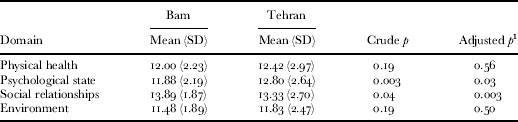
Comparing the mean overall QoL scores of the elderly survivors of the Bam earthquake (13.26±2.92) with those of 2,464 older people in Tehran (13.61±3.00) (Nedjat et al. Reference Nedjat, Majdzadeh, Kheiltash and Jamshidi2009), no significant difference was found between the two groups in the crude analysis (p=0.14). But adjusted for age, gender and two-way interaction of group with gender and age, the two groups showed a statistically significant difference in self-reported QoL (p=0.009). To assess whether the effect of study group (earthquake survivors versus general population) on QoL varied as a function of gender or age, a two-way interaction analysis was conducted that revealed the earthquake survivors with female gender or older ages had experienced lower levels of QoL than others (p=0.04 and 0.003, respectively). Table 3 presents a comparison of the scores for the current sample with the elderly subset of the Tehran general population (Nedjat et al. Reference Nedjat, Montazeri, Holakouie Naieni, Mohammad and Majdzadeh2008). Adjusted for age and gender, the earthquake survivors had lower levels of psychological health (p=0.03), but better social relationships than the Tehran elderly group (p=0.003). Two-way interaction analysis of group and age showed that earthquake survivors with higher age had worse psychological health (p=0.02).
Comparison of elders' quality of life scores in four domains between 210 Bam earthquake older survivors and 84 older people in Tehran's general population
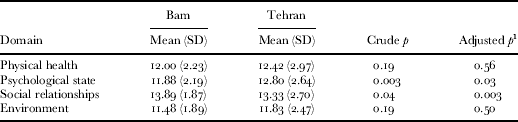
Note: 1. Adjusted for gender, age and two-way interaction of group with gender and age.
Discussion
This study has assessed the four domains of QoL and related determinants in older survivors five years after the Bam earthquake. Lower QoL was associated with female gender, higher age, living alone, severe earthquake-related injury, poor quality of living conditions at the time of study, increased dependence in ADL, living in an urban area, and being housed in temporary facilities. Although no data were available regarding QoL before the event or immediately afterwards, the comparison of the elderly survivors with the general population sample does suggest that earthquakes adversely affect the psychological dimensions of QoL of older people even five years after the event. However, paradoxically, being in the earthquake area associated with better social relationships in affected communities than in the general Tehran population.
To the best of our knowledge, this study has been the first attempt to assess multi-dimensional QoL among older earthquake elderly survivors some years after the event. We are aware of only one study with a focus on QoL among older people following major disasters, that by Lin et al. (Reference Lin, Huang, Huang, Hwang, Tsai and Chiu2002), although Chou et al. (Reference Chou, Chou, Su, Ou-Yang, Chien, Lu and Huang2004b) included elders in their analysis. Other studies have addressed the post-earthquake QoL among the general population of survivors, but none more than three years after the event (Chou et al. Reference Chou, Chou, Lin, Su, Ou-Yang, Chien, Su, Lu and Chen2004a; Lin et al. Reference Lin, Huang, Huang, Hwang, Tsai and Chiu2002; Wang et al. Reference Wang, Gao, Zhang, Chengzhi, Shen and Shinfuku2000). Ceyhan and Ceyhan (Reference Ceyhan and Ceyhan2007), however, studied post-earthquake QoL in a sample of university students six years after the Marmara earthquake, Turkey, but did not include analysis older people. All these studies have shown poor QoL as a consequence of earthquakes.
The effects of Bam earthquake on four domains of QoL
Earthquakes decrease the physical health status of survivors by causing injury, by exacerbating chronic illnesses, and reducing access to health services. This study found significant associations between severe injury and dependence for activities of daily living with poor physical health. A study by Wu et al. (Reference Wu, Chou, Chou, Su, Tsai, Ou-Yang, Su, Chao, Sun and Chen2006) three years after the 1999 Chi-Chi earthquake in Taiwan showed a similar correlation between poor health and poor QoL. In addition, poor health increases the dependence of elders on others and limits their ability to engage in life activities and may be one reason for self-reported lower QoL.
Many studies have shown an adverse effect of disasters on psychological state (e.g. Armenian et al. Reference Armenian, Morikawa, Melkonian, Hovanesian, Haroutunian, Saigh, Akiskal and Akiskal2000; Lin et al. Reference Lin, Huang, Huang, Hwang, Tsai and Chiu2002). Montazeri et al. (Reference Montazeri, Baradaran, Omidvari, Azin, Ebadi, Garmaroudi, Harirchi and Shariati2005) reported that 58 per cent of the Bam earthquake survivors suffered from severe mental health problems, three times higher than reported psychological distress among the general population. In fact, elders are among those most vulnerable to psychological distress following a disaster (Suar, Mishra and Khuntia Reference Suar, Mishra and Khuntia2010) and in great need of social support to mitigate the effects of stress (Fernandez et al. Reference Fernandez, Byard, Lin, Benson and Barbera2002). Our study has shown that mental health is a real concern among older people in the earthquake-affected area, even five years later. The finding of higher than expected rates of self-reported poor psychological health is supported by comparison with data from the general population and the results of qualitative research on elderly Bam survivors (Ardalan et al. Reference Ardalan, Mazaheri, Rezaie, Holakouie Naieni and Teimouri2010). Although a comprehensive mental health intervention was carried out within one year of the Bam earthquake (Ardalan et al. Reference Ardalan, Masoomi, Goya, Ghaffari, Miadfar, Sarvar, Soroush, Holakouie Naieni, Kabir, Khankeh, Abolshams and Aghazadeh2009), no active interventional programme was running in the affected area at the time of this study. This fact highlights the importance of including long-term monitoring for mental health in recovery plans after earthquakes and other disasters. Providing the relief and financial support would buffer the adverse psychological impacts of extensive earthquakes (Altindag, Ozen and Sir Reference Altindag, Ozen and Sir2005; Ceyhan and Ceyhan Reference Ceyhan and Ceyhan2007; Wang et al. Reference Wang, Gao, Zhang, Chengzhi, Shen and Shinfuku2000).
Poor social relationships can result in the deterioration of physical health and mental wellbeing (Farquhar Reference Farquhar1995; Gallicchio, Hoffman and Helzlsouer Reference Gallicchio, Hoffman and Helzlsouer2007). A disaster event may also, however, provide an opportunity for strengthened social ties among the victims. The Bam earthquake survivors experienced better social relationships than the general population. This is consistent with a study that showed that elders who reported higher damage from the Chi-Chi earthquake also experienced better social relationships than before the event (Lin et al. Reference Lin, Huang, Huang, Hwang, Tsai and Chiu2002). This finding may be attributed to the support that victims receive from families, relatives and other survivors. Such social relationships represent a coping strategy that the affected communities implement to provide psycho-social support and to minimise the adverse effects of the earthquake.
Environmental health has complex associations with socio-demographic characteristics and health-related factors. Some like Schroeder-Butterfill and Marianti (Reference Schroeder-Butterfill and Marianti2006) have suggested that environmental factors have little relevance to individual wellbeing, while other studies emphasise the complexity of environmental influences (Sirgy and Cornwell Reference Sirgy and Cornwell2002). Bramston, Pretty and Chipuer (Reference Bramston, Pretty and Chipuer2002) argued that neighbourhood variables might exert only an indirect impact on quality of life. This study found that male gender, living in a rural area and living in an ordinary house (not pre-fabricated) were associated with better environment domain scores.
Determinants of QoL: targeting the interventions
Cost-effective interventions for improving the QoL of elderly survivors of a disaster require identifying the sub-groups that would most benefit. By exploring the determinants of QoL, this study has found that increased age associated with lower physical health, psychological health and social relationships. Greater age is related to a higher prevalence of chronic diseases and functional impairments that adversely affect psychological state and social relationships (cf. Teymoori, Dadkhah and Shirazikhah Reference Teymoori, Dadkhah and Shirazikhah2006). No association was found between age and the environmental domain score, which indicates that different age groups of elders rated their environments similarly. Some researchers contend that satisfactory living conditions may reduce the negative effects of age on the mental health of older people (Hellstrom and Hallberg Reference Hellstrom and Hallberg2004; Mowad Reference Mowad2004). Our participants reported that they were satisfied with their living situation and demonstrated better psychological health.
Several studies after earthquakes and other disasters have found lower QoL among women (Montazeri et al. Reference Montazeri, Baradaran, Omidvari, Azin, Ebadi, Garmaroudi, Harirchi and Shariati2005; Nedjat et al. Reference Nedjat, Montazeri, Holakouie Naieni, Mohammad and Majdzadeh2008; Tajvar, Arab and Montazeri Reference Tajvar, Arab and Montazeri2008; Vahdaninia et al. Reference Vahdaninia, Goshtasebi, Montazeri and Maftoon2005). This study found that women reported lower scores for all aspects of QoL than men. Such a finding may be correlated with lower levels of education, access to information and employment, as well as with women's more general disadvantages in economic status and social positions (Tajvar, Arab and Montazeri Reference Tajvar, Arab and Montazeri2008). Only one-sixth of the women participants in our study were literate, one-third of the proportion of the men. Males reported better social relationships both in this study and in the comparison group from the general population. This finding may be related to higher incidence of psychological stress (Montazeri et al. Reference Montazeri, Baradaran, Omidvari, Azin, Ebadi, Garmaroudi, Harirchi and Shariati2005) and lower psychological QoL among women and the cultural norms that limit women's social activities.
Lower educational achievement is associated with unhappiness, poor social relationships, poor self-assessed health, and sensory problems among older people (Lasheras et al. Reference Lasheras, Patterson, Casado and Fernandez2001). Armenian et al. (Reference Armenian, Morikawa, Melkonian, Hovanesian, Haroutunian, Saigh, Akiskal and Akiskal2000) also reported the protective effect of education on risk of developing post-traumatic stress disorder following the Armenia earthquake of 1998. Education may affect QoL through its effects on knowledge, problem-solving skills and socio-economic status. In a study of elders in Tehran, a strong association was observed between education and health-related QoL (Tajvar, Arab and Montazeri Reference Tajvar, Arab and Montazeri2008). Our own bivariate findings indicate that education was an important factor, partly because illiterate elders experienced lower levels of physical, psychological and environmental health. In the multivariate analysis, including the education variable led to gender becoming insignificant (the two variables were moderately correlated with r=+0.32). So we decided to keep gender but not education as a covariate in the final multiple regression model, seeing education as an intermediate variable in the probable ‘gender–QoL’ causality pathway. The role of level of education, however, should be kept in mind in any community intervention programme.
Several studies have revealed the positive association of marital status with QoL (Tajvar, Arab and Montazeri Reference Tajvar, Arab and Montazeri2008; Vahdaninia et al. Reference Vahdaninia, Goshtasebi, Montazeri and Maftoon2005). Married participants felt a better level of QoL in all domains in this study, although in the adjusted analysis the effect was observed only for the psychological aspects of QoL. This was because of the high correlation between gender and marital status (r=+0.47): when marital status was included in a model, gender was insignificant. We decided to keep gender in the final model. Married respondents had better reported QoL than non-married participants that were either living alone or with family. Furthermore, all the participants living with relatives had lower scores of QoL than people living alone or with a spouse, except in the domain of psychological wellbeing. Poor physical health of the elders may have be the reason for living with relatives, but in many cases living alone diminishes psychological health. Being hospitalised or undergoing surgery for an earthquake-related injury adversely affected all domains of QoL except for the environment score. This finding can be explained by the limitations that severe injuries might cause to participants' conduct of physical activities and social interaction. It can also be postulated that elders with experience of severe injury have a heightened feeling of being victims of the earthquake.
We did not determine any relation between QoL and building damage as a result of the earthquake. This contradicts the findings by Lin et al. (Reference Lin, Huang, Huang, Hwang, Tsai and Chiu2002) for the Chi-Chi earthquake. This discrepancy may be related to the difference in the timing of each study relative to the earthquake event. Furthermore, while Sharan et al. (Reference Sharan, Chaudhary, Kavathekar and Saxena1996) and Chen et al. (Reference Chen, Tan, Liao, Chen, Chan, Cheng, Chen and Lu2007) believed that the destruction of houses and possessions could act as a life-threatening stressor and promote psychiatric disorder and mental health problems, the finding from this study of a relationship between satisfaction with current living place and both physical and psychological health suggests that, with the passage of time and the reconstruction of houses, survivors become more concerned about their current living circumstances than about past losses. Elders who were living in the connexes experienced lower QoL in domains of social relationships and environment than those living in ordinary houses. The reason may be attributed to their poor financial status, as indicated by their inability to buy a new house or repair their damaged house. It can also be related to the poor design of this emergency housing and poor safety and security in the immediate environs of these housing projects (Ardalan et al. Reference Ardalan, Masoomi, Goya, Ghaffari, Miadfar, Sarvar, Soroush, Holakouie Naieni, Kabir, Khankeh, Abolshams and Aghazadeh2009). Paying attention to comfort and safety features of temporary housing and prefabricated connexes, including security, easy access to safe water, toilets and bathrooms, would much improve the comforts of earthquake victims. Paradoxically, elders who reported the loss of a household member during the earthquake reported higher social relationships scores than others. This may be related to increased community support of these survivors.
Higher dependency in the activities of daily living was associated with lower physical and psychological aspects of QoL. Older people who are more dependent on others for their daily activities are likely to benefit less from the services provided following an earthquake at hospitals, clinics and other health-related facilities because of their difficulty in getting to such services. This finding supports the case for functional screening of elderly earthquake survivors for their ability to handle ADLs as part of post-disaster assessments. Active service delivery should be a component of long-term service delivery in a post-disaster area to meet the needs of those with diminished functional status. The perception of QoL varied between urban and rural inhabitants. The lower ratings of environmental QoL by people living in Bam's urban areas may be explained by exposure to more severe destruction of homes and livelihoods, but may also be explained by the higher expectations of assistance than their rural counterparts – expectations that were not always met. While considerable relief efforts were carried out in Bam, there remains a great deal to do.
Limitations
This study has several limitations, the most critical being the absence of a control group of non-earthquake-affected elderly Iranians from Kerman province, which made it difficult to associate QoL outcomes with the earthquake and resulting traumas. For instance, the better social relations among the earthquake survivors compared to the general population in Tehran might be associated with their different socio-economic backgrounds rather than the disaster impact. In addition, the lack of baseline QoL data in the earthquake-affected area did not allow us to compare the post-earthquake QoL with the preceding situation. Future studies should include a matched comparison group from similar communities in Kerman province. Baseline QoL assessments should be also conducted in earthquake-prone areas of the country to enable longitudinal comparisons and ‘before and after’ studies.
The study was also limited by its cross-sectional design. The lack of longitudinal tracking meant that no data were captured on older people who died, emigrated to other parts of Iran, or were admitted to nursing homes. The deaths of older people with poor health status in Bam following the earthquake could imply that the reported QoL is an over-estimate. As for nursing homes, there are few in Bam and they accommodate a very small proportion of the elderly population, and it is not expected that this limitation significantly affects the results. A further expansion of this study might include a survey of emigrants to other parts of Iran from the earthquake-affected region. It is not known whether they have had better or worse QoL than those who have stayed in Bam. Another possible limitation is a ‘social desirability bias’, whereby elders report elevated QoL scores to preserve their dignity (cf. Tanida Reference Tanida1996). It was also suspected, however, that some participants reported low QoL scores to qualify for expected or possible relief (despite our careful explanation of the study's independent aims). Iranian relief agencies have argued that some earthquake survivors develop exaggerated expectations, which might be a reaction to the high level of the relief operations immediately after the earthquake and to the commitments that the relief agencies made.
Conclusions
Earthquakes exact a rapid and severe toll on communities in terms of physical destruction and compromise the physical and mental health of the affected populations. The combination of destruction of the physical environment, sudden reductions in physical and mental health, and disrupted livelihoods and social relationships result in lower QoL. This study is one of the first to document the long-term impacts of earthquakes on QoL. The elderly survivors of the Bam earthquake reported better social functioning but lower psychological wellbeing, even five years after the event. While this study has advanced the study of the long-term outcomes for older people who survive earthquakes, more research is needed to compare the experiences of such survivors to those in different settings. Additionally, longitudinal studies of future events might capture important data on the effects of migration and about those who survived the earthquake but died in the immediately following years. The presented findings, however, stress the importance of assessing QoL's determinants when planning for post-emergency recovery as well as the reconstruction and development programmes.
Acknowledgements
Our thanks to Kerman University of Medical Sciences and to Bam Health Centre for their generous support with the collection of the data. We also thank the Iranian Research Centre on Ageing at the University of Social Welfare and Rehabilitation Sciences and the National Institute for Health Research (formerly Institute of Public Health Research) at Tehran University of Medical Sciences for their financial support.