n-3 fatty acids have been explored as a potential protective factor against CVD(Reference de Oliveira Otto, Wu and Baylin1), the leading cause of death in adults worldwide(Reference Roth, Mensah and Johnson2). In 2004, the n-3 index (O3I) was defined as the sum of EPA and DHA fatty acids in erythrocyte membranes, a biomarker reflecting habitual intake of n-3 and suggested as a risk factor for CHD mortality(Reference Harris and Von Schacky3). The cut-offs proposed in the original method classified an O3I ≤ 4 % as indicative of high cardiovascular risk, and ≥ 8 % as desirable for reducing risk(Reference Harris and Von Schacky3). While the O3I and the cut-off values were developed considering CHD mortality, the role of n-3 on other CVD endpoints and risk factors has been less studied. Differential influences of n-3 on clinical outcomes are plausible since some clinical trials suggest that EPA and DHA reduce plasma TAG concentration by about 15 % but do not affect other lipid traits, including total cholesterol and LDL-cholesterol(Reference Abdelhamid, Brown and Brainard4). Understanding the association of O3I with these factors is of clinical relevance given the key role of metabolic risk markers – such as insulin resistance, central obesity, and dyslipidemias – on CVD morbidity and mortality(Reference Roth, Mensah and Johnson2).
The second gap in the literature is that the O3I cut-offs were generated from studies with limited ethnic diversity, so the findings may not apply to broader populations, especially those with low intake of n-3. In 2016, a review of 298 studies that reported fatty acids revealed considerable variability in EPA + DHA(Reference Stark, Van Elswyk and Higgins5). Using modified cut-offs and categories from the original O3I, the authors identified higher O3I among residents from the Sea of Japan, Scandinavia and Indigenous communities not fully adapted to industrialised food habits. At the same time, very-low blood levels (≤ 4 %) were observed in North, Central and South America, Europe, the Middle East, Southeast Asia, and Africa. Similar patterns were shown in another study(Reference Schuchardt, Cerrato and Ceseri6). These modified cut-offs were adapted from the original ones proposed by Harris & Von Schacky(Reference Harris and Von Schacky3) to reflect better distribution of the O3I in different populations, in which most individuals fall below the recommended category level (≥ 8 %). Therefore, Stark et al. (Reference Stark, Van Elswyk and Higgins5) suggested adding an intermediate O3I level between 6 and 8 %, alongside the categories previously defined in the original study(Reference Harris and Von Schacky3).
Unfortunately, little to no data exist on the O3I in most countries from Latin America, Africa and the Middle East region; thus, relationships between the O3I and CVD or its risk factors in these populations are unknown(Reference Stark, Van Elswyk and Higgins5,Reference Schuchardt, Cerrato and Ceseri6) . The 2024 update of the n-3 world map(Reference Schuchardt, Beinhorn and Hu7) showed that 92 % of the n-3 PUFA status data come from European or North American residents. Furthermore, the cut-offs were developed considering supplementation trials and secondary prevention studies in high-risk patients or those with preexisting CVD. Even though a systematic review and meta-analysis showed that n-3 supplementation was dose-dependently associated with a lower risk of CVD-related mortality(Reference Rizos, Markozannes and Tsapas8), the O3I was not reported in most of these studies. Thus, n-3 levels in these settings may not reflect the usual n-3 levels in the general population, and these findings may not be generalisable to individuals without a history of CVD events.
In that regard, Puerto Ricans, the second largest Hispanic/Latino ethnic heritage in the USA, have a higher prevalence of several chronic conditions – including a 6·3 % prevalence of angina and CHD(Reference Koyama, McKeever and Xu9) – when compared with non-Hispanic Whites and other Hispanic/Latino heritages(Reference Tucker, Mattei and Noel10,Reference Daviglus, Talavera and Avilés-Santa11) . Paradoxically, their reported PUFA intake is higher than these groups, although n-3 intake remains low(Reference Noel, Newby and Ordovas12,Reference Mattei, Sotres-Alvarez and Daviglus13) . On the other hand, adults in Brazil present a similarly high prevalence of non-communicable diseases(Reference Felisbino-Mendes, Cousin and Malta14) – including a 6·1 % prevalence of CHD(Reference Oliveira, Brant and Polanczyk15) – but report intake of PUFA far below the recommendations(Reference Sisa, Abeyá-Gilardon and Fisberg16). Major food sources that contribute to n-3 intake, such as fish, represent less than 1 % of the total energy intake in the Brazilian population(17).
Thus, this analysis was designed to investigate associations between two cut-offs of the O3I (a biomarker of n-3 intake) and cardiometabolic risk factors in Brazilian and Puerto Rican adults. Identifying the erythrocyte membrane fatty acid profile and the O3I in two Latin American groups would be a new contribution to the literature.
Methods
Study design and population
This cross-sectional analysis used data from two population-based studies: the 2015 Health Survey of São Paulo (2015 ISA-Nutrition) and the Boston Puerto Rican Health Study (BPRHS). The 2015 ISA-Nutrition is a cross-sectional study with a stratified, multistage representative sample of residents in the urban area of São Paulo, Brazil, the largest city in Latin America. The study included 901 individuals with blood samples, anthropometric measurements and dietary data divided into three age strata: 291 adolescents (aged 12–19 years), 302 adults (aged 20–59 years) and 308 older adults (age ≥ 60 years). The BPRHS is a longitudinal cohort of Puerto Rican adults living in the Greater Boston area, Massachusetts, USA. The study recruited 1500 participants aged 45–75 years between 2004 and 2009 (i.e. baseline data). Previous research has shown that BPRHS participants exhibit low levels of acculturation, despite having arrived in the USA mainland at a young age and residing there for an extended period. This suggests that their dietary habits may still more closely reflect those of Puerto Ricans rather than those of the general US population(Reference van Rompay, McKeown and Castaneda-Sceppa18). Detailed protocols with eligibility and exclusion criteria for both studies are described elsewhere(Reference Tucker, Mattei and Noel10,Reference Fisberg, Sales and Fontanelli19) . To maximise comparability between the studies, we restricted the 2015 ISA-Nutrition dataset to participants aged 45–75 years and the BPRHS dataset to baseline only. Other exclusion criteria were missing data on erythrocyte membrane fatty acid composition, history of cardiovascular events and pregnancy or lactating status.
After laboratory analysis and data organisation, this study included 1261 participants in the BPRHS and 249 participants in the 2015 ISA-Nutrition. The flow charts for the final samples are illustrated in online Supplementary Figure 1 (BPRHS) and online Supplementary Figure 2 (2015 ISA-Nutrition).
This study was conducted according to the guidelines laid down in the Declaration of Helsinki, and all procedures involving human subjects/patients were approved by the Ethics Committee on Research of the School of Public Health, University of São Paulo (CAAE n º 51618721.6.0000.5421). Written informed consent was obtained from all subjects/patients.
Fatty acids composition in erythrocyte membranes
In both studies, participants were asked to fast for 12 h, and blood was drawn into an EDTA tube. Erythrocytes were separated from plasma (2015 ISA-Nutrition: 3000 × g, 4°C, 10 min; BPRHS: 3421 × g, 4°C, 15 min) and stored at −80°C immediately after centrifugation. The fatty acid composition was quantified using a GC with a flame ionisation detector (Shimadzu, CG-2010). In the BPRHS, erythrocyte fatty acid composition was determined using the HS-n-3 Index® method(Reference Harris, Pottala and Vasan20). The 2015 ISA-Nutrition adapted previous methods(Reference Block, Harris and Reid21,Reference Masood, Stark and Salem22) to reflect the same methodology applied in the BPRHS as closely as possible. Briefly, after cell lysis, the membrane pellet was resuspended in methanol with acetyl chloride (100 μL) and 50 μL of the internal standard (13:0 methyl ester, Sigma Aldrich) and heated at 100°C for 10 min to generate fatty acids methyl esters. The internal standard was dissolved in a hexane solution at a concentration of 1:10. After cooling, equal portions of hexane were added, and the tubes briefly vortexed and centrifuged for 2 min at 1500 × g at 4°C to separate layers. A 150 μL aliquot of the hexane (upper) layer was filtered and transferred to a vial for injection at the GC. Fatty acids were identified by comparison with an external standard mixture of 37 fatty acids for peak identification (FAME 37, 47 885, Sigma-Aldrich Co). Two fatty acids that were included in the BPRHS analysis but were not present in the FAME 37 were bought separately and injected at the GC to detect their retention time (all-cis-7,10,13,16-docosatetraenoic acid and all-cis-7,10,13,16,19-docosapentaenoic acid, D3534 and 17 269 Sigma-Aldrich Co). Each peak was quantified by calculating the area under the peak, and the concentration of each fatty acid was expressed as a percentage of the total area under the peaks. A total of twenty-one fatty acids with clear peak separation under the GC column conditions and that presented meaningful concentrations (> 0·1 % of total fatty acids) were integrated. After the analysis, we used the ratio between highly unsaturated fatty acids and SFA to detect degraded samples. If the ratio of highly unsaturated fatty acids to SFA was less than 0·52, the sample was deemed degraded(Reference Pottala, Espeland and Polreis23), and we excluded them from the final analysis.
Definition of the n-3 index
The O3I was defined as the sum of EPA and DHA expressed as a percent of the total fatty acids(Reference Harris and Von Schacky3). We used two cut-offs to evaluate the distribution of the O3I in the population. The original cut-offs classified the O3I into three categories: ≤ 4 % (low), > 4–8 % (intermediate) and ≥ 8 % (desirable)(Reference Harris and Von Schacky3). Additionally, we used the classification proposed by Stark et al. (Reference Stark, Van Elswyk and Higgins5), grouping the O3I into four categories: ≤ 4 % (very low), > 4–6 % (low), > 6–8 % (moderate) and > 8 % (high).
Anthropometrics and cardiometabolic risk factors
In both studies, trained interviewers collected body weight, height and waist circumference using standard protocols(Reference Tucker, Mattei and Noel10,Reference Fisberg, Sales and Fontanelli19) . All anthropometric measures were measured in duplicate in the BPRHS and triplicate in the 2015 ISA-Nutrition, and the average of the assessments was calculated to minimise measurement errors. BMI was calculated as the ratio between weight (kg) and height squared (m2). In both studies, blood samples were drawn at home by a certified phlebotomist after 12 h of fasting. In the BPRHS, the laboratory methods to assess these biomarkers were previously published(Reference Tucker, Mattei and Noel10). In the 2015 ISA-Nutrition, the lipid profile included the serum concentration of total cholesterol, LDL-cholesterol, HDL-cholesterol, VLDL and TAG, which were determined by enzymatic colorimetric methods, using reagents from Cobas – Roche Diagnostics GmbH®. The VLDL concentration was obtained by dividing the TAG concentration by 5. Glucose was measured in plasma using the enzymatic colorimetric glucose oxidase method (Trinder reaction), using Cobas reagent kits. Insulin was evaluated by multiplex immunoassay using the LINCOplex® kit (Linco Research Inc.). The homeostasis model assessment (HOMA-IR) was calculated using the empirical formula suggested by Matthews et al. (Reference Matthews, Hosker and Rudenski24). Additionally, using the lipid profile, we calculated non-HDL-cholesterol, obtained by subtracting HDL-cholesterol from total cholesterol, and TAG-to-HDL-cholesterol ratio, due to their association with CVD(Reference Carr, Hooper and Sullivan25,Reference Kosmas, Rodriguez and Bousvarou26) .
Other covariates
We used age, sex as a biological variable, medication use, physical activity level and diet quality to describe the population and adjust the models. Both studies collected sociodemographic and lifestyle covariates through interviewer-administered questionnaires. Physical activity was assessed in the BPRHS using a modified Paffenbarger Physical Activity Questionnaire(Reference Paffenbarger, Hyde and Wing27,Reference Paffenbarger, Wing and Hyde28) , validated in an older Puerto Rican population(Reference Tucker, Bermudez and Castaneda29). The 2015 ISA-Nutrition used the long version of the International Physical Activity Questionnaire (IPAQ)(Reference Craig, Marshall and Sjöström30), also validated for the Brazilian population(Reference Matsudo, Araújo and Matsudo31). Diet quality was determined by the Alternative Healthy Eating Index (AHEI-2010)(Reference Chiuve, Fung and Rimm32), and details on the dietary intake assessment of both studies were published elsewhere(Reference Tucker, Mattei and Noel10,Reference Fisberg, Sales and Fontanelli19) . Individuals reported supplement intake (name, brand, dosage and frequency). However, we did not use it for adjustments or stratification due to the low percentage of individuals reporting n-3 supplement use in both studies (2 % in the 2015 ISA-Nutrition and 3 % in the BPRHS). Because we were interested in cardiometabolic risk markers, particularly related to lipid profile and insulin resistance, we classified medication use based on two categories: lipid-lowering and hypoglycemics. We did not exclude people using lipid-lowering medication due to the high prevalence in both studies (varying from 12 to 39 %), to preserve statistical power and avoid reducing the sample size. Although the distribution of the O3I showed a slight difference between categories of lipid-lowering medication only for the BPRHS (online Supplementary Figure 3), we used it as a confounder to perform the adjustment of the models, given the potential effect of statins on PUFA metabolism.
Statistical analyses
We described the population in each study according to the data distribution and the type of variable (quantitative or categorical), using median and interquartile range (IQR) for continuous variables, and absolute and relative frequencies for categorical variables. We checked if variables adhered to the normal distribution using the Shapiro–Wilk test to decide between parametric or non-parametric tests. Then, we tested the differences between studies by independent t test (for parametric variables) or Mann–Whitney test (for non-parametric variables). χ 2 tests were used to assess differences in categorical variables between the studies. The differences in fatty acid composition in erythrocyte membranes between the studies and stratified by sex within each population were evaluated using an independent t test.
To investigate the distribution of the exposure variable (O3I) in relation to the cardiometabolic risk factors of interest, we divided the O3I into tertiles and compared differences across tertiles using the Kruskal–Wallis test, with Bonferroni post hoc test for pairwise multiple comparisons. Then, we investigated the association between the O3I (as a continuous variable) and the cardiometabolic risk factors of interest using multiple linear regression models adjusted for confounders. We initially explored associations with several covariates, but only those with a P-value < 0·20 or strong biological plausibility were included in the multivariable models. As a result, some variables, such as education level (used as a proxy for socioeconomic status), family history and smoking status, were excluded from the final analysis due to a lack of statistical significance and minimal impact on the magnitude of the associations. We log-transformed variables with a very skewed distribution to meet linear assumptions. We checked multicollinearity by the variance inflation factor, and the final models were assessed for homoscedasticity by analysing the residuals. When adjusting the models for diet quality, we removed the long-chain fatty acids (EPA + DHA) component from AHEI-2010(Reference Chiuve, Fung and Rimm32) to prevent overfitting the models. For interpreting the magnitude of association on the log-transformed variables, we exponentiated the regression coefficients (β), and the results reflected the multiplicative effect of a 1 unit (i.e. 1 %) increase in O3I on the dependent variables with all confounders held constant.
In both populations, we calculated the proportion of participants in each category of O3I level according to the two cut-offs defined(Reference Harris and Von Schacky3,Reference Stark, Van Elswyk and Higgins5) . We investigated the association of the two cut-offs with cardiometabolic risk factors using multiple linear regression models adjusted for confounders. The homogeneity of variance on the O3I among the categories of each cut-off was evaluated by Levene’s test. When they violated the assumptions of the regression models, we merged the categories to create dummy variables. Then, we tested three different cut-offs of the O3I: > 4 % (compared with those ≤ 4 %), > 5 % (compared with those ≤ 5 %) and > 6 % (compared with those ≤ 6 %).
The proportion of missing data in both studies was sparse (online Supplementary Table 1). Statistical analyses were conducted with SAS version 9.4 (SAS Institute), and the integrated development environment RStudio (version 2023.06.1), with a significance level of 5 %. We used the Strengthening the Reporting of Observational Studies (STROBE) checklist for cross-sectional studies(Reference Von-Elm, Altman and Egger33) to guide the manuscript writing and reporting of the results.
Results
There were differences in most cardiometabolic risk factors and clinical and sociodemographic characteristics between populations, except for waist circumference, HDL-cholesterol, VLDL and TAG/HDL-cholesterol ratio (Table 1). Participants from 2015 ISA-Nutrition presented higher total cholesterol, LDL-cholesterol and non-HDL-cholesterol (P < 0·001) than BPRHS participants, while Puerto Ricans had higher body weight (P < 0·001), BMI (P < 0·001), TAG (P = 0·020), glucose (P = 0·022) and HOMA-IR (P < 0·001) than Brazilians. Puerto Ricans also reported higher sedentary or insufficient physical activity and had a higher prevalence of overweight or obesity and medication use than Brazilians (P < 0·001).
Sociodemographic, behavioural and clinical characteristics of Brazilian and Puerto Rican middle-aged adults

BPRHS, Boston Puerto Rican Health Study; ISA, Health Survey of São Paulo; HOMA-IR, Homeostatic Model Assessment for Insulin Resistance; IQR, interquartile range; AHEI, Alternative Healthy Eating Index; P, Mann–Whitney U test for comparisons between BPRHS and 2015 ISA-Nutrition.
Boldface indicates the statistical significance.
*P for the χ 2 test for comparisons between the studies.
**Fisher’s exact test.
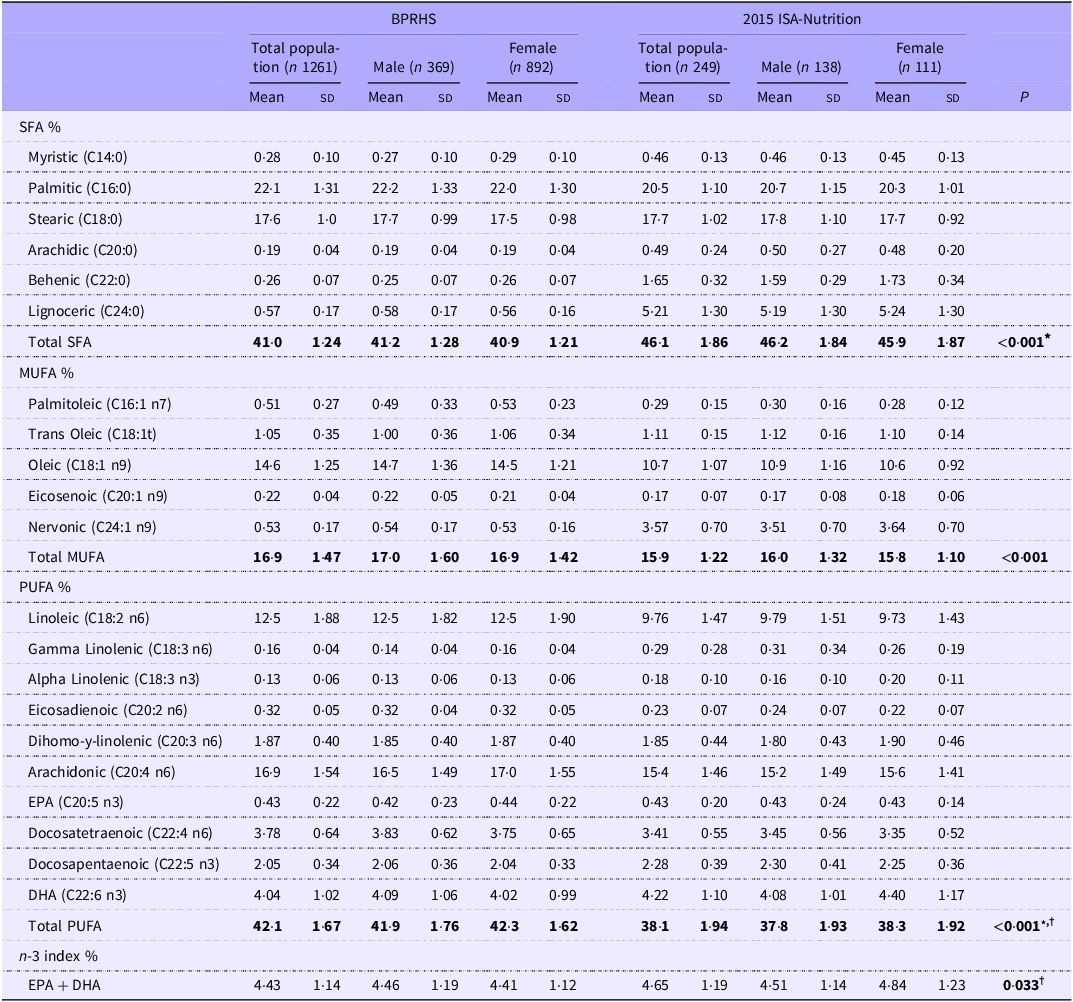
There were significant differences in erythrocyte membrane fatty acid composition between the studies (Table 2). Participants from 2015 ISA-Nutrition presented a higher proportion of SFA and lower proportions of PUFA and MUFA than BPRHS participants (P < 0·001). Additionally, the O3I was slightly higher in the Brazilian population, with a mean (sd) of 4·65 % (1·19 %) v. 4·43 % (1·14 %) in the BPRHS (P = 0·033). There were no O3I differences by sex in the BPRHS, but women in the 2015 ISA-Nutrition presented a higher O3I than men (P = 0·032).
Fatty acid composition in erythrocyte membranes in Brazilian and Puerto Rican middle-aged adults stratified by sex

BPRHS, Boston Puerto Rican Health Study; ISA, Health Survey of São Paulo; MUFA, monounsaturated fatty acids.
P, independent t test for comparison between the total populations of BPRHS and 2015 ISA-Nutrition.
Boldface indicates the statistical significance.
*BPRHS Men v. BPRHS Women.
†ISA-2015 Men v. ISA-2015 Women.
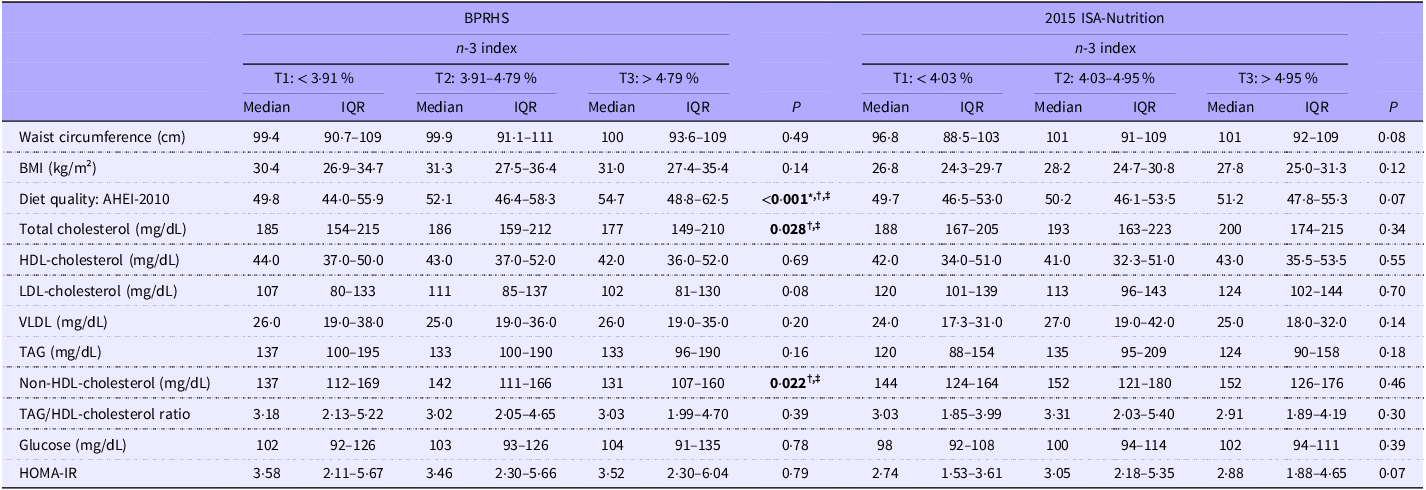
The O3I was distributed as Tertile 1 (T1) ≤ 3·91 %, Tertile 2 (T2) = 3·91–4·79 %, Tertile 3 (T3) ≥ 4·79 % in the BPRHS and T1 ≤ 4·03 %, T2 = 4·03–4·95 %, T3 ≥ 4·95 % in the 2015 ISA-Nutrition (Table 3). There were no significant differences in the rank distribution of cardiometabolic risk factors across tertiles of O3I in the 2015 ISA-Nutrition. However, in the BPRHS, the diet quality score was significantly higher with increasing tertiles (P < 0·001), while total cholesterol (P = 0·028) and non-HDL cholesterol (P = 0·022) were lower in T3 of O3I compared with T1 and T2.
Cardiometabolic risk markers and erythrocyte membrane fatty acid composition in Brazilian and Puerto Rican middle-aged adults, stratified by tertiles of the n-3 index

BPRHS, Boston Puerto Rican Health Study; ISA, Health Survey of São Paulo; AHEI, Alternative Healthy Eating Index; IQR, interquartile range; HOMA-IR, Homeostatic Model Assessment for Insulin Resistance; T1, Tertile 1; T2, Tertile 2; T3, Tertile 3.
P, Kruskal–Wallis with Bonferroni post hoc test for pairwise multiple comparisons.
Boldface indicates the statistical significance.
*T1 v. T2.
†T1 v. T3.
‡T2 v. T3.
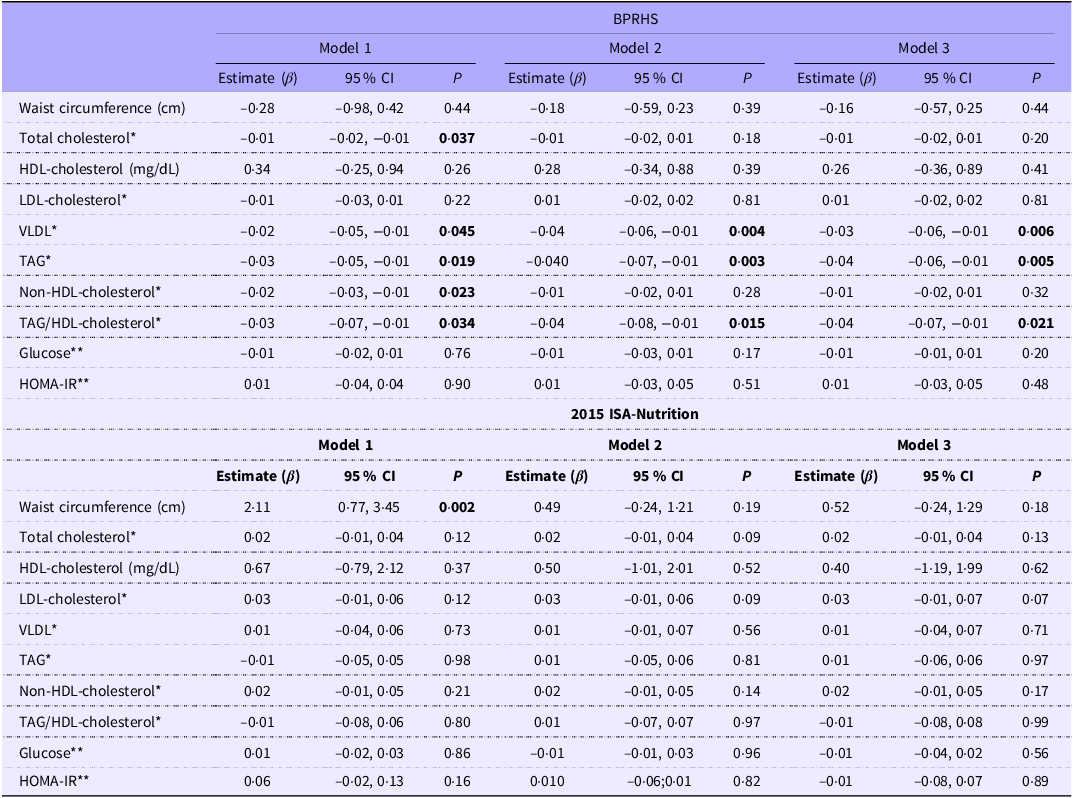
Crude or adjusted models did not show significant associations between the O3I (as a continuous variable) and cardiometabolic risk factors in the 2015 ISA-Nutrition (Table 4). Nevertheless, in the BPRHS, the O3I was inversely associated with log-transformed VLDL, TAG and TAG/HDL-cholesterol ratio in both crude and fully adjusted models. O3I was inversely associated with total and non-HDL cholesterol in the crude model only, but confounders mitigated the association.
Association of EPA + DHA in erythrocyte membranes (as percent from total fatty acids) and cardiometabolic risk markers in Brazilian and Puerto Rican middle-aged adults

BPRHS, Boston Puerto Rican Health Study; ISA, Health Survey of São Paulo; HOMA-IR, Homeostatic Model Assessment for Insulin Resistance.
Boldface indicates the statistical significance.
*Variables transformed for its natural logarithm.
Model 1 – Crude model (univariate or unadjusted).
Model 2 – Adjusted for age, sex, BMI, physical activity, medication**, and diet quality (AHEI-2010 without EPA/DHA component).
Model 3 – Model 2 + total percentage of SFA in erythrocyte membranes.
**Glucose and HOMA-IR adjusted for hypoglycemics, and lipid markers for lipid-lowering medication.
Because the proportion of SFA in erythrocyte membranes differed between the studies and due to its known influence on lipid metabolism, especially on LDL-cholesterol concentrations, we included SFA as a covariate in our models (model 3) to better account for its potential confounding effect, but the associations remained unchanged. In the BPRHS, with all the confounders held constant, modelling a 1 % higher O3I was associated with 3 % lower VLDL (β = exp (–0·03) = 0·97, P = 0·006), 4 % lower TAG (β = exp (–0·04) = 0·96, P = 0·005) and 4 % lower TAG/HDL-cholesterol ratio (β = exp (–0·04) = 0·96, P = 0·021).
In both populations, the proportion of individuals reaching the highest categories of the O3I according to the tested cut-offs was small. Only fifteen (1·2 %) and four (1·6 %) participants reached an O3I above 8 % (the ‘desirable’ category in the original definition, and the ‘high’ category in the Stark et al. (Reference Stark, Van Elswyk and Higgins5) definition) in the BPRHS and 2015 ISA-Nutrition, respectively, while most of the population was classified in the low to intermediate level of O3I based on the original definition, or the very-low to low level in the Stark et al. (Reference Stark, Van Elswyk and Higgins5) definition (Figure 1). Because of this unbalanced scenario, we merged the categories to create dummy variables to prevent violating the statistical modelling assumptions.
Proportion of participants according to levels of n-3 index based on different cut-off points in Brazilian and Puerto Rican adults. BPRHS, Boston Puerto Rican Health Study; ISA, Health Survey of São Paulo.

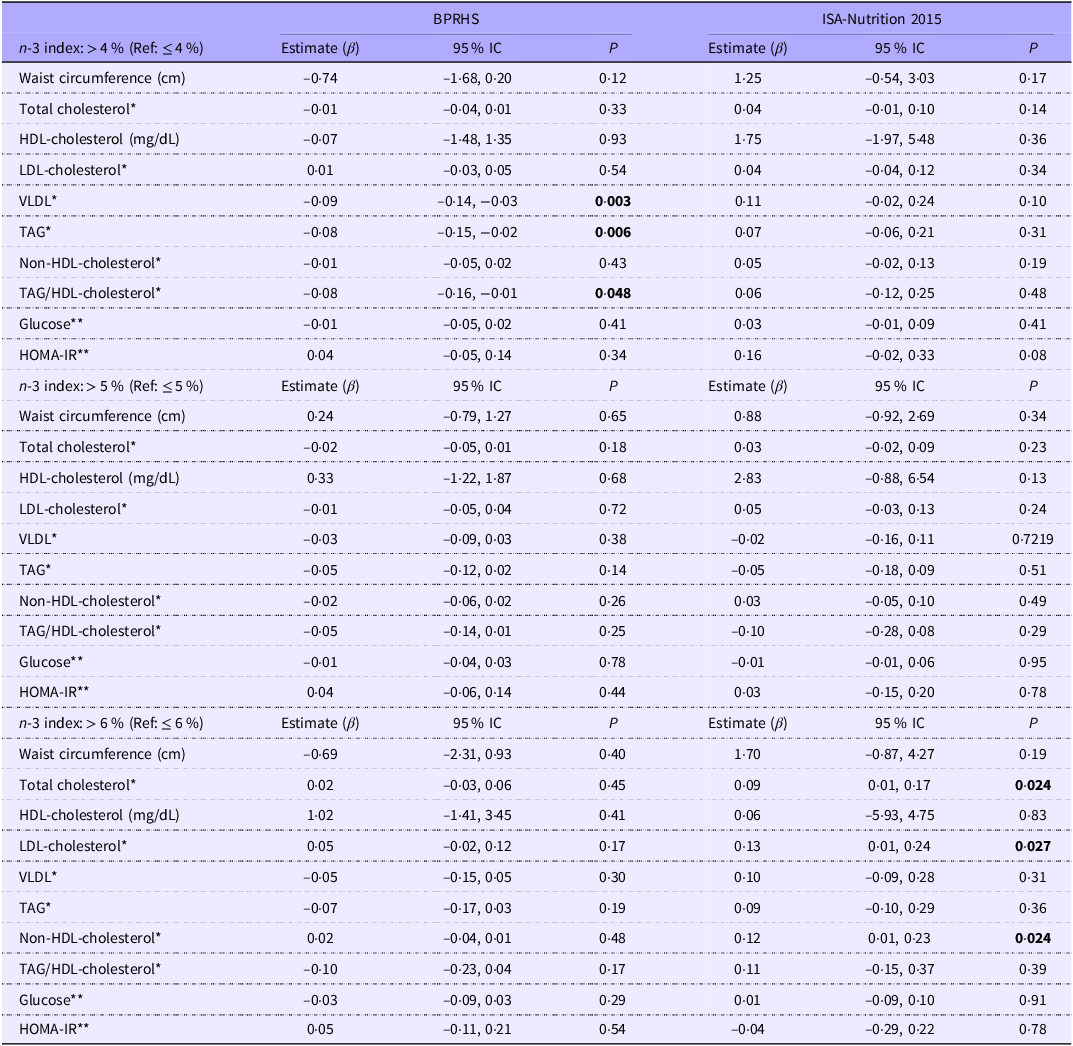
We tested the associations of the cardiometabolic risk factors of interest with three different cut-offs of the O3I: > 4 % (v. ≤ 4 %), > 5 % (v. ≤ 5 %) and > 6 % (v. ≤ 6 %) (Table 5). Similar to the previous results, there were associations for BPRHS participants in the 4 % cut-off and lower log-transformed VLDL, TAG and TAG/HDL-cholesterol ratio. Puerto Ricans with an O3I above 4 %, compared with those ≤ 4 %, had an average 9 % lower VLDL (β = exp (–0·09) = 0·91, P = 0·003), 8 % lower TAG (β = exp (–0·08) = 0·92, P = 0·006) and 8 % lower TAG/HDL-cholesterol ratio (β = exp (–0·08) = 0·92, P = 0·048). However, these associations did not remain with upper cut-offs. In contrast, being in the 6–8 % O3I category for 2015 ISA-Nutrition participants was associated with higher total cholesterol, LDL-cholesterol and non-HDL-cholesterol. Brazilians with an O3I above 6 %, v. ≤ 6 %, had an average 9 % higher total cholesterol (β = exp (0·09) = 1·09, P = 0·024), a 14 % higher LDL-cholesterol (β = exp (0·13) = 1·14, P = 0·027) and a 13 % higher non-HDL-cholesterol (β = exp (0·12) = 1·13, P = 0·024), with no differences in associations after further adjustment for the proportion of SFA in erythrocyte membranes (not shown).
Association of different levels of n-3 index and cardiometabolic risk factors in Brazilian and Puerto Rican middle-aged adults

BPRHS, Boston Puerto Rican Health Study; ISA, Health Survey of São Paulo; Ref., reference for comparison; HOMA-IR, Homeostatic Model Assessment for Insulin Resistance; β, regression model coefficient.
Models adjusted for age, sex, BMI, physical activity, medication**, and diet quality (AHEI-2010 without EPA/DHA component).
Boldface indicates the statistical significance.
*Variables transformed for its natural logarithm.
**Fasting plasma glucose and HOMA-IR adjusted for hypoglycemics, and lipid markers for lipid-lowering medication.
Discussion
This study assessed the fatty acid composition in erythrocyte membranes in Brazilian and Puerto Rican middle-aged adults. It evaluated associations of O3I with clinically relevant cardiometabolic risk factors, expanding the original intention of the O3I of reflecting CVD mortality risk(Reference Harris and Von Schacky3). Less than 2 % of both populations had an O3I above the desirable (high) levels, consistent worldwide, especially in countries with diets marked by low fish consumption and/or high consumption of industrialised foods. In Canada, the first country to conduct a nationwide survey of the O3I, less than 5 % of the population, had levels > 8 %(Reference Jackson and Harris34). A systematic review of n-3 fatty acids in healthy adults globally also found percentages for O3I below the optimal range in many Western countries(Reference Stark, Van Elswyk and Higgins5). Although most studies evaluating the O3I in the US population are based on ethnically homogenous groups, the O3I levels found in the BPRHS were aligned with these previous results, showing an average O3I level of about 4 % in the US population(Reference Stark, Van Elswyk and Higgins5,Reference Schuchardt, Cerrato and Ceseri6) . The one study that evaluated O3I in the Brazilian population found average levels about 3–4 %(Reference Gonçalinho, Sampaio and Soares-Freitas35), which is closely aligned with the percentages found in our study.
The associations between n-3 levels in erythrocyte membranes and cardiometabolic risk factors showed different patterns in each study. Higher O3I was associated with lower TAG, VLDL and TAG/HDL-cholesterol in the BPRHS as both continuous percentages and using the 4 % cut-off point. Although the magnitude of our results is lower than in previous studies, the direction of these findings aligns with high-certainty evidence from over 35 000 patients in twenty-four randomised clinical trials, showing that there was a dose–response reduction in TAG by about 15 % for higher n-3 intake, but with no effect on other lipid traits(Reference Abdelhamid, Brown and Brainard4,Reference Chao, Sun and Ge36) . Therefore, it would be expected that the results should be attenuated in the general population with lower n-3 intake. Notably, these results are biologically plausible due to the intrinsic relation between TAG and VLDL. The major lipid content transported by the VLDL is TAG, which consist of 50 % to 70 % particle mass(Reference Huang and Lee37). Reducing one directly affects the other, with n-3 reducing TAG by lowering VLDL production and secretion, increasing VLDL clearance and stimulating lipoprotein lipase, which is an extracellular enzyme on the vascular endothelial surface that degrades circulating TAG in the bloodstream(Reference Kaur, Mason and Steg38). A previous study also derived five patterns of fatty acid composition in Puerto Ricans. However, only the one relatively high in de novo lipogenesis fatty acids was associated with insulin resistance. Similarly to our results, the authors did not find any association of the pattern high in n-3 fatty acids with HOMA-IR(Reference Bigornia, Lichtenstein and Harris39).
The individuals in the 2015 ISA-Nutrition, on the other hand, showed a positive association between higher O3I and total cholesterol, LDL-cholesterol and non-HDL-cholesterol, but only when using the 6 % cut-off point, which contrasts with previous results showing that n-3 had little or no effect on these lipoproteins(Reference Abdelhamid, Brown and Brainard4). Additionally, considering the important role played by these markers, especially LDL-cholesterol in increasing the prevalence of CVD(Reference Roth, Mensah and Johnson2), we would expect an inverse association with the O3I.
To better understand these results, we first adjusted the models for the percentage of SFA in erythrocyte membranes, given existing evidence linking SFA to lipid levels, particularly LDL-cholesterol, and the fact that SFA was higher in the Brazilian population. It is important to highlight, however, that unlike n-3 fatty acids, the fatty acid composition in erythrocyte membranes does not serve as a direct biomarker for saturated fat intake. However, its metabolic effects on lipoproteins should not be overlooked. For example, different dietary sources and cooking methods may have influenced not only n-3 levels but also the content of other fatty acids, whose synergistic or antagonistic effects could have impacted lipoprotein profiles. For example, red meat consumption has been historically far above the recommendations in Brazil(Reference Avila, Luz and Assumpção40,Reference Santin, Gabe and Levy41) , contributing to the higher proportion of SFA in this population while the frequency of fish consumption(17), an important food source of EPA and DHA, is low. On the other hand, an analysis of Puerto Rican adults found that two major principal components contributing to fatty acid patterns were comprised of SFA predominantly in dairy products and a heavy load of n-3 fatty acids, mainly from fish(Reference Noel, Newby and Ordovas12).
This study has some limitations. The cross-sectional design of the surveys allowed neither the investigation of cardiovascular events, usually the long-term outcome of interest in clinical trials with n-3 exposure, and a causal relationship with the exposure cannot be assumed; thus, future longitudinal studies should be conducted. Also, the small sample size in the Brazilian population, mostly due to sample degradation, may have compromised the power of the study. However, we followed a rigorous protocol to ensure data quality in the remaining sample. Although the methods to detect the fatty acid composition differed between the studies, we tried to reproduce the original method as closely as possible for comparison purposes. This included using the same chromatography equipment, matching the fatty acid profile, and following consistent methodological procedures for fatty acid extraction and analysis to ensure comparability in the proportional representation of each fatty acid. We also did not evaluate n-3 fatty acid dietary intake, primarily due to limitations and differences in the self-reported dietary assessment methods used in each study (a FFQ in the BPRHS and two 24-h recalls (24HR) in the 2015 ISA-Nutrition). Instead, we chose to focus solely on biomarker data, which offers a more objective and direct measure of n-3 status, minimising the potential biases and comparability issues associated with dietary intake data. Lastly, it is important to consider the possibility of residual confounding (e.g. we were unable to adjust for some socio-economic variables that may influence the associations), in addition to social and environmental differences between the two populations that influence both diet and CVD risk factors. Additionally, we cannot discard reverse causation, since people with CVD risk factors may consume more n-3 food sources or take n-3 supplements as lifestyle changes and/or medical recommendations. Our findings show that even though the BPRHS had a worse cardiometabolic profile, including higher rates of obesity, insulin resistance and physical inactivity, their lipid profile was better than Brazilians. This may be partially explained by the higher prevalence of lipid-lowering medication use in BPRHS. However, this apparent paradox highlights existing research gaps in understanding these health-related markers in these populations. Similar patterns in lipid profile differences were also reported by Pereira et al. (Reference Pereira, Mattei and Isasi42) in a previous study comparing Brazilian adolescents and Latino communities living in the USA.
These limitations are counterbalanced by the considerable strengths of the study. First, Stark et al. (Reference Stark, Van Elswyk and Higgins5) showed that data availability on the fatty acids profile in Latin American countries is scarce, with most data coming from plasma phospholipids, not erythrocyte membranes. A major contribution of this analysis is the identification of the fatty acid profile in erythrocyte membranes in two Latin American samples. Second, we contribute by presenting results on alternate cut-off points of the O3I that may help discern categories for CHD risk assessment. As no standardisation of the O3I exists, these explorations are valuable.
In summary, despite a clinically trivial difference in the mean O3I levels in Brazilian and Puerto Rican adults, distinct patterns were observed in each study regarding the fatty acid composition, as well as the magnitude, direction and specific cardiometabolic risk factors with which it was associated. Variations in the types of food and cardiometabolic profiles between the populations may explain the contrasting results. In both populations, the proportion meeting desirable levels was minimal, at less than 2 %. Considering that our study assessed biomarkers of n-3 intake, and given the variability in cardiometabolic profiles across populations, recommendations for increased n-3 intake or supplementation may be needed and should be explored in further investigations. Although short-term trials have demonstrated that fish oil may raise erythrocyte EPA and DHA levels and improve the O3I(Reference Cao, Schwichtenberg and Hanson43,Reference Flock, Skulas-Ray and Harris44) , these biological changes do not necessarily translate into clinical benefits for all individuals, and the clinical relevance may vary by population or individual context. Plant-based sources of n-3, such as flaxseeds and walnuts, offer alternative dietary options(Reference Wood, Mantzioris and Gibson45,Reference Santos, Price and Bueno46) , but the limited conversion of α-linolenic acid to EPA and DHA underscores the complexity of n-3 metabolism and its effects(Reference Brenna47,Reference Gerster48) . Thus, further research is needed to better understand which populations may benefit from n-3 interventions. Meanwhile, public health strategies should prioritise individualised, evidence-based approaches rather than universal promotion of n-3 supplementation. Assessing specific n-3 biomarkers in diverse populations is essential when studying their role in cardiometabolic health. This study highlights the need for future randomised-controlled trials and long-term investigations that contribute to a better understanding of the role of n-3 fatty acids on cardiometabolic health, and of expanding these investigations to more diverse populations, to help establish O3I cut-offs relevant to CVD risk factors.
Supplementary material
For supplementary material/s referred to in this article, please visit https://doi.org/10.1017/S0007114525104182
Acknowledgements
The authors thank all field staff and all participants in the BPRHS and the 2015 ISA-Nutrition. The authors also acknowledge Professor Elizabeth Aparecida F. S. Torres, Rosana Aparecida Manolio Soares-Freitas and Geni Rodrigues Sampaio for their contribution during the fatty acid composition analysis at the Food Components and Health Laboratory of the University of São Paulo.
This work was supported by the São Paulo Research Foundation (L.D.B., grant numbers 2020/019451-9 and 2022/11755-1), (R.M.F., grant number 2017/05125-7) and by NIH P01 (K. L. T.; grant number AG023394). The funders had no role in the design, analysis or writing of this article.
L. D. B., J. M. and R. M. F. designed research; L. D. B., W. S. H., R. A. M. B., S. B. and J. V. N. conducted research; J. M., R. M. F., K. L. T., S. E. N., N. R. T. D., M. M. R. and F. M. S. provided essential material; L. D. B. and J. V. N. analysed data; and L. D. B. wrote the paper. L. D. B., R. M. F. and J. M. had primary responsibility for the final content. All authors read and approved the final manuscript.
L. D. B., K. L. T., S. B., S. E. N., R. A. M. B., J. V. N., N. R. T. D., M. M. R., F. M. S., J. M. and R. M. F. declare no conflict of interest. W. S. H. holds stock in OmegaQuant Analytics, LLC; a laboratory that offers blood fatty acid testing.