Introduction
Depression and anxiety during pregnancy constitute a public health problem because of their high prevalence (Lovisi et al. Reference Lovisi, López, Coutinho and Patel2005; Faisal-Cury & Rossi, Reference Faisal-Cury and Rossi2007; WHO, 2009), the suffering caused to women and the potential impact on infant outcomes (Dagg, Reference Dagg1991; Rahman et al. Reference Rahman, Iqbal and Harrington2003; O'Connor et al. Reference O'Connor, Caprariello, Blackmore, Gregory, Glover and Fleming2007). They also place women at a higher risk for postpartum depression (Chandran et al. Reference Chandran, Tharyan, Mulilyi and Abraham2002; Rahman et al. Reference Rahman, Iqbal and Harrington2003; Heron et al. Reference Heron, O'Connor, Evans, Golding and Glover2004; Iramfar et al. Reference Iramfar, Shakeri, Ranjbar, Nazhadjafar and Razaie2005).
Many women get pregnant even though they do not want to have children and can experience ambivalent feelings towards the pregnancy (Alan Guttamacher Institute, 2006; Morrissey, Reference Morrissey2007). Unintended or unplanned pregnancies (Iramfar et al. Reference Iramfar, Shakeri, Ranjbar, Nazhadjafar and Razaie2005; Rich-Edwards et al. Reference Rich-Edwards, Kleinman, Abrams, Harlow, Mclaughlin, Joffe and Gillman2006; Lau & Keung, Reference Lau and Keung2007; WHO, 2009) have been associated with a greater prevalence of depression and anxiety in pregnant women. Some women will also consider or attempt terminating the pregnancy. Because of the stigma associated with abortion, research in both developing and developed countries has been limited. In countries where legal abortion is restricted, research samples commonly comprise women presenting to public hospitals with serious complications following unsafe abortion. Research into an illegal act can also be difficult. Respondents might be reluctant to divulge an illegal activity and researchers themselves might face legal repercussions for keeping such information confidential (Herrera & Zivy, Reference Herrera and Zivy2002).
Previous studies from countries where legal abortion is less restricted suggest that women who experienced an unintended pregnancy and wanted an abortion but were unsuccessful had higher rates of depression and anxiety (Illsley & Hall, Reference Illsley and Hall1976; Handy, Reference Handy1982; Dagg, Reference Dagg1991). Presumably women denied an abortion might experience poor mental health as they will carry a pregnancy to term, deliver and parent a child that they did not want to have (Handy, Reference Handy1982; Cohen, Reference Cohen2006; Villela et al. Reference Villela, Oliveira, Silva and Maia2008). A recent New Zealand study (Fergusson et al. Reference Fergusson, Horwood and Boden2008) found that abortion was associated with only a small increase in the risk of mental disorders compared to women who had never had a child. However, comparing women who had received an abortion with those who had an unwanted pregnancy that proceeded to term is more relevant to the discussion on the mental health effects of terminating pregnancy.
It has been argued that the lack of reproductive choice is one of the central contributing factors to disparity in reproductive health between developed and developing countries (Sedgh et al. Reference Sedgh, Bankole, Oye-Adeniran, Adewole, Singh and Hussain2006; Singh et al. Reference Singh, Prada and Kestle2006; WHO, 2009). Research into the mental health implications of reproductive choice from countries with liberal approaches towards abortion (Reardon & Cougle, Reference Reardon and Cougle2002; Rich-Edwards et al. Reference Rich-Edwards, Kleinman, Abrams, Harlow, Mclaughlin, Joffe and Gillman2006; Fergusson et al. Reference Fergusson, Horwood and Boden2008) are difficult to generalize to places where it is effectively illegal (WHO, 2009).
The Brazilian law allows abortion when there is either a threat to the woman's life or in case of rape. Consequently, abortion is almost always performed as an illegal procedure and women are therefore exposed to extra fear from medical complications and the risk of legal repercussions. These could have a severe impact on mental health (Villela et al. Reference Villela, Oliveira, Silva and Maia2008). In countries such as Brazil, poor women are more likely to resort to unsafe abortion (Herrera & Zivy, Reference Herrera and Zivy2002) and many unwanted pregnancies are carried to term (Lovisi et al. Reference Lovisi, López, Coutinho and Patel2005; Villela et al. Reference Villela, Oliveira, Silva and Maia2008).
Few studies have been carried out on mental disorders during pregnancy in Brazil (Lovisi et al. Reference Lovisi, López, Coutinho and Patel2005; Faisal-Cury & Rossi, Reference Faisal-Cury and Rossi2007) and they have been performed on women who attended hospital (Lovisi et al. Reference Lovisi, López, Coutinho and Patel2005) or private health services (Faisal-Cury & Rossi, Reference Faisal-Cury and Rossi2007).
The present paper investigates the prevalence of the common mental disorders (CMDs) of depression and anxiety in the third trimester of pregnancy in women who wanted or attempted an abortion. We studied a population-based sample of women who were registered with publicly funded primary health care in a poor area of northeast Brazil.
Method
Study area and design
The study was conducted in Health District II (one of six health districts) in Recife, the capital of the state of Pernambuco in northeastern Brazil. The population of this area was 217 293 (Recife, 2006), with a high proportion of low-income families, and represented almost 15% of the Recife population.
A cross-sectional study was carried out with the baseline data of a cohort study designed to investigate risk factors for postpartum depression and adverse maternal and perinatal outcomes. The study population consisted of all (1133) pregnant women aged 18–49 years in the third trimester of pregnancy registered in the Primary Health Care Program [Health Family Program (HFP) and Community Health Workers Program] in the study area. The program coverage was about 78% of the population. It was estimated that 10% of the population in this area were not in need of the public primary health-care services provided by the government as they had private insurance (Recife, 2006).
Pregnant women were identified from antenatal care records from 42 primary care teams and also from the records of community health workers in order to include those not receiving antenatal care at an HFP unit.
Data collection
After informed consent was obtained, data were collected by trained female interviewers between July 2005 and March 2006. The interview was most often performed at a health-care unit, but some interviews were conducted in the interviewee's home at the request of the woman.
Ethical considerations
Confidentiality and privacy of the interviewees were guaranteed. The study received approval from the Ethics Committee of the Federal University of Pernambuco. Appropriate health services were contacted to assist those women with severe depression or suicidal ideation or behavior. All women received a local health service guide prepared by the research team.
Instrument and measures
CMDs, including depression and anxiety, were evaluated using the Self-Reporting Questionnaire (SRQ-20; Harding et al. Reference Harding, Arango, Climent, Ibrahim, Ladrido-Ignacio, Murthy and Wig1980), which is composed of 20 ‘yes/no’ questions: four on physical symptoms and 16 on psycho-emotional disturbances. The psychometric qualities of the SRQ-20 have been assessed in independent studies (Mari & Williams, Reference Mari and Williams1986; WHO, 1994; Harpham et al. Reference Harpham, Reichenheim, Oser, Thomas, Hamid, Jaswal, Ludermir and Aidoo2003; Ludermir & Lewis, Reference Ludermir and Lewis2005), with sensitivity ranging from 62% to 90% and specificity ranging from 44% to 95%. In the analysis of the data, one point was awarded for each positive answer and zero for each negative answer. The cut-off point in the SRQ-20 for this study was set at 7/8 on the basis of previous validity studies from Brazil (Mari & Williams, Reference Mari and Williams1986; Harpham et al. Reference Harpham, Reichenheim, Oser, Thomas, Hamid, Jaswal, Ludermir and Aidoo2003; Ludermir & Lewis, Reference Ludermir and Lewis2005) and the women were divided into two groups: non-cases of mental disorders (a score ⩽7) and cases of mental disorders (a score ⩾8). In response to referees' comments we also carried out a sensitivity analysis in which a cut-off score of 11/12 was used as a case definition. This corresponded to the 20th percentile of the distribution.
A standardized structured questionnaire was used to obtain information on previous history of abortion (none, miscarriage or abortion), intended pregnancy (yes, no), contraception use at conception (yes/no), and women's views and action on abortion. Regarding the current pregnancy, women were asked whether they had ‘wanted an abortion at any time during the current pregnancy’ and, if they answered yes, whether they had ‘attempted an abortion’ (yes/no). A question related to the method used to terminate the pregnancy was used to check for consistency of response. The responses were coded in three categories: not considered an abortion, wanted an abortion, and attempted an abortion. The women were asked about their perception of the father's acceptance of the pregnancy (was content/accepted/was indifferent; did not like/other; suggested an abortion).
Some potentially confounding variables were assessed: age (18–24, 25–29, 30–49 years), marital status (currently married/living with partner/dating with a sexual relationship; without sexual–emotional partner at the time of the research), years of schooling (0–4, 5–7, 8–10, ⩾11) and any source of personal income (yes/no). To assess race/skin color, respondents were invited to classify themselves on a five-level skin-color classification adopted by the Brazilian Census (IBGE, 2000): white, black, mulatto, yellow and indigenous. However, for this paper women were grouped as White and non-White. Employment status was categorized according to the classification adopted by the Brazilian Census in 1991 (IBGE, 1991) and adapted by Ludermir & Lewis (Reference Ludermir and Lewis2003): formal worker, informal worker, housewife, unemployed, student, and retired. Self-reported personal history of mental illness during previous pregnancy (yes/no) was also assessed.
Data analysis
Analysis was performed with Stata statistical software version 10 (Stata Corporation, USA). Odds ratios (ORs) and 95% confidence intervals (CIs) were calculated using logistic regression to estimate the magnitude of the association between CMDs and the women's views and action on abortion. Linear regression was used to investigate mean differences in SRQ-20 scores between levels of the exposure variable. These analyses were carried out with the 1104 women who had complete data on all variables included in the model. The assessment of confounding factors was carried out by including potential confounders in the regression models.
Results
The study achieved a high response rate and 1121 (98.9%) women completed the interview. A total of 1104 women had complete data on all the variables including confounders so all subsequent analyses refer to this sample.
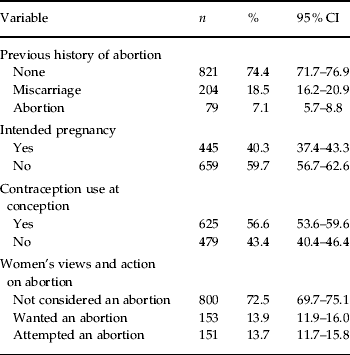
Considering the current pregnancy, 13.7% attempted an abortion and 25.6% had reported either one or more previous miscarriages or abortions. Unintended pregnancy was reported by almost 60%, and 56.6% had been using a contraceptive method at the time of conception (Table 1).
Distribution of study sample by previous history of abortion, intended pregnancy, contraception use at conception, and women's views and action on abortion regarding the current pregnancy
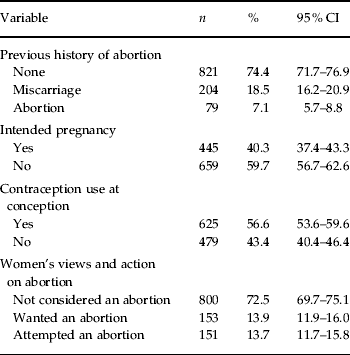
CI, Confidence interval.
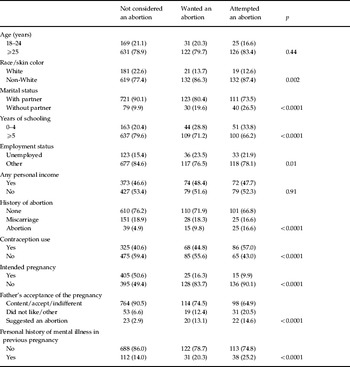
The vast majority of the women were age ⩾25 years (79.6%), of non-White race/skin color (80.0%) and currently married or had a partner (86.5%). Of the 1104 women, 23.4% had less than 5 years of schooling, 17.4% were unemployed and 53.0% had no personal income of their own.
Women who attempted an abortion were more likely to be non-White, living at the time of pregnancy without a partner, have lower education and be unemployed than those who did not consider performing an abortion (Table 2). Most of them were using contraceptive methods at conception and had not intended to become pregnant, 16.6% reported a previous abortion, 25.2% reported a personal mental illness related to previous pregnancy and in 14.6% the father of the child suggested an abortion (Table 2).
Characteristics of women according to their views and action on abortion regarding the current pregnancy

Values given as n (%).
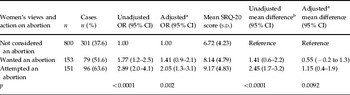
The prevalence of CMDs for the sample was 43.1% (95% CI 40.2–46.1), and 63.6% (95% CI 55.4–71.2) among those who attempted an abortion (Table 3). The association between attempted abortion and CMDs (OR 2.05, 95% CI 1.3–3.1) was reduced after all adjustments but remained statistically significant (p=0.002). The most important confounders were self-reported personal history of mental illness during a previous pregnancy, which reduced the OR to 2.66 (95% CI 1.8–3.9), and father's acceptance of the pregnancy (2.46, 95% CI 1.7–3.6). The results from the linear regression model, after adjustment, were very similar. Women who had attempted an abortion had more SRQ-20 symptoms (mean SRQ-20 difference 1.15, 95% CI 0.4–1.9) than those who did not consider an abortion.
Prevalence of common mental disorders (CMDs) by women's views and action on abortion regarding the current pregnancy, odds ratios (ORs) and mean SRQ-20 scores

SRQ-20, 20-item Self-Reporting Questionnaire; CI, confidence interval; s.d., standard deviation.
a Adjusted for age, race/skin color, marital status, years of schooling, employment status, previous history of abortion, contraception use at conception, intended pregnancy, father's acceptance of the pregnancy and personal history of mental illness during previous pregnancy.
b Difference from not consider an abortion.
Sensitivity analysis
We carried out a sensitivity analysis in which a higher cut-off score on the SRQ-20 was used to define a case. The threshold, at about the 20th percentile, was 11/12. The analysis gave similar results to those at our primary case definition (7/8 cut-off). For example, for the same adjusted analysis as in Table 3, the OR was 1.45 (95% CI 0.9–2.3) for wanted an abortion and 1.73 (95% CI 1.1–2.8) for attempted an abortion.
Discussion
We found that women in the third trimester who attempted an abortion in the current pregnancy had an increased prevalence of anxiety and depression after adjustment for potential confounders. This is consistent with some earlier results from western countries (Illsley & Hall, Reference Illsley and Hall1976; Handy, Reference Handy1982; Dagg, Reference Dagg1991) but we are not aware of any previous population-based studies that have investigated this issue in a country where abortion is illegal under most circumstances, such as Brazil.
There are several strengths in the current study including the use of the Health Family and Community Health Workers Programs to identify the women and the excellent response rate. We were able to adjust for a large number of potentially confounding variables and it was a relatively large study. However, before discussing its possible contribution to the understanding of anxiety and depression during pregnancy, some limitations should be considered. One concerns reporting bias. In Brazil, induced abortion is illegal, so women may be reluctant to report a current pregnancy as unwanted or to disclose an unwanted pregnancy that they wanted to terminate. However, we used a standardized questionnaire that introduced these issues by asking women about other aspects of their reproductive histories. If under-reporting of the desire for an abortion occurred, such random misclassification would tend to reduce the size of the OR. We also do not have information on women who carried out termination earlier in pregnancy.
The cross-sectional design limits the establishment of a possible causal relationship between CMDs and the desire for an abortion. It is possible that CMDs increase the likelihood that a woman wants or attempts an abortion, or reports these desires, and this could have led to an overestimate of the observed association. One way to investigate this possibility is by adjusting for previous pregnancy history of mental illness. This adjustment only reduced the OR by 8%, although residual confounding is still a possibility.
Some authors have emphasized the importance of unintended pregnancies on the mental health of the women in the postpartum period (Iranfar et al. Reference Iramfar, Shakeri, Ranjbar, Nazhadjafar and Razaie2005) and the consequent impact on the child (Dagg, Reference Dagg1991). However, women's health in the antenatal period is important in its own right and may lead to poor mental health in the child and interfere with the woman's preparation for motherhood (O'Connor et al. Reference O'Connor, Caprariello, Blackmore, Gregory, Glover and Fleming2007). The findings of the present study show that, for many women, especially those who carried an unintended pregnancy to term, pregnancy represented an emotional and psychological stress.
The attitude of the male partners can influence how women feel towards pregnancy (Romans-Clarkson, Reference Romans-Clarkson1989; Fisher et al. Reference Fischer, Stanford and Tewitt1999). In our data, their dissatisfaction upon learning about the pregnancy was strongly associated with attempting an abortion (Table 2). Furthermore, the prevalence of CMDs was very high (74%) in women whose male partners suggested an abortion. Therefore, it is important to promote a greater involvement of men in reproductive planning actions.
The possible association between abortion and mental heath is still controversial (Charles et al. Reference Charles, Polis, Sridhara and Blum2008; WHO, 2009), even though the review performed by the American Psychological Association Task Force on Mental Health and Abortion (Major et al. Reference Major, Appelbaum, Beckman, Dutton, Russo and West2008) concluded that women who had a legal and early abortion following unintended pregnancy were not at any higher risk of mental health problems than were women whose unintended pregnancy was carried to term. By contrast, Fergusson et al.'s (Reference Fergusson, Horwood and Boden2008) recent longitudinal analysis found that women who had had an abortion were more likely to have mental disorders. However, as mentioned, they did not conduct a comparison with women who did not want to be pregnant but had decided to continue with the pregnancy.
We argue that findings from studies in countries where abortion is readily available cannot be compared with countries such as Brazil, where it is almost impossible to obtain a legal abortion and women face the possibility of death, severe morbidity, or prosecution (WHO, 2009). In countries with comprehensive health systems and liberal abortion laws, women who carry an unwanted pregnancy to term have chosen this option. Therefore, this represents a distinct group of people from women in poorer countries, such as Brazil, where such a straightforward choice is not available.
In conclusion, we have reported an association between attempting an abortion and a higher prevalence of CMDs. We suggest that this result might be generalizable to many other countries where abortion is difficult or impossible to obtain for most women. Our findings support arguments to improve the coverage and quality of family planning programs, including access to contraceptive methods and safe abortion. The impact of unsafe illegal abortion on physical health has been documented previously (Hardy et al. Reference Hardy, Bugalho, Faundes, Duarte and Bique1997; Ahman & Shan, Reference Ahman and Shan2004). The possibility that restricting abortion could also have a deleterious effect on women's mental health should also be considered by policy makers. Future research needs to investigate this from a longitudinal perspective and attempt to include women who have had their pregnancies terminated.
Acknowledgments
This study was funded by the Departamento de Ciência e Tecnologia da Secretaria de Ciência, Tecnologia e Insumos Estratégicos (DECIT) and Conselho Nacional de Desenvolvimento Científico e Tecnológico (CNPq), Brazil. We are greatly indebted to the women of Recife who participated in the study, and without whom this research would not have been possible.
Declaration of Interest
None.