The United States needs a national health-care and public health workforce that possesses the knowledge, skills, and abilities to respond to any disaster or public health emergency in a timely and appropriate manner. The level of workforce readiness as well as willingness to participate will be critical to the success of any large-scale disaster response and to maintain national security against other significant threats. The role of nurse practitioners (NPs) and other health-care professionals across a broad range of specialties and during all phases of a disaster should not be minimized as disaster competence will be critical to population health and survival. An unprepared workforce has the potential to limit the effectiveness of local, state, and federal response plans; limit organizational surge capacity; and to negatively impact health outcomes in populations impacted by disasters. Reference Kuntz, Frable and Qureshi1 While selected government agencies, schools, and professional organizations have developed disaster preparedness programs, formal academic systems and curricular guidelines are not in place to provide schools and their students in the health professions with consistent and comprehensive education and training in emergency preparedness (EP) and disaster response. Reference Cole2
A single list of curricular competencies that are leveled as basic, intermediate, and expert does not currently exist. Reference Ripoll Gallardo, Djalali and Foletti3 However, most lists of competencies address the broad categories of prevention, mitigation, preparedness, and relief responses. For the purposes of this study, competence is operationally defined as “applied skills and knowledge that enable people to perform work.” Reference Gebbie and Gill4 Some of the general competencies listed among several publications include the ability for health-care professionals to locate agency disaster response plans, to describe the chain of command in emergency response, to identify one’s role within the emergency management system and to demonstrate the use of equipment, including personal protective equipment. Additional competencies are the ability to demonstrate basic public health skills, such as the safe administration of vaccines and first aid; to describe general signs and symptoms of exposure to selected chemical, biological, radiological, nuclear, and explosive agents (CBRNE); to use reliable information sources for current referral and management guidelines; and to describe communication roles in emergency response within your agency, with news media, the general public, and personal contacts. Reference Walsh, Subbarao and Gebbie5-Reference Stanley, Chastain and Davies9 In particular, the work of the TIIDE Program, convened by the American Medical Association Center for Public Health Preparedness and Disaster Response, and funded by the Centers for Disease Control and Prevention, developed a set of core competencies recommended for all Emergency Support Function #8 responders. The competencies, a result of a 2-year development process, were used as the basis of competency assessment in this study. Reference Walsh, Subbarao and Gebbie5
Multiple studies have examined health-care professional willingness to work. Reference Qureshi, Gershon and Sherman10-Reference Berg, Muller and Wilson15 Key factors impacting this include confidence in their role and ability to carry out necessary duties in disasters. Reference Gebbie and Qureshi7,Reference Goodhue, Burke and Ferrer12 Confidence is defined as “a feeling or belief that you can do something well or succeed at something”. 16 Studies have shown that continuous education and training enhances health-care professionals’ knowledge and competence in disaster preparedness skills. This enhanced knowledge and skill level improves the professionals’ confidence in carrying out their roles, managing EP events, and in working in teams. Reference Park and Kim17,Reference Unver, Basak and Tastan18 Additionally, personal preparedness, including adequate preparation for the well-being of dependents, is thought to play a significant role in willingness to respond to disasters. Reference Kohn, Semon and Hedlin19,Reference Brice, Gregg and Sawyer20 Their own homes, offices, and places of employment need to be prepared for emergencies. Plans need to be in place and practiced on a regular basis so that they may seek shelter or know that their loved ones are safe so that they can respond to their places of employment to aid in the relief efforts.
Disaster response, a multifaceted effort involving “staff, stuff, and space”, is conducted in collaboration, between hospitals, clinics, public health, and other private and public sectors. This collaboration is essential to expand the ability to provide quality health care at a time when staff and resources are limited. Reference Conlon, Ruhren and Johansen21 Instruction has traditionally been conducted individually in the classroom or online, if present in the curriculum. However, multiple studies have also showed positive impact on cross-collaborative efforts in drills. Reference Saber, Strout and Caruso22,Reference Chalcraft, Owens and Lindemann23
The purpose of this study was to describe current disaster content and determine gaps in disaster management curriculum amongst MPH, NP, and MD/DO students, as well as assess self-perceived confidence and competence in fulfilling their duties in their professional roles. Discrepancies between administrators and students were also assessed, and the school and personal preparedness of both.
METHODS
Sample
All 54 public health schools, 434 NP programs (as identified by the American Association of Colleges of Nursing), 31 osteopathic medical school programs, and a stratified random sample of 55 medical schools (approximately 40% stratified sample of the 143 schools by region and public vs private) were chosen to participate in this research. An online survey was sent to administrators of MPH programs, NP/doctor of nursing practice programs, osteopathic medical school programs, and (allopathic) medical school programs during February 2017. Administrators included were the directors of each NP/MPH program and the assistant dean for (undergraduate) medical education at both osteopathic and allopathic medical schools. This study received Institutional Review Board (IRB) approval at each of the respective investigators’ universities in addition to 8 universities that required IRB approval to distribute the survey.
Survey
The survey was developed to assess curriculum content coverage as measured in time covered and ability to meet disaster response duties, with development led by a trained sociologist. Survey questions were derived from prior studies on disaster preparedness curricula and/or attitudes of nurses, physicians, and nursing and medical students or other health professionals. Reference Walsh, Subbarao and Gebbie5,Reference Everly, Beaton and Pfefferbaum24-Reference Schmidt, Davis and Sanders26 Primary measures of student and program actions taken (having personal and/or institutional plans in place, conducting drills, etc.) were patterned largely after the items used to assess nursing students’ preparedness at home and school. Reference Schmidt, Davis and Sanders26 Nursing and public health competencies were used to derive questions on curriculum content and confidence. Reference Walsh, Subbarao and Gebbie5,Reference Subbarao, Lyznicki and Hsu27 Cronbach’s alphas for internal reliability coefficients for all scales were 0.80 or greater.
Curriculum Coverage
Based primarily off the competencies developed by the TIIDE workgroup, as reported in the manuscript by Walsh et al., the 15 competency areas assessed for curriculum coverage included: (1) phases of disaster management, (2) conducting a hazards risk assessment, (3) the concept of disaster functional roles, (4) the disaster response functional role for one’s own profession, (5) the concept of incident command, (6) incident management applied at various levels, (7) processes and lines of communication in multi-agency emergency response, (8) risk communication principles, (9) basic legal and regulatory measures related to EP, (10) knowledge of the major classes of CBRNE agents, (11) principles of surveillance and reporting of actual emergencies, (12) understanding location and capabilities of shelters, (13) implementing the Incident Command System, (14) connecting survivors to available resources, and (15) potential implications of loss of community resources. Reference Walsh, Subbarao and Gebbie5 Students were asked coverage of each topic from 1 to 4 (not covered at all to covered thoroughly) and administrators were asked on time given to each topic 1-4 (not at all to 1+h). We then created a score variable summing the numerical responses from each of the 15 items asking how thoroughly each topic was covered in the curriculum (total 15 to 60 points). Hours spent on disaster preparedness topics range from 0 to 5+, with the curriculum spread out over the years of the program.
Curriculum Competence
The 15 related behaviors of health professionals in emergencies about which students were asked about their confidence level at knowing what to do and about which administrators were asked to indicate how adequately each was covered in the curriculum included the following tasks: (1) solving problems under emergency conditions, (2) manage behaviors associated with emotional responses, (3) act within the scope of one’s legal authority, (4) facilitate collaboration with partners, (5) use principles of risk and crisis communication, (6) report information relevant to the identification and control of an emergency through the chain of command, (7) contribute expertise to the development of emergency plans, (8) refer matters outside of one’s legal authority through the chain of command, (9) maintain personal/family EP plans, (10) use protective behaviors according to changing situation, (11) report unresolved threats to physical/mental health through the chain of command, (12) match antidote/prophylactic medications to specific agents, (13) assist with triage in large-scale emergency event, (14) report unusual symptoms to epidemiologist, and (15) present information about degree of risk to various audiences.
Students were asked confidence in their ability to perform each task from 1 to 7 (not confident at all to extremely confident) and administrators were asked on coverage of each task from 1 to 7 (not covered at all to covered very thoroughly). A score variable was created summing the numerical responses to each individual topic ranging from 15 to 105, with higher scores indicating more confidence/more thorough coverage. A scale of 1-7 was chosen to assess confidence versus the 1-4 scale used for curriculum coverage to allow for more precise response to questions on perceptions (confidence) versus the more categorical coverage questions.
Personal and school preparedness plans were assessed for students and administrators, as well as demographics and personal history of disaster experience. We assessed student year in the program and administrator role in curriculum planning and how long they had been in that role.
Analysis
Due to large differences between the group sizes, we used the Mann-Whitney U-tests to examine differences between students and administrators on mean scores of curriculum coverage and confidence in disaster preparedness competence at the tasks/behaviors related to EP. One-way analysis of variance (ANOVA) with Tukey’s post-hoc tests were used to examine the differences in mean scores of curriculum coverage of disaster preparedness topics and competence at the tasks/behaviors related to EP by program type among each separate group of students and administrators. We used chi-square statistics to examine differences between students and administrators related to individual topics pertaining to personal disaster preparedness. All analyses were performed in SPSS© 24.
RESULTS
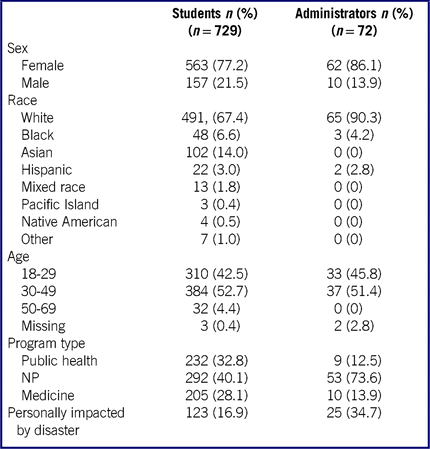
A total of 729 students and 72 administrators completed the survey. Demographics of each group are listed on Table 1.
Demographics

Perceptions of Curriculum Coverage
Results of the Mann-Whitney U-test to compare of scores between students and administrators regarding their perceptions of how thoroughly they believed their program covered 15 topics related to disaster preparedness. There was not a statistically significant difference of mean scores between students and administrators related to curriculum coverage. Scores ranged from 15 to 60, and the overall mean (for students and administrators combined) was 24.4 (SD = 9.6).
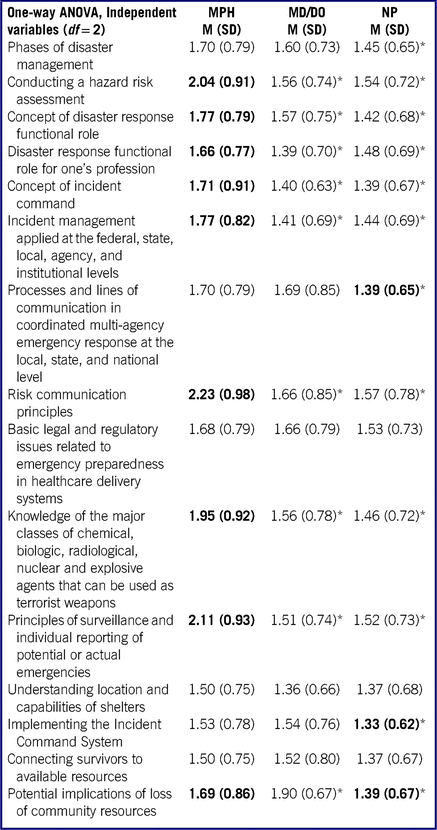
Among students, (F[2,706] = 20.25; P < 0.001), NP students (21.66 ± 8.56) scored significantly lower than MD/DO students (23.32 ± 8.19; P < 0.001) and MPH students (26.58 ± 9.06; P < 0.001) on curriculum coverage. The mean difference between MPH and MD/DO students was also significant, with MPH students scoring highest on the overall measure of curriculum coverage related to 15 disaster preparedness topics. There were also significant differences between groups on individual topic coverage (Table 2). There were no statistically significant differences among administrators on either individual topic or the combined score of curriculum coverage.
Comparison of Students on Curriculum Coverage

Abbreviation: ANOVA, analysis of variance.
Figures in bold denote P < 0.05 significant difference from MD/DO. Key: 1 = not covered at all; 2 = covered minimally; 3 = covered moderately; 4 = covered thoroughly.
* Denotes P < 0.05 significant difference from MPH.
Perceptions of Curriculum Competence
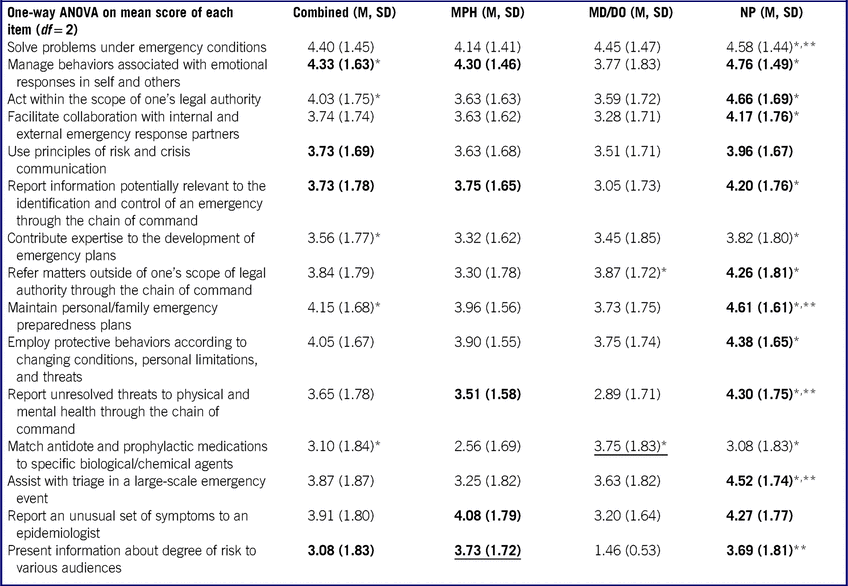
When students were compared with administrators by means of the Mann-Whitney U-test, there was a statistically significant difference between the 2 groups on curriculum competence (U = 14987; P < 0.0001), with students scoring lower on perceptions of competence (23.7 ± 8.9) than administrators (32.0 ± 13.2). Results of a 1-way ANOVA measuring curriculum competence scores among students also returned significant findings by program type. For the combined curriculum competence score (F[2,697] = 24.05; P < 0.001), NP students scored significantly higher (63.12 ± 20.69; P < 0.001) than both MPH students (54.85 ± 17.82) and MD/DO (51.17 ± 19.71; P < 0.001) students. There was not a statistically significant difference between MPH and MD/DO students on the overall curriculum competence score. There were significant differences on individual topics. Students expressed overall low confidence in their skills, with means on a scale from 1 to 7 from 1.46 to 4.76 across all schools (Table 3). Lowest confidence was seen in ability to present information about risk to various audiences, ability to match antidote and prophylactic medications to specific biological and chemical agents, and ability to contribute expertise to the development of emergency plans. Students were more likely to feel confident in their abilities to “manage behaviors associated with emotional response in self or others”.
Comparison of Students on Disaster Preparedness Confidence Based on Their Curriculum

Abbreviation: ANOVA, analysis of variance.
Figures in bold denote significantly higher mean compared to MD/DO group. Figures underlined denote significantly higher mean compared to NP group. Key: 1= not confident at all – 7 = very confident.
* Denotes P < 0.05 significantly higher mean compared to MPH scores.
** Denotes P < 0.05 significantly higher mean compared to combined/overall scores.
MD/DO students were significantly less likely to be confident than MPH and NP students in multiple areas of confidence: in their ability to manage behaviors associated with emotional response in themselves and others, report information potentially relevant to the identification and control of an emergency through the chain of command, refer matters outside of one’s scope of legal authority through the chain of command, report unresolved threats to physical and mental health through the chain of command, match antidote and prophylactic medications to specific biological/chemical agents, report an usual set of symptoms to an epidemiologist, and to present information about degree of risk to various audiences. This was despite expressing equal or higher curriculum coverage compared with NP students across all domains. NP students reported significantly more confidence in all areas in comparison to at least 1 of their peer groups. MPH students, while significantly more confident in their abilities compared with MD/DO peers in several domains, were not more confident then NP students in any domain other than 1: presenting information about degree of risk to various audiences. Again, this was despite MPH students reporting equal or higher levels of curriculum coverage than NP students across all domains.
Personal and School Preparedness
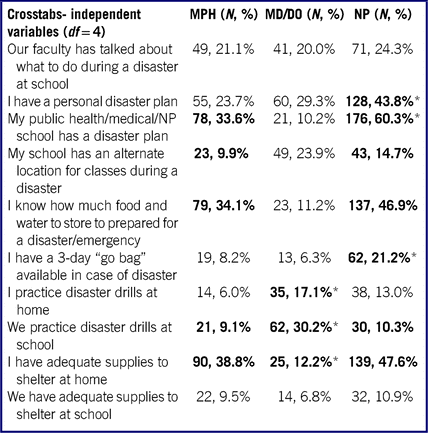
Personal and school preparedness and awareness ranged from 6 to 60.3% on individual items across schools. NP students were more likely than either MPH or MD/DO students to have heard a discussion from faculty on what to do in a disaster at school, have a personal disaster plan, and have a 3-day go bag (Table 4). MD/DO students were significantly less likely than either NP or MPH students to believe their school to have a disaster plan have knowledge of how much water and food to store, or to have adequate supplies to shelter at home. Few students across the schools believed that they had adequate supplies to shelter at school (6.8-10.9%).
Comparison of Percentage of Students Answering “Yes” to Items of Personal Preparedness

Figures in bold denotes P < 0.05 significant difference from MD/DO.
* Denotes P < 0.05 significant difference from MPH.
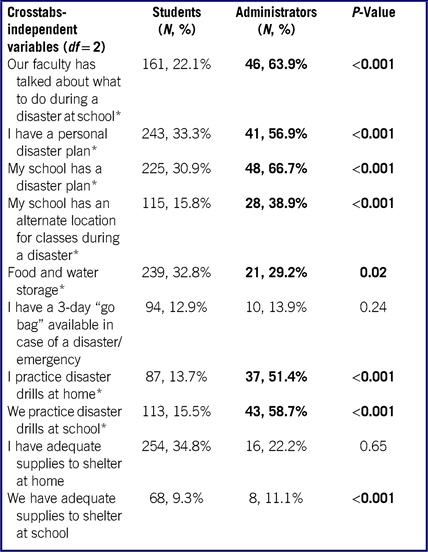
Compared with administrators, students were significantly less likely to report personal and school preparedness (Table 5). The exceptions to this were equally low probability of having a 3-day go-bag (12.9% students vs 13.9% administrators) and stocks of supplies at home and at school (34.8% and 9.3%, respectively, students, 22.2% and 11.1%, respectively, administrators).
Comparison of Percentages of Students and Administrators Answering “Yes” to Questions on Personal Preparedness

Figures in bold denote significantly higher difference.
* Denotes P < 0.05 significant difference.
DISCUSSION
It is an acknowledged and recurrent finding that disaster education in professional health-care schools remains inadequate. Reference Wunderlich, Ragazzoni and Ingrassia28 Health-care students also continue to express dissatisfaction in their curriculum coverage, as well as a desire to increase their skillset related to disaster preparedness. Reference Kaji, Coates and Fung29-Reference Curtis32 This study found similar results, a combination of poor curriculum coverage of disaster topics and a lack of confidence in acting on what was learned in their future positions. Reference Smith, Levy and Hsu33,Reference Markenson, Woolf and Redlener34 This low coverage is concerning due to documented links between disaster training and willingness to work. Reference Patel, Wattamwar and Kanduri35
While also low in adequacy of curriculum coverage, MPH students reported the most coverage and NP students the least. However, these differences did not correlate with confidence, with NP students expressing the highest confidence in their abilities to use their disaster knowledge. This discrepancy may result from several possible sources, due to the teaching methodology, differences in expected versus delivered content, NPs already practicing as registered nurses, or a view biased by satisfaction with the amount of coverage, and warrants further exploration. Prior studies have failed to determine the superiority of a particular teaching method in transmitting disaster preparedness training, but have pointed to coverage gaps that this study confirmed. Reference Ingrassia, Ragazzoni and Tengattini36-Reference Bajow, Djalali and Ingrassia39
Addressing this mediocrity of coverage could be remedied in multiple ways. Increased time in the curriculum is often difficult, due to multiple pressing topics that must be covered in instructional time. The relative coverage and confidence strengths present in the MPH, MD/DO, and NP programs, could be used to advantage, however. Disaster response is by nature a teamwork-based system, requiring a level of collaboration between practitioners well beyond that required by daily health care, especially that between public health and MDs/NPs. Where possible, curriculum that brings together students from varied health-care schools can take advantage of the strengths each school can bring, as well as making students more aware of the roles each practitioner brings. Reference Strout, Saber and Caruso40
Furthermore, it has been suggested that the mental health of the community may benefit from the inclusion of community cooperation in disaster recovery efforts. Reference Lebowitz41 Defined as “when students from 2 or more professions learn about, from, and with each other to enable effective collaboration and improve health outcomes,” this is termed interprofessional education (IPE), and studies have shown effectiveness in increasing confidence and collaboration. Reference Subbarao, Lyznicki and Hsu27,Reference Strout, Saber and Caruso40,Reference Farrell, Payne and Heye42,43 This may be particularly important, as prior work by Markenson et al., found that students perceived less competence and confidence compared with their actual knowledge assessed by survey. This, combined with reported discomfort working with other health-care providers could be addressed through IPE. Reference Markenson, Woolf and Redlener34
Confidence and a feeling of competency are directly related to willingness to work. Reference Patel, Wattamwar and Kanduri35,Reference Barnett, Thompson and Errett44 Increasing curriculum coverage and focusing on IPE increases both knowledge and competency in health-care workers. The ability to respond, however, also depends on concern for family safety, which can be measured in part by personal preparedness levels of confidence in ability to maintain personal preparedness plans, which this study confirms remains inadequate. Reference Qureshi, Gershon and Sherman10,Reference Brice, Gregg and Sawyer20 Administrators, while reporting better personal and school preparedness than students, still appear to be failing to demonstrate the importance of this to professional health-care students. As studies show improvement in personal preparedness after focused curricula, it behooves schools to emphasize personal preparedness to their students. Reference Kohn, Semon and Hedlin19 Whether this emphasis will result in lasting improvements in personal preparedness is an area which remains in need of study. It is suggested that a focus on small steps and addressing challenges to acquiring a personal preparedness plan may be more effective than pure instruction on need and method. Reference Blessman, Skupski and Jamil45
This study, while strengthened by its ability to compare professional health-care students likely to be at the forefront of disaster response, as well as unique in its comparison of student versus administrator perceptions, is limited. While a large sample of 730 students and 74 administrators, the results represent a small proportion of health-care students and may lack generalizability. However, our findings align with prior studies, suggesting their accuracy. Additionally, it is possible that students may have recall bias when reporting curriculum coverage.
CONCLUSIONS
Professional health-care students continue to report inadequate coverage of disaster management topics in their schools. Administrators perceive a higher competence outcome than students, causing a possible false assurance of the curriculum adequacy. We suggest that improvements in knowledge and confidence could be derived by cross-school training and collaboration. Administrators, while expressing better personal and facility preparedness than students, have room to further emphasize personal preparedness to their students. Incorporation of recommended disaster response competencies to professional health-care curricula should increase knowledge and improve willingness and comfort in responding to disasters in critical health-care professionals.
Funding
This work was partially funded through a Centers for Disease Control and Prevention/American Association of Colleges of Nursing Workforce Improvement Projects cooperative agreement number 2016-N-03.