


Introduction
The late-Wisconsin and Hoiocene Glaciol history of the Ross Sea embayment, Antarctica (Fig. 1), has been the subject of extensive research since the early part of this century (Reference ScottScott, 1905; Reference HollinHollin, 1962; Reference MercerMercer, 1968; Reference Denton, Prentice, Burckle and TingeyDenton and others 1991). Glaciol geologic records show that the Ross Ice shelf once extended some 2000km further north than it docs today, and that a grounded Ross Sea ice sheet extended into the Dry Valleys; retreat of the ice-sheet grounding line began by about 14 000 BP (14 ka) (Stuiver and others, 1981; Reference Denton, Bockheim, Wilson and StuiverDenton and others, 1989; Reference Licht, Jennings, Andrews and WilliamsLicht and others, 1996). It seems clear from the timing of grounding-line retreat — coincident with the melting of Northern Hemisphere ice sheets—that rising sea level played a dominant role in the initiation of déglaciation in the Ross embayment (Reference Thomas and BentleyThomas and Bentley, 1978; Denton and others, 1986). Less well understood is the relationship between regional climate and continued evolution of the ice-shelf margin after the end of the last glaciation. in particular, changes in ocean temperatures, which control ice-shelf basal melting rates, could have played an important role in determining the rate and timing of ice-shelf margin retreat (Reference Thomas, MacAyeal, Eilers, Gaylord, Hayes and BentleyThomas and others, 1984; Reference MacAyeal, Shabtaie, Bentley and KingMacAyeal and others, 1986; Reference Rott, Skvarca and NaglerRott and others, 1996).
In this paper, we present new data from theTaylor Dome ice core, at the western margin of the Ross embayment. Stable-isotope and melhanesulfonic acid concentrations in the Taylor Dome core indicate that warm conditions prevailed in the early Hoiocene, followed by rapid cooling at about 6 ka and continued climatic deterioration through the late Hoiocene. Inferred mid- to late-Holocenc cooling is corroborated by preliminary results from Ross Sea sediment cores, which show an increase in percentages of sca-ice diatoms after 6 ka. A review of the literature of radiocarbon-dated macrofossils from raised beach deposits provides independent control on marine environmental conditions in coastal Antarctica, and suggests that changes in climate in the Ross embayment had an important influence on the evolution of ice-shelf margins.
Evidence from the Taylor Dome Ice Core
Taylor Dome is located just inland of the Transantarelic Mountains across McMurdo Sound from Ross Island, Antarctica. Taylor Dome is a local ice-accumulation area that
Map of Antarctica, showing locations mentioned in the text Shaded areas are ice shelves. Ross Sea sediment cores are shown by plussign (core NBP9501-KC31), cross (NBP9501-KC37) and star (NBP9501-KC39). Terra Nova Bay is on the coast between cores 31 and 37. McMurdo Sound is the small embayment to the right (west) of the Ross Ice Shelf.
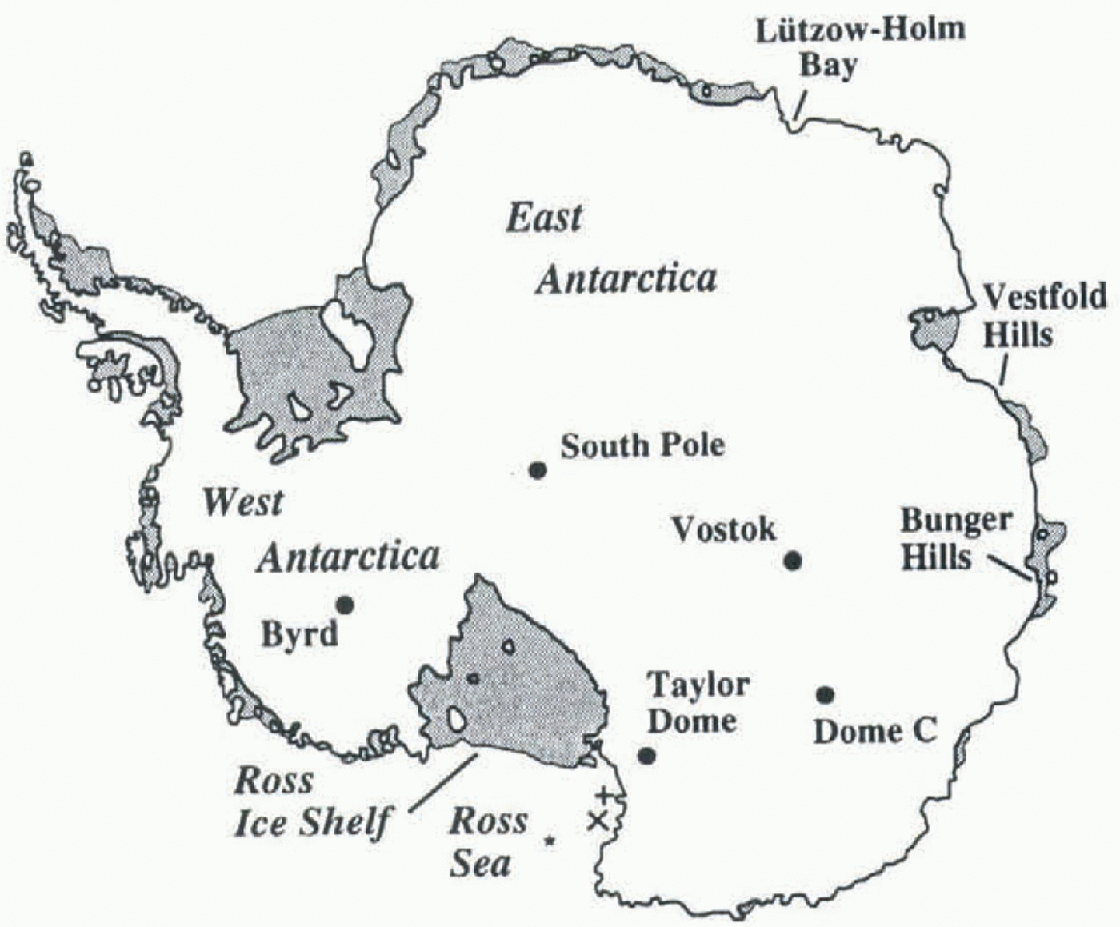
supplies ice to Taylor Glacier to the southeast and to the Skelton Névé to the southwest. A 554 M ice core retrieved at Taylor Dome in early 1994 yields a climate record through marine isotope stage 5e (Reference Grootes, Steig and StuiverGrootes and others, 1994). Glacio-logical reconstructions, constrained by the Glaciol-geologic record at the margins of Taylor Glacier, show that the height of Taylor Dome has changed by at most 160 m in the last IMa, and by far less in the last 100 ka (Reference Marchant, Denton, Bockheim, Wilson and KerrMarchant and others, 1994). Thus, the isotope profile at Taylor Dome should not be significantly affected by elevation change. Taylor Dome differs in this respect from many other long ice cores in Antarctica, including Vostok (central East Antarctica) and Byrd Station (central West Antarctica), which may have experienced significant elevation change since the Last Glaciol Maximum (Reference Jenssen and RobinJenssen, 1983; Reference Grootes and StuiverGrootes and Stuiver, 1986).
Wc measured deuterium isotope concentrations (δD, the D/H ratio normalized to a value of δDV-SMOW = 0%) and methanesulfonic acid concentrations (CH3SO3H or MSA) at ~0.5m resolution through the Wisconsin-Holocene transition at about 375 m in the Taylor Dome ice core. Analyses for δD were performed at the University of Colorado, according to the methods discussed by Reference VaughnVaughn (1994). MSA concentrations were measured at the University of Miami, according to methods described by Whung and others (1994). The time-scale for the Taylor Dome core is based on a finite-element flow model, constrained by radar profiling and surface velocity data, and accumulation rates from 10Be concentrations, as discussed by Steig (1996), Reference MorseMorse (1997) and Steig and others (1998). We estimate that this time-scale is accurate to about 10% during the Hoiocene, as indicated by an independent comparison with the GISP2 ice core on the basis of high-resolution trace-gas (CH4 and δ18O of O2) measurements.
Figure 2 shows δD and MSA at Taylor Dome during the Hoiocene, with Vostok δD (Reference JouzelJouzel and others, 1993) for comparison. Figure 2 also shows sea-ice diatom percentages from western Ross Sea sediment cores, discussed in the following section. Clearly, isotopic changes at Taylor Dome during the Hoiocene are much larger in magnitude than at Vostok, and are anticorrelated with MSA. The “early Hoiocene warm period”, as inferred from relatively high δD values, ends by about 8ka at Vostok, as at other sites in central East Antarctica (Reference CiaisCiais and others, 1992). AtTaylor Dome, high δ D values last until about 6 ka. Between about 9 and 6ka, δD values are higher than at any other time sinc e the previous interglaciol period. At 6 ka, δD drops by a full 10%, and then declines more gradually towards the present by another 10%.
The δD concentration in polar precipitation is widely accepted as a proxy for temperature (Reference Dansgaard, Johnsen, Clausen and GundestrupDansgaard and others, 1973). The most straightforward interpretation of the δD profile at Taylor Dome core is that it reflects rapid cooling at 6 ka followed by continued climatic deterioration through the late Hoiocene. This cooling was evidently restricted to coastal regions, since it does not appear in the Vostok record (Ciais and others, 1992). Although recent work in central Greenland shows thai the slope of the iso-lope-tempcrature relationship cannot be assumed to be constant at all temporal scales, it may be reasonable to assume that a linear relationship applies for the Hoiocene (Reference Cuffey, Clow, Alley, Stuiver, Waddington and SaltusCuffey and others, 1995). For central East Antarctica, Jouzel and others (1996) use a  gradient of 9%C−1. Applying the same relationship to the Taylor
Top panel: stable-isotope concentrations at Taylor Dome (upper) and Vostok (lower). Middle panel: MSA concentrations at Taylor Dome. Bottom panel: abundance of Fragilariopsis curta in sediment cores from the western Ross Sea: plus signs, core NBP9501-KC31; crosses, core MBP9501-KC37.

Dome core, this indicates a cooling of about 2°C between 6 ka and the present, in good agreement with results from borehole paleothermometry (Reference Waddington and ClowWaddington and Clow, 1997).
The importance of seasonal changes in moisture sources and in the timing of precipitation in determining mean annual isotope values has been emphasized recently in the literature (Charles and others, 1994; Steig and others, 1994; Reference Fawcett, Agústsdóttir, Alley and ShumanFawcett and others, 1997). Changes in δD may not be strictly related to temperature. At Taylor Dome, only 150 km from seasonally open water, δD may be particularly sensitive to the seasonal influence of sea-ice cover. According to model estimates, a 1% decrease in δD for coastal Antarctica would require a northward increase in winter sea-ice extent of only 0.2° of latitude (Reference Bromwich and WeaverBromwich and Weaver, 1983). The effect of sea ice on δD largely reflects the increased distance to the moisture source during the period of maximum precipitation (mostly in winter). Increased sea ice, either locally in the Ross embayment or Antarctica-wide, may additionally delay summer warming (Reference HannaHanna, 1996), resulting in a decrease in the relative proportion of summer (high δD) snowfall in the annual average.
The MSA profile in the Taylor Dome ice core (Fig. 2) supports the inference that the δD decrease since 6 ka in part reflects an increase in sea-ice cover. MSA is an oxidation product of dimethylsulfide (DMS), which is produced by certain marine algae, especially in polar waters (see Saltzman 1995, for a review). A positive correlation between sea-ice cover and MSA deposition at the ice-sheet surface is postulated to result from enhanced productivity of DMS-producing algae during high-sea-ice years (see Reference Legrand and DelmasLegrand, 1995, for a review). in particular, Phaeocystis is an abundant component of pack-ice algal assemblages (Reference Garrison, Buck and FryxellGarrison and others, 1987) and is a major producer of DMS Reference Gibson, Garrick, Burton and McTaggartGibson and others, 1989). Although the environmental factors determining the distribution and abundance of Phaeocystis are not fully understood (Reference Leventer and DunbarLeventer and Dunbar, 1996), Phaeocystis blooms are probably favored by stabilization of the water column resulting from sea-ice melt-out (Reference Smith and NelsonSmith and Nelson, 1985; Reference DiTullio and SmithDiTullio and Smith, 1995).
A positive correlation between sea-ice cover and MSA concentration has been observed for at least two Antarctic ice cores (Reference Peel and MulvaneyPeel and Mulvaney, 1992; Reference Welch, Mayewski and WhitlowWelch and others, 1993). Welch and others (1993) report that the correlation between sea ice and MSA is not statistically significant at Taylor Dome; however, the period of comparison is less than 20 years and the changes in MSA concentration are small. For the Hoiocene, MSA and δD at Taylor Dome are strongly anticorrelated: MSA values are lowest between 9 and 6 ka, where δD values are highest, while MSA increases rapidly at 6 ka and continues to rise throughout the Hoiocene, with a total change of more than a factor of five. Taken together, the MSA and δD data in the Taylor Dome core both suggest cooler temperatures and increased sea ice since 6 ka in the Ross embayment.
Microfossil Evidence from Ross Sea Sediment Cores
Independent evidence for colder conditions and/or increased sea-ice cover since 6 ka comes from the microfossil record in the Ross Sea. Reference BurckleBurckle (1972) and Reference Kellogg and TruesdaleKellogg and Truesdale (1979) used diatom assemblages from sediment cores to infer both cooling and increased sea-ice extent around Antarctica during the late Hoiocene. We report here results from cores obtained from cruise 9501 of the R/V Nathaniel B. Palmer in the Ross Sea which support this earlier research. Because this work is still in progress, we report data only for kasten cores NBP9501-KC31, NBP9501-KC37 and NBP9501-KC39, obtained respectively from basins at water depths of 879, 924 and 557 m. Also, wc report data only for the dominant diatom species in these cores, Fragilar-iopsis curta.
Chronologies were obtained by interpolation of ten radiocarbon dates (one every ~1000 years) on bulk organic matter in each core, measured by accelerator mass spectrometry at the University of Arizona (Cunningham, 1997). Due to the potential of reworking of organic carbon in Ross Sea shelf sediments (Hart and others, 1996), all ages must be considered maximum ages. There arc, however, no age reversals during the Hoiocene portions of the cores, and calculated sedimentation rates are essentially constant, giving us confidence in the chronologies. A correction factor oi 1200 years is applied to account for Antarctic marine l4C reservoir effects (Reference Gordon and HarknessGordon and Harkness, 1992). Wc converted the reservoir-corrected dates to calendar age using the calibration of Stuiver and Reimer (1993); for corrected ages greater than 9000 radiocarbon years BP we use the U-Th calibration of Reference Bard, Arnold, Fairbanks and HamelinBard and others (1993).
The bottom panel in Figure 2 shows Fragilariopsis curia abundance (percentage by number of diatoms counted) vs age for cores 31 and 37. Between 9 and 6 ka, K curia percentages are low, generally below 20%. After 6 ka, they increase steadily to 40-65%. Surveys of modern Ross Sea diatom assemblages show that F. curta is common in both fast ice and pack ice and may be considered an indicator of seasonal sea-ice cover (e.g. Truesdale and Kellogg, 1979; Leventer and Dunbar, 1996). Thus, the F. curta profiles in both of these western Ross Sea cores suggest increased sea-ice cover since about 6ka, in excellent agreement with Our inference from the Taylor Dome ice-core data. Increased sea-ice cover may have been limited to coastal arcas: F. curta percentages in core NBP9501-KC39, from the central Ross Sea, do not change appreciably throughout the entire Hoiocene (Cunningham, 1997).
Macrofossil Evidence from Raised Beach Deposits
Assemblages of molluscs on isostatically uplifted beach deposits are known from a number of locations in coastal East Antarctica, including the Ross embayment (see Reference BerkmanBerkman, 1992, for a summary). These assemblages are found as both in situ placements and wave-reworked shell accumulations. A compilation of radiocarbon dates from these assemblages, and from ice-shelf uplifted macrofossils in southern McMurdo Sound (Kellogg and others, 1990), suggests that the environmental changes recorded in the Taylor Dome ice core and Ross Sea sediment cores may coincide with the last phase of ice-shelf retreat in the Ross embayment.
The chronology of deglaciation in the Ross embayment is based largely on radiocarbon dates from terrestrial and marine Glaciol deposits (e.g. Stuiver and others, 1981). Using such data, Denton and others (1989) and Licht and others (1996) showed that grounded ice had retreated from McMurdo Sound by 7 ka: this date gives a minimum esli-mate for ice-sheet grounding-line retreat. A chronology restricted to fossil samples collected from ice shelves and raised beach deposits can be used to date the establishment of full marine conditions in a particular locale. This reflects more directly the existence of ice shelves or sea ice, as opposed to an ice-sheet grounding line (Denton and others, 1991). Because withdrawal of ice shelves is not a prerequisite for colonization of an area by benthic invertebrates (Reference Hain and MellesHain and Melles, 1994), such a chronology should yield a maximum age for ice-shelf retreat.
Histograms of published radiocarbon dates (converted to calendar age) from raised beach deposits from East Antarctica excluding the Ross embayment, andfrom Terra Mva Bay, and from raised beaches and ice-shelf sediments in southern McMurdo Sound. References are given in the text.

Figure 3 shows histograms of radiocarbon dates compiled for (I) coastal East Antarctica excluding the Ross embayment (Reference PickardPickard, 1985; Reference Adamson and ColhminAdamson and Colhoun, 1992; Reference Hayashi and YoshidaHayashi and Yoshida, 1994; Reference Igarashi, Harada and MoriwakiIgarashi and others, 1995a, b); (2) Terra Nova Bay, northwestern Ross embayment (Reference Baroni, Belluomini, Branca, Improta and OrombelliBaroni and others, 1991); and (3) southwestern Ross embayment/ McMurdo Sound (Stuiver and others, 1981; Kellogg and others, 1990). Sampling locations are shown on the map in Figure I. Radiocarbon studies on modern Antarctic invertebrates collected prior to 1945 (and therefore unconlami-nated by bomb-14C) suggest that species-specific reservoir corrections might be appropriate (Berkman and Forman, 1996). For this review we use a reservoir correction of 1400 years for dates from the scallop Adamussium colbecki and a correction of 1200 years for all other analyses on carbonate shells. The corrected data have been calibrated according to Stuiver and Reimer (1993), as described above for the Ross Sea sediment cores.
The upper histogram in Figure 3 shows that the establishment of marine conditions dates to about 7.5 ka or earlier in most coastal settings in East Antarctica. This almost certainly reflects the rapid response of both ice-sheet grounding lines and ice-shelf margins to eustatic sea level, which was still rising at this time (Bard and others, 1990). Ice-shelf retreat may have continued past 7.5 ka, but there are insufficient data to address this possibility. For the Ross embayment, the data reveal a more complex déglaciation history. Stuiver and others (1981) and Denton and others (1989) note the absence of any raised-beach deposits in southernmost McMurdo Sound. They suggest that ice-shcet grounding-line retreat in the Ross embayment was followed by an “ice-shelf phase” which continued until some time after 7 ka. At Terra Nova Bay (Fig. 3), retreat of the Ross Ice Shelf exposed beaches by about 7.5 ka, but there may have been a readvance of local ice shelves after 6 ka, reflected in the low number of dates between 2.5 and 6ka (Baroni and Orombelli, 1994). Thus, the ice margin at Terra Nova Bay was either stable or undergoing continued retreal until 6ka. For the southwestern Ross embayment (southern McMurdo Sound), there is one calibrated date of 7.1 ka (Fig. 3). This is from uplifted debris from beneath the McMurdo Ice Shelf (an extension of the Ross Ice Shelf); all other dates, mostly from raised beaches, are 6ka or younger. Taken together, the radiocarbon data from Terra Nova Bay and southern McMurdo Sound suggest that ice-shelf retreat continued in the Ross embayment until about 6 ka.
Discussion
The geochemical and isotopic data at Taylor Dome and the microfossil evidence from Ross Sea sediment cores show that 6 ka is an important temporal boundary for climate conditions in the Ross embayment. The bulk of the evidence points to an extended length for the “early Hoiocene climatic optimum”, which is generally taken to have ended at about 8ka (Ciais and others, 1992), and to lower temperatures and increased sea-ice cover through the late Hoiocene.
Denton and others (1986) have argued that sea level played a dominant role in the initiation of déglaciation in the Ross embayment following the end of the last glaciation. They further suggest that retreat of the Ross Ice Shelf margin led to increased southward advection of warm ocean water, which contributed to regionally increased precipitation rates and higher temperatures, accounting for Hoiocene advances of alpine glaciers in the Dry Valleys. For the early Hoiocene, data from the Taylor Dome ice core tend to support this concept: temperatures at Taylor Dome, as inferred from δD, are highest at about 9 and 11 ka, well after the initiation of ice-sheet retreat. Also, Steig (1997) showed that the increase in accumulation rate between the last glacia-tion and the present was greater at Taylor Dome than at Vostok and other more inland sites.
Our compilation of radiocarbon dates suggests that 6 ka at least roughly marks a maximum for Hoiocene ice-shelf retreat in the Ross embayment. This agrees rather well with the evidence given above for warmer ocean and atmospheric conditions until 6 ka, suggesting an important role for climate in controlling the timing of ice-shelf retreat. Certainly, the recent collapse of the Larsen Ice Shelf on the Antarctic Peninsula illustrates the importance of ocean surface temperatures in controlling ice-shelf dynamics (Roll and others, 1996). Thus, for the mid-Holocene, warm ocean-surface temperatures may have contributed to continued evolution of ice-shelf margins, while the abrupt cooling at about G ka stabilized the margin and prevented further retreat. Continued cooler air and sea-surface tem-peratures through the late Hoiocene suggest the possibility that the current position of the ice-shelf margin does not represent the Hoiocene minimum, but could reflect at least a minor readvance since 6 ka.
Acknowledgements
This work was supported by grants from the U.S. National Science Foundation (OPP-9526979, 8919524, 9222178). The manuscript benefited greatly from helpful reviews by A. Levenler and an anonymous reviewer.



