Growth and achievements
The Journal of Institutional Economics (JOIE) has grown from a two-issue volume in 2005 to six issues per volume since 2018. Article submissions are received from all around the world, and they have been increasing at an average rate of about 10 per cent per year since 2005.
There has been some increase of article submissions from less developed countries. Submissions from Africa have been growing, and in 2021 they reached 11.6 per cent of the total. Submissions from Asia have exceeded 20 per cent for a while, and in 2021 they reached 22.2 per cent. In the same year, submissions from Europe were 47.3 per cent and from North America 15.4 per cent.
JOIE has established and maintained a rapid refereeing process for its authors. On average, for all papers sent out to referees, the editors have provided a verdict on the paper within 50 days in 65 per cent of cases, and within 100 days in 95 per cent of cases. The median time it has taken to provide an editorial verdict is 45 days. Since 2016, the acceptance rate for all submitted papers, typically after one or more revisions, has averaged about 17 per cent.
Over the same time period, about 44 per cent of papers were rejected without being sent out the referees. Typical reasons for these desk rejections were that the paper was not centrally about institutions, and thus a poor fit for JOIE, or that the quality of the analysis was poor. The JOIE editors are dedicated to maintaining very high-quality standards for the journal.
The current JOIE editors are:
• Geoffrey M. Hodgson, Emeritus, Loughborough University London, UK (Editor in Chief)
• Richard Langlois, University of Connecticut, US
• Jason Potts, RMIT University, Australia
• Esther-Mirjam Sent, Radboud University, the Netherlands
• Claudia Williamson, University of Tennessee at Chattanooga, US
The editors serve five-year (renewable) terms.
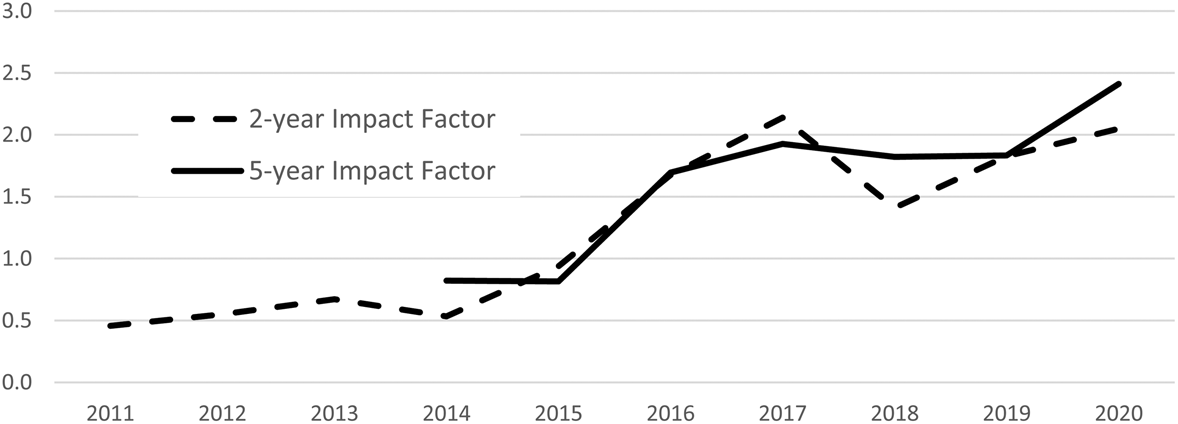
Since 2011 JOIE has received citation impact factors from Clarivate Analytics, which is the leading global provider of bibliometric data for academic journals. The data are shown in Figure 1. Since 2016 the JOIE citation impact factors have been well above 1.0. In 2020, both the 2-year and 5-year impact factors exceeded 2.0. These impact factors are similar to those of older, well-established journals such as the Cambridge Journal of Economics, Economy and Society, Journal of Economic Behavior and Organization, Journal of Evolutionary Economics, Journal of Law and Economics, and Kyklos.
Figure 1.Clarivate analytics annual impact factors for JOIE.
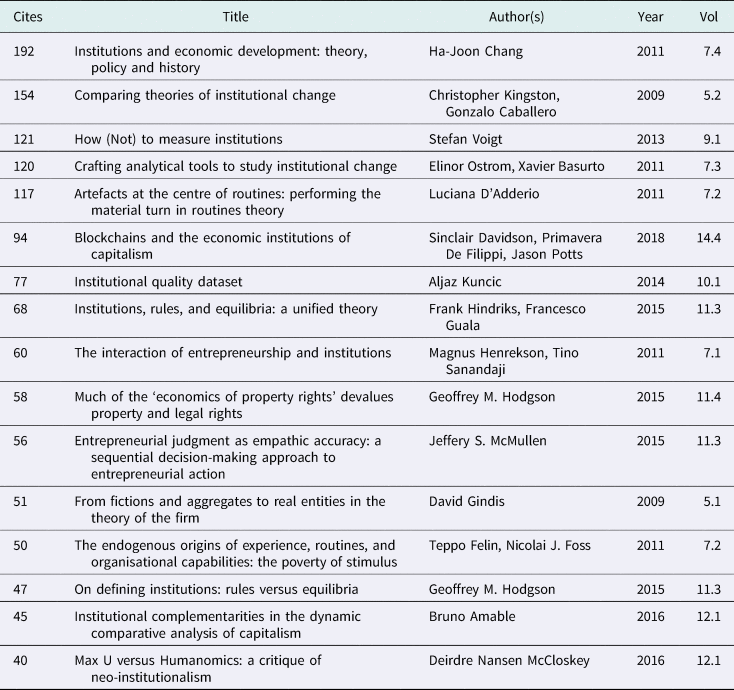
Table 1 shows the top 16 most cited JOIE articles in Web of Science. Famous authors on the list include Ha-Joon Chang, Elinor Ostrom (Nobel Laureate) and Deirdre Nansen McCloskey. The topics covered by the papers include the nature of institutions (Hindriks and Guala, Reference Hindriks and Guala2015; Hodgson, Reference Hodgson2015a), the role of institutions in economic development (Chang, Reference Chang2011; McCloskey, Reference McCloskey2016), theories of institutional change (Amable, Reference Amable2016; Kingston and Caballero, Reference Kingston and Caballero2009; Ostrom and Basurto, Reference Ostrom and Basurto2011), and on the measurement of institutions (Kuncic, Reference Kuncic2014; Voigt, Reference Voigt2013). There are several papers on businesses, entrepreneurship and routines (D'Adderio, Reference D'Adderio2011; Felin and Foss, Reference Felin and Foss2011; Gindis, Reference Gindis2009; Hendrekson and Sanandaji, Reference Henrekson and Sanandaji2011; McMullen, Reference McMullen2015). Further papers address specific institutional topics, such as property rights (Hodgson, Reference Hodgson2015b) and blockchains (Davidson et al., Reference Davidson, De Filippi and Potts2018). Taken together, these 16 papers touch on a range of analytical, conceptual and empirical issues, all relating to the role of institutions in the economy.
Table 1.The top 16 most cited JOIE articles in the Web of Science
JOIE is a hybrid journal, where the purchase of an open-access agreement is an option for authors. The open-access content of the journal is increasing due to funding agreements. All authors publishing in JOIE are invited to submit an article summary on the JOIE Blog website (https://joie-blog.net/). This helps to bring attention to articles in JOIE and to promote them on social media.
JOIE is owned by Millennium Economics Ltd (a UK company) and published by Cambridge University Press. The company manages the journal and appoints its editors. The shareholders of Millennium are the World Interdisciplinary Network for Institutional Research (WINIR) and the European Association for Evolutionary Political Economy (EAEPE).
The Elinor Ostrom prize
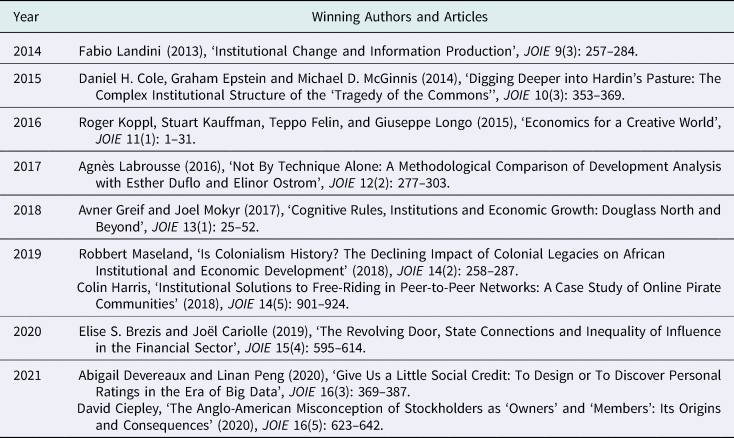
Since 2014, in honour of Nobel Laureate Elinor Ostrom, an annual prize of £1000, funded by Millennium Economics Ltd, has been awarded for the best full-length article (or articles) published in JOIE in the preceding calendar year. Each annual prize competition is judged by an international, multi-disciplinary committee of experts in the field of institutional research. The past winners of the prize are shown in Table 2.
Table 2.Winners of the Elinor Ostrom Prize
Looking forward: gender balance
A major problem for JOIE is the male dominance of submissions, and the gender imbalance of authors that publish in the journal. Since 2019 the gender of submitting authors has been monitored. So far, women have accounted for about 24 per cent of submitting authors, without any discernible upward or downward trend. In 2021, female authors that published in JOIE reached 22 per cent of all authors. These figures are far too low.
As recently as the 19th century, women were barred from entering many universities, or were disallowed from obtaining degrees. Just over forty years ago, a collection of essays examined how women had been largely excluded from the production of academic knowledge (Spender, Reference Spender1981). Despite some significant progress since then, gender imbalance remains a serious problem in academia. But getting to the source of this problem, understanding its underlying causes, and designing policies to improve gender balance, are not easy.
Consider the percentages of women in some relevant academic disciplines. A 2020 survey by the American Economic association found that the share of women in the faculty of PhD-granting economics departments in the US reached 25 per cent, after much lower levels in previous years (Chevalier, Reference Chevalier2021). A 2021 report published by the Royal Economic Society found that 26 per cent of UK academic economists were women (Bateman et al., Reference Bateman, Gamage, Hengel and Liu2021). This too was higher than in previous years. At least in these countries, there has been some progress within economics as a discipline. But levels are still low.
These figures for economics are also lower than in some other disciplines. One study found that 31 per cent of academic positions in UK political science were filled by women (Bates et al., Reference Bates, Jenkins and Pflaeger2012: 141). Another reported that 47 per cent of academic positions in US sociology were filled by women (Vidal-Ortiz, Reference Vidal-Ortiz2009).
Although JOIE is explicitly a multi-disciplinary journal, the prominence of ‘Economics’ in its title may deter some women from other disciplines from submitting their work to JOIE, including from those where there are greater percentages of women. A remedy here would be to make the multi-disciplinary character of JOIE more widely known. The publisher and the editors of JOIE have been publicising this for a while. But more could be done to enhance the attractiveness of JOIE to scholars from outside economics.
In a major international survey of economists, Andre and Falk (Reference Andre and Falk2021) found that female economists put greater stress on policy relevance, and compared with men, they gave greater stress to the need for research by economists to be more multi-disciplinary. These inclinations align with the objectives of JOIE. These results suggest that JOIE should attempt to increase is visibility among female economists, as well as among women from other disciplines.
Studies show that women are often less numerous in senior academic posts. All the above-cited studies of gender representation, which examined the academic hierarchies within disciplines, found that women were less prevalent in the more senior faculty positions. This may be explained by a number of factors, including male prejudice and people being promoted in past decades before gender inequality was perceived as a major problem. Lower publication rates by women in leading journals would also help to explain the deficit of women in senior positions, but these lower rates would also require an explanation.
Taking the last point into account, traditional assumptions and norms about gender roles are relevant, particularly concerning childcare. In a study of two academic disciplines – linguistics and sociology – Hunter and Leahey (Reference Hunter and Leahey2010: 433) found that, for parents in academia, ‘after the birth a child, [academic] productivity growth declines, but more so for women. Thus, children account for part of the gender gap in rates of productivity over time.’ But while traditional gender roles concerning childcare and housework may be deeply ingrained, there is some evidence (cited below) that progress toward greater gender balance in academic outputs may be possible.
Gender publication rates in reputable journals offer important benchmarks for JOIE in assessing its own gender submission and publication rates. Ongoing research by Caroline Krafft, of St Catherine University in Minnesota in the US, suggests that only 17 per cent of the authors publishing in five leading journals in economics (American Economic Review, Econometrica, Journal of Economic Literature, Journal of Political Economy, and Quarterly Journal of Economics) have been women (Ho, Reference Ho2020). This is remarkably low and we would hope to reach much higher levels.
A study by Bird (Reference Bird2011) looked at female publication rates among UK academics in 16 social sciences. In each social science, 10 journals were chosen randomly, and UK-based authors were identified from published papers in 2005. This data, from 202 papers written by UK-based authors in 72 international and UK-based journals in the 16 social sciences showed that 68 per cent were written by men and 32 per cent by women. To put this in context, Bird cited a survey that found about 60 per cent of UK-based social scientists were men and 40 per cent women. In terms of publications per person, female social scientists in the UK have underperformed their male counterparts (Bird, Reference Bird2011: 929–30).
In Bird's sample of articles from political science, 92 per cent were written by men and 8 per cent by women. This compares with cited survey evidence that 76 per cent of UK-based political scientists were men and 24 per cent were women. This is a sizeable disparity. Turning to economics, 87 per cent of the articles were written by men and 13 per cent by women. At the time it was estimated that 78 per cent of UK-based economists were men and 22 per cent were women (Bird, Reference Bird2011: 930–31). Women underperform men dramatically in these two disciplines.
But a different picture emerged in two other academic disciplines, where women were more prominent. In psychology, 57 per cent of the articles in the sample were written by men and 43 per cent by women. These figures are equivalent to the surveyed gender ratio of academics in this discipline, namely 57 per cent men and 43 per cent women. In social policy, 47 per cent of articles in the sample were by men and 53 per cent by women. In UK social policy departments, by the same survey, 54 of academics were male and 46 per cent were female. Consequently, in disciplines where the proportion of women academics is high, publication rates by women are pulled up to similar levels. As a possible explanation, Bird (Reference Bird2011: 931–5) opined that a ‘critical mass’ of women may change academic norms and behaviours, and thereby facilitate the research output and career progression of women (Beutel and Nelson, Reference Beutel and Nelson2006). This suggests that in research communities where gender balance is approached, it is possible to achieve a similar parity of publication rates.
Normally, JOIE operates a double-blind review system, where the names and details of authors and reviewers are unavailable to everyone except the editors. A recent study across the sciences concluded that ‘there is reasonable evidence that gender bias may exist in scientific publishing and that double-blinding can mitigate its impact’ (Kern-Goldberger et al., Reference Kern-Goldberger, James, Berghella and Miller2022). This contrasts with an earlier study that found no gender bias mitigation with double-blind review systems (Blank, Reference Blank1991). This policy issue remains controversial. Other journals have dropped double-blind refereeing. This matter merits further research.
Without compromising on matters of quality, we need to consider additional measures that will encourage higher female submission rates and lead to a greater percentage of articles being published in JOIE that are by women. Obviously, gender balance among the JOIE editors and other bodies linked to the journal – including the jurors for the Elinor Ostrom Prize – must be maintained. It is already JOIE policy that proposals for special issues should pay attention to gender balance among the nominated possible authors. We should also encourage greater gender balance in multiple-author articles.
But so far, the existing measures have been insufficient. Encouraging submissions on gender-related institutional topics, such as the family, or female representation in corporate and other institutional governance, would be helpful. But many excellent female social scientists do not work in these areas. Emphatically, female authors should not be confined to gender-related topics. We need to attract women authors from all important areas of institutional research. This is a goal that needs to be constantly revisited.
Looking forward: some guidance for authors
Nobel Laureate Oliver Williamson (Reference Williamson2000: 595) noted that ‘we are still very ignorant about institutions.’ Although considerable progress has been made in subsequent years, there remains some truth in this statement. The major goal of the Journal of Institutional Economics is to enhance our knowledge of institutions and of their role in the economy. In this way, we can improve policy making at all levels – organisational, regional, national and global – and contribute to economic development and human welfare.
JOIE is a multi-disciplinary journal. Especially for the study of institutions, it is important to draw relevant insights from multiple disciplines including anthropology, biology, geography, history, law, politics, psychology, philosophy, social theory and sociology, as well as from economics itself. Within institutional economics, good ideas are welcome from both the original tradition of Thorstein Veblen, John Commons and others, as well as the new institutional economics of Ronald Coase, Douglass North, Elinor Ostrom, Oliver Williamson and others.
Institutions rely upon evolved human nature and its capacities. Modern institutions are often entwined with law and politics. All institutions are laden with ethical considerations. Institutional research is necessarily multi-disciplinary. This makes it challenging and exciting. It is important to enhance channels of communication between disciplines, especially given the problems of insularity, with disciplinary differences in terminology and methodology (Campbell, Reference Campbell, Sherif and Sherif1969).
For this and other reasons, conceptual clarity is vital. Mathematics is widely promoted because it can enhance analytical precision. But conceptual precision is often neglected. A consensus of the meaning on a key term is often wrongly assumed without further ado. But many such terms are used in different ways, and there is no general agreement on their meaning.
Fortunately, there is a near-consensus on the meaning of the term ‘institution’, as a system of behavioural or constitutive rules that are shared by the members of a group of society (Crawford and Ostrom, Reference Crawford and Ostrom1995; Hodgson, Reference Hodgson2019; Knight, Reference Knight1992; Mantzavinos, Reference Mantzavinos2001; North, Reference North1990; Ostrom, Reference Ostrom1990). Most (but not all) authors regard organisations as a special type of institution.
On the meanings other terms there is much less agreement. A distinction between ‘formal’ and ‘informal’ institutions is commonly invoked, but it is rarely explained. Does ‘formal’ mean ‘written’, ‘potentially written’, ‘legal’, ‘designed’ or something else? And what is the difference between ‘informal institutions’ and (say) ‘culture’? Without clear and parsimonious explanations of intended meaning, these terms should not be used. Other common terms that carry different meanings and require clarification include ‘neoclassical’, ‘rational’, ‘rationality’, ‘individualism’, ‘methodological individualism’, ‘uncertainty’, ‘determinism’, ‘socially embedded’, ‘essentialism’, ‘evolutionary’, ‘capitalism’, ‘neoliberal’, and many more. There is no consensus on their meanings. Even leading scholars are often unclear.
As the result of sustained work in recent years, the importance of institutions in economic development has now become widely recognised (Acemoglu et al., Reference Acemoglu, Johnson, Robinson, Aghion and Durlauf2005; Acemoglu and Robinson, Reference Acemoglu and Robinson2012; North et al., Reference North, Wallis and Weingast2009; Rodrik and Trebbi, Reference Rodrik and Trebbi2004). To make further progress, we need to know more about what kind of institutions matter, and how. General (often aggregated) measures of institutional quality can help, but on their own, they are of limited use. A deeper understanding of the role of institutions in development requires a forensic conceptual toolkit applied to rich and robust empirical evidence. The work of Ostrom and her colleagues is exemplary in these respects (Ostrom, Reference Ostrom1990, Reference Ostrom2005; Ostrom and Basurto, Reference Ostrom and Basurto2011). There is also an explosion of interest in the textual and documentary analysis, some of which uses machine learning techniques. These approaches have proven their value in economic history and elsewhere (Grajzl and Murrell, Reference Grajzl and Murrell2021a, Reference Grajzl and Murrell2021b). These examples show important ways forward for empirical research on institutions.
Papers with some mathematical content will be considered by JOIE if it is fully explained for a general readership, the mathematics is consigned as much as possible to appendices, the assumptions have sufficient grounding in reality, and the paper enhances our understanding of past, present, or feasible socio-economic institutions. JOIE is not interested in the advancement of formal or econometric technique for their own sake. The primary objective of JOIE is to enhance our understanding of real-world institutional phenomena.
We ask prospective authors to refer, where possible and appropriate, to previous research on their topic that has been published in JOIE, as well as to research that is published elsewhere. First and foremost, we want to establish and maintain a forum for ongoing conversation on key institutional issues. In this way, we aim to make contributions to scholarship cumulative, rather than fragmented and less consequential. Science is an institutionalised endeavour, depending on networked connections and institutionalised screening (Goldman, Reference Goldman1999; Kitcher, Reference Kitcher1993; Kuhn, Reference Kuhn1962; Polanyi, Reference Polanyi1962). Making appropriate links with the work of others is vital for scientific progress. This is especially important in this age of digital communication. Among the noise and information overload, judicious citations highlight important connections. Second, it is possible that a submitted paper will be sent to referees who have published on its topic in our journal. They may note any failure to cite their work.
WINIR and EAEPE organise online and in-person conferences and symposia where institutional research can be presented for discussion and feedback. Other forums for institutional research include the Association for Evolutionary Economics (AFEE), the Society for the Advancement of Socio-Economics (SASE) and the Society for Institutional and Organizational Economics (SIOE). Presenting research work at focused academic events can be very useful to obtain critical feedback before submission to a reputable journal.
Looking forward: some strategic issues
Four people who received the Nobel Prize in Economics were cited for their work on institutions. They are Ronald Coase, Douglass North, Elinor Ostrom and Oliver Williamson. Despite these accolades, what is called institutional economics is generally dispersed across different academic departments, such as economic history, management and political science. It is found within departments of economics, but because economists typically focus on mathematical models and give them the highest scientific kudos, work in institutional economics is often given lower priority and prestige within economics itself.
There is much research into the nature and role of institutions (including institutions in economic contexts) that is not described as (institutional) economics. Such research is found in sociology, political science, law and philosophy. JOIE uses the term ‘institutional economics’ in the broad and inclusive sense of ‘the study of institutions in the economy’ and it does not insist on the application of methods and assumptions taken from economics. The focus is on the nature and role of institutions in the economy, using suitable insights or methods from any relevant discipline. This gives the journal its multi-disciplinary character.
There is a great deal of academic chatter about interdisciplinarity and multidisciplinary, as if these were inherently virtuous. But the problems and costs involved in crossing disciplinary boundaries are often underestimated. It also needs to be recognised that much day-to-day progress in science is achieved by specialists digging deeper, followed by subdividing problems for the attention of different teams, allowing each group of specialists to dig down even further. Much incremental advance in science comes from increased specialism and an ever-finer division of labour. But this also brings limitations.
Some major scientific innovations come from jumping across disciplinary and sub-disciplinary boundaries, to combine ideas from very different domains. One famous example is of how the economist Thomas Robert Malthus inspired Charles Darwin. But successful transdisciplinary leaps are rare, and once Darwin's theory was established, biology had to follow with the work of specialists, in attempts to refute, confirm or elaborate Darwin's ideas. Indeed, it was only through this specialist work that Darwin's theory gained hegemony in biology.
The great polymath Donald T. Campbell addressed the problem of the ‘ethnocentrism’ of academic disciplines. He was under no illusion about inter-disciplinarity as a remedy. Campbell, Reference Campbell, Sherif and Sherif1969: 329–30) criticised the ‘Leonardesque aspiration’ – ‘the goal of creating current-day Leonardos who are competent in all of science.’ Modern science is too complex to be spanned in this way. As Polanyi (Reference Polanyi1962) pointed out, science depends on institutionalised networks of scientists that have sufficient expertise to appraise and guide the work of those that is closest to theirs. It also depends on a measure of trust that is fortified by institutional checks. Rather than impossible omniscience, science depends on institutionalised networks of scrutiny criticism and approval.
Polanyi (Reference Polanyi1958: 216) argued further that institutionalised science created incentives to conform to consensus opinions, ‘through the control of university premises, academic appointments, research grants, scientific journals and the awarding of academic degrees which … open up the possibility of academic appointment.’ At the same time, pluralism and dissent were necessary for scientific innovation (Polanyi, Reference Polanyi1962: 59).
Campbell built on this argument, to note that the ‘ethnocentrism’ of disciplines created barriers to the interlinking of knowledge across disciplinary boundaries. Current academic disciplines, especially in the social sciences are ‘arbitrary composites’ and products ‘in large part of historical accident’ (Campbell, Reference Campbell, Sherif and Sherif1969: 331–2). But disciplines become institutionalised units, with their own internal mechanisms of power. Within their terrain, a number of forces, including qualifying exams, core curricula and dissertation committees exercise ‘a constant centralizing bias.’ Relentless specialisation, facilitated by larger departments, and a quest for higher standards, all add to this disciplinary centralisation (Campbell, Reference Campbell, Sherif and Sherif1969: 335, 346). Campbell's solution to the problem was not a ‘Leonardesque aspiration’ of ubiquitous interdisciplinarity but an ‘interdisciplinary narrowness’ focusing on specific problems and types of phenomena.
Institutional research today faces these strategic challenges. It is increasingly recognised that an adequate understanding of institutions cannot come from one discipline. At the same time, the importance of institutions in social and economic life is also widely accepted. These convictions provide much of the justification impetus for change, and for attempts to cross partially obsolete disciplinary boundaries, notwithstanding the difficulties involved.
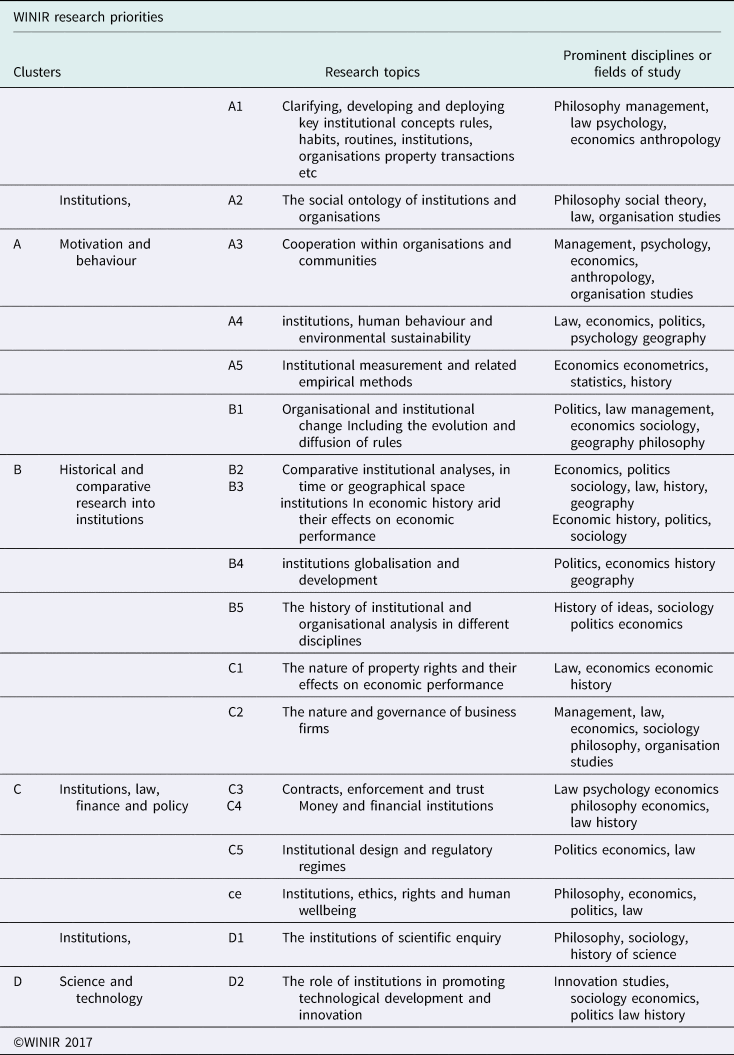
Organised efforts are required to establish a cross-disciplinary conversation about the nature and role of institutions in social and economic life. But these efforts have to prioritise and focus, and not be too wide-ranging in their scope. The World Interdisciplinary Network for Institutional Research (WINIR) has devised a list of priorities for multi-disciplinary institutional research. These are reproduced in Table 3 for information and guidance. JOIE has not formally adopted a detailed list of priorities along these lines, but it sees the WINIR priorities as very useful and broadly aligned with its own mission.
Table 3.WINIR research priorities for institutional research





 You have
Access
Growth and achievements
The Journal of Institutional Economics (JOIE) has grown from a two-issue volume in 2005 to six issues per volume since 2018. Article submissions are received from all around the world, and they have been increasing at an average rate of about 10 per cent per year since 2005.
There has been some increase of article submissions from less developed countries. Submissions from Africa have been growing, and in 2021 they reached 11.6 per cent of the total. Submissions from Asia have exceeded 20 per cent for a while, and in 2021 they reached 22.2 per cent. In the same year, submissions from Europe were 47.3 per cent and from North America 15.4 per cent.
JOIE has established and maintained a rapid refereeing process for its authors. On average, for all papers sent out to referees, the editors have provided a verdict on the paper within 50 days in 65 per cent of cases, and within 100 days in 95 per cent of cases. The median time it has taken to provide an editorial verdict is 45 days. Since 2016, the acceptance rate for all submitted papers, typically after one or more revisions, has averaged about 17 per cent.
Over the same time period, about 44 per cent of papers were rejected without being sent out the referees. Typical reasons for these desk rejections were that the paper was not centrally about institutions, and thus a poor fit for JOIE, or that the quality of the analysis was poor. The JOIE editors are dedicated to maintaining very high-quality standards for the journal.
The current JOIE editors are:
• Geoffrey M. Hodgson, Emeritus, Loughborough University London, UK (Editor in Chief)
• Richard Langlois, University of Connecticut, US
• Jason Potts, RMIT University, Australia
• Esther-Mirjam Sent, Radboud University, the Netherlands
• Claudia Williamson, University of Tennessee at Chattanooga, US
The editors serve five-year (renewable) terms.
Since 2011 JOIE has received citation impact factors from Clarivate Analytics, which is the leading global provider of bibliometric data for academic journals. The data are shown in Figure 1. Since 2016 the JOIE citation impact factors have been well above 1.0. In 2020, both the 2-year and 5-year impact factors exceeded 2.0. These impact factors are similar to those of older, well-established journals such as the Cambridge Journal of Economics, Economy and Society, Journal of Economic Behavior and Organization, Journal of Evolutionary Economics, Journal of Law and Economics, and Kyklos.
Clarivate analytics annual impact factors for JOIE.
Table 1 shows the top 16 most cited JOIE articles in Web of Science. Famous authors on the list include Ha-Joon Chang, Elinor Ostrom (Nobel Laureate) and Deirdre Nansen McCloskey. The topics covered by the papers include the nature of institutions (Hindriks and Guala, Reference Hindriks and Guala2015; Hodgson, Reference Hodgson2015a), the role of institutions in economic development (Chang, Reference Chang2011; McCloskey, Reference McCloskey2016), theories of institutional change (Amable, Reference Amable2016; Kingston and Caballero, Reference Kingston and Caballero2009; Ostrom and Basurto, Reference Ostrom and Basurto2011), and on the measurement of institutions (Kuncic, Reference Kuncic2014; Voigt, Reference Voigt2013). There are several papers on businesses, entrepreneurship and routines (D'Adderio, Reference D'Adderio2011; Felin and Foss, Reference Felin and Foss2011; Gindis, Reference Gindis2009; Hendrekson and Sanandaji, Reference Henrekson and Sanandaji2011; McMullen, Reference McMullen2015). Further papers address specific institutional topics, such as property rights (Hodgson, Reference Hodgson2015b) and blockchains (Davidson et al., Reference Davidson, De Filippi and Potts2018). Taken together, these 16 papers touch on a range of analytical, conceptual and empirical issues, all relating to the role of institutions in the economy.
The top 16 most cited JOIE articles in the Web of Science
JOIE is a hybrid journal, where the purchase of an open-access agreement is an option for authors. The open-access content of the journal is increasing due to funding agreements. All authors publishing in JOIE are invited to submit an article summary on the JOIE Blog website (https://joie-blog.net/). This helps to bring attention to articles in JOIE and to promote them on social media.
JOIE is owned by Millennium Economics Ltd (a UK company) and published by Cambridge University Press. The company manages the journal and appoints its editors. The shareholders of Millennium are the World Interdisciplinary Network for Institutional Research (WINIR) and the European Association for Evolutionary Political Economy (EAEPE).
The Elinor Ostrom prize
Since 2014, in honour of Nobel Laureate Elinor Ostrom, an annual prize of £1000, funded by Millennium Economics Ltd, has been awarded for the best full-length article (or articles) published in JOIE in the preceding calendar year. Each annual prize competition is judged by an international, multi-disciplinary committee of experts in the field of institutional research. The past winners of the prize are shown in Table 2.
Winners of the Elinor Ostrom Prize
Looking forward: gender balance
A major problem for JOIE is the male dominance of submissions, and the gender imbalance of authors that publish in the journal. Since 2019 the gender of submitting authors has been monitored. So far, women have accounted for about 24 per cent of submitting authors, without any discernible upward or downward trend. In 2021, female authors that published in JOIE reached 22 per cent of all authors. These figures are far too low.
As recently as the 19th century, women were barred from entering many universities, or were disallowed from obtaining degrees. Just over forty years ago, a collection of essays examined how women had been largely excluded from the production of academic knowledge (Spender, Reference Spender1981). Despite some significant progress since then, gender imbalance remains a serious problem in academia. But getting to the source of this problem, understanding its underlying causes, and designing policies to improve gender balance, are not easy.
Consider the percentages of women in some relevant academic disciplines. A 2020 survey by the American Economic association found that the share of women in the faculty of PhD-granting economics departments in the US reached 25 per cent, after much lower levels in previous years (Chevalier, Reference Chevalier2021). A 2021 report published by the Royal Economic Society found that 26 per cent of UK academic economists were women (Bateman et al., Reference Bateman, Gamage, Hengel and Liu2021). This too was higher than in previous years. At least in these countries, there has been some progress within economics as a discipline. But levels are still low.
These figures for economics are also lower than in some other disciplines. One study found that 31 per cent of academic positions in UK political science were filled by women (Bates et al., Reference Bates, Jenkins and Pflaeger2012: 141). Another reported that 47 per cent of academic positions in US sociology were filled by women (Vidal-Ortiz, Reference Vidal-Ortiz2009).
Although JOIE is explicitly a multi-disciplinary journal, the prominence of ‘Economics’ in its title may deter some women from other disciplines from submitting their work to JOIE, including from those where there are greater percentages of women. A remedy here would be to make the multi-disciplinary character of JOIE more widely known. The publisher and the editors of JOIE have been publicising this for a while. But more could be done to enhance the attractiveness of JOIE to scholars from outside economics.
In a major international survey of economists, Andre and Falk (Reference Andre and Falk2021) found that female economists put greater stress on policy relevance, and compared with men, they gave greater stress to the need for research by economists to be more multi-disciplinary. These inclinations align with the objectives of JOIE. These results suggest that JOIE should attempt to increase is visibility among female economists, as well as among women from other disciplines.
Studies show that women are often less numerous in senior academic posts. All the above-cited studies of gender representation, which examined the academic hierarchies within disciplines, found that women were less prevalent in the more senior faculty positions. This may be explained by a number of factors, including male prejudice and people being promoted in past decades before gender inequality was perceived as a major problem. Lower publication rates by women in leading journals would also help to explain the deficit of women in senior positions, but these lower rates would also require an explanation.
Taking the last point into account, traditional assumptions and norms about gender roles are relevant, particularly concerning childcare. In a study of two academic disciplines – linguistics and sociology – Hunter and Leahey (Reference Hunter and Leahey2010: 433) found that, for parents in academia, ‘after the birth a child, [academic] productivity growth declines, but more so for women. Thus, children account for part of the gender gap in rates of productivity over time.’ But while traditional gender roles concerning childcare and housework may be deeply ingrained, there is some evidence (cited below) that progress toward greater gender balance in academic outputs may be possible.
Gender publication rates in reputable journals offer important benchmarks for JOIE in assessing its own gender submission and publication rates. Ongoing research by Caroline Krafft, of St Catherine University in Minnesota in the US, suggests that only 17 per cent of the authors publishing in five leading journals in economics (American Economic Review, Econometrica, Journal of Economic Literature, Journal of Political Economy, and Quarterly Journal of Economics) have been women (Ho, Reference Ho2020). This is remarkably low and we would hope to reach much higher levels.
A study by Bird (Reference Bird2011) looked at female publication rates among UK academics in 16 social sciences. In each social science, 10 journals were chosen randomly, and UK-based authors were identified from published papers in 2005. This data, from 202 papers written by UK-based authors in 72 international and UK-based journals in the 16 social sciences showed that 68 per cent were written by men and 32 per cent by women. To put this in context, Bird cited a survey that found about 60 per cent of UK-based social scientists were men and 40 per cent women. In terms of publications per person, female social scientists in the UK have underperformed their male counterparts (Bird, Reference Bird2011: 929–30).
In Bird's sample of articles from political science, 92 per cent were written by men and 8 per cent by women. This compares with cited survey evidence that 76 per cent of UK-based political scientists were men and 24 per cent were women. This is a sizeable disparity. Turning to economics, 87 per cent of the articles were written by men and 13 per cent by women. At the time it was estimated that 78 per cent of UK-based economists were men and 22 per cent were women (Bird, Reference Bird2011: 930–31). Women underperform men dramatically in these two disciplines.
But a different picture emerged in two other academic disciplines, where women were more prominent. In psychology, 57 per cent of the articles in the sample were written by men and 43 per cent by women. These figures are equivalent to the surveyed gender ratio of academics in this discipline, namely 57 per cent men and 43 per cent women. In social policy, 47 per cent of articles in the sample were by men and 53 per cent by women. In UK social policy departments, by the same survey, 54 of academics were male and 46 per cent were female. Consequently, in disciplines where the proportion of women academics is high, publication rates by women are pulled up to similar levels. As a possible explanation, Bird (Reference Bird2011: 931–5) opined that a ‘critical mass’ of women may change academic norms and behaviours, and thereby facilitate the research output and career progression of women (Beutel and Nelson, Reference Beutel and Nelson2006). This suggests that in research communities where gender balance is approached, it is possible to achieve a similar parity of publication rates.
Normally, JOIE operates a double-blind review system, where the names and details of authors and reviewers are unavailable to everyone except the editors. A recent study across the sciences concluded that ‘there is reasonable evidence that gender bias may exist in scientific publishing and that double-blinding can mitigate its impact’ (Kern-Goldberger et al., Reference Kern-Goldberger, James, Berghella and Miller2022). This contrasts with an earlier study that found no gender bias mitigation with double-blind review systems (Blank, Reference Blank1991). This policy issue remains controversial. Other journals have dropped double-blind refereeing. This matter merits further research.
Without compromising on matters of quality, we need to consider additional measures that will encourage higher female submission rates and lead to a greater percentage of articles being published in JOIE that are by women. Obviously, gender balance among the JOIE editors and other bodies linked to the journal – including the jurors for the Elinor Ostrom Prize – must be maintained. It is already JOIE policy that proposals for special issues should pay attention to gender balance among the nominated possible authors. We should also encourage greater gender balance in multiple-author articles.
But so far, the existing measures have been insufficient. Encouraging submissions on gender-related institutional topics, such as the family, or female representation in corporate and other institutional governance, would be helpful. But many excellent female social scientists do not work in these areas. Emphatically, female authors should not be confined to gender-related topics. We need to attract women authors from all important areas of institutional research. This is a goal that needs to be constantly revisited.
Looking forward: some guidance for authors
Nobel Laureate Oliver Williamson (Reference Williamson2000: 595) noted that ‘we are still very ignorant about institutions.’ Although considerable progress has been made in subsequent years, there remains some truth in this statement. The major goal of the Journal of Institutional Economics is to enhance our knowledge of institutions and of their role in the economy. In this way, we can improve policy making at all levels – organisational, regional, national and global – and contribute to economic development and human welfare.
JOIE is a multi-disciplinary journal. Especially for the study of institutions, it is important to draw relevant insights from multiple disciplines including anthropology, biology, geography, history, law, politics, psychology, philosophy, social theory and sociology, as well as from economics itself. Within institutional economics, good ideas are welcome from both the original tradition of Thorstein Veblen, John Commons and others, as well as the new institutional economics of Ronald Coase, Douglass North, Elinor Ostrom, Oliver Williamson and others.
Institutions rely upon evolved human nature and its capacities. Modern institutions are often entwined with law and politics. All institutions are laden with ethical considerations. Institutional research is necessarily multi-disciplinary. This makes it challenging and exciting. It is important to enhance channels of communication between disciplines, especially given the problems of insularity, with disciplinary differences in terminology and methodology (Campbell, Reference Campbell, Sherif and Sherif1969).
For this and other reasons, conceptual clarity is vital. Mathematics is widely promoted because it can enhance analytical precision. But conceptual precision is often neglected. A consensus of the meaning on a key term is often wrongly assumed without further ado. But many such terms are used in different ways, and there is no general agreement on their meaning.
Fortunately, there is a near-consensus on the meaning of the term ‘institution’, as a system of behavioural or constitutive rules that are shared by the members of a group of society (Crawford and Ostrom, Reference Crawford and Ostrom1995; Hodgson, Reference Hodgson2019; Knight, Reference Knight1992; Mantzavinos, Reference Mantzavinos2001; North, Reference North1990; Ostrom, Reference Ostrom1990). Most (but not all) authors regard organisations as a special type of institution.
On the meanings other terms there is much less agreement. A distinction between ‘formal’ and ‘informal’ institutions is commonly invoked, but it is rarely explained. Does ‘formal’ mean ‘written’, ‘potentially written’, ‘legal’, ‘designed’ or something else? And what is the difference between ‘informal institutions’ and (say) ‘culture’? Without clear and parsimonious explanations of intended meaning, these terms should not be used. Other common terms that carry different meanings and require clarification include ‘neoclassical’, ‘rational’, ‘rationality’, ‘individualism’, ‘methodological individualism’, ‘uncertainty’, ‘determinism’, ‘socially embedded’, ‘essentialism’, ‘evolutionary’, ‘capitalism’, ‘neoliberal’, and many more. There is no consensus on their meanings. Even leading scholars are often unclear.
As the result of sustained work in recent years, the importance of institutions in economic development has now become widely recognised (Acemoglu et al., Reference Acemoglu, Johnson, Robinson, Aghion and Durlauf2005; Acemoglu and Robinson, Reference Acemoglu and Robinson2012; North et al., Reference North, Wallis and Weingast2009; Rodrik and Trebbi, Reference Rodrik and Trebbi2004). To make further progress, we need to know more about what kind of institutions matter, and how. General (often aggregated) measures of institutional quality can help, but on their own, they are of limited use. A deeper understanding of the role of institutions in development requires a forensic conceptual toolkit applied to rich and robust empirical evidence. The work of Ostrom and her colleagues is exemplary in these respects (Ostrom, Reference Ostrom1990, Reference Ostrom2005; Ostrom and Basurto, Reference Ostrom and Basurto2011). There is also an explosion of interest in the textual and documentary analysis, some of which uses machine learning techniques. These approaches have proven their value in economic history and elsewhere (Grajzl and Murrell, Reference Grajzl and Murrell2021a, Reference Grajzl and Murrell2021b). These examples show important ways forward for empirical research on institutions.
Papers with some mathematical content will be considered by JOIE if it is fully explained for a general readership, the mathematics is consigned as much as possible to appendices, the assumptions have sufficient grounding in reality, and the paper enhances our understanding of past, present, or feasible socio-economic institutions. JOIE is not interested in the advancement of formal or econometric technique for their own sake. The primary objective of JOIE is to enhance our understanding of real-world institutional phenomena.
We ask prospective authors to refer, where possible and appropriate, to previous research on their topic that has been published in JOIE, as well as to research that is published elsewhere. First and foremost, we want to establish and maintain a forum for ongoing conversation on key institutional issues. In this way, we aim to make contributions to scholarship cumulative, rather than fragmented and less consequential. Science is an institutionalised endeavour, depending on networked connections and institutionalised screening (Goldman, Reference Goldman1999; Kitcher, Reference Kitcher1993; Kuhn, Reference Kuhn1962; Polanyi, Reference Polanyi1962). Making appropriate links with the work of others is vital for scientific progress. This is especially important in this age of digital communication. Among the noise and information overload, judicious citations highlight important connections. Second, it is possible that a submitted paper will be sent to referees who have published on its topic in our journal. They may note any failure to cite their work.
WINIR and EAEPE organise online and in-person conferences and symposia where institutional research can be presented for discussion and feedback. Other forums for institutional research include the Association for Evolutionary Economics (AFEE), the Society for the Advancement of Socio-Economics (SASE) and the Society for Institutional and Organizational Economics (SIOE). Presenting research work at focused academic events can be very useful to obtain critical feedback before submission to a reputable journal.
Looking forward: some strategic issues
Four people who received the Nobel Prize in Economics were cited for their work on institutions. They are Ronald Coase, Douglass North, Elinor Ostrom and Oliver Williamson. Despite these accolades, what is called institutional economics is generally dispersed across different academic departments, such as economic history, management and political science. It is found within departments of economics, but because economists typically focus on mathematical models and give them the highest scientific kudos, work in institutional economics is often given lower priority and prestige within economics itself.
There is much research into the nature and role of institutions (including institutions in economic contexts) that is not described as (institutional) economics. Such research is found in sociology, political science, law and philosophy. JOIE uses the term ‘institutional economics’ in the broad and inclusive sense of ‘the study of institutions in the economy’ and it does not insist on the application of methods and assumptions taken from economics. The focus is on the nature and role of institutions in the economy, using suitable insights or methods from any relevant discipline. This gives the journal its multi-disciplinary character.
There is a great deal of academic chatter about interdisciplinarity and multidisciplinary, as if these were inherently virtuous. But the problems and costs involved in crossing disciplinary boundaries are often underestimated. It also needs to be recognised that much day-to-day progress in science is achieved by specialists digging deeper, followed by subdividing problems for the attention of different teams, allowing each group of specialists to dig down even further. Much incremental advance in science comes from increased specialism and an ever-finer division of labour. But this also brings limitations.
Some major scientific innovations come from jumping across disciplinary and sub-disciplinary boundaries, to combine ideas from very different domains. One famous example is of how the economist Thomas Robert Malthus inspired Charles Darwin. But successful transdisciplinary leaps are rare, and once Darwin's theory was established, biology had to follow with the work of specialists, in attempts to refute, confirm or elaborate Darwin's ideas. Indeed, it was only through this specialist work that Darwin's theory gained hegemony in biology.
The great polymath Donald T. Campbell addressed the problem of the ‘ethnocentrism’ of academic disciplines. He was under no illusion about inter-disciplinarity as a remedy. Campbell, Reference Campbell, Sherif and Sherif1969: 329–30) criticised the ‘Leonardesque aspiration’ – ‘the goal of creating current-day Leonardos who are competent in all of science.’ Modern science is too complex to be spanned in this way. As Polanyi (Reference Polanyi1962) pointed out, science depends on institutionalised networks of scientists that have sufficient expertise to appraise and guide the work of those that is closest to theirs. It also depends on a measure of trust that is fortified by institutional checks. Rather than impossible omniscience, science depends on institutionalised networks of scrutiny criticism and approval.
Polanyi (Reference Polanyi1958: 216) argued further that institutionalised science created incentives to conform to consensus opinions, ‘through the control of university premises, academic appointments, research grants, scientific journals and the awarding of academic degrees which … open up the possibility of academic appointment.’ At the same time, pluralism and dissent were necessary for scientific innovation (Polanyi, Reference Polanyi1962: 59).
Campbell built on this argument, to note that the ‘ethnocentrism’ of disciplines created barriers to the interlinking of knowledge across disciplinary boundaries. Current academic disciplines, especially in the social sciences are ‘arbitrary composites’ and products ‘in large part of historical accident’ (Campbell, Reference Campbell, Sherif and Sherif1969: 331–2). But disciplines become institutionalised units, with their own internal mechanisms of power. Within their terrain, a number of forces, including qualifying exams, core curricula and dissertation committees exercise ‘a constant centralizing bias.’ Relentless specialisation, facilitated by larger departments, and a quest for higher standards, all add to this disciplinary centralisation (Campbell, Reference Campbell, Sherif and Sherif1969: 335, 346). Campbell's solution to the problem was not a ‘Leonardesque aspiration’ of ubiquitous interdisciplinarity but an ‘interdisciplinary narrowness’ focusing on specific problems and types of phenomena.
Institutional research today faces these strategic challenges. It is increasingly recognised that an adequate understanding of institutions cannot come from one discipline. At the same time, the importance of institutions in social and economic life is also widely accepted. These convictions provide much of the justification impetus for change, and for attempts to cross partially obsolete disciplinary boundaries, notwithstanding the difficulties involved.
Organised efforts are required to establish a cross-disciplinary conversation about the nature and role of institutions in social and economic life. But these efforts have to prioritise and focus, and not be too wide-ranging in their scope. The World Interdisciplinary Network for Institutional Research (WINIR) has devised a list of priorities for multi-disciplinary institutional research. These are reproduced in Table 3 for information and guidance. JOIE has not formally adopted a detailed list of priorities along these lines, but it sees the WINIR priorities as very useful and broadly aligned with its own mission.
WINIR research priorities for institutional research