In connected discourse like a narrative text, each utterance must contain some time reference. So, whatever is expressed by the clause must be brought into relation to the time at which the event took place. Time reference can be expressed through different linguistic devices, particularly grammatical categories of tense and lexical items. Grammatical marking of temporal reference may be achieved by adjusting the morphology of the verb, i.e., by inflecting the verb for tense. The most common grammatical categories of tense are present, past and future. Lexical marking of temporal reference is achieved by using temporal adverbs or adverbial phrases and connectives such as now, three days ago, tomorrow, then.
Grammatical and lexical marking of temporal reference in Dutch is illustrated in the following three fragments of personal-experience stories about social conflicts between people, written by an 11-year-old deaf boy who is proficient in sign language, an 11-year-old deaf boy who is not proficient in sign language, and an 11-year-old boy without hearing impairment, respectively.
(1) Vroeger ik en mijn klas ruzie met ander klas. Dat is niet leuk. Ander kind zegt. Mieke is stom en altijd baas. Dan Mieke zegt. Dat jij bent zelf. Dan beginen ruzie. Dan ander kinderen helpen op ander kind. Dan mijn klas helpen op Mieke. Later wij gaan naar binnen. Dan ander kinderen zeggen op ze leraar. Leraar van ander klas zegt op onze leraar. Dan wij moeten niet ruize maken en ook ander kinderen! Dan wij zeggen sorry. En ook ander kinderen zeggen sorry. Nu wij maken niet ruize nou beetje niet erg. Wij kunnen wel goedmaken.
“In the past [past tense temporal adverb in Dutch], me and my class argument with another class [verb is missing]. That is not funny. Other child says. Mieke is stupid and always boss. Then [present tense temporal adverb in Dutch] Mieke says. That you are yourself. Then [present tense temporal adverb in Dutch] quarrel start. Then [present tense temporal adverb in Dutch] other children help other child. Then [present tense temporal adverb in Dutch] my class help Mieke. Later we go inside. Then [present tense temporal adverb in Dutch] other children say to teacher. Teacher of other class says to our teacher. Then [present tense temporal adverb in Dutch] we must not have argument and other children also! Then [present tense temporal adverb in Dutch] we say sorry. And other children also say sorry. Now we don't have argument well a little not much. We can make up.”
[11-year-old deaf boy, proficient in sign language]
(2) Een keer op dinsdagavond moest ik gaan darten. Toen ik klaar was, ging ik naar buiten om naar huis te gaan. Toen kwam er die zei mijn naam en schelden. Later ben ik weggerend naar de wijkgebouw waar ik moest darten. En iemand heeft mij weggebracht naar huis.
“Once on a Tuesday evening I went to play darts. When [past tense temporal adverb in Dutch] I was ready, I went outside to go home. Then [past tense temporal adverb in Dutch] [subject is missing] came who said my name and [finite verb is missing] swear [infinitive]. Later, I ran away [perfect tense in Dutch which corresponds to imperfective tense in English] to the community centre where I had to play darts. And someone brought me home [perfect tense in Dutch which corresponds to imperfective tense in English].”
[11-year-old deaf boy, low proficiency in sign language]
(3) Het gebeurde op een mooie zonnige dag. Ik was aan het skaten bij de olifantjes speeltuin. Daar was ook mijn vriendje Johnny aan het skaten samen met Edward. Van het een kwam het ander en we hadden knallende ruzie. Slaan, schoppen enzovoort. Mijn moeder zach dat, en zei dat ik naar binnen moest. Ik kon zonder eten naar bed.
“It happened on a beautiful sunny day. I was skating at the elephants playground. My friend Johnny was also playing there together with Edward. One thing led to another and we had a terrible fight. Hitting, kicking, etcetera. My mother saw that and said that I had to come inside. I was sent to bed without having dinner.”
[11-year-old hearing boy]
Personal-experience narratives typically recapitulate a past experience by matching a sequence of clauses to the sequence of events that actually occurred (Labov, Reference Labov1972). The typically developing boy and the deaf boy who is not proficient in sign language anchored their narratives in the past tense, by using past tense verb forms and temporal adverbs. The proficiently signing deaf boy, in contrast, anchors his story in the present by using present tense verb forms and temporal adverbs. Once, however, he starts a clause with a temporal adverb indicating past tense, vroeger “in the past”, but then refrains from using past tense verbs. In the present study, we examine the use of grammatical and lexical markers of temporal reference in personal-experience narratives written by deaf individuals of different ages and with different proficiency levels in sign language, and by hearing individuals. We also examine how sign language proficiency influences temporal reference marking in texts written by deaf children and adults, and hypothesize that the acquisition of temporal reference marking in deaf children who are proficient in sign language can be framed in a bilingual and second language acquisition (SLA) perspective. Before describing our study in more detail, we will first discuss the acquisition of temporal reference marking in SLA in hearing children. We then discuss relevant studies on temporal reference marking in deaf children's writing. As will become evident, the relatively few studies that have examined temporal reference marking in deaf children's writing have focused on isolated sentences, presented outside of a meaningful context. Further, most studies of deaf children's writing (on tense and other linguistic aspects) have not taken into account that deaf people vary in the use of, and proficiency in, sign language. We discuss how variations in sign language may influence temporal reference marking in writing, and outline the bilingual perspective that we adopt to understand temporal reference marking in deaf writers.
Acquisition of temporal reference marking in SLA
Researchers on SLA have extensively investigated the acquisition of temporality (see Bardovi-Harlig, Reference Bardovi-Harlig1999, Reference Bardovi-Harlig2000, for reviews). One line of research is concerned with how second language learners express temporal relations (e.g., Bardovi-Harlig, Reference Bardovi-Harlig1999, Reference Bardovi-Harlig2000; Dietrich, Klein & Noyau, Reference Dietrich, Klein and Noyau1995; Ellis, Reference Ellis2006; Ellis & Collins, Reference Ellis and Collins2009; Lee, Reference Lee2001; Meisel, Reference Meisel and Pfaff1987; Prévost & White, Reference Prévost and White2000; Schumann, Reference Schumann1987; von Stutterheim & Klein, Reference von Stutterheim, Klein and Pfaff1978). Several target languages (in particular, English, Dutch, German, French, Swedish, Spanish, Italian and Korean) have been studied in mostly longitudinal designs, using interlanguage samples through different elicitation methods. These studies have well documented that second language learners have difficulty with the overt realization of tense morphology when referring to past events. In the earlier developmental stages of temporal expression the use of verbal morphology or even verbs is very limited. Learners first employ discourse and pragmatic means, such as calendric expressions and context, to express temporality. In a next stage, lexical devices such as adverbials and connectives are used predominantly to express temporality (Bardovi-Harlig Reference Bardovi-Harlig1999; Meisel, Reference Meisel and Pfaff1987). After this adverbial-only stage, tense morphology appears. At first, tense morphology is not used systematically, and it can take a while until tense marking becomes a reliable indicator of temporal reference. In fact, many second language learners may never reach this stage (Dietrich et al., Reference Dietrich, Klein and Noyau1995). In sum, studies along this line of research basically agree that second language learners' expression of temporality displays a developmental pattern, from using pragmatic and lexical devices to gradually using more and more morphology (Bardovi-Harlig, Reference Bardovi-Harlig1999).
Ellis and colleagues adopt a cognitive perspective to explain why second language learners have difficulty producing verbal markers of temporal reference. Verbal inflections and lexical markers of temporal reference both provide cues to temporal relationships, but the lexical items are quite pronounced in the language stream and are therefore much more likely to be perceived than verbal inflections. The low saliency of verbal morphemes tends to make them more difficult to learn. Not only are verbal markers low in salience, they can also be redundant in understanding the meaning of an utterance. When accompanied by a temporal adverb, inflections are often unnecessary to interpret the message. Moreover, learners of a second language know that temporal adverbs are more reliable than the non-salient verbal inflections and this knowledge likely blocks the second language acquisition of verbal morphology. Another explanation offered for second language learners' difficulty with tense morphology is transfer. Second language learners whose first language does not make the same semantic discriminations as the second language with regard to particular morphemes have more difficulty learning to use these morphemes (Ellis, Reference Ellis2006; Ellis & Collins, Reference Ellis and Collins2009).
Transfer
When learning a particular language, learners come to attend to particular types of meanings and expect them to be expressed by particular types of forms. Form–function relations between linguistic forms and their discourse function are language-specific, and can be different across different languages (e.g., Slobin, Reference Slobin, Bowerman and Levinson2001). Berman and Slobin (Reference Berman and Slobin1994), for example, studied the development of temporal expression in spoken retellings of the story Frog, where are you? (Mayer, Reference Mayer1969) in different languages, and found that monolingual hearing children who speak different languages acquire typologically distinct ways of expressing temporal relations, reflecting differences in linguistic structure among the various languages. Theories of transfer in bilingual language development claim that when certain morphosyntactic structures in the first language are absent or substantially different, these structures are difficult to learn (Ellis, Reference Ellis2006; MacWhinney, Reference MacWhinney, Kroll and de Groot2005). Adult second language learners of Hungarian, for example, have severe difficulties in learning the conjugation of verbs (Langman & Bayley, Reference Langman and Bayley2002; MacWhinney, Reference MacWhinney and Harris1992). Hungarian distinguishes two ways of verb conjugations: transitive and intransitive. The choice between transitive and intransitive conjugations is controlled by thirteen different factors, such as transitivity, definiteness and reference (MacWhinney, Reference MacWhinney, Corrigan, Eckman and Noonan1989). Not surprisingly, choosing the proper conjugation of the verb is extremely difficult for L2 learners of Hungarian, such as Chinese learners who are not used to taking these different factors into account in their native language (Langman & Bayley, Reference Langman and Bayley2002).
Cross-linguistic transfer has been reported for a number of different morphosyntactic structures and different language combinations (e.g., Gathercole, Reference Gathercole, Kimbrough Oller and Eilers2002, Müller & Hulk, Reference Müller and Hulk2001; Nicoladis, Reference Nicoladis2006). Several empirical studies have examined transfer of temporal reference marking in L2 (e.g., Bartelt, Reference Bartelt, Dechert and Raupach1989, in adult Navajo- and Western Apache-speaking learners of English; Kupersmitt & Berman, Reference Kupersmitt, Berman, Verhoeven and Strömqvist2001, in Spanish children learning Hebrew; Yang & Huang, Reference Yang and Huang2004, in Chinese children and adults learning English; Wenzell, Reference Wenzell, Dechert and Raupach1989, in Russian adults learning English).
These studies typically focus on narrative development in bilingual speakers of typologically different languages and show that bilinguals use different linguistic forms to meet narrative functions of tense and aspect from what monolingual speakers of each of these languages use. Kupersmitt and Berman (Reference Kupersmitt, Berman, Verhoeven and Strömqvist2001), for example, studied tense, aspect and modality in the Spanish spoken narratives of nine Spanish–Hebrew children between four and twelve years old. The marking of tense, aspect and modality is more elaborate in the grammatical system of Spanish than in that of Hebrew. Spanish verbs are inflected for tense and aspect (perfective and imperfective in past tense, and progressive and perfect aspect in present, past and future tense), whereas Hebrew has no grammatical aspect but only marks tense on verbs (present, past and future). Although most monolingual Spanish storytellers anchor their picture book based stories in the present tense (Salaberry, Reference Salaberry1999), analysis of the Hebrew bilingual children's narratives revealed that Spanish–Hebrew bilingual children anchor their Spanish narratives in the perfective tense, which corresponds to the simple past tense in Hebrew, the typical form used in Hebrew stories (Berman & Neeman, Reference Berman, Neeman, Berman and Slobin1994). The Spanish–Hebrew children also made relatively little use of different forms of tense and aspect marking. Kupersmitt and Berman (Reference Kupersmitt, Berman, Verhoeven and Strömqvist2001) conclude that the bilingual children seemed to avoid those devices in their Spanish stories that are typologically different from Hebrew.
Yang and Huang (Reference Yang and Huang2004) investigated the acquisition of the English tense system by Chinese children and adults. Chinese is a language that has no tense but uses pragmatic and lexical devices to mark temporal reference. In contrast, in English temporal reference is grammaticalized. The study involved the analysis of past event narratives written by five age groups (i.e., 10-, 12-, 14-, 16- and 19-year-olds) of Chinese learners of English (with English proficiency levels ranging from late beginning to advanced) in Hong Kong. Yang and Huang found that beginning Chinese learners of English followed the same developmental pathway from the more pragmatic and lexical way of marking references to the grammatical way. However, because of the Chinese tenseless system, the period in which pragmatic and lexical ways of expressing temporal reference is dominant seems more persistent in these learners. Only university students, being the most advanced learners of English, appeared to have acquired English tense morphology.
Acquisition of temporal reference marking in deaf writers
Only a few studies have examined the acquisition of temporal reference marking in deaf children's writing (Ivimey, Reference Ivimey1981; Quigley, Montanelli & Wilbur, Reference Quigley, Montanelli and Wilbur1976). Quigley et al. (Reference Quigley, Montanelli and Wilbur1976) performed a large-scale study on the use of auxiliary verbs, tense sequencing and verb deletion in 427 English-speaking deaf children between ten and eighteen years old. The deaf children's language backgrounds, particularly variations in proficiency in sign language, were not described. Children had to make a judgment of the grammaticality of sentences. In addition, if a sentence was judged to be incorrect, the children were asked to rewrite it. Results showed that deaf children, generally speaking, knew when a verb was required, but were unable to use one that was correct in either number or tense.
Ivimey (Reference Ivimey1981) examined tense marking in eleven English-speaking severely deaf children between nine and ten years old. One child had deaf parents and used sign language at home. The other ten children used a mixture of oral communication and sign language. The children were asked to write a sentence about a picture. Then, the children were asked to indicate the time reference of their written sentence. Finally, they were asked to change the time reference of the sentence, for example from present to simple past. Results demonstrated that 80% of the children wrote sentences in which tense agreement between the temporally marked verb and the temporal adverb was violated. Ivimey suggested that deaf children express temporal reference mainly by the use of temporal adverbs rather than through inflection of the verb.
A bilingual perspective on the writing of deaf proficient signers
Children who are deaf often have late or limited exposure to an oral language because of their hearing impairment. Moreover, many individuals who are deaf use sign language as their main language of communication, although variation exists among deaf people in the use of and proficiency in sign language. Deaf children who use a signed language and an oral/written language receive a quantitatively different amount of language input as well as a qualitatively different type of language input, compared to deaf children who hardly ever use sign language, and to hearing children. The majority of previous studies on the writing acquisition of deaf children, however, have not taken variations in children's proficiency in sign language into account, and have treated deaf children as a single and uniform group in the comparison with hearing children (Ivimey, Reference Ivimey1981; Quigley & King, Reference Quigley and King1980; Quigley et al., Reference Quigley, Montanelli and Wilbur1976; Taeschner, Devescovi & Volterra, Reference Taeschner, Devescovi and Volterra1988; Tur-Kaspa & Dromi, Reference Tur-Kaspa and Dromi2001). Given the differences in the amount and type of language input among deaf children (with high or low proficiency in sign language) and hearing children, it can be expected that the developmental trajectories in learning to write in an oral language will be different for these groups of children. Research on deaf children's writing that takes into account differences in language backgrounds may also provide useful input for teaching spoken/written language to deaf students.
Most theories and studies concerning bilingual or second language development involve two oral languages. Recently, researchers have begun to explore the issue of language interaction and transfer in bimodal bilinguals who use two languages in different modalities, in particular a signed language and an oral/written language, with the goal of characterizing the nature of this type of bilingualism (Bishop & Hicks, Reference Bishop and Hicks2005, Reference Bishop and Hicks2009; Emmorey, Borinstein, Thompson & Gollan, Reference Emmorey, Borinstein, Thompson and Gollan2008; Singleton, Morgan, DiGello, Wiles & Rivers, Reference Singleton, Morgan, DiGello, Wiles and Rivers2004; van Beijsterveldt & van Hell, Reference van Beijsterveldt and van Hell2009a, Reference van Beijsterveldt and van Hellb). A sign language is a language which uses manual communication, body language and mouth patterns to convey meaning. The complex spatial grammar is markedly different from the grammar of spoken language (e.g., Liddell, Reference Liddell2003). Little is known about bimodal bilingual language development, and whether transfer across languages, as observed in hearing bilinguals, is also observed in deaf children who handle a signed language and a written language.
Recent evidence for the influence of sign language proficiency on writing comes from studies by van Beijsterveldt and van Hell (Reference van Beijsterveldt and van Hell2009a, Reference van Beijsterveldt and van Hell2010). In one study, van Beijsterveldt and van Hell (Reference van Beijsterveldt and van Hell2009a) compared evaluative expressions in narratives written by 11- and 12-year-old deaf children who were proficient in sign language with those of deaf peers who were of low proficiency in sign language, and hearing bilingual and monolingual peers. Evaluative expression is an important narrative technique in signed language, and signed language has many channels for conveying evaluation. Van Beijsterveldt and van Hell found that proficient signers used more evaluation in their written narratives than low-proficiency signers, and than hearing bilingual and monolingual children did. This finding suggests that deaf children who are proficient in signed language use their knowledge of evaluative expression in signed language to enrich their narratives in written Dutch.
Importantly, oral language and signed language differ in the marking of temporal reference. In the following paragraph we explain the differences between SLN and Dutch with respect to temporal reference marking.
Temporal reference marking in Dutch and SLN
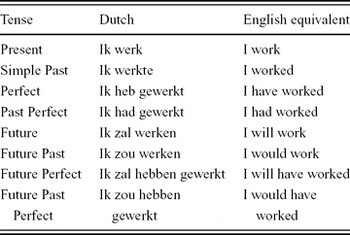
Dutch and SLN differ with respect to the degree in which time reference is achieved by grammatical categories or by lexical items. In Dutch, just like English, the grammatical marking of temporal reference is indicated by verb inflection and is obligatory. Table 1 presents and illustrates the tense forms of Dutch.
Tense forms in Dutch.

The sentence Yesterday I go to work early and come back late, for example, is grammatically incorrect because the finite verbs go and come must be marked for past tense, as in I went to work and came back late. Finite verbs are marked for present tense, for example, zij werkt “she works”, or past tense, zij werkte “she worked”. In complex verbal structures, tense is marked on the first element, the auxiliary, for example, had moeten werken “had-past must-inf work-inf” “must have worked”. Future tense is formed with the modal verb zullen “will”. Non-finite verbs are not marked for tense. They may stand alone as main verbs, for example slapen “sleep” as in Zij ging naar huis om te slapen “She went-aux home to sleep-inf”. They can also be preceded by tense-marked auxiliaries and modal verbs, for example, had kunnen werken “had-past could-inf work-inf” “could have worked”. The Dutch language does not have a rich aspectual system, and we therefore only focus on temporal reference marking and not on aspectual marking.
The Dutch system of lexical marking of temporal references, i.e., temporal adverbs (e.g., gisteren “yesterday”), adverbial phrases (e.g., vorig jaar “last year”), and temporal conjunctions (toen “then”), resembles the English system. There is one exception. Dutch has two equivalents of the English then: dan and toen. Dan can only be used for reference to present or future, and toen is limited to reference to the past.
Research is only beginning to describe temporality, temporal aspect and verb morphology in sign languages. However, research on the typology of sign language basically agrees that in contrast to many spoken languages, sign language does not use bound morphemes, like the past tense marker -te or -de in Dutch, to refer to the past. This is also true for SLN (Schermer & Koolhof, Reference Schermer, Koolhof, Prillwitz and Vollhaber1990). Generally, time in sign language is described in terms of an imaginary time line in the syntactic signing space. The area near the signer's body has the general meaning of “present”, the space in front of the body represents “future”, and the area behind the shoulder has the general meaning of “past”. In addition to the time line, many lexical items, such as “yesterday” can be located on or move along certain positions in the syntactic signing space to indicate temporal reference (see e.g., Klima & Bellugi, Reference Klima and Bellugi1979, for American Sign Language (ASL); Jacobowitz & Stokoe, Reference Jacobowitz and Stokoe1988, for British Sign Language (BSL); Schermer, Reference Schermer, Schermer, Fortgens, Harder and de Nobel1991, for SLN).
The time marking system in SLN strongly resembles the systems of ASL and BSL. Signers of SLN generally use a similar imaginary time line as described for ASL and BSL (Schermer & Koolhof, Reference Schermer, Koolhof, Prillwitz and Vollhaber1990). The space near the body represents the present, the space in front of the body represents future and the space behind the shoulder represents past. Moreover, lexical items are used to refer to past or future, and present time is not marked overtly. The sign gisteren “yesterday” is used to indicate that something happened yesterday. The neutral past tense marker “verleden” “past” is articulated above the right shoulder. Signs such as komt “will”, toekomst “future” or morgen “tomorrow” are used to indicate future tense. In short, present tense is unmarked and past and future time reference in SLN is expressed by lexical items which can be located on an imaginary time line (Schermer & Koolhof, Reference Schermer, Koolhof, Prillwitz and Vollhaber1990).Footnote 1
The present study
The present study examines temporal reference marking in the writing of deaf children and adults who are proficient in signed language, deaf children and adults who are of low-proficiency in signed language, and hearing children and adults who do not use signed language. Specifically, we examine to what extent sign language proficiency influences temporal reference marking in written Dutch. We compare the temporal reference marking of deaf children and adults who are proficient in SLN with deaf peers who are of low proficiency in SLN, and with hearing peers. In particular, we focus on grammatical and lexical markers of temporal reference, in which SLN and Dutch differ, and on errors in tense agreement between grammatical and lexical markers of temporal reference. As we described in the previous paragraph, the tense systems in Dutch and SLN differ substantially, with Dutch displaying a wide range of inflected verb forms and lexical expressions of time, and SLN having only lexical markers of temporal reference. If knowledge of (and fluency in) one language affects performance in another language, and if such transfer effects also occur across languages from different modalities, it can be expected that deaf individuals who are proficient in SLN experience more difficulty with linguistic features that are absent in sign language, like grammatical markers of temporal reference, in their written Dutch than deaf low-proficiency signing individuals and hearing individuals. Likewise, as both SLN and Dutch have lexical markers of temporal reference marking, we expect little difference in the use of lexical devices for temporal reference marking between deaf proficient signers and deaf low-proficiency signers and hearing peers.
Most studies on the acquisition of temporal reference marking in bilingual speakers of spoken languages focus on narrative types of discourse. In the present study, we examine the effect of variations in discourse genre on temporal reference marking by comparing personal-experience narrative (an account of an incident related to a conflict in which the writer had been personally involved) and expository discussion (a treatise on the topic of interpersonal conflict from an analytical perspective). Personal-experience narratives, typically, focus on what happened and are built around the temporal sequencing of events (e.g., Berman & Slobin, Reference Berman and Slobin1994; van Hell, Verhoeven & van Beijsterveldt, Reference van Hell, Verhoeven and van Beijsterveldt2008). Expository texts are built around a topic that usually does not have a temporal dimension. This type of discourse informs about how something is, needs to be, or should be. Consequently, the ordering of descriptions in expository texts does not follow the temporal sequencing of events but is dictated by a problem that needs to be addressed. Personal experience narratives are predominantly anchored in the past, and expository texts are typically anchored in the present (see e.g., Ragnarsdóttir, Aparici, Cahana-Amitay, van Hell & Vigué, Reference Ragnarsdóttir, Aparici, Cahana-Amitay, van Hell and Vigué2002). Because narratives typically have the marked past tense as the default tense, we expect differences in grammatical markers of temporal reference between proficient signers and low-proficiency signers, and hearing writers to be more pronounced in narratives than in expository texts.
Finally, previous studies investigating the writing of deaf individuals focused on either elementary school students (Quigley & King, Reference Quigley and King1980; Singleton et al., Reference Singleton, Morgan, DiGello, Wiles and Rivers2004; Taeschner et. al., Reference Taeschner, Devescovi and Volterra1988; Tur-Kaspa & Dromi, Reference Tur-Kaspa and Dromi2001; van Beijsterveldt & van Hell, Reference van Beijsterveldt and van Hell2009a, Reference van Beijsterveldt and van Hellb) or adults (Fabbretti, Volterra & Pontecorvo, Reference Fabbretti, Volterra and Pontecorvo1998). The present study aims to explore the influence of sign language on writing in different age groups. Because narrative and expository writing is part of later language development (Nippold, Reference Nippold2007), we examine writing from the ages of eleven and twelve onwards, and compare the writing of three age groups: 11- and 12-year-olds, 15- and 16-year-olds, and adults. Assuming that the expression of tense is a developmental phenomenon, and that differences between two language systems lead to transfer, particularly in the early stages of language learning (e.g., MacWhinney, Reference MacWhinney, Kroll and de Groot2005), we expect that the differences between proficiently signing writers and low-proficiency signing writers (on those structures that differ across SLN and Dutch) will be particularly pronounced in the children.
Method
Participants
Three age groups of Dutch deaf individuals participated in the study: thirty-one children aged eleven and twelve years (M = 11;9, SD = .05), thirty-one high-school students aged fifteen and sixteen years (M = 16;0, SD = .06), and fifteen adults (M = 30;7, SD = 6.6). Three age-matched groups of hearing native speakers of Dutch participated, twenty children aged eleven and twelve years (M = 12;2, SD = 0.4), twenty high-school students aged fifteen and sixteen years (M = 16;2, SD = 0.6), and twenty adults (M = 25;5, SD = 5.7), as well as a fourth group of twenty hearing children who were younger than the youngest deaf children, i.e., 9- and 10-year-olds (M = 10;3, SD = 0.6). All hearing children grew up in monolingual Dutch families, and none of the children had any known learning disabilities or developmental delays. They attended school in a small town. Children were tested at their schools, and parents had given permission for their children to participate in this study.
The selection criteria for deaf participant inclusion were pre-lingual, severe to profound deafness (> 80 dB hearing loss on the best ear), and no learning disabilities. Eight of the 11–12-year-olds, two 15–16-year-olds, and one adult had a Cochlear implant (CI); the other deaf participants wore other types of hearing aids. Participants with a CI were implanted after at least four years of age and had worn their CI for two to seven years. The deaf children were recruited from schools for deaf students, schools for hard of hearing students, and ambulatory educational services for deaf students enrolled in mainstream schools in the Netherlands. The deaf adults were recruited via advertisements in special schools for deaf students, the Institute of Signs, Language and Deaf Studies at the Utrecht University of Applied Sciences, and local welfare foundations.
We administered a detailed questionnaire to deaf participants that included questions about literacy background (i.e., reading and writing), educational background (i.e., type(s) of schooling and language of instruction), and language background (i.e., language use with parents, siblings and friends). Questionnaires were administered by an experimenter who was proficient in Dutch and SLN. Information that was unknown to the participants (such as children's audiograms) was retrieved from the personal files available at the schools or was provided by teachers. The literacy background questionnaire demonstrated that the deaf participants used written language regularly. 22% of the 11–12-year-olds, 71 % of the 15–16-year-olds and 53% of the adults read newspapers weekly; 81% of the 11–12-year-olds, 68% of the 15–16-year-olds, and 87% of the adults used books of reference monthly; 87% of the 11–12-year-olds, 55% of the 15–16-year-olds, and 47% of the adults read at least one novel a month (the remaining participants indicated reading at least one novel a year); 74% of the 11–12-year-olds, 77% of the 15–16-year-olds, and 60% of the adults read magazines monthly; 45% of the 11–12-year-olds, 94% of the 15–16-year-olds, and 93% of the adults wrote in their leisure time weekly (e.g., diary, letter, story, poem).
Each age group of deaf participants contained two subgroups: proficient signers of SLN and low-proficiency signers of SLN. Proficiency in SLN in the 11–12-year-olds was measured by means of a sign language fluency test (Hermans, Knoors & Verhoeven, Reference Hermans, Knoors and Verhoeven2007). Children were administered a production task which assesses the children's use of a variety of SLN structures of syntax and morphology (i.e., verb of motions, verb agreement, aspect, and number marking on verbs). After they had seen an example in which a picture was described in SLN by a signer of SLN, children were asked to describe a comparable picture in SLN. The task consisted of thirty-two items. The task was scored by fourth-year students who were training at the Utrecht University of Applied Sciences to become sign language interpreters; the correlation between their scores was .86. On the basis of a visual inspection (box plots) of their test scores, children were classified as proficient or low-proficiency in SLN. Children who scored 15 or above (M = 19.00, SD = 2.66, n = 15, range = 15–22) were classified as proficient in SLN, and children who scored 11 or lower (M = 3.69, SD = 4.30, n = 16, range = 0–11) were classified as low-proficiency in SLN.Footnote 2 Because this test is designed to measure SLN proficiency in deaf children in primary education only, we used a different sign language fluency task for 15–16-year-olds and adults. We asked them to sign a short narrative in front of a camera. A native signer of SLN assessed the quality of the narratives on the use of morphosyntax (i.e., hand configurations, verb inflection, word order, and non-manual component) on a scale from 0 to 5. A proficiency rating was assigned to thirteen students aged fifteen to sixteen years and to seven adults (M = 3.76, SD = 0.97) and a low-proficiency rating was assigned to eighteen students aged fifteen to sixteen years and to eight adults (M = 0.54, SD = 0.76). To ensure reliability of scoring, a second rater (who was a trained teacher of SLN) scored the narratives as well, using the same procedure, and agreement between raters was substantial (Cohen's κ = .66).
The language background questionnaire data of the deaf proficient signers revealed that 11–12-year-olds and 15–16-year-olds had learned Dutch and SLN in special primary and secondary schools for deaf students. The classroom language of instruction for these children was Sign Language of the Netherlands, which was frequently combined with Sign Supported Dutch.Footnote 3 At home, the main language of communication for these children was SLN, often used in combination with Sign Supported Dutch, with the exception of one 11–12-year-old child and two 15–16-year-old children with deaf parents who only used SLN, and one 15–16-year-old with a deaf brother and sister who also used only SLN at home. The adult proficient signers had been educated in special primary and secondary schools for deaf students. Before the 1980s, the only language available to deaf children in special schools was oral Dutch without sign language. However, all adults claimed to have used sign language at home from an early age. Three of them had two deaf parents, and four had two hearing parents. One participant (with hearing parents) had a deaf sibling.
The language background questionnaire data of the low-proficiency signers indicated that the 11–12-year-olds and 15–16-year-olds learned Dutch in special schools for deaf students (three 11–12-year-olds, eleven 15–16-year-olds), special schools for hard-of-hearing children (five 11–12-year-olds) or mainstream schools (seven 11–12-year-olds). Seven 15–16-year-olds were educated in either special or mainstream primary schools followed by mainstream secondary schools. Children who were educated in mainstream schools were always supported by ambulatory education services. The classroom language of instruction for most children was Dutch, sometimes supported with signs at special schools for deaf students. At home, all children used Dutch. Seven of the adults were educated in special primary and secondary schools for deaf students, and one adult was educated in mainstream schools. At home, during the school years, all adults used Dutch, sometimes supported with signs. Some of them learned SLN later in life but never attained high proficiency.
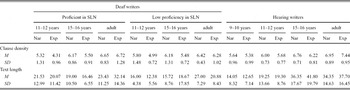
To verify that deaf proficient signers and deaf low-proficiency signers differed in sign language proficiency only, and not in proficiency in Dutch, we compared proficient and low-proficiency signers on three different measures. First, for the written narratives and expository texts, we calculated text length (in clauses) and mean clause density (number of words per clause). Both measures are assumed to reflect the writers' levels of language development (e.g., Berman, Reference Berman2008; Brown, Reference Brown1973). Mean clause density and text lengths for narratives and expository texts are given in Table 2.
Mean MLU and number of clauses (and SDs) in the narrative and expository texts of deaf proficient and low-proficiency signers and hearing writers.

note: SLN = Sign Language of the Netherlands; Nar = Narrative; Exp = Expository text; Clause density = number of words per clause; Text length = number of clauses per text.
No significant differences were observed between proficient and low-proficiency signers in each age group on the two measures of clause density and text length. Finally, we compared proficient and low-proficiency signing children (11–12-year-olds and 15–16-year-olds) on their scores on the Reading Comprehension Tests (Aarnoutse, Reference Aarnoutse1996) obtained in previous research (Wauters, van Bon & Tellings, Reference Wauters, Van Bon and Tellings2006), in which 76% of the children participated. A one-factor ANOVA revealed that proficient signers (M = 20.38, SD = 5.38) and low-proficiency signers (M = 22.13, SD = 4.07) did not differ significantly in level of reading comprehension (F(1,46) = 1.622, p = .21).
Materials and procedure
The procedures for eliciting narrative and expository texts were similar to those used in a large-scale international research program on later language development in different contexts and in (seven) different languages (e.g., Berman & Verhoeven, Reference Berman and Verhoeven2002; Ragnarsdóttir, Aparici, Cahana-Amitay, van Hell & Vigué, Reference Ragnarsdóttir, Aparici, Cahana-Amitay, van Hell and Vigué2002; Ravid, van Hell, Rosada & Zamora, Reference Ravid, van Hell, Rosado and Zamora2002; Reilly, Jisa, Baruch & Berman, Reference Reilly, Jisa, Baruch and Berman2002; van Hell, Verhoeven, Tak & van Oosterhout, Reference van Hell, Verhoeven, Tak and van Oosterhout2005). Participants first viewed a 3-minute video clip without words that showed fragments with teenagers involved in different social, moral and physical conflicts. Participants were then asked to write a story about a conflict situation in which they had been involved or an incident of interpersonal conflict they had experienced. The instruction explicitly told them not to retell the fragments they had seen in the video. Participants were also instructed to write an expository text discussing the issue of problems between people and to give their opinion. The order in which the writing tasks were performed was counterbalanced. The participants were not limited in time when writing their texts.
Data analysis
All texts were transcribed, coded and analyzed using the CLAN program of the CHILDES International Child Language Data Base (MacWhinney, Reference MacWhinney2000). Texts were divided into clauses and coded for the presence of grammatical and lexical markers of temporal reference, clauses without obligatory grammatical tense markers, and errors in tense agreement between grammatical and lexical tense markers. Below, we describe these measures in more detail. In the analyses, each score of each writer was divided by the total number of clauses in her or his text (and expressed in percentages), so that differences in text length are controlled for and cannot bias the effects. A clause is defined as “any unit that contains a unified predicate which expresses a single situation (i.e., activity, event, state), including finite and nonfinite verbs, as well as predicate adjectives” (Berman & Slobin, Reference Berman and Slobin1994).
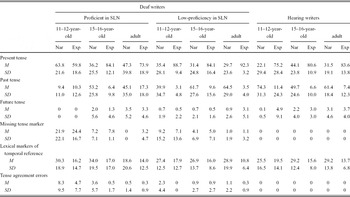
Grammatical markers of temporal reference (tense). Each clause in each text was coded for categories of tense. Table 1 lists the eight categories of tense and examples for Dutch and translations in English. Because future tense was rarely used (see Table 3), we included only present and past tense in the statistical analyses. For each child in each text, all present tense markers were divided by the total number of clauses in that text. Similarly, all past tense markers (i.e. simple past, present perfect, and past perfect) were divided by the total number of clauses in each text.
Mean frequencies (and SDs) of grammatical and lexical markers of temporal reference (in percentages) and tense agreement errors (in percentages) in the written narratives and expository texts of deaf proficient signers, low-proficiency signers and hearing writers.

note: Because not all clauses contained a finite verb the tense colums do not sum up to 100.
Missing obligatory tense marker. Each text was coded for clauses in which an obligatory grammatical tense marker was missing. In this category we included clauses without any verbs (e.g., *soms hij wel lief of zo of boos “sometimes he sweet or something or angry”), and clauses without a finite verb indicating tense (e.g., *de jongen altijd taxi slapen “the boy always taxi sleep” [infinitive in Dutch]). For each child in each text, all obligatory grammatical tense markers were divided by the total number of clauses in that text.
Lexical markers of temporal reference. Each text was coded for total number of temporal adverbs (e.g., nu “now”, dan “then”), temporal adverbial phrases (e.g., volgende week “next week”, vorig jaar “last year”), and temporal conjunctions (e.g., toen “when”). These different devices were collapsed for the statistical analyses. For each child in each text, all lexical markers of temporal reference were divided by the total number of clauses in that text.
Tense agreement errors. Each text was coded for clauses in which the lexical marker of temporal reference does not agree in tense with the verb. This scoring category includes clauses in which there is disagreement in tense between the temporal adverb and the finite verb. An example is *Vroeger ik woon daar “In the past I live there” from a narrative of a 12-year-old deaf boy. In this example, the temporal adverb marks past tense, whereas the finite verb marks present tense. A second frequently observed error was when there was no grammatical tense marker but only a temporal adverb for marking tense. An example from a narrative of a 12-year-old deaf boy is *En toen mijn fiets pakken door stom jongen “And then my bike take by stupid boy”. In this example, the Dutch temporal adverb toen “then” indicates past tense. The only verb in this clause, pakken “take”, is an infinitive, which has not been marked for tense. For each child in each text, all tense agreement errors were divided by the total number of clauses in that text.
Results and discussion
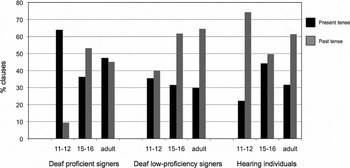
Deaf proficient signers, deaf low-proficiency signers and hearing peers in three age groups (11–12-year-olds, 15–16-year-olds and adults) were compared on: (1) grammatical markers of temporal reference (i.e., present and past tense); (2) missing obligatory tense markers; (3) lexical markers of temporal reference; and (4) tense agreement errors in narratives and expository texts.Footnote 4 The step-by-step procedure that was followed in the analyses is described below. The resulting means and standard deviations are presented in Table 3. The results on tense are also displayed in Figure 1.
Percentages of clauses in present and past tense.

Narrative texts
Tense. In the first analysis, we examined the distribution of present and past tense in the narratives of deaf proficient signers, deaf low-proficiency signers and hearing participants and the extent to which this pattern is qualified by age. A three-way ANOVA: Group (deaf proficient signers, deaf low-proficiency signers, hearing participants) × Age (11–12-year-olds, 15–16-year-olds, and adults) × Tense (present, past), treating Group and Age as between-subjects variables, and Tense as a within-subject variable, was performed on the mean number of (grammatical) tense-marked clauses. In this and all following ANOVAs, alpha was set at .05.
The overall analysis showed a significant three-way interaction between Group, Age and Tense (F(4,128) = 6.20, p < .0001, η2p = .16). Further, there were significant main effects of Group (F(2,128) = 4.91, p < .01, η2p = .07), Age (F(2,128) = 8.23, p < .0001, η2p = .11), and Tense (F(1,128) = 8.11, p < .01, η2p = .06). The analysis also showed significant interaction effects between Group and Age (F(4,128) = 3.88, p < .01, η2p = .11), and between Group and Tense (F(2,128) = 7.78, p < .001, η2p = .11). Because the significant main effects and two-way interaction effects were qualified by the significant three-way interaction, we performed subsequent Group (deaf proficient signers, deaf low-proficiency signers, hearing participants) × Tense (present, past) ANOVAs for each age group to gain more insight into the source of the three-way interaction.
11–12-year-olds. The analysis showed a significant main effect of Group (F(2,48) = 6.39, p < .01, η2p = .21). Hearing participants used more tense-marked clauses than both proficient (p < .01) and low-proficiency signers (p < .05). Proficient and low-proficiency signers did not differ significantly in the overall number of tense-marked clauses. There was also a significant interaction between Tense and Group (F(4,96) = 18.87, p < .0001, η2p = .44). To explain this interaction, we performed subsequent one-way ANOVAs (Tense) for proficient signers, low-proficiency signers and hearing 11–12-year-olds.
The analysis in the 11–12-year-old proficient signers showed a significant main effect of tense (F(1,14) = 62.81, p < .0001, η2p = .82). Present tense (M = 63.8%) was used more much more frequently than past tense (M = 9.4%) (p < .0001). The main effect of tense was not significant in the 11–12-year-old low-proficiency signers, indicating that past tense (M = 39.86%) and present tense (M = 35.45%) were used equally often. The main effect of Tense was significant in the 11–12-year-old hearing children (F(1,19) = 14.91, p < .001, η2p = .44), but the pattern differed from that of both deaf groups: Past tense (M = 74.3%) was used more often than present tense (M = 22.1%).
15–16-year-olds. The analysis showed only a significant main effect of Tense (F(1,48) = 6.19, p < .05, η2p = .11). Past tense was used more often than present tense.
Adults. As with the 15–16-year-olds, the analysis showed only a significant main effect of Tense (F(1,32) = 5.01, p < .05, η2p = .14). Past tense was used more often than present tense.
So, the source of the three-way interaction appeared to be the relatively frequent use of the present tense by the 11–12-year-old proficient signers (63.8%; use of present tense in remaining groups varies from 22.1% to 47.3%; see also Figure 1).
Omissions of obligatory tense markers. A two-way ANOVA: Group (3) × Age (3) on the mean percentages of omitted obligatory tense markers showed a significant interaction effect only between Group and Age (F(4,128) = 4.82, p < .001, η2p = .13). To explain this interaction, we performed subsequent one-way ANOVAs (Group) for each age group.
The analysis for the 11–12-year-old children showed a significant effect of Group (F(2,48) = 9.57, p < .0001, η2p = .29). Deaf proficiently signing children omitted an obligatory tense marker (M = 21.9%) significantly more often than hearing children (who never omitted one) (p < .0001), but not more often than deaf low-proficiency signers (M = 9.2%). Deaf low-proficiency signers did not differ significantly from hearing children. The analysis for the 15–16-year-olds also showed a significant effect of Group (F(2,48) = 7.28, p < .01, η2p = .23). As with the 11–12-year-olds, the 15–16-year-old deaf proficient signers omitted an obligatory tense marker (M = 7.2%) significantly more often than their hearing peers (who never omitted one) (p < .01), but not more often than deaf low-proficiency signers (M = 4.1%). Deaf low-proficiency signers did not differ significantly from their hearing peers. Also, the analysis for the adults showed a significant effect of Group (F(2,32) = 4.08, p < .05, η2p = .20). Only low-proficiency signing adults still omitted obligatory tense markers (M = 1.0%) and did this more often than hearing adults (p < .05). None of the hearing and proficiently signing adults made this error.
Lexical markers of temporal reference. A two-way ANOVA: Group (3) × Age (3) on the mean percentages of lexical markers of temporal reference yielded no significant effects. This implies that the use of lexical markers of temporal reference was not different for deaf proficient signers, deaf low-proficiency signers and hearing participants.
Tense agreement errors. A two-way ANOVA: Group (3) × Age (3) on the mean percentages of tense agreement errors (i.e., lexical marker of temporal reference did not agree with tense of the verb) showed significant main effects of Group (F(3,137) = 7.48, p < .0001, η2p = .15) and Age (F(2,137) = 5.68, p < .01, η2p = .08). Proficient signers made more errors than both low-proficiency signers and hearing participants (p < .05 and p < .0001, respectively). Low-proficiency signers and hearing participants did not differ significantly in the number of tense agreement errors. Further, post-hoc tests comparing the three age groups did not yield significant effects. The main effects of Group and Age were qualified by a significant interaction (F(4,137) = 3.36, p < .05, η2p = .10). To explain this interaction, we performed subsequent one-way ANOVAs for each age group.
The analysis on the 11–12-year-olds yielded a significant effect of Group (F(2,50) = 9.54, p < .0001, η2p = .28). Proficient signers made more tense agreement errors (M = 8.3%) than low-proficiency signers (M = 2.3%) and their hearing peers, who never made such errors (p < .05 and p < .0001, respectively). Low-proficiency signers and hearing children did not differ significantly from each other. The analysis of the 15–16-year-olds also yielded a significant effect of Group (F(2,48) = 4.97, p < .05, η2p = .18). Proficient signers (M = 3.6%) made significantly more tense agreement errors than their hearing peers, who made no such errors at all (p < .01). Low-proficiency signers (M = 0.95%) did not differ significantly from their hearing peers. The analysis of the adults showed no effect, indicating that deaf proficient signers, low-proficiency signers and hearing adults did not differ in the number of tense agreement errors.
Expository texts
The statistical procedure was similar to that of the narrative texts.
Tense. A three-way ANOVA: Group (3) × Age (3) × Tense (2) was performed on the mean percentages of tense-marked clauses. The resulting means are presented in Table 3. This analysis showed significant main effects of Group (F(2,128) = 4.99, p < .01, η2p = .07), Age (F(2,128) = 6.83, p < .0001, η2p = .10), and Tense (F(1,128) = 732.96, p < .0001, η2p = .85). First, deaf proficient signers used fewer tense-marked clauses than deaf low-proficiency signers (p < .0001) and hearing participants (p < .001). Deaf low-proficiency signers and hearing participants did not differ in the number of tense-marked clauses. Second, 11–12-year-olds used fewer tense-marked clauses than 15–16-year-olds (p < .01) and adults (p < .001). The 15–16-year-olds and adults did not differ in the number of tense-marked clauses. Third, present tense was used considerably more often than past tense (p < .0001) and future tense (p < .0001), and past tense was used more often than future tense (p < .01). Moreover, Group interacted with Age (F(4,128) = 3.19, p < .05, η2p = .09) and with Tense (F(4,156) = 4.82 p < .01, η2p = .07). As can be seen in Table 3, all nine groups of writers clearly anchor their expository texts in the present tense (as also observed in a cross-linguistic study on hearing writers who wrote expository texts in one of five different languages; Ragnarsdóttir et al., Reference Ragnarsdóttir, Aparici, Cahana-Amitay, van Hell and Vigué2002). At a more detailed level, however, the pattern in the 11–12-year-old proficient signers is somewhat different. Because these children omitted obligatory tense markers relatively often (see the analysis reported in the next section), their overall use of tense-marked sentences is lower than in the remaining groups. Therefore, the dominance of using present tense over past tense is attenuated in the 11–12-year-old proficient signers (i.e., post-hoc analyses confirmed that the difference in use of present and past tense in the 11–12-year-old proficient signers (49.6%) was indeed smaller than the corresponding differences in the remaining groups that ranged between 56.6% and 88.8%).
Missing obligatory tense markers. A two-way ANOVA: Group (3) × Age (3) on the mean percentages of omitted obligatory tense markers showed significant main effects of Group (F(2,136) = 20.03, p < .0001, η2p = .24) and Age (F(2,136) = 12.12, p < .0001, η2p = .16). Both deaf proficient and low-proficiency signers omitted an obligatory tense marker significantly more often than hearing participants, who never omitted an obligatory tense marker (p < .0001 and p < .05, respectively). Proficient signers made this error more often than low-proficiency signers (p < .001). Further, the 11–12-year-old children omitted obligatory tense markers more often than the 15–16-year-olds (p < .001) and adults (p < .0001). The 15–16-year-olds and adults did not differ significantly from each other. The effects of Group and Age were qualified by a significant interaction (F(4,136) = 6.82, p < .0001, η2p = .18). To explain this interaction, we performed subsequent one-way ANOVAs (Group) for each age group.
The analysis for the 11–12-year-old children showed a significant effect of Group (F(2,50) = 18.84, p < .0001, η2p = .44). Deaf proficiently signing children omitted an obligatory tense marker (M = 24.4%) significantly more often than deaf low-proficiency signers (M = 7.1%) (p < .0001) and hearing children (who never omitted one) (p < .0001). Deaf low-proficiency signers did not differ significantly from hearing children. The analysis for the 15–16-year-olds also showed a significant effect of Group (F(2,50) = 5.37, p < .01, η2p = .18). Deaf 15–16-year-old proficient signers omitted an obligatory tense marker (M = 7.8%) significantly more often than their hearing peers (who never omitted one) (p < .01), but not more often than deaf low-proficiency signers (M = 5%). Deaf low-proficiency signers did not differ significantly from their hearing peers. Finally, the analysis for the adults also showed a significant effect of Group (F(2,34) = 4.28, p < .05, η2p = .21). Deaf proficiently signing adults (M = 3.2%) omitted obligatory tense markers more often than hearing adults (who never omitted one) (p < .05), but not more often than low-proficiently signing adults (M = 1.1%).
Lexical markers of temporal reference. A two-way ANOVA: Group (3) × Age (3) on the mean percentages of lexical markers of temporal reference yielded no significant effects, indicating that, as was found for the narratives, deaf proficient and low-proficiency signers and hearing participants did not differ in the use of lexical markers of temporal reference.
Tense agreement errors. A two-way ANOVA: Group (3) × Age (3) on the mean percentages of tense agreement errors showed a significant main effect of Group (F(2,136) = 4.53, p < .05, η2p = .07). Deaf proficient signers made more tense agreement errors (M = 1.8%) than hearing participants (who never omitted an obligatory tense marker (p < .05), but not more than low-proficiency signers (M = 0.4%). The main effect of Age was not significant. However, Group interacted with Age (F(4,136) = 4.34, p < .01, η2p = .12). We therefore performed subsequent one-way ANOVAs for each age group. Only the analysis for the 11–12-year-olds yielded a significant effect of sign language proficiency (F(2,50) = 6.76, p < .01, η2p = .22). Proficient signers made tense agreement errors (M = 4.7%) more often than low-proficiency signers and hearing children, who never made this type of error (both ps < .01). Few errors were observed in the 15–16-year-olds, and no significant differences were observed. As can be seen in Table 3, tense agreement errors were no longer or were rarely observed in the proficiently and low-proficiency signing adults, respectively. This pattern of results is comparable to that observed in the narratives.
General discussion
This study focused on temporal reference marking in narratives and expository texts written by Dutch deaf individuals at different ages (11–12-year-olds, 15–16-year-olds, adults) and with different levels of proficiency in sign language, and their hearing peers. We analyzed the use of grammatical and lexical markers of temporal reference. It appeared that narrative texts of typically developing individuals are predominantly anchored in the past. Expository texts are mostly written in the (timeless) present tense. These findings correspond to those of Ragnarsdóttir et al. (Reference Ragnarsdóttir, Aparici, Cahana-Amitay, van Hell and Vigué2002), who compared the form and content of verb phrases in narrative and expository texts written by hearing children and adults in five languages. Moreover, our data showed that typically developing hearing individuals at all age levels had no difficulties with temporal reference marking. All hearing writers used the morphologically marked tense form (past tense) fluently, and made no errors in tense agreement between lexical and grammatical markers of temporal reference.
Tense morphology developed differently for deaf writers. The omission of obligatory tense-marked finite verbs, tense agreement errors, and the tendency to use the unmarked tense form (present tense) we observed in the deaf writers, parallel earlier findings on tense and verb morphology in English-speaking deaf children (Ivimey, Reference Ivimey1981; Quigley et al., Reference Quigley, Montanelli and Wilbur1976). Both the Dutch and English tense marking systems are highly grammatical systems, and the empirical studies demonstrated that grammatical marking of temporal reference is difficult to learn for deaf individuals.
It can hardly be surprising that individuals who are deaf have difficulty with highly complex morphosyntactic aspects of a language they have not been able to perceive auditorily from birth. Children who are deaf often have limited exposure to oral language and consequently receive quantitatively different language input compared to children with typical hearing. However, there is also a major variation in the language backgrounds among children who are deaf. Some children who are deaf use sign language as their main language of communication, whereas others are less frequently exposed to sign language and use mainly spoken language. The majority of previous studies on deaf children's writing did not take into account that deaf people may vary in proficiency in sign language. To gain more insight into the potential cause of deaf writers' difficulty with tense marking in Dutch, we distinguished between deaf individuals who are proficient in SLN and deaf individuals who are low-proficiency in SLN and use oral language predominantly. SLN is a language in which the temporal characteristics of events are not categorized by a rich and obligatory system of grammatical morphology, as is the case in Dutch, but by a system of lexical markers. In our analyses, we distinguished tense (which is different in SLN and oral Dutch) and the lexical marking of temporal reference (which occurs in both SNL and oral Dutch). Our results showed that deaf writers who differ in sign language proficiency demonstrate different patterns of tense marking. This was particularly pronounced in the 11–12-year-old children. In the narratives, the proficiently signing 11–12-year-olds used the unmarked tense form (present tense) considerably more often than a marked tense form (past tense, as used by typically developing and low-proficiency signing children) to refer to states, actions or events that happened in the past. Further, the proficiently signing 11–12-year-olds omitted obligatory tense marking – by omitting finite verbs or using infinitives – more often than their low-proficiency signing peers, in both narratives and expository texts. Also, the proficiently signing 11–12-year-olds made more errors in tense agreement between temporal adverb and finite verb than their low-proficiency signing peers. Although proficiently signing 15–16-year-olds used past tense more often than the 11–12-year-olds in narratives, they still omitted more finite verbs and made more tense agreement errors than their low-proficiency signing peers. The differential patterns of tense of deaf proficient signers and low-proficiency signers (and hearing writers) were not observed in the adults.
Lexical marking of temporal reference via the use of lexical devices (temporal adverbs, phrases and connectives) is typologically less different in Dutch and SLN, although the position of lexical markers of temporal reference within a sentence may vary across the two languages. Hence, we expected that the effect of writers' variation in sign language proficiency would be less pronounced in the use of lexical markers of temporal reference in Dutch writing. Our data indeed showed that proficient and low-proficiency signers and hearing writers did not differ in the use of lexical markers of temporal reference.
Implications for theories of second language acquisition
The difficulties proficiently signing deaf children initially experience in using tense morphology in writing can be understood in light of models and studies on temporality in second language acquisition. Studies along this line of research basically agree that second language learners' expression of temporality displays a developmental pattern, from using pragmatic and lexical devices to gradually using more and more morphology (Bardovi-Harlig, Reference Bardovi-Harlig1999; Dietrich et al., Reference Dietrich, Klein and Noyau1995; Ellis & Collins, Reference Ellis and Collins2009; Yang & Huang, Reference Yang and Huang2004). The present study suggests that proficiently signing children follow the same developmental pathway in temporal reference marking in an oral language as learners of two oral languages who first depend on pragmatic devices and lexical devices, and gradually start using more and more verb morphology to mark temporal reference in their second language. The initial difficulty with producing verbal markers of temporal reference can be interpreted in terms of Ellis's theory. The low saliency and redundancy of verbal (morphological) cues, which make temporal adverbs more reliable cues, may block L2 acquisition of verbal morphology (Ellis, Reference Ellis2006; Ellis & Collins, Reference Ellis and Collins2009).
Secondly, grammatical tense marking in the 11–12-year-old proficiently signing deaf children ties in with developmental patterns of grammatical tense marking observed in children and adults whose L1 has no grammatical tense, and who are learning an oral L2 (e.g., Ellis, Reference Ellis2006; Kupersmitt & Berman, Reference Kupersmitt, Berman, Verhoeven and Strömqvist2001; MacWhinney, Reference MacWhinney, Kroll and de Groot2005; Wenzell, Reference Wenzell, Dechert and Raupach1989; Yang & Huang, Reference Yang and Huang2004). Deaf children who mainly use sign language cannot use their knowledge of sign language to acquire tense, because sign language does not mark temporal reference grammatically. Rather, SLN uses lexical items for expressing temporal reference, and, moreover, has no auxiliary verbs and copulas. The cross-modal bilingual writers' challenge was indeed large for grammatical temporal reference marking. Proficient signers (but only the 11–12-year-olds, and the 15–16-year-olds to a lesser extent) more often preferred the morphologically unmarked verb form, frequently omitted finite verbs (which are marked for tense) or used no verb at all, and made more errors in tense agreement between temporal adverb and verb in Dutch texts in comparison to their low-proficiency signing peers. In contrast, with respect to the use of lexical items for temporal reference marking, SLN and Dutch overlap to a large extent, and it is expected that lexical marking of temporal reference can be learned more easily. Our data indeed show that proficient and low-proficiency signers at all age levels did not differ in the use of temporal adverbs, phrases and conjunctions. Our data correspond to findings obtained by Yang and Huang (Reference Yang and Huang2004), who investigated the acquisition of the English tense system by hearing Chinese children and adults whose L1, just like SLN, has no tense but uses pragmatic and lexical devices to mark temporal reference. Yang and Huang found that beginning Chinese learners of English avoided verb morphology to mark tense, and used pragmatic and lexical ways of marking time reference. It was not until adulthood, being the advanced stage of L2 learning, that verb morphology was used appropriately to mark temporal reference. This study thus contributes to previous work on the acquisition of temporal reference marking in SLA by showing that the basic patterns of development and transfer also apply to languages from two different modalities, SLN and oral Dutch, that differ with respect to temporal reference marking.
The observed developmental pattern of temporal reference marking in deaf proficiently signing children suggests that the effect of acquiring and using two languages from different modalities, here SLN and Dutch, does not seriously impede performance in writing in an oral language, and may eventually even benefit written performance (Singleton et al., Reference Singleton, Morgan, DiGello, Wiles and Rivers2004; van Beijsterveldt & van Hell, Reference van Beijsterveldt and van Hell2009a). Van Beijsterveldt and van Hell (Reference van Beijsterveldt and van Hell2009a) examined the use of enriching evaluative expressions in narratives written by deaf proficiently and low-proficiency signing children (and hearing monolingual and bilingual children). Given the importance of evaluation in signed narratives and the many channels sign language has to convey evaluation, it was expected that deaf proficient signers used this knowledge of rhetorical devices such as evaluative expressions to enrich their narratives in written Dutch, and more so than deaf children who predominantly use spoken language. It was indeed found that deaf proficiently signing children used more evaluative devices in writing (i.e., evaluations of objects or persons and references to emotional states) than deaf low-proficiency signing children (and hearing monolingual and bilingual children), suggesting that deaf proficiently signing children use their knowledge of sign language to enrich their written narratives. In a study on English deaf children's written narratives, Singleton et al. (Reference Singleton, Morgan, DiGello, Wiles and Rivers2004) found that deaf children who are proficient in American Sign Language (ASL) used more non-frequent words in their written narratives than deaf children who are low-proficiency in ASL. This suggests that proficient signers use semantic knowledge derived from sign language to write semantically richer texts.
Obviously, given the scarce number of empirical studies on how variations in sign language proficiency may explain deaf people's writing, more research is necessary to gain further insight into the basic mechanisms and intricacies of cross-language interaction and transfer processes in users of languages from two different modalities.
The typical pattern of temporal reference in proficiently signing children's writing may hint at a developmental stage in which children mix the morphosyntactic systems of oral language and signed language, just like hearing bilinguals in two spoken languages do. What are the implications of this finding for teaching deaf signers a written language? Methods of language teaching to L2 learners have traditionally focused on the monolingual native speaker, and minimized the role of the L1. Cook (Reference Cook1999) argues for an L2 user approach to language teaching, in which L2 learners are considered as speakers and writers in their own right, and which takes variations in L2 learners' language profiles into account. Following Cook's line of argument, teaching written language to deaf signers should focus on the specific difficulties deaf children encounter in learning an auditory–oral language. Teachers could draw students' attention to the nature of a written language, and highlight those aspects of written language that are differently marked in signed language, such as verb inflection. On the other hand, skills developed in signed language could be used to support learning to read and write. Recent research has shown that signed personal experience narratives contain similar narrative techniques and discourse functions to written or oral narratives (Mulrooney, Reference Mulrooney2009). We have superficial understanding, however, of how signed language works to support writing and reading development in deaf children (Mayer, Reference Mayer2007). This needs to be investigated in future research, and this research may further benefit our thinking about ways in which signed language can be used to provide access to oral/written language.
The potential influence of sign language knowledge onto writing in an oral language has largely been neglected in related studies on writing in children and adults who are deaf. Our cross-sectional study has demonstrated that deaf proficient signers, deaf low-proficiency signers and hearing children follow different developmental trajectories in temporal reference marking in writing. This implies that in order to gain further insight into deaf people's writing, it is important to adopt a bilingual perspective and to take variations in sign language proficiency into account.